Ask a local where the best snorkeling in Maui is and you will not get one answer — you will get a question back: “What are the conditions doing today?” Maui has two snorkel coasts, West Maui and South Maui, and they take turns being best. When winter swell rolls into the north-west shores, the south side stays calm. When a summer south swell arrives, the west side goes flat and clear. Pick the right coast for the day and Maui is, beach for beach, the strongest shore-snorkeling island in Hawaii — which is exactly why it tops our best Hawaiian island for snorkeling ranking. For the full trip picture, see our ranked best things to do in Maui — plus town guides for Wailea, Lahaina and Kihei.
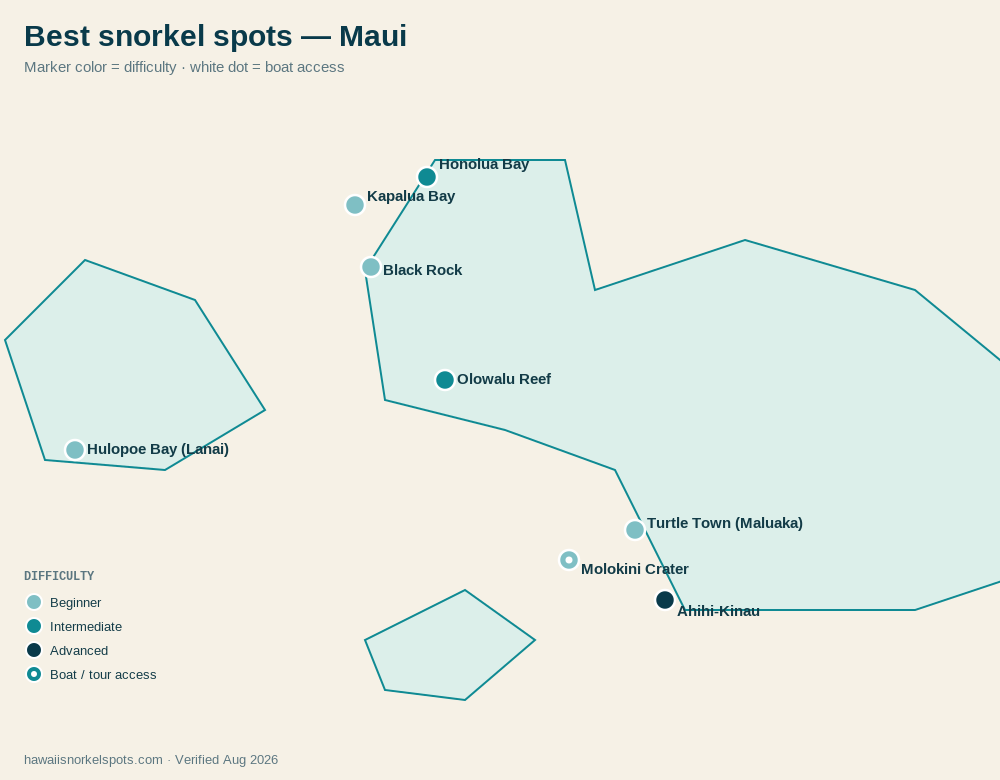
This guide covers the 10 spots that matter — nine you can walk into from shore and one famous crater you reach by boat — with the entry, parking and timing details that decide whether a spot is brilliant or a wasted drive. Every spot is compared in the table below, then covered one by one. For every shore spot pinned with GPS coordinates, difficulty ratings and seasons, see our Maui snorkeling map.
Planning beyond the water? Our guides to the best things to do in Maui and the best beaches in Maui rank every beach and activity with the same snorkeling depth. See our Things to Do in Hana guide for the east-side waterfalls, black-sand beaches and Road to Hana stops.
Best snorkeling in Maui at a glance
| Spot | Area | Best for | Entry | Turtles? |
|---|---|---|---|---|
| Honolua Bay | West (north of Kapalua) | Experienced snorkelers, coral | Rocky shore after a forest walk | Sometimes |
| Kapalua Bay | West | Beginners, families | Easy sand | Often |
| Napili Bay | West | Beginners, relaxed sessions | Easy sand | Often |
| Black Rock | Ka’anapali, West | Turtles, easy resort access | Sand, then a lava point | Very often |
| Kahekili Beach Park | North Ka’anapali, West | Long reef swims | Sand | Often |
| Ulua Beach | Wailea, South | Beginners, quieter mornings | Easy sand | Often |
| Olowalu | South of Lahaina | Shallow reef, turtles | Sand off the highway | Very often |
| Ahihi-Kinau Reserve | Makena, South | Coral, calm shallow coves | Rocky coves | Sometimes |
| Maluaka Beach (Turtle Town) | Makena, South | Turtles above all | Sand or a boat-ramp entry | Almost guaranteed |
| Molokini Crater | Offshore, boat only | Clarity, fish, coral | Boat ladder | Sometimes |
Four newer dedicated guides go deeper on spots named in the table above: the relaxed west-side reef in our Napili Bay snorkeling guide, the easy Wailea entry in our Ulua Beach snorkeling guide, the resort crescent in our Wailea Beach snorkeling guide and the Five Graves reef in our Makena Landing snorkeling guide.
For the reef itself, our Coral Reef Snorkeling guide explains how Hawaii’s coral reefs form, what lives on them and how to snorkel them without causing damage.
West Maui or South Maui: which coast today?
This is the single most useful thing to know about snorkeling Maui. The island’s good spots split between the north-west coast (Kapalua, Napili, Ka’anapali, Honolua) and the southern coast (Wailea, Makena, Olowalu). They are sheltered from opposite swells:
- Winter (roughly November to March): north and west shores take the big Pacific swells — the same surf season that makes Honolua a world-class wave. On swell days, head south to Ulua, Olowalu, Ahihi-Kinau and Maluaka.
- Summer (roughly May to September): occasional south swells wrap into the southern bays while the west side lies flat. That is when Honolua and Kapalua are at their glassy best — head west and north-west.
- Any season: wind matters as much as swell. Maui’s trade winds build through the morning, so the daily rule below applies everywhere on the island.
Check the morning’s wind and swell forecast before you choose a coast, and be willing to drive 40 minutes to the calm side. That flexibility, more than any single spot, is the secret to great Maui snorkeling.
The 10 best snorkeling spots in Maui
1. Honolua Bay — the best reef on the island, when it’s calm
Honolua Bay is a marine life conservation district north of Kapalua, and on a calm summer morning it is the best shore snorkeling in Maui: a boulder-and-coral bay with reef running along both sides and the clearest water on the west side. Park along the highway past the overlook and walk down through the forest — allow about half a mile of trail — to an all-rock beach. There is no sand entry here. The best snorkeling follows the left and right edges of the bay, it is a long swim out, and the catamarans anchored in the bay are a good marker for where the reef is liveliest.
Because the entry is over rocks, fins are essential and the exit can scrape unprotected feet. Non-swimmers should use flotation, and anyone uncomfortable with a rocky entry and a long swim should pick Kapalua instead. In winter, forget it — Honolua becomes a famous surf break and the bay is dangerous. Our full Honolua Bay snorkeling guide covers the trail, the entry points and the conservation-district rules in detail.
2. Kapalua Bay — the best beginner spot in West Maui
Five minutes south of Honolua, Kapalua Bay could not be more different: a sheltered, sandy crescent that stays calm when other west-side spots are already chopping up. The entry is an easy walk-in from the sand, the reef sits in comfortable depths, turtles cruise through regularly, and a beach stand rents gear and paddleboards if you arrived empty-handed. It is the spot we send first-timers and families to on the west side, and it anchors our beginners’ snorkeling guide. Go early — the bay is small, popular, and at its clearest before the wind and the crowds arrive.
3. Napili Bay — the relaxed local favourite
Napili Bay, just south of Kapalua, has the same easy personality: a sandy-beach entry with reefs starting in relatively shallow water, which makes it one of the best snorkeling beaches in Maui for beginners who want a gentle session rather than an expedition. At low tide the rock formations at the edges form tide pools worth a look between swims, and turtles are often seen surfacing near the rocks. Napili works beautifully as a double-header with Kapalua — snorkel one, walk to the other, and let the morning’s conditions make the final call.
4. Black Rock (Ka’anapali) — turtles at the lava point
Black Rock is the big lava point at the north end of Ka’anapali Beach, in front of the Sheraton, a short walk up the coast from the resort condos. Enter from the sand and follow the point out: the rock wall holds schooling fish, turtles are here very often, and the inside of the point is usually calmer than the rest of Ka’anapali Beach. One warning matters more than any other on this page: the current just beyond the rocky point can be very strong, and wave action can push into the shore rocks. Snorkel the inside of the point, turn around before its end, and never round it. Our Black Rock guide maps the entry and the turn-around point.
5. Kahekili Beach Park — the long reef of North Ka’anapali
Kahekili Beach Park — Airport Beach — runs along North Ka’anapali with a long reef paralleling the shore, which makes it a favourite for snorkelers who like to cover ground: pick an entry, swim the reef line, and drift as far as your legs and the current allow (always noting where you started, and what the current is doing, before you go far). It shares Ka’anapali’s winter-swell exposure, so treat it as a calm-day, morning spot, and pair it with Black Rock for a full west-side session.
6. Ulua Beach — Wailea’s easy, uncrowded option
South Maui’s most straightforward snorkel is Ulua Beach in Wailea, set between the Marriott and Andaz resorts. Ulua has plenty of parking, draws fewer crowds than the west-side names, and is popular with scuba classes for good reason — a gentle sandy entry and reef close to shore. It is one of the best places to snorkel in Maui for beginners on the south side, and because South Maui often stays calm when the west is rough, Ulua is the winter default for many local snorkelers. Like everywhere on Maui, it is best before the late-morning wind turns the south shore onshore.
7. Olowalu — shallow reef and turtles off the highway
Olowalu, south of Lahaina near Leoda’s Pie Shop, is a continuous stretch of shallow reef right off the highway — pull off where the other cars are parked and you are basically there. The reef runs a long way out in gentle depths, turtles are very common, and the shallows suit confident beginners on calm mornings. Stay aware of how far out you have drifted; the reef’s size makes it easy to swim a long way from your entry without noticing. Our Ahihi-Kinau and Olowalu guide covers both south-side reefs together.
8. Ahihi-Kinau Natural Area Reserve — wild, shallow and protected
At the far south end of the road through Makena, the Ahihi-Kinau reserve protects a chain of small coves with very shallow, lagoon-like water and some of the healthiest coral in South Maui. Parking is roadside and can be a tight squeeze, entries are over rock and lava rather than sand, and facilities are minimal — this is a spot for snorkelers who are comfortable looking after themselves. In return you get calm, clear shallows that stay swimmable on days when more exposed beaches are not. Because it is a natural area reserve, treat everything here with extra care: no touching coral, no taking anything, and reef-safe sunscreen only.
9. Maluaka Beach — Turtle Town from shore
“Turtle Town” is not one beach but a stretch of turtle-rich reef along the Makena coast, and Maluaka Beach is how you snorkel it from shore. Drive south, turn onto Makena Road, use the parking lot there, and walk a few hundred feet past it to the beach access. Enter and snorkel south toward the rocks and reefs — that is where the turtles gather at cleaning stations. If you do not need a sandy beach, the Makena Landing boat-ramp area is a closer, easier entry to the same reef system. The area is fairly protected, but a flotation belt is a smart call for independent snorkeling, and having someone on shore keep an eye on you is better still. Our dedicated Turtle Town guide decodes the north and south access points and the full route — and if turtles are your whole reason for coming to Maui, start with our island-wide snorkeling with turtles guide.
10. Molokini Crater — the boat trip that earns it
Molokini is the one Maui spot you cannot walk to: a sunken volcanic crater offshore, reachable only by boat. Inside the sheltered crescent the water clarity is exceptional, the coral is in good shape, and the fish life is denser than at any shore spot — with easy entry straight off the boat’s ladder or deck. Molokini trips are the core of Maui’s tour scene; our Molokini guide and our Hawaii snorkeling tours guide explain what the trips include and how the morning and midday departures differ. If you only book one tour in Maui, this is the one — everything else on this page is free from shore.
Every Maui snorkeling location, by area
The ten spots above are the best snorkeling locations in Maui — but they are not the whole island. Maui has more than 25 named shore-snorkeling locations, every one of them with a full guide on this site, plus two boat-only ones. Use the lists below to find the spot nearest where you are staying, or the one that matches how you snorkel. Every entry links to its full guide, with parking, entry, conditions and what you will see. For a plotted view of all of them, see our Maui snorkeling map.
South Maui snorkeling locations — Kihei, Wailea and Makena
- Keawakapu Beach — where Kihei runs into Wailea: about seven-tenths of a mile of golden sand with a reef at both lava points, and turtles at both ends.
- Kamaole Beach Parks I, II and III — three sandy Kihei beaches strung along South Kihei Road, with reef at all three; Kamaole III has the lifeguard.
- Wailea Beach — the resort crescent in front of the Grand Wailea and the Four Seasons, with a real reef at each end. Enter at the ends, not the sandy middle.
- Polo Beach — twin golden crescents at the southern end of the Wailea strip, between the Fairmont Kea Lani and the Polo Beach Club condos.
- Palauea Beach — hidden behind a grove of kiawe trees off Makena Road, just south of Polo Beach: the quiet, uncrowded end of Wailea.
- Po’olenalena Beach — a long, undeveloped stretch of caramel sand on the Wailea–Makena coast, with no hotel on the beach.
- Makena Beach (Big Beach) — a mile-plus arc of golden sand with no fringing reef along its length, and a shorebreak locals call Breakneck Beach. Snorkel only at the lava-rock edges, on the calmest mornings.
- Makena Landing (Five Graves) — confident swimmers only: a lava-shelf entry to coral-covered lava fingers, a turtle cleaning station and cave mouths.
- La Perouse Bay — the literal end of Makena Road: a lava coast for experienced snorkelers only.
- Cove Park — Kihei’s beginner-surf beach, with a reef off the sand that is worth a mask on flat mornings.
West Maui snorkeling locations — Lahaina to Kapalua
- Kaanapali Beach — Black Rock is the main entry, but there are quieter reef patches along the sand north of it.
- Honokowai Beach Park — a locals’ beach-park reef on Lower Honoapiilani Road in Lahaina, between the condos.
- Baby Beach (Lahaina) — the sandy in-town Lahaina beach, not the rocky north-shore lagoon of the same name.
- Mala Wharf — a collapsed 1922 shipping pier off north Lahaina, now an artificial reef crowded with green sea turtles and resting whitetip reef sharks. Intermediate only: a rocky entry best attempted at high tide, and stay well clear of the boat channel.
- Honokeana Cove — a small, rocky cove just south of Napili Bay along the condo shoreline, and a locals’ secret.
- Slaughterhouse Beach (Mokuleia Bay) — reserve-quality reef in the western half of the Honolua-Mokule’ia Bay Marine Life Conservation District, without Honolua Bay’s rocky scramble.
- Fleming Beach (D.T. Fleming Beach Park) — Kapalua’s long white-sand beach. Poor snorkeling on most days, but a real reef at the far end on the right calm morning.
- Coral Gardens — a boat-accessed reef off the West Maui coast, and the usual fallback when Molokini is blown out.
East Maui snorkeling locations — the Hana side
The east side is the exception to Maui snorkeling. It faces the open trade-wind ocean, so the water is rougher and the calm windows are shorter. Come for the drive and the beaches; snorkel only on a genuinely flat morning.
- Hana Bay — one of the weakest snorkeling destinations on Maui. Come for the drive, not the reef.
- Hamoa Beach — a crescent of soft sand just south of Hana town. Snorkel only at the edges of the cove, on a small-wave morning, and only if you are a confident swimmer.
- Waianapanapa State Park (Pa’iloa Beach) — the black-sand beach at the bottom of the stairs. A photo stop first, a snorkel only on a genuinely calm morning.
By boat, Molokini Crater is covered in the top ten above, and Coral Gardens is the usual second stop. Lanai, across the channel from Lahaina, is a separate day trip — see our Lanai vs Molokini comparison before booking it.
Maui snorkeling map: every spot by coast
The best way to plan a Maui snorkel day is on a map, not a list. Our Maui snorkeling map pins 26 shore spots with GPS coordinates, a difficulty rating and a best-for verdict for each, so you can see exactly where each reef sits before you drive there. The pattern is simple once you see it: nearly every pinned spot sits on the island’s two leeward coasts — the west coast from Honolua Bay down to Lahaina, and the south coast from Kihei through Wailea to Makena. The north shore and the east (Hana) coast face the open ocean and are rough most of the year, so only two Hana-side spots make the map, and both are seasonal.
West Maui on the map — Honolua Bay to Lahaina
The west-coast run starts at Honolua Bay, the best reef on the island when it is calm, and works south through Slaughterhouse Beach, Fleming Beach, Kapalua Bay and Napili Bay to Black Rock at Ka’anapali, then Mala Wharf and Baby Beach in Lahaina. This is the coast to snorkel in summer, when the water is at its calmest. In winter, roughly November to March, north swells can close the north-west spots — Honolua, Slaughterhouse and Fleming first — so check conditions before driving north.
South Maui on the map — Kihei to La Perouse
The south coast is the year-round coast and the winter safe bet. The map runs from the Kamaole beaches through Ulua Beach in Wailea to Maluaka Beach (Turtle Town), the Ahihi-Kinau reserve, Makena Landing and La Perouse Bay at the end of the road. Turtles are the south coast’s signature — Maluaka and the lava points around Makena are where shore snorkelers meet them most reliably — and the entries here are mostly sandy, which is why families base themselves in Kihei and Wailea.
East Maui and offshore on the map
East Maui barely makes the map: two Hana-side spots, both seasonal and both for confident swimmers on a calm summer morning only. Everything else off the map is boat-only. Molokini Crater sits offshore and is reached by tour boat, and Lanai’s Hulopoe Bay is a ferry or boat trip from Lahaina. If a spot is not pinned on the map, that is usually the reason — there is no safe shore entry, not that we missed it.
| Coast | Headline spots | Best for | When to go |
|---|---|---|---|
| West Maui | Honolua Bay, Kapalua Bay, Napili Bay, Black Rock | Best reef, beginners, turtles | Summer; calm mornings |
| South Maui | Ulua Beach, Maluaka (Turtle Town), Ahihi-Kinau, La Perouse | Turtles, families, year-round snorkeling | Year-round; the winter safe bet |
| East Maui | Hana-side spots (seasonal) | Confident swimmers only | Calm summer mornings only |
| Offshore | Molokini Crater, Lanai | Clearest water, boat trips | Year-round by tour |
How to use the Maui snorkeling map
Open the full Maui snorkeling map and tap a pin for the spot name, difficulty and its full guide — every pin links to the guide for that beach, and every pin is also listed with GPS coordinates in the table below the map, so you can paste any coordinate pair into Google Maps to drop a pin on the exact entry area. Two rules run the whole map: mornings are calmest everywhere, because trade winds build through the afternoon, so plan shore entries before about 11am year-round; and in winter, pick the south coast, where the north swells that close Honolua and Slaughterhouse never reach.
Maui snorkeling locations at a glance
If you just want the shortlist, here it is: every Maui snorkeling location on this page in one table, with the entry and who it suits best. All of them are covered in full in their own guides, linked below. For a plotted view, see our Maui snorkeling map.
| Location | Area | Entry | Best for |
|---|---|---|---|
| Honolua Bay | West Maui | Rocky shore entry, summer only | Reef fish and turtles |
| Mokuleia Bay (Slaughterhouse) | West Maui | Rocky shore entry, summer only | A quieter reef, fewer people |
| Kapalua Bay | West Maui | Sandy beach | Beginners and families |
| Napili Bay | West Maui | Sandy beach | Relaxed snorkeling, families |
| Black Rock, Kaanapali | West Maui | Sandy beach, lava point | Turtles at the point |
| Kahekili Beach Park | West Maui | Sandy beach, reef close to shore | Beginners, families, turtles |
| Olowalu | West Maui | Shallow sandy entry | Beginners; reef farther out |
| Ulua Beach | South Maui (Wailea) | Sandy beach | Easy, uncrowded snorkeling |
| Kamaole Beach Park III | South Maui (Kihei) | Sandy beach, lifeguard | Kids and nervous swimmers |
| Wailea Beach | South Maui | Sandy beach, reef at the ends | Resort-area snorkeling |
| Polo Beach | South Maui (Wailea) | Sandy beach | Twin crescents, calm water |
| Makena Landing (Five Graves) | South Maui (Makena) | Lava-shelf entry | Turtles, confident swimmers |
| Maluaka Beach (Turtle Town) | South Maui (Makena) | Sandy beach, lava point | Turtles from shore |
| Molokini Crater | Offshore | Boat tour only | Clearest water, coral and fish |
Where to snorkel for free in Maui
Every shore location in the table above is free to snorkel. Hawaii’s beaches are public, and none of the shore spots on this page charges an entry fee for getting in the water with a mask — you walk in from the sand, the same as any beachgoer.
The only money you will usually spend is on parking and gear. Parking is free at the county beach parks; a few state-park lots charge non-residents for parking, so check the lot signs before you leave the car. If you do not own gear, rental is the one real cost — see the gear section in the questions below — and it is far cheaper than a boat ticket.
The one exception is Molokini Crater. It sits about three miles offshore and can only be reached on a paid boat tour, so it is the only location on this page that is not free. Everything else — including Turtle Town, Honolua Bay and Kapalua Bay — costs nothing but the drive there.
Best time to snorkel in Maui
Two rules cover most of it. First: snorkel in the morning. Maui’s east trade winds build through the morning, and by around noon they are generally strong enough to chop up exposed spots; South Maui in particular turns onshore later in the day. The calmest, clearest window at almost every spot on this page is roughly 7–10 a.m. Second: match the coast to the season. Summer is generally the best season overall — but the real skill is the winter/summer coast swap explained above: south in winter, west in summer, and always a same-morning check of wind and swell before you commit to a beach.
The rainy season runs roughly October to April and the hurricane season June to November (storms mainly July to September); a storm anywhere near the islands can murk every spot for days, so build a spare snorkel day into your trip. Water temperatures hover near 80°F in the warm months — comfortable in a rash guard for most people. For the island-wide picture, see our best time to snorkel in Hawaii guide.
Best Maui snorkeling for beginners and kids
If it is a first snorkel — yours or your child’s — keep it simple and sandy:
- Kapalua Bay — sheltered crescent, easy sand entry, reef in comfortable depths.
- Napili Bay — shallow reef from a sandy beach, tide pools at low tide.
- Ulua Beach — gentle Wailea entry, fewer crowds, close reef.
- Maluaka Beach (south end) — calm on good days, with turtles as the reward.
- Black Rock (inside the point only) — easy resort access, but respect the current warning above.
Skip Honolua and Ahihi-Kinau until you are confident: rocky entries and long swims reward experience. Whichever spot you choose, mornings, flotation for anyone who is not a strong swimmer, and a buddy on the surface are non-negotiable — and our beginners’ guide walks through the first-session basics step by step.
Shore or boat?
Nine of the ten spots on this page are free from shore, and for most visitors that is the right way to snorkel Maui: no schedule, no ticket, and you can hop coasts as conditions change. A boat earns its money in exactly two situations. Molokini is boat-only, full stop — there is no shore alternative to the crater. And Turtle Town by boat suits visitors who want a guide, provided gear and a second snorkel stop without handling Makena’s parking and entries themselves. Everything else — Honolua’s reef, Kapalua’s bay, Black Rock’s turtles — is a walk-in. Our Hawaii snorkeling tours guide breaks down what tours actually include, and our gear checklist covers what to bring if you are going it alone. Gear itself is easy to sort on-island: rental shops such as Boss Frog’s and Snorkel Bob’s are everywhere, Costco sells sets cheaply, and resorts rent by the hour, half-hour, or through the resort fee.
What you will see
Green sea turtles are abundant island-wide — Maluaka, Napili, Black Rock, Kapalua and Olowalu are all reliable, and even Ahihi-Kinau produces occasional turtles. Around them expect the full Hawaiian reef cast: dense schools of tropical fish over hard coral (note that the 2014–15 bleaching event killed many corals, cauliflower coral in particular, so cherish the healthy stands at Ahihi-Kinau and Molokini), moray eels in the rockwork, octopus — Maui is known for them, at comfortable snorkeler depths — eagle rays cruising the blue edges, and sea urchins tucked into the Turtle Town reef. Turtles are protected by law: watch them from a respectful distance, never crowd, chase or touch one, however close they come to you.
Maui snorkeling safety essentials
- Reef-safe sunscreen is required in Hawaii. Use mineral (zinc/titanium) sunscreen only, and wear a rash guard to cut how much you need.
- Respect point currents. The water beyond Black Rock’s point — and past any rocky point between beaches — can pull hard. Stay inside points, and turn around while it still feels easy.
- Fins are essential, especially at rocky entries like Honolua. Walk backwards into the water in fins rather than shuffling forwards.
- Mornings only for beginners. Wind and chop build fast; a spot that was gentle at 8 a.m. can be a workout by noon.
- Never snorkel alone, and leave someone on shore who knows where you went in — the Maluaka locals’ rule works everywhere.
Our full Hawaii snorkeling safety guide covers currents, entries and ocean etiquette in depth.
Where to stay for snorkeling in Maui
Base yourself near the spots you will actually use. From south to north, the five snorkeling bases are: Wailea/Makena (Ulua, Ahihi-Kinau, Maluaka on your doorstep), Kihei (the budget-friendly option, still an easy drive to the same south spots), Lahaina (the historic town was largely destroyed in the 2023 fire and is still recovering — check the current state of any Lahaina stay carefully before booking), Ka’anapali (Black Rock and Kahekili walkable from the resorts), and Honokowai/Napili/Kapalua (Napili and Kapalua bays at your feet, Honolua minutes north). Most of Maui’s good snorkeling is in the south, so a Wailea, Makena or Kihei base minimises driving in winter; a Kapalua-area base wins in summer. Our where to stay in Hawaii for snorkeling guide compares the bases island by island.
Snorkeling Maui vs the other islands
Maui is the shore-snorkeler’s island: nowhere else in Hawaii packs this many quality walk-in spots into one coastline. Oahu counters with Hanauma Bay and Shark’s Cove — see the Oahu snorkeling hub — the Big Island with Kealakekua Bay and the Kona coast on the Big Island hub, and Kauai with Tunnels and Poipu on the Kauai hub. If your trip includes two islands, snorkel Maui first and use the others for variety.
Frequently asked questions
What is the best snorkeling beach in Maui?
For most visitors, Kapalua Bay — sheltered, sandy, turtle-friendly and calm on days other west-side spots are not. For experienced snorkelers in summer, Honolua Bay has the better reef. In winter, Ulua Beach in Wailea is the reliable pick.
Where is the best place to snorkel in Maui for beginners?
Kapalua Bay and Napili Bay in the west, Ulua Beach in the south. All three have sandy entries and shallow reef; go in the morning and use flotation if you are not a strong swimmer.
What is the best time to snorkel in Maui?
Early morning, roughly 7–10 a.m., before the trade winds build — by noon they are often too strong for comfortable snorkeling. Seasonally, summer is generally best, with the south coast the safer bet in winter.
Can you snorkel in Maui without a tour?
Yes — nine of the ten best spots are free shore entries. The only one that requires a boat is Molokini Crater.
Where can I snorkel with turtles in Maui?
Maluaka Beach (Turtle Town) is the most reliable, followed by Black Rock, Olowalu, Napili and Kapalua. Keep a respectful distance — turtles are protected.
Is snorkeling in Maui safe?
Generally yes, with ocean sense: snorkel in the morning, stay inside rocky points (the current beyond Black Rock’s point is strong), use fins at rocky entries, never go alone, and skip any spot when the surf is up. Honolua in winter is a surf break, not a snorkel spot.
West Maui or South Maui — which is better for snorkeling?
Neither, permanently. The west (Kapalua, Honolua, Ka’anapali) is best in summer; the south (Wailea, Makena) is best in winter. Check the morning’s swell and wind and pick the sheltered coast.
Do I need to rent snorkel gear in Maui?
Unless you bring your own, yes — rental shops like Snorkel Bob’s and Boss Frog’s are island-wide, resorts rent gear too, and Costco is the cheap buy option. Fit matters more than brand: a leaking mask ruins a session faster than anything.
How many snorkeling locations are there in Maui?
More than 25 named shore spots with full guides on this site — the ten best above, plus the rest listed by area below — and two boat-only ones, Molokini Crater and Lanai. The right one depends on where you are staying and what the ocean is doing that morning.
Which Maui snorkeling location is closest to Kihei?
Kamaole Beach Parks I, II and III are in Kihei itself, strung along South Kihei Road, and Keawakapu Beach is just south, where Kihei runs into Wailea. All four are sandy entries with reef close to shore.
Is there snorkeling on the east side of Maui, near Hana?
Yes, but it is the exception: Hana Bay, Hamoa Beach and Waianapanapa face the open trade-wind ocean, so the water is rougher and the calm windows are short. Snorkel only at the edges of the coves on a genuinely flat morning — and if the surf is up, enjoy the beaches from the sand.
Where can you snorkel for free in Maui?
Anywhere you can walk in from a public beach — which is every shore location on this page. Kapalua Bay, Honolua Bay, Turtle Town (Maluaka Beach), Ulua Beach and the Kamaole beach parks are all free to snorkel; you pay nothing to enter the water. The only costs are parking at a few state-park lots and gear rental if you do not bring your own. Molokini Crater is the exception: it needs a paid boat tour.
What part of Maui has the best snorkeling?
The west-facing coast — West Maui and South Maui. West Maui (Honolua Bay, Kapalua Bay, Napili Bay, Black Rock) has the most reef variety, and South Maui (Kihei, Wailea and Makena, including Turtle Town) has the calmest water and the most reliable turtle sightings. The north shore near Paia and the east side near Hana face the open trade-wind ocean and are too rough for snorkeling on most days.
Where can I find a map of Maui snorkeling spots?
Our Maui snorkeling map pins 26 shore spots with GPS coordinates, difficulty ratings and a best-for verdict for each. You can open it here: https://hawaiisnorkelspots.com/maui/maui-snorkeling-map/ — every pin links to the full guide for that beach.
Which side of Maui has the most snorkeling spots?
The west and south coasts hold nearly all of them. The west coast runs from Honolua Bay to Lahaina and is best in summer; the south coast runs from Kihei to La Perouse and is the year-round, winter-safe coast. The north shore and Hana side have almost no shore snorkeling because they face the open ocean.
Two more Maui spots now have dedicated guides of their own: our Kahekili Beach Park snorkeling guide covers the long North Ka’anapali reef in full, and our Kihei snorkeling guide covers every beach from Charley Young to Keawakapu on the south shore.
Three more Maui spots now have dedicated guides of their own: on the Wailea–Makena coast, our Polo Beach snorkeling guide and our Po’olenalena Beach snorkeling guide cover two quieter south-side shores, and around the point from Napili Bay, our Honokeana Cove snorkeling guide covers the sheltered turtle cove next door.
Newest Maui guide: the sandy half of the Honolua-Mokule’ia reserve now has its own dedicated guide — see our Slaughterhouse Beach snorkeling guide for its summer-calm entry, parking and reef notes.
Newest Maui guides: five more Maui spots now have their own dedicated guides — La Perouse Bay, Makena Beach and Palauea Beach down the south shore, and Fleming Beach and Baby Beach over on the west side.
Four more fresh guides round out the island: Honokowai Beach Park and Coral Gardens on the west side, and Hamoa Beach and Waianapanapa out along the Hana Highway.
Newest Maui guides: our Kamaole Beach snorkeling guide compares all three Kam beaches in Kihei — which reef suits your swim — and our Mala Wharf snorkeling guide covers the collapsed 1922 pier reef in Lahaina, with its turtles and whitetip sharks.
Newest Maui guides: our Lahaina snorkeling guide covers the best shore spots and boat tours from Mala Wharf to Black Rock, and our Maui snorkeling map pins all 26 shore spots with GPS coordinates and difficulty ratings.
Newest Maui guides: our Kaanapali Beach snorkeling guide covers the full beach beyond Black Rock, our Hana snorkeling guide rounds up the east-side spots, our Cove Park snorkeling guide covers Kihei’s small surf cove, and our Lanai vs Molokini snorkeling guide compares the two boat days.