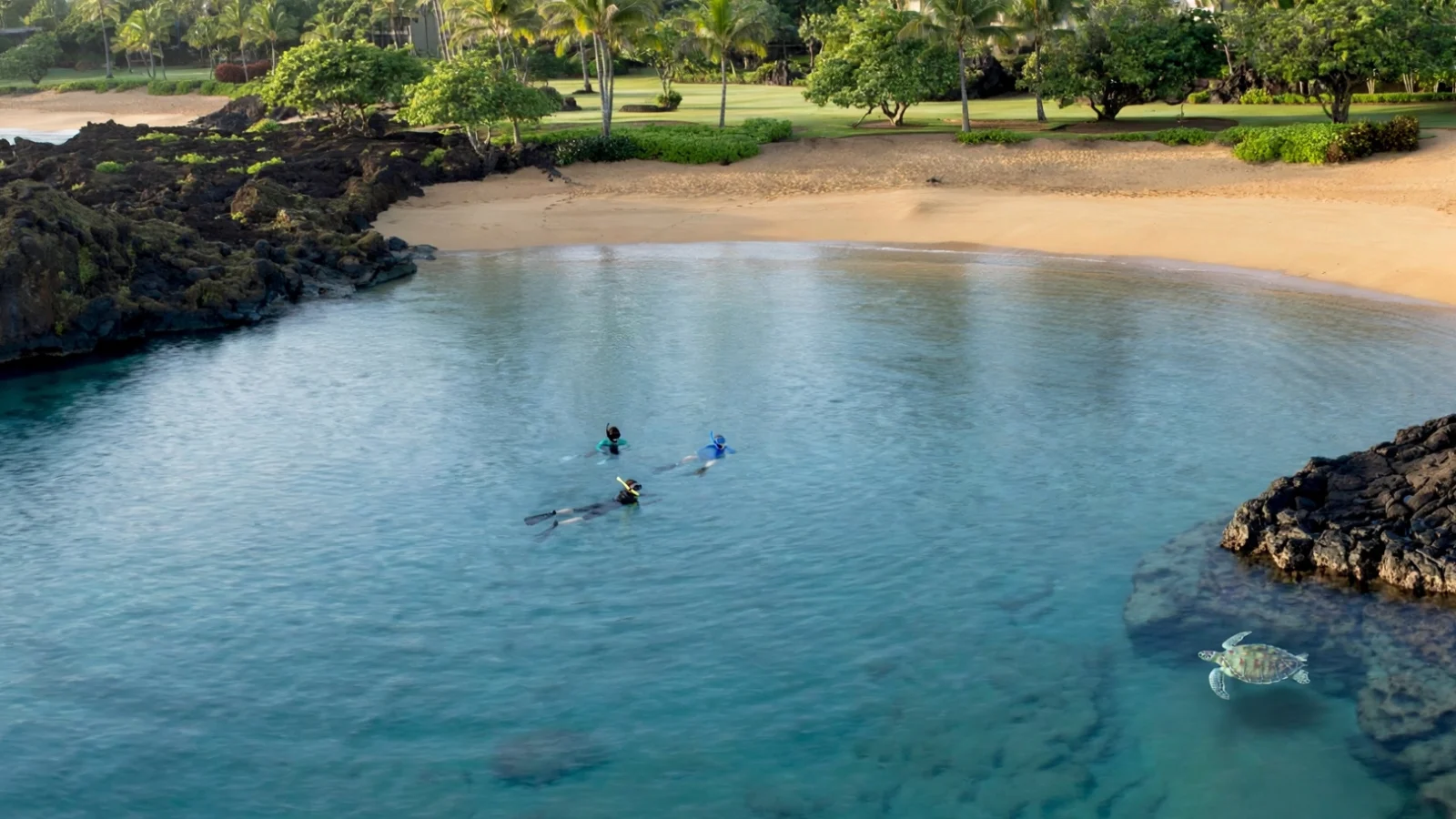
Kapalua Bay is the snorkel most West Maui visitors should do first. A near-perfect crescent of golden sand curves between two lava arms, and those arms do the work: they block the open-ocean swell, keep the middle of the bay gentle, and concentrate reef life along the rocky edges where the fish actually are. Add frequent green sea turtles, a sandy walk-in entry you can stand up in, and no reservation system to fight with, and you get the rare Hawaii spot that suits a nervous first-timer and still rewards an experienced snorkeler who knows to work the north rocks early.
This guide covers the full picture for 2026: which side of the bay to snorkel, what parking really costs now (it changed — older guides, including an earlier version of this page, still say free), the best morning window, the winter swell warning nobody should skip, and how Kapalua compares with Napili Bay and Black Rock nearby.
Quick answer — Kapalua Bay at a glance
- Where: Kapalua, West Maui — 5900 Lower Honoapiilani Hwy, just past Napili, about 15 minutes north of Ka’anapali
- Best for: Beginners, families, turtle watching, a calm first snorkel
- Entry: Sandy beach walk-in, mostly standing depth in the centre
- Lifeguard: None — calm does not mean supervised
- Reservations: None required
- Parking: Small 40-space beach-access lot; paid for non-residents in 2026 (see table below), arrive before 9 AM
- Facilities: Restrooms, outdoor showers, drinking fountain; no food vendors, no gear rentals on the beach
- Best time: Early morning, ideally in the water before 9–10 AM
Why Kapalua Bay stays calm
Geometry is the whole story. The bay is a tight C-shape, open to the northwest but pinched by lava points at both ends. Swell rolling down the Pailolo Channel hits those points first and loses its energy on the rocks, so the sand bowl in the middle stays placid on most trade-wind days. The bottom in the centre is sand with scattered coral heads — poor fish habitat, but perfect forgiving entry water.
That same geometry shapes the snorkeling. Life lives on the structure: the two rocky arms, the reef fingers reaching in from each point, and the coral heads near the edges. The middle is your corridor; the edges are your aquarium. Snorkelers who float over the central sand for twenty minutes and leave disappointed simply never reached the good water — it starts about 50–100 feet out, along the rocks.
One honest caveat: “sheltered” is not “always safe.” In winter, a big north or northwest swell wraps straight into the bay’s opening, and Kapalua can go from bathtub to washing machine in a day. More on that below — it is the single most important safety fact about this spot. The bay earns its calm reputation on ordinary trade-wind days, in summer, and on small-swell mornings, not on every day of the year, and treating that distinction seriously is what keeps a beginner-friendly beach beginner-friendly in practice as well as in reputation.
Where to snorkel: north rocks vs south rocks vs the sandy centre
The north rocks (right side, facing the ocean) hold the densest reef: more coral structure, more fish schools, and the most reliable turtle encounters, as turtles graze the algae on the lava and rest along this edge. Depths run roughly 5–15 feet over the reef, deepening toward the point. This is the side confident snorkelers should work first, slowly, in the morning light.
The south rocks (left side) are shallower and generally calmer — the beginner side. Fish numbers are lower and visibility can be a touch milkier near the sand line, but for a first snorkel, a child on a float, or anyone rebuilding confidence, the south edge is the kind choice. The swim from the sandy entry to real reef is short, the depth builds gradually, and a nervous snorkeler can stay close to shore while still seeing genuine reef fish instead of only sand, which makes those first minutes encouraging rather than anticlimactic.
The sandy centre is for entry, exit, and practice. Put your mask on here, clear it, get your breathing calm, practise standing and re-seating your fins — then fin out to an edge. Practising in the centre also keeps new snorkelers off the reef itself while they learn, because standing is safe on sand and damaging on coral, and it lets a buddy check straps, snorkel position and comfort before anyone is over deeper water.
Sources disagree about which side is “best” because conditions flip the answer: a light south swell dirties the south rocks, a building north swell dirties the north. On the day, look before you commit — the clearer, quieter edge is obvious from the beach in about ten seconds. Whichever side you choose, stay inside the bay’s points. The reef extends roughly 900–1,000 feet out to the tips, and beyond them the current and open-ocean swell are a different proposition entirely. Never round the points.
Kapalua Bay snorkeling route: a simple out-and-back loop
The easiest way to snorkel Kapalua Bay is as a simple out-and-back loop: enter on the sand, swim out over the middle, turn right along the north rocks, then come back toward the beach. You do not need a boat, a guide, or a set route — the shape of the bay does the navigating for you. The loop keeps you inside the points the whole time, which is the one rule that matters here.
Start at the sandy southern end of the beach, where the entry is sand underfoot. Wade out until the water is deep enough to float, then put your fins on — walking in fins over the sand is awkward, and there is the occasional rock underfoot. Swim straight out over the sandy centre until you are about 50–100 feet from shore, then turn right (north) and follow the rocky edge. The reef is thin and patchy close to the beach and gets better the farther out you go, and the visibility usually improves with it. Depths run roughly 5–15 feet over the reef, deepening to around 20 feet as you near the point, so stay as shallow or as deep as you are comfortable with — the good fish are along the rocks at every depth.
Do not swim past the rocky point. The point sits roughly 900 feet from the beach, and the current beyond it is a different proposition — the bay’s protection ends there. Most snorkelers turn around well before the point, once they have had their fill of the reef or as soon as the water starts to push. On the way back, drop into the rocky strip that runs parallel to the beach: plenty of fish hold there, and the shallow 3–5 feet of water over it is the best place in the bay to look for the small stuff — blennies and the small reef fish that hide in the rocks. If you want a shorter swim, the south (left) side is the same idea in miniature: the reef is thinner and the visibility is often poorer, and most snorkelers stay within about 500 feet of the beach there.
Swim the loop in the morning, when the water is calmest and the light is best for seeing into the reef. If a north swell is running, or the water at the rocks looks milky and surgy from the beach, save the far end of the loop for another day and stay in the sandy middle. And snorkel with a buddy — the loop is easy, but there is no lifeguard at Kapalua Bay, and a second pair of eyes is the cheapest safety gear there is.
Best time to snorkel Kapalua Bay
Go early. Every local source agrees on the same stack of morning advantages: the water is clearest before the trade winds texture the surface, the turtles are feeding undisturbed, and — just as practical — the 40-space parking lot still has spaces in it. Morning light also comes into the bay at an angle that makes fish easier to see, the beach itself is quieter, and you finish with the whole day still ahead of you for the coastal trail, breakfast in Napili, or a second beach later.
- Before 8 AM: Glassy on most days, lot nearly empty, best turtle behaviour. The connoisseur’s slot.
- 8–10 AM: Still excellent; lot filling fast, especially weekends.
- 10 AM–1 PM: Good snorkeling, harder parking, more people on the north rocks.
- Afternoon: Trade-wind chop commonly clouds the bay; fine for a swim, second-best for snorkeling.
Seasonally, summer and autumn bring the calmest, clearest Kapalua conditions. Winter (roughly November to March) is the judgement call: between swells, a winter morning here can be superb — but a rising north swell makes the bay dangerous despite its sheltered shape, with surge over the rocks and rip currents near the points. Our best time to snorkel in Hawaii guide explains the seasonal pattern across the islands. For Kapalua specifically, use this no-go checklist: skip Kapalua if you see whitewater breaking across the bay mouth; the sand is churned brown after heavy rain; nearby beaches are posting high-surf advisories; or you cannot comfortably hold your position inside the bay. Our Hawaii snorkeling safety guide covers how to read those signs before you get in.
What you will see at Kapalua Bay
- Hawaiian green sea turtles (honu) — the headline. They feed on algae along both rocky edges and rest on the reef; early, quiet snorkelers see them most reliably.
- Reef fish — Moorish idols, butterflyfish (raccoon, threadfin, ornate), parrotfish grazing the coral, surgeonfish schools, triggerfish including Hawaii’s state fish, the humuhumunukunukuapua’a, and damselfish over the coral heads.
- And with luck — octopus in the rock crevices on the north side, moray eels tucked into the reef (look, never reach), and spotted eagle rays occasionally cruising the deeper centre.
Keep at least 10 feet (3 metres) from turtles — the distance NOAA Fisheries recommends — and never touch, chase, feed, or crowd them. A turtle that changes direction because of you is a turtle you have come too close to, so back away slowly and let it choose its own path along the reef. The same hands-off rule protects everything else here: coral is a living animal that dies where fins and feet break it, and the bay stays this good only because most visitors treat it gently. If turtles are the main reason for your trip, our guide to where to snorkel with turtles in Hawaii compares the best spots island by island.
Parking, access and fees (2026 — updated)
The small beach-access lot nearest Kapalua Bay holds about 40 spaces and fills before 9 AM on most decent days. As of 2026 that lot is paid for non-residents — around $29 per day, paid by QR code (Parklinq-managed, no attendant) — with a second option at the Kapalua Ranch / upper lot at roughly $19 per day. But those are not your only choices: the Tennis Garden, Merriman’s and the paid public lot each have their own prices, hours and walk, and limited free street parking exists on Lower Honoapiilani Road. Rates change, so treat the posted signs on the day as final. Budget for the paid lot rather than assuming the old free-parking advice still applies, and have a phone ready for the QR payment before you are holding up the small lot.
| Option | Cost (2026) | Hours / payment | Walk to the sand |
|---|---|---|---|
| Beach-access lot (~40 spaces) | ~$29/day, non-residents | QR pay, no attendant | Closest to the path; fills before 9 AM |
| Kapalua Tennis Garden | $10 for 3 hours, $15 all-day | Kiosk near lower tennis courts | Dirt path to the bay parking entrance |
| Merriman’s | $15–$29 (dynamic; cheaper earlier) | 6am–3pm, Mon–Sat; not Sunday; QR codes | Next door to the beach lot |
| Paid public lot (Parklinq) | $25–$39/day (dynamic; ~$29 typical) | 5am–8pm; pay by phone | Stairs + tunnel to the beach |
| Kapalua Ranch / upper lot | ~$19/day | Same QR system | Short walk down |
| Kapalua Golf Villas | $10 | Across the street | Short walk |
| Lower Honoapiilani Rd street parking | Free | Limited, about 20–25 spaces | Parallel park; often full by 8 AM |
One Parklinq payment covers the paid lots at Kapalua Bay, Ironwoods, Dragon’s Teeth and Maui Pineapple Chapel for the rest of the day, so keep the receipt if you plan to move between them. All prices are 2026 reports and change — the posted signs and the QR/kiosk price on the day are final, and dynamic lots cost more as they fill.
Walk from the lot down the beach-access path and you reach the sand in a couple of minutes, passing the restrooms and showers. There is no reservation system for Kapalua Bay — your only “booking” problem is the parking clock. If the lot is full, do not circle endlessly: Napili Bay, five minutes south, is a genuinely good Plan B, with its own reef, a broad sandy beach, and an easier fallback than driving back toward Ka’anapali and starting again.
How to get to Kapalua Bay beach from each parking lot
Kapalua Bay sits at 5900 Lower Honoapiilani Highway in West Maui — the address is in the quick-answer table at the top. The driving part is easy; the trick is knowing which lot you are aiming for before you turn in. The Maui hub has the wider West Maui driving picture if you are coming from elsewhere on the island.
From Highway 30 north, turn left at Napili Plaza (mile marker 29) onto Napilihau Street, down the hill, then right on Lower Honoapiilani Road for about a mile. Just past Napili Kai Beach Resort, look for the ‘Kapalua Bay Beach Parking’ sign and turn left, then continue right toward the restrooms. Pay by phone, then take the stairs and the tunnel down to the beach.
The beach-access lot is the small lot right by the beach path — closest to the sand, and the first to fill. If it is full, do not circle endlessly: Napili Bay, five minutes south, is the Plan B already noted above.
Drive past Merriman’s Restaurant, turn right onto Kapalua Drive, up the hill, then right into The Kapalua Tennis Garden. Pay at the kiosk near the lower tennis courts, then follow the dirt path toward the Kapalua Bay parking entrance.
Exit left from the beach-access lot and turn immediately left into Merriman’s lot. Paid parking signage with QR codes; the price is lower earlier in the day when the lot is less full. Not available on Sundays.
For free street parking, parallel park along Lower Honoapiilani Road near the beach access area — about 20–25 spaces, usually gone by 8 AM on calm days. Unload gear near the showers in the parking lot, cross the street, walk through the lot to the stairs, and through the tunnel to the beach.
Facilities and what to bring
On site: public restrooms and outdoor showers near the access path, a drinking fountain, and lawn shade behind the beach. Not on site: food vendors, shops, or gear rentals — there is no rental on Kapalua Beach itself. Rent mask, snorkel and fins beforehand in Napili or Lahaina, and bring water and snacks with you.
Bring reef-safe sunscreen (Hawaii law requires reef-compliant sunscreen sold in the state), a rash guard, and a dry pouch for keys. Our Hawaii snorkeling gear checklist covers the full kit, from a mask that actually fits to the flotation that helps new snorkelers relax. Water shoes are less critical here — the entry is sand — but never stand on reef: stand only on sand. Apply sunscreen well before you get in, and carry out everything you carried in so the lawn and sand stay as clean as you found them.
Is Kapalua Bay good for beginners and kids?
Yes — it is one of Maui’s kindest first snorkels, with three honest caveats. Strengths: sandy gradual entry; standing depth across the centre; short swim to real reef life on the south rocks; facilities that make a family morning easy. Start new snorkelers in the centre, let them master mask and breathing standing up, then float them along the south edge. Our beginner’s guide to snorkeling in Hawaii walks through those first-session basics step by step. For children, short early sessions work best: get in while the water is calm and the lot is quiet, come out for water and shade before anyone is tired or cold, and let a good first experience — rather than a long one — be the goal of the morning.
Caveat one: there is no lifeguard. Caveat two: the winter-swell rule applies to everyone. Caveat three: urchins sit in rock cracks — fins on, feet up, no standing on structure. None of those caveats cancels the recommendation; they simply define how a good Kapalua morning is run — with a buddy, with flotation for weak swimmers, with a same-day look at the surf, and with beginners kept over sand and the gentle south edge until their confidence is earned rather than assumed.
Kapalua vs Napili vs Black Rock: which West Maui snorkel?
| Kapalua Bay | Napili Bay | Black Rock (Ka’anapali) | |
|---|---|---|---|
| Best for | Beginners + turtles | Sandy beach day + decent reef | Confident snorkelers, turtles |
| Entry | Sand, very gradual | Sand, shore break can thump | Sand, then deep water quickly |
| Calmest when | Most days; risky in big N swell | Similar swell exposure | Exposed to current at the point |
| Parking | Small paid lot, fills early | Tight street/lot parking | Ka’anapali resort parking, pricey |
| Vibe | Quiet, upscale, lawn shade | Local beach-day feel | Busy resort energy |
Our pick: Kapalua for a first or family snorkel, Black Rock when confident, Napili when Kapalua’s lot is full. Ready to step up? Honolua Bay, about 15 minutes north, offers a bigger, wilder reef on calm summer days, and Molokini Crater is the boat-trip step up for exceptional clarity. The Maui hub maps the whole coast so you can plan a progression across a trip instead of repeating the same beach every day.
Make a morning of it: nearby stops
- Kapalua Coastal Trail — 1.76 miles from Kapalua Bay to D.T. Fleming Beach; perfect post-snorkel walk.
- Napili Bay — five minutes south; breakfast, then a second snorkel.
- Honolua Bay — 15 minutes north for your next snorkel day.
- D.T. Fleming Beach — trail’s far end; picnic finish.
FAQ
Is Kapalua Bay good for snorkeling?
Yes — one of West Maui’s best all-round snorkels: sheltered crescent, reef along both rocky arms, frequent turtles, sandy entry. North rocks densest fish life; south rocks shallower and calmer. Go in the morning and stay inside the points.
Is Kapalua Bay good for beginners and kids?
One of Maui’s best beginner spots — gradual sandy entry, standing depth in the centre, easy south-side reef. There is no lifeguard, so weak swimmers need flotation and supervision, and winter swell days are a no.
How much is parking at Kapalua Bay in 2026?
The 40-space beach-access lot is paid for non-residents — about $29/day by QR code as of 2026 — and the upper Kapalua Ranch lot is around $19/day. Rates change, so check the posted signs. Limited free street parking on Lower Honoapiilani Road goes early. Cheaper options exist — see the comparison table above: the Tennis Garden is $15 all-day, Merriman’s runs $15–$29, and the paid public lot is $25–$39 depending on availability.
Is parking at Kapalua Bay free?
No longer reliably. Older guides said free, but the beach lots have moved to paid QR parking for non-residents. Limited free street parking remains if you arrive early.
Do you need a reservation for Kapalua Bay?
No. There is no reservation or booking system for the beach — unlike Hanauma Bay on Oahu. The only timing pressure is the small lot filling before 9 AM.
Is there a lifeguard at Kapalua Bay?
No. There is no lifeguard. Snorkel with a buddy, keep beginners in the centre and along the south side, and skip high-surf and brown-water days.
What is the best time to snorkel Kapalua Bay?
Early morning, in the water before 9–10 AM: calmest, clearest, best turtles, and parking still exists. Summer and autumn are most consistently calm; winter needs a same-day swell check.
Can you snorkel Kapalua Bay in winter?
Sometimes — between swells it can be excellent. But a big north or northwest swell wraps in and makes it dangerous despite the shelter. If whitewater breaks across the bay mouth, do not go in.
Can you see turtles at Kapalua Bay?
Frequently, yes. Green sea turtles feed along both rocky edges, most reliably early in the morning. Keep at least 10 feet away per NOAA guidance, and never touch, chase or feed them.
Can you rent snorkel gear at Kapalua Bay?
No — there is no rental on the beach itself. Rent in Napili or Lahaina before you come, and bring water and snacks too, as there are no vendors at the bay.
Where to park for Kapalua Bay beach?
Start with the beach-access lot by the beach path (about $29/day for non-residents), but have a backup: the Kapalua Tennis Garden ($15 all-day), Merriman’s ($15–$29, not Sundays) and the paid public lot ($25–$39) are all within a short walk, and free street parking on Lower Honoapiilani Road is the only free option — about 20–25 spaces, usually full by 8 AM. The full comparison table is in the parking section above.
Is there free parking at Kapalua Bay beach?
Only street parking. Free parking at Kapalua Bay is limited to parallel spaces along Lower Honoapiilani Road — about 20–25 of them — and they usually fill by 8 AM, especially on calm days. The beach lots themselves are paid for non-residents in 2026.
What time does Kapalua Bay parking fill up?
Free street parking is usually gone by about 8 AM, and the small beach-access lot fills before 9 AM on most decent days. The nearby Coastal Trail pay lot has been reported full by 9:30 AM on a Friday. Arrive before 8 AM if you want a free space, before 9 AM for the beach lot.
Is there parking at Kapalua Bay on Sunday?
Yes — the beach-access lot, the paid public lot and the Tennis Garden operate on Sundays. Merriman’s paid parking is the exception: it runs Monday to Saturday, 6am to 3pm, and is not available on Sunday.
Do you need a reservation for Kapalua Bay parking?
No. There is no reservation or booking system for Kapalua Bay parking — unlike Hanauma Bay on Oahu. All lots are pay on site by QR code, phone or kiosk, and the only timing pressure is the lots filling up in the morning.
How far out can you snorkel at Kapalua Bay?
As far as the rocky points — the reef runs roughly 900–1,000 feet out to the tips — but the best snorkeling is along the north rocks well inside that. Depths run from about 2 feet at the sand to around 15–20 feet near the point. Never swim past the points: the current and open-ocean swell beyond them are much stronger than the calm water inside the bay.
Can you snorkel at Kapalua Bay on your own, without a tour?
Yes. Kapalua Bay is a shore-entry beach — you walk in from the sand, so no boat or guided tour is needed. Bring your own mask, snorkel, and fins — there is no rental on the beach itself; rent in Napili or Lahaina before you come — and go with a buddy. The only things to sort out in advance are parking, which fills up in the morning, and a check of same-day ocean conditions.
Verified November 19, 2026 against NOAA Fisheries wildlife guidance, county and visitor sources, and current parking reports. Fees and conditions change — check posted signs and same-day ocean conditions on arrival.