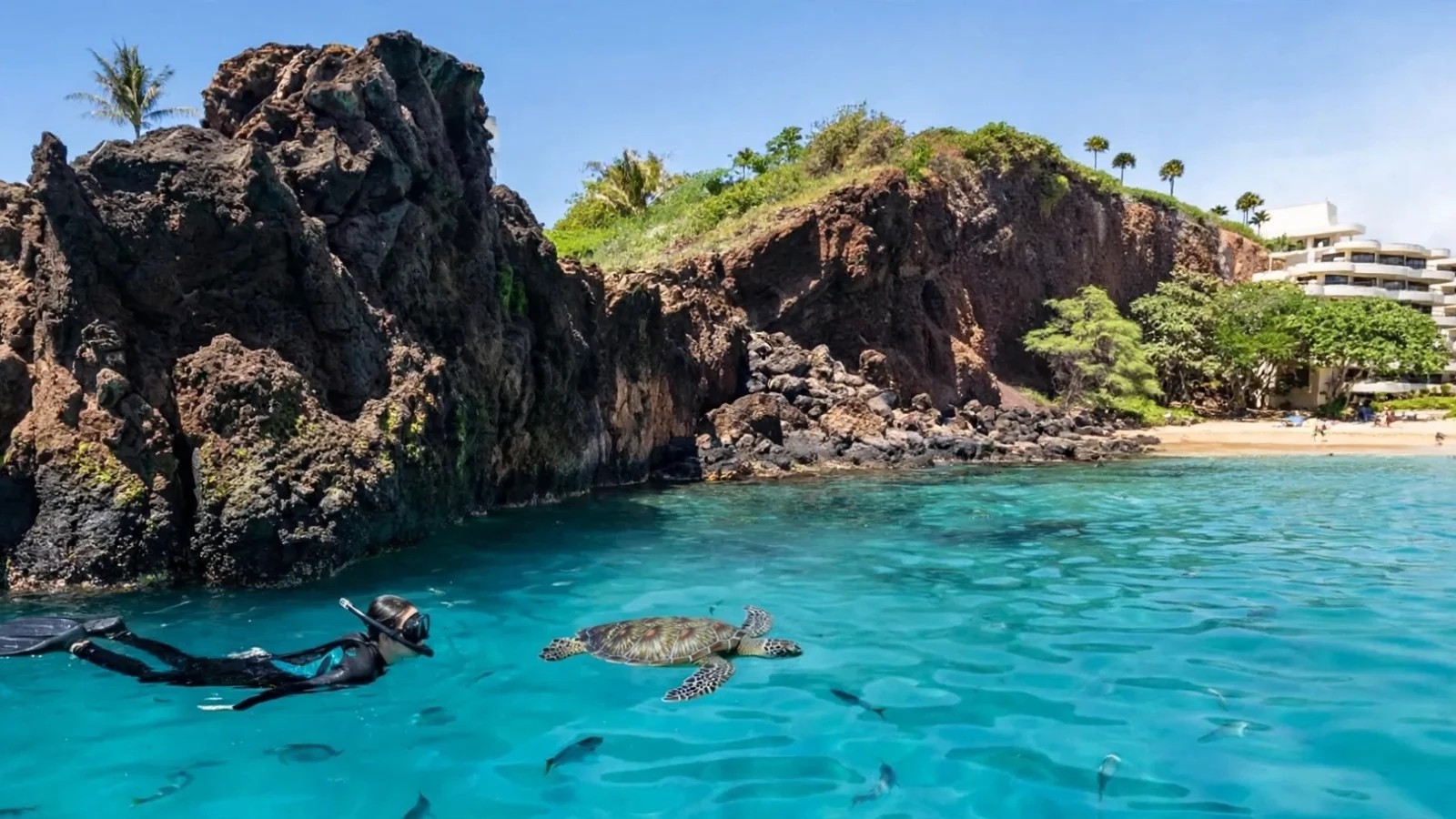
- Where
- North end of Ka’anapali Beach, West Maui — beside the Sheraton
- Cost
- Free to snorkel · parking is the only likely expense (limited public stalls or a paid garage)
- Difficulty
- Beginner on calm mornings on the beach side — experienced only around the point
- Turtles
- Very likely — green sea turtles feed and rest along the rock face
- Best time
- Early morning: calmer water, clearer visibility, fewer people, better parking odds
Why Black Rock snorkeling works so well
Most great shore snorkels ask something of you first: a long drive, a rocky entry, a hike, a boat or a reservation. Black Rock asks for almost none of that. It sits at the end of one of Hawaii’s most famous resort beaches, the entry is soft sand, and the underwater wall starts almost as soon as you can float. Staying anywhere in West Maui, you can be looking at a turtle before breakfast and back on the beach with a coffee while the resort is still waking up.
Pu’u Keka’a is also a place with real meaning. In Hawaiian tradition it is known as a leina, a place where spirits leapt into the next world, honoured every evening in the torch-lighting and cliff-dive ceremony at sunset. Snorkel it respectfully, give the ceremony and jumpers their space, and treat the rock as a cultural site that holds excellent snorkeling — not the other way round. This guide is part of our complete Maui snorkeling hub, where we compare every West and South Maui spot by difficulty, turtles, parking and conditions.
Quick verdict: who it is — and is not — for
Black Rock is for you if you want turtles without a boat tour, you are staying in Ka’anapali, Lahaina or Kapalua, you can arrive in the morning, and you are happy to stay in sheltered water along the inner rock face. Experienced snorkelers on an easy day will also enjoy the wall, the point on a genuinely calm day, and the chance of a spotted eagle ray over the sand.
It is not for you if you want a wide living coral reef for hours, or you plan to arrive late hoping for empty parking and water. There is very little true reef here — the interest is the wall, its fish, and the turtles. For a bigger reef, look at Honolua Bay or Molokini Crater.
Where is Black Rock, Maui?
Black Rock Maui sits at the far north end of Ka’anapali Beach, on Maui’s west shore in front of the Sheraton Maui Resort — about 10 minutes north of Lahaina by car. Its Hawaiian name is Pu’u Keka’a, and it is the lava-rock point that closes off the north end of the three-mile Ka’anapali Beach. Black Rock Beach Maui is the stretch of sand at the base of the point; the snorkeling runs along the rock wall on the north side, not across the open beach.
That position is the whole story of the spot. Because the rock juts out at the end of a long, straight beach, the wall beside it drops into deep water fast, the current around the point picks up when the swell does, and the calm water is on the inner face, close to shore. It is also why the spot is so easy to reach: you walk in from the beach, not down a trail, and the resort strip behind it means parking, food and gear are a short walk away rather than a drive. Our Maui snorkeling hub puts Black Rock in context with the rest of the island’s west-side spots, and our Kaanapali Beach snorkeling guide covers the whole three-mile beach the rock anchors.
Conditions: what the water is really like
On the beach side, the bottom is sand that slopes away from shore, and the rock face drops into deeper water surprisingly quickly for a beach snorkel. That depth is part of the appeal — you do not swim far over empty sand to reach fish — but weaker swimmers should not treat this like a shallow lagoon. Stay parallel to the wall, where you can still see the beach clearly, and you will see most of what Black Rock offers.
Visibility is typically good to excellent, and on a calm morning it can be outstanding. It falls when surf stirs the sand, wind chops the surface, or heavy rain has run off the land. If the water looks milky from the beach, it will not clear once you are in it. That is a day to wait, or to choose a more sheltered spot.
The key condition is the difference between the inner face and the point. Along the inner face, a calm morning is usually manageable. Around the point you are in open ocean: waves can push you toward the rock, currents are frequently reported as strong, and getting back can be harder than getting out. Every serious guide gives this warning and we agree: do not round the point unless you are a strong, experienced ocean swimmer, conditions are genuinely calm, and you are with a buddy. Larger winter swells can make West Maui rougher, while summer mornings are more often flat — but daily forecasts always beat the calendar. Read our best time to snorkel in Hawaii guide and check a local surf report that morning.
What you will see: marine life on the wall
Turtles are the headline, and for once it is honest. Green sea turtles — honu — feed on algae on the rock, rest in its shelter and cruise slowly along the wall. A calm morning without one is unusual, though nothing wild is guaranteed. Float still, keep at least 10 feet away, never chase, block or touch a turtle, and they will often feed as if you are not there. Honu are protected and fines for harassing them are steep. Our guide to snorkeling with turtles in Hawaii explains the rules in full.
Expect Hawaii’s state fish, the reef triggerfish — humuhumunukunukuapua’a — plus yellow tang grazing in small groups, Moorish idols, longnose and raccoon butterflyfish, Hawaiian sergeants in the surge, and bullethead parrotfish scraping algae. Goatfish schools work the sand at the base of the wall, trumpetfish hang almost motionless, and orangespine unicornfish and surgeonfish cruise the deeper edge. Look down too: moray eels tuck into cracks, urchins sit in crevices — never grab the rock for balance — and patches of coral grow on the wall itself. Keep an eye on the blue beyond the point for a spotted eagle ray gliding over the sand. The best sightings here come to snorkelers who move slowly, not to those who swim furthest.
Access, parking and fees: the honest version
Beach access is free and there is no entry fee to snorkel here in the sources we checked. Parking is where money and frustration live, so plan it first. Black Rock is reached through the Ka’anapali resort area, off Honoapi’ilani Highway via Ka’anapali Parkway, at the north end of the beach in front of the Sheraton. Staying at a Ka’anapali resort? Walk — the beach path connects the resorts and the rock is a short walk from most.
Hawaii resorts must provide a limited number of public beach-access spaces, and at Ka’anapali they are genuinely limited and fill early, especially in high season and on weekends. A small public lot sits by the beach-access walkway near the Ka’anapali Beach Resort, a short walk from the rock. Treat any stall count, price or time limit as changeable: read the signs on the day, and do not rely on a price published months earlier.
The paid fallback most guides recommend is the Whalers Village garage, a beach walk from Black Rock. It is paid parking; some visitors have parking validated in part by shopping or dining there, but policies change, so check current terms at the garage rather than counting on it. Arriving early, or later in the afternoon as day visitors leave, improves your odds either way — mid-morning is the worst of both worlds.
Facilities need the same honesty. Sources disagree about public facilities at the rock itself: resort facilities are for guests, while restrooms and showers are reported in the resort and Whalers Village area near the beach. Do not plan around a dedicated public block at the rock — bring water, shade and reef-safe sunscreen with you. On lifeguards, we could not verify a station for this specific stretch in sources checked, so do not assume a lifeguard is watching Black Rock. That is another reason for the buddy rule and a conservative line at the point.
Best time to snorkel Black Rock
Early morning wins on every count. Water is usually calmest before trade winds build, visibility is best before crowds stir the sand, turtles are actively feeding, parking still exists, and the beach has not filled. Aim to be parked, geared up and in the water in the first part of the morning — not circling the resort at ten. Late afternoon can work on a calm day and pairs with the sunset ceremony, but it is not the choice for a first, nervous snorkel. And how is Black Rock today? Only that morning’s surf report, wind and a look at the water can say. If waves are breaking hard on the rock or the water is milky, postpone.
How to snorkel Black Rock: step by step
- Check conditions first. Read a local surf report, then watch the water for five minutes. If the point looks rough from the beach, your snorkel ends before the point today.
- Park or walk in early. Use a signed public beach-access stall or the paid Whalers Village garage, note time limits, and leave valuables at your hotel.
- Gear up on the sand. Mask defogged, fins in hand, reef-safe sunscreen applied in advance — Hawaii restricts sunscreens that harm reefs. Our gear checklist covers fit and renting versus bringing your own.
- Enter over sand, away from the rock. Walk in south of the rock face so shore break cannot push you onto lava, and put fins on in waist-deep water.
- Swim slowly along the inner wall. Keep rock on one side and sand on the other, with distance from the wall so surge cannot push you into it. This stretch holds most turtles and fish.
- Watch the jump zone. Cliff jumpers use the rock all day. Never linger below them, and look up as well as down along the wall.
- Make the point a decision, not a drift. Stop, check current, wind, energy and your buddy. Continuing is for strong, experienced snorkelers on calm days only.
- Exit the way you entered. Return along the wall, leave over sand away from the rock, and remove fins where you can stand.
Safety: read this before you get wet
Black Rock’s risks are specific, which makes them manageable. First, the point: current, depth and open ocean. Second, the rock itself: wave action against the wall can be rough even when entry looks easy, so keep space from the lava all session, never climb wet rock in fins, and never pull yourself along the rock. Third, other people: watch for jumpers above, snorkelers around blind corners, and catamarans working the beach further out. A bright rash guard or snorkel vest makes you easier to see and adds buoyancy.
The universal rules apply too. Never snorkel alone. Do not snorkel tired, unwell or after drinking. Know your limits in open water, not a pool — if you cannot float and breathe through a snorkel without standing, practise in calm shallows or book instruction first. Tell someone on shore your plan. Our guide, is snorkeling in Hawaii safe?, covers currents, entries and changing plans in the water.
Beginners and kids
Is Black Rock good for beginners? Yes, with those boundaries. A confident beginner who can swim, goes early on a calm morning, stays on the inner wall and snorkels with a buddy will usually have an excellent first Hawaii snorkel — and may see a turtle within minutes. A nervous non-swimmer will not: no spot with immediate depth beside a rock wall is where to learn from zero. See our guide to snorkeling in Hawaii for beginners before you travel.
For families, be precise. Good local guides do not rate Black Rock as the most ideal family snorkel, because water can be rougher than at nearby alternatives — and we agree. Older kids who are confident swimmers, wear a vest, stay close to a parent and stay off the point can do very well. Younger children will usually have a calmer time at Kahekili Beach Park just north, or at sheltered Kapalua Bay. Choose the calmer bay for small kids and save Black Rock for the adults’ early swim.
Cliff jumping and the sunset ceremony
You will see people jumping from Black Rock — it is famous for it. This guide does not recommend it: landings, submerged rock, currents past the point and changing surf make it a different risk from snorkeling. As a snorkeler, stay out of the landing zone and never swim under a jumper. At sunset, do stay for the torch-lighting and ceremonial dive from Pu’u Keka’a, one of Ka’anapali’s signature moments. Watch from the beach, keep the landing area clear, and it is a memorable end to a day that began with turtles in the same water.
Cliff jumping at Black Rock: what actually happens
The jump is the other half of Black Rock’s reputation, and on most days you will see people doing it. There are two jump spots: one about halfway up the rock and one at the very top. Reaching either one means swimming out from the beach — about 300 feet from the shoreline — then climbing wet lava rock in bare feet. Jumpers gather on the ledges through the day; the crowd thins and the watching picks up again at sunset, when the torch-lighting ceremony ends with the ceremonial dive.
This guide’s position does not change: we do not recommend cliff jumping at Black Rock. The heights are in the next section, and they are only part of the risk — landings, submerged rock, currents past the point and changing surf are the rest, and the height of any ledge changes with the tide. If you go to watch, do it from the beach or the sand at the base of the rock, stay out of the landing zone, and never swim under a jumper. The same rule applies if you are snorkeling: the jumpers come down where the water is deep off the point, which is also where the wall snorkel route runs, so keep to the inner face while anyone is jumping and give the landing area a wide berth.
How high is Black Rock, Maui?
There is no single official height for Black Rock, and that is exactly why the question gets asked so often — every source gives a slightly different number, because the answer depends on where you measure from and what the tide is doing. Here is the honest version, from the guides that have actually measured and jumped it.
The ledges people jump from are about 12 to 20 feet above the water. Most jumpers use the lower ledges, around 12 to 15 feet; the jump most often described is roughly 20 feet. Higher points on the rock reach around 30 feet. The nightly ceremonial dive — the torch-lighting jump the Sheraton has staged since 1963 — is about 35 feet. The rock formation itself rises higher than any jump ledge, but no surveyed height is published for it, so treat any single big number you see online with suspicion: the old stories of Chief Kahekili leaping from hundreds of feet are legend, not a measurement of this rock.
There are two jump spots: one about halfway up and one at the very top. Reaching either one means swimming out from the beach — about 300 feet from the shoreline — then climbing wet lava rock in bare feet. The water below is deep, which is why the jump is survivable at all, but deep water does not make it safe: landings, submerged rock, currents past the point and changing surf are the same risks this guide already warns about, and the height changes with the tide, so a ledge that was 15 feet at high tide is higher at low tide.
Our position does not change: this guide does not recommend cliff jumping at Black Rock. If you go to watch, stay out of the landing zone and never swim under a jumper — and if you are snorkeling, the same rule applies. The height question matters to snorkelers for a different reason: the same deep water that makes the jump possible is why the wall beside the rock drops away so fast, and why weaker swimmers should stay on the inner face and off the point.
Black Rock Beach: the sand, the swim, and the walk from Whalers Village
Black Rock Beach is the stretch of sand at the base of the rock, at the north end of Ka’anapali Beach — a three-mile run of white sand on Maui’s west shore. It is a beach in its own right, not just a snorkel entry: people come here to swim, sunbathe and watch the sunset ceremony from the sand, and there is no fee to use the beach itself.
For swimming without a snorkel, the sandy entry just south of the rock is the easy part: waist-deep water over sand for the first stretch, then the bottom drops away quickly and the current around the point picks up — the same caution as for snorkeling, just without fins on. On a calm morning it is a straightforward swim; on a rough or murky day, do not get in. There are no public restrooms at the rock itself, and no lifeguard station we could verify for this stretch, so plan around the facilities at Whalers Village and the resorts, and bring water and shade with you.
Getting here on foot from Whalers Village is a 10- to 15-minute walk — roughly 700 to 800 feet north along the beach path. The Whalers Village garage is the paid fallback most visitors use, at around $3 an hour with validation from shops or restaurants, but prices and validation terms change, so read the signs at the garage rather than counting on a figure from months ago. The small public beach-access stalls nearer the rock are free but few, and they fill early. Our full picture of the whole beach — parking, the resort strip, and where else to swim along it — is in our Kaanapali Beach snorkeling guide.
Gear, food and tours
You need only a well-fitting mask, snorkel and fins. Rental gear is available from kiosks, resorts and shops in Ka’anapali and Lahaina; renting for several days is usually better value and fit than a single beach rental. Bring a rash guard, a dry bag, and more water than you think you need. Food is a short walk away at Whalers Village and resort restaurants, at resort prices. No tour is needed for Black Rock itself, but boat tours add guides, gear and shore-inaccessible spots; compare them in our Hawaii snorkeling tours guide.
Nearby spots: where next
Kahekili Beach Park (Airport Beach), just north on the other side of the rock, has a broader reef many families prefer — the smart check if Black Rock looks rough or crowded.
Kapalua Bay snorkeling, about ten minutes north, is a sheltered sandy bay, calmer for beginners and kids on many days, with turtles and reef fish in a contained setting.
Honolua Bay snorkeling is the West Maui step up: a much bigger reef in a reserve setting when calm, for experienced snorkelers.
Ahihi-Kinau and Olowalu cover South Maui if you are based in Kihei or Wailea, while Molokini Crater is the boat-only splurge — clear water and a protected crater reef.
Black Rock vs Maui’s other snorkel spots — which one fits your day?
Black Rock is the easiest great snorkel to reach on Maui’s west side — walk off Kaanapali Beach and you’re in. But easiest to reach is not the same as best for your day. If you’re staying in Kaanapali and the morning is calm, Black Rock is the obvious first choice. If you’re a first-timer, if it’s winter, or if you want the clearest water on the island, another Maui spot may serve you better. Here’s how Black Rock stacks up against the Maui shore spots visitors actually weigh it against — and the one boat trip that changes the comparison entirely.
Black Rock vs Honolua Bay
Honolua Bay is the best reef on Maui — when it’s flat. The bay sits inside a protected marine reserve north of Kapalua, and on a calm summer morning its coral variety is the strongest of any shore snorkel on the island. But it is a summer-only spot in practice: from roughly December through March, north swells roll straight into the bay and it turns rough and murky, and the entry is a rocky trail down to a boulder beach with no sand to walk in on. Black Rock is the opposite trade: a smaller reef, but a sandy entry, resort facilities a short walk away, and water you can get into on far more days of the year. Choose Honolua if you’re an experienced snorkeler visiting between May and September and the swell forecast is flat. Choose Black Rock if you want a straightforward morning swim without the drive, the hike, and the rock entry — and check the swell either way.
Black Rock vs Kapalua Bay
Kapalua Bay is the gentlest of the three. It’s a small, sheltered crescent with a sandy bottom and the easiest water entry on Maui’s west side, which is why it suits first-timers and families with kids better than Black Rock does. The reef is healthy, fish variety is solid, and turtles show up regularly. Black Rock answers with a deeper wall and more fish variety right off the rock, plus the Kaanapali beach scene — restaurants, rentals, and the sunset cliff ceremony — that Kapalua doesn’t have. The catch at Kapalua is parking: the small lot is commonly full by 8:30–9 a.m. The catch at Black Rock is the point itself: the current picks up around the tip, and the cliff-jump zone gets busy toward sunset. If anyone in your group is nervous in the water, start at Kapalua Bay. If everyone swims confidently and you’re already in Kaanapali, Black Rock saves you the drive.
Black Rock vs Turtle Town (Maluaka Beach)
Turtle Town is a broad reef area in South Maui, and it is where Maui’s most consistent turtle encounters happen — the Maluaka Beach shore access is the best-known public way in. But Turtle Town is a stretch of reef, not a single beach, and the shore route varies by zone; most visitors see it best from a boat. Black Rock gives you a single, defined spot: walk in off the sand, swim to the wall, and turtles graze the same coast — just with less certainty than a guided Turtle Town trip. Pick Turtle Town if turtles are the whole point of your day and you’re willing to book a boat or drive south to Maluaka. Pick Black Rock if you’re staying in Kaanapali and want turtles as a likely bonus on a morning you were already spending at the beach.
Black Rock vs Molokini Crater: shore or boat?
This is the real fork in the road. Molokini Crater sits about three miles off the Maalaea coast and you can only reach it by boat — but what you get is the clearest water on Maui, often over 100 feet of visibility, and more than 250 fish species inside a protected crater reef, with a crew, fitted gear, and a guide watching the group. Black Rock costs nothing beyond parking and gear, and you go whenever you like — but there’s no guide, no lifeguard, and visibility depends on the morning’s wind and swell. The honest rule: if anyone in your group is a first-timer, a weak swimmer, or nervous in deep water, take the Molokini tour and let the crew do the worrying. If everyone swims well, the morning is calm, and you’re staying in Kaanapali, Black Rock gives you a very good snorkel for free. Our Hawaii snorkeling tours guide compares the boat options if you decide to go that way.
Maui shore snorkels at a glance
| Spot | Entry | Reef & depth | Turtles | Best for | Watch out |
|---|---|---|---|---|---|
| Black Rock (Pu’u Keka’a), Kaanapali | Sandy beach, swim to the rock | Wall reef, 3–30 ft | Regular grazers | Resort-area convenience, confident swimmers | Current at the point; cliff-jump crowds at sunset; no lifeguard |
| Honolua Bay | Rocky trail, boulder beach | Reserve reef, best coral on Maui | Regular | Experienced snorkelers, May–Sep | Winter north swells; rough entry; no facilities |
| Kapalua Bay | Sandy, easiest on the west side | Sheltered crescent reef | Regular | First-timers, families | Small lot fills by ~8:30 a.m.; winter swells Dec–Mar |
| Turtle Town (Maluaka Beach) | Shore varies by zone; boat preferred | Broad South Maui reef | Most consistent on Maui | Turtle-focused days | It’s a reef area, not one beach; conditions vary by zone |
| Kahekili Beach Park (Airport Beach) | Sandy beach-park entry | Broad reef, family favourite | Regular | Families; a backup when Black Rock is rough | Can be busy; check the morning report too |
| Molokini Crater | Boat only, from Maalaea | Crater reef, 250+ species, 100 ft+ visibility | Regular | Clearest water, guided trips | Tour cost; captain may change the stop; deep water |
Winter at Black Rock: the north-swell catch
April through October is the easy season at Black Rock — that’s when the west side is at its calmest and the mornings are most reliably flat. Winter is where the point earns its caution. Maui’s west side is generally calmer than the north shore in winter, which is why Kaanapali stays swimmable on days Honolua is blown out — but north swells can still wrap around Black Rock’s point and bring surge to the wall, even when the beach itself looks fine. The rule doesn’t change: check that morning’s surf report before you go, and if waves are breaking on the rock or the water is milky, don’t force it. On a rough winter morning, Kahekili Beach Park just north of the point, or Kapalua Bay ten minutes up the road, is often the better call — both are on our Maui snorkeling map if you need a backup plan.
Sources we drew from
- Semrush keyword and SERP research for black rock snorkeling and the Ka’anapali cluster, checked October 2026.
- Local guides from Maui Hideaway, Tropical Snorkeling and Paradise Found in Maui, compared for entry, currents, parking and marine life, hedged where they disagreed, notably on facilities.
- Wildlife rules: NOAA Fisheries viewing guidelines (10-ft turtle rule).
Comparison and winter-swell detail checked November 2026 against Maui Snorkeling, Hawaii.com, Snorkel Guardians and MauiBookIt.
FAQ
Is Black Rock good for snorkeling?
Yes, for what it is: an easy-access rock wall with turtles, reef fish and usually good visibility — not a wide coral reef. Go early on a calm morning and stay on the beach side. For an extensive reef, choose Honolua Bay or Molokini.
Is Black Rock snorkeling safe for beginners?
It can be, on a calm morning, for beginners who can swim and float comfortably. Enter over sand, stay on the inner wall with a buddy, watch for jumpers, and do not go around the point. Nervous non-swimmers should start at Kapalua Bay or take instruction first.
Where do you park for Black Rock snorkeling?
Use a signed public beach-access stall in Ka’anapali — the small lot by the access walkway near the Ka’anapali Beach Resort is closest — or pay at the Whalers Village garage and walk the beach. Stalls are limited and fill early; read signs for current prices and limits.
How do you snorkel Black Rock safely?
Check the surf report, enter over sand away from the rock, put fins on in waist-deep water, swim slowly along the inner wall keeping distance from the lava, stay out of the jump landing zone, and turn back before the point unless you are strong and experienced on a calm day. Never snorkel alone.
Are turtles guaranteed at Black Rock?
No, nothing wild is guaranteed, but turtles live and feed along this fixed feature, so a calm morning without one is uncommon. Keep at least 10 feet away, never chase or touch a turtle, and let it close any gap if it chooses.
Is Black Rock safe for kids?
For older, confident swimmers with a vest and close supervision on a calm morning, yes, on the inner wall. For younger children, Kahekili Beach Park and Kapalua Bay are usually calmer. Depth beside the rock and the jump zone make this no toddler paddle spot.
Should I snorkel Black Rock or Wailea?
Snorkel where you are staying first. West Maui visitors should do Black Rock; South Maui visitors should do Wailea, Kihei and Turtle Town, visiting Black Rock as part of a planned Ka’anapali day instead of a cross-island drive for one hour in the water.
What is the best time — and how is Black Rock today?
Early morning: calmer water, clearer visibility, active turtles, fewer people, better parking odds. For today, check the local surf and ocean-safety report and look at the water — if surf is breaking hard on the rock or water is milky, postpone or choose a sheltered bay.
How high is Black Rock in Maui?
The jump ledges run about 12 to 20 feet above the water depending on the tide, with higher points around 30 feet; the nightly ceremonial dive is about 35 feet. There is no single official height — the number changes with the tide and with which ledge you measure.
How tall is Black Rock in Maui?
There is no single official height — the number changes with the tide and with which ledge you measure. The jump ledges run about 12 to 20 feet above the water, higher points on the rock reach around 30 feet, and the nightly ceremonial dive is about 35 feet. The full honest version, with why every source gives a different number, is in the “How high is Black Rock, Maui?” section above.
Where is Black Rock in Maui?
At the far north end of Ka’anapali Beach, in front of the Sheraton Maui Resort, about 10 minutes north of Lahaina on Maui’s west shore. Its Hawaiian name is Pu’u Keka’a. The snorkeling is along the rock wall on the north side of the point; the beach at its base is Black Rock Beach.
Is there free parking at Black Rock Beach?
Yes, but very little of it. A small number of free public beach-access stalls sit near the rock, and a small public lot sits by the beach-access walkway near the Ka’anapali Beach Resort — both fill early, especially on weekends and in high season, so arrive early or later in the afternoon. The paid fallback is the Whalers Village garage, a beach walk from Black Rock; validation (often around three hours with a purchase at a Whalers Village shop or restaurant) can cut the cost, but terms change, so read the signs at the garage rather than counting on a figure from months ago. Full detail is in the “Access, parking and fees” section above.
Can you cliff jump at Black Rock?
People do, from two ledges about halfway up and at the top, after a roughly 300-foot swim out from the beach. This guide does not recommend it: landings, submerged rock, currents past the point and changing surf make it a different risk from snorkeling. If you watch jumpers, stay out of the landing zone and never swim under one.
Is Black Rock Beach good for swimming if I don’t snorkel?
Yes, on a calm morning, from the sandy entry south of the rock — waist-deep sand at first, then the water deepens quickly and currents run around the point, so stay close to shore and skip it on a rough day. There is no verified lifeguard station at this stretch. Families with small kids will usually have a calmer time at Kahekili Beach Park or Kapalua Bay.
Is Black Rock the best snorkeling in Maui?
There’s no single best spot — it depends on what you want. Molokini has the clearest water, Honolua Bay has the best reef in summer, and Kapalua Bay is the easiest entry. Black Rock is the best resort-area snorkel on Maui: the most convenient great reef if you’re staying in Kaanapali, with turtles, a reef wall, and a sandy entry — as long as the morning is calm and everyone in your group swims confidently.
Should I snorkel Black Rock or Molokini?
If you’re a confident swimmer staying in Kaanapali and the morning is calm, Black Rock is a very good free snorkel. If anyone in your group is a first-timer, a weak swimmer, or nervous in deep water, book the Molokini tour instead — you get a crew, fitted gear, a guide, and the clearest water on the island. The two aren’t really rivals: plenty of visitors do Black Rock on a calm Kaanapali morning and Molokini on another day.
Can you snorkel Black Rock in winter?
Yes, on calm days — Maui’s west side stays swimmable through winter far more often than the north shore. But winter north swells can wrap around the point and bring surge to the wall, so check that morning’s surf report and skip it if waves are breaking on the rock. April through October is the easiest season. If Black Rock looks rough, Kahekili Beach Park or Kapalua Bay is usually the better call that day.
And if you are based in Ka’anapali for a few days, pair Black Rock with the reef just around the point at Kahekili Beach Park — broader, quieter, and an easy walk north along the beach path.
For the whole Ka’anapali Beach beyond the point, see our Kaanapali Beach snorkeling guide.