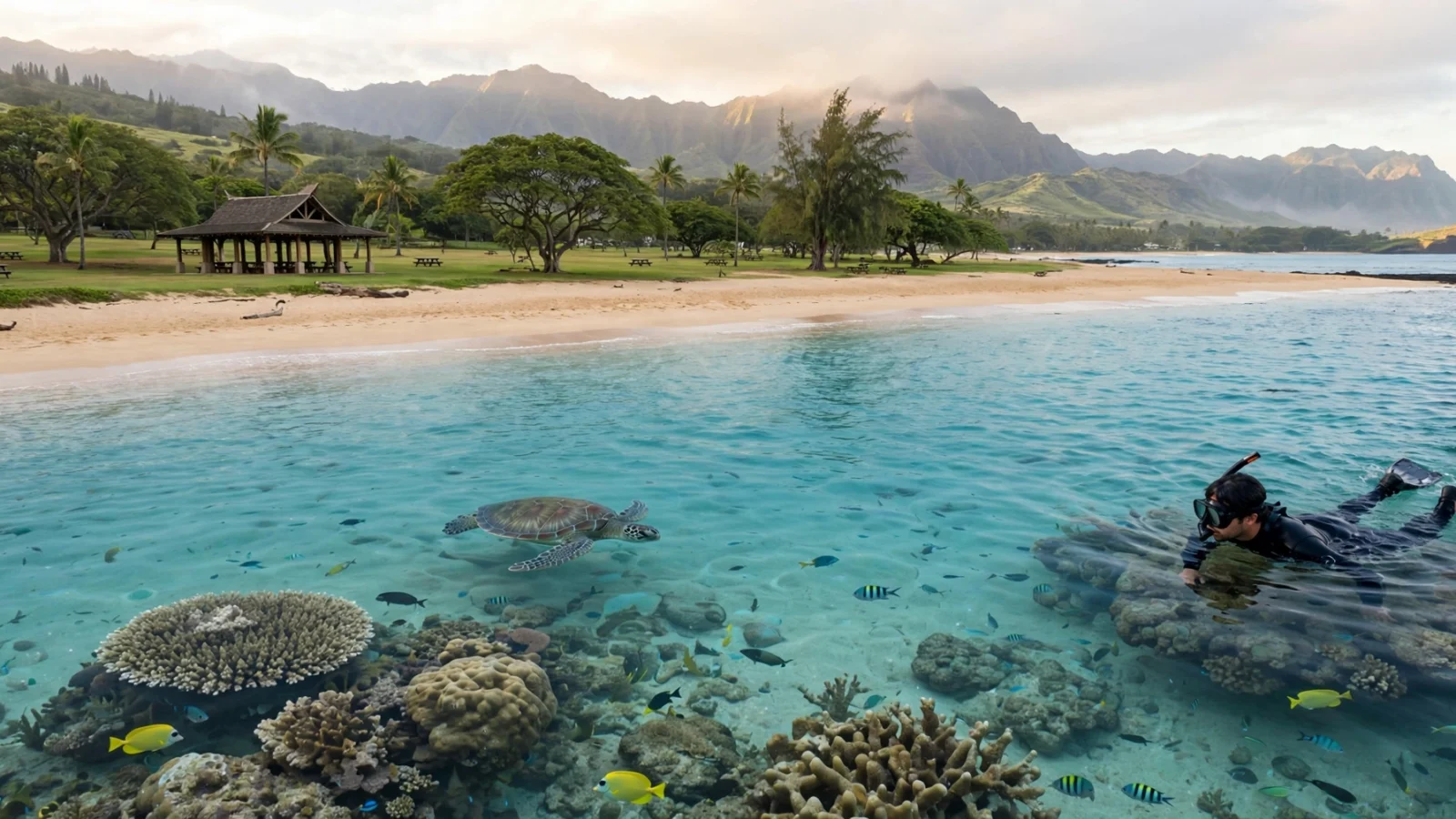
Kahekili Beach Park is the snorkel spot Kaanapali regulars quietly prefer. While the crowds cluster around Black Rock at the south end of the resort strip, the north end has this: a long golden beach backed by a grassy county park, a big free parking lot, and a fringing reef that starts almost as soon as the water reaches your knees. Locals call it Airport Beach, and on a calm morning it delivers the easiest reef snorkeling on Maui’s west side — turtles, dense reef fish, and coral close enough to shore that nobody has to swim far to find it.
Easy does not mean consequence-free. There is no lifeguard at Kahekili, the reef shallows out over coral you must not stand on, a longshore current can start running along the beach on windy days, and the whole reef sits inside a special fisheries management area with rules worth knowing. This guide covers all of it: where the reef actually runs, which way to swim, when to go, and how Kahekili compares with Black Rock down the beach.
Quick facts
| Entry fee | None — county beach park, free parking, no reservation |
| Lifeguard | None |
| Entry | Easy sand entry in front of the park; reef begins very close to shore |
| Depths | Shallow over the inner reef (a few feet in places — do not stand), deepening gradually offshore with a drop-off farther out |
| Restrooms / showers | Yes — restrooms with changing area, outdoor showers, covered pavilion, picnic tables |
| Rentals / food | None in the park; rentals and food along the Kaanapali resort strip nearby |
| Best conditions | Calm early mornings before the trade winds; avoid west/northwest swell days |
| Parking | Large free lot at the park (65 Kai Ala Drive, Lahaina) — fills by mid-morning on weekends |
| Also known as | Airport Beach (the old Kaanapali airstrip stood here) |
| Management | Inside the Kahekili Herbivore Fisheries Management Area — no taking of herbivorous reef fish or sea urchins |
Quick answer: is Kahekili Beach good for snorkeling?
Yes — on a calm morning it is one of the best shore snorkels in West Maui, especially for people who want real reef without a long swim. The fringing reef runs parallel to the beach just offshore, holds turtles and thick schools of reef fish, and the park behind it makes the logistics painless: free parking, showers, restrooms and shade. The honest catches are the missing lifeguard, reef that gets very shallow at low tide, afternoon trade-wind chop, and a current that can push along the shore when the wind or swell is up. Beginners who are comfortable ocean swimmers do well here on a short, close-to-shore route in the morning; anyone else should start with our beginners’ guide and pick a lifeguarded day elsewhere first.
Where Kahekili Beach Park is — and why it is called Airport Beach
Kahekili Beach Park sits at 65 Kai Ala Drive in Lahaina, at the north end of Kaanapali Beach in front of the Westin Ka’anapali Ocean Resort Villas. From Honoapiilani Highway, turn toward the ocean on Kai Ala Drive (the Kaanapali Parkway side of north Kaanapali) and the county park and its parking lot are right there — a broad lawn, a pavilion, and a paved path down to a long, wide stretch of golden sand.
The Airport Beach name is literal history. Before the Kapalua–West Maui airport existed, a small airstrip — the old Royal Kaanapali / Kaanapali landing strip — operated on this shoreline, and planes used the beachfront here as Kaanapali’s gateway. The runway is long gone; what replaced it is one of the most convenient public beach parks in West Maui, and the name stuck anyway.
One orientation note that saves confusion: Kahekili is the same continuous Kaanapali shoreline as Black Rock, just the far north end of it. The two spots share a coast and a swell window but not a reef, a crowd level, or a parking problem — the comparison table below spells out the choice.
The entry and the route: reef right from the sand
There is no trick to getting in. Walk from the pavilion to the sand, pick a clear sandy patch in front of the park, and wade in. The reef begins very close to shore — close enough that the first discipline of Kahekili applies immediately: once the bottom turns to reef, float, don’t stand. The inner reef shallows to just a few feet in places, and standing crushes coral that this reef is specifically managed to protect.
The proven route, used by regulars and shore divers alike:
- Enter in front of the park over sand, fins on once you are floating.
- Turn right (north) along the reef. Visitor and diver reports consistently rate the reef toward the north end as the richest stretch — more structure, more fish, the turtle cleaning spots — though the whole reef line holds life, so a short southward look is never wasted.
- Follow the reef edge, not the reef top. Swim where the reef meets the sand channel: deeper water, no risk of finning coral, and the fish stack along the edge.
- Mind the slow drift. On many days a gentle longshore current runs along this coast; on windy or swell days it strengthens into something divers describe as a treadmill. Check your bearings against the beach every few minutes, and turn back while the swim in still feels easy — you will be swimming home against whatever is pushing you.
- Exit where you entered, over the same sandy patch, and rinse at the park showers.
Stay in the shore-parallel band. Farther out the bottom drops away beyond the reef, the current has more grip, and there is less to see — the show at Kahekili is the inner reef, and it starts immediately.
What you will see
Kahekili’s reef is a working demonstration of what protection does. The snorkeling highlights:
- Hawaiian green sea turtles — frequent along the reef edge and resting in the structure; give them at least 10 feet and never block their path to the surface
- Thick reef-fish life — surgeonfish and tangs grazing the reef in numbers (this is the management area working, see below), butterflyfish in variety, Moorish idols, trumpetfish and wrasses
- Octopus and moray eels in the reef structure, especially along the northern stretch
- Coral formations closer to shore than almost anywhere else on the west side — the reason the no-standing rule matters here more than most places
- Urchins tucked into the reef — beautiful, protected in this zone, and one more reason hands and fins stay off the bottom
- Whales on the horizon in winter — surface watching from the beach between snorkels, not an underwater expectation
Our snorkeling with turtles guide covers the viewing distances and the law that protects everything on that list.
The Kahekili Herbivore Fisheries Management Area: why this reef looks different
In 2009 the state designated the reef off this beach the Kahekili Herbivore Fisheries Management Area — the first of its kind in Hawaii. Inside the zone, taking herbivorous reef fish (the surgeonfish and parrotfish that graze algae off the coral) and sea urchins is prohibited. The logic is reef science in action: grazers keep algae from smothering coral, so protecting the grazers protects the reef — and researchers have used Kahekili as a long-running study site to watch exactly that recovery happen.
For snorkelers the rules are simple and the payoff is visible:
- No fishing for herbivores or collecting urchins inside the marked area — and as a snorkeler, no touching, standing on, or taking anything at all
- Expect denser fish life than unprotected stretches of the same coast; the tangs and surgeonfish working the reef in schools are the management area doing its job
- Follow any posted signs at the park for the current boundaries and rules, which are the authority on the day
It is the same ethic as the rest of this coast, just formalised: look, photograph, leave everything exactly where it was. Our coral reef snorkeling guide explains why the grazing fish matter so much to a reef’s survival.
Best time to snorkel Kahekili Beach Park
Time of day: early morning, decisively. Regulars aim for the 7:30–9:00 window: glassy water before the trade winds, the best light on a shallow reef, and turtles active along the edge. By late morning the trades usually chop the surface, visibility drops, and the longshore drift strengthens. Our best time to snorkel in Hawaii guide covers the pattern island-wide.
Season and swell: watch the west and northwest. Kahekili faces the open west coast. Winter northwest swells wrap onto this shoreline and can make the reef unsnorkelable — surge over shallow coral is both dangerous and destructive — while calm summer and shoulder-season mornings are the reliable window. Local rule: if the Kaanapali shorebreak looks energetic from the parking lot, believe it, and move the snorkel to a sheltered south-side spot like Ulua Beach instead.
Tide matters more than most places. At low tide the inner reef gets extremely shallow — less water over the coral means less room for you and more risk to the reef. A mid-to-higher tide gives the comfortable margin this spot needs.
Parking, access and facilities
This is Kahekili’s other superpower: it is built for a beach day. The county park has a large free parking lot (no entry fee, no reservation — but it fills by mid-morning on weekends and holidays, so early snorkeling and easy parking are the same decision), restrooms with a changing area, outdoor showers, a covered pavilion, picnic tables and a wide grassy lawn with a paved walkway to the sand. There is no lifeguard — Maui County does not staff a tower here — and no rental stand or food in the park; gear rentals and restaurants line the Kaanapali resort strip a short drive south, and everything you need to bring is on our snorkel gear checklist. Resort guests at the north Kaanapali properties can simply walk down; everyone else drives in via Kai Ala Drive.
Is Kahekili Beach good for beginners?
Qualified yes — and the qualification is the whole answer. In its favour: a sandy entry, reef within a few fin kicks, park facilities, and water that stays shallow along the inner reef. Against it: no lifeguard, coral shallow enough to punish a standing beginner, a drop-off farther out, and a current that builds with the wind. The verdict that local guides converge on, and the one this site stands behind: Kahekili suits beginners who are already confident ocean swimmers, on a calm morning, on a short route that stays close to shore with a buddy in arm’s reach — per the buddy and conditions rules in our snorkeling safety guide. First-ever snorkelers and nervous swimmers will have a better first day at a lifeguarded, lagoon-sheltered spot, then graduate to Kahekili on the next calm morning.
Kahekili vs Black Rock
The two ends of Kaanapali, compared honestly:
| Kahekili Beach Park (Airport Beach) | Black Rock (Pu’u Keka’a) | |
|---|---|---|
| Setting | County park at the north end; long wide beach, lawn and pavilion | Resort beach at the south end, beneath the lava point |
| Reef | Fringing reef parallel to the beach, starts immediately offshore | Reef wraps the lava point; best around the point itself |
| Entry | Easy sand | Easy sand at the beach; point route adds distance |
| Parking | Large free county lot | Paid resort-area parking, tighter |
| Lifeguard | No | No |
| Signature extra | Herbivore Fisheries Management Area — protected, fish-dense reef | Cliff-jump zone at the point (stay clear of jumpers) |
| Watch out for | Shallow coral at low tide; longshore current on windy days | Crowds; current around the point builds fast |
| Best for | Unhurried reef snorkeling with park facilities | Snorkel + beach scene combined day |
Full detail on the southern option is in our Black Rock guide, and the full island picture is in the Maui snorkeling hub.
Nearby spots
Kahekili anchors the north-Kaanapali end of a natural West Maui rotation: Black Rock south along the same shore for the point reef; Kapalua Bay ten minutes north for the sheltered crescent that works when Kahekili is too open; Napili Bay beside it for an easy beach-day snorkel; and Honolua Bay farther north when summer flattens the north shore — the marine conservation district that shows what a fully protected reef looks like.
FAQ
Why is Kahekili Beach called Airport Beach?
Because a small airstrip — the old Kaanapali landing strip — operated on this shoreline before the Kapalua–West Maui airport was built. The runway is gone and a county beach park stands there now, but the Airport Beach name stuck.
How much does parking cost at Kahekili Beach Park?
Nothing. The county park lot at 65 Kai Ala Drive is free, with no entry fee and no reservation. It is large but fills by mid-morning on weekends and holidays, so arriving for the early-morning snorkel window also solves parking.
Is there a lifeguard at Kahekili Beach?
No. Maui County does not staff a lifeguard tower at Kahekili Beach Park. Snorkel with a buddy, stay in the shore-parallel reef band, and get out before conditions build.
Where is the best snorkeling at Kahekili Beach?
On the fringing reef that runs parallel to the beach just offshore. Enter over the sand in front of the park, then follow the reef edge — most regulars rate the stretch to the right (north) as the richest. Stay off the shallow reef top, especially at low tide.
Is Kahekili Beach good for beginners?
For beginners who are confident ocean swimmers, yes — on a calm morning, on a short route close to shore, with a buddy. The sandy entry and close reef help; the missing lifeguard, shallow coral and building current are why first-ever snorkelers should start somewhere sheltered and lifeguarded.
When is the best time to snorkel Kahekili Beach Park?
Early morning — roughly 7:30 to 9:00 — before the trade winds chop the surface, ideally on a mid-to-higher tide and a day with no west or northwest swell. Winter northwest swells can shut this exposed shoreline down entirely.
Can you fish at Kahekili Beach?
The reef is inside the Kahekili Herbivore Fisheries Management Area, where taking herbivorous reef fish and sea urchins is prohibited to protect the coral’s grazers. Check the posted rules at the park for the current boundaries — and as a snorkeler, take nothing and touch nothing regardless.
What will I see snorkeling at Kahekili Beach?
Hawaiian green sea turtles, dense schools of tangs and surgeonfish grazing the reef, butterflyfish, Moorish idols, trumpetfish, octopus and moray eels in the structure, and coral closer to shore than almost anywhere else in West Maui.
Facts checked against Maui County park information, DLNR fisheries-management material and local Maui snorkeling guides, October 2026. Conditions change daily — always check the surf report and posted signs before entering the water, and if the shorebreak looks energetic, it is.