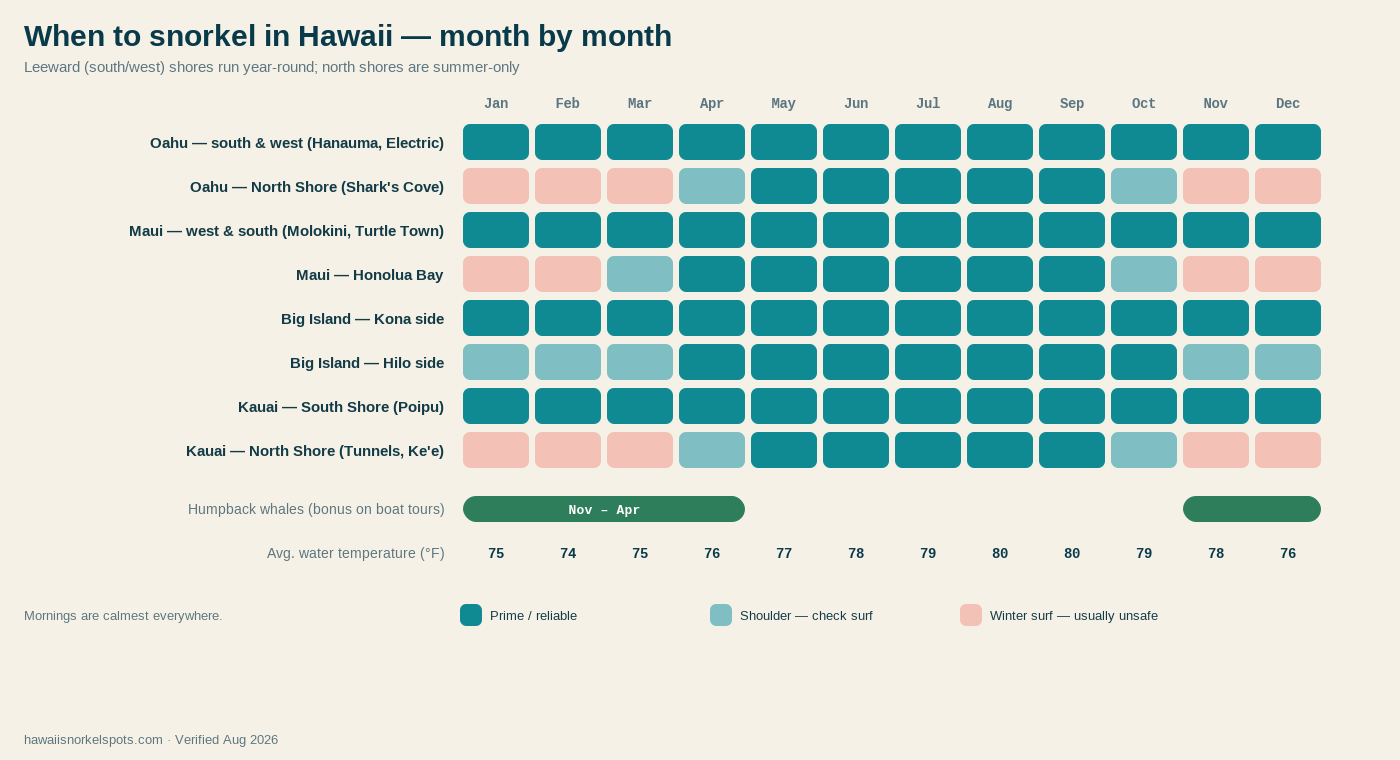
The one rule that organizes everything
Hawaii’s snorkeling calendar isn’t about temperature — the water stays swimmable all year. It’s about swell direction. Winter storms in the North Pacific send big surf onto every north-facing shore from roughly October through April: Oahu’s North Shore, Kauai’s north shore, Honolua on Maui. Summer flips the pattern gently southward. The practical translation: north shores are summer-only; south and west (leeward) shores work year-round. Every island guide on this site is built around that split.
May–September: the full menu. North-shore prizes open — Shark’s Cove, Tunnels, Honolua — while the leeward standards keep running. October and April: shoulder months — north shores are swell-dependent day to day; watch the surf report and keep leeward backups. November–March: leeward season. Kona’s bays, Maui’s west and south coasts, Hanauma Bay and Poipu are all fine, often glassy in the mornings — and humpback whales fill the channels.
The best time to snorkel, anywhere: the short answer
If you only remember four rules, make them these. Go in the morning, ideally in the water by 8 or 9 a.m., before the wind builds and the day’s fins stir the water. Go on a rising or slack tide, when the water is coming in or briefly still — never on a strong outgoing tide near a channel. Go in the dry season for your destination, when rain runoff is not clouding the reef. And go on a weekday if you can: the same reef on a Tuesday morning and a Saturday midday is a different experience. As a rough check before you get in, look for light wind and small waves — a commonly used rule of thumb is wind under about 10 knots and waves under about 2 feet. Everything below is how those four rules play out in Hawaii, month by month and island by island.
Month by month: the Hawaii snorkeling calendar
| Month | Water temp (approx.) | North shores | South & west (leeward) shores | Notes |
|---|---|---|---|---|
| Jan | ~74°F (23°C) | Mostly closed by surf | Good | Whale season building; jellyfish windows on Oahu |
| Feb | ~73–74°F (23°C) | Mostly closed by surf | Good | Peak whale season |
| Mar | ~74°F (23°C) | Surf easing late month | Good | Whales still present |
| Apr | ~75°F (24°C) | Shoulder — check the forecast | Very good | Whales departing; crowds thin |
| May | ~76°F (24°C) | Opening up | Excellent | Best-value month: open coasts, fewer crowds |
| Jun | ~78°F (26°C) | Open | Excellent | Hurricane season begins (storms rarely affect snorkeling directly — watch forecasts) |
| Jul | ~79°F (26°C) | Open | Excellent | Peak summer crowds |
| Aug | ~80°F (27°C) | Open | Excellent | Warmest water begins; peak crowds |
| Sep | ~80–81°F (27°C) | Open | Excellent | The connoisseur’s month: warmest water, crowds gone |
| Oct | ~79–80°F (27°C) | Shoulder — first big swells possible | Excellent | Last month of the full menu, early on |
| Nov | ~78°F (26°C) | Mostly closed by surf | Good | Whales arriving late month |
| Dec | ~76°F (25°C) | Mostly closed by surf | Good | Holiday crowds at the famous spots |
Read the table with the one rule in mind: the month rarely cancels a Hawaii snorkel trip — it just moves you to a different coast. Pick the island and shore to match the season, not the other way round.
Hawaii water temperature by month — and whether you need a wetsuit
Water temperature is the question behind half of all timing searches, so here it is plainly. These are approximate average surface temperatures for Hawaii’s leeward coasts; the windward (east) sides and Hilo run a degree or two cooler after rain, and any single week can sit a degree either side of the average.
| Month | Avg water temp °F | °C | What it feels like / what to wear |
|---|---|---|---|
| January | 74 | 23 | Coolest-feeling month for long sessions; a 3mm top or full suit helps if you chill easily |
| February | 73 | 23 | Annual low point; most visitors still fine for 45–60 minutes in a rash guard |
| March | 74 | 23 | As February; children chill faster — keep sessions shorter |
| April | 75 | 24 | Comfortable for most; rash guard for sun, not warmth |
| May | 76 | 24 | Warm; no wetsuit needed for typical sessions |
| June | 78 | 26 | Warm; reef-safe sunscreen and a rash guard are the real kit list |
| July | 79 | 26 | Warm everywhere, including north shores |
| August | 80 | 27 | Peak warmth begins |
| September | 81 | 27 | Warmest month of the year on average |
| October | 80 | 27 | Still summer-warm |
| November | 78 | 26 | Warm; a thin top only for long boat-trip sessions |
| December | 76 | 25 | Comfortable; holiday crowds matter more than temperature |
Do you need a wetsuit to snorkel in Hawaii? For most people, no — not in any month. Hawaii never gets cold by snorkeling standards. A wetsuit (or a 2–3mm top) is a comfort choice for winter mornings, long sessions over an hour, boat trips where you re-enter the water several times, and anyone who runs cold. Everyone, in every month, needs sun protection in the water: a rash guard does that job and adds a little warmth as a bonus. New to this? Start with our beginner’s guide and how to snorkel walkthrough before your first session.
Best time to snorkel, island by island
Maui — the biggest timing question of all
Maui draws more timing searches than any other island, and its answer has two halves. West Maui (Kapalua, Honolua, Ka’anapali’s Black Rock) faces northwest: superb from May to September, surf-prone in winter. South and southwest Maui (Turtle Town, Ahihi-Kinau, Olowalu) plus the boat-only Molokini Crater work year-round, with mornings decisively better — afternoon Molokini trips are regularly rerouted to backup reefs when the trades build, which tells you everything about the time-of-day rule. If your Maui trip is in winter, plan west-coast snorkels only on flat-forecast days and build the trip around the south. Full island picture: our Maui hub.
Oahu
Oahu splits cleanly in two. The North Shore — Shark’s Cove and Kuilima Cove at Turtle Bay — is a May-to-September snorkel coast and a winter surf spectacle you watch from the sand. The south shore (Hanauma Bay, Waikiki’s boat-access Turtle Canyon) and the west coast (Electric Beach / Kahe Point) run all year. Oahu is also the jellyfish island (see below), so for south-shore dates the moon calendar matters as much as the month calendar. See the Oahu hub.
Big Island
The Big Island’s snorkel coast — Kona and the Kohala coast — faces west, which makes it the most reliable winter snorkeling in the state: Kealakekua Bay, Two Step and Kahalu’u run in every month, and the manta ray night snorkel is a year-round, after-dark exception to every rule on this page. The Hilo side is the weather exception: its lagoons (Carlsmith, Richardson) are calm in most months but lose clarity after heavy rain in any season — a dry morning matters more than the month on the calendar. See the Big Island hub.
Kauai
Kauai is the most seasonal island. Its famous north shore (Tunnels, Ke’e, Anini) is summer-only — roughly May to September, with shoulder months decided by the forecast — and in winter the same coast is genuinely dangerous surf, not just poor snorkeling. The south shore (Poipu and the protected Lydgate ponds on the east side) covers the rest of the year. If snorkeling is the point of a Kauai trip, book summer; if the trip is fixed in winter, Poipu is your base. See the Kauai hub.
Best time of day to snorkel in Hawaii
Two of the most-asked questions we see are “best time of year” and “best time of day” — and the second one moves the needle more. Snorkel before 10 a.m. The trade winds build through late morning and texture the surface by early afternoon on every island; visibility follows the same curve, helped by the fact that morning water hasn’t been stirred by hundreds of fins yet. The pattern is so consistent that afternoon Molokini tours get rerouted to backup reefs and afternoon boats everywhere sell at discounts. Sunrise-to-mid-morning is Hawaii’s honest snorkeling window; plan the beach for the afternoon.
Three honest exceptions and refinements. First, parking and reservations: at the famous spots, an early start is also how you get in at all — lots fill and reservation slots go first for morning times. Second, the manta exception: the one world-class Hawaii snorkel that happens after dark is the Kona manta ray night snorkel — timing rules are written for daylight reef snorkeling. Third, winter afternoons on leeward shores can be perfectly good when the trades stay light; check the day’s wind forecast rather than treating the morning rule as a ban. It is a strong default, not a law.
Morning or afternoon: which is better for snorkeling?
Morning wins on conditions; afternoon wins on warmth and lie-ins. Here is the honest head-to-head.
| Morning (before ~10 a.m.) | Afternoon | |
|---|---|---|
| Wind and surface | Calmest water of the day; the wind has not built yet. | Wind builds through late morning and textures the surface; in Hawaii the trade winds are the reason afternoon boats get rerouted. |
| Visibility | Clearest — the water has not been stirred by hundreds of fins yet. | Murkier as the day goes on; rain squalls are also more likely in the afternoon. |
| Water temperature | Coolest part of the day; a thin top helps in winter. | Warmest water, by a degree or two — the one real afternoon advantage. |
| Crowds | Fewest people in the water, but the famous spots’ car parks fill early — arrive early to get in at all. | Peak crowds from about 10 a.m. to 2 p.m.; the beach thins again after about 3 p.m. |
| Marine life | Fish are out feeding after the night predators have moved back to deeper water. | Fish are more scattered and warier after a day of swimmers. |
| Photography | Low sun, good light, little glare — the best time for underwater photos. | Harsh overhead light at midday washes out color; late afternoon, when the sun drops, is the second-best light of the day. |
| Boat tours | Standard departures; the best boats and the calmest crossings. | Often discounted — and often rerouted to a backup reef when the wind builds. |
| Gear rental | Best pick of the equipment, and the most hygienic — nobody has used it yet today. | Leftover sizes only at the busy shops. |
The verdict: if conditions are what you care about, snorkel in the morning. If you are not a morning person, the late afternoon — roughly 3 to 5 p.m., once the midday crowds have thinned — is the best afternoon slot, and on a light-wind day on a leeward shore it can be genuinely good. Midday is the worst of both worlds: the most people, the most wind, the harshest light. Weekday mornings beat weekend mornings by the same logic. One exception to all of this: the one world-class Hawaii snorkel that happens after dark is the Kona manta ray night snorkel — the timing rules above are written for daylight reef snorkeling.
Best tide for snorkeling
No timing guide seems to answer this one, so here is the practical version. A mid-to-high tide, ideally on the way in (a rising or “pushing” tide), is usually best at Hawaii’s reef flats and lagoons: there is enough water over the reef to swim without scraping coral, the incoming water is clear ocean water, and entries over rock are deeper and easier. Low tide exposes shallow reef flats — fine in deep lagoons, a problem at flat, rocky spots where you can end up with too little water to swim and too much fragile coral under you. A strong outgoing (falling) tide is the one to respect: it can pull toward channels and reef gaps, and it carries stirred-up, murkier water out of lagoons.
Tides in Hawaii are small (roughly 1–2 feet between low and high), so the tide rarely makes or breaks a snorkel the way swell and wind do — treat it as the third check, after the surf forecast and the wind. Check a local tide chart for your spot and day, and if in doubt ask the lifeguard which side of the tide the spot likes. Our safety guide covers the currents that tides feed into.
High tide vs low tide — and the slack tide in between
Is it better to snorkel at high tide or low tide? The honest answer is: neither extreme — the best window is the slack tide, the still period at the turn of the tide when the water briefly stops moving and there is little or no tidal current. High slack (just after the tide finishes rising) brings clear ocean water in over the reef, so visibility is at its best — but the water is at its deepest, which can unsettle weaker swimmers. Low slack (just after the tide finishes falling) is shallow and calm, which suits beginners and families with kids, with the reef closer to the surface — but visibility can be slightly worse, with more particles in the water.
One warning about generic advice: a lot of snorkeling guides say to prefer low tide. That advice comes from sandy-bottom destinations, and it is wrong for Hawaii’s reef flats. At low tide on a flat, rocky Hawaiian reef you can end up with too little water to swim in and too much fragile coral under you — which is exactly why the default on this page is a mid-to-high tide on the way in. Use slack tide as your timing target, and the rising tide as your direction of travel. Hawaii’s tides are small (roughly 1–2 feet between low and high), so the tide is the third check after the surf forecast and the wind — but on a flat reef on a calm day, it is the check that decides whether you swim or scrape. Our safety guide covers the currents that tides feed into.
Best time of day at Hawaii’s famous snorkel spots
The morning rule holds everywhere, but the reason it matters changes by spot. These are the windows our spot guides use.
| Spot | Best window | Why |
|---|---|---|
| Tunnels Beach | First light to mid-morning, summer only | The trades arrive by late morning, and the tiny roadside parking fills before that — early is how you get in at all. |
| Electric Beach | Morning | Afternoon trade winds chop the surface over the outflow; mornings are calmer and clearer. |
| Poipu Beach | Morning | The south-shore afternoon wind builds through the day; mornings are the glassy window. |
| Hanauma Bay | Earliest reservation slot | The water is clearest before the day’s fins stir it, and the first slots go first — reservations open 2 days out from 7:00am HST. |
| Molokini Crater | Morning boats | Afternoon trips are discounted and often rerouted to a backup reef when the wind builds. |
| Sharks Cove | Summer mornings only | Winter surf closes it entirely; in summer the morning is the calm window before the trades. |
Best time to snorkel at six more famous spots — entry, reef and timing
The table above answers “when” in one line. At a real beach, though, “when” depends on where you get in and where the reef actually sits. Here is the same question answered spot by spot, for six of Hawaii’s most-visited snorkels the table above does not cover.
Kapalua Bay, West Maui
Enter on the sand at the southern end of the beach and wade out over a gentle, sandy bottom — the centre is mostly standing depth, which is why this is Maui’s kindest first snorkel. The reef lives on the two rocky arms: the north rocks (right side, facing the ocean) hold the densest coral and the most fish; the south rocks are shallower and calmer. Stay inside the rocky points — the reef runs roughly 900–1,000 feet out and the current strengthens beyond them. Best time: in the water before 9–10 AM; summer and autumn are the calmest seasons, and a big winter north swell can shut the bay down. See our Kapalua Bay guide for parking details.
Black Rock, Ka’anapali (West Maui)
Walk in over sand just south of the lava point — never enter against the rock itself — put your fins on in waist-deep water and swim slowly along the inner wall, rock on one side and sand on the other. Green sea turtles feed on algae on the rock face, with reef triggerfish and yellow tang below. The inner face is a calm-morning beginner snorkel; the point itself is for strong, experienced snorkelers only. Best time: early morning, for the calmest water, clearest visibility and the best parking odds.
Honolua Bay, West Maui
Park on the roadside near mile markers 32–33, walk a 5–15 minute forest trail, and enter over rocks on the right (north) side near the old boat ramp, in reef shoes — there is no beach and no sand entry. The reward is the biggest, healthiest coral in West Maui, a no-take Marine Life Conservation District. Best time: a calm summer morning (roughly April–October), in the water before 9 AM. In winter the bay is a world-class surf break and snorkeling ends completely.
Two Step, Honaunau Bay (Big Island)
The name is literal: sit on the first lava ledge at water level, pull your fins on, lower yourself to the second ledge — the water is already about 10 feet deep at the steps — and push off in a lull between sets. Wear reef shoes: urchins live in the steps and there is no sand anywhere. The right (north) side is the gentle zone over shallow reef 6–10 feet deep; the left (south) side has spur-and-groove canyons where turtles rest. Best time: early morning, before the trade winds and afternoon cloud build — and year-round, since the Kona coast runs in every month. See our Two Step guide for the full entry walkthrough.
Kahalu’u Beach Park, Kona (Big Island)
The easy one. Enter from the sandy-rock edge of this free county park — no lava steps, no trail — and the reef is right there in shallow water, which is why it is the Kona coast’s beginner spot, with a lifeguard on duty. Best time: morning, like everywhere, but Kahalu’u is forgiving: the Kona side is prime in every month, so the question is the hour, not the season.
Kuilima Cove, Turtle Bay (Oahu)
The North Shore’s exception. Enter over sand on the right-hand half of the beach into a small, rock-rimmed cove that stays calm even when winter surf is breaking on every beach around it. The reef sits 4–8 feet below the surface and the cove is mostly 4–10 feet deep — fish and occasional turtles rather than a coral garden. Best time: a calm morning, in summer at its best, and workable year-round with judgment; at low tide the cove is shallower and stirred sand can cloud the water.
Two calendar quirks worth knowing
Box jellyfish (Oahu): about 8–10 days after each full moon, box jellyfish drift onto Oahu’s south-facing beaches — Waikiki, Ala Moana, Hanauma (which sometimes closes for it). Lifeguards post warnings; the other islands see far less of it. If your Oahu dates land in that window, shift south-shore snorkels a few days or swap in a west- or north-coast day (in summer). Our Oahu hub carries the detail.
Whale season: humpback whales are in Hawaiian waters roughly November through April, peaking around February–March. They don’t change where you snorkel, but they change boat trips completely — every snorkel boat becomes a whale watch at no extra charge — and you will often hear whale song underwater on winter snorkels near the channels between Maui, Lanai and Molokai. If whales plus snorkeling is the dream, February–March on the leeward coasts is the combination to book.
Crowds: mid-June to mid-August and the winter holidays pack the famous spots; May, September and early October combine open north shores with thinner beaches — the connoisseur’s window.
Can you snorkel in Hawaii in winter? (December, January, February)
Yes — this is the most common winter question, and the answer is a confident yes with one condition: snorkel the leeward coasts. In December, Kona, south/west Maui, Hanauma and Poipu are all in normal form; only the holiday crowds and the closed north shores mark the season. January is the same picture with the coolest water of the year (about 74°F) and whales building. February adds peak whale season to identical snorkeling conditions. What winter actually costs you is a short list of summer-only spots — Shark’s Cove, Tunnels, Ke’e, Honolua in surf — not the trip itself. Winter visitors who plan around the one rule routinely report the best snorkeling of their trip; winter visitors who drive to the North Shore expecting a snorkel are the disappointed ones.
Winter, island by island: where it is actually calm
Winter surf in Hawaii is a north-shore story. Hawaii’s official ocean-safety calendar puts the winter surf season at roughly November through April, with the largest surf on north-facing shores, while south-facing shores generally see much smaller waves. That is why the winter plan is never “skip snorkeling” — it is “change shores.” Here is the working list, island by island:
| Island | Winter go — start here | Winter no-go — save for summer |
|---|---|---|
| Oahu | Hanauma Bay, Waikiki / Turtle Canyon, Ala Moana, Ko Olina lagoons, Kuilima Cove (protected exception) | Shark’s Cove, Three Tables, Sunset Beach, Ehukai, Waimea Bay, Chun’s Reef |
| Maui | Ulua Beach, Turtle Town (Maluaka), Ahihi-Kinau, Kamaole beaches, Molokini by morning boat | Honolua Bay in swell; Kapalua and Black Rock are daily checks, not guarantees |
| Big Island | Kahalu’u, Two Step, Kealakekua Bay, Kamakahonu, the Manta Ray night snorkel; Hilo’s protected ponds on calm, dry days | Exposed north- and west-facing entries on big-swell days |
| Kauai | Poipu Beach, Lawai Beach, Koloa Landing, Salt Pond | Tunnels, Ke’e, Anini, Hideaways, Hanalei Bay |
Oahu in winter
The south and southeast shores carry the season. Hanauma Bay is the most reliable winter snorkel on the island — a curved, reef-protected conservation bay (book its reservation ahead; holiday weeks fill first). The south-facing reef strip at Waikiki and Ala Moana snorkels all winter, and boat trips to Turtle Canyon run year-round, best on calm mornings. On the leeward west coast, the rock-protected Ko Olina lagoons are among the most dependable family snorkels in winter, while Electric Beach is a forecast-check spot, not a default. The one North Shore exception is Kuilima Cove at Turtle Bay, shielded by rock barriers and often workable when the surf beaches are closed — look at the water first and stay inside the protected area. The famous names — Shark’s Cove, Three Tables, Sunset Beach, Ehukai and Waimea Bay — are winter surf-watching stops, not snorkels.
Maui in winter
Live on the south and southwest. Ulua Beach in Wailea and Turtle Town at Maluaka are the classic winter morning snorkels, the Kamaole beaches work around their rocky points early, and Ahihi-Kinau rewards careful entries on flat days. Molokini by boat is a winter highlight — take the earliest departure, before afternoon wind, and in peak whale months you may hear humpback song underwater. West Maui is a daily check, not a plan: Kapalua Bay and Black Rock work on many winter days, while Honolua Bay is a no-go whenever surf is up.
Big Island in winter
The Kona coast faces west, away from the swell, and holds the state’s most concentrated winter snorkeling: Kahalu’u for beginners, Two Step and Kealakekua Bay for the famous reefs, Kamakahonu in town — and the Manta Ray night snorkel runs year-round. On the wet east side, the lava-protected ponds at Richardson and Carlsmith can be calm in winter, but after heavy rain, runoff clouds the water — wait a day or two, as our Hilo guide explains.
Kauai in winter
Kauai’s seasonal switch is the hardest in Hawaii: the north shore (Tunnels, Ke’e, Anini, Hideaways, Hanalei) is summer-only and genuinely dangerous in winter surf. Go south: Poipu Beach is the island’s most reliable winter snorkel, with Lawai Beach, Koloa Landing and Salt Pond as the step-ups — and the south shore needs no Haena reservation.
The winter morning go / no-go check
- Check the surf forecast by shore, not by island. Ten feet on the north and two feet on the south can be the same morning; only your spot’s shore matters.
- Watch the entry for five minutes before unloading. Sets arrive in groups — a flat gap between sets is not calm water.
- Go early. Winter mornings are calmest; if whitecaps are showing by 9 a.m., move to your most sheltered backup or call it.
- Check the rain history. After heavy rain, especially near stream mouths, runoff turns water brown — clear water only.
- Ask the lifeguard and obey the flags. When in doubt, don’t go out. Our snorkeling safety guide covers winter currents and entries in depth.
One winter calendar note: Oahu’s box jellyfish pattern does not pause for the season — they typically arrive on south-shore beaches about 8–10 days after each full moon in any month, and lifeguards post warnings at Waikiki and Hanauma. Check before a south-shore swim day, and pick a boat trip on a jellyfish morning.
Can you snorkel in Hawaii in November?
Yes — November is the first month of leeward season, and it is a good month to snorkel as long as you pick the right coast. The water is still around 78°F, the south- and west-facing shores are in normal form, and humpback whales start arriving late in the month. What November takes away is the north shore: the famous north-facing beaches are mostly closed by surf by now, so a November trip built around a north-shore snorkel is a trip built on hope. Base on a leeward coast and November is easy.
Oahu: Hanauma Bay is the default — book its reservation ahead, because Thanksgiving week fills first. Boat trips to Turtle Canyon run year-round, and Ala Moana and the Ko Olina lagoons are dependable family water. Electric Beach is a forecast check, not a default, and Kuilima Cove at Turtle Bay is the one protected North Shore exception worth a look. Maui: live on the south and southwest — Turtle Town, Ulua Beach, the Kamaole beaches and Ahihi-Kinau — with Molokini by the earliest boat. Big Island: the Kona coast is at its most reliable — Kahalu’u, Two Step and Kealakekua Bay, plus the manta ray night snorkel after dark; Hilo’s protected ponds work on calm, dry days. Kauai: go south — Poipu Beach, Lawai Beach, Koloa Landing and Salt Pond, with the Lydgate ponds on the east side as the guaranteed backup. The north shore (Tunnels, Ke’e, Anini, Hanalei) is closed for the season in practice.
Three November quirks worth knowing. First, early November can still throw a flat north-shore day — enjoy it if it comes, but never plan a trip around it. Second, Thanksgiving week is a crowd spike at the famous spots, so reservations and early starts matter more that week than the water temperature does. Third, Oahu’s box jellyfish pattern does not pause for the season: they typically arrive on south-shore beaches about 8–10 days after each full moon in any month, so check before a south-shore swim day and pick a boat trip on a jellyfish morning. The morning rule still governs everything: be in the water early, before the trades build.
Can you snorkel in Hawaii in December?
Yes — December is leeward season, and it is a good month to snorkel as long as you pick the right coast. The water is still around 76°F, the south- and west-facing shores are in normal form, and humpback whales start arriving late in the month. What December takes away is the north shore: the famous north-facing beaches are closed by winter surf, so a December trip built around a north-shore snorkel is a trip built on hope. Base on a leeward coast and December is easy — the real December complication is not the water, it is the holiday crowds.
Oahu: Hanauma Bay is the default — book its reservation ahead, because the Christmas-to-New-Year stretch fills first, and note Hanauma is closed on Christmas Day itself. Boat trips to Turtle Canyon run year-round, and Ala Moana and the Ko Olina lagoons are dependable family water. Electric Beach is a forecast check, not a default, and Kuilima Cove at Turtle Bay is the one protected North Shore exception worth a look. Maui: live on the south and southwest — Turtle Town, Ulua Beach, the Kamaole beaches and Ahihi-Kinau — with Molokini by the earliest boat. Big Island: the Kona coast is at its most reliable — Kahalu’u, Two Step and Kealakekua Bay, plus the manta ray night snorkel after dark; Hilo’s protected ponds work on calm, dry days. Kauai: go south — Poipu Beach, Lawai Beach, Koloa Landing and Salt Pond, with the Lydgate ponds on the east side as the guaranteed backup. The north shore (Tunnels, Ke’e, Anini, Hanalei) is closed for the season in practice.
Three December quirks worth knowing. First, the calendar: the Christmas-to-New-Year stretch is the year’s biggest crowd spike at the famous spots, so reservations and early starts matter more that week than the water temperature does — and Hanauma Bay’s reservations open just 2 days ahead from 7:00am HST, so set the alarm rather than assuming a slot. Second, the whales: humpbacks arrive late in December, so a late-month boat trip may already include whale song underwater, with the real peak still to come in February. Third, Oahu’s box jellyfish pattern does not pause for the season: they typically arrive on south-shore beaches about 8–10 days after each full moon in any month, so check before a south-shore swim day and pick a boat trip on a jellyfish morning. The morning rule still governs everything: be in the water early, before the trades build.
Can you snorkel in Hawaii in January?
Yes — January is deep leeward season, and it is a good month to snorkel as long as you pick the right coast. The water is around 74°F, the coolest-feeling month of the year, and the south- and west-facing shores are in normal form, with humpback whales building through the month. What January takes away is the north shore: the famous north-facing beaches are closed by winter surf, so a January trip built around a north-shore snorkel is a trip built on hope. Base on a leeward coast and January is easy.
Oahu: Hanauma Bay is the default — book its reservation ahead, because the early-January holiday stretch fills first. Boat trips to Turtle Canyon run year-round, and Ala Moana and the Ko Olina lagoons are dependable family water. Electric Beach is a forecast check, not a default, and Kuilima Cove at Turtle Bay is the one protected North Shore exception worth a look. Maui: live on the south and southwest — Turtle Town, Ulua Beach, the Kamaole beaches and Ahihi-Kinau — with Molokini by the earliest boat, when you may hear humpback song underwater. Big Island: the Kona coast is at its most reliable — Kahalu’u, Two Step and Kealakekua Bay, plus the manta ray night snorkel after dark; Hilo’s protected ponds work on calm, dry days. Kauai: go south — Poipu Beach, Lawai Beach, Koloa Landing and Salt Pond, with the Lydgate ponds on the east side as the guaranteed backup. The north shore (Tunnels, Ke’e, Anini, Hanalei) is closed for the season in practice.
Three January quirks worth knowing. First, the water temperature: at around 74°F January is the month most likely to make you want a thin top — a 3mm top or full suit helps on long sessions, and children chill faster, so keep their sessions shorter. Second, the calendar: the early-January holiday stretch is a crowd spike at the famous spots, so reservations and early starts matter more that week than the water temperature does. Third, Oahu’s box jellyfish pattern does not pause for the season: they typically arrive on south-shore beaches about 8–10 days after each full moon in any month, so check before a south-shore swim day and pick a boat trip on a jellyfish morning. The morning rule still governs everything: be in the water early, before the trades build.
Can you snorkel in Hawaii in February?
Yes — February is peak leeward season, and it is a good month to snorkel as long as you pick the right coast. The water is around 73–74°F, the coolest of the year, and the south- and west-facing shores are in normal form, with humpback whales at their peak. What February takes away is the north shore: the famous north-facing beaches are closed by winter surf, so a February trip built around a north-shore snorkel is a trip built on hope. Base on a leeward coast and February is easy — and February is the one winter month where the water is not the story at all, the whales are.
Oahu: Hanauma Bay is the default — book its reservation ahead (reservations open just 2 days ahead from 7:00am HST), because peak whale season fills boats and bays alike. Boat trips to Turtle Canyon run year-round, and Ala Moana and the Ko Olina lagoons are dependable family water. Electric Beach is a forecast check, not a default, and Kuilima Cove at Turtle Bay is the one protected North Shore exception worth a look. Maui: live on the south and southwest — Turtle Town, Ulua Beach, the Kamaole beaches and Ahihi-Kinau — with Molokini by the earliest boat, when whale song underwater is at its most likely. Big Island: the Kona coast is at its most reliable — Kahalu’u, Two Step and Kealakekua Bay, plus the manta ray night snorkel after dark; Hilo’s protected ponds work on calm, dry days. Kauai: go south — Poipu Beach, Lawai Beach, Koloa Landing and Salt Pond, with the Lydgate ponds on the east side as the guaranteed backup. The north shore (Tunnels, Ke’e, Anini, Hanalei) is closed for the season in practice.
Three February quirks worth knowing. First, the whales: February is the peak, not just the season — this is the month the page’s own booking advice points whale-plus-snorkel trips at, every snorkel boat doubles as a whale watch, and on leeward boat trips you may hear humpback song underwater. Second, the water temperature: at around 73°F February is the annual low point, so it is the month most likely to make you want a thin top — a 3mm top helps on long sessions, most visitors are still fine for 45–60 minutes in a rash guard, and children chill faster, so keep their sessions shorter. Third, Oahu’s box jellyfish pattern does not pause for the season: they typically arrive on south-shore beaches about 8–10 days after each full moon in any month, so check before a south-shore swim day and pick a boat trip on a jellyfish morning. The morning rule still governs everything: be in the water early, before the trades build.
Can you snorkel in Hawaii in March?
Yes — March is the bridge month, and it is a good month to snorkel as long as you pick the right coast. The water is around 74°F, the south- and west-facing shores are in normal form, and humpback whales are still around. What March takes away is still the north shore for most of the month: the famous north-facing beaches are easing late in the month, not open, so a March trip built around a north-shore snorkel is still a trip built on hope. Base on a leeward coast and March is easy — and March is the last month where the whales, not the water, are the headline.
Oahu: Hanauma Bay is the default — book its reservation ahead (reservations open just 2 days ahead from 7:00am HST), because spring-break weeks fill the famous spots first. Boat trips to Turtle Canyon run year-round, and Ala Moana and the Ko Olina lagoons are dependable family water. Electric Beach is a forecast check, not a default, and Kuilima Cove at Turtle Bay is the one protected North Shore exception worth a look. Maui: live on the south and southwest — Turtle Town, Ulua Beach, the Kamaole beaches and Ahihi-Kinau — with Molokini by the earliest boat, when whale song underwater is still likely early in the month Big Island: the Kona coast is at its most reliable — Kahalu’u, Two Step and Kealakekua Bay, plus the manta ray night snorkel after dark; Hilo’s protected ponds work on calm, dry days. Kauai: go south — Poipu Beach, Lawai Beach, Koloa Landing and Salt Pond, with the Lydgate ponds on the east side as the guaranteed backup. The north shore (Tunnels, Ke’e, Anini, Hanalei) is still closed for the season in practice, whatever the late-month easing suggests
Three March quirks worth knowing. First, March has two halves: early March still delivers near-peak whale sightings, while late March is when mothers and calves begin leaving, so encounter rates drop meaningfully into April — if whales plus snorkeling is the point, book the first half of the month. Second, the north shore eases but does not open: by the last week of March the big winter surf softens, yet the north-shore snorkel beaches remain forecast-checks, not plans — enjoy a flat late-March day if it comes, never plan a trip around it. Third, the calendar: spring-break weeks cluster from mid-March into early April, so reservations and early starts matter more that fortnight than the water temperature does — and Oahu’s box jellyfish pattern does not pause for the season: they typically arrive on south-shore beaches about 8–10 days after each full moon in any month, so check before a south-shore swim day and pick a boat trip on a jellyfish morning. The morning rule still governs everything: be in the water early, before the trades build..
Can you snorkel in Hawaii in April?
Yes — April is the shoulder month, and it is a good month to snorkel as long as you pick the right coast first and let the forecast decide the rest. The water is around 75°F, the south- and west-facing shores are in very good form, and humpback whales are departing — still possible early in the month, largely gone by the end of it. What April changes is the north shore: the winter surf season is ending, so the famous north-facing beaches turn from closed to shoulder — swell-dependent day to day, worth checking, never worth building a trip around. Base on a leeward coast, keep a leeward backup for every north-shore hope, and April is easy — and it is the month where the crowds thin before the summer.
Oahu: Hanauma Bay is the default — book its reservation ahead (reservations open just 2 days ahead from 7:00am HST), because the spring-break tail still fills the famous spots early in the month. Boat trips to Turtle Canyon run year-round, and Ala Moana and the Ko Olina lagoons are dependable family water. Electric Beach is a forecast check, not a default, and Kuilima Cove at Turtle Bay is the one protected North Shore exception worth a look. Maui: live on the south and southwest — Turtle Town, Ulua Beach, the Kamaole beaches and Ahihi-Kinau — with Molokini by the earliest boat, when a whale sighting is still possible early in the month. Big Island: the Kona coast is at its most reliable — Kahalu’u, Two Step and Kealakekua Bay, plus the manta ray night snorkel after dark; Hilo’s protected ponds work on calm, dry days. Kauai: go south — Poipu Beach, Lawai Beach, Koloa Landing and Salt Pond, with the Lydgate ponds on the east side as the guaranteed backup. The north shore (Tunnels, Ke’e, Anini, Hanalei) is shoulder in April, not open: late-month flat days do happen, but check the surf report that morning and never plan a trip around them.
Three April quirks worth knowing. First, April has two halves for whales: early April still delivers whale sightings on leeward boat trips, while late April is past the season for most practical purposes — if whales plus snorkeling is the point, book the first half of the month, and treat any late-month sighting as a bonus. Second, the north-shore transition: the winter surf season runs roughly November through April, so April is its last month — by late April the big winter surf has mostly softened and the first flat north-shore days appear, yet a single late swell can still close a beach, so the rule stays the same as winter: check the forecast, keep a leeward backup, enjoy a flat day if it comes. Third, the calendar: spring-break and Easter weeks cluster early in the month, so reservations and early starts matter more then than the water temperature does — after they pass, crowds thin and April becomes one of the best-value months on the calendar. And Oahu’s box jellyfish pattern does not pause for the season: they typically arrive on south-shore beaches about 8–10 days after each full moon in any month, so check before a south-shore swim day and pick a boat trip on a jellyfish morning. The morning rule still governs everything: be in the water early, before the trades build.
Can you snorkel in Hawaii in May?
Yes — May is the month the full menu opens, and it is the best-value month on the calendar. The water is around 76°F, the south- and west-facing shores are excellent, and the north shores turn from shoulder to open — the winter surf season is over, so the famous north-facing beaches join the plan instead of sitting outside it. What May changes is the choice: for the first time since September you can pick any coast on any island, and still miss the summer crowds, because schools are mostly still in session for much of the month. Whale season is over — no bonus whale song on the boat trips now — but that is the only thing May takes away. Base anywhere, keep the morning rule, and May is easy.
Oahu: Hanauma Bay is the default — book its reservation ahead (reservations open just 2 days ahead from 7:00am HST), because weekends still fill the famous spots first. Boat trips to Turtle Canyon run year-round, and Ala Moana and the Ko Olina lagoons are dependable family water. Electric Beach improves through the month, and the North Shore opens: Shark’s Cove and Three Tables become real snorkels again after their winter closure, with Kuilima Cove at Turtle Bay the protected exception that was already workable. Maui: the south and southwest stay the base — Turtle Town, Ulua Beach, the Kamaole beaches and Ahihi-Kinau — with Molokini by the earliest boat, now firmly in its May—October window. And west Maui opens: Kapalua Bay, Black Rock and Honolua Bay join the plan as the north Pacific swell fades, though early May is still a forecast check there. Big Island: the Kona coast is at its most reliable — Kahalu’u, Two Step and Kealakekua Bay, plus the manta ray night snorkel after dark; Hilo’s protected ponds work on calm, dry days. Kauai: the south stays the default — Poipu Beach, Lawai Beach, Koloa Landing and Salt Pond, with the Lydgate ponds on the east side as the guaranteed backup — and the north shore opens: Tunnels, Ke’e, Anini and Hanalei become plans, not hopes, with an early-May surf check still wise before the summer pattern settles.
Three May quirks worth knowing. First, May has two halves for the north shore: early May is still a forecast check — the summer pattern is arriving, not yet locked in — while late May is the summer pattern itself, with flat north-shore mornings the norm rather than the exception. Second, the crowd quirk: May is the best-value month precisely because it sits between spring break and summer — open coasts, thinner beaches, easier parking — but that gap closes fast, so a late-May weekend at Hanauma Bay still wants a reservation booked ahead. Third, the calendar: Oahu’s box jellyfish pattern does not pause for the season — they typically arrive on south-shore beaches about 8–10 days after each full moon in any month, so check before a south-shore swim day and pick a boat trip on a jellyfish morning. The morning rule still governs everything: be in the water early, before the trades build.
Can you snorkel in Hawaii in June?
Yes — June is the first full summer month, and the simplest month on the calendar to plan around. The water is around 78°F, every coast on every island is open, and the north shores are no longer opening — they are open, flat on most mornings, with the winter surf season a memory. What June changes from May is not the water or the coast choice, it is the crowd clock: the month starts quiet and ends busy, as schools let out across the US and the summer season fills the famous spots. Snorkel the same plan as May, but book the famous names earlier and get in the water earlier, and June is easy.
Oahu: Hanauma Bay is the default — book its reservation ahead (reservations open just 2 days ahead from 7:00am HST), because June weekends fill the famous spots first. Boat trips to Turtle Canyon run year-round, and Ala Moana and the Ko Olina lagoons are dependable family water. Electric Beach is in full summer form, and the North Shore is fully open: Shark’s Cove and Three Tables are everyday snorkels now, not forecast checks, with Kuilima Cove at Turtle Bay the protected exception. Maui: the south and southwest stay the base — Turtle Town, Ulua Beach, the Kamaole beaches and Ahihi-Kinau — with Molokini by the earliest boat, now firmly in its May–October window. West Maui is fully in: Kapalua Bay, Black Rock and Honolua Bay are plans, not hopes, on flat summer mornings. Big Island: the Kona coast is at its most reliable — Kahalu’u, Two Step and Kealakekua Bay, plus the manta ray night snorkel after dark; Hilo’s protected ponds work on calm, dry days. Kauai: the south stays the default — Poipu Beach, Lawai Beach, Koloa Landing and Salt Pond, with the Lydgate ponds on the east side as the guaranteed backup — and the north shore is fully open: Tunnels, Ke’e, Anini and Hanalei are at their best, with June through August the prime window for Tunnels in particular.
Three June quirks worth knowing. First, June has two halves for crowds: early June is still the quiet gap between spring break and summer, while late June is the summer season itself — the same beach on June 5 and June 25 can feel like two different places, so a late-June trip wants reservations, early starts and weekday plans at the famous spots. Second, the swell flip: June is when the south swells arrive — the surf picks up along southern shores while the northern-shore waves entirely disappear, which is why the north shores are at their calmest and a south-facing entry like Waikiki can occasionally see small, manageable waves instead of glass. Third, the calendar: hurricane season begins June 1, but storms rarely affect snorkeling directly — watch the forecast rather than re-planning around it — and Oahu’s box jellyfish pattern does not pause for the season: they typically arrive on south-shore beaches about 8–10 days after each full moon in any month, so check before a south-shore swim day and pick a boat trip on a jellyfish morning. The morning rule still governs everything: be in the water early, before the trades build.
Can you snorkel in Hawaii in July?
Yes — July is peak summer, and the busiest snorkeling month on the calendar, not the hardest. The water is around 79°F, every coast on every island is open, and the north shores are at their calmest — flat on most mornings, with the winter surf season long gone. What July changes from June is not the water or the coast choice, it is the crowd level: June started quiet and ended busy, while July is busy from the first week to the last, with the July 4 week the single most crowded stretch of the summer. Snorkel the same plan as June, but book everything earlier, get in the water earlier, and prefer weekdays at the famous spots, and July is easy.
Oahu: Hanauma Bay is the default — book its reservation ahead (reservations open just 2 days ahead from 7:00am HST), because the July 4 week fills the famous spots first. Boat trips to Turtle Canyon run year-round, and Ala Moana and the Ko Olina lagoons are dependable family water. Electric Beach is in full summer form, and the North Shore is fully open: Shark’s Cove and Three Tables are everyday snorkels now, not forecast checks, with Kuilima Cove at Turtle Bay the protected exception. Maui: the south and southwest stay the base — Turtle Town, Ulua Beach, the Kamaole beaches and Ahihi-Kinau — with Molokini by the earliest boat, now firmly in its May–October window. West Maui is fully in: Kapalua Bay, Black Rock and Honolua Bay are plans, not hopes, on flat summer mornings. Big Island: the Kona coast is at its most reliable — Kahalu’u, Two Step and Kealakekua Bay, plus the manta ray night snorkel after dark; Hilo’s protected ponds work on calm, dry days. Kauai: the south stays the default — Poipu Beach, Lawai Beach, Koloa Landing and Salt Pond, with the Lydgate ponds on the east side as the guaranteed backup — and the north shore is fully open: Tunnels, Ke’e, Anini and Hanalei are at their best, with July inside the June-through-August prime window for Tunnels in particular.
Three July quirks worth knowing. First, the July 4 week: this is the year’s first true peak — the famous spots are at their fullest, parking lots fill earliest, and boat trips and reservations book out furthest ahead, so a July trip wants everything booked before arrival and weekday plans at the famous names. Second, the swell pattern holds from June: the south swells are in, so the surf picks up along southern shores while the northern-shore waves stay gone — which is why the north shores are at their calmest and a south-facing entry like Waikiki can occasionally see small, manageable waves instead of glass. Third, the morning rule matters most in July: with the most fins in the water all year, the gap between a calm, clear morning session and a stirred-up afternoon one is at its widest — be in the water early, before the trades build, and treat the afternoon as beach time. The calendar notes carry over: hurricane season runs June 1 to November 30 but storms rarely affect snorkeling directly — watch the forecast rather than re-planning around it — and Oahu’s box jellyfish pattern does not pause for the season: they typically arrive on south-shore beaches about 8–10 days after each full moon in any month, so check before a south-shore swim day and pick a boat trip on a jellyfish morning.
Can you snorkel in Hawaii in August?
Yes — August is the warmest water of the summer and the last full month of the peak season, not a step down from July. The water is around 80°F, every coast on every island is open, and the north shores are still at their calmest — flat on most mornings, with the winter surf season still months away. What August changes from July is the shape of the crowds, not the snorkeling: early August is still peak — families fitting in a last trip before school — while late August starts to thin out, with hotel rates and flight prices easing after about August 20 and the famous spots noticeably quieter by the last week. Snorkel the same plan as July, but if your dates flex, the last week of August buys you July’s water with thinner beaches, and August is easy either way.
Oahu: Hanauma Bay is the default — book its reservation ahead (reservations open just 2 days ahead from 7:00am HST), because the early-August peak fills the famous spots first. Boat trips to Turtle Canyon run year-round, and Ala Moana and the Ko Olina lagoons are dependable family water. Electric Beach is in full summer form, and the North Shore is fully open: Shark’s Cove and Three Tables are everyday snorkels now, not forecast checks, with Kuilima Cove at Turtle Bay the protected exception. Maui: the south and southwest stay the base — Turtle Town, Ulua Beach, the Kamaole beaches and Ahihi-Kinau — with Molokini by the earliest boat, now firmly in its May–October window. West Maui is fully in: Kapalua Bay, Black Rock and Honolua Bay are plans, not hopes, on flat summer mornings. Big Island: the Kona coast is at its most reliable — Kahalu’u, Two Step and Kealakekua Bay, plus the manta ray night snorkel after dark; Hilo’s protected ponds work on calm, dry days. Kauai: the south stays the default — Poipu Beach, Lawai Beach, Koloa Landing and Salt Pond, with the Lydgate ponds on the east side as the guaranteed backup — and the north shore is fully open: Tunnels, Ke’e, Anini and Hanalei are at their best, with August inside the June-through-August prime window for Tunnels in particular.
Three August quirks worth knowing. First, August has two halves for crowds: early August is the summer peak’s last surge, while late August is the first exhale — the same beach in the first week and the last week can feel like two different places, so a late-August trip wants fewer reservations and still gets the warm water, while an early-August trip wants everything booked before arrival and weekday plans at the famous names. Second, the swell and storm pattern: the south swells are in, so the surf picks up along southern shores while the northern-shore waves stay gone — which is why the north shores are at their calmest — but August is also inside hurricane season (June 1 to November 30), so a tropical system can change the pattern for a few days: watch the forecast rather than re-planning around it, and treat an actual warning seriously. Third, the heat and the morning rule: August is the hottest month on land as well as the warmest in the water, so reef-safe sunscreen and shade matter as much as fins — and with the most fins in the water in early August, the gap between a calm, clear morning session and a stirred-up afternoon one is at its widest: be in the water early, before the trades build, and treat the afternoon as beach time. The calendar note carries over: Oahu’s box jellyfish pattern does not pause for the season — they typically arrive on south-shore beaches about 8–10 days after each full moon in any month, so check before a south-shore swim day and pick a boat trip on a jellyfish morning.
Can you snorkel in Hawaii in September?
Yes — September is the connoisseur’s month, not a comedown after August. The water is at its warmest of the year, around 80–81°F, every coast on every island is still open, and the north shores are still in their summer pattern. What September changes from August is the crowds, not the snorkeling: once schools are back and the Labor Day weekend passes, the famous spots empty out — the same beach that needed a reservation and a dawn start in August is quiet by mid-September, with hotel rates and flight prices at their softest of the summer window. Snorkel the same plan as August, but if your dates flex, mid-to-late September buys you the warmest water of the year with the thinnest beaches, and September is easy either way.
Oahu: Hanauma Bay is the default — book its reservation ahead (reservations open just 2 days ahead from 7:00am HST), though September is the month the reservation pressure finally eases. Boat trips to Turtle Canyon run year-round, and Ala Moana and the Ko Olina lagoons are dependable family water. Electric Beach is in full summer form, and the North Shore is still open: Shark’s Cove and Three Tables are everyday snorkels early in the month, turning into daily forecast checks only if a first fall swell arrives late in the month, with Kuilima Cove at Turtle Bay the protected exception. Maui: the south and southwest stay the base — Turtle Town, Ulua Beach, the Kamaole beaches and Ahihi-Kinau — with Molokini by the earliest boat, still firmly in its May–October window. West Maui is fully in: Kapalua Bay, Black Rock and Honolua Bay are plans, not hopes, on flat mornings, with the same late-month watch as Oahu’s North Shore. Big Island: the Kona coast is at its most reliable — Kahalu’u, Two Step and Kealakekua Bay, plus the manta ray night snorkel after dark; Hilo’s protected ponds work on calm, dry days. Kauai: the south stays the default — Poipu Beach, Lawai Beach, Koloa Landing and Salt Pond, with the Lydgate ponds on the east side as the guaranteed backup — and the north shore is still open: Tunnels, Ke’e, Anini and Hanalei are at their best early in the month, but September is the last month of the north-shore window, so front-load the north-shore days and keep Poipu as the backup if a first swell lands.
Three September quirks worth knowing. First, September has two halves for crowds: the Labor Day weekend is the summer’s last surge, while mid-to-late September is the quietest stretch of the whole calendar — the same beach in the first week and the third week can feel like two different places, so a mid-September trip wants almost nothing booked ahead except Hanauma, while a Labor Day trip still wants the August playbook. Second, the swell flip begins: the south swells ease while the first north swells of the fall season can arrive late in the month — which is why the north shores go from plans to daily checks as September wears on, and why September, not October, is the month to finish the north-shore list. Third, the value and the morning rule: September is the best-value month of the warm-water window, with the warmest water and the thinnest crowds, but the trades still build by late morning — be in the water early, before the wind textures the surface, and treat the afternoon as beach time. The calendar notes carry over: hurricane season runs June 1 to November 30 but storms rarely affect snorkeling directly — watch the forecast rather than re-planning around it — and Oahu’s box jellyfish pattern does not pause for the season: they typically arrive on south-shore beaches about 8–10 days after each full moon in any month, so check before a south-shore swim day and pick a boat trip on a jellyfish morning.
Can you snorkel in Hawaii in October?
Yes — October is the shoulder month, not the end of snorkeling, and it is one of the best-value months of the year if you plan it right. The water is still summer-warm, around 79–80°F, and the leeward coasts on every island are excellent all month. What October changes from September is the north shores: they go from open to day-to-day. The first North Pacific swells of the winter season can arrive any time in October, so a north-shore snorkel that was a plan in September becomes a morning forecast check in October — and the month splits in two, with early October still mostly full-menu and late October increasingly leeward-first. What October does not change is the crowds: the summer peak is gone, the holiday crowds have not arrived, and the famous spots are quiet. Snorkel the leeward plan as the base, add north-shore days only on flat forecasts, and October is easy either way.
Oahu: Hanauma Bay is the default — book its reservation ahead (reservations open just 2 days ahead from 7:00am HST), though October is the month the reservation pressure stays low. Boat trips to Turtle Canyon run year-round, and Ala Moana and the Ko Olina lagoons are dependable family water. Electric Beach is a forecast check rather than a default once the west swells build, and the North Shore is the month’s big conditional: Shark’s Cove and Three Tables are early-October possibilities on flat mornings only, turning into surf-watching stops once the first big swell lands, with Kuilima Cove at Turtle Bay the protected exception that outlasts them. Maui: the south and southwest stay the base — Turtle Town, Ulua Beach, the Kamaole beaches and Ahihi-Kinau — with Molokini by the earliest boat, still inside its May–October window early in the month. West Maui is a daily check, not a plan: Kapalua Bay and Black Rock work on flat days, while Honolua Bay is a no-go whenever surf is up. Big Island: the Kona coast is at its most reliable — Kahalu’u, Two Step and Kealakekua Bay, plus the manta ray night snorkel after dark; Hilo’s protected ponds work on calm, dry days. Kauai: the south stays the default — Poipu Beach, Lawai Beach, Koloa Landing and Salt Pond, with the Lydgate ponds on the east side as the guaranteed backup — and the north shore is the month’s farewell: Tunnels, Ke’e, Anini and Hanalei are early-October days only, so front-load them in the first week and keep Poipu as the backup for the rest of the month.
Three October quirks worth knowing. First, October has two halves for swell: early October is still the full menu on flat days, while late October is leeward season in practice — the same north-shore beach in the first week and the last week can be a snorkel and then a surf break, so an October trip wants a leeward base with north-shore days added opportunistically, not a north-shore base with leeward backups. Second, the surf-season flip: the winter surf season runs roughly October through April on north-facing shores, which is why October is the month the north-shore list gets finished or postponed — finish it early, or save it for May. Third, the value and the morning rule: October is the quietest warm-water month before the holidays, with the warmest water still in play and the thinnest crowds, but the trades still build by late morning — be in the water early, before the wind textures the surface, and treat the afternoon as beach time. The calendar notes carry over: hurricane season runs June 1 to November 30 but storms rarely affect snorkeling directly — watch the forecast rather than re-planning around it — and Oahu’s box jellyfish pattern does not pause for the season: they typically arrive on south-shore beaches about 8–10 days after each full moon in any month, so check before a south-shore swim day and pick a boat trip on a jellyfish morning.
So when should you book?
Snorkeling-first trip: May–September, with September the sleeper pick (warmest water, post-summer crowds). Whales + snorkeling: February–March, leeward islands. Maui trip: any month works if you weight the south in winter and the west in summer; mornings always. Family with school dates: summer works perfectly — just snorkel mornings and beach the afternoons. Whatever the month, the Spot Finder filters to what’s in season, and our snorkeling tours guide explains which boat trips are worth booking in each season.
FAQ
What is the best month to snorkel in Hawaii?
September, if forced to one: warmest water (about 80–81°F), every coast open, summer crowds gone. May is its spring twin — slightly cooler water, equally open coasts, low crowds.
What is the best time to snorkel in Maui?
May through September for the whole island, including the west coast. In winter, snorkel Maui’s south and southwest shores (Turtle Town, Ahihi-Kinau, Olowalu) and Molokini by morning boat, and treat west-Maui spots like Honolua as flat-day bonuses. In every month, go in the morning.
What is the best time of day to snorkel in Hawaii?
Morning — ideally in the water by 8–9 a.m. Calmest surface, best visibility, coolest sun, available parking. It is the single highest-value habit in Hawaii snorkeling.
What tide is best for snorkeling?
A mid-to-high tide on the way in (rising) is usually best: deeper, clearer water over the reef and easier entries. Avoid snorkeling shallow reef flats at very low tide, and respect strong outgoing tides near channels and reef gaps.
How cold is the water in Hawaii, and do I need a wetsuit?
Hawaii’s ocean runs about 73–74°F at its coolest (February) to about 80–81°F at its warmest (September). Most people snorkel comfortably without a wetsuit in every month; a thin 2–3mm top is a comfort option for winter, long sessions and boat trips.
Is winter snorkeling in Hawaii worth it?
Absolutely — on the right coasts. Kona, west/south Maui, Hanauma and Poipu run all winter, and the whales are a genuine bonus. What winter costs you is the north-shore spots only.
Can you snorkel in Hawaii in February?
Yes — on the leeward coasts. February water is around 73–74°F, the coolest of the year, Kona, south/west Maui, Hanauma Bay and Poipu are all in normal form, and February is peak humpback whale season — snorkel boats double as whale watches and you may hear whale song underwater. The compromise is the same as all winter: the north shores are closed by surf. Book Hanauma Bay ahead (reservations open 2 days out from 7:00am HST).
Can you snorkel in Hawaii in December?
Yes — on the leeward coasts. December water is still around 76°F, Kona, south/west Maui, Hanauma Bay and Poipu are all in normal form, and humpback whales start arriving late in the month. The compromise is the same as all winter: the north shores are closed by surf, and the Christmas-to-New-Year stretch brings the year’s biggest crowds to the famous spots — book Hanauma Bay ahead (reservations open 2 days out from 7:00am HST) and note it is closed on Christmas Day itself.
Can you snorkel in Hawaii in November?
Yes — on the leeward coasts. November water is around 78°F, Kona, south/west Maui, Hanauma Bay and Poipu are all in normal form, and humpback whales start arriving late in the month. The compromise is the same as all winter: the north shores are mostly closed by surf, and Thanksgiving week brings crowds to the famous spots.
Can you snorkel in Hawaii in January?
Yes — on the leeward coasts. January water is around 74°F, the coolest of the year, Kona, south/west Maui, Hanauma Bay and Poipu are all in normal form, and humpback whales are building through the month. The compromise is the same as all winter: the north shores are closed by surf, and the early-January holiday stretch brings crowds to the famous spots.
Can you snorkel in Hawaii in March?
Yes — on the leeward coasts. March water is around 74°F, Kona, south/west Maui, Hanauma Bay and Poipu are all in normal form, and humpback whales are still around, strongest early in the month. The north shores are easing late in the month but remain forecast-checks, not plans. Book Hanauma Bay ahead (reservations open 2 days out from 7:00am HST).
Can you snorkel in Hawaii in April?
Yes — on the leeward coasts, and April is a shoulder month for the north shores. April water is around 75°F, Kona, south/west Maui, Hanauma Bay and Poipu are all in very good form, and humpback whales are still around early in the month before departing. The north shores are shoulder — check the surf forecast that morning, never plan a trip around them. Book Hanauma Bay ahead (reservations open 2 days out from 7:00am HST).
Can you snorkel in Hawaii in May?
Yes — everywhere, and May is the month the full menu opens. May water is around 76°F, the leeward coasts are excellent, and the north shores (Shark’s Cove, Tunnels, Honolua) open after their winter closure — check the surf forecast early in the month, then enjoy the summer pattern. Whale season is over, and crowds are still thin before summer. Book Hanauma Bay ahead (reservations open 2 days out from 7:00am HST).
Can you snorkel in Hawaii in June?
Yes — everywhere, and June is the first full summer month. June water is around 78°F, every coast is open, and the north shores (Shark’s Cove, Tunnels, Honolua) are fully in their summer pattern. Early June is still quiet; late June brings summer crowds as schools let out, so book the famous spots ahead. Hurricane season begins June 1 but rarely affects snorkeling directly — watch the forecast. Book Hanauma Bay ahead (reservations open 2 days out from 7:00am HST).
Can you snorkel in Hawaii in July?
Yes — everywhere, and July is peak summer. July water is around 79°F, every coast is open, and the north shores (Shark’s Cove, Tunnels, Honolua) are at their calmest. Expect peak crowds all month, worst around July 4, so book the famous spots ahead and snorkel mornings. Hurricane season runs June 1 to November 30 but rarely affects snorkeling directly — watch the forecast. Book Hanauma Bay ahead (reservations open 2 days out from 7:00am HST).
Can you snorkel in Hawaii in August?
Yes — everywhere, and August has the warmest water of the summer. August water is around 80°F, every coast is open, and the north shores (Shark’s Cove, Tunnels, Honolua) are still at their calmest. Expect peak crowds early in the month easing late in the month, so book the famous spots ahead and snorkel mornings. Hurricane season runs June 1 to November 30 but rarely affects snorkeling directly — watch the forecast. Book Hanauma Bay ahead (reservations open 2 days out from 7:00am HST).
Can you snorkel in Hawaii in September?
Yes — everywhere, and September has the warmest water of the year. September water is around 80–81°F, every coast is open, and the north shores (Shark’s Cove, Tunnels, Honolua) are still open, though late-month swells can start to close them — front-load north-shore days. Expect crowds to collapse after Labor Day, so book the famous spots ahead only early in the month and snorkel mornings. Hurricane season runs June 1 to November 30 but rarely affects snorkeling directly — watch the forecast. Book Hanauma Bay ahead (reservations open 2 days out from 7:00am HST).
Can you snorkel in Hawaii in October?
Yes — with a leeward-first plan. October water is still around 79–80°F and the leeward coasts (Kona, south/west Maui, Hanauma, Poipu) are excellent all month, but the north shores (Shark’s Cove, Tunnels, Honolua) turn into morning forecast checks once the first winter swells arrive — front-load north-shore days early in the month. Expect thin crowds all month, so book the famous spots ahead only for holiday-adjacent dates and snorkel mornings. Hurricane season runs June 1 to November 30 but rarely affects snorkeling directly — watch the forecast. Book Hanauma Bay ahead (reservations open 2 days out from 7:00am HST).
When are box jellyfish in Hawaii?
On Oahu’s south shore, box jellyfish typically arrive about 8–10 days after each full moon, in any month. Lifeguards post warnings and occasionally close beaches like Hanauma; the pattern is much weaker on the other islands.
Is it better to snorkel in the morning or afternoon?
Morning, for conditions: calmest water, clearest visibility, fewest people, best light for photos. Afternoon is warmer by a degree or two, and the late afternoon (roughly 3 to 5 p.m.) is the best afternoon slot once the midday crowds thin. Midday — about 10 a.m. to 2 p.m. — is the worst of both worlds in Hawaii, because the trade winds build through late morning. In Hawaii, go in the water by 8 or 9 a.m. whenever you can.
Is it better to snorkel at high tide or low tide?
Neither extreme — aim for slack tide, the still window at the turn of the tide. High slack brings the clearest water but the deepest conditions; low slack is shallow and calm, which suits beginners, but visibility can be slightly worse. In Hawaii specifically, prefer a mid-to-high tide on the way in: at low tide on a shallow reef flat you can end up with too little water to swim in and fragile coral under you. Hawaii’s tides are small (roughly 1–2 feet), so treat the tide as the third check after the surf forecast and the wind.
What is the best time of day to snorkel at Tunnels Beach?
First light to mid-morning, in summer only. The trades arrive by late morning and the tiny roadside parking fills before that, so early is how you get in at all. Winter surf closes Tunnels entirely — snorkel the south shore instead. Our Tunnels Beach guide covers access and parking in full, and the same early-morning rule applies at Electric Beach and Poipu Beach, where the afternoon wind is the limiting factor.
What is the best time to snorkel at Kapalua Bay?
Early morning — in the water before 9–10 AM, when the bay is at its glassiest, the turtles are feeding along the rocky edges and the small parking lot still has space. Summer and autumn are the calmest seasons; a big winter north swell can make the bay unsafe, so check the surf report first.
What is the best time to snorkel at Two Step?
Early morning, before the trade winds and afternoon cloud build over Honaunau Bay. Two Step is a year-round spot on the Kona coast, so the hour matters more than the month — and arriving early also matters for parking, which is limited.
Sources
- Seasonal swell pattern and per-spot behavior: consensus across the firsthand reports in our source set — the north/south seasonal split is the least disputed fact in Hawaii snorkeling.
- Jellyfish timing: Honolulu Ocean Safety’s jellyfish calendar.
- Water temperatures: approximate published monthly averages for Hawaiian leeward coasts.