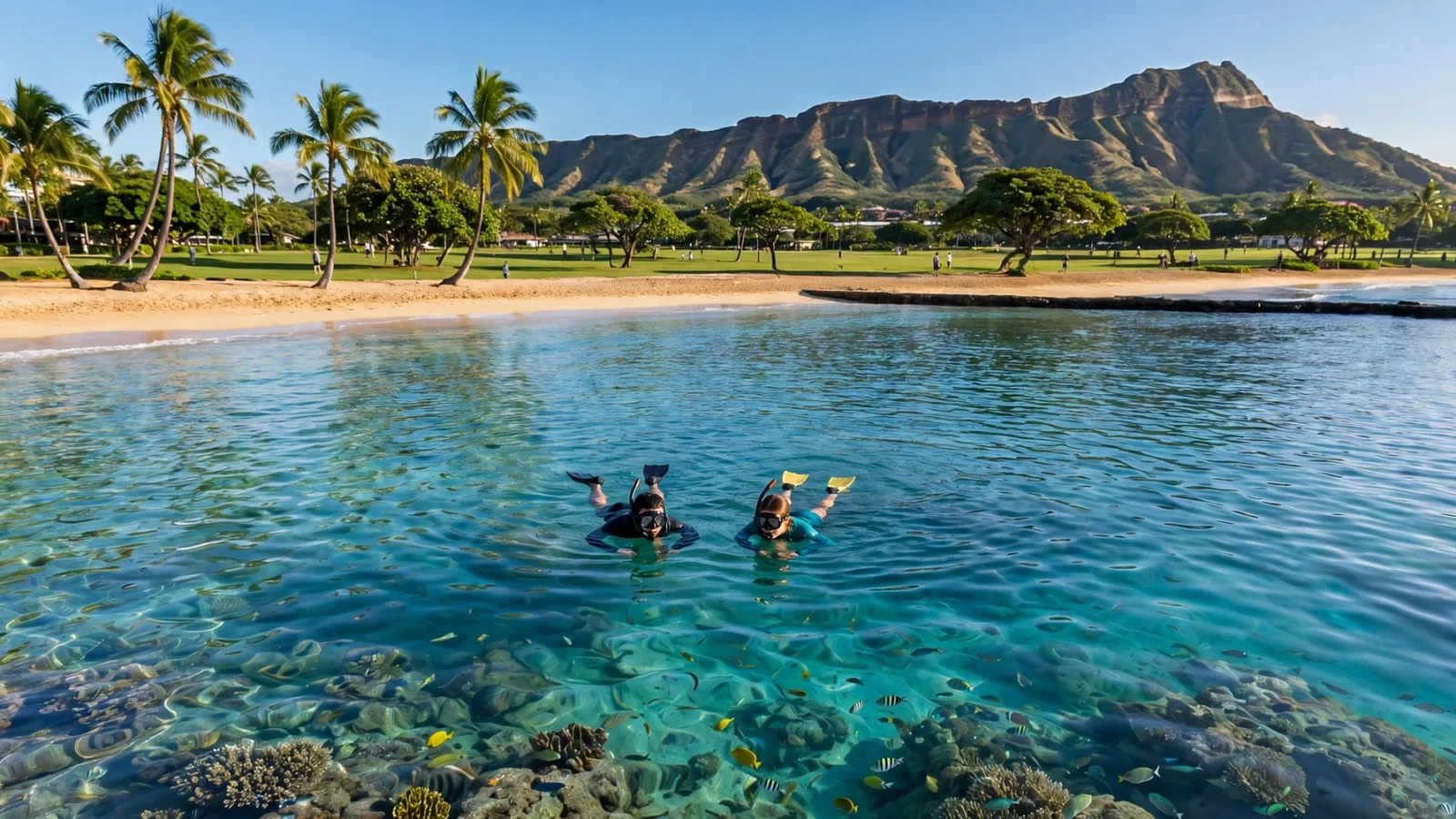
Yes, you can snorkel at Waikiki Beach — but go in with the right expectations. Waikiki is not Hanauma Bay. What you get at the quiet east end of Waikiki, around Queen’s Beach and Sans Souci Beach, is a protected marine reserve with a shallow reef flat, a dredged channel full of reef fish, and an outer reef edge where the snorkeling genuinely gets good on a calm day. The bottom is mostly coral rubble and rock rather than lush coral gardens, so think of this as fish snorkeling: schools of reef fish in clear, warm, walk-from-your-hotel water. Beyond the reef, see our guide to the things to do in Waikiki.
That trade-off is exactly why Waikiki snorkeling works so well for a lot of visitors. There is no drive across the island, no reservation window to win, and no boat to book. You can walk down Kalakaua Avenue in the morning, snorkel for an hour inside a no-fishing conservation district, and be back at your hotel before lunch. This guide shows you precisely where to get in, where the fish actually are, how deep it is, where to park, and the days when you should skip it entirely — plus the honest point at which a boat trip to Turtle Canyon is the better call.
Quick facts
- Where: Queen’s Beach and Sans Souci Beach, at the Diamond Head (east) end of Waikiki, fronting Kapiolani Park, Honolulu, Oahu
- Best spot overall: Queen’s Beach — the channel and outer reef hold the most fish
- Best for beginners and kids: Sans Souci Beach — sandy, gradual, shallow
- Depths: Under 3–4 ft over the reef flat; about 8 ft in the dredged channel; 15–20 ft at the outer reef edge
- Cost: No entry fee or reservation system is stated by the state for shore snorkeling here; parking is the main cost (see below)
- Lifeguard: Lifeguards are on duty year-round on the beach at the Waikiki end of the conservation district — always check the tower on the day
- Facilities: Restrooms, showers and a snack bar near the Natatorium end; picnic tables and shade under the trees by Kapiolani Park
Waikiki snorkeling at a glance
| Spot | Entry | Depth | Lifeguard | Facilities | Best for |
|---|---|---|---|---|---|
| Queen’s Beach | Sandy entry by the Kapahulu groin, then reef flat | Flat under 3–4 ft; channel ~8 ft; outer reef 15–20 ft | Yes — tower at the Waikiki end of the district | Restrooms, showers, snack bar nearby | Confident swimmers who want the most fish |
| Sans Souci Beach | Gentle sandy entry | Shallow flat, mostly under 3–4 ft; deeper along the wall | Lifeguard stand reported at Sans Souci | Restrooms, showers, picnic tables, shade | Beginners, kids, first-timers |
| Turtle Canyon (boat only) | Boat tour from Waikiki/Kewalo harbours | Offshore reef, roughly 15–40 ft | No — crew-supervised tour | On the boat | Turtles and a bigger reef — see our Turtle Canyon guide |
Snorkeling at Waikiki Beach itself: the honest map
Search “waikiki beach snorkeling” and you will find dozens of pages that treat the two-mile curve of Waikiki Beach as one snorkel spot. It is not. The famous central strip — Fort DeRussy down past the Royal Hawaiian — is a man-made sand beach with a sandy bottom, soft entries, and almost nothing to look at underwater. People wade, learn to surf, and play here. Nobody seriously snorkels here. The snorkeling people mean when they type “waikiki beach snorkeling” is the east end of that curve: the reef flat, dredged channel, and outer reef at Queen’s Beach and Sans Souci, inside the Waikiki Marine Life Conservation District. So read this page with that translation: snorkeling off Waikiki Beach = the east end. Everything below maps exactly where to go.
The geography in one walk. Start at the Royal Hawaiian and walk the beachfront path toward Diamond Head. You pass Kuhio Beach (sand, seawall, poor snorkeling), then the surf zone off Queen’s (boards, not fins), then the path opens onto Queen’s Beach — this is where the sand gives way to reef flat and the water starts holding fish. Another ten minutes brings you to the War Memorial Natatorium, then Kaimana Beach (Sans Souci), and the shoreline ends at the Diamond Head lighthouse. The whole east-end walk is about 1.5 miles, flat, and stroller-friendly — and it is the only part of “Waikiki Beach” worth snorkeling.
Why the center fails. The central beach sits inside a breakwater with a sandy floor and little structure; fish need structure. On a calm morning you can float over sand for a hundred yards and see almost nothing, which is why first-timers sometimes come away saying Waikiki snorkeling is a scam. The complaint is real — they were just in the wrong hundred yards of beach. Move to Queen’s or Sans Souci and the page turns: a fringing reef flat under 3–4 feet deep, a dredged channel where fish stack along the walls, and an outer reef edge dropping to about 15–20 feet.
Entry points, in order
Queen’s Beach — the best all-round entry. Walk in off the sand east of the surf lineup. The inner flat is shallow and calm on no-swell mornings; swim out to the dredged channel (a few minutes of easy finning) and the fish life concentrates along the channel walls. The outer reef edge, a longer swim out, is the best zone on the whole beach — clear water, bigger structure, confident swimmers only, and off-limits when south swell is running.
Sans Souci (Kaimana Beach) — the beginner and family entry. Calmer, shallower, a short swim to interest. Enter off the sand by the Natatorium end and work the inner flat; keep an eye on the reported wall current along the channel exit, note your entry point, and do not let it carry a tired swimmer.
Natatorium lot / Aquarium seawall area — not an entry. The small parking lot by the War Memorial Natatorium is a parking asset (limited, fills early), and the seawall marks the start of the reef flat, not a swim-in.
Conditions: the two things that decide your day
Swell, first. Waikiki faces south, and summer south swell is the single biggest snorkeling variable here. Check a south-shore surf report the morning of: no meaningful swell, and the whole east end opens; swell running, and the outer reef is off-limits — stay on the inner flat and Sans Souci or move the snorkel to another day. Winter is the reliable window on the south shore; the North Shore goes down then and the south shore calms. Morning is the second rule: go early, before the trades chop the surface and the beach crowds arrive. Tide, second. The flat is under 3–4 feet deep, so a dead-low tide makes it uncomfortably shallow and turns a lazy fin kick into a reef scrape. A mid or higher tide gives comfortable clearance. Our best time to snorkel in Hawaii guide explains the swell seasons that drive all of this.
Safety depth-check
Lifeguards are on duty year-round at the beach towers toward the Waikiki end of the district — know where the tower is before you enter and stay within sight of it when you can. The real injury record here is boring and preventable: shallow-reef scrapes on the flat. Keep horizontal, wear fins, and never stand on the reef (it is both a rules breach in the conservation district and a good way to bleed). The outer reef is a real open-ocean swim — buddy, confident swimming, energy left for the return. Read the full picture in our guide to whether snorkeling in Hawaii is safe.
Gear and the rental reality
Renting is easy here and buying-to-fit is better. Waikiki is dense with rental shops along Kalakaua and Kuhio Avenues renting mask, snorkel, and fins by the day or the week; try the mask on in the shop (a leak ruins the snorkel faster than anything), confirm fins are included in the set, and ask your hotel first — many lend or rent sets to guests. Bring reef-safe sunscreen either way; because the flat is so shallow, fins matter more here than at deep-water spots, keeping you horizontal and off the reef. Fitting details are in our Hawaii snorkeling gear checklist.
One last placement note: if you want turtles, bigger reef, or a proper deep-water float, this is not the beach for it. Hanauma Bay is the east-side upgrade and Turtle Canyon is the Waikiki boat trip for turtles. And for the rest of the island, our Oahu snorkeling hub maps every coast.
The Waikiki Marine Life Conservation District
Almost everything worth snorkeling in Waikiki sits inside the Waikiki Marine Life Conservation District (MLCD), and that protection is the whole reason the fish are here. Established in 1988 and covering about 76 acres, the district runs from the groin at the end of Kapahulu Avenue to the west wall of the Waikiki War Memorial Natatorium, and extends seaward about 500 yards or to the edge of the reef.
The rules (Hawaii Administrative Rules 13-36, administered by the Department of Land and Natural Resources) are simple and strict:
- No fishing, and no taking, injuring or disturbing any marine life
- No taking or altering sand, coral, rock or other geological features
- No fishing gear in the water
For snorkelers, this is good news twice over. Fish inside a no-take zone for nearly four decades are more numerous and less skittish than fish on an open coastline, and the rules double as your etiquette: look, photograph, and leave everything exactly where it is. Do not stand on the reef flat — it is shallow enough to tempt you, and standing damages the very habitat that makes the spot work. If you need a rest, float on your back or head for the deeper channel. Our Hawaii coral reef snorkeling guide explains why that matters more than most visitors realise.
Queen’s Beach — the best shore snorkeling in Waikiki
Queen’s Beach is the stretch of sand and reef directly in front of Kapiolani Park, between the Kapahulu groin and the Natatorium. It is the local answer to “where to snorkel in Waikiki,” and it rewards swimmers who understand its layout, because the snorkeling quality changes completely depending on which of its three zones you are in.
Exactly where to enter
Enter on the sand near the Kapahulu groin, at the Diamond Head end of the Waikiki beach strip. The entry is sandy and gradual. From there, the reef flat stretches roughly 35 yards out from the Waikiki Aquarium seawall before it meets the channel. Wade and then swim — the water over the flat is generally less than 3–4 feet deep, so you will be swimming over it rather than walking on it, and fins help you stay horizontal in the shallows.
The dredged channel: where most of the fish are
The centrepiece of Queen’s snorkeling is the dredged boat channel that cuts through the reef, roughly 100 feet offshore and about 8 feet deep. Fish concentrate along the shore side of this channel, where small caves and ledges in the wall give them shelter, around the Natatorium wall, and on the patches of exposed reef on the channel’s seaward side. Work slowly along the channel edge rather than across the flat: that wall is where a quiet snorkeler sees the most life, and it is deep enough that you are never tempted to stand.
The outer reef edge: best snorkeling, confident swimmers only
Beyond the channel, the outer edge of the reef drops sharply to around 15–20 feet, with arches and crevices that hold the densest fish life in the district. This is the best snorkeling in Waikiki — and it comes with conditions. The state specifically warns that waves are particularly dangerous at the outer reef edge where the reef is exposed, and summer swells frequently bring high surf to this south-facing shoreline. Treat the outer reef as a calm-day, higher-water option for confident ocean swimmers only, never on a day with any south swell running, and always with a buddy.
What you’ll actually see
Set honest expectations and Queen’s rarely disappoints. The bottom is mostly rubble and coralline algae with small patches of live coral and some sediment, so the scenery is the fish, not the reef structure. Commonly reported sightings along the channel and outer reef include schooling reef fish such as unicornfish and needlefish and Moorish idol-type reef species, with turtles passing through occasionally rather than resident. Nothing here is guaranteed on any given day — fish move with tide, swell and time of day — but a calm morning on the channel wall is reliably the liveliest shore snorkel in Waikiki. If turtles are your main goal, be honest with yourself and read the boat section below instead.
Sans Souci Beach — best for beginners and kids
Sans Souci Beach, the small sandy beach between the Natatorium and the New Otani hotel at the very end of Kalakaua Avenue, is Waikiki’s gentle introduction to snorkeling. The entry is sandy and gradual, the inner flat is shallow (mostly under 3–4 feet), and the whole spot sits inside the same protected MLCD, so there are reef fish to find without any of Queen’s deeper-water commitment.
For a first snorkel, stay over the sandy and patchy-reef areas inside the flat, in water you could stand in if you had to — although, as everywhere in the district, floating is kinder than standing. Slightly stronger swimmers can follow the wall line, where the water deepens to roughly 4–15 feet and the fish life improves. One caution is regularly reported by local snorkel guides: a current can run along the Sans Souci wall and channel exit, especially as water drains on a falling tide. Stay aware of how far along the wall you have drifted, keep an easy swim back in reserve, and get out the way you got in.
What makes Sans Souci the family pick is everything around the water: a lifeguard stand on the beach, restrooms and showers, picnic tables, and grass and shade under the trees at the edge of Kapiolani Park for the non-snorkeling members of the group. If you are snorkeling with children or nervous beginners anywhere in Waikiki, start here — and if this is a first-ever snorkel for anyone in your group, skim our beginners’ guide to snorkeling in Hawaii before you go.
Other Waikiki spots, honestly ranked
- Kuhio Beach — the walled swimming areas in the middle of Waikiki, by the Duke Kahanamoku statue. The seawalls make it calm and safe for a float, but the enclosed basins are sandy and the snorkeling is poor. Fine for a first mask-dip with a child; not a snorkeling destination.
- Duke Kahanamoku Beach and Fort DeRussy — the wide west end of Waikiki by the Hilton Hawaiian Village. Calm water and a jetty to look around, but mostly sand with limited reef structure, so sightings are sparse compared with Queen’s. Choose it for convenience if you are staying at that end, not for the snorkeling.
- Everywhere else on the Waikiki strip — the central beach is a swimming and surf-lesson zone over sand. If someone tells you they “snorkeled Waikiki” and saw nothing, this is almost certainly where they were. The snorkeling lives at the Diamond Head end, inside the MLCD.
Best time to snorkel Waikiki
Forget generic “best month” advice — in Waikiki, the best time is dictated by swell, not by the calendar. This is a south-facing shoreline, and the state’s guidance is blunt: summer swells frequently bring high surf here, visibility is best when there is little or no wave action, and waves are particularly dangerous at the exposed outer reef edge.
In practice:
- Pick a no-swell morning. Ocean conditions on a calm morning, before the trade winds chop the surface, are the single biggest factor in both safety and visibility. Our best time to snorkel in Hawaii guide explains how swell seasons work across the islands.
- Summer needs the most care. South swell peaks in summer, which is when Queen’s outer reef is most often off-limits. The inner flat and Sans Souci stay usable on smaller days, but check the surf forecast before you walk down.
- Mind the tide over the flat. The reef flat is under 3–4 feet deep, so a very low tide makes it uncomfortably shallow and increases the risk of brushing the reef. A mid or higher tide gives you comfortable clearance.
- Check before you go. Look at a south-shore surf report on the morning itself; if there is any meaningful south swell, move your snorkel to Sans Souci’s inner flat or postpone the outer reef for another day.
Parking, access and costs
Most Waikiki visitors should simply walk. Queen’s and Sans Souci sit at the east end of the strip, an easy stroll along the beachfront or Kalakaua Avenue from any Waikiki hotel, and walking removes the parking question entirely.
If you are driving in:
- Natatorium lot — the state notes a small parking lot by the Waikiki War Memorial Natatorium. It is limited and fills early; treat it as a bonus, not a plan.
- Kalakaua Avenue street parking — street parking runs along Kalakaua Avenue by Kapiolani Park. Read every sign carefully; rules and enforcement in Waikiki are strict.
- Honolulu Zoo lot — the most predictable option, with its entrance on Kapahulu Avenue a short walk from Queen’s and Sans Souci. The City and County of Honolulu lists it at $1.50 per hour with a four-hour limit. Rates can change, so check the lot signage when you arrive.
- Bus — city buses serve Kalakaua Avenue and stop close to the park, which avoids parking costs altogether.
On costs generally: DLNR states no entry fee and no reservation system for shore snorkeling in the Waikiki MLCD — a sharp contrast with Hanauma Bay, where reservations, entry fees and fixed hours apply. Do not confuse the beach with its neighbours: the Waikiki Aquarium and Honolulu Zoo next door are separate paid attractions, and their admission has nothing to do with beach access.
Safety at Waikiki
Waikiki’s east end is one of Oahu’s more forgiving snorkel areas, but it is still open ocean. The main hazards, in order:
- South swell — the big one. High surf reaches this shoreline most often in summer and is dangerous at the exposed outer reef edge. No swell, no problem; swell running, stay inside or stay out.
- Shallow reef — at under 3–4 feet over the flat, cuts from brushing rock or coral are the most common injury, and standing on the reef is both an injury risk and a rules breach in the MLCD. Keep horizontal, and wear fins.
- The Sans Souci wall current — local guides regularly report a current along the wall and channel exit at Sans Souci. Note your entry point, check your position often, and never let it carry a tired swimmer.
- Distance at the outer reef — the best zone is also the furthest from shore. Confident swimmers only, always with a buddy, and leave energy for the swim back.
Lifeguards are on duty year-round on the beach at the Waikiki end of the district — know where the tower is before you enter, and swim within sight of it when you can. For the full picture, read our guide to whether snorkeling in Hawaii is safe — and never snorkel alone, tired, or after drinking, here or anywhere.
Gear and rentals in Waikiki
You do not need much: a well-fitting mask, snorkel and fins, plus reef-safe sunscreen. If you own gear, bring it — the fit will be better than any rental. If you are renting, Waikiki is dense with rental shops along Kalakaua and Kuhio Avenues renting by the day or week; compare the fit in the shop (a leaking mask ruins a snorkel faster than anything), ask whether fins are included, and check whether your hotel lends or rents sets, as many do. What to pack and how to check fit properly is covered in our Hawaii snorkeling gear checklist. One Waikiki-specific tip: because the flat is so shallow, fins matter more here than at deep-water spots — they keep you horizontal and off the reef.
Shore snorkeling vs a Waikiki snorkel tour
So when is the boat worth it? Waikiki’s famous offshore reef, Turtle Canyon, sits about a mile off the beach and is reachable only by boat — it is a deeper reef known for resident green sea turtles at cleaning stations, which shore snorkeling at Queen’s simply cannot promise. Choose the shore if you want free, flexible, walk-up snorkeling with good reef fish on a calm day. Choose the boat if turtles are the point of the trip, if you want a crew handling gear, entry and supervision, or if south swell has shut the outer reef but boats are still running to more sheltered water.
Waikiki snorkeling tours range from catamaran sails to dedicated snorkel boats, mostly departing the Waikiki and Kewalo Basin harbours. We compare the options in our Hawaii snorkeling tours guide, and our dedicated Turtle Canyon snorkeling guide covers that reef in full — costs, what you see, and who it suits. Many visitors do both: a free morning at Queen’s to find their feet, then a Turtle Canyon trip for the turtles.
Waikiki snorkeling: common questions
Where can I snorkel in Waikiki?
At the east (Diamond Head) end, inside the Waikiki Marine Life Conservation District. Queen’s Beach offers the best fish life along its dredged channel and outer reef; Sans Souci Beach, by the Natatorium, is the calmer beginner- and kid-friendly entry. The central Waikiki strip is mostly sand and poor snorkeling.
Can you snorkel at Waikiki Beach?
Yes. Shore snorkeling is allowed and popular at Queen’s Beach and Sans Souci Beach within the conservation district, where fishing and taking marine life are prohibited. There is no reservation system and the state states no entry fee for shore snorkeling here. Search engines call this ‘waikiki beach snorkeling,’ and the honest answer is that it means the east-end conservation district — Queen’s and Sans Souci — not the sandy central strip.
Is Waikiki good for snorkeling?
It is good for what it is: convenient, protected, fish-focused snorkeling over a rubble-and-rock reef flat, with genuinely lively spots along the Queen’s channel and outer reef on calm days. It is not a lush coral garden, and for turtles or a bigger reef, Hanauma Bay or a Turtle Canyon boat trip is better. For more options around the island, see our Oahu snorkeling hub.
Is there a reef at Waikiki Beach?
Yes — a fringing reef flat extends from the Aquarium seawall area out to a dredged channel, with an outer reef edge dropping to about 15–20 feet. Most of the fish gather along the channel walls and the outer edge, not over the shallow inner flat.
Where can I snorkel in Waikiki for free?
Queen’s Beach and Sans Souci Beach. Shore entry is from public beach access inside the MLCD, with no entry fee or reservation stated by the state; your only likely costs are parking (for example the Honolulu Zoo lot at $1.50/hour, four-hour limit — check signage) and any gear rental. It pairs well with other calm south-shore days; if conditions are rough here, Shark’s Cove on the North Shore is only worth it in its own calm summer season, so always check the forecast for the shore you choose.
How deep is Waikiki snorkeling?
Under 3–4 feet over the inner reef flat, about 8 feet in the dredged channel off Queen’s Beach, roughly 4–15 feet along the Sans Souci wall, and 15–20 feet at the outer reef edge. Beginners should stay over the flat and the Sans Souci shallows; the outer reef is for confident ocean swimmers on calm days only.
If you have a car and a free morning, the windward side makes a very different beach day: our Lanikai Beach snorkeling guide covers the powder-soft sand in the Mokulua islets’ shadow — what snorkeling there actually is, and the parking reality in the Lanikai lanes.