
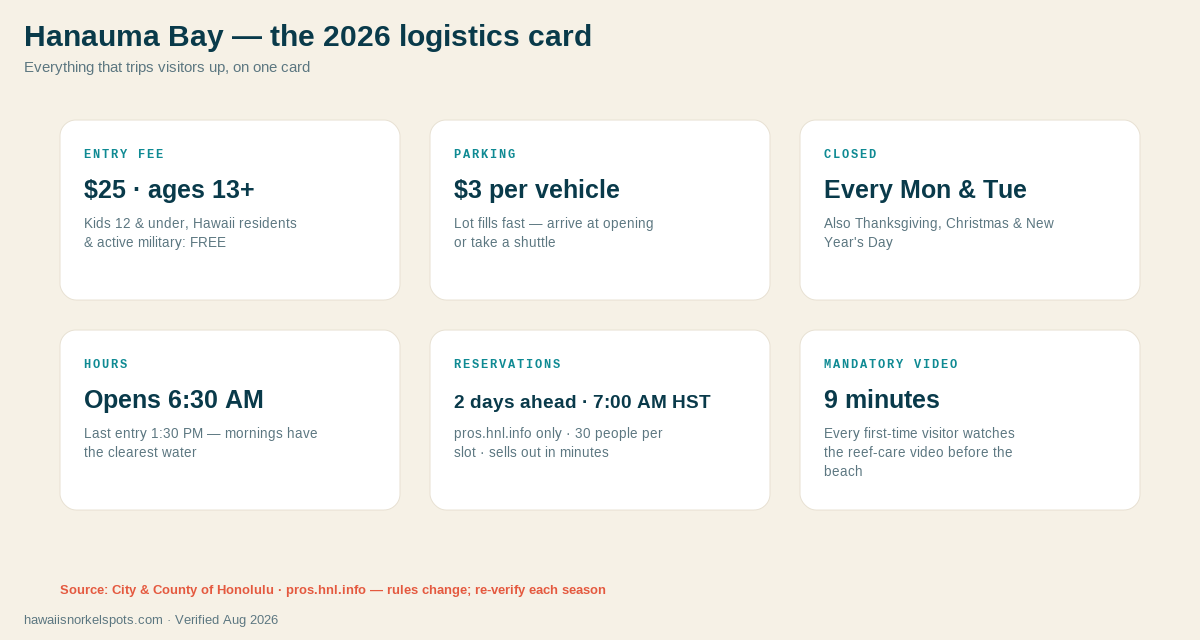
- Entry fee
- $25 ages 13+ for non-residents, plus a 2.35% online service fee · free for kids 12 & under, Hawaii residents & active U.S. military and dependents
- Reservations
- pros.hnl.info (PROS) — released 2 days ahead at 7:00 a.m. HST, up to 10 people per booking · about 25% of entry held for walk-ins · transport packages bookable up to 1 month ahead
- Closed
- Every Monday & Tuesday, plus Christmas Day (Dec 25) & New Year’s Day (Jan 1)
- Hours
- Wed–Sun · entry 6:45 a.m.–1:30 p.m. · beach cleared 3:30 p.m. · everyone out by 4:00 p.m.
- Parking
- $3 per vehicle for non-residents, $1 for residents — cash on site, refunded if you leave within 15 minutes
- Mandatory
- Educational video in the theatre on every visit — repeat visitors cannot skip it
Why Hanauma Bay is different from every other Oahu snorkel
Hanauma is a volcanic crater that the sea broke into, and that shape explains everything about the snorkeling. The curved bay and its fringing reef blunt most ocean swell before it reaches the beach, so the inner lagoon is usually calm and shallow while exposed coast nearby is rough. In 1967 it became Hawaii’s first Marine Life Conservation District (MLCD). Fishing is prohibited, fish feeding was later banned, and generations of reef fish here have grown up never being hunted — which is why they swim close, hold still for photographs and behave differently from fish at unprotected spots.
That protection nearly did not save it. At its peak the bay received an estimated 10,000 visitors a day. A management plan from 1990 onward cut numbers, built the Marine Education Center and made education part of entry. After the long COVID closure in 2020 the reef visibly rebounded, and the city kept the tighter system: a daily cap, reservations, two closed days a week and the video for all. Today average attendance is roughly half the pre-pandemic level. The rules can feel like friction, but they are also the honest reason Hanauma still looks like this. Treat them as part of the visit, not an obstacle to it.
The quick verdict: who should go, and who should skip it
Go if you are a first-time snorkeler, a nervous swimmer, a family with children, or anyone who wants a high chance of seeing lots of reef fish on a first Hawaii snorkel without a boat. Lifeguards, facilities, gear rental and a protected lagoon make this the lowest-stress introduction on Oahu — see also our guide to snorkeling in Hawaii for beginners.
Think twice if you hate planning, cannot work around a Wednesday-to-Sunday schedule, or are an experienced snorkeler who prefers deep walls, caves and pelagic life. You may find the inner reef tame and the $25 fee poor value compared with free spots. In that case the alternatives table near the end of this guide will serve you better.
Hanauma Bay reservations: the step-by-step walkthrough
This is the section to get right. For non-residents, a reservation is highly recommended and, in practice, it is how most people get in. There are three legitimate routes — do not buy entry from unofficial resale listings, because reservations are non-transferable and are checked against photo ID.
Route 1: Admission only through PROS (the main system)
- Pick your day first. It must be a Wednesday, Thursday, Friday, Saturday or Sunday. Mondays and Tuesdays never open.
- Count back exactly two days. Reservations open at 7:00 a.m. Hawaii Standard Time two days before. To visit on Wednesday, be online at 7:00 a.m. on Monday. To visit on Saturday, be online at 7:00 a.m. on Thursday. Reservations stay open until spaces fill or midnight the night before, but popular morning slots can go in minutes — treat 7:00 a.m. as the real deadline.
- Prepare before 7:00 a.m. Have the full names and ages of everyone in your group, your payment card and a backup time slot decided in advance. Bookings can cover up to 10 people at a time. Payment is taken online when you reserve; the official system lists Visa, Mastercard and JCB, plus a 2.35% service fee.
- Book the earliest slot you can use. Morning water is clearer, the reef is less stirred up, shade and parking are easier, and you leave yourself slack if check-in queues build.
- Save the confirmation email. That email is your reservation proof. Bring a printed or digital copy plus photo ID matching the booking — reservations are non-transferable, non-refundable and cannot be exchanged, unless the park itself closes for unforeseen reasons.
- Arrive early for your slot. Budget for parking, check-in, the educational video and the walk or tram down to the beach. Thirty to forty minutes from gate to water is a sensible plan, not a pessimistic one.
Route 2: Admission with transportation (book further ahead)
Since late 2025, packages that combine round-trip transport from the Ala Moana / Waikiki area with park entry have been bookable up to a month in advance through Roberts Hawaii, linked from the official Hanauma Bay page. This is the best legitimate workaround if the two-day window does not suit you, if you do not have a car, or if you want to avoid the parking problem entirely. You pay for transport on top of entry, so it costs more — but certainty has value on a short trip.
Route 3: Walk-in (possible, never guaranteed)
About one-quarter of daily access is held for walk-in or drive-in visitors, with on-site payment available. Everyone in your party must be present to get a walk-in ticket. This is a genuine backup, not a strategy: arrive very early, expect a queue, and have a Plan B for the day if the allocation is gone.
| Route | When to book | Best for | Watch out for |
|---|---|---|---|
| PROS admission only | 2 days ahead, 7:00 a.m. HST | Drivers and planners | Sells out fast; non-refundable |
| Admission + transport | Up to 1 month ahead | Waikiki stays, no car | Higher total cost |
| Walk-in | On the day, early | Flexible backup plans | Only ~25% held back; no guarantee |
If reservations are sold out
Do not give up immediately, and do not buy a resold reservation. Check the official system again for later slots, consider the transport package above, try the walk-in allocation early, or swap to another day of your trip. If Hanauma will not work at all, use the alternatives table below rather than wasting a morning — Kuilima Cove is the calm, family-friendly substitute and Sharks Cove is the adventurous summer substitute.
The booking details most guides skip
The 10-person limit has a split inside it. A single PROS booking covers up to 10 people, but no more than five adults and five children — the city’s own FAQ puts it as five non-resident adults or active military plus five children. If your party has more than five adults, you need a second reservation made in another adult’s name, using that adult’s email address. That is the rule that trips up big family groups who assume one booking covers everyone.
If the payment screen freezes, do not refresh the page and do not press the back button. The city’s FAQ is explicit about this: refreshing means you will not be able to retrieve the reservation. The site is simply busy processing — an incomplete booking returns to the reservation pool after 10 minutes, and you can try again. If the card screen does not load at all, take a snapshot of the screen for your records and call the Hanauma Bay information hotline at 1-808-768-6861, leaving your phone number and email address; the call is returned as soon as possible.
Running late is not the same as losing your booking. The city’s FAQ says late reservations are accepted before 1:30 p.m. — the last entry time. Some guides claim late entry is not allowed; the city’s own page says otherwise, so a delayed morning is still salvageable if you arrive before the 1:30 p.m. cutoff. After that, entry closes for the day, and reservations are non-refundable unless the preserve itself closes.
The walk-in route has its own choreography. Walk-in tickets are handed out from when the parking lot gate opens at 6:45 a.m., and the whole party must be present. In peak season, from 6:45 to 7:10 a.m., there is a drive-through process: traffic is directed to the Commercial Parking Lot ticket booth to receive walk-in tickets. After 7:10 a.m., walk-in tickets move to the public parking lot loading zone, where a person under a blue umbrella hands them out. Knowing which window you are in saves a confused lap of the lot.
One more thing the confirmation email does not buy: a parking space. A reservation secures admission only, not a stall. If the lot is full when you arrive, the city’s advice is to wait until the lot reopens or find legal street parking nearby and walk in — never park illegally on the highway.
If you are booking for early 2027, check the official city page before you fix a date. The city is replacing the preserve’s 35-year-old sewer system, a project that began in August 2026 and runs to summer 2027. The first closure ran August 3–18, 2026, and the bay reopened on schedule. A second closure is anticipated at the beginning of 2027, when the new lift station is brought online — but the specific dates have not been set yet, and the city says they will be announced as soon they are confirmed. Until dates are announced, a January 2027 trip should keep a backup morning in mind.
Two small fixes if something goes wrong with the booking itself: if you entered the wrong email address or misspelled a name, or if you ended up with multiple reservations and only need one, call the Hanauma Bay information hotline at 1-808-768-6861 on the day you booked and leave a message — the call is returned as soon as possible. And if the two-day window keeps failing, remember the transport route: Roberts Hawai’i is the only authorised provider of tickets with transport, and its own site advertises tickets up 60 days in advance — further ahead than the city’s one-month wording — with the required video watched on the bus.
Hanauma Bay tickets and entry: what to know before you book
Search “Hanauma Bay tickets” and you will find plenty of sellers — but there is no separate ticket product. A Hanauma Bay ticket is a reservation for admission, made through the city’s PROS system at pros.hnl.info. It buys entry for one person on one day. It does not buy a parking space, a time-slot guarantee beyond your entry window, or a refund if your plans change — and that distinction explains most of the confusion first-time visitors run into.
Reservations stay open until midnight the night before your visit, as long as slots remain. A sold-out 7:00 a.m. release is not always the end of it: check back during the day, and check again in the 48 hours before your visit, because cancelled reservations return to the system. That is also why the transport package matters — admission with round-trip transport from the Waikiki area can be booked up to a month ahead, which removes the two-day race entirely.
Payment is taken online when you reserve. The official system accepts Visa, Mastercard and JCB, plus a 2.35% service fee. Reservations are non-refundable and non-transferable, with no cancellations or exchanges, and they are checked against photo ID at entry. The only exception is if the preserve itself closes. Do not buy a reservation from a reseller: a booking in someone else’s name will not get you in.
Hawaii residents enter free and need no reservation, but bring the right ID: a Hawaii driver’s license, a Hawaii State ID, or a school student ID. Non-residents travelling with a kamaaina do not enter free — every non-resident aged 13 and over pays the $25 entry fee. Active U.S. military enter free with military ID. Groups arriving by commercial vehicle should know the vehicle fees too: $10 for 1–7 passengers, $20 for 8–25, and $40 for 26 or more.
Without a car, note that city bus service directly into the preserve has been discontinued. Route 22 still stops at the top of Hanauma Bay on Kalanianaole Highway, and you walk down from there — or take the admission-with-transport package described above. If anything about your booking is unclear, the Hanauma Bay information hotline is 1-808-768-6861. And if your trip falls in the winter holidays, read our guide to snorkeling in Hawaii in December before you fix a date, because the same two-day system faces far more competition in Christmas week.
Peak season: booking Hanauma Bay for late November to early January
The reservation system does not change in peak season — the odds do. From late November through early January the same two-day, 7:00 a.m. HST release has far more people competing for it, morning slots can go in minutes in Christmas week, and two holiday closures remove days that would otherwise be open. If Hanauma Bay is a must-do on a winter trip, treat the booking as its own small project, using the walkthrough above plus the peak-season adjustments below.
What 7:00 a.m. HST means where you are
Hawaii does not observe daylight saving time, so 7:00 a.m. HST is always UTC-10 — but what that is on your home clock depends on the season. In winter, when the mainland is on standard time, the release happens at:
| Where you are booking from | Local time of the 7:00 a.m. HST release (winter) |
|---|---|
| Hawaii (HST) | 7:00 a.m. the same day |
| US West Coast (PST) | 9:00 a.m. |
| Mountain (MST) | 10:00 a.m. |
| Central (CST) | 11:00 a.m. |
| US East Coast (EST) | 12:00 noon |
Set the alarm by Hawaii time, not by how the offset felt in summer — the gap is an hour wider in winter than many visitors expect. If you are already in Hawaii, it is simply 7:00 a.m. local: be logged in, with names, ages and payment ready, a few minutes before.
Christmas and New Year week, worked out day by day
The preserve is closed on Christmas Day and New Year’s Day as well as every Monday and Tuesday. In the 2026–27 holiday period both holidays fall on a Friday — a day the bay would normally be open — so plan around them:
| Visit day | Be online at 7:00 a.m. HST on | Note |
|---|---|---|
| Wednesday, December 23, 2026 | Monday, December 21 | Usually the calmest booking of Christmas week |
| Thursday, December 24, 2026 | Tuesday, December 22 | Christmas Eve — expect fast sell-outs |
| Friday, December 25, 2026 | — | CLOSED for Christmas Day |
| Saturday, December 26, 2026 | Thursday, December 24 | Busiest weekend day of the season |
| Sunday, December 27, 2026 | Friday, December 25 | The release is online — confirm the day’s availability on the official page |
| Wednesday, December 30, 2026 | Monday, December 28 | Good backup if Christmas week failed |
| Thursday, December 31, 2026 | Tuesday, December 29 | Last open day of the year |
| Friday, January 1, 2027 | — | CLOSED for New Year’s Day |
Five moves that raise your odds in peak season
- Rank your backup dates before release morning. Wednesday to Friday visits are usually easier to win than weekend and holiday-adjacent days. Decide your second and third choices in advance, so a sold-out first choice costs you seconds, not the whole release.
- Start from the official city page, not an old bookmark. Begin at the City and County of Honolulu Hanauma Bay page and use its reservation button to reach the current booking system. Saved booking links from older blog posts can point at retired addresses.
- Include children in the party count. Entry is free for children 12 and under, but a reservation is per person — count free children in your booking, or your party may not match at check-in.
- Check back for cancellations. Cancelled reservations return to the system. If your day sold out, check the booking page again periodically in the 48 hours before the visit — released slots do appear, especially for later entry times.
- Use the transport package as the certainty route. If the two-day window keeps failing, or your trip is short, the admission-with-transportation package described above can be booked up to a month ahead. It costs more, but it removes both the 7:00 a.m. race and the parking problem. Keep one of the calm winter alternatives in mind as a Plan B morning rather than losing the day entirely.
None of this changes the snorkeling itself: the earliest slot you can win is still the best slot, for the clearest water and the easiest parking, in December exactly as in July.
Fees and the real cost of a visit
| Item | Cost | Notes |
|---|---|---|
| Entry, non-resident 13+ | $25 | Plus 2.35% service fee when paid online |
| Entry, child 12 and under | Free | Regardless of residency; a reservation is still recommended |
| Entry, Hawaii resident | Free | Valid Hawaii photo ID; no reservation needed |
| Entry, active U.S. military + dependents | Free | Military ID required |
| Parking | $3 non-resident / $1 resident | Cash on site; refunded if you leave within 15 minutes |
| Snorkel rental | Paid on site | Rentals run 7:00 a.m.–3:00 p.m., card payment only; confirm the day’s price at the concession |
For two non-resident adults driving in, the unavoidable cost is about $53 before rentals, food or transport — $25 each plus parking and the online fee. Whether that is fair depends on the comparison: a boat snorkel costs far more per person, and free beach spots offer no lifeguarded, protected lagoon of this quality. Judge it as a half-day nature preserve visit that includes a snorkel, not as a beach parking ticket.
Hours, closed days and the best time to snorkel Hanauma Bay
The preserve is open Wednesdays through Sundays. Entry is allowed from 6:45 a.m. to 1:30 p.m., the beach is cleared at 3:30 p.m. and all visitors must leave by 4:00 p.m. It is closed every Monday and Tuesday, and on Christmas Day and New Year’s Day. This schedule can change — if your trip hinges on one day, confirm on the official Honolulu Hanauma Bay page or by phone before you set an alarm.
Best time of day: the earliest entry you can manage. Visibility is best before hundreds of fins have stirred the sand, trade winds are usually lighter in the morning, and the limited natural shade on the beach is claimed early. By late morning the lagoon is busier and choppier, though the fish do not disappear.
Best time of year: Hanauma’s south-shore, protected position makes it one of Oahu’s most year-round spots. Summer generally brings the calmest, clearest water. Winter south swells are less common than summer ones, but any large swell can close or murk the bay — always check conditions and lifeguard advice on the day. For the wider seasonal picture, see our guide to the best time to snorkel in Hawaii.
| Factor | Better | Worse |
|---|---|---|
| Time of day | 6:45–9:00 a.m. entry | Late entry, afternoon wind |
| Day of week | Wednesday–Friday | Weekends and holidays |
| Season | Calm summer mornings | Days with large south swell |
| Tide and weather | Light winds, incoming tide | Strong trades, recent heavy rain |
Parking and getting there without the stress
Hanauma Bay sits off Kalanianaole Highway in southeast Oahu, roughly a half-hour drive from Waikiki in light traffic. Parking costs $3 per vehicle for non-residents ($1 for residents), is paid in cash on site, and is refunded if you leave within 15 minutes. The lot is the bottleneck: when it fills, a reservation alone does not create a space. Arriving for an early slot solves most of this. If the lot is full, staff can advise current options — do not park illegally on the highway.
Without a car, the transport package described above is the simplest door-to-beach option. City bus service directly into the preserve has been discontinued, although a bus stop remains at the top of Hanauma along the highway on Route 22 — expect the walk from there. Taxis and rideshares can drop you, but plan your return pickup carefully, because demand spikes when the beach clears.
The snorkeling itself: zones, reef and what you will see
Hanauma rewards people who snorkel it in zones instead of swimming straight out.
The inner reef and lagoon. This is the main event for most visitors: shallow, sandy patches between reef, generally calm, and busy with reef fish. Work slowly along the reef edges rather than over the sand — fish live at the boundary of reef and open water. Look for yellow tangs, convict tangs, butterflyfish, wrasses, damselfish, trumpetfish and Hawaii’s state fish, the humuhumunukunukuapuaa (reef triggerfish). Parrotfish graze the coral, and you may hear their beaks scraping if the water is quiet.
Sand channels and patch reef. Slightly deeper sand channels between reef sections are good places to watch for rays on lucky days, goatfish sifting the sand and turtles resting or feeding. Turtles are seen here, but they are a bonus, not a promise — Hanauma is a fish spot first. If turtles are your priority, read our guide to snorkeling with turtles in Hawaii and consider the boat trip to Turtle Canyon.
The channel to the outer reef (often called the Slot or Cable Channel). Confident, experienced swimmers can follow the marked channel through the reef to deeper outer water, where fish life is larger, turtles are more likely and the reef is more dramatic. This is also where current lives. Water moving out through the channel can be strong, and beyond the bay an alongshore current can push swimmers toward Molokai side on rough days. If that sentence makes you nervous, it is useful information: stay inside. No photograph is worth fighting a channel current on a first snorkel.
The outer reef and back wall. For strong snorkelers in calm conditions only, the outer reef offers the bay’s best visibility and biggest fish. Check with lifeguards first, go with a buddy, know your exit, and turn back early while you still have energy. Conditions here are a different category from the lagoon, and they can change while you are out.
Technique matters more than fitness in the inner bay. Float, breathe slowly, fin gently and stay horizontal. Standing on reef to adjust a mask is the most common beginner mistake here — move to sand, fix the problem, then continue. If you are brand new, our how to snorkel in Hawaii primer takes ten minutes and will double what you see.
Conditions: what changes the day
Three things decide a Hanauma day: swell, wind and crowd-stirred sand. A large south swell can send surf over the reef and close entry or cut visibility sharply. Afternoon trade winds chop the surface and make weaker swimmers work harder. And even on a perfect ocean day, a busy lagoon gets cloudy by midday. None of this ruins a morning visit, which is why the early-slot advice appears in every section of this guide. Check the surf report the night before, listen to lifeguards on arrival, and let them — not your reservation — have the final word.
Beginners and kids: the honest verdict
For beginners and children, Hanauma is as close to a controlled environment as ocean snorkeling gets: lifeguards on duty, a shallow inner lagoon with sandy standing areas, on-site rental gear, bathrooms, showers and a tram between the entrance and the beach. Children 12 and under enter free, which softens the family cost — though adults should budget honestly using the fees table above.
The caveats are real. Every visitor, including children, goes through the educational video and check-in process on every visit, so a Hanauma morning needs patience before anyone touches water. Non-swimmers should stay in standing-depth water over sand, use flotation, and never be talked into the channel. Young kids often do best with a short first session, a shade and snack break, then a second short session, rather than one long swim. Done that way, this is the Oahu snorkel we recommend first to families — with Kuilima Cove as the calmer, reservation-free alternative on the North Shore.
Safety at Hanauma Bay
The inner reef is forgiving; it is not a swimming pool. Never snorkel alone, tell lifeguards if you plan to go to the outer reef, and stay well within your swimming ability. The main hazards are current in and beyond the channel, sharp reef in shallow water, sunburn during long floats, and exhaustion from swimming out further than planned. Enter and exit over sand where possible, keep an eye on your position relative to the beach, and come in before you are tired — the swim back is always longer. Our broader Hawaii snorkeling safety guide covers ocean safety in full. If lifeguards close an area or advise against going out, that instruction ends the discussion, reservation or not.
Rules, MLCD etiquette and reef care
These rules protect the reason you came. Do not feed the fish — it is banned and enforced, and it harms both fish behaviour and water quality. Do not touch, stand on or collect coral, rock or marine life; much of what looks like bare rock is alive. Give turtles and any monk seal a wide berth — observe from a respectful distance, never chase or touch them, and let them pass. Use reef-conscious sun protection: Hawaii law restricts sunscreens containing oxybenzone and octinoxate, and a rash guard reduces how much sunscreen you need at all. Take every scrap of rubbish back up the hill with you. The video you watch on entry covers the same ground — when you follow it in the water, staff and other visitors notice, in a good way.
What to bring
- Mask, snorkel and fins, or money and a card for the on-site rental (7:00 a.m.–3:00 p.m., card only)
- Reef-conscious sunscreen and / or a rash guard
- Swimsuit, towel, and a dry change for the drive back
- Water and snacks — food concessions run roughly 8:30 a.m.–2:00 p.m., card only, but choice is limited
- Cash for parking ($3) even if everything else is paid by card
- Photo ID matching your reservation, plus the confirmation email on your phone
- A waterproof case if your phone is your camera; a simple action camera earns its space here
Our full Hawaii snorkeling gear checklist covers fit, defogging and what not to waste money on.
Your Hanauma morning, step by step
| Stage | Allow | Tip |
|---|---|---|
| Park and check in | 10–15 min | Have ID and confirmation ready |
| Educational video | About 10 min | Required on every visit |
| Walk or tram to beach, set up | 10–15 min | Claim shade early |
| First snorkel session | 45–60 min | Stay in the inner reef first |
| Break, then second session | 30–45 min | Reapply sun protection, hydrate |
| Shower, tram up, leave | By 4:00 p.m. | Beach clears at 3:30 p.m. |
Facilities include bathrooms, showers, lockers and rental concessions, a gift shop (about 8:00 a.m.–3:30 p.m.) and the Marine Education Center. It is a genuinely easy half-day: snorkel in the morning, then lunch in Hawaii Kai or, if you have energy, an east-side hike afterwards.
If not Hanauma: the best Oahu alternatives
| Spot | Best for | Cost / booking | Trade-off |
|---|---|---|---|
| Kuilima Cove | Families, calm water | Free, no reservation | North Shore drive; fewer fish |
| Sharks Cove | Adventurous snorkelers | Free, no reservation | Summer only; rough in winter |
| Electric Beach (Kahe Point) | Experienced swimmers, big fish | Free | Current and open-ocean entry |
| Turtle Canyon | Turtle sightings by boat | Paid boat tour | Boat trip, not a beach day |
None of these replicates Hanauma’s combination of protection, facilities and tame fish — that is the point of the table. Pick the alternative that matches the reason Hanauma did not work: no reservation, no fee, more adventure, or better turtle odds. Our Oahu snorkeling hub compares all ten main spots on one page.
Is Hanauma Bay worth it in 2026?
Yes — for the right visitor, and with eyes open. You are paying $25 and planning two days ahead for the most reliable beginner snorkel in Hawaii, in a recovering conservation district, with lifeguards and facilities. You are not paying for wilderness, solitude or the island’s most dramatic reef. Visitors who arrive early, follow the reservation steps above and snorkel the zones in order almost always leave understanding the reputation. Visitors who arrive late, fight for parking and stand on the reef in the shallows leave wondering what the fuss was about. Hanauma rewards the first group completely.
Field reports we drew from
- Official rules, fees, hours and reservations: City & County of Honolulu, Hanauma Bay Nature Preserve — including the PROS two-day system, walk-in share, parking and video requirements, verified October 2026.
- Love Oahu — conservation history, zone detail and current visitor impressions.
- Shaka Guide — reservation timing, ticket types and transport-package context.
FAQ
Do I need a reservation for Hanauma Bay?
For non-residents, a reservation is highly recommended and is how most people enter. Book admission-only on pros.hnl.info exactly two days ahead from 7:00 a.m. HST, or an admission-with-transport package up to a month ahead. About 25% of entry is held for walk-ins. Hawaii residents with valid ID enter free without a reservation.
How much does Hanauma Bay cost in 2026?
Entry is $25 for non-residents aged 13 and over, plus a 2.35% online service fee, with parking at $3 per vehicle in cash. Children 12 and under, Hawaii residents and active U.S. military with dependents enter free. Rentals, food and transport packages cost extra.
What days and hours is Hanauma Bay open?
Wednesday to Sunday, with entry from 6:45 a.m. to 1:30 p.m. The beach is cleared at 3:30 p.m. and everyone leaves by 4:00 p.m. It is closed Mondays, Tuesdays, Christmas Day and New Year’s Day.
Can I go to Hanauma Bay without a reservation?
Sometimes. About a quarter of daily access is held for walk-ins, with everyone in your party present and payment on site. Arrive very early and have a backup plan — walk-in entry is never guaranteed, especially on weekends.
Is Hanauma Bay good for beginners and kids?
Yes — it is Oahu’s best first snorkel. The inner lagoon is shallow and protected, lifeguards are on duty, and rental gear and facilities are on site. Keep non-swimmers in standing depth over sand and never take beginners through the channel to the outer reef.
What will I see snorkeling at Hanauma Bay?
Expect dense reef fish — yellow and convict tangs, butterflyfish, wrasses, parrotfish and the humuhumunukunukuapuaa — over a protected inner reef. Turtles are seen regularly but not guaranteed, more often in deeper water. Hanauma is a fish spot first.
Can I rent snorkel gear at Hanauma Bay?
Yes. The on-site rental concession operates from about 7:00 a.m. to 3:00 p.m. with card payment only. Confirm the day’s price on site. Renting in Waikiki or bringing your own can work out cheaper if you plan several snorkels on your trip.
What if reservations sell out or the parking lot is full?
Check for later slots, consider the admission-with-transport package, try the walk-in allocation early, or swap days. Never buy a resold reservation — bookings are non-transferable and checked against ID. If Hanauma will not work, Kuilima Cove and Sharks Cove are the best free alternatives.
What if my payment screen freezes while booking Hanauma Bay?
Do not refresh the page or press the back button — the city’s FAQ warns you will not be able to retrieve the reservation. Wait it out: an incomplete booking returns to the reservation pool after 10 minutes. If the card screen never loads, take a snapshot of the screen and call the Hanauma Bay information hotline at 1-808-768-6861, leaving your phone number and email address.
What if I miss my Hanauma Bay reservation time?
Late reservations are accepted before 1:30 p.m., the last entry time, according to the city’s FAQ — so a delayed morning is still salvageable. After 1:30 p.m. entry closes for the day, and reservations are non-refundable unless the preserve itself closes.
Will Hanauma Bay close again in 2027?
A second closure is anticipated at the beginning of 2027, when the new sewer lift station is brought online — but the city has not announced specific dates yet. The first closure ran August 3–18, 2026, and the bay reopened on schedule. Check the official City and County of Honolulu Hanauma Bay page before fixing a January 2027 date, and keep a backup morning in mind.
How fast do Hanauma Bay reservations sell out?
Popular morning slots can go within minutes of the 7:00 a.m. HST release, especially on weekends and in Christmas week. Reservations stay open until midnight the night before if any slots remain, and cancelled reservations return to the system — so if your day sold out, check the booking page again in the 48 hours before your visit.
Are Hanauma Bay reservations refundable or transferable?
No. Reservations are non-refundable and non-transferable, with no cancellations or exchanges, and they are checked against photo ID at entry. The only exception is if the preserve itself closes. Never buy a resold reservation — a booking in someone else’s name will not get you in.
What ID do Hawaii residents need for free entry to Hanauma Bay?
A Hawaii driver’s license, a Hawaii State ID, or a school student ID. Hawaii residents enter free and need no reservation. Non-residents travelling with a kamaaina do not enter free, and active U.S. military enter free with military ID.
Can I take the bus to Hanauma Bay?
There is no longer a city bus into the preserve. Route 22 stops at the top of Hanauma Bay on Kalanianaole Highway and you walk down from there. Without a car, the admission-with-transport package is the simplest door-to-beach option. For questions, call the Hanauma Bay information hotline at 1-808-768-6861.
Can I get Hanauma Bay walk-in tickets on the day?
Sometimes. About a quarter of daily entry is held for walk-in visitors, handed out from when the parking lot gate opens at 6:45 a.m., with everyone in your party present and payment on site. On busy days the allocation can be gone early, so arrive at gate opening and keep a backup plan for the day — walk-in entry is never guaranteed.
After Hanauma, Makapuu is the easy east-side add-on — see our Makapuu Beach snorkeling guide.