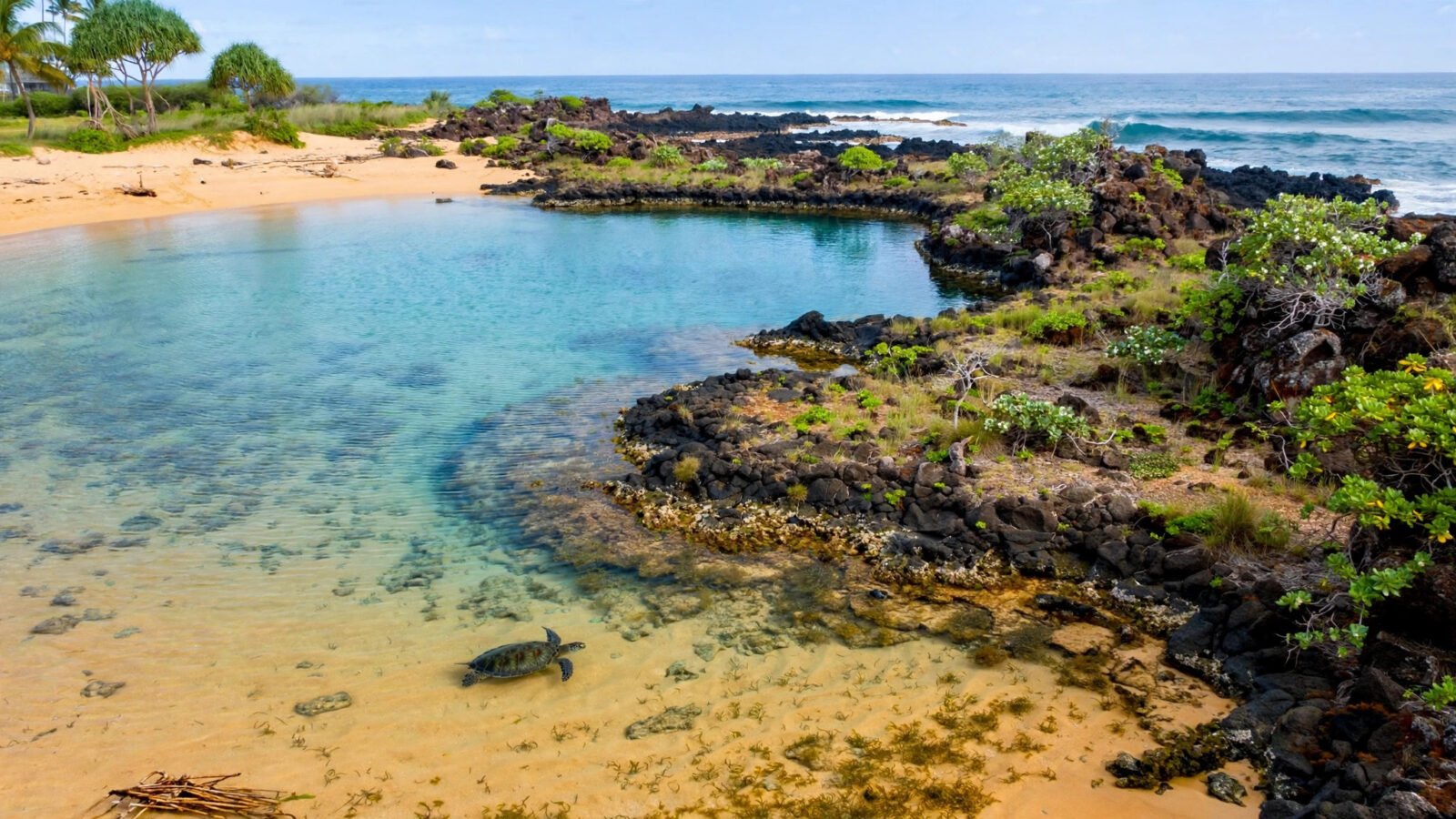
- Where
- Beside Turtle Bay Resort, Kahuku — east (right) side of the resort, North Shore Oahu
- Cost
- Beach is public and free; parking for non-resort guests varies — see below
- Difficulty
- Beginner — the most protected water on the North Shore, on calm days
- Season
- Year-round in principle — the rock rim works in winter, with judgment
- Depth
- Shallow; reports commonly put most of the cove at roughly 4–10 ft, shallowest inside
- Turtles
- Sometimes — keep at least 10 ft away
- Facilities
- Showers and restrooms near the cove; no lifeguard
Why Kuilima Cove is the North Shore winter exception
The rule elsewhere on this coast is simple: summer is for snorkeling, winter is for surfing. From October to April, big swells turn most North Shore beaches into expert surf breaks, and snorkeling them would be reckless. Kuilima breaks the rule because of its shape. A natural rock barrier rims the cove and takes the force out of incoming swell, leaving a sheltered pool where beginners can float over reef fish while contest-sized waves unload on the open coast nearby.
The barrier lowers the energy inside; it does not switch the ocean off. On the biggest winter days, water still pushes over and around the rocks, visibility drops, and the cove stops being a beginner spot for that day. Think of Kuilima as the North Shore’s most forgiving snorkel, not a guaranteed one. In summer, when this coast usually lies flat, it is simply an easy, pleasant snorkel — useful, but no longer unique. And remember: all beaches in Hawaii are public. The resort changes the parking, not your right to be here.
Where exactly to snorkel in the cove
Enter over the sand on the right-hand half of the beach. Walk in barefoot until the water is deep enough to float, then put your fins on once buoyant — shuffling in wearing fins is how ankles twist and reef gets kicked. Inside, work slowly toward the rocks and reef edges rather than the sandy middle. Fish gather around the rock patch in front of the beach and along the rocky rim and point on the right; that right-hand side, along the rock breakwater, is generally the most interesting water here. The bottom is sand, coral flats and scattered boulders, so this cove rewards slow looking rather than distance.
Now the boundary that matters. The left side is where the water leaves the cove. When waves wash over the outer rocks, that water escapes through a channel on the left — which is why a floating barrier is used to keep swimmers out of that side. Treat any floating barrier or roped area as a hard line, not a suggestion. Currents in that outflow can be strong even when the rest of the cove looks gentle, and they pull toward the opening. Stay centre and right, inside the protected pool — and if no barrier is visible, apply the same rule anyway.
What you will see
Set expectations honestly and Kuilima will meet them: this is a fish-and-turtles cove, not a coral garden. Coral is patchy — scattered heads and flats among the rocks — but fish life around that structure is reliable. Snorkelers regularly report butterflyfish, parrotfish, damselfish, surgeonfish, tangs, wrasses, triggerfish, goatfish and Hawaii’s state fish, the reef triggerfish (humuhumunukunukuapua’a), with crustaceans hiding in the rockwork if you slow down and look into the shadows.
Turtles are a genuine possibility, not a promise. Green sea turtles (honu) visit the cove and point to feed and rest, and a calm morning gives you the best chance. Watch from at least 10 feet (about 3 metres) away, never touch, chase or block a turtle, and let it leave if it moves off. Turtles are protected by law — and a calm, distant snorkeler usually gets the longer view anyway.
Kuilima Cove in numbers: depth, visibility and the current
The cove is shallow. The reef sits 4–8 feet below the surface in places, and the snorkelling water inside the cove is no more than about six feet deep — wading depth at the sand, swimming depth a short way out. That is why it suits beginners: you are never far from a bottom you can see, and you do not need to dive to find the fish.
Visibility is typically 20–40 feet on a calm day. It drops fast when conditions turn: trade winds chop the surface by mid-morning and stir sand inside the cove, and winter swell pushing white water over the outer reef clouds it further. The practical rule is the one in the best-time section — mornings, before the wind, on a small-swell day.
A mild longshore current runs across the cove and picks up near the reef edges, so stay in the middle of the cove and do not drift toward either end. Published sources disagree on its direction, so do not rely on a compass reading — rely on position: if you find yourself drifting toward the rocks or the point, swim back to the sandy centre. This is a separate, gentler movement from the left-side outflow channel described in the safety section, which is the current that matters most.
Tides at Kuilima Cove: what low tide changes
The depth and visibility figures above move with the tide. At low tide the cove is shallower still and the snorkelable area shrinks — one snorkeling guide puts it plainly: snorkeling here takes place in a small area, especially when the tide is low. The reef and the rocky edges sit closer to the surface, so the advice to keep your feet up and stay over the sand matters even more, and the urchin-bearing rock a short swim out is easier to reach by accident.
Low tide can also cost you visibility. Sand kicked up in the shallows clouds the water, so a low-tide afternoon with wind on it is the combination most likely to turn the cove milky — the same sand that makes entry easy is what clouds it. Tide is a second check, not a replacement for the first one: check the tide chart alongside the surf forecast and the morning rule, and if the water already looks cloudy from the sand, do not expect it to clear once you are in. Swell and wind still decide whether to get in at all; tide decides how much room and depth you will have once you do.
Best time to snorkel Kuilima Cove
Mornings win, as almost everywhere in Hawaii: lightest wind, clearest water, calmest surface — and a parking space. By afternoon, trade winds often pick up on this exposed coast; Kuilima is particularly open to them, and wind chop stirs the sand inside the cove, turning good visibility milky even on a fine day.
Season changes the calculation rather than cancelling it. In summer the cove is at its calmest and clearest. In winter it is often the only North Shore snorkel still on the table — but only on the right day. On small-to-moderate swell days the inner cove can be lovely; when a big swell runs, surge crosses the barrier, the left-side outflow strengthens, and the correct decision is to watch from the sand. Field test: if water inside the cove is visibly moving, textured or washing over the rocks, skip it. Calm inside means go; energy inside means don’t. Check a North Shore surf forecast before you drive, then re-check with your eyes on arrival.
Getting there and public parking
Kuilima Cove sits beside The Ritz-Carlton Turtle Bay Resort (formerly Turtle Bay Resort), near Kahuku on Oahu’s northern tip, off Kamehameha Highway (Highway 83). From Waikiki, allow roughly an hour to an hour and a quarter — up the windward coast on Highway 83, or through central Oahu on the H-2 and Highway 99 to Haleiwa, then east along the North Shore. Follow the resort entrance signs to beach access parking; the cove is the beach on the east (right-hand) side of the hotel. Look for the signed public-access entrance off Kuilima Drive, separate from the main resort entrance — the public lot sits near the tennis courts. Do not confuse it with the open bay on the resort’s other side — a different, far less sheltered piece of water.
Parking needs planning, and it is the one topic where published sources do not fully agree — so we report that, rather than inventing a tidy answer. Sources agree that public beach-access parking near the resort is limited, first-come, and that arriving early is the best tactic. They differ on cost for non-resort guests: some guides describe a small dedicated public-access lot as free, while other long-standing snorkeling sources warn that non-guests should expect to be charged, and resort parking beyond the public spaces is paid. Aim for the signed public spaces first, read the signs and rates on the day, and do not assume resort parking is free because the beach is. Nobody can charge you for the sand or water — beach entry is public and free.
One figure is now firm, for the resort side at least: the resort’s own site lists on-site self-parking and valet both at $48 a day ($336 a week) as of November 2026. That is resort guest parking, not the public-access lot — the public lot’s cost is the part sources still disagree on, so the hedge above stands.
Is Kuilima Cove good for beginners and kids?
On a calm day, yes — arguably the best learning water on the North Shore. Entry is over sand, the area is small and contained so nobody drifts far, and the water is shallow, with visitor reports commonly describing most of the cove in roughly the 4 to 10 foot range, shallowest inside the rim. A first-timer can practise breathing, clearing a mask and floating calmly here without fighting shore break.
The caveat travels with the praise: there is no lifeguard. Children need an adult within arm’s reach, weak swimmers should wear a flotation aid, and everyone stays away from the left-side channel. A beginner-friendly cove on a calm morning can still be the wrong place on a rough afternoon — judge the day in front of you, not this page.
Safety: the honest list
Channel and rip risk. The main hazard is moving water at the cove opening, especially the left-side outflow channel. In higher surf, water entering over the rocks drains out there with real force — a rip-like current that can carry a swimmer out. Respect the floating barrier, stay off the left side, and never snorkel out of the cove or around the point.
High surf. Winter swells can make even this cove surge and churn. If waves break over the outer barrier or the water inside rises and falls with each set, stay on the beach.
Reef hazards. Snorkelers report sharp reef and sea urchins in the rocky areas a short swim out — around twenty yards in, in some reports. Keep your feet up, float rather than stand, and never put a foot down on coral: it protects you from cuts and spines, and protects reef that takes decades to grow.
Basics. Never snorkel alone, enter and exit at the same sandy spot, and get out if you are tired, cold or being pushed somewhere you did not choose. Trade winds can cloud visibility fast, which disorients beginners — another reason mornings are the smart session.
There is no county lifeguard at Kuilima Cove. The resort’s beach attendants watch the cove during the day but have no formal lifeguard authority, so treat them as a courtesy presence rather than a safety net. The nearest staffed county lifeguard towers are at Sunset Beach and Waimea Bay, a short drive south — in a real emergency, dial 911.
Facilities and snorkel gear rentals
Facilities are simple but sufficient: outdoor showers and restrooms near the cove, some shade at the back of the beach, and resort food and drink outlets beside the beach for guests and paying customers — treat those as a bonus, not a plan, and bring your own water and snacks.
Can you rent snorkel gear at Kuilima Cove? Rental has been available from beach and water-activities services in the resort area — which is why that question is such a common search — and rentals also exist in Haleiwa and elsewhere on the North Shore. Desks, stock and prices change, so confirm on the day, or bring your own kit: a well-fitting mask beats a rental every time.
Kuilima Cove vs Shark’s Cove vs Hanauma Bay
Vs Shark’s Cove: In summer, Shark’s Cove, a short drive west, is the better snorkel — bigger, more structure, more life. But it is summer-only; in winter surf it is dangerous and off the table. Kuilima wins exactly when Shark’s Cove loses, and works year-round as the calm backup.
Vs Hanauma Bay: Hanauma, on the south-east coast, is Oahu’s famous managed preserve — denser fish life, plus a formal entry and reservation system. It is the better headline snorkel if you can book it. Kuilima is the opposite: no booking battle, just a quiet cove where you already are. Do Hanauma as the planned excursion; Kuilima as the easy North Shore morning.
Nearby: Kawela Bay, the main bay, and a North Shore day plan
Kawela Bay, a walk east along the coast path, is a quiet, scenic bay with a banyan-tree shoreline — go for the walk and scenery, and apply the same conditions-first judgment to any swimming. Turtle Bay’s main bay, on the resort’s other side, is not the same snorkel: open, exposed water with no protective rim, generally not good swimming or snorkeling water. When people say they snorkeled “Turtle Bay,” they almost always mean Kuilima Cove — a distinction that matters for safety, not just geography.
A good day built around Kuilima: arrive early, snorkel the calm morning window, walk toward Kawela Bay, then watch surf — in winter, the famous breaks around Pipeline and Waimea Bay are a short drive west — and finish with lunch in Haleiwa. For every option across the island, start with our Oahu snorkeling hub, and consider Electric Beach or a boat trip to Turtle Canyon off Waikiki for a different, turtle-focused day.
Waialea Bay (Two Ponds): the other Turtle Bay snorkel
Kuilima is not the only snorkel cove on this stretch of coast. Waialea Bay — known locally as Two Ponds — is the other named snorkel spot on the Turtle Bay coast: two natural ponds in the reef that hold fish and, on the right day, superb visibility.
It is more exposed than Kuilima, so it is a calm-days-only spot. Apply the same conditions-first test, and be stricter with it: if Kuilima is rough, Waialea will be worse, so it is not a fallback for a day Kuilima has already failed. On a flat summer morning it is a genuine second snorkel within the same visit; on any other day, treat it as a look, not a swim.
What to bring
- Mask, snorkel and fins that fit — rented nearby or brought with you
- Reef-safe sunscreen and a rash guard for sun protection
- A flotation aid for weak swimmers and children — there is no lifeguard
- Water, snacks and a towel; resort outlets are a bonus, not a guarantee
- A dry bag for keys and phone while you swim
- Respect: no touching turtles or coral, and take all rubbish away
Where Kuilima fits in an Oahu trip
Kuilima is a supporting act, not a headliner — and knowing that is the point. It will not be the most spectacular snorkel of your trip. What it offers is rarer: a beginner-friendly North Shore snorkel that works in months when this coast offers beginners nothing else, and a calm morning option a short walk from where North Shore visitors already stay. Judged on those terms, it earns its place in any Oahu plan — especially a winter one.
The name problem: Kuilima Cove, Turtle Bay, Bayview Beach — and Turtle Beach
Four names, one beach — and one beach that is not this one at all. Kuilima Cove is the cove itself: the reef-protected swimming hole on the east side of the resort. Turtle Bay is the whole coast the resort sits on — the open main bay, Kuilima Cove, Kawela Bay and Waialea Bay together — which is why “snorkelling Turtle Bay” almost always means Kuilima Cove, the only sheltered water of the four.
Bayview Beach is the same beach under a different listing name: some beach directories list this exact spot — 57-35 Kuilima Drive — as Bayview Beach. If a guide, a map pin or a review calls it Bayview Beach, it is still Kuilima Cove, and the directions on this page still apply.
Turtle Beach is the one to watch out for. That is the nickname of Laniakea Beach, a different North Shore beach south of here, famous for green sea turtles resting on the sand — and a place where swimming is not recommended. Do not drive to Laniakea expecting Kuilima’s calm cove; if turtles on the sand are the goal, our Laniakea Beach guide explains that beach properly.
Snorkeling at Turtle Bay: which beach is which
When people search for turtle bay snorkeling, they usually mean one specific place — but Turtle Bay is a whole stretch of coast, not a single beach. The Ritz-Carlton O’ahu, Turtle Bay sits on about five miles of North Shore coastline with seven beaches, and only one of them is the snorkel spot. Getting the beaches straight is the difference between a calm morning with turtles and a frustrating swim in open surf.
Kuilima Cove is the snorkeling beach. It is the small, reef-sheltered cove on the east (right-hand) side of the hotel, and it is what every “turtle bay snorkeling oahu” result is really describing: shallow sand entry, a reef arc offshore, and the best chance of honu on this stretch of coast. If you are standing on the sand at Kuilima Cove, you are snorkeling at Turtle Bay in the only sense that matters.
The main Turtle Bay beach — the wide stretch of sand directly in front of the hotel — is a different piece of water. It is a swimming and sunbathing beach, exposed to the open ocean, and it is not a snorkel spot. Do not walk in there with a mask expecting the cove; the entry is surf, not shelter. The same goes for the resort’s other beaches: they are for walking, surfing and sunset, not for snorkeling.
The one other snorkel option on the property is Waialea Bay (Two Ponds), covered above: two natural ponds west of the cove, more exposed than Kuilima and a calm-days-only call, not a fallback when Kuilima is rough.
So the short version: snorkeling in Turtle Bay means snorkeling Kuilima Cove, in the morning, from the sand on the east side of the hotel. Everything else at Turtle Bay is a beach day, not a snorkel day.
Turtle Bay snorkeling tours: what actually exists
There is no dedicated Turtle Bay snorkel boat to book, and that is the first thing to understand: Kuilima Cove is a shore-entry spot. You walk in from the sand, so no boat, no check-in and no tour is needed to snorkel here. The “turtle bay snorkeling tour” listings you will find are doing one of three things, and they are not the same thing.
The first is a resort activity. The resort’s activities desk and the beach services on the property handle snorkel gear rental and beach activities; ask at the desk about any guided shore session running during your stay, because what is on offer changes with the season and the surf.
The second is a circle-island tour with a turtle snorkel stop. Hawaii Turtle Tours runs a full-day Oahu circle-island tour that stops for a turtle snorkeling session at a North Shore turtle spot, with HMAR steward guides, a lifeguard present and gear included, in groups of up to 22 with Waikiki pickup. That is a day tour that includes a snorkel, not a Turtle Bay-only trip — and the stop is a North Shore turtle beach, so confirm where the snorkel happens before you book.
The third is a naming trap. Living Ocean Tours has a page called “Turtle Bay Snorkeling Oahu” that pitches its Turtle Canyon boat tour — but Turtle Canyon is a reef off Waikiki, on the opposite side of the island. It is a good turtle boat trip in its own right, and our Turtle Canyon guide covers it, but booking it will not take you to Turtle Bay.
If you want a guide at Kuilima itself, the honest answer is that the cove is the guide: shallow, marked by its reef arc, and covered end to end by this page. Bring your own gear or rent at the resort, get in before 10 a.m., and stay inside the cove.
Field reports we drew from
- Consensus of firsthand North Shore reports in our source set — Kuilima’s winter-refuge status is its defining, repeated observation.
- Beach access: all Hawaii beaches are public by state law; resort areas must provide access.
- Parking accounts differ between sources on cost for non-resort guests; this page reports that disagreement rather than a single unverified price.
FAQ
Is Kuilima Cove open to the public?
Yes. Like every beach in Hawaii, Kuilima Cove is public. You do not need to be a resort guest — use the public beach-access parking and walk in. Resort buildings and guest-only services are separate.
Is Kuilima Cove free if I’m not a resort guest?
The beach and snorkeling are free. Parking is the variable part: public spaces are limited, sources differ on whether non-guests pay in practice, and resort parking beyond the public spaces is paid. Arrive early and check signs on the day.
Can you snorkel at Turtle Bay?
Yes — but what people mean is Kuilima Cove, the sheltered cove east of the resort. The open main bay on the other side is exposed and is not the beginner spot.
Is Turtle Bay good for snorkeling in winter?
It can be: Kuilima’s rock barrier shelters the inner cove on small-to-moderate swell days, when other North Shore spots are impossible. On big-swell days the cove surges and the outflow strengthens — stay out.
Can you rent snorkel gear at Kuilima Cove?
Rental has been available from beach and water-activities services in the resort area, and in Haleiwa and elsewhere on the North Shore. Desks, stock and prices change, so confirm on the day — or bring your own mask.
Can kids snorkel at Kuilima Cove?
On calm days it is one of Oahu’s better kid coves — shallow, contained, sandy entry. There is no lifeguard, so children need an adult right beside them, and everyone stays away from the left-side channel.
Will I see turtles at Kuilima Cove?
Sometimes. Green sea turtles visit the cove and point to feed and rest; calm mornings give the best chance, but sightings are never guaranteed. Watch from at least 10 feet away and never touch or chase one.
Is Kuilima Cove worth a special trip across the island?
Usually not on its own. It is the right snorkel when you are already on the North Shore, especially in winter. Crossing the island for one headline snorkel? Hanauma Bay or Electric Beach will reward the drive more — or combine Kuilima with Kawela Bay, the surf breaks and Haleiwa.
Is Kuilima Cove the same as Bayview Beach?
Yes. Bayview Beach is the listing name some beach directories use for this same beach at 57-35 Kuilima Drive. Kuilima Cove is the name snorkellers and the resort use; the directions, parking and entry on this page apply to both names.
Do you need a reservation for Kuilima Cove?
No. Kuilima Cove is a public beach and there is no reservation or booking — you just turn up. The constraint is parking, not entry: the public spaces are limited and first-come, so arrive early, especially on weekends and holidays.
Is there a Turtle Bay snorkeling tour?
Kuilima Cove is a shore-entry spot and needs no boat — you walk in from the sand. Some Oahu operators advertise guided Turtle Bay snorkelling, so if you want a guide, check what the tour actually covers before booking: a shore session at the cove, or a boat trip elsewhere. The cove itself is covered end to end by this guide.
Where is the best snorkeling at Turtle Bay?
Kuilima Cove, the sheltered cove on the east side of the hotel. It is the only real snorkel beach on the Turtle Bay property — the main beach in front of the hotel is open surf, not a snorkel spot.
Is there a guided snorkel tour at Turtle Bay?
No dedicated Turtle Bay boat tour exists — Kuilima Cove is shore-entry, so no boat is needed. Circle-island day tours (Hawaii Turtle Tours) include a North Shore turtle snorkel stop with a guide and lifeguard, and the resort’s activities desk handles gear rental. Watch out for “Turtle Bay” pages that sell a Turtle Canyon boat trip: Turtle Canyon is off Waikiki, a different place.
Can you snorkel from the main Turtle Bay beach in front of the hotel?
No — that beach is exposed to open-ocean swell and is for swimming and sunbathing, not snorkeling. Walk around to Kuilima Cove on the east side of the hotel for the sheltered snorkel.
Does the tide matter at Kuilima Cove?
Yes. At low tide the cove is shallower and the snorkelable area is smaller, and stirred-up sand can cloud the water — see the tides section above. Tide is a second check after swell and wind: check the tide chart with the surf forecast, and if the water looks cloudy from the sand, do not expect it to clear once you are in.
What fish species will I see at Kuilima Cove?
The common sightings are reef fish rather than a coral garden: convict tang and yellow tang, fourspot and millet butterflyfish, and the endemic fantail filefish, among the butterflyfish, parrotfish, damselfish, surgeonfish, wrasses, triggerfish and goatfish listed above. Green sea turtles visit too — keep at least 10 feet away and never touch or chase them.
The next bay west is quieter still — our Kawela Bay snorkeling guide covers its calm lagoon, stream mouth and monk seal sightings.