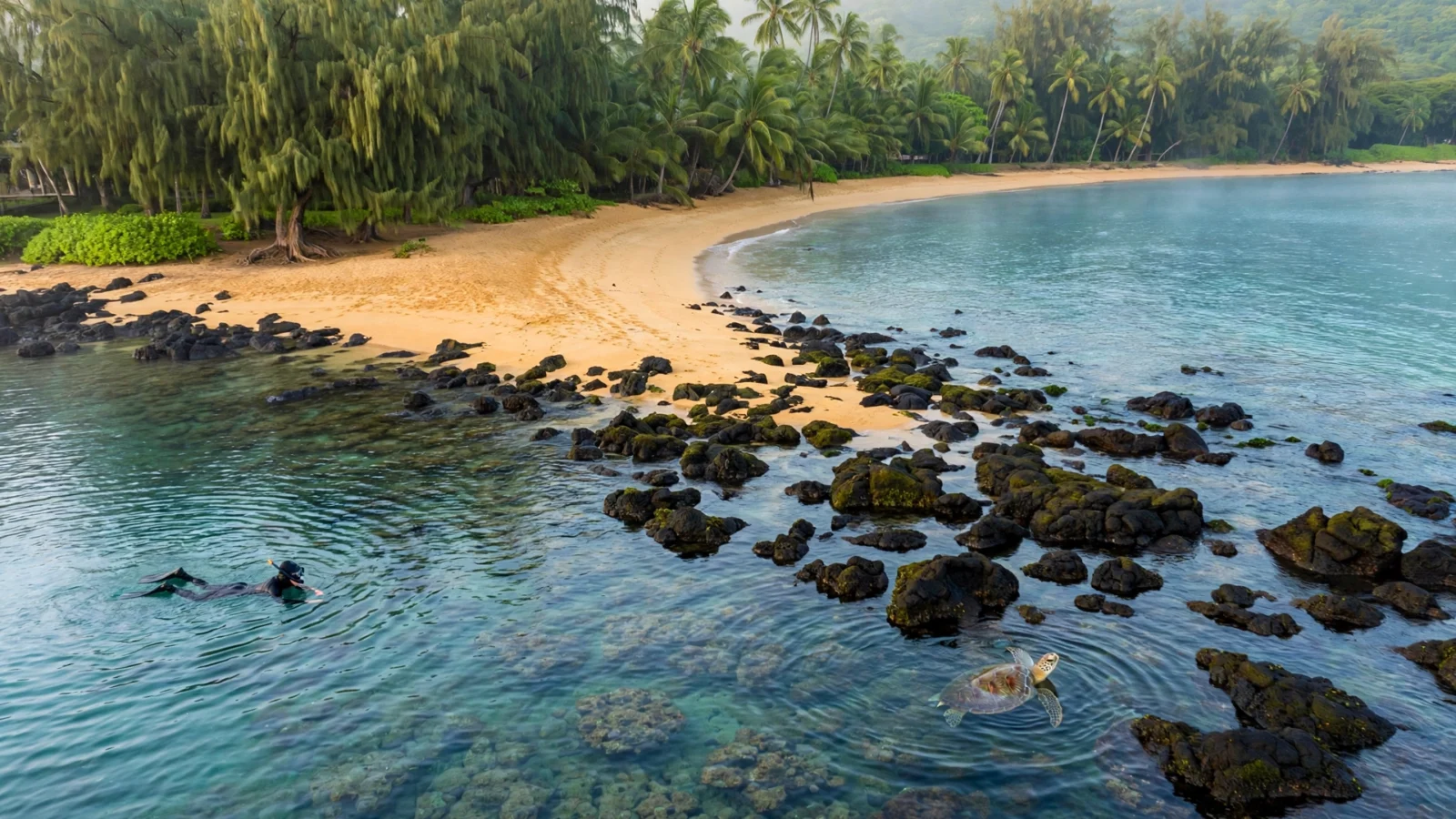
Kawela Bay is the North Shore beach that travel writing cannot agree about. One guide calls it a calm, clear snorkeling cove. A local family site says, flatly, that it is not really a swimming beach at all. Visitor reviews split down the middle: “great spot for snorkeling and spotting turtles” against “the visibility is not conducive to snorkeling.” All of them are describing the same bay — they are just describing different parts of it, on different days, with different expectations. Kawela is the last undeveloped bay before Turtle Bay Resort, a reef-protected crescent of narrow sand and ironwood shade an hour from Waikiki, and it rewards exactly one kind of snorkeler: the one who arrives knowing the bottom is coral rubble, the water near the main beach can run murky, and the clear water hides at the quieter end of the bay. This guide gives you the split verdict in full — where the snorkeling actually works, where it does not, how to reach a beach with no sign and no parking lot, and when the cove ten minutes away at Kuilima is simply the better choice.
The honest summary, up front: Kawela Bay is not a beginner’s first snorkel and it is not a reef showcase like Shark’s Cove in summer. What it is, on a calm morning, is one of the most peaceful shallow-water explores on the North Shore — a protected bay where the surf that closes every neighbouring beach in winter is diffused by the fringing reef, where turtles cruise the shallows, and where you may have a hundred metres of shoreline to yourself. The price of admission is effort and honesty: water shoes are non-negotiable, there are no facilities of any kind, and if the water looks brown-green from the sand, the right move is to walk the forest, see the famous banyan tree, and snorkel somewhere else that day. Read the conditions section before you commit to the drive.
Quick facts
- Location: Kawela Bay, Kahuku, on Oahu’s North Shore — the next bay west of the Ritz-Carlton O’ahu, Turtle Bay, reached from Kamehameha Highway or by the shoreline trail from the resort
- The snorkeling, honestly: A reef-protected bay with coral rubble across most of the bottom, patchy shallow reef, turtles, and visibility that ranges from genuinely clear at the quiet west end on calm mornings to murky near the main beach after swell or rain. A peaceful explore, not a coral showcase
- Lifeguard: None — two independent guides agree there is no lifeguard at Kawela Bay
- Fees and reservations: No fee and no reservation; the beach is a public beach park. There is no formal parking lot — see the access section
- Parking: Roadside parking across from the fruit stands on Kamehameha Highway near Kawela Camp Road (where the guardrail ends; no sign), or the Turtle Bay Resort public beach-access parking followed by a shoreline walk of a little over a mile
- Facilities: None at the bay — no restrooms, no showers. The nearest restrooms are at Turtle Bay (a short drive east). Bring everything, pack everything out
- Best time: A calm morning, ideally in summer or on a settled winter day inside the reef; visibility is at its best early, before wind and swimmers stir the shallows
- The one rule that matters: Wear water shoes or your fins from the moment you step in. Most of the bay floor is sharp volcanic rock and coral rubble, not sand
First, a naming warning: Kawela Bay is not Turtle Bay Beach
Half the confusion about this bay starts with the name. Some roundups merge “Turtle Bay Beach / Kawela Bay” into a single listing, and at least one recent visitor review insists the Kawela pin is “also known as Turtle Bay.” They are two different bays. Turtle Bay Beach — Kuilima Cove, the resort’s own sheltered cove with the sandy entry and the rental stand — sits on the resort point. Kawela Bay is the separate, undeveloped crescent west of it, beyond the point, with no resort frontage at all. If your map pin drops you at a beach with loungers and a snorkel-rental hut, you are at Kuilima, not Kawela. If it drops you on a highway shoulder opposite a fruit stand, with a dirt path disappearing into ironwood trees, you are in the right place. This guide is about the second beach. For the first one, our Kuilima Cove guide covers it properly, and the comparison table below lays the two side by side.
The snorkeling: rubble, patches and the clear end of the bay
Kawela’s underwater terrain is the first thing to understand, because it explains every divided review. Unlike Kuilima’s sand-bottomed cove, most of Kawela Bay’s floor is volcanic rock and coral rubble — loose stones, broken coral and reef flat stretching across the bay, with live coral in patches rather than gardens. A local family guide warns that the rubble runs throughout the bay and is thickest toward the northern end. You do not float over this bottom so much as pick your way through it, which is why the entry matters more here than the snorkeling itself.
The entry: shuffle, never stride
There is no soft sand channel to walk out through. Wade in slowly at the narrow sandy shore, shuffling your feet, in water shoes or with your fins already on — reviewers who skipped the footwear describe stepping on something pointy as a near-certainty. Once you are deep enough to float, stay floating: the rubble that is an annoyance to feet is a hazard to stand on, for your skin and for the reef. Snorkelers used to groomed resort coves find this first two minutes undignified. It is also the whole test — if the entry puts you off, Kawela was never your beach, and Kuilima is ten minutes away.
Where the clear water is
Visibility is Kawela’s swing factor, and the pattern across visitor reports is consistent: the water near the main, eastern beach — where the stream-side shallows and most swimmers are — can run murky, while heading west along the bay, toward the quieter far end, the water clears. Work the rocky structure and reef patches along that western shore in the morning, when the light is low, the surface is glassy and nothing has stirred the bottom yet. What lives here is the standard North Shore shallow cast rather than a spectacle: reef fish around the structure, the occasional eel in the rocks, and — the sighting the bay is genuinely known for — green sea turtles cruising the shallows or resting near shore. Turtles are frequent here, never guaranteed, and the full 10-foot rule applies. Hawaiian monk seals also haul out on this coast occasionally; give a resting seal even more room than a turtle.
The low-tide bonus: the northern tide pools
At low tide, the rocky northern end of the beach — the worst snorkeling terrain in the bay — turns into its other attraction: tide pools in the reef flat where small reef creatures collect. Families with kids who would rather explore than swim rate this end of the bay highly. Time it for a falling tide, wear the same water shoes, and leave every pool exactly as you found it.
Conditions: the reef-protected exception — with limits
Kawela’s one famous virtue is real. A broad fringing reef sits off the bay and diffuses the North Shore’s winter surf before it reaches the shore, making Kawela one of the most protected bays on this coast — nearshore water that stays comparatively calm in winter, when Waimea Bay and the Pupukea coast are closed out entirely. That is why Kawela appears on “year-round calm” lists. But two honest limits come with it. First, protected is not the same as clear: big swell outside the reef still stirs sand and sediment over the reef flat, and winter clarity drops accordingly — several guides rate summer the bay’s best snorkeling season for exactly this reason. Second, the reef has openings, and calm-looking water can still pull near them; local safety notes flag rip currents by the reef gaps. Stay inside the bay, in the shallows, well away from the openings and the surf breaking on the outer reef — that outer zone belongs to surfers, and its currents are strong.
Rain matters here too. The bay sits below green hills and a stream mouth, and after heavy rain the nearshore water browns out — the classic Hawaii rule applies: if the water looks murky from the sand, it is murky, and the snorkel can wait. Build Kawela into a North Shore day as the calm-morning first stop, with Kuilima or a best-time check as your plan B, and a brown-water day costs you nothing.
How to get there: two routes, no sign
Kawela Bay has no entrance sign, no parking lot and no facilities — finding it is part of the experience, and sources describe two working routes.
Route 1: the fruit-stand gate (shortest walk)
Drive Kamehameha Highway east past Haleiwa toward Turtle Bay. Near Kawela Camp Road, across from the fruit stands, the guardrail ends — park along the road there. A local family guide’s precise advice: there is no sign; cross the highway carefully (this is a fast rural road — treat the crossing as the most dangerous part of your visit), and follow the dirt path through the trees to the beach. The same guide suggests the highway parking is the safer option over the dirt lot, and that buying fruit from the stand is a reasonable thank-you for parking opposite it. The path brings you through the forest — past the banyan tree — to the middle of the bay.
Route 2: the resort shoreline trail (longest walk, easiest parking)
Park in the Turtle Bay Resort’s public beach-access parking (follow the resort’s beach-access signs; the resort is now the Ritz-Carlton O’ahu, Turtle Bay), then walk the shoreline trail west. Roundups put the walk at a little over a mile each way to Kawela; resort guests quote the full trail loop at about 2.5 miles. It is a beautiful, shaded coastal walk past Kuilima Cove and the point — and it comes with the resort’s restrooms at the trailhead end, which Kawela itself entirely lacks. If anyone in your group needs facilities, this route is how you build them into the day.
The banyan tree and the pillbox
Behind the beach stands the bay’s famous banyan — a sprawling multi-trunk tree filmed for Lost, Pirates of the Caribbean and The Hunger Games: Catching Fire. One current note the older guides miss: the tree is now roped off by the resort and climbing is no longer allowed — you can walk the forest and stand among the roots, but treat it as a look, not a playground. At the bay’s point, a short rise leads to a WWII pillbox with the coast’s best sunrise view over the bay. Together they make the land half of a Kawela visit — which, on a murky-water day, becomes the whole visit, and is honestly still worth the stop.
Kawela Bay Beach Park: what the park listing actually means
Search “kawela bay beach park” and you will find a park listing — Kawela Bay Beach Park, 57 Kamehameha Hwy, Kahuku, HI 96731. Expecting a developed county park from that listing is the mistake. Land for a beach park here was allocated but never improved, and on the ground the bay has no lifeguard, no restrooms, no showers and no formal parking lot — the same reality the safety section below spells out. Treat the listing as a map pin, not a facilities promise: this is an undeveloped bay you walk into, not a park you drive into. Do not rely on any hours shown on listing sites either; they disagree with each other and none of them is an official county schedule.
Safety at Kawela Bay
- No lifeguard, no facilities. Confirmed by multiple guides: no lifeguard, no restrooms, no showers, no formal lot. Snorkel with a buddy, and tell someone your plan — this is an undeveloped bay, not a managed beach park in practice
- The rubble is the main hazard. Sharp volcanic rock and coral cover most of the bottom. Water shoes or fins from the first step; float, never stand; shuffle on entry and exit
- Stay inside the reef. Currents strengthen near the reef openings, and the outer reef is a surf zone with strong currents. The calm you came for lives in the inner bay
- Murky water means no snorkel. After rain or big swell, visibility collapses and hidden rubble gets harder to avoid. Brown water, no entry — the forest and pillbox are the backup plan
- Turtles and seals are protected. Ten feet minimum for turtles; much more for a hauled-out monk seal. Never touch, chase or position yourself between an animal and the open water
- The highway crossing. If you use the fruit-stand route, you cross a fast, unmarked stretch of Kamehameha Highway on foot, twice. Look both ways twice — it is statistically the riskiest moment of the trip
- Our full Hawaii snorkeling safety guide covers the pre-snorkel checklist, jellyfish windows and current rules for every spot on this coast, and reef-safe sunscreen is the only kind to bring — there is no shop here to buy it from
Kawela Bay vs Kuilima Cove: which Turtle Bay snorkel?
Visitors mix these neighbours up constantly, and they serve genuinely different people:
| Kawela Bay (this guide) | Kuilima Cove | |
|---|---|---|
| Setting | Undeveloped bay west of the resort point; forest and ironwood shade | The resort’s own cove at Turtle Bay |
| The bottom | Coral rubble and rock across most of the bay; patchy reef | Sand-bottomed cove with reef at the edges |
| Entry | Shuffle-in over rubble; water shoes essential | Sandy, gentle entry |
| Visibility | Variable — murky near the main beach, clearer at the west end on calm mornings | More consistent, sheltered cove water |
| Crowds | Secluded; often near-empty on weekdays | Resort-busy |
| Facilities | None at all; no lifeguard | Resort-adjacent facilities; the beginner infrastructure |
| Best for | A quiet, self-sufficient explore + forest walk on a clear calm morning | First snorkels, families, and a guaranteed-easy session |
Our verdict: if you are choosing your one North Shore snorkel and anyone in the group is a beginner, choose Kuilima. Choose Kawela when you have already done the easy coves, the morning is calm and clear, and a quiet bay with a forest walk sounds better than a sure thing.
Beyond snorkeling: kayaks, the fishpond and the land walk
On a calm morning the bay is as good for paddling as it is for floating. Kayaking and stand-up paddleboarding suit Kawela’s sheltered water, and kayak rentals are listed on-site; guided kayak tours also run from the Turtle Bay side — Shaka Kayaks offers roughly 90-minute guided paddles around the bay with turtle spotting — which is the easy option if you would rather not bring your own gear. Stay inside the reef either way: the outer reef carries surf breaks and strong currents, and it is not paddling water.
At the eastern end of the beach sits Loko Pa’aiau, an ancient Hawaiian fishpond, partially restored and a significant cultural and an archaeological site. It is the bay’s quiet history lesson — look from the shore, leave it alone, and pair it with the banyan tree and the WWII pillbox on the point above. The whole shoreline stays this way by design: a 2014 conservation easement covering 665.8 acres, agreed between Turtle Bay Resort, the State of Hawaii, the City and County of Honolulu and the North Shore Community Land Trust, protects Kawela Bay from future development. That is why the bay still feels undeveloped — and why it is worth keeping it that way on your visit.
Nearby snorkeling spots
- Kuilima Cove (Turtle Bay) — the resort cove just east, via the same shoreline trail: the beginner-friendly neighbour
- Laniakea Beach — Turtle Beach proper, down the coast toward Haleiwa, for shore-side honu watching
- Haleiwa Beach — Ali’i Beach Park’s trench and turtles, with a town day attached
- Shark’s Cove — the North Shore’s real summer reef showcase, when the swell is down
- Waimea Bay — the famous bay west: a summer-only snorkel under the rock
- The whole coast is mapped in our Oahu snorkeling hub
Frequently asked questions
Is Kawela Bay good for snorkeling?
Sometimes — and that is the honest answer the other guides avoid. On a calm, clear morning, the protected bay offers a peaceful shallow snorkel over patchy reef with a real chance of turtles, with the clearest water at the quiet west end. After swell or rain, or near the main beach on a stirred-up day, visibility can be poor and there is little to see over the rubble. It is a conditions-dependent explore for self-sufficient snorkelers, not a reliable reef showcase.
Is Kawela Bay the same as Turtle Bay Beach?
No. Turtle Bay Beach is Kuilima Cove, the resort’s sandy, beginner-friendly cove on the point. Kawela Bay is a separate, undeveloped bay about a mile west along the shoreline trail, with a rubble bottom, no facilities and far fewer people. Roundups and map pins confuse the two constantly — if you see loungers and a rental stand, you are at Kuilima.
How do you get to Kawela Bay?
Two ways. Park along Kamehameha Highway across from the fruit stands near Kawela Camp Road, where the guardrail ends (there is no sign), cross the highway carefully and follow the dirt path through the forest. Or park in the Turtle Bay Resort’s public beach-access parking and walk the shoreline trail west for a little over a mile. There is no formal parking lot at the bay itself.
Are there lifeguards, restrooms or showers at Kawela Bay?
No — none of them. Kawela is an undeveloped public beach: no lifeguard, no restrooms, no showers, no rentals and no shop. The nearest facilities are at Turtle Bay Resort, a short drive east. Bring your own gear, water, food and reef-safe sunscreen, and pack everything out.
Can you see turtles at Kawela Bay?
Frequently, yes. Green sea turtles cruise Kawela’s shallows and rest near shore, and the bay is one of the better North Shore spots for an unhurried sighting simply because it is so quiet. Sightings are never guaranteed. Keep at least 10 feet (3 metres) away, never touch or chase, and give the occasional hauled-out monk seal far more room still.
Is Kawela Bay good for beginners and kids?
It is a split answer. The water is sheltered and shallow, which suits confident beginners on a calm, clear day — but the rubble entry, absent lifeguard and variable visibility make it a poor choice for a very first snorkel; Kuilima Cove nearby is built for that. For kids, the bay’s forest trails and low-tide pools at the northern end are a genuine highlight — as an explore day rather than a swim day.
When is the best time to snorkel Kawela Bay?
A calm early morning, when the surface is still glassy and visibility peaks before wind and swimmers stir the shallows. Summer offers the most reliable clarity; winter’s big swells are diffused by the reef, so the bay stays comparatively calm, but the stirred-up water is often murkier. After heavy rain, skip the snorkel entirely and take the forest walk instead.
Can you climb the famous banyan tree at Kawela Bay?
Not any more. The multi-trunk banyan behind the beach — the filming tree from Lost and Pirates of the Caribbean — is now roped off by the resort and climbing is no longer allowed. You can still walk the forest trails among its roots, and the shoreline path continues through to Turtle Bay.
What does Kawela mean?
Ka wela means “the heat” in Hawaiian — a fitting name for this dry, sunny stretch of the North Shore between Turtle Bay and Kahuku.
Is there a Kawela Bay Beach Park — and does it have facilities?
There is a listing for Kawela Bay Beach Park at 57 Kamehameha Hwy, Kahuku, but the land was allocated and never improved as a park. At the bay itself there are no restrooms, showers, lifeguards or formal parking — come self-sufficient, as the guide above explains.
Can you kayak at Kawela Bay?
Yes, on calm days — the reef-sheltered water suits kayaks and stand-up paddleboards, rentals are listed on-site, and guided kayak tours run from the Turtle Bay side. Stay inside the reef and skip it entirely on rough or rainy days, when the water turns murky.