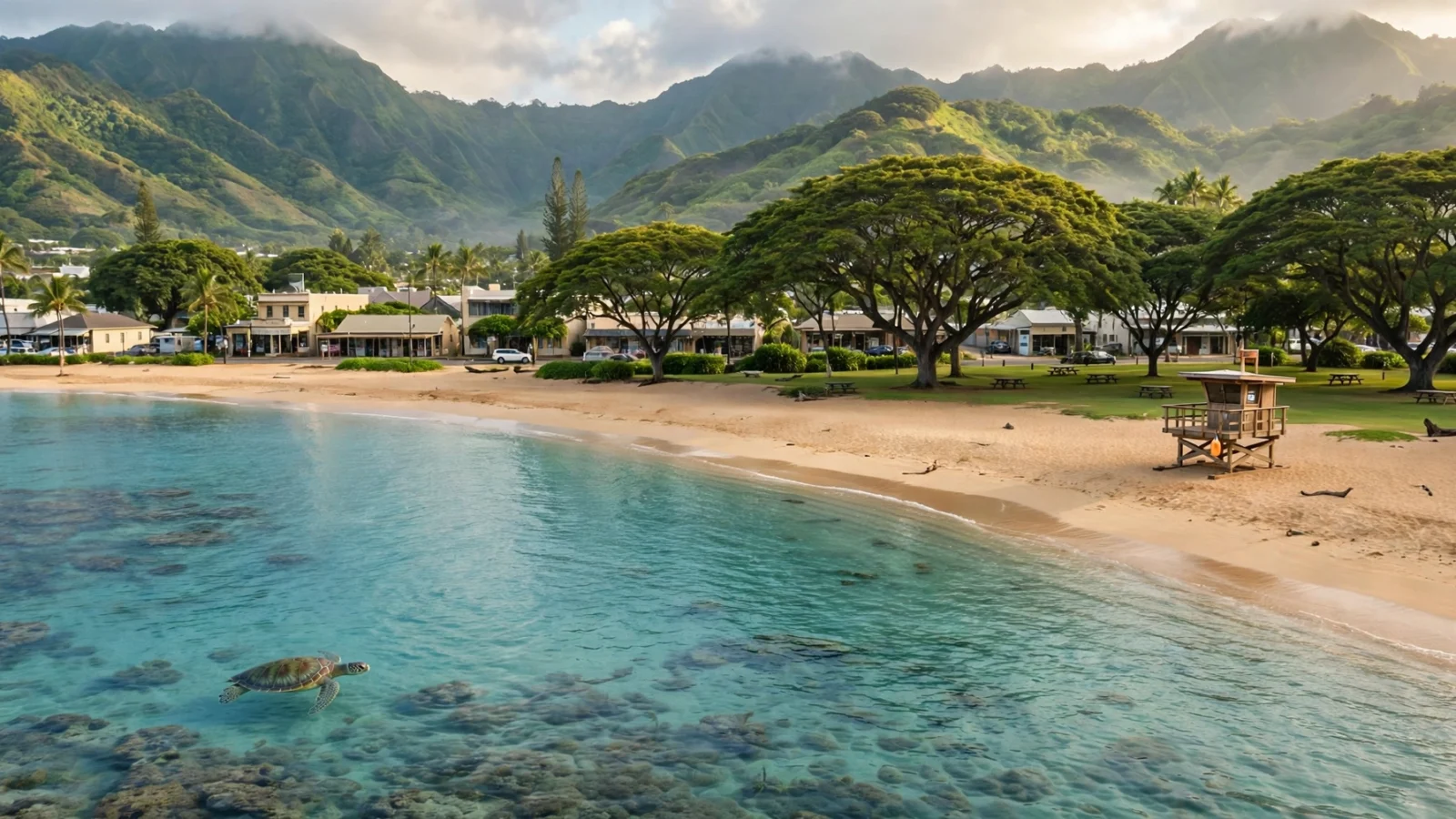
Every North Shore snorkeler knows Shark’s Cove. Far fewer know that fifteen minutes west, in the middle of Hale’iwa town, sits the shore snorkel the tour vans quietly use for their turtle stop: the reef off Hale’iwa Ali’i Beach Park, where green sea turtles feed on the algae-covered rocks in water calm enough — in summer — for a supervised first snorkel, with lifeguards, showers, free parking and a whole surf town’s worth of shave ice waiting on the sand.
Hale’iwa comes with a trap, though, and this guide exists largely to spring it: there are TWO beach parks with almost the same name. Hale’iwa Beach Park, by the harbour, has a shallow, rocky bottom where even the local beach guides admit swimming “isn’t that good.” Hale’iwa Ali’i Beach Park, west of the harbour at the end of Hale’iwa Road, is the one with the reef, the turtles and the lifeguard tower. Show up at the wrong one and you will conclude — wrongly — that Hale’iwa has no snorkeling. This guide covers the right park properly: the inshore reef zones, the turtle etiquette, the advanced-only Hale’iwa Trench offshore, and the hard North Shore rule that governs all of it — this is a summer snorkel that shares its reef with a world-famous winter surf break.
Haleiwa Beach snorkeling at a glance
| Question | Answer |
|---|---|
| Where is it? | Hale’iwa Ali’i Beach Park, 66-167 Haleiwa Rd, Hale’iwa — a ~19-acre park on the west side of Hale’iwa town, Oahu’s North Shore, just west of the boat harbour |
| Not to confuse with | Hale’iwa Beach Park (62-449 Kamehameha Hwy), the harbour-side park by Pua’ena Point — shallow and rocky, swimming “isn’t that good” there; Ali’i is the snorkel park |
| The draw | Green sea turtles feeding on the inshore reef + a family-friendly, lifeguarded park — plus the Hale’iwa Trench drop-off for advanced snorkelers |
| The zones | 1) The inshore reef and sandbar (families, turtles), 2) the reef line west along the beach, 3) the Haleiwa Trench walk-out (advanced only, flat days only) |
| What you see | Green sea turtles grazing the rocks, reef fish over the coral and rock, and — from the sand — Hale’iwa’s famous surf in winter |
| Best time | Summer, roughly April/May to October, on a calm morning; winter is surf season and a no-go for snorkeling |
| Parking | Free park lot — large by North Shore standards; the lot closes at 10pm |
| Lifeguards | Yes — lifeguards on duty during regular hours (unusual for a North Shore snorkel, and a real plus) |
| Facilities | Restrooms, outdoor showers, picnic tables, grassy shade, the John K. Kalili Surf Center; gear rentals and food in Hale’iwa town, minutes away |
| Who it suits | Families and confident beginners in summer calm (inshore zones); the Trench is for strong, experienced snorkelers only |
New to the North Shore? Our Shark’s Cove guide and Waimea Bay guide cover the other summer snorkels east of here — and our best time to snorkel in Hawaii guide explains the North Shore’s summer-calm / winter-surf split that rules them all.
First, the two Hale’iwa beach parks — do not mix them up
This is the single most useful paragraph in this guide, because the naming confusion sends people to the wrong water:
- Hale’iwa Ali’i Beach Park — 66-167 Haleiwa Rd, on the WEST side of town, past the boat harbour. This is the surf-and-snorkel park: a wide sandy beach, a reef offshore, lifeguards, the surf center, the war memorial in the park, and room to spread out across roughly 19 acres of grass and sand. This is the park this guide is about.
- Hale’iwa Beach Park — 62-449 Kamehameha Hwy, on the harbour side by Pua’ena Point and the Anahulu Stream mouth (the Rainbow Bridge end of town). A pleasant picnic and paddling park — canoe crews train here and beginner surf lessons run at Pua’ena — but its ocean bottom is shallow and rocky, and swimming there is genuinely poor. It is a fine place for a picnic. It is not the snorkel.
Even some big guide sites merge the two into one entry. If your map pin lands you beside the harbour looking at a rocky flat, you are at the wrong park: drive west through town and follow Haleiwa Road to Ali’i.
The three zones: how to snorkel Ali’i Beach Park
Zone 1: the inshore reef and sandbar — the family snorkel
Off the main beach, the bottom starts as sand — including a shallow sandbar area where keiki splash — then gives way to the patchy coral and rock of the inshore reef. This is the snorkel most visitors should do, and the one the circle-island tours use: enter on the sand, fin out over the reef edge, and work slowly along the rock-and-coral line where the fish hold.
The headline here is turtles. Honu graze the algae and seaweed growing on the inshore rocks — the tours come for exactly this — and on calm summer days multiple turtles feeding close to shore is a normal, not lucky, outcome; they also haul out to bask on the sand. Float, watch, and keep at least 10 feet away at all times (our snorkeling with turtles guide covers the full etiquette). Two honest cautions for this zone: the bottom past the sand edge can drop off a few feet fairly quickly, so non-swimmers should stay over the sandbar; and where the bottom is rock rather than sand, watch your footing and never stand on coral.
Zone 2: the reef line west — the quieter water
Follow the reef west along the beach, away from the busiest sand, and the snorkeling turns quieter: more continuous rock-and-coral structure, reef fish holding in the shade of the ledges, and turtles working the same feeding line with fewer people around. This is still inshore, lifeguarded water in summer — the step up here is not depth but awareness: you are drifting toward the harbour side of the bay, so keep your bearings, check back at the beach regularly, and never work your way into the boat channel near the harbour entrance. If the surface starts to texture with wind or the lifeguards are flagging conditions, this is the zone to give back first.
Zone 3: the Hale’iwa Trench — advanced only, flat days only
Offshore from the west end of the park lies the feature divers know as the Hale’iwa Trench. The entry is west of the parking lot: a trail runs past the harbour building to a small beach area, from where you walk and then snorkel out roughly 75–100 metres over a shallow bottom — ankle-to-waist deep at first, booties genuinely useful at low tide — until the bottom falls away, from around 30 feet down a wall to a trench floor of around 90 feet at its deepest. On a good-light day you can see the Trench from shore as a dark patch in the water.
Treat this zone with respect. It is a dive site that strong snorkelers can work as a surface swim in near-flat conditions — think surf under about 2 feet, which on the North Shore means the heart of the summer window (roughly April to October) and not every day in it. A dive flag or float is essential, not optional: you are near a working boat harbour. Go with a buddy, brief your exit before you enter, and if there is any swell running, leave the Trench for the divers and take Zone 1 instead — it gives up nothing on a turtle morning.
| Zone | Best for | Depth feel | Skip it when |
|---|---|---|---|
| Inshore reef + sandbar | Families, first snorkels, turtles | Shallow sand, then reef in snorkel depth | Surf is up or lifeguards advise against entering |
| Reef line west | Confident snorkelers wanting quieter water | Inshore reef, gradually less crowded | Wind is texturing the surface, or you lose sight of the beach |
| Hale’iwa Trench (west end) | Strong, experienced snorkelers | Shallow walk-out, then a wall dropping toward ~90 ft | Any swell (needs <~2 ft), no buddy, no float/flag — divers’ water |
The season rule: summer snorkel, winter surf break
There is no “shoulder season” subtlety at Hale’iwa, and pretending otherwise is how visitors get hurt. The same reef that makes a gentle summer snorkel is Hale’iwa Ali’i, a renowned surf break: in winter, west and northwest swells turn it into everything from a beginner’s inside wave to a high-performance right-hander under the world’s best surfers, with currents to match. Snorkeling then is not “rougher” — it is off the table.
- Snorkel window: roughly April/May through October, when the North Shore goes calm; early mornings are clearest, before wind and stirred sand cloud the inshore reef.
- Winter (roughly November to March/April): come to Ali’i to WATCH — it is a superb, lifeguarded, picnic-ready surf-watching park — and snorkel somewhere sheltered instead: Kaiona Beach on the windward side on a light-wind day, or the south shore’s protected water.
- Every day, every season: read the lifeguards’ posted signs and ask them. They staff this beach year-round for a reason, and their call overrules this guide, any guide, and your drive time.
Our snorkeling safety guide covers the North Shore winter rule and the rest of the island-wide safety picture.
What you will see
Green sea turtles (honu) are the reason to choose Hale’iwa over a prettier reef. They feed on the algae and seaweed on the inshore rocks, cruise the reef edge, and bask on the sand — reliably enough that commercial circle-island tours build their snorkel stop here. Sightings are never guaranteed on a given morning, but your odds of watching a honu graze in snorkel depth, at a lifeguarded beach, with no boat and no reservation, are about as good here as anywhere on Oahu. Keep 10 feet of distance, never touch or crowd one, and let it surface where it wants.
On the reef, expect the working cast of a North Shore shallows: reef fish holding over the coral and rock — grazing parrotfish, butterflyfish along the structure, wrasses and surgeonfish working the algae (the same algae that brings the turtles). Visibility is honest rather than spectacular: this is a living, surf-washed reef near a river-fed bay, at its clearest on calm summer mornings after dry days, and murkier after rain when runoff reaches the bay. Our Hawaii coral reef snorkeling guide helps you read the habitat once you are over it.
One warning about other guides: roundups promising shipwrecks and manta rays at this beach are inflating. The real show — turtles on a family-friendly reef with a town at your back — needs no inflation.
Conditions: the go / no-go checklist
- Surf first. Flat to small (and for the Trench, under roughly 2 feet) or do not enter. In winter swell, do not enter at all.
- Morning rule. Earliest is calmest and clearest; wind and use stir the inshore reef by afternoon.
- After rain. The Anahulu River feeds this bay; after heavy rain, expect brown water near the shore — give it a day or two and check for brown-water advisories.
- Harbour awareness. The boat harbour sits immediately east of the park. Stay out of the channel, and carry a float/flag anywhere near the west-end Trench route.
- Lifeguards are the final word. Signs posted, flags up, or a guard says no — that ends the discussion.
GO on a calm summer morning with clear water and small surf. GO SLOWLY (Zone 1 only, near the sandbar) when there is light texture on the water. NO-GO in winter swell, brown water, or any day the lifeguards are warning people out. First-timers: read our beginner’s guide to snorkeling in Hawaii before you come, and bring — or rent in town — proper gear (see the snorkel gear checklist).
Parking, facilities and making a day of it
Ali’i Beach Park is the easiest North Shore snorkel to logistically run. Parking is free and the lot is large by North Shore standards — a different world from the Shark’s Cove scramble — though the lot closes at 10pm, which matters for sunset picnics and night dives. On site: restrooms, outdoor showers, picnic tables, broad grassy shade, the John K. Kalili Surf Center, and the park’s war memorial, worth a quiet minute between swims. Dogs are allowed in the park, and the grass area is big enough that the beach rarely feels crowded even on weekends.
What the park does not have is rentals or food — and it does not need them, because Hale’iwa town is the support system: snorkel gear rentals and guided options in town (the surf shops on Kamehameha Highway stock rentals), plus shave ice, food trucks and coffee minutes from the sand. The drive from Waikiki takes about an hour without traffic. Plan Hale’iwa as a half-day: morning snorkel at Ali’i, lunch and a wander in town, and — in summer — an afternoon at Waimea Bay or Three Tables on the drive east.
Hale’iwa vs the other North Shore snorkels
| Hale’iwa Ali’i | Shark’s Cove | Waimea Bay | Hale’iwa Beach Park (other park) | |
|---|---|---|---|---|
| The draw | Turtles on a lifeguarded inshore reef, town at your back | The North Shore’s best reef-and-cave snorkel | Big-bay summer swim, rocks and deep centre | Picnics, paddling, beginner surf at Pua’ena |
| Snorkeling quality | Good, honest, turtle-led | Excellent (rocky entry) | Good at the edges, sand centre | Poor — shallow, rocky bottom |
| Entry | Sand, then reef | Lava rock — water shoes essential | Sand | Shallow rock |
| Lifeguards | Yes | No (seasonal coverage varies — check on the day) | Yes | No |
| Season | Summer (Apr/May–Oct) | Summer (May–Oct) | Summer only | Not a snorkel — any season for a picnic |
| Facilities | Full: restrooms, showers, picnic, big free lot | Portable toilets, food trucks nearby | Restrooms, showers, lot fills early | Restrooms, showers, picnic |
| Beginners | Yes, Zone 1 in summer calm | Confident beginners, calm days | Confident swimmers | No |
| Best pick when | You want turtles + lifeguards + an easy day | The reef is the point of the day | You want the bay, the rock, the valley | You want a harbour-side picnic |
The Oahu snorkeling hub maps all of it, including Kuilima Cove at Turtle Bay at the far end of the North Shore run. The short version: Shark’s Cove is the better reef, Waimea is the bigger day out — and Hale’iwa Ali’i is the North Shore turtle snorkel that asks the least of you.
Frequently asked questions
Is Hale’iwa good for snorkeling?
Yes — in summer. The reef off Hale’iwa Ali’i Beach Park (not the harbour-side Hale’iwa Beach Park) offers a lifeguarded inshore snorkel where green sea turtles feed on the rocks, with sand entry, full facilities and free parking. In winter the same reef becomes a famous surf break and snorkeling is off the table.
Where exactly do you snorkel at Hale’iwa?
At Hale’iwa Ali’i Beach Park, 66-167 Haleiwa Rd, west of the boat harbour. Enter on the sand off the main beach and work the inshore reef for turtles and reef fish; the reef line west is quieter; the Hale’iwa Trench, reached by a walk-out from the west end, is an advanced, flat-days-only extension. Do not go to Hale’iwa Beach Park by the harbour for snorkeling — its bottom is shallow and rocky and swimming there is poor.
Are there really turtles at Hale’iwa Ali’i Beach Park?
Yes — turtles feeding in the shallows are the park’s signature; commercial circle-island snorkel tours stop here for them, and visitors regularly report several turtles close to shore on calm summer days, plus turtles basking on the sand. No sighting is guaranteed, but the odds are among the best on Oahu. Keep at least 10 feet away and never touch them.
Can you snorkel Hale’iwa in winter?
No. From roughly November to March/April, North Shore swells turn the Ali’i reef into a world-class surf break with dangerous currents. Winter at Ali’i is for watching surf from a lifeguarded park with a picnic — snorkel on a sheltered coast instead, and always follow lifeguard signs in any season.
Is Hale’iwa Ali’i Beach Park good for beginners and kids?
In summer calm, yes — it is one of the friendliest first snorkels on the North Shore: a shallow sandbar for small children, sand entry, lifeguards on duty, showers and restrooms at hand. Confident beginners belong in the inshore zone; the bottom drops off a few feet past the sand edge, so weak swimmers should stay over the sandbar, and the Hale’iwa Trench is never a beginner swim.
What is the Hale’iwa Trench?
A deep channel offshore from the park’s west end, known mainly as a dive site: a shallow 75–100 metre walk-and-snorkel out from the small beach west of the parking lot reaches a drop from about 30 feet down toward 90 feet. Strong snorkelers can work it at the surface only on near-flat days (surf under roughly 2 feet), with a buddy and a dive flag — it sits near the boat harbour. In any swell, skip it entirely.
Is there parking at Hale’iwa Ali’i Beach Park, and what facilities are there?
Parking is free and the lot is large by North Shore standards (it closes at 10pm). The park has restrooms, outdoor showers, picnic tables, grassy shade and the John K. Kalili Surf Center. There are no rentals or food in the park itself — Hale’iwa town, minutes away, has gear rentals, food trucks, shave ice and coffee.
How do you get to Hale’iwa Ali’i Beach Park from Waikiki?
About an hour’s drive without traffic: H-1/H-2 north across the island, then Kamehameha Highway into Hale’iwa, and through town to Haleiwa Road for Ali’i Beach Park on the west side, past the boat harbour. Go early — the snorkeling is best in the morning calm, and a Hale’iwa day pairs naturally with Waimea Bay and Shark’s Cove further east.
The verdict
Hale’iwa Ali’i is not the North Shore’s prettiest reef, and this guide has not pretended otherwise. What it is, is the North Shore’s easiest turtle snorkel: a lifeguarded, free-parking, full-facility park in the middle of Oahu’s best beach town, where the honu come in to feed on summer mornings and the only real homework is showing up at the right park in the right season. Get those two things right — Ali’i, in summer — and it might be the most relaxed snorkel on the whole North Shore run.
Aweoweo Beach Park, about ten minutes west of Haleiwa town, is the quieter turtle spot to try next — see our Aweoweo Beach Park snorkeling guide.