- Where
- Pupukea, North Shore Oahu — on Kamehameha Highway (Hwy 83), at Pupukea Beach Park, near the Pupukea Foodland, between Waimea Bay and the Banzai Pipeline
- Cost
- Free entry and free parking (small lot — see parking below)
- Season
- Core season May–September; October only on genuinely flat forecasts; closed by nature November–April
- Difficulty
- Intermediate — rocky entries, uneven footing, no sand beach entry
- Lifeguard
- None at Shark’s Cove (lifeguards are at Waimea Bay, not here)
- Protection
- Pupukea Marine Life Conservation District — no fishing, no taking, no feeding
- Bring
- Reef shoes (non-negotiable here) and your own gear — there are no rentals at the cove itself
What Shark’s Cove actually is
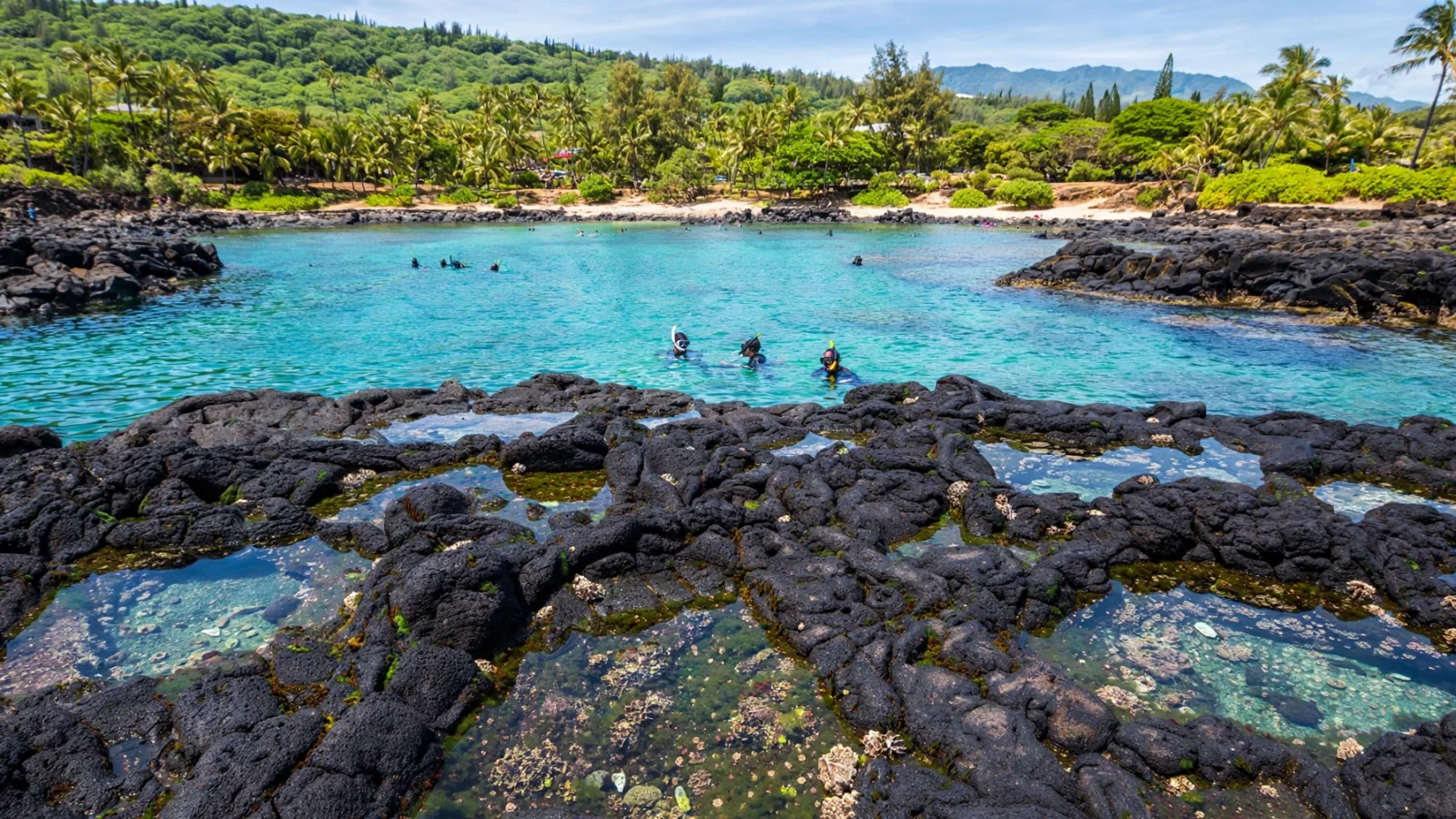
Despite the name, Shark’s Cove is not about sharks. Hawaii’s DLNR notes that the origin of the name is actually uncertain — it is often said to describe the shape of the reef as seen from above — and sharks are no more common here than anywhere else around Oahu. What the cove actually is: a lava-rock amphitheatre on the Pupukea coast, made of a deeper outer cove for snorkeling and a shallow tide-pool zone that works like a natural aquarium at low tide. For ideas beyond the cove, see our guide to Things to Do in North Shore Oahu.
The reason the fish life is so dense is the protection. The Pupukea Marine Life Conservation District (MLCD), established in 1983, covers this stretch of coast, and inside an MLCD almost nothing can be taken. Decades without fishing pressure means surgeonfish, goatfish and parrotfish in numbers you simply do not see at unprotected Oahu beaches — many regulars rate this the island’s best shore snorkel outright, ahead of Hanauma Bay. The trade-off is that it demands more of you: rock entries, surge awareness, and no lifeguard watching over a managed lagoon.
One honest expectation to set before you go: visibility inside the cove itself is often only fair — DLNR describes it as generally poor inside, improving as you move outside the cove mouth. Go for the fish density and the structure, not for gin-clear postcard water.
Where is Shark’s Cove in Oahu?
Shark’s Cove sits in Pupukea on Oahu’s North Shore, roughly an hour’s drive from Honolulu Airport in normal traffic. Follow Kamehameha Highway (Hwy 83) along the coast: coming from Haleiwa you pass Waimea Bay first, and Shark’s Cove is the rocky cove area at Pupukea Beach Park, just along from the Pupukea Foodland supermarket — the Foodland is the landmark every local direction uses. Coming from the Turtle Bay side, you pass Kuilima Cove and Sunset Beach before reaching Pupukea. The cove is part of the same MLCD shoreline that runs toward Three Tables at the district’s southern end, near Waimea.
There is no gate, ticket booth or check-in — it is an open beach park on a public highway, which is also why everything about a good visit here comes down to timing and parking.
The season rule: when you can (and cannot) snorkel Shark’s Cove
This is the section that matters most, so it gets no hedging: Shark’s Cove is a summer-only snorkel.
- May to September — core season. The North Shore’s winter swell is gone, the cove is at its calmest, and both the cove and the tide pools are at their best. This is the window to plan a North Shore trip around.
- October — shoulder month, conditions decide. DLNR counts October inside the generally calm May–October window, but the first big swells of the season can arrive this month. Snorkel in October only on a flat forecast, early in the day, and be ready to call it off.
- November to April — do not snorkel here. Winter surf on this coast is extremely dangerous in all parts of the MLCD — DLNR’s warning explicitly includes the tide pools. The same water that looks like a rock pool in July sits in the impact zone of waves that run the Banzai Pipeline contests just down the road. If there is any winter surf running, Shark’s Cove is a viewpoint, not a snorkel.
Best time of day, and the tide question
Within the season, mornings win for three reasons: the parking lot is not yet full, the surface is glassiest before the day’s winds build, and surge is usually at its daily minimum. Aim to be in the water before 10 a.m. For the tide pools, low tide is the sweet spot — the pools separate from the cove and become calm, clear little aquariums; at high tide they merge back into the cove’s surge. For the cove proper, a lower-to-mid tide generally makes the rocky entry easier to read.
One tide nuance worth planning around: the two zones want opposite tides. The tide pools are at their best at low tide, when they close off from the cove and turn into calm, clear little aquariums. The cove itself is easier to move around in at a mid-to-higher tide, when there is more water and space between the rocks. If you can only pick one tide, pick low tide for the pools with kids, and a rising tide for a proper cove swim.
How to check Shark’s Cove conditions today
There is no lifeguard and no official daily snorkel report for this cove, so check like a local: look at the North Shore surf forecast before you leave (any forecast showing a rising northwest swell means no), check the wind (light is good, strong trades chop the surface), and — decisively — stand on the rocks and watch for five minutes before getting in. If waves are washing over the lava shelf into the tide pools, or the cove surface is foaming and surging, the answer that day is no, whatever the calendar says. Our island-wide best time to snorkel in Hawaii guide explains the seasonal pattern in full, and the North Shore’s calm-summer alternative on a marginal day is sheltered Kuilima Cove at Turtle Bay.
Water temperature and visibility, honestly
In summer the water at Shark’s Cove runs warm — typically in the high 70s to low 80s Fahrenheit — so nobody needs a wetsuit for a morning swim, and kids can stay in the tide pools for a long time without getting cold. Winter water is still warm by mainland standards, but that hardly matters: the surf, not the temperature, is what closes the cove from roughly November to April.
Visibility is the honest mixed bag here, and Hawaii’s DLNR says it plainly: visibility is generally poor inside the cove, but improves quickly outside it. On a good summer morning, visitor reports put the inside water at roughly 10 to 20 feet — enough to watch the reef fish working the boulders, not the gin-clear postcard water of a south-shore lagoon. Outside the cove mouth, where the bottom drops away, the water clears up fast. In winter, visibility inside can drop below 5 feet with heavy surge — one more reason the season rule is a safety rule, not a preference. Come for the fish density and the structure, in the morning, in summer, and the visibility will be good enough for what this cove does best.
The two zones: the cove and the tide pools
The cove proper. Enter over the rocks — slowly; this is where reef shoes pay for themselves — and you are in shallow water of roughly 2–4 feet that deepens to about 6–20 feet among boulders, arches, caves and ledges, with the cove mouth at around 20 feet and the bottom outside sloping away to roughly 45 feet. Work the edges: the structure is where everything lives. Keep your fins off until you are in deeper water — walking in fins over lava rock is how ankles get twisted.
The tide pools. Beside the cove, on the Waimea (southern) side of the cove area near the fire station, a shallow sheet of protected water spreads over smooth rock. At low tide this is essentially a natural aquarium — small reef fish, crabs, sea cucumbers and juvenile everything, in water a child can stand in. Kids and nervous snorkelers can explore here while confident swimmers do the cove. Even the pools deserve respect: on a surge day, waves wash into them without warning, and in winter they are as dangerous as
Shark’s Cove tide pools: where they are, pool by pool
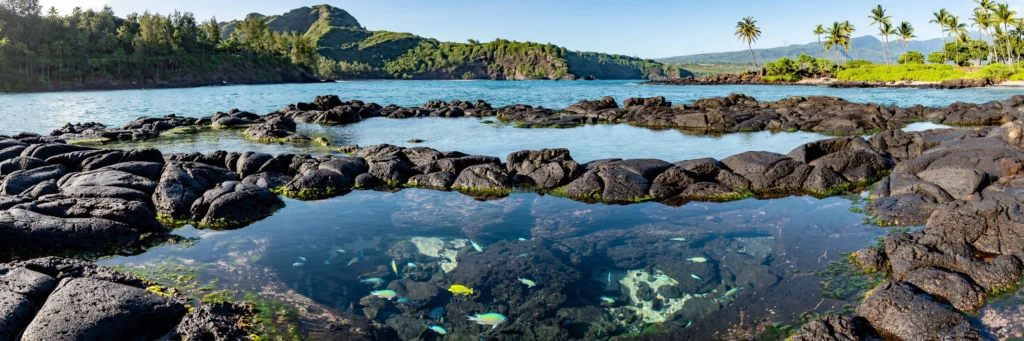
The tide pools are the first thing you meet at Shark’s Cove, and the easiest part of the visit to underestimate. From the parking lot, follow the steep dirt path down and the pools are on your left — the south, Waimea side of the cove, beside the fire station. Hawaii’s DLNR describes it plainly: the tidepool area to the left of Shark’s Cove is good for reef walking or snorkeling, depending on wave and tide conditions. What looks from the path like one flat sheet of water is really a set of zones, and knowing which one you are standing in decides whether the visit is a gentle paddle or a proper swim. The shallows — sometimes called the old quarry — are the broad, really shallow basin right beside the cove. At low tide this is ankle- to knee-deep water over smooth rock, the place to stand and look rather than swim. Regulars’ hand-drawn maps of the cove mark it as the shallow end, and it is where nervous first-timers and small kids belong. Beside it sits the punchbowl, a slightly deeper rounded bowl that works for confident kids on a calm summer day and is worth skipping the moment there is any surge. Then comes the entry ledge, the low rock ledge where snorkelers slide into the cove proper — the step-by-step entry is covered below. Inside the cove the water runs 2–4 feet in the shallows and deepens to about 6–20 feet among boulders, arches and ledges, with the cove mouth at around 20 feet and the bottom outside sloping away to roughly 45 feet. South along the shore, Three Tables is a separate cove whose three or four flat reef tables show at low tide, with about 15 feet of water around them. One rule covers all of it: stay between the two rock walls and away from the cove mouth, where the surge comes in. The mouth is the only way the open ocean reaches the pools, and it is the only part of the area that can catch you out on an otherwise calm day.
Best tide for the Shark’s Cove tide pools (and how to read the tide chart)
Low tide is the window, and it is worth planning the whole visit around it. As the tide drops, the pools separate from the cove and turn into calm, clear little aquariums; at high tide they merge back into the cove’s surge and the pool visit is over. Aim for an hour or two either side of low tide, and check the Hawaii tide chart the night before you drive up so you know which side of the tide you are on. A summer morning low tide is the jackpot: the water is at its calmest, the pools are at their clearest, and the parking lot — which fills by late morning — still has spaces. If you arrive at high tide, do not force the pools; snorkel the cove instead, which is easier to move around in at a mid-to-higher tide, when there is more water between the rocks. The two zones genuinely want opposite tides, so pick the tide that matches the visit you want. Two things override the tide chart entirely. First, the swell: if waves are breaking over the outer rocks, stay out of the pools no matter what the tide says — surge washes into them without warning. Second, the season: in winter no tide makes the pools safe. DLNR is blunt about it — during the winter months, current and wave conditions become extremely dangerous in all areas of the marine conservation district, including the tidepool area. If you want the full seasonal picture, our guide to the best time to snorkel in Hawaii covers the month-by-month pattern across the islands.
What lives in the tide pools — and tide pooling with kids
The pools are a nursery, and that is what makes them worth a slow hour. The juveniles live here: small reef fish darting through the shallows, crabs working the rock edges, sea cucumbers resting on the sandy patches, and small gobies and blennies in the tiniest pools. Sea urchins sit tucked into the crevices — look at them, never touch them. The deeper cove adds the showier fish — butterflyfish, parrotfish, tangs and surgeonfish — and the full list is in the marine-life section above. The rules that keep the pools this full are strict and simple, because Shark’s Cove sits inside the Pupukea Marine Life Conservation District: no taking, injuring or removing any marine life, no taking rocks or shells, no feeding the fish, and no device for taking marine life in the water. Look with a mask, keep your hands out of the water, and leave everything exactly where you found it. For kids, the pools are the best part of the North Shore — standing-depth water, creatures at eye level, and no need to swim. Keep it to a calm summer low tide, an adult within arm’s reach, reef shoes on even in the pools, and a mask for looking. The net and bucket in the packing list are for looking only: scoop, look, and gently put everything back where you found it — nothing leaves the pools. This is not a spot for toddlers except an ankle-deep pool on a flat calm day, and remember there is no lifeguard here. Two habits keep everyone safe: wear the reef shoes — the rock is sharp lava, the algae on it is slippery, and urchin spines are the souvenir nobody wants — and never turn your back on the ocean, even in the shallowest pool.
Shark’s Cove for scuba divers (and free divers)
Snorkelers are only half the story at Shark’s Cove. Hawaii’s DLNR calls it one of the North Shore’s most popular SCUBA destinations, and Scuba Diving Magazine has rated it among the world’s top twelve shore dives. The same lava structure that makes the snorkeling good — boulders, caves, ledges, arches and lava tubes — keeps going past snorkeling depth, and the diving is better outside the cove, where the bottom slopes to about 45 feet.
What divers come for, specifically: caves around the cove’s northwest point, and the water to the left of the cove, which DLNR describes as excellent for night diving. White-tipped reef sharks are reported here by divers — the small, reef-dwelling kind that rest on the bottom in the daytime, not the open-ocean species the cove’s name makes people imagine. Moray eels, octopus and turtles are regulars too, and the deeper water outside the mouth holds the bigger fish the shallow cove cannot.
Practical notes if you dive here: there is no dive shop at the cove itself, so bring full kit or rent in Haleiwa before you drive up. It is a shore dive with a rocky entry, so the same reef-shoe-and-timing rules apply, doubled. Dive with a buddy, fly a dive flag, and expect snorkelers in the shallow water — the two groups share this cove all summer, and the divers’ bubbles rising through the cove are part of the place. Free divers use the outside water too: the floor drops to 15 to 30 feet once you are out of the cove mouth, with turtles most often to the right and the swim-through to Three Tables to the left.
Swimming out to Three Tables
On a flat calm summer morning, the confident-swimmer version of Shark’s Cove is the swim out to Three Tables — the next cove south in the same Pupukea Marine Life Conservation District. The route: exit the cove at its eastern rocky end, where the boulders give the cleanest way out, then work left along the coast. Go right and you are in the deeper open water where turtles cruise; go left and you connect with the Three Tables reef, where the flat-topped tables sit in about 15 feet of water and the best diving runs 30 to 45 feet out.
Stay close to the reef edges on the way — that is where the fish are — and keep an eye out for scuba divers below you. This is a calm-days-only swim: any real swell turns the rocky exit and the open-water leg into a bad idea, and there is no lifeguard anywhere on this stretch. If the water is not flat, skip it and walk instead: a shaded coastal path runs from Pupukea Beach Park down to Three Tables Beach, a proper little sandy beach that is far better for sunbathing and sandcastles than anything at Shark’s Cove. Our Three Tables snorkeling guide covers the tables themselves, including when they are calm enough to snorkel.
Parking at Shark’s Cove (and Pupukea Beach Park)
Parking is the practical bottleneck of a Shark’s Cove visit, and it is simple once you know it:
- The beach-park lot serving Shark’s Cove and Pupukea Beach Park is small and free, and it is a one-way lot — enter slowly and commit.
- It fills early in summer: experienced visitors aim to be parked by 8–9 a.m. on weekends; by 9–10 a.m. you may be circling.
- Overflow is roadside parking along Kamehameha Highway — legal spots only, and never block driveways or the highway shoulder where signs prohibit it.
- Leave nothing in the car. Car break-ins are flagged by virtually every firsthand account of this coast. Take valuables with you or leave them where you are staying; a visible bag on a seat is an invitation.
- A bus runs along this coast daily if you would rather skip the lot entirely — the Foodland stop at Pupukea is your landmark.
The lot itself is small — roughly 40 to 50 spaces — which is why the 8 to 9 a.m. arrival matters more than anything else in this guide. A summer weekend can fill it before most visitors have finished breakfast in Haleiwa.
If the lot is full, do not circle for long. Paid private parking exists near Waimea Bay a few minutes south, and the honest pivot is to swim somewhere else that morning: Waimea Bay itself (lifeguarded, with a bigger lot), or Electric Beach (Kahe Point) on the west side if the North Shore is surging. Shark’s Cove rewards an early start and punishes a late one — plan the day around that, not around the parking lot.
Restrooms and showers are at the beach park, on the southern side of the cove area by the parking — rinse the salt off there, and use the showers rather than the reef to wash off sunscreen.
Getting here from Waikiki, and where to eat after your snorkel
From Waikiki the drive is straightforward: H1 West, then H2 North, then Kamehameha Highway (Highway 99 into Highway 83) through Haleiwa and past Waimea Bay. Allow about an hour from Honolulu Airport in normal traffic, longer at midday and in peak summer traffic. For GPS, search “shark’s cove haleiwa hi 96712” or “shark’s cove pupukea hi” — the Pupukea Beach Park lot is on your left coming from Waimea Bay, just past the Pupukea Foodland, which is the landmark every local direction uses. The bus runs this coast daily, with the Foodland stop at Pupukea as your landmark, if you would rather skip the lot entirely.
Eating here is easy, because the food is across the highway, not at the cove. Foodland Pupukea, directly across from the beach park, is the practical stop: bentos, poke, sushi and sandwiches for a beach lunch, plus reef shoes, dip nets and basic snorkel gear if you forgot something. The food trucks across the highway change lineup, but the regulars include the North Shore Shrimp Truck, Pupukea Grill and Seven Brothers. The bright-yellow Sunrise Shack stand sits right across the highway from the cove at 59-712 Kamehameha Hwy (open 7 a.m. to 6 p.m. daily) for açaí bowls, smoothies and coffee — note the stand’s future on that plot has been uncertain since the land changed hands, so it is worth a quick check before you count on it. For something more substantial, Ted’s Bakery in nearby Sunset Beach is famous for its chocolate haupia cream pie, and there is usually a shave ice truck near the food trucks. Our North Shore snorkeling guide maps the rest of the coast if you are making a full day of it.
What you’ll see: marine life at Shark’s Cove
Because the MLCD has protected this reef since 1983, the species list is long even by Hawaii standards. Organised by where you will actually see them:
| Zone | What to look for |
|---|---|
| Tide pools (shallow) | Juvenile reef fish, crabs, sea cucumbers, small gobies and blennies, sea urchins in the crevices |
| Inside the cove (6–20 ft) | Fourspot, lined and ornate butterflyfish; parrotfish; goldring, orangeband and ringtail surgeonfish; Achilles, convict and lavender tangs; wrasses; goatfish; needlefish and trumpetfish near the surface; the state fish, humuhumunukunukuapua’a; schools of mullet |
| Caves, ledges and the cove mouth | Moray eels in the lava crevices, day octopus, green sea turtles (visiting snorkelers report them on most trips), larger jacks working the deeper water outside |
A note on the turtles: they are protected, and inside an MLCD doubly so. Watch them from a respectful distance, never touch or crowd them, and let them surface in peace — the full etiquette is in our snorkel with turtles in Hawaii guide. And the name question, one last time: you are far more likely to see a turtle here than a shark.
Entry and exit: the rocky part, step by step
There is no sandy beach entry into the cove itself — the cove entry is over rock, and that single fact defines the visit. The one exception is a small, shallow sandy patch in the tide-pool area on the west side, near the restrooms, where small kids can stand and paddle at low tide. It is a paddling spot, not a way into the deeper cove: for the cove proper, you are climbing in over lava rock, and reef shoes stay non-negotiable.
- Suit up on the rocks, not in the water. Mask and snorkel on, reef shoes on, fins carried in your hand.
- Pick your entry at a calm moment. Watch a full set of small swells pass; enter in the lull, sitting and sliding in from a low rock ledge where possible rather than stepping down blind.
- Fins on only once you are floating in deeper water, away from the rocks.
- Snorkel the edges first — the walls and boulder fields hold the fish; the middle of the cove is the least interesting water.
- Plan your energy for the exit. Getting out over wet lava rock on tired legs is the hardest part of the swim. Exit at the same ledge you entered, again timing the lull, and take fins off before you stand.
If the entry looks intimidating from the rocks, believe it — conditions, not courage, should make the call. Beginners are honestly better served starting with our beginners’ snorkeling guide picks and the managed lagoon at Hanauma, then coming back to Shark’s Cove with a season of swims behind them.
Pupukea MLCD rules you are agreeing to by getting in
Shark’s Cove sits inside the Pupukea Marine Life Conservation District (Hawaii Administrative Rules 13-34), and the rules are stricter than at an ordinary beach:
- No fishing or taking marine life — no removing, injuring or collecting fish, shellfish or any other marine life (a narrow traditional limu hand-harvest exception exists; it is not a visitor activity).
- No feeding fish.
- No altering or taking geological features — the lava rock and coral structure stay exactly where they are.
- No device for taking marine life in the water with you.
- Standard Hawaii reef etiquette applies on top: reef-safe sunscreen only, never stand on coral, and give turtles and any monk seal you are lucky enough to see plenty of space.
These rules are exactly why the cove is so full of fish — the protection is the attraction. Our snorkeling safety guide covers the island-wide safety picture behind them.
Can you rent snorkel gear at Shark’s Cove?
No — there are no gear rentals at the cove itself, and no concession at Pupukea Beach Park. Rent or buy before you come: the nearest rental shops are in Haleiwa town, a short drive south, and many visitors simply rent for the week in Waikiki or at their accommodation and carry gear with them. What you specifically need here, beyond the standard mask/snorkel/fins on our Hawaii snorkeling gear checklist: reef shoes, which matter more at this spot than almost anywhere else on Oahu, and a flotation aid if you are anything less than a confident swimmer — remember, there is no lifeguard.
What to pack for Shark’s Cove
This is the one Oahu spot where the packing list genuinely changes the day, so pack like you mean it:
- Reef shoes, for everyone. The entry and exit are sharp, uneven lava rock, and bare feet or slippers are how cuts and urchin spines happen. If you do not own a pair, Foodland across the highway stocks basic ones, and Surf N Sea in Haleiwa has a better selection — buy before you drive up, not at the cove.
- A dry bag or zip-lock for your phone and keys. Leave nothing visible in the car; break-ins are a known problem on this coast, and the practical answer is to carry valuables in a dry bag while you swim.
- A dip net and bucket if you have small kids. The tide pools are full of hermit crabs and tiny fish at low tide, and a net turns a paddle into an expedition. Foodland sells both.
- Reef-safe sunscreen only — no aerosol. Hawaii banned the worst reef-damaging chemicals in 2021, and this is a protected marine conservation district, so it matters here more than anywhere. Our reef-safe sunscreen guide explains which ingredients to avoid.
- A flotation aid if you are anything less than a confident swimmer. There is no lifeguard, and the exit over wet rock on tired legs is the hardest part of the swim.
- Water and snacks. There is no concession at the cove; Foodland across the highway covers it.
For the gear itself, rent before you come — there are no rentals at the cove, and the nearest shops are in Haleiwa. Our snorkel gear rental guide has the published day and week prices by island, including the Haleiwa options.
Safety at Shark’s Cove, plainly
- No lifeguard at Shark’s Cove or neighbouring Three Tables. Lifeguards are posted at Waimea Bay. You are your own safety cover here; snorkel with a buddy.
- Season is safety. Everything in the season section above is a safety rule, not a preference: winter surf here can kill, including in the tide pools.
- Surge exists even in summer. A set can push you against lava rock without much warning; keep a margin from the walls when swells are rolling through, and never turn your back on the entry/exit ledge.
- Sharp rock everywhere. Reef shoes on entry and exit; expect cuts if you try it in bare feet or slippers.
- Know your alternatives. If Shark’s Cove is surging, Electric Beach (Kahe Point) on the west side and Kuilima Cove on this same coast are the usual plan-B swims — check their own conditions rather than assuming.
Nearby: Three Tables, Waimea Bay and the rest of Pupukea
The MLCD shoreline rewards a full morning. Three Tables, at the southern end of the district toward Waimea, is named for its flat-topped reef tables and is another summer-only snorkel with the same no-lifeguard warning. Waimea Bay, a few minutes south, is itself a swimmable summer bay (with lifeguards) and a winter big-wave spectacle. Ehukai Beach (the Banzai Pipeline) is just north — in winter, watch from the sand; in summer it is a different, calmer beach entirely. Food trucks frequently set up across the highway from Pupukea Beach Park, and the Foodland covers everything else, which makes Shark’s Cove an easy anchor for a full North Shore day — more options are mapped on our Oahu snorkeling hub.
Stay for sunset
If your snorkel ends in the late afternoon, stay for the light. The low sun turns the tide pools into mirrors — orange, red and pink sky reflected in the calm water — and the cove at golden hour is one of the North Shore’s quiet pleasures. Sunset Beach, a short drive north, is the famous sunset spot on this coast; Shark’s Cove is the uncrowded one. Do not snorkel after dark, and do not let the sunset distract you from the drive back: the highway is dark and winding, and the lot empties fast once the sun is down.
Shark’s Cove vs Hanauma Bay vs Kuilima Cove
- Choose Shark’s Cove if you are a confident swimmer visiting May–September, you want the densest fish life on Oahu without a boat, and you can handle rocks, surge and no lifeguard.
- Choose Hanauma Bay if you are a beginner, want a managed, lifeguarded lagoon with facilities and a sandy entry, and accept its reservation system and entry fee.
- Choose Kuilima Cove if you are on the North Shore with kids or beginners, or the season/conditions are marginal — it is the sheltered option on this coast.
- For a boat-based turtle trip instead, Turtle Canyon off Waikiki is the classic.
FAQ
Are there actually sharks at Shark’s Cove Oahu?
No more than anywhere else in Hawaii. DLNR notes the name’s origin is uncertain — it is often said to describe the reef’s shape seen from above — and sharks are no more common here than elsewhere around the island. In thousands of daily summer visits, sharks are a non-issue at Shark’s Cove; turtles are what you will actually see.
How much does Shark’s Cove cost?
Nothing. Entry to the cove and tide pools is free, and parking in the beach-park lot is free — the real cost is arriving early enough to get a space in it. Budget only for your gear (bring your own or rent in Haleiwa beforehand — there are no rentals at the cove) and food from the trucks or Foodland across the highway.
Where do you park for Shark’s Cove?
In the small, free Pupukea Beach Park lot by the cove — a one-way lot that routinely fills by 9–10 a.m. in summer, so aim for 8–9 a.m. Overflow is legal roadside parking along Kamehameha Highway. Leave nothing visible in the car; break-ins are a known problem on this coast.
Can you snorkel Shark’s Cove in winter?
No. From roughly November through April, North Shore winter surf makes the whole Pupukea MLCD — cove and tide pools alike — extremely dangerous, per DLNR. Winter is for watching the surf contests at Pipeline and Waimea, not for snorkeling. For winter snorkeling on Oahu, use the sheltered south and west shore spots instead.
What is the best time of day to snorkel Shark’s Cove?
Early morning, in the water before 10 a.m.: the lot still has spaces, the surface is calmest, and surge is at its daily low. For the tide pools specifically, target low tide, when they close off from the cove and become calm and clear.
Is Shark’s Cove good for snorkeling beginners and kids?
Split answer: the tide pools at low tide are genuinely good for kids and nervous first-timers under close watch. The cove proper is not a beginner spot — rocky entry, surge, no lifeguard. New snorkelers should start with a managed lagoon like Hanauma and our beginners’ guide, then graduate to the cove.
Can you rent snorkel gear at Shark’s Cove?
No rentals exist at the cove or at Pupukea Beach Park. Rent in Haleiwa town before you drive up, or carry weekly rental gear with you — and make sure reef shoes are in the bag, because this is the one Oahu spot where they are essential rather than optional.
Why is it called Shark’s Cove?
Honestly, nobody knows for certain — Hawaii’s DLNR lists the origin as uncertain. The popular story is that the reef’s outline, seen from the air or the highway, resembles a shark. What the name does not mean is that the cove is full of sharks; the residents you will meet are turtles, tangs and parrotfish.
Is there a sandy entry at Shark’s Cove?
Not into the cove itself — the cove entry is over lava rock, and that is the honest answer for anyone planning the swim. The exception is a small, shallow sandy patch in the tide-pool area on the west side, near the restrooms, where small kids can stand and paddle at low tide. It is a paddling spot, not a beach entry: for the deeper cove, you climb in over rock in reef shoes.
Can you scuba dive at Shark’s Cove?
Yes — Hawaii’s DLNR calls Shark’s Cove one of the North Shore’s most popular SCUBA destinations, and Scuba Diving Magazine has rated it among the world’s top twelve shore dives. The diving is best outside the cove, where the bottom slopes to about 45 feet, with caves around the northwest point and excellent night diving to the left of the cove. White-tipped reef sharks are occasionally seen by divers. There is no dive shop at the cove, so bring full kit or rent in Haleiwa first.
How warm is the water at Shark’s Cove?
In summer the water typically runs in the high 70s to low 80s Fahrenheit — warm enough that nobody needs a wetsuit. Visibility on a good summer morning is roughly 10 to 20 feet inside the cove, though DLNR notes it is generally poor inside and improves quickly outside the cove mouth. In winter, visibility can drop below 5 feet with heavy surge, which is one more reason the cove is a summer-only snorkel.
Where can I buy reef shoes near Shark’s Cove?
Foodland Pupukea, directly across the highway from the beach park, stocks basic reef shoes along with dip nets, snacks and bentos. For a better selection — and rentals — Surf N Sea in Haleiwa is the local pick. Buy before you drive up to the cove: there is nowhere to buy gear at Shark’s Cove itself.
Where are the tide pools at Shark’s Cove?
To the left — the south, Waimea side — of the cove, beside the fire station: a shallow sheet of protected water over smooth rock. From the parking lot, follow the path down and the pools are on your left before you reach the cove entry ledge.
What is the best tide for the Shark’s Cove tide pools?
Low tide — aim for an hour or two either side of it, when the pools close off from the cove and go calm and clear. Check the Hawaii tide chart before you drive up. At high tide the pools merge back into the cove’s surge. Summer mornings are best; in winter no tide makes the pools safe.
What can you see in the Shark’s Cove tide pools?
Juvenile reef fish, crabs, sea cucumbers, small gobies and blennies, and sea urchins tucked into the crevices. The deeper cove adds butterflyfish, parrotfish, tangs and surgeonfish — the full list is in the marine-life section above.
Are the Shark’s Cove tide pools safe for kids?
At low tide on a calm summer day, yes — with an adult within arm’s reach, reef shoes on, and a mask for looking. The cove proper is not a beginner spot. In winter or on any surge day, keep kids out of the pools entirely. There is no lifeguard at Shark’s Cove.
Can sharks get into the tide pools at Shark’s Cove?
No. The pools are ankle-deep and cut off from the cove at low tide, and Hawaii’s DLNR says sharks are no more common here than anywhere else on the island — the origin of the name is uncertain, and the popular story is that the reef’s outline looks like a shark from above. You are far more likely to see a turtle than a shark.
Just a few steps south in the same Pupukea park — about 170 feet away — our Three Tables snorkeling guide covers the flat-topped reef tables that give the spot its name, and when they are calm enough to snorkel.
A few minutes south, the big bay itself deserves its own morning: Waimea Bay pairs a lifeguarded summer swim with easy snorkeling along its rocky edges.