Kauai snorkeling runs on one seasonal switch, and understanding it matters more than any single spot recommendation. In summer the north shore — Tunnels, Ke’e and Anini — turns calm and clear, and it is some of the best shore snorkeling in Hawaii. In winter that same coast takes the full force of North Pacific swell and is usually off-limits, while the south shore around Poipu keeps working. Pick your shore by the month you visit, then pick your spot from the table below. This hub ranks every Kauai snorkel spot we cover in depth, with the parking, reservation, lifeguard and beginner facts the other guides leave out.
Planning beyond the water? Our guide to the best things to do in Kauai ranks every activity with the same snorkeling depth. See our Things to Do in Kauai with Kids guide for the family-friendly beaches, ponds and activities. See our Things to Do in Princeville guide for the north-shore town’s beaches, trails and tide pools. See our Things to Do in Kapaa guide to plan the east-side beaches and town stops around your snorkel days.
Kauai snorkeling at a glance
| Spot | Shore | Best season | Beginners? | Lifeguard | Parking / reservation |
|---|---|---|---|---|---|
| Tunnels Beach (Makua) | North | May–Sep | Confident swimmers | No (nearest at Ha’ena Beach Park) | Free at Ha’ena Beach Park, first-come |
| Ke’e Beach | North | May–Sep | Yes, inside the lagoon | Yes | Ha’ena State Park reservation required; $10/vehicle parking for non-residents |
| Anini Beach | North | May–Sep (calmest north water) | Yes, in the shallows | No | Free county lot |
| Poipu Beach Park | South | Year-round | Yes | Yes | Free county lot |
| Lydgate Beach Park | East | Year-round | Best for small kids | Yes | Free county lot |
| Lawai Beach / Prince Kuhio | South | Year-round | Intermediate | No | Limited roadside / small lot |
| Salt Pond Beach Park | South-west | Year-round | Yes, in the ponds | Yes | Free county lot |
| Koloa Landing | South | Year-round | Confident swimmers only | No | Dirt road to the boat ramp, free |
| Hideaways Beach | North | May–Sep | Confident swimmers only | No | 9–10 car lot, steep cliff trail |
Which side of Kauai is best for snorkeling?
In short: snorkel the north shore (Tunnels, Ke’e, Anini) in summer, when it is calmest, and the south shore around Poipu in winter, when the north takes the swell. Lydgate on the east side is the reliable year-round fallback.
The full month-by-month verdict, with the best spots on each side and the honest no-go zones, is in our which side of Kauai is best for snorkeling guide.
Tunnels Beach (Makua) — the summer headliner
Tunnels is the reef people picture when they picture Kauai snorkeling: a wide horseshoe of coral with ledges, arches and cavern-like formations (look, never swim inside them), turtles grazing the inner reef, and Mount Makana rising behind the beach. The inner lagoon suits confident snorkelers; the outer reef is for experienced ocean swimmers in flat conditions only.
Access is the part most guides get wrong. Tunnels has no car park of its own. The normal way in is Ha’ena Beach Park, the county park a little to the east: park there free, first-come, and walk roughly half a mile to a mile along the sand to the reef. You do not need a Ha’ena State Park reservation for the county beach park — that system covers the state park and Ke’e Beach at the end of the road. Arrive early: the county lot is small and fills fast in summer. There is no lifeguard at Tunnels itself (the nearest tower is back at Ha’ena Beach Park) and no facilities to plan around, so bring water and shade. Full detail — entry points, the inner-vs-outer reef call, and when to skip it — is in our Tunnels Beach snorkeling guide. Choosing between the two? Our Anini vs Tunnels Beach snorkeling guide settles it by traveler type.
Ke’e Beach — the lagoon at the end of the road
Ke’e is where Kuhio Highway ends and the Na Pali Coast begins: a reef-protected lagoon under the cliffs, with a lifeguard tower, and beginner-friendly water inside the reef on calm summer days. Stay inside the lagoon — the channel to open ocean on the left side pulls hard even when the surface looks gentle, and winter surf makes the whole beach a spectator sport.
Ke’e is inside Ha’ena State Park, and that means reservations — the full walkthrough is in its own section below. On the day, it pairs naturally with a Tunnels morning: snorkel Tunnels early, then use your Ha’ena parking slot for Ke’e and the Kalalau Trail lookout. Ke’e shares a dedicated guide with Lydgate: our Ke’e and Lydgate snorkeling guide.
Anini Beach — the calmest water on the north shore
Anini sits behind one of the longest fringing reefs in Hawaii, and that reef does the work: on most summer days the inside water stays shallow, warm and gentle when other north-shore spots have a shorebreak. It is the north shore’s best beginner and family snorkel — with two honest caveats. There is no lifeguard, and the channels through the reef carry current out to deep water, so the rule is simple: snorkel the shallows over sand and reef edge, never drift toward a channel, and get out if the water starts moving you sideways. Parking is free at the county beach park and rarely the battle it is farther west. Depths and the best entry stretch are covered in our Anini Beach snorkeling guide — and if you are choosing between the two north-shore beaches, our Anini vs Tunnels Beach snorkeling guide compares them head to head.
Poipu Beach Park — the year-round reliable one
Poipu is Kauai’s insurance policy: a lifeguarded south-shore park that works in every month, including the winter weeks when the north shore is closed out. The snorkeling sits around the tombolo — the narrow sand strip running out to Nukumoi Point — with the better reef and fish density on the western side, a shallow keiki area for small children, and turtles that haul out on the sand. Hawaiian monk seals nap here too; they are endangered and protected, so keep at least 50 feet back and let them sleep. Parking is free and the lot is large by Kauai standards, though midday weekends still fill it. Our Poipu Beach snorkeling guide covers the entry points, the tombolo current warning, and where the turtles actually feed.
Lydgate Beach Park — the easiest water on Kauai
On the east side between Lihue and Wailua, Lydgate’s two rock-walled ponds remove the ocean from the equation: no surf, no current, knee-to-chest-deep water, a lifeguard, and real fish — the ponds are stocked by the sea itself through gaps in the walls, so kids snorkel over genuine reef species in bathwater conditions. It is the best first snorkel on the island for small children, full stop. The honest trade-offs: visibility drops after heavy rain when the Wailua River runs brown, and confident adults will find the ponds small. Treat Lydgate as the family and bad-weather anchor, not the whole Kauai plan. It shares a guide with Ke’e: see the Ke’e and Lydgate guide.
Two more south-shore options
Lawai Beach and Prince Kuhio Park — a small, local-feeling reef just west of Poipu with dense fish life over a shallow bench. Entry is over rock and the surge matters more here, so it suits intermediates; go at a calm high-ish tide and watch how local snorkelers time the entry before copying it.
Salt Pond Beach Park — near Hanapepe on the south-west side, Salt Pond’s rock-enclosed ponds give another sheltered, lifeguarded option with a fraction of Poipu’s crowd, plus the working salt ponds behind the beach. A good second south-shore day when Poipu’s lot is full. For the zone-by-zone breakdown — airport-side reef, main bay, and keiki pond — see our Salt Pond Beach snorkeling guide.
Two more Kauai snorkel spots worth knowing
Two spots sit just outside the hub’s main seven, and both are worth knowing before you pick a shore: one has Kauai’s best coral, the other its quietest reef. Both already have full guides of their own.
Koloa Landing — the south shore’s best coral
Koloa Landing does not look like a snorkel spot. There is no beach and no sand — just an old concrete boat ramp at the end of a dirt road near Poipu, a rocky shoreline, and water that turns deep blue within a few fin kicks. Below the ramp is one of the healthiest reefs on Kauai, with large coral heads that are genuinely rare on this island, turtles on almost every visit, and walls that drop into proper blue water. It is not a beginner’s cove: the water gets deep quickly, there is no lifeguard, and the entry is a slippery ramp rather than a sandy slope. What it offers in return is the best coral-and-fish snorkeling on the south shore for confident swimmers — pick it over Poipu when you want reef life rather than an easy family swim, and check the rain rule first, because runoff after heavy rain clouds the water. The full ramp-entry walkthrough, the two walls and the visibility rules are in our Koloa Landing snorkeling guide.
Hideaways Beach — the quietest reef on the north shore
Hideaways Beach, also called Pali Ke Kua Beach, is the north-shore snorkel you have to earn. There is no sign on the highway, the car park holds nine or ten cars, and the beach sits at the bottom of a cliff in Princeville, down a trail steep enough that most visitors never attempt it. Those who make the descent on a calm summer morning find two small golden coves and a spur-and-groove reef that starts almost at the waterline — some of the fishiest snorkeling on the island, often with the beach nearly to themselves. It is a summer-only proposition: in winter this is a surf beach. There are no facilities and no lifeguard, and the trail was closed for rehabilitation for much of summer 2026, so check it is open before you go. The full trail, parking and reef-route detail is in our Hideaways Beach snorkeling guide.
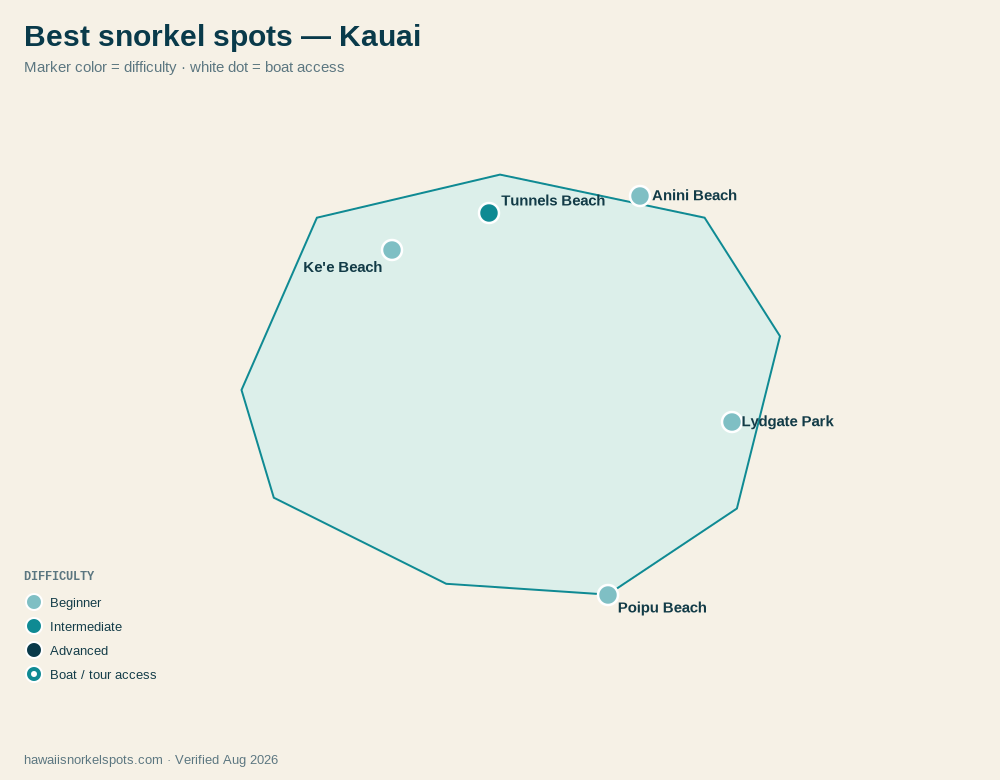
See every spot on this page pinned with GPS coordinates in our Kauai snorkeling map — the quickest way to check which ones sit near where you are staying.
Best snorkeling in Kauai for beginners
Ranked by how forgiving each spot is on a normal day:
- Lydgate Beach Park — walled ponds, lifeguard, no current. The default first snorkel, especially for kids.
- Poipu Beach Park — lifeguarded, shallow keiki side, real reef on the west side of the tombolo.
- Ke’e Beach (summer only) — calm lagoon inside the reef, lifeguard; the reservation is the only homework.
- Anini Beach (summer) — the gentlest open-coast water on the island, but unguarded, so beginners go with a confident buddy and stay shallow.
- Salt Pond Beach Park — sheltered ponds and a lifeguard, with a quieter scene than Poipu.
Beginners should skip Tunnels’ outer reef, Lawai on a surgy day, and every north-shore spot in winter, whatever the forecast app says. If nobody in your group has snorkeled before, read our beginner’s guide to snorkeling in Hawaii and our how to snorkel walkthrough before the trip, and keep the first session short.
Kauai snorkeling in winter (November–April)
Winter does not cancel Kauai snorkeling; it relocates it. The plan that works: base yourself around Poipu and Lawai on the south shore, keep Lydgate as the storm-day fallback, and treat any flat north-shore morning as a bonus you verify on the day — check the county ocean report and ask a lifeguard before driving up. Winter is also when the south shore’s visibility can be at its best between swells. What never works: a fixed plan to snorkel Tunnels or Ke’e on a specific winter date. Build the trip so the north shore is a pleasant surprise, not a promise.
Ha’ena State Park reservations for Ke’e — the exact steps
Ke’e Beach is the one Kauai snorkel spot you cannot simply drive to. As verified on the official DLNR State Parks page in October 2026:
- Reservations are required for non-resident day visitors, for entry and for parking separately, booked through the Go Ha’ena system (gohaena.com).
- Parking reservation: $10 per vehicle for non-residents — and it matters that a parking reservation includes park entry for the driver and everyone in the vehicle. Driving in, your total is $10, not $10 plus per-person fees.
- Entry-only reservation: $5 per person for non-residents arriving on foot or by shuttle. Children 3 and under are free. Hawaii residents with a Hawaii driver’s licence or state ID enter and park free and do not need a reservation.
- Book up to 30 days ahead. Parking is released in time slots and summer slots sell out — set the date and book the day your window opens.
- Park hours: 7:00 AM–7:45 PM in summer, 7:00 AM–6:45 PM in winter.
- Closures happen. The park reopened on 15 October 2026 after a hurricane closure, and it closes for high surf and emergencies — check the DLNR park page the week of your visit, not just the day you booked.
Only Ke’e needs this. Tunnels (via Ha’ena Beach Park), Anini, Poipu, Lydgate and Salt Pond are all free county parks with first-come parking and no reservation system.
Checking conditions: the Kauai snorkel report habit
“Conditions today” is the cluster nobody’s guide actually serves, so here is the routine local snorkelers use. The night before, check the Kauai ocean report and surf forecast for your shore — north and south reports are different forecasts, not one island-wide answer. On the morning, favour the first two hours after sunrise: trade winds build through the day and chop the surface even when the swell is small. At the beach, watch a full set cycle (five minutes, not one wave) and find the lifeguard tower if there is one — guards will tell you plainly whether the snorkeling side is in or out. After heavy rain anywhere on this island, expect brown runoff near river mouths — the Wailua River affects the east side around Lydgate — and pick the spot farthest from a river that day. Our statewide best time to snorkel in Hawaii guide covers the seasonal patterns behind these daily calls.
Reading Kauai snorkeling conditions: the four things that decide your day
Kauai’s conditions are never island-wide. A flat south shore and a closed-out north shore on the same day is normal here, which is why a single “conditions today” answer for the whole island would be useless even if one existed. Four things decide whether your shore is in or out, and they matter in this order.
1. Swell direction matters more than swell size
A small swell from the wrong direction closes a shore faster than a bigger swell from a kind direction. Winter’s North Pacific swells hit the north shore head-on — Tunnels, Ke’e and Anini — and that is what makes them a no-go from roughly November to April even on days the beach itself looks inviting. Summer’s south swells do the same job in reverse on the Poipu and Lawai side, usually for a day or two at a time rather than a whole season. The east side around Lydgate sits in between: trade-wind chop rather than groundswell is its usual problem. When you check a forecast, look at the swell direction for your shore first and the height second.
2. Wind builds through the day
Trade winds are the reason the morning rule exists. The first two hours after sunrise are reliably the calmest water of the day on every shore; by late morning the wind chops the surface even when the swell is small, and afternoon visibility drops with it. A day that looks marginal at noon may have been perfectly snorkelable at 8 AM — and a day that looks fine from the car park at 2 PM can still be a poor snorkel once you are in wind-chopped water. Plan the snorkel first, the rest of the day second.
3. Rain clouds the water near river mouths
Heavy rain does two things: it drops visibility, and it sends brown runoff out through river mouths. The east side feels this most — the Wailua River clouds Lydgate’s ponds after a big downpour — but any spot near a stream mouth is affected for a day or so after heavy rain. Light rain on its own does not ruin a snorkel; a flooded stream does. After a wet night, pick the spot farthest from a river mouth that day.
4. Tide changes the entry, not just the depth
Tide matters most at the rocky entries. At Lawai, a calm higher tide covers the rock bench and makes the entry far friendlier; at low tide the same entry is exposed rock and surge. Over Anini’s shallow reef flat, low tide can leave the water too thin to swim in places. Check the tide time for your spot before you go, and time rocky entries for the higher part of the cycle.
The go / no-go check, shore by shore
Shore | Green-light signs | Walk away when
North (Tunnels, Ke’e, Anini) | Summer months, small or no north swell, light morning wind | Any north swell in winter, sets breaking over the reef, water moving you sideways in a channel
South (Poipu, Lawai) | Light wind, small or no south swell, morning session | South swell running, surge over the Lawai rock bench, murky water after heavy rain
East (Lydgate) | Any day the ponds are clear — they work in almost any weather | Brown water after Wailua River runoff, strong trade-wind chop across the ponds
If two of the four factors are against you on your shore, switch shores instead of forcing it — that is what the south shore is for in winter and what Lydgate is for on a rough day anywhere.
What counts as calm? The numbers behind a good Kauai snorkel day
The sections above tell you which shore to pick and which four factors decide the day. This one turns those rules into numbers you can read off a forecast, so “calm” stops being a guess. The thresholds below come from SnorkelForecast’s published scoring model, which weights wave height most heavily, then wind, water temperature, tide and daylight, and scores each spot hourly. Use the numbers as a guide, not a guarantee: if the water in front of you looks worse than the forecast, trust your eyes and the lifeguard tower, not the screen.
The five numbers to check before you get in
Wave height. SnorkelForecast scores the water as calm when wave height is under 0.36 meters — about 1.2 feet — and gives wave height the biggest weight in its score (35%). Read the forecast for your shore, not the island: the same morning can be flat at Poipu and rough at Tunnels, and that is the normal Kauai pattern, not an exception. Once the forecast climbs well above that calm line on your shore, expect choppy water and poor visibility, and switch shores or switch days.
Wind speed. Light winds are under 5.4 meters per second — about 12 miles per hour — and wind is the second-biggest factor (25%). This is why the morning rule in the section above works: trade winds build through the day, so the first two hours after sunrise are the calmest water you will get, and a forecast that starts calm can turn choppy by the afternoon.
Water temperature. The same model counts 20.6 to 30.4 degrees Celsius (about 69 to 87 degrees Fahrenheit) as the comfortable range. Kauai’s water sits near the warm end of it: SnorkelForecast listed Kauai at 26.1 degrees Celsius, about 79 degrees Fahrenheit, on the morning of November 8, 2026. At that temperature most people snorkel comfortably in a swimsuit or rash guard; a thin top helps on a long session or a windy morning, when you cool off faster than you expect.
Tide and currents. Tide and currents carry a 15% weight, and the model scores the water best near high slack, when the current is weakest. That sits alongside the tide rule above: at rocky entries such as Lawai, a calm higher tide covers the rock bench and makes entry easier, while low tide exposes it. Check the tide time for your spot as part of the morning check, and aim for slack water; sheltered Anini is the forgiving option when the wind is wrong.
Daylight. The remaining 10% is daylight — the score only counts during daylight hours, which is another way of saying the same thing as the morning rule: plan to be in and out in good light. Na Pali Riders, a Kauai tour operator, puts the best light late in the morning and early in the afternoon, when the sun is high enough to light up the reef. That is the window to aim for once the numbers say go.
Where to check Kauai snorkeling conditions today
No single page covers everything, so check two sources, not one:
- SnorkelForecast’s Kauai report for the numbers: hourly wave height, wind, tide and water temperature, plus a scored verdict for the island. This is where the thresholds above come from.
- Safe Beach Day for the safety picture at your beach: per-beach pages for Ke’e, Ha’ena and Kekaha rate the hazards — caution, high hazard or extreme — and flag high surf, strong currents and jellyfish.
- Hawaii Weather Today’s snorkel and scuba diving report for an island-wide read: it breaks conditions down by shore, so you can see at a glance whether the north, west or south shore is the one to pick.
- Kauai Explorer’s ocean report for the local surf and ocean picture, including brown-water advisories after heavy rain.
Check the night before to pick your shore, check again in the morning for the numbers, and then do the five-minute watch at the beach from the section above. Forecasts change overnight, wind builds through the day, and a beach can look different from its forecast — the three checks together are the habit that keeps a Kauai snorkel day calm.
When the numbers say no on every shore, the fallback is still Lydgate’s ponds, which work in almost any weather unless brown water has clouded them after heavy rain. If even Lydgate is brown, that is a shore day, not a snorkel day.
The thresholds and sources in this section were checked on November 8, 2026.
Kauai snorkeling conditions by month: the calendar
Kauai’s snorkeling year runs on two seasons, not twelve equal months. From about May to September the north shore is at its calmest and the whole island is in play; from about November to April the big winter swells come out of the north and northwest, the north shore roughs up, and the south shore becomes the plan. The east side, Lydgate, is the exception that proves the rule: its walled ponds work in almost any month, as long as the water is not brown after rain. The table below gives a verdict for each shore, month by month, with the average water temperature for the month (monthly averages from NOAA buoy data, via SafeToSwimHawaii). A good month is still only a starting point: always check the morning’s wave height, wind and swell direction the way the sections above describe.
| Month | North shore (Tunnels, Ke’e, Anini, Hanalei) | South shore (Poipu, Lawai, Salt Pond) | East (Lydgate) | Water temp |
|---|---|---|---|---|
| January | Rough — winter north swells | Best side — usually calm | Ponds work | 74°F |
| February | Rough — winter north swells | Best side — usually calm | Ponds work | 73°F |
| March | Rough, easing late in the month | Best side — usually calm | Ponds work | 74°F |
| April | Mixed — swells easing | Good | Ponds work | 76°F |
| May | Opening up — north season begins | Good | Ponds work | 77°F |
| June | Best — calmest north water | Good — watch for south swell | Ponds work | 79°F |
| July | Best | Good — watch for south swell | Ponds work | 80°F |
| August | Best — warmest water of the year | Good — watch for south swell | Ponds work | 82°F |
| September | Best — still warm and calm | Good — watch for south swell | Ponds work | 82°F |
| October | Fading — first north swells return | Good — often the best month here | Ponds work | 80°F |
| November | Rough again as winter sets in | Best side again | Ponds work | 78°F |
| December | Rough — peak winter swells | Best side — the winter plan | Ponds work | 75°F |
Two things the table hides. First, water temperature barely moves: the year runs from about 73°F in February to about 82°F in August and September, and the north shore runs a touch cooler than the south side, so a rash guard is the difference between comfortable and chilly in winter, not a wetsuit. Second, the seasons have soft edges. A calm week in March can open the north shore early, and a north swell in October can close it overnight, so treat the calendar as the plan and the morning forecast as the decision.
Which Kauai spot for today’s conditions? A conditions picker
Pick the spot to match the forecast, not the other way around. Start with the swell direction and wave height from the morning check above, then use this picker:
- Calm summer morning, little or no north swell: go north. Tunnels Beach and Ke’e Beach are at their best, and early is everything — the reef is clearest before the wind and the crowds build.
- North swell running, or any winter day: go south. Poipu Beach is the sheltered, lifeguarded default, with Lawai next door when Poipu is busy.
- Trade winds up and the water choppy: Anini Beach is the north shore’s best wind answer — its long fringing reef knocks the chop down — or head east to Lydgate’s walled ponds.
- Heavy rain, or brown water at the beach: skip the open reef and use Lydgate’s ponds. If the ponds are brown too, take a shore day: runoff after rain is when visibility and water quality are worst.
- South swell running (most common in summer): Poipu and Lawai can get surgy, so move to Anini or Lydgate, or wait for the swell to drop.
Morning or afternoon? Light, wind and visibility through the day
The morning wins almost every day. The trades are lightest in the first two hours after sunrise, the water is at its glassiest, fish are most active, and the sun is high enough by late morning to light the reef without the hard glare of midday. That is the window to aim for, especially on the north shore: Tunnels and Ke’e lose their calm first once the wind builds, and by the afternoon the chop can make the same reef unreadable. The south shore holds up better in the afternoon — Poipu and Lawai are the fallback when a morning plan slips — because they sit out of the trades, but even there the water is rarely as clear as it was at 8 a.m. If the afternoon is the only time you have, pick a sheltered south-shore entry, go in close to the reef rather than swimming out to it, and treat any whitecaps as a sign to stay in the shallows or call it a day.
Winter south swells: what they do to each spot
Winter’s big swells come from the north and northwest — that is what closes Tunnels, Ke’e, Anini and Hanalei from about November to April. True south swells are a summer pattern, running roughly May to September, and they are the reason the south shore is not automatically calm in summer: a south swell can make Poipu and Lawai surgy and push water over the reef at Salt Pond, even in August. In winter the south shore is the sheltered side, and the usual rule holds — if the north is closed, go south. The exceptions are worth knowing: a west or southwest swell can reach Poipu and Lawai even in winter, and Koloa Landing, which faces south, feels a south swell quickly. So in any season, check the swell direction, not just the size: a 3-foot north swell is a north-shore problem, a 3-foot south swell is a south-shore problem, and Lydgate’s ponds are the answer when both are running.
Box jellyfish in Kauai: when to watch for them
Box jellyfish show up in Hawaii roughly 8 to 10 days after each full moon, most often on south- and west-facing shores, and an influx usually lasts a few days. On Kauai that makes the Poipu area the place to watch, while the north and east shores see them less often. The dates are estimates, not a guarantee — a calm-looking beach in the window can still have jellyfish in the water — so check the Waikiki Aquarium box jellyfish calendar before a trip that falls in that window, and ask the lifeguard when you arrive. If lifeguards post a jellyfish warning, or you see jellyfish in the water, stay out: stings are painful and can need medical care. If you are stung, get out of the water, alert a lifeguard, and seek medical help rather than trying to treat it yourself.
What you will see
Kauai’s reefs hold the classic Hawaiian cast: green sea turtles (honu) at Tunnels, Poipu and Anini; parrotfish grazing audibly on the reef; yellow tangs and butterflyfish over the coral benches; humuhumunukunukuapua’a, the rectangular triggerfish that is Hawaii’s state fish; moray eels in the ledges at Lawai; and the occasional white-tip reef shark resting under a Tunnels ledge — a highlight, not a hazard, if you watch from a respectful distance. Keep at least 10 feet from turtles at all times, 50 feet from monk seals (150 feet from a mother with a pup), and never touch coral or stand on the reef. More turtle spots statewide are in our guide to snorkeling with turtles in Hawaii.
Staying safe on Kauai
Three Kauai-specific rules cover most incidents. First, respect the seasonal switch: winter north-shore surf has killed strong swimmers who entered on a deceptively calm-looking morning, and if in doubt, don’t go out is the island’s own standard. Second, mind the channels — at Ke’e, Anini and Tunnels, every gap in the reef is a one-way current to deep water when the surf is up; snorkel parallel to shore and never let a channel be your exit route. Third, use the lifeguarded spots when anyone in the group is still learning: Ke’e, Poipu, Lydgate and Salt Pond all have towers. Reef-safe sunscreen is required by Hawaii law for sunscreens sold in the state, and a rash guard cuts both burn and chill. The full picture is in our guide to whether snorkeling in Hawaii is safe, and the kit list is in our snorkel gear checklist.
Planning the rest of the trip
Kauai rewards a two-base mental model even if you stay in one place: north-shore days need an early start from anywhere, while Poipu pairs easily with a same-day Lydgate stop on the way across the island. If Kauai is one island on a multi-island trip, compare it honestly with the neighbours — our Oahu hub, Maui hub and Big Island hub use the same at-a-glance format, and the statewide ranking is in our guide to the best Hawaiian island for snorkeling. Shore-based trips like this one are the theme of our shore snorkeling guide — no boat required for anything on this page.
FAQ
Where is the best place to snorkel in Kauai?
In summer, Tunnels Beach for the reef and Ke’e Beach for the protected lagoon. Year-round, Poipu Beach Park is the most reliable single answer — lifeguarded, free parking, and snorkelable in months when the north shore is closed out by surf.
Which side of Kauai is best for snorkeling?
The north shore in summer (roughly May to September) and the south shore the rest of the year. The east side’s Lydgate ponds work in almost any conditions and are the fallback when both coasts are rough.
Is there good snorkeling in Kauai for beginners?
Yes — some of the easiest water in Hawaii. Lydgate’s walled ponds and Poipu’s lifeguarded park are the best first snorkels; Ke’e’s lagoon (summer) and Anini’s shallows (summer) follow. The beginner ranking above orders all five.
Do you need a reservation to snorkel in Kauai?
Only for Ke’e Beach inside Ha’ena State Park: non-residents book entry ($5 per person) or parking ($10 per vehicle, which includes entry for everyone in the car) up to 30 days ahead. Every other spot on this page is a free county park with first-come parking.
Does Tunnels Beach need a Ha’ena State Park reservation?
No. Tunnels is normally reached from Ha’ena Beach Park, the free county park next door, with a walk of about half a mile to a mile along the beach. The state park reservation system covers Ke’e Beach and the state park lot at the end of the road.
When is the best time to snorkel in Kauai?
May to September for the north shore, mornings year-round everywhere. Winter visitors should plan around the south shore (Poipu, Lawai) and Lydgate, and treat any calm north-shore morning as a bonus verified on the day.
Can you snorkel in Kauai in winter?
Yes — on the south shore. Poipu and Lawai carry the winter season, Lydgate’s ponds are the storm-day fallback, and the north shore is usually too rough to snorkel safely from about November to April.
What will you see snorkeling in Kauai?
Green sea turtles, parrotfish, tangs, butterflyfish, the humuhumunukunukuapua’a triggerfish, moray eels, and occasionally a resting white-tip reef shark or a napping monk seal on the sand at Poipu. Keep 10 feet from turtles and 50 feet from seals.
Where can I check Kauai snorkeling conditions today?
There is no single official daily snorkel report for Kauai, so use the three-part check in the “Checking conditions” section above: the county ocean report and surf forecast for your shore the night before, the lifeguard tower on arrival, and your own five-minute watch of a full set cycle before getting in. If the lifeguard says the snorkeling side is out, it is out — no forecast overrules the tower.
What wave height is too rough to snorkel in Kauai?
There is no single official cutoff, but SnorkelForecast’s scoring model treats wave height under 0.36 meters (about 1.2 feet) as calm. Once the forecast for your shore climbs well above that line, expect choppy water and poor visibility — switch shores, pick a sheltered spot such as Lydgate’s ponds, or switch days. And if the water in front of you looks rougher than the forecast, trust your eyes.
How warm is the water for snorkeling in Kauai?
Warm. SnorkelForecast’s model counts 20.6 to 30.4 degrees Celsius (about 69 to 87 degrees Fahrenheit) as comfortable, and Kauai’s water sits near the warm end: it listed Kauai at 26.1 degrees Celsius (about 79 degrees Fahrenheit) on the morning of November 8, 2026. Most people snorkel comfortably in a swimsuit or rash guard, with a thin top for long or windy sessions.
Can you snorkel in the rain?
Light rain on its own does not ruin a snorkel — the fish do not care, and a calm morning in drizzle can be perfectly clear. What matters is what the rain brings with it: heavy rain sends brown runoff out through river mouths and drops visibility for a day or so, so after a wet night pick the spot farthest from a river mouth. If there is lightning, or a stream is running flooded into the bay, stay out of the water.
Where is the best coral snorkeling in Kauai?
Koloa Landing, on the south shore near Poipu. Below its old boat ramp is one of the healthiest reefs on the island, with large coral heads that are rare on Kauai and turtles on almost every visit. It is for confident swimmers only — the water gets deep quickly, there is no lifeguard, and the entry is a slippery ramp. Our Koloa Landing snorkeling guide has the full ramp-entry walkthrough and the rain rule that decides visibility.
What is the quietest snorkeling beach in Kauai?
Hideaways Beach in Princeville, also called Pali Ke Kua Beach. The steep cliff trail and a car park that holds nine or ten cars keep it nearly empty on calm summer mornings, and the spur-and-groove reef starts almost at the waterline. It is summer-only, with no facilities and no lifeguard — our Hideaways Beach snorkeling guide covers the trail, parking and reef route.
Is there a snorkeling map of Kauai?
Yes — our Kauai snorkeling map pins every shore spot on the island with GPS coordinates, a difficulty rating and a best-for verdict, so you can see at a glance which spots sit near where you are staying.
What are Kauai snorkeling conditions like in December?
December is peak winter on the north shore: Tunnels, Ke’e and Anini are usually rough from north swells, and the south shore is the plan — Poipu and Lawai are at their calmest, with water around 75°F. Go in the morning, check the swell direction the night before, and keep Lydgate’s ponds as the storm-day fallback.
Which Kauai beach is best for snorkeling when it is windy?
Head south or east. Poipu and Salt Pond sit on the sheltered south shore, and Lydgate’s walled ponds on the east side work in almost any wind. Anini is the north shore’s best wind answer because its long fringing reef knocks the chop down. Avoid exposed north-shore entries — Tunnels and Ke’e — on a windy afternoon.
What time of day is best for snorkeling in Kauai?
The morning, especially the first two hours after sunrise, when the trades are lightest and the water is glassiest. Fish are most active early, and the light is best late in the morning. If you can only go in the afternoon, pick the south shore — Poipu or Lawai — which holds up better than the north shore once the wind builds.
When do box jellyfish show up in Kauai?
Roughly 8 to 10 days after each full moon, most often on south- and west-facing shores, for a few days at a time. Check the Waikiki Aquarium box jellyfish calendar before a trip in that window, and if lifeguards post a jellyfish warning — or you see jellyfish in the water — stay out.
Facts verified October 2026 against the Hawaii DLNR State Parks page for Ha’ena (fees, hours, reservation window, October 2026 reopening), Hawaii Ocean Safety lifeguard listings, and NOAA wildlife viewing guidance. Conditions change daily — check the county ocean report and the lifeguard tower on the day.
Ke’e now has a dedicated guide of its own, too: our Ke’e Beach snorkeling guide covers the lagoon, the Ha’ena reservation steps and the best entry points in full.
More Kauai spots now have full guides of their own: our Lawai Beach snorkeling guide and our Koloa Landing snorkeling guide cover the Poipu-side south shore, our Salt Pond Beach snorkeling guide covers the sheltered south-west ponds, and our Hideaways Beach snorkeling guide covers the Princeville reef on the north shore.
Newest Kauai guides: our latest spot guides cover the north and south shores in our Moloaa Bay snorkeling guide, Hanalei Bay snorkeling guide, Anahola Beach snorkeling guide and Shipwreck Beach snorkeling guide.
Newest Kauai guides: our Kalapaki Beach snorkeling guide covers the harbor beach at Nawiliwili in Lihue, and our Secret Beach snorkeling guide covers the big, wild stretch of sand below Kilauea on the north shore.
Newest Kauai guides: our Mahaulepu Beach snorkeling guide covers the wild south-shore coast at Gillin’s and Kawailoa (experienced snorkelers, winter mornings only), our Kalihiwai Beach snorkeling guide gives the honest no-reef verdict on the north-shore bay, our Larsen’s Beach snorkeling guide covers the experts-only reef and the channel to never enter, and our Brennecke’s Beach snorkeling guide covers the Poipu cove’s winter-morning reef.
Newest Kauai guides: our Princeville snorkeling guide covers the cliff-access coves at Hideaway Beach, Wyllie’s and nearby Anini, our which side of Kauai is best for snorkeling guide settles the north-vs-south season question, and our Kauai snorkeling map pins all 19 shore spots with GPS coordinates.
Newest Kauai guides: our Na Pali Coast snorkeling guide covers the boat-only coast, our Queen’s Bath snorkeling guide covers the Princeville tide pool, and our Anini Beach vs Tunnels Beach snorkeling guide compares the two north-shore favorites head to head.