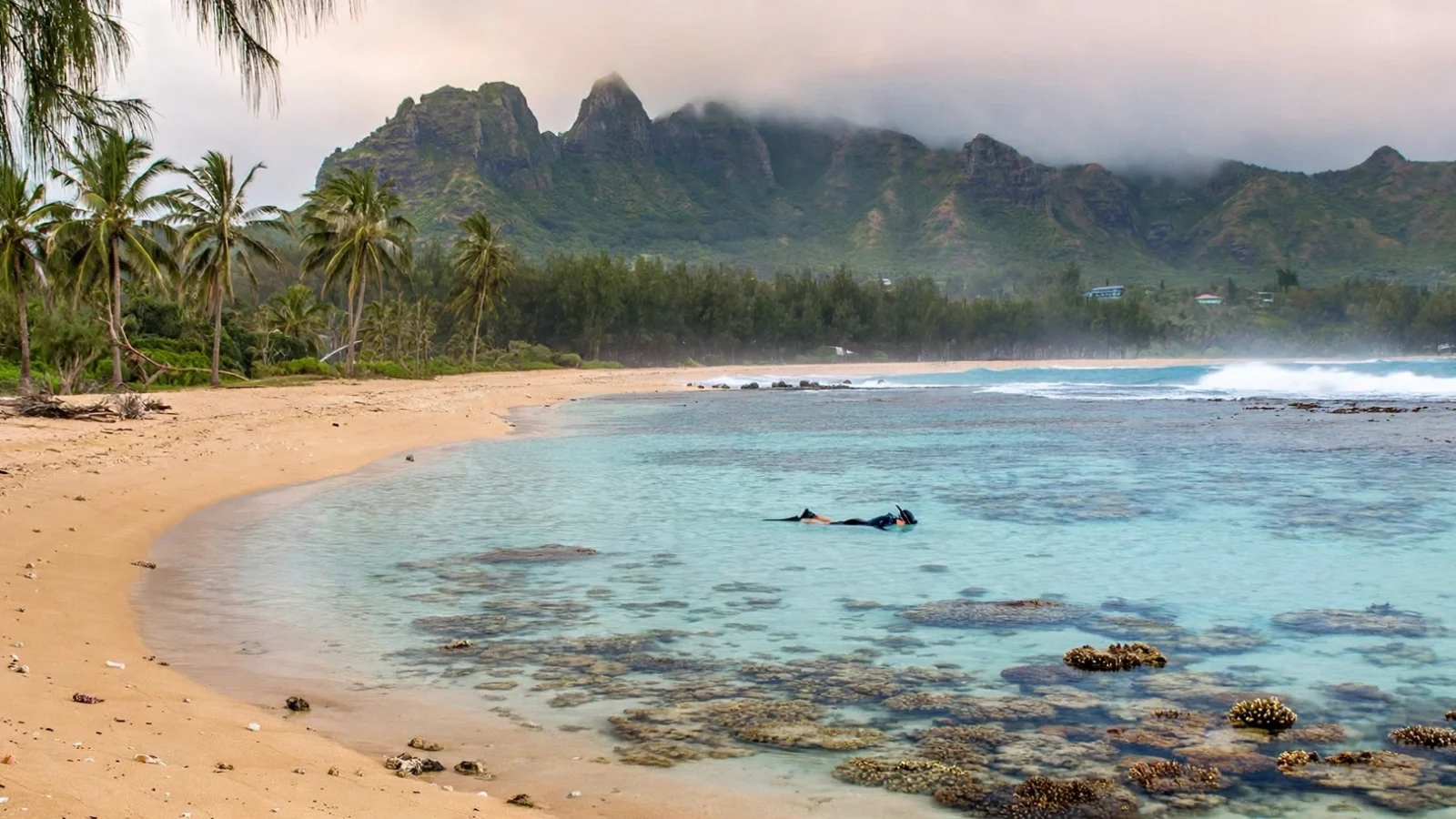
Anahola is the Kauai beach the tour buses drive straight past. Halfway between Lihue and Princeville, on the island’s green northeast coast, a wide golden crescent sits inside a fringing reef, backed by the jagged Kalalea mountains and fronting a small Hawaiian Home Lands community. There are no resorts here, no rental stands, no shave-ice truck — and, on a weekday morning, often almost nobody else in the water.
What there is, is a reef. Anahola Bay’s fringing reef runs close to shore, the surf breaks out on it instead of on the beach, and inside it the water is shallow, sandy in patches and reefy in others. This is not Tunnels Beach — the coral is less dramatic and the visibility is less reliable — and this guide will not pretend otherwise. It is something else instead: the east side’s local snorkel beach, reef-protected, lifeguarded at the park, and quiet in a way the famous north-shore spots stopped being years ago. Here is exactly where to swim, where not to, and what decides whether you get a clear reef morning or a murky one.
Quick facts
- Location: Anahola Bay, northeast Kauai — Anahola Beach Park at the bay’s south end, off Kuhio Highway (Hwy 56) near mile marker 13
- Entry: Sandy walk-in inside the fringing reef; the snorkeling reef is on the bay’s east side and along the inshore reef
- Parking: Free dirt lot at Anahola Beach Park; no fee, no reservation for the beach
- Facilities: Restrooms, showers and picnic tables at the beach park; campsites in the park area
- Lifeguard: Yes at Anahola Beach Park (typically daytime hours, around 9 am–5 pm — check the tower on the day)
- Fees / reservations: None for the beach; camping requires a County of Kauai permit
- Rentals: None at the beach — bring your own gear or rent in Kapa’a or Lihue before you come
- Best window: Calm mornings, ideally after a dry spell — see the visibility section before you plan around this beach
- Community note: Anahola is Hawaiian Home Lands and a local residential beach. Weekends belong to local families; visit quietly, especially on weekdays
Where Anahola Beach is — two ends of one bay
Anahola Bay curves for roughly half a mile of wide sand, with the beach continuing in a narrower strip further north. Anahola Stream cuts the beach in two near its middle, flowing out of the valley behind and meeting the sea through the reef flat. The Kalalea ridge — including the profile locals call King Kong — fills the background, which is why photos of this beach always look more dramatic than a “local beach park” has any right to.
There are two ways in, and they lead to different days:
Anahola Beach Park (south end). The main public access, reached by Kukuihale Road off Kuhio Highway. This is the managed end: the free parking lot, restrooms, showers, picnic tables, the lifeguard tower and the campground area. The snorkeling reef on the bay’s east side is a short swim from here, and this is the right base for almost every visitor.
The northern stretch (Anahola Road side). The beach continues north, quieter and less serviced, reached from the Anahola Road side — note that visitor reports mention a road block part-way along Anahola Road, so do not count on driving its full length. Most snorkelers are better served by the park.
Whichever end you choose, understand what this beach is: the neighbourhood’s backyard. People fish here, camp here, celebrate birthdays here. Snorkelers are welcome — the reef is public water — but you are a guest at a community beach, and the sections below are written that way.
Getting there and parking
From Lihue, drive north on Kuhio Highway (Hwy 56) for roughly 25–30 minutes; from Princeville and Hanalei, drive south for roughly the same. Near mile marker 13, turn toward the ocean on Kukuihale Road and follow it down to Anahola Beach Park. The parking lot at the end is unpaved dirt, free, and — on weekdays — usually close to empty. Weekends fill with local families from mid-morning.
There is no entrance fee, no gate and no reservation system for the beach itself. Camping in the park area (including the Kumu Camp site) is a separate matter and requires a County of Kauai camping permit booked in advance through the county — do not just pitch a tent.
Bring everything with you. There are no shops, food trucks or rental stands at the beach, and the small town of Anahola has only limited options. Water, food, shade and your snorkel gear all come in the car — and everything you bring in, you carry back out.
Snorkeling at Anahola: the reef route
The layout is simple once you see it from the sand. The fringing reef runs across the bay close to shore, which is why the waves you can see breaking are breaking out there, not on the beach. Inside the reef is a shallow, protected flat of sand patches and reef. The snorkeling is not evenly spread across it — it concentrates in specific places, and two places are genuinely off-limits.
The east-side reef (the main event). Swim out from the park end toward the eastern side of the bay. This is the stretch every snorkeling source on Anahola points to: coral heads scattered across a shallow reef flat, sand channels winding between them, and the densest fish life in the bay. Work slowly along the coral heads rather than crossing the open sand — the animals live on the reef structure, not over the flats. Depths inside the reef stay shallow, which is what makes this a workable beginner snorkel on a calm morning.
The inshore reef patches. Closer to shore, smaller reef patches hold fish in very shallow water. On a calm, clear morning these are a gentle first look for nervous snorkelers and older kids — you can often stand up, which you should do only on sand, never on reef.
The stream mouth — do not snorkel here. Where Anahola Stream meets the sea, currents funnel out through the reef and rip currents are common; after rain the outflow turns the water murky and pushes debris into the bay. Every credible guide to this beach gives the same instruction: swim and snorkel away from the stream mouth. The lagoon-like area behind the beach near the stream is a kids’ splash zone on calm days, not a snorkel route.
The old pier ruins — look, don’t swim. At the edge of the beach park sit the remains of an old pier: rotted timber and iron pilings from the bay’s steamer era. They photograph beautifully and snorkel badly — the wood splinters, the iron is sharp, and the structure is a hazard, not a reef. Admire them from the sand.
The outer reef — experienced only, calm days only. Beyond the fringing reef the bay opens to the ocean. Surf breaks there, currents strengthen, and local surfers use the north side of the bay. There is no reason for a visiting snorkeler to cross the reef line at Anahola; everything this beach does well happens inside it.
What you will see
The fish list at Anahola is the classic Hawaiian reef cast, and the incumbent guides’ species lists agree with each other: schools of yellow tang and convict tang working the coral heads, parrotfish scraping the reef, ornate and raccoon butterflyfish in pairs, and Picasso triggerfish — the humuhumu — picking around the rocks. Because the inside of the reef is shallow and sunlit, it is a good beach for learning to tell these species apart; our guide to snorkeling with turtles in Hawaii covers the etiquette that applies to the bigger animals below.
Turtles deserve the honest sentence. Hawaiian green sea turtles are seen at Anahola — snorkelers report them over the reef and they come ashore toward evening — but this is not a turtle-guarantee beach the way Poipu or Turtle Town can be. Treat one as a welcome bonus, keep the legal 10 feet of distance, and never follow or touch one. Hawaiian monk seals also haul out on this sand occasionally to rest; they are among the most endangered marine mammals on earth, the rule is 50 feet, and a resting seal is a reason to move your towel, not to move closer with a phone.
Just as honest: you may see loose limu (seaweed) drifting in the shallows, and on some days it clouds the water — visitor reviews mention it at Anahola more than at any other Kauai snorkel beach in this series. It is part of this reef’s ecology, and it is one of the two things that decide visibility here. The other is rain, covered next.
Conditions and the best time to snorkel Anahola
Anahola’s protection is real but conditional, and this is the section the other guides skip.
The reef protects you — until surf gets big. In normal trade-wind conditions the fringing reef knocks the energy out of the surf and the inside stays calm. In high surf, especially from winter north and east swells, waves overtop the reef, the inside gets rough and currents strengthen — the sources are blunt that the beach is safe except in high surf. If the ocean looks energetic from the parking lot, the snorkeling is off for the day; ask the lifeguard if you are unsure.
Morning is the window. As at almost every Hawaii snorkel beach, the first hours are calmest and clearest, before the trade winds build and stir the shallows. Arrive early, snorkel first, picnic after. Our best time to snorkel in Hawaii guide explains the island-wide pattern.
Rain is the visibility switch. Anahola Stream drains a wet valley. After heavy rain it runs brown, the outflow clouds the bay, and debris washes down — the same stream rule that governs the Moloa’a Bay guide a few miles north. If it rained hard in the last day or two, choose a south-shore beach instead and come back after a dry spell. Brown water is also a shark-caution condition everywhere in Hawaii — another reason the post-rain snorkel is simply off.
Season, honestly. The east side does not flip as hard as the north shore in winter — Anahola is snorkeled year-round in calm spells — but winter brings the biggest surf and the roughest weeks, and summer brings the longest runs of calm, clear mornings. Check the surf report the night before, not just the calendar.
Beginners and kids at Anahola
On a calm morning, the inside of Anahola’s reef is one of the east side’s workable beginner snorkels: shallow water, a sandy entry at the park, reef fish in water you can stand up in (on sand), and a lifeguard tower watching the park section — a combination most east-side beaches do not offer. Families already use the beach this way; local kids learn to swim and bodyboard here.
The conditions are the ones above, without exception: calm day, morning, inside the reef, away from the stream mouth, and within the lifeguarded area for new swimmers. First-timers should read our beginners’ snorkeling guide before choosing any unguarded moment, and our Hawaii snorkeling safety guide for the full picture. What Anahola is not: a rough-day fallback. When the surf is up, the east side’s genuinely sheltered alternative is the rock-walled pool at Lydgate, covered in our Lydgate Beach guide.
Facilities, camping and food
Anahola Beach Park covers the basics properly: restrooms, outdoor showers, picnic tables, a grassy park area and the campsites, all behind a wide ironwood-shaded backshore. The parking lot is free dirt. There is no drinking-water guarantee worth planning around and nothing for sale — Anahola town, a few minutes back on the highway, has a small cafe and a weekly farmers market, but the working rule is to arrive self-sufficient.
Camping is this beach’s second identity — “anahola beach camping” is one of the biggest searches in the whole cluster. The campground at the park (including Kumu Camp) operates on County of Kauai permits, booked ahead; campers get the beach at its best hours, dawn and dusk, as part of the deal. If you camp, you are staying in the community’s park: quiet hours and pack-it-out are not suggestions.
Visiting a Hawaiian Home Lands beach, respectfully
Anahola is one of the largest Hawaiian Home Lands communities on Kauai — land held for Native Hawaiian families under the Hawaiian Homes Commission Act. The beach park is public, and visitors are genuinely welcome, but this is a residential, working beach in a way resort-front beaches are not:
- Give fishermen their water. Shore fishing and net fishing are subsistence here, not scenery. Swim wide of lines, poles and nets.
- Weekday-quiet is the local rhythm. Weekends and holidays are family time — that is when the park fills, and when visitors should most keep to the edges.
- Stay off homestead land. Beyond the park and the beach, the land behind you is people’s homes and lots. The beach and the park are your area.
- Pack out everything. The community keeps this beach; leave it the way the families who live here do.
None of this is complicated, and visitors who follow it tend to have the best version of this beach anyway — the quiet one.
Anahola vs its neighbours
| Beach | Snorkeling character | Lifeguard | Best for |
|---|---|---|---|
| Anahola (this guide) | Fringing reef inside a protected bay; east-side reef route; visibility varies with rain and limu | Yes, at the park | A quiet local snorkel with facilities, camping next door |
| Moloa’a Bay | Ends-only reef, centre is a no-go; stream rule applies there too | No | An even quieter, more conditional reef — see our Moloa’a Bay guide |
| Lydgate Beach Park | Rock-walled enclosed pool; fish inside a wall, almost no ocean energy | Yes | Small kids and rough-day snorkeling |
| Anini Beach | Long shallow lagoon reef on the north shore | No | Calm summer lagoon snorkeling — see our Anini Beach guide |
| Kalapaki Beach | Sandy bay, no real offshore reef | No | Swimming and beginner surf in Lihue — not a snorkel beach |
For the full island picture, start from our Kauai snorkeling hub — and if you are heading north anyway, Tunnels Beach is the reef Anahola honestly cannot match, an hour’s drive in good traffic.
What to bring
Your own everything. There are no rentals at Anahola, so mask, snorkel and fins come with you — rent the day before in Kapa’a or Lihue if you are not travelling with gear; our Hawaii snorkeling gear checklist covers what matters. Add reef-safe sunscreen (Hawaii law bans the sale of sunscreens with oxybenzone and octinoxate), more water than you think, food, and shade for the picnic half of the day. Reef shoes help for the walk across the shallow reef flat’s sandy-rocky mix — and keep them off the coral itself.
FAQ
Is Anahola Beach good for snorkeling?
Yes — with the right expectations. The fringing reef on the bay’s east side holds plentiful reef fish in shallow, protected water, and it is the east side’s local snorkel beach. It is not as dramatic as Tunnels Beach, and visibility varies more (loose seaweed and post-rain stream murk are real factors). On a calm morning after dry weather, it is a genuinely good snorkel.
Is Anahola Beach safe for beginner snorkelers?
On calm days, yes — inside the reef, in the morning, near the lifeguarded park section. The water inside the fringing reef is shallow with a sandy entry. The exceptions are absolute: stay away from the Anahola Stream mouth (rip currents), do not cross the outer reef, and skip it entirely in high surf, when the reef’s protection fails.
Is there a lifeguard at Anahola Beach?
Yes, at Anahola Beach Park — typically on daytime hours (around 9 am to 5 pm). Some older listings wrongly say there is no lifeguard; the tower at the park is staffed, but always check on the day and swim within the guarded area if you are a new swimmer.
How much does parking cost at Anahola Beach?
Parking at Anahola Beach Park is free, in an unpaved lot at the end of Kukuihale Road. There is no entrance fee and no reservation for the beach. The lot is small and fills on weekends — arrive early.
Can you see turtles at Anahola Beach?
Sometimes. Turtles are reported over the reef and come ashore toward evening, but Anahola is not a turtle-guarantee beach. If you see one, keep at least 10 feet away and never touch or follow it. Monk seals also rest on this beach occasionally — give them 50 feet.
Can you camp at Anahola Beach?
Yes — camping is available in the beach park area (including Kumu Camp) with a County of Kauai camping permit, which must be booked in advance. It is one of the few Kauai beaches where you can legally sleep next to a snorkel reef.
Are there snorkel rentals at Anahola Beach?
No. There are no rentals, shops or food stands at the beach. Bring your own gear, or rent in Kapa’a or Lihue the day before, and pack all your food and water in — and back out.
When is the best time to snorkel Anahola Beach?
Early morning, on a calm day, after a dry spell. Mornings beat the trade winds, dry weather keeps the stream from clouding the bay, and summer brings the longest calm runs. After heavy rain or in high surf, choose another beach that day.