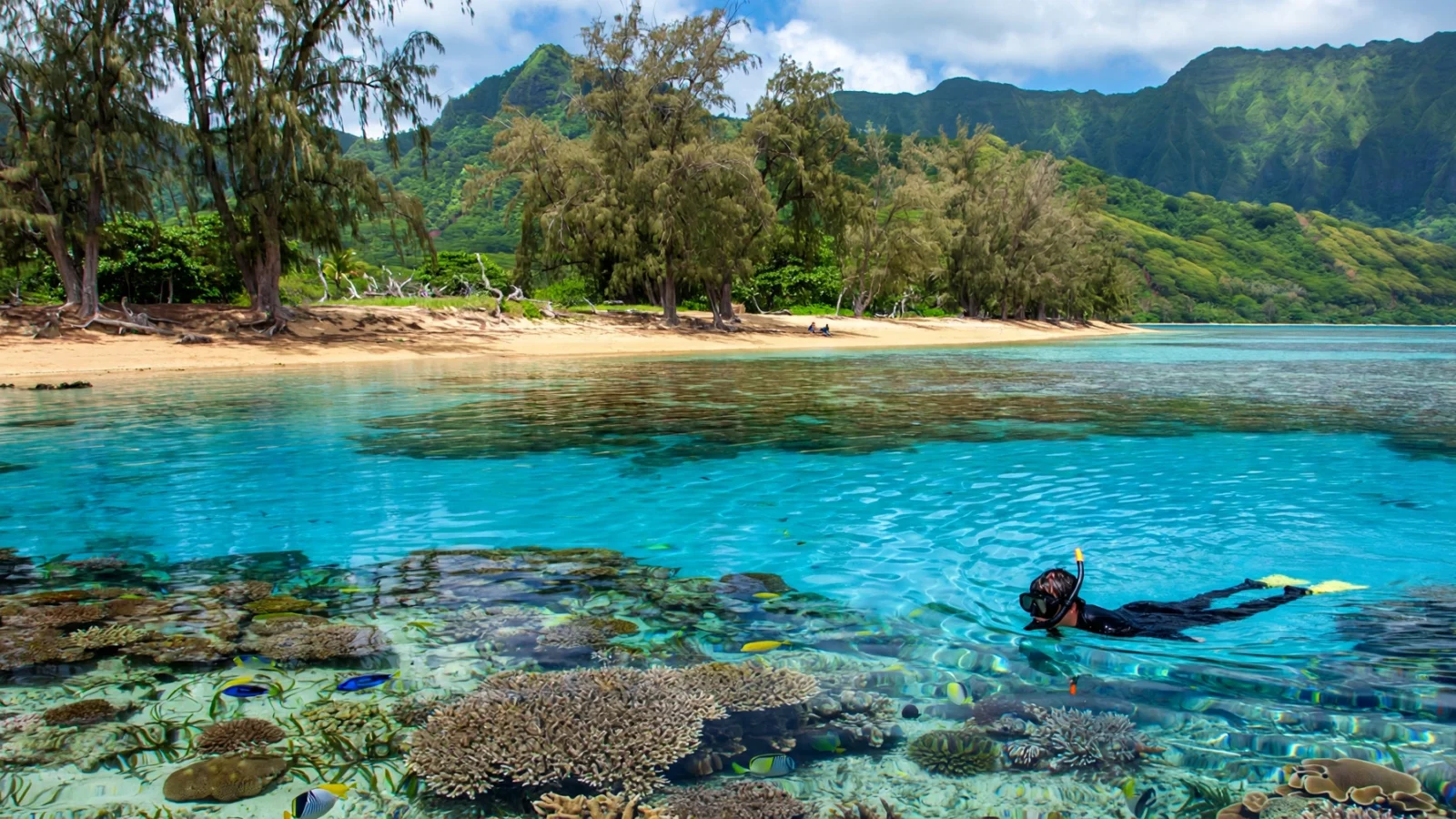
Most North Shore beaches ask you to earn your snorkeling. Winter surf, boat traffic, a long swim out to the reef. Anini Beach is the opposite. A huge fringing reef sits offshore here and soaks up the open-ocean swell before it reaches the sand, leaving a wide, shallow lagoon that stays swimmable on many days when other Kauai spots are a write-off. That sheltered water is why Anini Beach snorkeling has a loyal following with beginners, families, and anyone who would rather spend an hour watching turtles than fighting a current.
It is not a perfect aquarium, and honest guides should say so. The lagoon can be murky after rain, parts of the reef flat are very shallow at low tide, and there is a deep channel through the reef that you must never swim into. Go in with the right zone, the right tide, and a clear safety plan, though, and Anini gives you one of the calmest, most forgiving snorkels on Kauai’s North Shore — no boat, no tour, and no reservation,
Anini Beach, Kauai: the reef that makes it work
Anini Beach sits on Kauai’s North Shore between Princeville and Kilauea, and the thing that defines it is the reef offshore: one of the longest fringing reefs in Hawaii, running for more than two miles parallel to the beach. That reef is the whole reason Anini snorkels the way it does — it breaks the open-ocean swell before it reaches the sand, leaving a wide, shallow lagoon that stays calm on days when the rest of the North Shore is a write-off.
The lagoon is not one uniform pool. It is a long, reef-sheltered strip with sandy gaps, scattered coral heads, and a deep channel cutting through the reef — and the snorkeling changes along its length, which is why the three zones below matter more here than at most beaches. To picture it: the main beach park sits roughly in the middle, with its pavilions, restrooms and the boat ramp nearby; the quiet west end — Wyllie’s Beach, also called Kalihikai — runs toward Princeville; the east end stretches on toward the stream mouths and Kilauea. The reef sits offshore along the whole length, and the channel — the one place you must never swim through — is the gap in that reef line.
That size is part of the appeal and part of the caution. Even on a busy weekend you can walk a few minutes from the park and have a stretch of lagoon to yourself — but conditions at the west end can differ from conditions at the park, so check the water where you plan to get in, not just from the car park.
Where to snorkel at Anini Beach: the three zones
Anini is a long beach — sources put the shoreline at more than two miles — and the snorkeling changes a lot along its length. Choosing the wrong stretch is the main reason visitors come away saying the snorkeling was disappointing. Use these three zones instead of wandering in anywhere.
1. Anini Beach Park: the easy first snorkel
Start here if it is your first visit. The county beach park in the middle of the beach has the facilities, the shade, and a gentle sandy entry. Wade in slowly, put your fins on in waist-deep water, and work along the scattered coral heads and reef patches inside the lagoon rather than heading straight out. Depths stay manageable, the bottom is never far below you, and you can stand up on sand — never on coral — whenever you need a rest. This zone is also the easiest place to spot turtles cruising the inside edge of the reef on a calm morning.
2. Wyllie’s Beach and Kalihikai: the quiet west end
At the western end, past the beach park, Wyllie’s Beach (also called Kalihikai Beach) feels like a different place: narrower, quieter, and backed by ironwood trees. The snorkeling here can be rewarding around the reef structure close to shore, and it is a favourite with locals who want to escape the main park crowd. Facilities are minimal, the entry is less obvious, and you need to be more careful about where the reef gives way to deeper water. Confident beginners who have already done a session at the beach park will enjoy it most.
Anini Beach snorkeling map: entry points, reef zones and turtle spots
No official snorkeling map of Anini Beach exists, so here is the beach laid out the way snorkelers actually use it — west to east along more two miles of shoreline, with the three zones from the section above pinned to their entries. The beach park sits roughly in the middle; the quiet west end runs toward Princeville; the east end stretches toward the boat ramp and the stream mouths near Kilauea.
Entry 1 — Anini Beach Park (the easy first snorkel). The main beach park, with restrooms, showers, pavilions and free parking. Sandy entry, stand-up depths, scattered coral heads inside the lagoon — start here on a first visit. The Anini Beach pin on our Kauai snorkeling map is 22.2230, -159.4685; navigate to Anini Beach Park from there.
Entry 2 — Wyllie’s Beach / Kalihikai (the quiet west end). Past the beach park toward Princeville: narrower, quieter, backed by ironwood trees, with reef structure close to shore. No real facilities and a less obvious entry — best for confident beginners who have already done a session at the park.
Entry 3 — The boat ramp and the east end (the turtle drift). Park near the boat ramp, enter to the right of the ramp, and let the along-shore drift carry you back toward the ramp at high tide on a calm morning — the stretch where visitors most often report swimming alongside green sea turtles. Stay well clear of the ramp itself and of any boat launching, and never let the drift carry you toward the channel.
The one place never to enter: the channel. A deep channel cuts through the reef, and water leaving the lagoon funnels through it. On the map, it is the gap in the reef line — inside the lagoon you are sheltered; in and beyond the channel the current can carry a swimmer out to sea. Snorkel inside the reef, and turn back the moment the bottom drops away into deep blue water. For the island-wide picture, with GPS pins for all 19 Kauai shore spots, see our Kauai snorkeling map.
Wyllie’s Beach and the trail down from Princeville
The far west end of Anini is a different beach with a different name. Wyllie’s Beach — also written Wyllie Beach, at Kalihikai — sits across Anini Stream from the main beach, under the Princeville cliffs. The stream spills into the ocean at the boundary and makes a sandbar that little ones love to play on, and on a calm day you can cross where the channel is shallow and walk the beach between the two. The water at Wyllie’s is calm, shallow and warm behind the same reef, and it is one of the better paddleboarding spots on the North Shore.
The other way in is the trail down from Princeville. Park at the public-access parking lot in front of the Westin resort and golf course, find the trailhead by the edge of the golf course, and walk down — about a 10-minute walk to the beach, with mango trees and a waterfall to look for on the way. The climb back up is the part to respect: Princeville sits on a cliff, so it is roughly a 300-foot elevation change, and the dirt trail is steep and slippery when wet. Wear sturdy shoes, not flip-flops, and do not attempt it after heavy rain. There is no fee and no ticket for the trail or the beach, and the walk is the only link between the two ends on foot — Anini Road does not go through to Princeville, so by car it is the 15-minute drive back around. For the wider north-shore picture, see our Kauai snorkeling hub.
Best time to snorkel at Anini Beach
Time of day: Early morning wins, almost every time. Arrive before the trade winds fill in and the lagoon is at its glassiest, the light is best for spotting turtles, and the car park is still quiet. By late morning on a breezy day the surface chop inside the lagoon can make a long snorkel tiring even though the reef keeps the big swell out.
Tide: A mid-to-high tide is your friend here. Parts of the inner reef flat are shallow enough that at a very low tide you will be finning over inches of water, forced wide around coral heads, or tempted to stand where you should not. An incoming or high tide gives you clearance over the reef, easier entries, and better snorkeling close to shore. Plan the session around the tide table, not just the clock.
Season: Summer is Anini’s most reliable season, when North Shore surf is usually at its smallest and the lagoon is calmest for the longest stretches. Winter is the honest warning in this guide: large north swells can break over and inside the reef, currents strengthen, visibility falls, and the beach can go from friendly to dangerous. Local advice and warning signs have flagged Anini’s channel and winter surf for years — treat any high-surf day as a no-snorkel day here, however calm the sand-level water first looks. Spring and autumn sit in between: often excellent, but check the surf forecast the night before. For the island-wide picture, see our guide to the best time to snorkel in Hawaii.
Checking conditions today: a 60-second routine
- Check the North Shore surf and wind forecast. Big swell or strong trades? Choose another day or a sheltered south shore spot.
- Check the tide. Aim to be in the water in the two hours either side of high tide.
- Think about rain. Heavy rain in the previous day or two usually means cloudy water inside the lagoon.
- On arrival, watch the water for five minutes before gearing up. Look for whitewater pushing over the reef, a muddy colour, or other swimmers being carried sideways.
- Read and obey any posted warning signs, and if a lifeguard or county warning is in place anywhere on your route, follow it — the Wanini Beach tower is staffed daily, 8 a.m. to 6 p.m., but it does not cover the whole beach, so ask the lifeguard where it is safe to enter.
Getting there, parking and facilities
Anini sits on Kauai’s North Shore between Kilauea and Princeville, at the end of Anini Road. From Kuhio Highway, turn onto Kalihiwai Road between mile markers 25 and 26, then turn left onto Anini Road and follow it to the beach — the road nearly reaches Princeville but does not go through, so the drive back around is the only way out by car. On Kauaʻi the beach is also called Wanini Beach, so a sign or map that says Wanini is pointing at the same place.
Parking is free street parking: pull off the road near the stretch of beach you want, and arrive early on calm weekends, when the spaces fill. If you drive past the beach park toward the west end, you are parking along the road near residences — keep driveways clear and do not block the road. There is no day-use reservation for the beach itself.
The beach park has the facilities that make Anini a proper base for the day: restrooms and outdoor showers near the parking lot, drinking water, picnic pavilions and tables, barbecue grills, a grassy lawn behind the sand, and a boat ramp at the east end. Two of the pavilions are often reserved for family gatherings and weddings. The ironwood trees give the best shade on this stretch of the North Shore, which is half the reason families stay past lunch.
Safety at Anini: the channel rule and other essentials
Anini’s calm reputation comes with one serious exception, and every visitor needs to understand it before getting in. A deep channel cuts through the reef, and water leaving the lagoon funnels through that opening. Inside the lagoon you are sheltered; in and beyond the channel the current can be strong enough to carry a swimmer out to sea. Warning signs at the beach flag this hazard, and Anini has a history of drownings and rescues linked to the channel, strong winter surf, and swimmers overestimating the lagoon’s calm. The rule is simple and absolute: snorkel inside the reef, never swim out through a gap in the break, and turn back the moment the bottom drops away beneath you into deep, blue water.
Build the rest of your safety habits around that rule. Never snorkel alone, and always keep one person watching from the beach when children are in the water. Stay well inside the reef break in winter or whenever surf is up. Keep off the reef flat itself — fins and feet damage coral that took decades to grow, and sharp coral and urchins punish careless steps. Wear reef-safe sunscreen, applied before you arrive so it has time to absorb, and remember Hawaii bans sunscreens containing oxybenzone and octinoxate. Our full Hawaii snorkeling safety guide is worth ten minutes before any trip.
Anini Beach for beginners and kids
For a first snorkel, Anini Beach Park is hard to beat on Kauai — in calm conditions. The sandy entry means no rock scrambling, the lagoon lets nervous swimmers stay in water they can stand up in, and the shade, grass, restrooms and picnic pavilions make the out-of-water hours easy with children. Prepare properly and it gets even better: practise mask breathing at the water’s edge first, use a well-fitting mask and a flotation belt or vest for anyone who is not a confident swimmer, and keep first sessions short, warm and successful rather than long and exhausting. If you are building a family trip around spots like this, start with our beginner snorkeling guide for Hawaii and run through the gear checklist the night before.
Swimming at Anini Beach: the calm-water case
Anini is a swimming beach first and a snorkeling beach second, and the 2.5-mile sandy stretch is the reason. The same fringing reef that shelters the snorkel zones keeps the water inside the lagoon shallow and calm on a settled day, so swimming here feels closer to a protected cove than to an open North Shore beach. The best swimming is near the end of Anini Road, past the beach park, where the water is clearest and the entry is sandy all the way in.
It is also one of the few North Shore beaches that can sometimes be safe for swimming in winter, when the reef takes the edge off swells that shut down the neighbouring beaches. Sometimes is the operative word: a winter swell can still push surf over the reef, and the lagoon turns rough on those days. Check the conditions routine in this guide before you go in, and if the water looks doubtful, do not go out.
Two honest limits. At low tide the lagoon gets very shallow in places, and the water can turn murky where the sand stirs up — early morning, around a higher tide, is the better swim. And the calm is local, not general: the deep channel through the reef carries a real current, and the county warns it has a history of drownings. Swim near the lifeguard tower, stay inside the reef, and keep children close even on a flat day. If you want the full safety picture before a family swim, read our Hawaii snorkeling safety guide first.
Tips for a better Anini snorkel
- Snorkel the coral heads, not the open sand — fish and turtles concentrate around structure.
- Move slowly. Hovering quietly over one coral head for two minutes reveals more than a fast lap of the lagoon.
- Bring your own gear. There is no rental stand at the beach, and the nearest rental shops are in Kilauea, Princeville and Hanalei.
- Take a photo of the channel warning signs and your entry landmark before you get in — orientation is easier from the water when you have a plan.
- Pair the snorkel with the shade: the ironwoods and pavilions make Anini one of the best picnic beaches on the North Shore, so plan to stay for lunch.
- Leave the reef as you found it. Take photos, leave
Anini Beach beyond the snorkel
Anini earns its keep even on a day the water says no. The same steady trade winds that chop up the lagoon by late morning make the beach a magnet for windsurfing and kitesurfing — on a breezy day you will see sails and kites working the lagoon, which is one more reason snorkelers should get in early and keep an eye out for boards once the wind fills in. The grassy park behind the sand, with its picnic tables, BBQ grills, restrooms and outdoor showers, makes Anini a proper beach-day base rather than just a snorkel stop, and the ironwood shade is the best on this stretch of the North Shore.
Camping is the other thing visitors ask about: it is allowed only in the designated camping area and only with a county permit — a day snorkel needs no reservation, but camping without the permit is not allowed. In winter, when the north swells arrive and the lagoon turns rough, the honest move is the south shore: our Snorkeling in Hawaii in December guide covers which side of each island stays calm in the cold months — and when the whales are in.
Anini Beach snorkeling FAQs
Is Anini Beach good for snorkeling?
Yes, on calm days. The reef-sheltered lagoon gives shallow, beginner-friendly snorkeling with turtles and reef fish. Visibility depends on wind, swell and recent rain, so go early after settled weather.
Where to snorkel at Anini Beach?
Start at Anini Beach Park, working the coral heads inside the lagoon. Confident snorkelers can try the quieter west end at Wyllie’s Beach (Kalihikai). Never snorkel in or beyond the channel through the reef.
Can you snorkel at Anini Beach?
Yes, it is a public county beach park with shore entry, restrooms, showers and free parking in the sources checked.
The Wanini Beach tower is staffed daily from 8 a.m. to 6 p.m., so ask the lifeguard about the day’s conditions before you get in — and stay inside the reef, away from the channel.Will I see turtles at Anini Beach?
Often, but never guaranteed. Green sea turtles regularly cruise the lagoon and feed around the reef. Watch from at least 10 feet away, never touch or chase them.
Is Anini Beach snorkeling good for beginners and kids?
In calm summer conditions, yes — sandy entry, stand-up depths and good facilities make it one of Kauai’s best learning spots. Use flotation for weak swimmers and supervise children constantly.
When is the best time to snorkel at Anini Beach?
Early morning around a higher tide, ideally in summer when North Shore surf is smallest. Avoid it in large north swells and after heavy rain.
Can you snorkel at Anini Beach in winter?
Sometimes, on unusually calm winter days — but winter is its dangerous season, with big surf and stronger channel currents. If in any doubt, choose a sheltered south shore beach such as Poipu instead.
What are Anini Beach snorkeling conditions like today?
Check the North Shore surf and wind forecast, the tide, and the last 48 hours of rain. On arrival, watch the lagoon for five minutes: clear water and no whitewater over the reef means go; muddy water or breaking surf means no.
Can you camp at Anini Beach?
Yes, but only in the designated camping area and only with a county permit. Camping is a separate permitted activity — a day visit for snorkeling needs no reservation and no permit, but setting up camp without one is not allowed.
Where do you park for Anini Beach?
Parking is free, spread between the main beach park area and pull-ins along Anini Road. It is limited for a beach this popular, so on a calm weekend morning arrive before 9 a.m. or accept a walk. Never block driveways on Anini Road — homes line the lane, and access must stay clear.
Where is Anini Beach in Kauai?
On Kauai’s North Shore, between Princeville and Kilauea. From Kuhio Highway (Highway 56), turn onto Anini Road and follow it down as it becomes a narrow, winding lane under the trees — the beach park, pavilions and parking areas are obvious when you reach them. The beach itself stretches for more than two miles along the shore.
Anini rewards the snorkeler who plans around it. Pick your calmest North Shore morning, aim for high tide, stay inside the reef, and this long, shaded, turtle-friendly lagoon will show you exactly why locals keep it at the top of their list.
shells and coral, and never feed the fish.
Is there a snorkeling map for Anini Beach?
Yes — the map section above lays out the three entry points, the reef zones and the turtle spots west to east, and our Kauai snorkeling map carries the Anini Beach GPS pin (22.2230, -159.4685) alongside the island’s other 18 shore spots. No official printed snorkeling map of Anini exists, so use this guide’s map together with the tide and surf check before you go in.
Where should I park for the east-end turtle drift?
Park near the boat ramp at the east end of the beach, not at the main beach park — the drift route starts with an entry to the right of the ramp and ends back at the ramp. For a first snorkel, park at the main beach park instead and use its sandy entry. Parking is free in both areas but limited on calm weekend mornings, so arrive before 9 a.m.
Is Anini Beach good for swimming?
Yes, in calm conditions — it is one of the best swimming beaches on Kauai’s North Shore, because the fringing reef keeps the lagoon shallow and calm. The best swimming is near the end of Anini Road, past the beach park. It can even be swimmable on some winter days, but a winter swell can still push surf over the reef, so check conditions before you get in and swim near the lifeguard tower.
Is there a lifeguard at Anini Beach?
Yes. Kauaʻi County installed a new lifeguard tower at Wanini Beach — the same beach, under its other name — on October 15, 2026, and lifeguards are stationed there seven days a week, 8 a.m. to 6 p.m. The tower covers the beach park area; the Back Channel and the far west end are not covered the same way, so ask the lifeguard where it is safe to enter.
Can you walk from Anini Beach to Princeville?
On foot, yes, by the trail — not by the road. A short, steep dirt trail runs from the public-access parking lot in front of the Westin resort in Princeville down to Wyllie’s Beach at the far west end of Anini, about a 10-minute walk down and a roughly 300-foot climb back up. It is slippery when wet, so wear sturdy shoes. Anini Road itself does not go through to Princeville; by car it is the 15-minute drive back around.
Anini Beach vs Tunnels Beach
Visitors staying on the North Shore usually ask us to choose between these two, because they rank for each other constantly. It is not really a contest — they reward different days and different swimmers. Tunnels Beach has the more dramatic reef system, richer coral formations, and the higher ceiling for experienced snorkelers on a calm summer day, along with harder parking and less shelter when the wind and swell pick up. Anini has the calmer lagoon, the easier entry, the better facilities, and the longer season for beginners and families. The smart North Shore plan is both: Anini first to build confidence, Tunnels on your calmest morning. In winter, when both north shore reefs get rough, switch to Poipu Beach snorkeling on the south shore instead, and use Ke’e Beach and Lydgate as further trip ideas when you are planning the rest of your Kauai week.
d Princeville, reached from Kuhio Highway (Highway 56). For the west end and Wyllie’s Beach, turn off the highway onto Kalihiwai Road; for the main beach park and the east end, use the second turn onto Anini Road and follow it down as it becomes a narrow, winding lane under the trees. Sources differ slightly on the exact street address they list for the beach park, so navigate to Anini Beach Park or Anini Road, Kilauea — the road simply runs along the beach, and the park, pavilions and parking areas are obvious when you reach them.
Parking is free in the sources checked for this guide, spread between the main beach park area and pull-ins along the road, but it is limited for a beach this popular. On a calm weekend morning, arrive before 9 a.m. or accept a walk. Never block driveways on Anini Road — homes line the lane, and access must stay clear. Anini Beach Park provides restrooms, outdoor showers, drinking water, picnic pavilions and tables, grassy shade, and a boat ramp. Camping is a separate county-permit activity in the designated area only; a day snorkel needs no reservation in the sources checked, but camping without the permit is not allowed. There are no equipment rentals and no food vendors at the beach itself — bring your gear, water and snacks with you, and take every scrap of rubbish back out.
3. The east end and the boat ramp area
East of the park the beach stretches on towards the boat ramp and the stream mouths. This stretch is better for a beach walk than a first snorkel. Water clarity suffers sooner here after rain, boat movement adds a hazard you do not need, and the interesting reef structure is patchier. If the park zone is crowded, move a short distance east for space in the water — but keep the same rule: stay inside the lagoon, over sand and scattered coral, well away from any opening in the reef.
The boat-ramp drift: the turtle route regulars use
There is one more way to snorkel the east end, and it comes from the people who swim here every week rather than from a guidebook. Park near the boat ramp, enter the water to the right of the ramp, and let the gentle along-shore drift carry you back down toward the ramp — at high tide, on a calm morning, this is the stretch where visitors most often report swimming alongside green sea turtles, sometimes several in a single session. The reef structure just off the ramp holds fish too, and the drift means you cover ground without fighting the water.
Take the cautions with the tip. This is a working boat ramp, so stay well clear of the ramp itself and of any boat launching or coming in, and never let the drift carry you toward the channel opening in the reef. It is a route for confident snorkelers who have already done a session at the beach park and know how the lagoon feels — first-timers should start at the park zone, not here. And the same rules apply: go at high tide for clearance over the reef, stay inside the lagoon, and get out the moment the bottom drops away into deep blue water.
How to enter the water safely
Walk the shoreline first and look for a pale, sandy gap in the reef flat. Shuffle in slowly to avoid stepping on a sea urchin or a sharp piece of reef, and never stand on living coral — it damages the reef and can cut your feet badly. Once the water is waist-deep, float, clear your mask, and check that you are drifting gently along the shore rather than out towards the reef break. If you feel a steady pull seaward at any point, do not fight it head-on: swim parallel to the beach back into the sheltered lagoon and exit at the sand. Pick a landmark on shore — a pavilion, a distinctive tree — and check it every few minutes so you always know where your exit is.
What you will see snorkeling at Anini
Green sea turtles are the headline, and Anini is one of the more reliable shore snorkels on Kauai for seeing them without a boat. Look for a slow, dark shape gliding over the sand channels between coral heads, or a turtle resting quietly under a ledge. Give them at least 10 feet of space, never touch or chase one, and let a turtle pass rather than blocking its path to the surface. Our guide to snorkeling with turtles in Hawaii covers the viewing rules in full.
Around the coral you can expect Hawaii’s classic reef community: yellow tangs and other surgeonfish grazing the rocks, butterflyfish picking at the coral in pairs, parrotfish scraping algae with audible crunches, Moorish idols, wrasses, damselfish, and the state fish, the humuhumunukunukuapua’a, defending its small patch of reef. Trumpetfish hang almost motionless above the coral waiting to ambush smaller fish. You may also see rays gliding over the sand on quiet mornings, and — very occasionally, and usually further out — a monk seal resting on the beach. If you find one hauled out on the sand, keep a wide distance and leave it completely alone. Numbers and variety improve the closer you work to healthy coral, so spend your time around structure rather than over bare sand.
straight off the beach.
Anini Beach snorkeling quick facts
- Island and area: Kauai, North Shore, off Anini Road near Kilauea and Princeville
- Best for: Beginners, families, calm-water snorkeling, turtles, long relaxed sessions
- Water: Reef-protected lagoon, mostly shallow inside the reef — about 5 to 20 feet in the snorkel zones
- Entry: Sandy shore entry at Anini Beach Park, plus a quieter west end at Wyllie’s Beach (Kalihikai)
- Facilities: Restrooms, showers, drinking water, picnic pavilions and tables, boat ramp
- Parking: Free in the sources checked for this guide; no day-use reservation was listed. Arrive early — spaces fill on calm weekends
- Lifeguard: Yes — the Wanini Beach tower is staffed seven days a week, 8 a.m. to 6 p.m. (new tower installed October 15, 2026, per Kauaʻi County). The tower covers the beach park area; the Back Channel and the far west end are not covered the same way, so ask the lifeguard where it is safe to enter
- Best window: Early morning, ideally around a higher tide, before the trade winds build
- Main hazard: The deep channel through the reef, where current can carry swimmers out to sea. Stay inside the lagoon
Is Anini Beach good for snorkeling?
Yes — with a condition attached. Anini is good for snorkeling when you judge it by the thing it does best: calm, protected, shallow water over a living reef, with a real chance of green sea turtles. It is not the place to promise yourself clouds of fish on every visit. Visibility inside the lagoon is usually fair rather than crystal, and it drops quickly after heavy rain, when runoff from the nearby streams clouds the water. On a dry, calm morning after a few settled days, the same lagoon can be clear, bright, and full of reef fish feeding around the coral heads.
Think of Anini as a conditions beach rather than a guarantee beach. Check the wind, the tide, and the last 48 hours of weather before you drive over. If all three are working for you, it can be the best beginner snorkel on the North Shore that day. If a big north swell is running or the water looks brown from the car park, save it for another morning and use one of the south shore backups later in this guide.
For the head-to-head verdict, see our Anini Beach vs Tunnels Beach snorkeling guide.