- Where
- Ha’ena, north shore Kauai — Kuhio Hwy (560), past Hanalei, near mile marker 8
- Cost
- Free — no entry fee, no reservation for Tunnels itself (reservations are for Ha’ena State Park / Ke’e, further on)
- Season
- May–September; winter surf makes the north shore unsafe for snorkeling
- Difficulty
- Inner lagoon: careful beginners on flat days. Outer reef: experienced snorkelers only
- Parking
- Two small beach-access alleys near mile marker 8, or free Ha’ena Beach Park lot plus a 10–15 minute sand walk. Shoulder parking is banned and ticketed
- Facilities
- None directly at Tunnels; nearest restrooms and picnic areas are at Ha’ena Beach Park
- Gear
- No rental on site — rent in Hanalei on the way out
Tunnels Beach at a glance
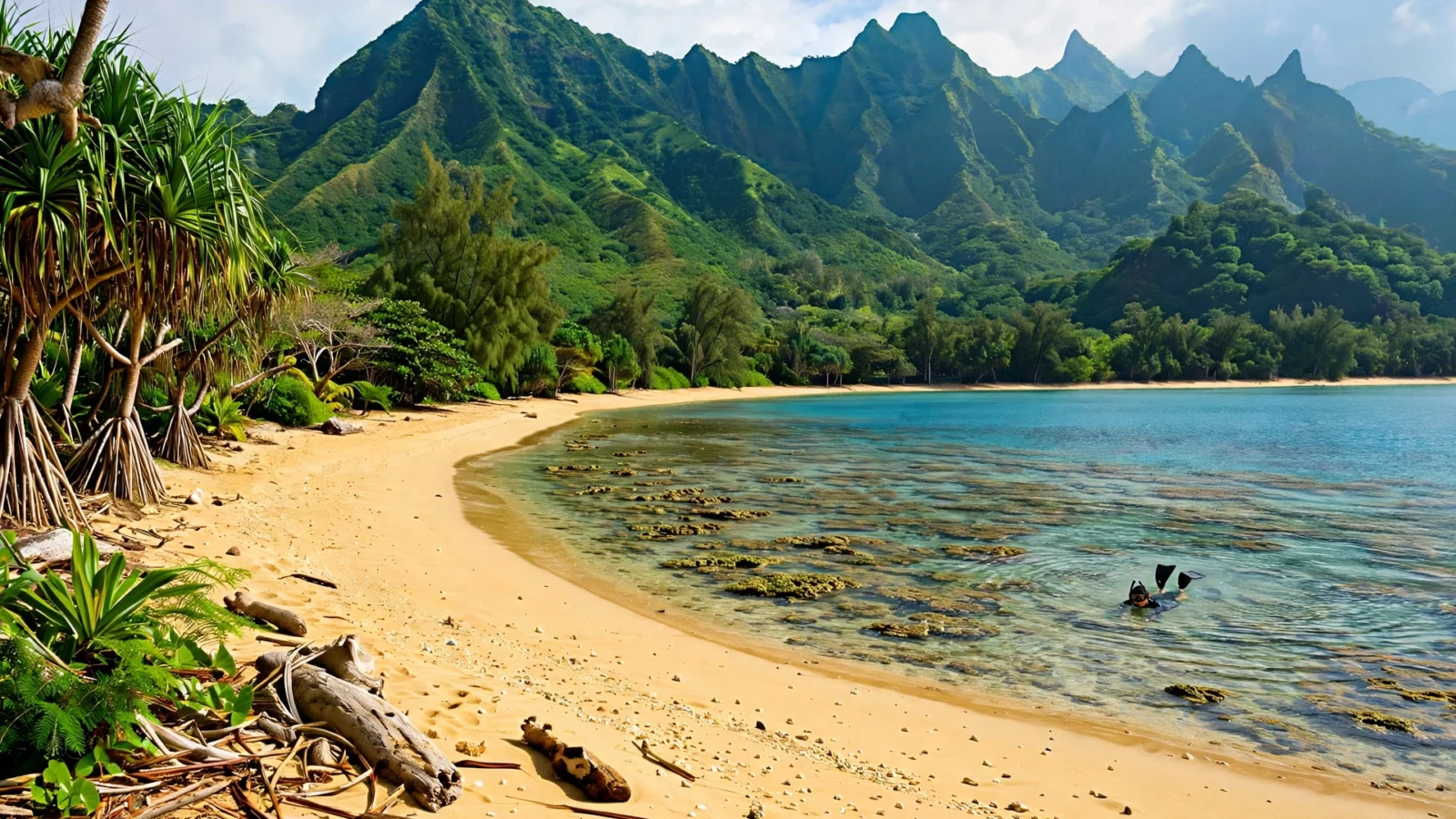
Tunnels is the north shore’s signature reef, and the name is literal: the underwater terrain, not the beach, gives it away. From the sand you see a wide, pale lagoon backed by one of the most photographed ridgelines in Hawaii. Under the surface, that lagoon is ringed by a reef system full of structure — arches to look under, ledges to follow, and caverns that experienced snorkelers can peer into from outside. That three-dimensional quality separates Tunnels from a flat patch reef, and it anchors our Kauai snorkeling hub as the island’s headline summer spot.
It is not an every-day beach, though. Tunnels works inside a narrow set of conditions: the calm half of the year, a morning before the wind builds, a legal parking space secured early, and a swimmer honest about which reef zone matches their ability. Get those right and it can be the best snorkel of a Hawaii trip. Get the season wrong and there is no version of this beach to snorkel at all.
Where Tunnels (Makua) is — and the Makua name confusion
Tunnels Beach sits in Ha’ena, at the far western end of Kauai’s north shore, along Kuhio Highway (Route 560) beyond Hanalei and past mile marker 8. Ha’ena Beach Park is roughly half a mile west of Tunnels, and Ha’ena State Park, with Ke’e Beach at the end of the road, lies beyond that.
The beach’s other name causes real confusion, so it is worth settling. Tunnels is also called Makua Beach — that is the Makua of Ha’ena, Kauai. It is not the Makua Beach on Oahu’s west side, near Waianae, which is a completely different beach on a different island. Searches and map results mix the two. If your directions mention Ha’ena, Hanalei or Mount Makana, you have the right Makua. If they mention Waianae or Oahu’s leeward coast, you do not.
How to get to Tunnels Beach: driving directions from Lihue, Princeville and Hanalei
Every route to Tunnels ends the same way: north up Kauai’s east side on Kuhio Highway, then west on Route 560 past Hanalei to Ha’ena. There is no parking lot at Tunnels itself, so plan the drive and the parking together — you either catch one of the small access alleys near mile marker 8, or you park at Ha’ena Beach Park and walk in along the sand. The last few miles are narrow, with a series of one-lane bridges, so the drive takes longer than the mileage suggests.
| Starting point | Distance to Tunnels | Drive time |
|---|---|---|
| Hanalei town | 5.7 miles | About 15 minutes |
| Princeville | 9 miles | About 20 minutes |
| Lihue and Lihue Airport | About 37 miles | About 1 hour 15 minutes |
| Waimea | 51 miles | About 1 hour 45 minutes |
Treat these as planning figures, not odometer promises: sources disagree slightly on the Lihue run, with one directions site giving 36.8 miles in its distance table and 38 miles in its step-by-step. Poipu is the long way round at about 48.5 miles, and Kapa’a sits about 28 miles out.
From Lihue Airport
Leave the airport and turn onto Kapule Highway (HI-51), which merges into Kuhio Highway (HI-56). Head north through Wailua, Kapa’a and Kilauea, past Princeville and through Hanalei, then stay on the highway as it becomes Route 560 and narrows into a winding road with one-lane bridges. It is about 15 minutes from Hanalei to Ha’ena. Watch for mile marker 8: the access alleys are there, and Ha’ena Beach Park is about half a mile further west.
From Princeville
Take Route 560 west through Hanalei — the Hanalei Valley Lookout is on the way — then keep going through the one-lane bridges to Ha’ena. The whole run is about 9 miles and about 20 minutes, and mile marker 8 is your cue to start looking for an alley or to continue to the Ha’ena Beach Park lot.
From Hanalei town
It is a short run: Route 560 west for 5.7 miles to the first access alley. If the alleys are full, keep going about half a mile further west to Ha’ena Beach Park and walk back along the sand.
Spotting the two access alleys
The alleys are two short, unpaved pull-off lanes off Route 560 near mile marker 8, a few minutes’ walk from the reef. Together they hold roughly two dozen cars, first-come and free, and in summer they are usually full by 8 AM. The lanes can be soft sand, so low-clearance cars are better off using the Ha’ena Beach Park lot instead. Only use clearly legal spaces, respect no-parking signs and residents’ driveways, and do not fall back on the shoulder: shoulder parking on the narrow access road is banned and enforced with ticketing and towing. If the alleys are full, the Ha’ena Beach Park lot is the reliable plan — a free county lot with restrooms and outdoor showers — followed by a 10 to 15 minute walk east along flat sand to the Tunnels reef.
What to type into your maps app and what time to leave
Search for “Tunnels Beach” or “Makua Beach, Haena” in Google Maps or Apple Maps. The pin sits at mile marker 8 on Kuhio Highway (Route 560), at about 22.224036, -159.560551. Do not navigate to Haena Beach Park or Haena State Park instead: Haena Beach Park is about half a mile west of Tunnels, and Haena State Park and Ke’e are farther west still, past the beach.
Work backwards from 7:30 AM, when the alleys are usually close to full. To be at mile marker 8 by then, leave Lihue or Lihue Airport no later than about 6:15 AM, Princeville no later than about 7:10 AM, and Hanalei town no later than about 7:15 AM. Add extra time after rain or on a bridge-delay day: a November 1, 2026 road check reported Kuhio Highway near Hanalei Bridge open to alternating traffic only, so check Kauai County or HDOT road controls before you leave and do not treat the table drive times as guarantees.
Without a car: the GoHaena shuttle
The GoHaena North Shore shuttle is the named shuttle option for this corridor. It is sold as the way into Ha’ena State Park, but its route includes a stop at Ha’ena Beach Park, which is the Tunnels walk-in: board at the Waipa Park & Ride near Hanalei, where parking is free, or in Princeville, ride about 20 minutes, and tell the driver at check-in that you plan to hop off at Ha’ena Beach Park. As reported in 2026, it runs about every 20 minutes on a summer schedule from 6:20 AM, with last pickup at 6:40 PM, and fares of $45 for ages 16 and over and $25 for ages 4 to 15, including same-day state park entry. Confirm the current timetable and fares before you travel, as corridor services change. A Ha’ena State Park parking pass does not help for Tunnels: the state park lot sits about a mile past Tunnels.
The reef: inner lagoon, outer reef and lava tubes
The reef is best understood as two zones with very different personalities. The inner lagoon, close to shore, is the sheltered part of the system: shallower, sand-bottomed in places, and protected by the reef beyond it on calm summer days. This is where most visitors should spend their time, working slowly along the reef edges where fish gather.
The outer reef is bigger, deeper and more exposed, and it is a different proposition. Out here the reef drops into ledges, arches and the lava tubes that named the beach — hollow, collapsed-tube formations you view from their openings, not enclosed caves to swim into. Depth, surge and moving water all increase outward, and passes through the reef carry current. The outer zone rewards experienced snorkelers in genuinely calm conditions, and it should be treated as optional. The inner lagoon on a flat morning is not a consolation prize; it is the snorkel most people picture.
The restricted area: Makua Pu’uhonua, explained carefully
One part of the Tunnels story needs care, because sources do not all treat it the same way. Two of the detailed snorkeling guides to this beach describe an area of the reef, referred to as Makua Pu’uhonua, as restricted or closed, with entry into that specific area requiring a special permit. Other guides do not mention the restriction at all. We present it the way the evidence supports: part of the reef system here is treated as a restricted area, and the famous lava-tube terrain is the area most associated with it.
Practically, that means this: do not assume every part of the reef you can see is open to snorkel. Check the DLNR markers and signs on the day you visit, respect any boundary you find, and keep to the open lagoon and reef areas covered in this guide. Boundaries at managed reef areas can change, and on-site signage outranks anything written here, including this paragraph.
What you’ll see underwater
On a good morning, the fish life registers first: clouds of reef fish working the structure, including butterflyfish, parrotfish, yellow tangs, triggerfish and Moorish idols. Green sea turtles — honu — are a headline sighting, often grazing along the seaweed-covered rocks by the reef ledges. Look for them along edges rather than in open sand, give them a wide berth, and let them set the distance. Our guide to snorkeling with turtles in Hawaii covers the distance rules that apply everywhere, including here.
The structure also shelters a smaller cast: moray eels tucked into crevices, octopus camouflaged against rock, and cleaning stations where small fish attend larger ones. Hawaiian monk seals occasionally haul out on this beach to rest; a resting seal is not a close-range photo opportunity — keep well back and never position yourself between a seal and the water. Visibility here is genuinely conditions-dependent: some summer mornings are clear enough to take in whole ledges at once, others noticeably murkier, which is why the conditions section matters more than any promised number.
Conditions and best time to snorkel
Tunnels is a summer beach, and this calendar is the honest version of that. For statewide context, see our guide to the best time to snorkel in Hawaii.
| Month | Tunnels outlook |
|---|---|
| January | Winter surf — not snorkelable in practice |
| February | Winter surf — not snorkelable in practice |
| March | Late winter — large surf still common, unreliable |
| April | Transition — occasional calm windows late in the month, no guarantees |
| May | Season opens — first reliably calm mornings |
| June | Prime season — calm, warm, best odds |
| July | Prime season — calm, warm, best odds |
| August | Prime season — calm, warm, best odds |
| September | Late season — often still good; watch for the first autumn swells |
| October | Transition out — surf returns, snorkeling becomes unreliable |
| November | Winter pattern — not snorkelable in practice |
| December | Winter surf — not snorkelable in practice |
Within a good month, time of day decides quality: mornings are calmest, before the trade winds build — and arriving early is also the parking strategy, below. For conditions today, there is no substitute for checking the current surf and ocean-safety forecasts for Kauai’s north shore that morning, then reading the water in person. If the lagoon is not visibly calm when you arrive — white water across the reef, surge in the shallows, other swimmers staying out — that is your report, whatever a forecast said.
Winter at Tunnels: why the north shore closes
Visitors regularly arrive in winter expecting a lesser version of the summer snorkel. There is no lesser version. In winter the north shore takes the full energy of Pacific swells, and the reef at Tunnels takes it directly: the structure that creates a sheltered lagoon in July creates breaking waves and powerful water movement in January. Snorkeling is not degraded in those months; it is off the table, and testing that is how people get hurt. If your trip falls between October and April, plan snorkeling around the south shore instead — Poipu Beach snorkeling is the island’s winter answer — and visit Tunnels as a beach to look at, not a reef to enter.
Parking and access in 2026
Parking is where a Tunnels morning is won or lost, so plan it before you leave. Access is through two small beach-access alleys off Kuhio Highway just past mile marker 8. Between them there is only a handful of legal spaces, and on a summer morning they go early. The shoulder of the narrow access road is not a fallback: shoulder parking there has been banned, and it is enforced with ticketing and towing.
The reliable alternative is Ha’ena Beach Park, about half a mile west. Its free lot holds roughly three dozen cars, and from there it is a pleasant 10 to 15 minute walk east along the sand to Tunnels. Many families drop passengers and gear at an access alley, then send one driver to park at Ha’ena and walk back. A shuttle serving the Ha’ena corridor from the Hanalei side is the third option and removes the parking problem entirely; confirm its current stops and timetable before your trip, as corridor services change. Whichever option you choose, early is not a tip at Tunnels — it is the system working as intended.
Do you need a Ha’ena State Park reservation for Tunnels?
No — and this is the most common misunderstanding about this beach, so it gets its own section. Tunnels sits before the Ha’ena State Park boundary. Visiting Tunnels itself is currently free, and no reservation is required for the beach. The reservation system, entry passes and parking bookings discussed everywhere apply to Ha’ena State Park and to Ke’e Beach at the end of the road, beyond Tunnels. If your plan includes Ke’e, that part of the day does need booking, and it books out — see the Ke’e coverage in our Ke’e Beach and Lydgate guide.
One honest caveat: whether Tunnels might one day be brought under a reservation or fee system is a live local discussion. Treat any claim that it definitely has been — or definitely never will be — with suspicion. Our position is: currently free and unreserved, under discussion for the future, so check the rules again shortly before you travel.
How to snorkel Tunnels well
Enter over sand, not over reef. Wade out through a sandy patch until the water is deep enough to float without your fins near the bottom, then start slowly. Work along reef edges rather than across the shallow flats: the edges hold the fish, turtles and structure, and crossing flats puts both coral and your stomach at risk in shallow, surging water. A slow loop along the inner reef edge beats a long push outward. If shore snorkeling off the beach is your style, this is one of its finest examples; if you are still building skills, our how to snorkel in Hawaii guide covers the basics worth rehearsing first.
The beginner verdict, zone by zone: inner lagoon — yes, with caution. A careful beginner who can swim, on a flat mid-summer morning, staying in the sheltered zone with a stronger swimmer alongside, can have a good snorkel here. Our beginners’ guide to Hawaii snorkeling shows where Tunnels sits in that learning curve. Outer reef — experienced snorkelers only; its depth changes, surge and pass currents are not the place to discover your limits. And on any day that is not visibly calm, the verdict is no, for everyone.
Safety at Tunnels
There is no lifeguard at Tunnels. The nearest lifeguarded beach is Ha’ena Beach Park, about half a mile west, and its guards are also the best local source of advice about that day’s water. Self-reliance is the entry requirement here. The hazards that matter are current moving through the reef passes and channels — especially on any route away from the reef structure — surge over shallow reef, and seasonal surf. Staying near the reef, without touching or standing on it, keeps you out of the sandy channels where water moves fastest. Our guide to whether snorkeling in Hawaii is safe covers the general rules — swim with a buddy, know your limits, exit before you are tired — and all apply here with extra weight, because no tower watches this water. If conditions look marginal, the correct decision is the sand, a walk to Ha’ena, and the reef another day.
Facilities and gear
Manage expectations: there are no facilities directly at Tunnels — no restrooms, showers or picnic setup on this beach itself. Sources occasionally list facilities for the area without separating the two beaches, which is how the confusion starts. The nearest restrooms and picnic areas are at Ha’ena Beach Park, half a mile west, which also has the lifeguards and the larger parking lot; plan bathroom and shade stops around that, especially with children. There are no food vendors at Tunnels, so water and snacks are bring-your-own.
Gear follows the same pattern: no rental on site, and nothing to buy when a strap breaks. Rent mask, snorkel and fins in Hanalei on the drive out — the last practical stop before the road narrows — and check the fit in the shop, not at the water’s edge. Our Hawaii snorkeling gear checklist covers what to bring, including reef-safe sunscreen and a rash guard for long, bright, shallow swims.
Tunnels vs Ke’e vs Anini vs Poipu
Visitors usually choose between four Kauai snorkels, and the answer depends on season, skills and appetite for logistics. Tunnels offers the best reef and no reservation, at the price of the hardest parking, no lifeguard and a hard summer-only window. Ke’e Beach, at the end of the same road, pairs its lagoon and lifeguard with the Ha’ena State Park booking hurdle — our Ke’e Beach guide explains that system. Anini Beach is the calmer north-side option for groups with nervous swimmers. And Poipu, on the south shore, is the year-round banker: it works in winter, works for beginners, and works when the north shore is closed. One summer morning with strong swimmers: choose Tunnels. A winter trip or a mixed-ability group: choose Poipu, and save Tunnels for a summer return.
FAQ
Do I need a Ha’ena State Park reservation for Tunnels?
No. Tunnels sits before the state park boundary and is currently free with no reservation. The booking system covers Ha’ena State Park and Ke’e Beach, further along the road. A future change is under discussion, so check current rules shortly before you travel.
Where do you park for Tunnels Beach?
In one of the two small beach-access alleys near mile marker 8 on Kuhio Highway — a handful of spaces that fill early — or at the free Ha’ena Beach Park lot about half a mile west, plus a 10 to 15 minute walk along the sand. Shoulder parking is banned and ticketed.
Is Tunnels Beach good for snorkeling — and for beginners?
In summer conditions, it is among the best snorkeling on Kauai. For beginners the verdict splits by zone: the inner lagoon on a flat morning suits careful beginners who can swim; the outer reef is experienced-only. There is no lifeguard here.
When is the best time and month to snorkel Tunnels?
May through September, with June, July and August most reliable. Within the day, go in the morning, when the water is calmest and parking is still available.
Is part of Tunnels Beach closed — do I need a permit?
Part of the reef, referred to as Makua Pu’uhonua, is described by detailed snorkeling guides as restricted, with entry into that specific area requiring a special permit. Stay in the open lagoon and reef areas, and follow DLNR markers and signs on the day, which outrank anything published online.
Is there a lifeguard, restrooms or showers at Tunnels?
No lifeguard, and no facilities directly at Tunnels. The nearest lifeguarded beach, restrooms and picnic areas are at Ha’ena Beach Park, about half a mile west — the same place as the larger free parking lot.
Can you snorkel Tunnels in winter?
Not in practice. From roughly October through April, north-shore surf and current make this reef dangerous. In winter, snorkel the south shore instead — Poipu is the island’s winter option — and treat Tunnels as scenery.
Is Makua Beach the same as Tunnels Beach?
Yes, on Kauai: Makua Beach in Ha’ena is Tunnels Beach’s other name. Do not confuse it with Makua Beach on Oahu’s west side, near Waianae — a different beach on a different island.
How do I get to Tunnels Beach from Lihue Airport?
Drive about 37 miles, roughly 1 hour 15 minutes: Kapule Highway (HI-51) out of the airport, merging into Kuhio Highway (HI-56) north through Wailua, Kapa’a and Kilauea, then Route 560 west through Hanalei to mile marker 8. Park in one of the access alleys if you arrive early, or continue to the Ha’ena Beach Park lot about half a mile further west and walk back along the sand for 10 to 15 minutes.
Is there a shuttle to Tunnels Beach?
Yes — the GoHaena North Shore shuttle, boarded at the Waipa Park & Ride near Hanalei or in Princeville, stops at Ha’ena Beach Park, from where it is a 10 to 15 minute beach walk to the Tunnels reef. Tell the driver at check-in that you will hop off at Ha’ena Beach Park. As reported in 2026 it runs about every 20 minutes on a summer schedule, 6:20 AM to 6:40 PM, at $45 for ages 16 and over and $25 for ages 4 to 15 — confirm the current timetable and fares before you travel.
Is Tunnels Beach open to the public?
Yes. Tunnels is a public beach — there is no gate, no entry fee and no reservation to visit it. It sits in a residential neighbourhood, so access is through the two small public beach-access alleys near mile marker 8 on Kuhio Highway, or on foot from Ha’ena Beach Park about half a mile west. The reservation system people hear about applies only to Ha’ena State Park and Ke’e Beach further along the same road, not to Tunnels itself. Do respect the neighbours: use only clearly marked legal parking, never block a driveway, and do not park on the shoulder — it is banned and enforced with ticketing and towing. Our Kauai snorkeling hub puts Tunnels in the island-wide picture.
Can you swim at Tunnels Beach?
Yes, in the same narrow conditions as snorkeling here: a flat summer morning, inside the sheltered inner lagoon, with a swimmer who is honest about their ability. The lagoon’s shallow sand patches are the swimmable part; the outer reef is for experienced snorkelers only, and in winter — roughly October through April — north-shore surf makes swimming at Tunnels unsafe for everyone. There is no lifeguard at Tunnels itself; the nearest lifeguarded beach is Ha’ena Beach Park, about half a mile west, and if the water at Tunnels does not look calm when you arrive, swimming there is the safer choice. Our Poipu Beach guide covers the island’s winter swimming option.
Is Tunnels Beach free to visit?
Yes — visiting Tunnels itself is currently free. There is no entry fee, no parking fee in the access alleys or at the Ha’ena Beach Park lot, and no reservation fee, because no reservation is required for Tunnels. The only money a Tunnels morning usually costs is gear rental in Hanalei on the drive out, and — only if you continue past Tunnels to Ke’e Beach — the Ha’ena State Park entry and parking booking. Whether Tunnels might one day be brought under a fee or reservation system is a live local discussion, so check the rules again shortly before you travel.
What should I type into Google Maps to find Tunnels Beach?
Search for “Tunnels Beach” or “Makua Beach, Haena” in Google Maps or Apple Maps. The pin is at mile marker 8 on Kuhio Highway, at about 22.224036, -159.560551.
Are there road delays on the way to Tunnels Beach?
It varies, so allow extra time and check before you leave. A November 1, 2026 road check reported Kuhio Highway near Hanalei Bridge open to alternating traffic only. Check Kauai County or HDOT road controls before you travel, especially after rain, and do not treat the usual drive times as guarantees.
Field reports we drew from
- TunnelsBeach.org and Tropical Snorkeling — access, parking and restricted-area accounts, cross-checked against each other in 2026.
- TunnelBeachKauai.com — parking and Ha’ena corridor detail, read critically where it differed from the sources above.
- Where sources disagreed — facilities on the beach itself and summer visibility — this guide says so in the text rather than picking a side silently.
Back toward Princeville, the north shore hides a smaller gem: Hideaways Beach, a steep-path cove whose reef rewards the short hike down on calm summer days.
Pair a Tunnels morning with the wider bay back toward Hanalei — our Hanalei Bay snorkeling guide covers the pier, the river mouth
and when that big bay is actually swimmable.