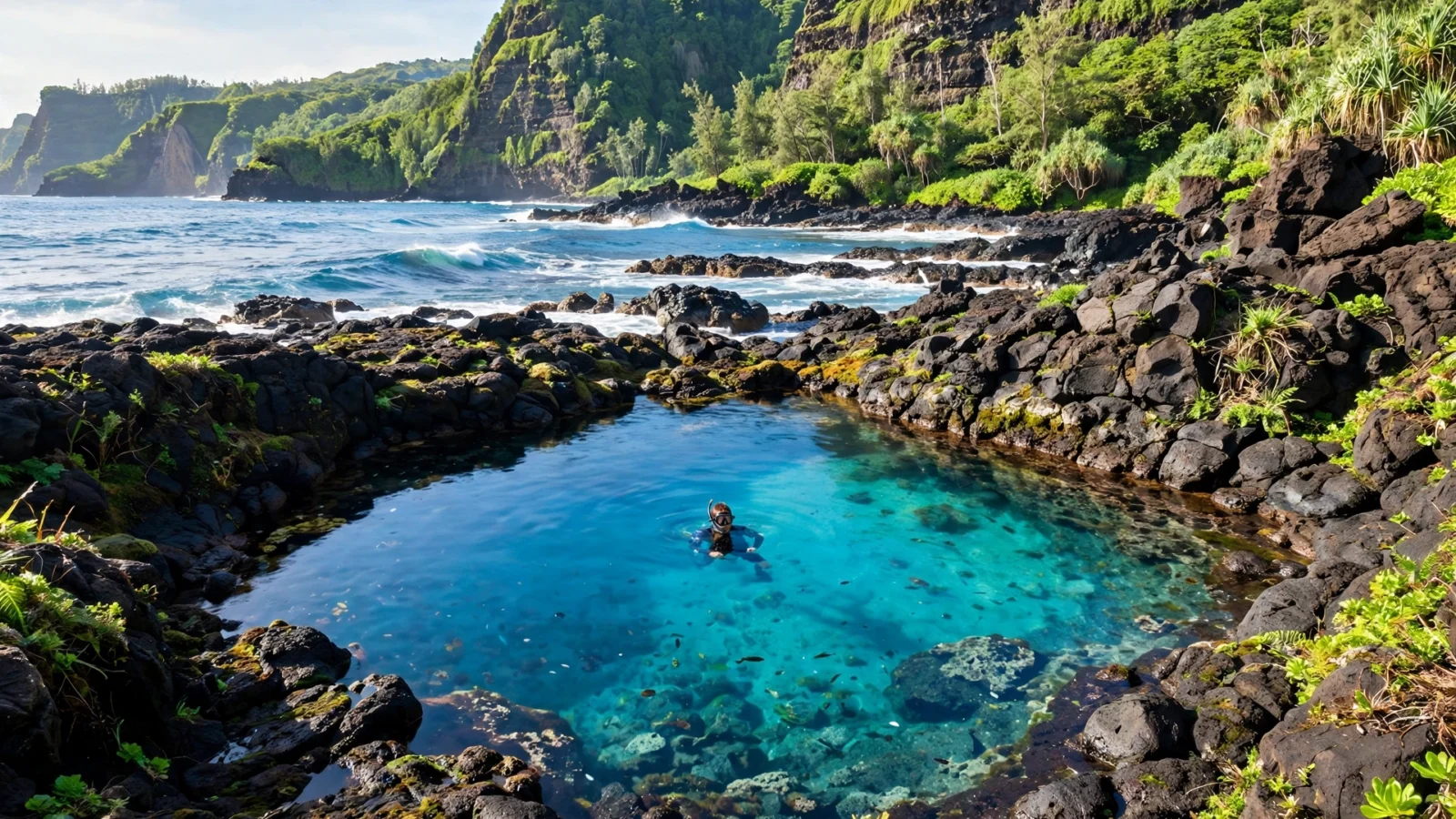
Yes — you can snorkel at Queen's Bath on Kauai's North Shore, and on a calm summer morning it is one of the most memorable snorkel spots on the island. But Queen's Bath is not a beach, and it is not a place to mess around with. It's a natural lava-rock tide pool sitting right at the edge of the open ocean near Princeville, and whether it's a magical swim or a place you should stay far away from depends entirely on the surf. This guide covers it all: what Queen's Bath actually is, when it's safe to snorkel there, how to get there, what you'll see underwater, and the safety rules that matter more here than at almost any other snorkel spot on Kauai.
What is Queen's Bath?
Queen's Bath is a large, naturally formed tide pool — often described as an anchialine pond — carved into the lava-rock shoreline just outside Princeville on Kauai's North Shore. Ocean water washes in over the rocks and settles into a deep, clear pool that's sheltered from the direct pounding of the surf, at least when the ocean is calm.
The name is a bit of a misnomer. Despite the royal-sounding name, there's no verified history of Hawaiian royalty bathing here — it's simply a nickname that stuck because the pool is so striking. What is real is the setting: dark volcanic rock, turquoise water, and the open Pacific crashing just beyond the pool's edge.
One important note before we go further: there is another spot called Queen's Bath on the Big Island's Kona coast. This guide is about the Queen's Bath in Princeville, Kauai — the famous North Shore tide pool. If you're researching the Kona one, you're in the wrong place.
Can you snorkel at Queen's Bath?
Yes. Snorkeling at Queen's Bath is absolutely possible, and the conditions that make it possible are specific: calm seas, low tide, and small surf — the classic Kauai summer pattern from roughly June through September.
Here's what snorkeling here is actually like. The pool is a contained body of water, not open ocean, so you're not fighting currents the way you would at a beach break. On a calm day the water is remarkably clear — clear enough that you can see the bottom from the rocks above without even putting your face in. Once you're in with a mask, you're floating over a rocky bottom with fish moving through the pool and around its edges.
A few practical realities:
- The pool is small. This isn't a reef you swim along for half a mile. A mask and snorkel are all you really need — many people skip fins entirely here, since there's nowhere far to go. What you do need is foot protection: the lava rock around and inside the pool is sharp, and reef shoes or sturdy water shoes matter more than fins.
- Enter from the inner edge. Get in from the calm, shore-side edge of the pool — never from the ocean side where waves wash over the rocks. Watch the water for a few minutes before getting in. If waves are washing into the pool with any force, don't get in at all.
- It's not a beginner-only spot, but it's not advanced either. If you're comfortable in the water and the conditions are right, it's easy snorkeling. The difficulty at Queen's Bath was never the swimming — it's the judgment call about conditions, which is why the safety section below is the most important part of this guide.
For general snorkeling fundamentals, our beginner's guide to snorkeling in Hawaii covers the basics that apply everywhere.
Best time to snorkel Queen's Bath
Summer — roughly June through September — is the season. This is when Kauai's North Shore goes calm, the surf drops, and the pool sits glassy and clear. Mornings are best: lighter winds, calmer water, and fewer people.
Winter is the no-go season. From roughly October through May, North Shore surf turns big and dangerous, and Queen's Bath becomes genuinely life-threatening. Waves can sweep entirely across the rocks and the pool without warning — this is not an exaggeration, and it's the reason the spot has a grim history (more below). As a rule of thumb: check the North Shore surf forecast before you even drive there, and if the surf is up beyond small, calm conditions, pick a different spot for the day.
Tide matters too. Low tide is the best window — the pool is at its calmest and clearest, and entry over the rocks is easiest. At high tide with any surf running, waves push into the pool and conditions deteriorate fast.
Useful resources: the National Weather Service Honolulu surf forecast and Surfline's Kauai North Shore reports. If either shows meaningful swell, save Queen's Bath for another trip and head to a sheltered south-shore spot instead — Poipu or Lydgate stay calmer when the north is rough. Our best time to snorkel in Hawaii guide breaks the island-by-island seasonality down further.
What you'll see underwater
On a calm summer day, the pool holds a solid cast of North Shore marine life:
- Tropical reef fish — small schools of reef fish move through the pool and around its rocky edges. Don't expect the density of a dedicated reef like Tunnels, but for a tide pool it's lively.
- Sea urchins — they cling to the rocks inside and around the pool. Look, don't touch: urchin spines and bare feet are a bad combination, which is another reason for reef shoes.
- Green sea turtles (honu) — turtles do show up at Queen's Bath. If one is in the pool with you, enjoy it from a distance and give it plenty of space — the federal guideline is 10 feet, and a resting turtle in a small pool deserves even more room. Our guide to snorkeling with turtles in Hawaii covers the etiquette in full.
- The rock formations themselves — the lava-rock walls of the pool, the surge channels, the way the ocean moves just beyond the edge. Half the experience here is geological.
Visibility is excellent on calm days and poor on rough ones — it's that binary. If the water looks milky or churned from the rocks above, the snorkeling won't be worth it, and the conditions probably aren't safe either.
How to get to Queen's Bath: the trail
Queen's Bath isn't visible from any road — you reach it on foot. The trailhead is off Pu'u Po'a Road in Princeville, in a residential area. From the trailhead it's roughly a 10–15 minute walk down to the shoreline.
What to expect on the trail:
- It's short but can be slippery. The path is dirt and roots, and after rain it turns to mud — which, on the North Shore, is often. Wear shoes with grip, not flip-flops, for the walk down. You'll change into reef shoes at the rocks.
- It's popular. This is one of Kauai's most-visited natural attractions (thousands of hikers log it on trail apps), so don't expect solitude, especially midday in summer.
- The trailhead is unsigned or minimally signed. Having the location pinned on your phone before you go saves a lot of circling through Princeville's residential streets.
There's no shuttle, no tour booth, no entrance station — you just walk in. That informality is part of the appeal and part of the risk: there's nobody there to tell you the conditions are bad.
Parking
Parking is the practical bottleneck. There is no dedicated parking lot for Queen's Bath — you park along Pu'u Po'a Road near the trailhead, where space is limited and fills up early on nice days. Arrive in the morning for the best shot at a spot, park fully off the travel lane, and respect the residential neighborhood (drive slowly, keep noise down). Never block driveways or mailboxes — this is a residential street first and a trailhead second.
Queen's Bath safety: read this first
This is the section that matters most, so let's be direct.
- There is no lifeguard at Queen's Bath. No lifeguard tower, no rescue staff, no one watching the water. You are entirely on your own out there, which is why the conditions call is yours to make — conservatively.
- Rogue waves are the killer. The ocean here doesn't need to look angry to be dangerous. On days when the surf is up, waves can surge across the entire rock shelf and sweep people off the rocks and into the ocean — or slam them into the lava rock. People have died at Queen's Bath, and it happens in exactly these circumstances: winter surf, or a summer day when a swell arrives unexpectedly. Never turn your back on the ocean, and never get in the water if waves are washing over the rocks.
- Winter surf is a hard no. If it's the October–May season and the North Shore is showing surf, don't even walk out to the pool's edge for photos. The rocks are the danger zone, not just the water.
- Go with a buddy. This is non-negotiable at an unguarded tide pool. If something goes wrong, you need someone who can call for help.
- Watch first, then decide. Stand back and watch the ocean for 10–15 minutes before approaching the pool. If you see waves reaching the pool or washing over the shelf, leave and come back another day.
Our Hawaii snorkeling safety guide covers ocean judgment calls like this in more depth — worth a read before any North Shore snorkeling.
Is Queen's Bath open right now?
This is one of the most-searched questions about the spot, and the honest answer is: it depends on when you're reading this. In recent years, access to Queen's Bath has been restricted during the rougher ocean months (roughly October through May), and authorities have closed the trailhead area at times when conditions turn dangerous. The open/closed status changes — it has been listed as temporarily closed during winter stretches.
There is no ticket, no entry fee, and no reservation system when it's open — you just walk in. But "open" is a conditions-dependent thing here, not a posted schedule. Before you go:
- Check the current status (a quick search for "is Queen's Bath open" plus the current month usually surfaces recent reports).
- Check the surf forecast, as above.
- Have a backup plan — the North Shore has plenty, listed below.
Facilities: there are none
Set expectations correctly: Queen's Bath has no restrooms, no changing facilities, no showers, no trash cans, no food, and no drinking water. It's a trailhead in a neighborhood and a pool on the rocks. Bring everything you need, change discreetly at your car, and pack out every bit of trash — including fruit peels and tissues. The "leave no trace" standard matters double in a residential area.
What to bring
- Reef-safe sunscreen — applied 15+ minutes before you get in the water. Hawaii state law bans sunscreens containing oxybenzone and octinoxate; our reef-safe sunscreen guide for Hawaii explains what to buy.
- Reef shoes or sturdy water shoes — the single most important gear item here. The lava rock is sharp and urchin-covered.
- Mask and snorkel — fins optional; the pool is small and fins are clumsy on the rocks.
- Water and snacks — no facilities, remember.
- A dry bag or ziplock — for your phone and keys on the rocks.
- Towel and a change of clothes — you'll change at the car.
Our Hawaii snorkeling gear checklist has the full packing version if you want it.
Snorkeling etiquette at the pool
Tide pools are fragile, high-traffic ecosystems. A few rules:
- Don't stand on living rock. The rocks in and around the pool host urchins, small corals, algae, and invertebrates. Move carefully and keep your feet to bare rock where possible.
- Don't touch the urchins or chase the fish. Watch, float, enjoy.
- Give turtles space. Ten feet minimum, more in a small pool — and never touch or crowd a resting honu.
- Don't take anything. Shells, rocks, and coral fragments all stay.
- Keep sunscreen out of the pool. Apply it well before swimming, and consider a rash guard to cut down on how much you need.
Nearby snorkeling spots
If Queen's Bath is closed, rough, or too crowded, the North Shore has excellent backups:
- Hideaways Beach (Pali Ke Kua) — also in Princeville, a short drive away. A sheltered cove with good summer snorkeling.
- Hanalei Bay — the big crescent bay just west; summer snorkeling along its reefs.
- Anini Beach — the island's most sheltered snorkeling, behind a fringing reef. Your best bad-weather backup.
- Tunnels Beach — world-class in calm summer conditions, off-limits in winter surf like everywhere on the north shore.
- Na Pali Coast boat tours — if the shore is rough, a boat day on the Na Pali Coast gets you to calm-water snorkel stops with a crew watching conditions.
Our Princeville snorkeling guide and the main Kauai snorkeling hub round up everything on this side of the island.
FAQ
Can you snorkel at Queen's Bath?
Yes — in calm summer conditions (roughly June–September, low tide, small surf). The pool is clear and full of reef fish, urchins, and occasional turtles on calm days. In winter surf, or any time waves are washing over the rocks, do not get in.
Is Queen's Bath open?
Access has been restricted during rough-ocean months in recent years (roughly October–May), and the status changes. Check current reports and the surf forecast before going. There's no ticket or reservation system — when it's open, you just walk in.
When is the best time to visit Queen's Bath?
Summer mornings: June through September, at low tide, on a day with small North Shore surf. Arrive early for parking and the calmest water.
Is Queen's Bath safe?
It can be, in the right conditions — and it has been deadly in the wrong ones. There is no lifeguard, and rogue waves have swept people off the rocks, mostly in winter surf. Never turn your back on the ocean, never enter if waves are washing over the shelf, and always go with a buddy.
Where do you park for Queen's Bath?
Along Pu'u Po'a Road in Princeville near the trailhead — street parking only, no lot, and it fills early. Park considerately in the residential neighborhood.
Are there restrooms at Queen's Bath?
No. No restrooms, no changing facilities, no showers, no trash cans, no water. Bring everything and pack it all out.
Do you need a reservation or pay an entry fee?
No — there's no ticket, fee, or reservation system. (That also means no staff and no lifeguard.)
Is this the same as the Queen's Bath in Kona?
No. There's a separate spot also called Queen's Bath on the Big Island's Kona coast. This guide covers the Princeville, Kauai tide pool.
Queen's Bath rewards good judgment more than any snorkel spot on Kauai. Check the surf, go in summer, wear reef shoes, respect the ocean — and you'll get one of the island's most unique swims: a crystal-clear natural pool at the edge of the Pacific, all to the rhythm of the waves just beyond the rocks.