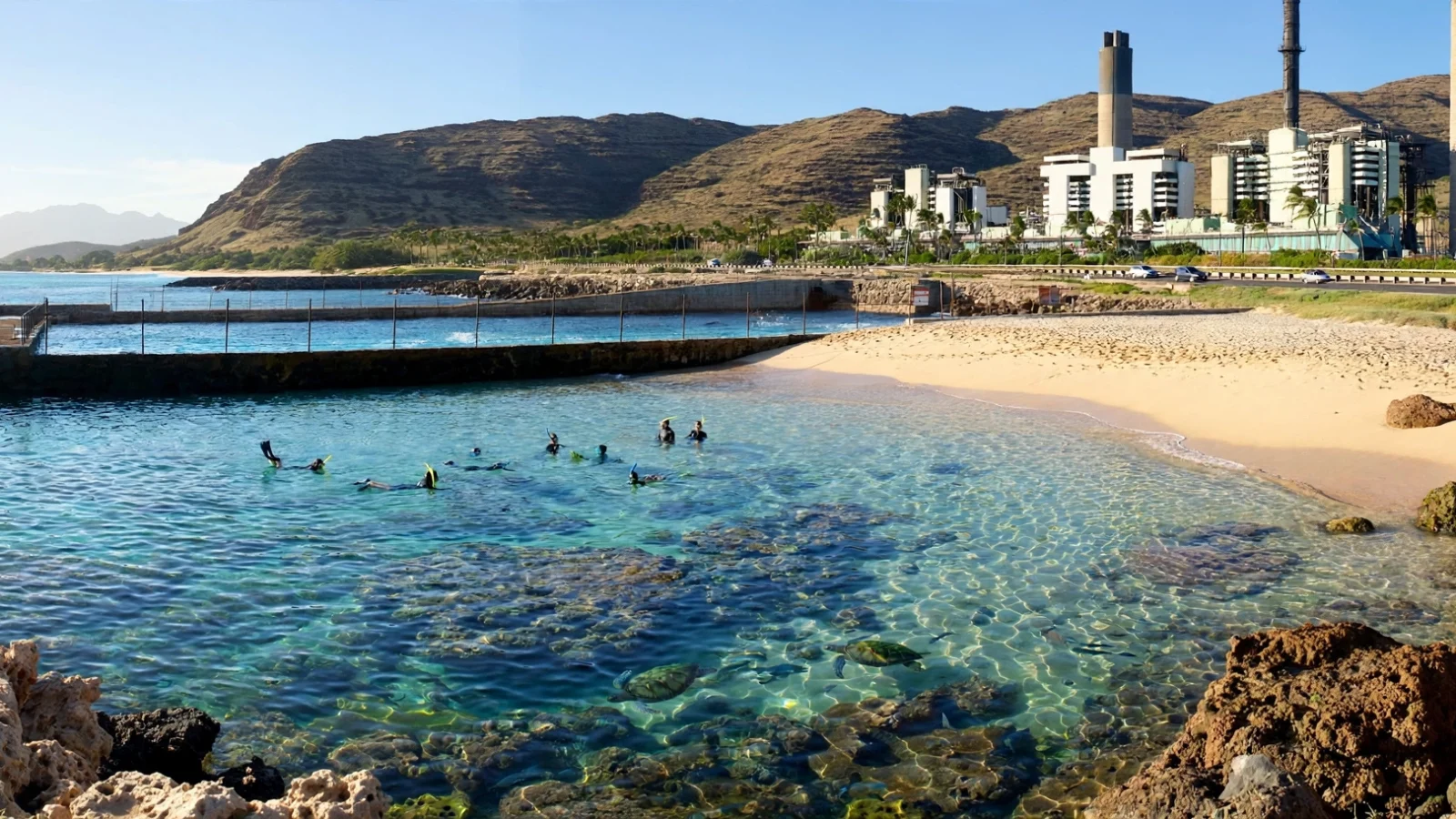
- Where
- Kahe Point Beach Park, 92-301 Farrington Hwy, Kapolei — West Oahu, opposite the Kahe power plant
- Cost
- Free entry and free parking · no reservation required
- Difficulty
- Intermediate to advanced — open-water swim of ~100 m+, current near the outflow
- Best time
- Early morning, before the trades build · calmest in summer
- Turtles
- Often · eagle rays and dolphins pass regularly
- Lifeguard
- Tower at the park (reported hours roughly 8am–6:30pm) · the outflow itself is beyond the guarded swim area
- Facilities
- Restrooms and showers reported at the park · no rentals, no food — bring everything
Why a power plant made a great reef
The Kahe generating station draws in seawater for cooling and returns it — warm and clean — through two large pipes that end offshore. That warm outflow attracts plankton and baitfish, which attract everything else; over the decades a full ecosystem has organised itself around the pipes, complete with coral-crusted structure. The Smartrippers, whose firsthand Oahu reports we drew on, rate it their favourite snorkel on the island for exactly this reason — and note that dive boats visit the site daily, which tells you what the underwater scene is worth. It is the least pretty backdrop in Hawaiian snorkelling, and one of the best paybacks.
That is also why the spot has two names, and why searches for it split in two. Kahe Point Beach Park is the official name of the park and the headland. Electric Beach is the nickname the plant earned it. They are the same place, the same car park and the same swim — if a guide, a tour listing and a map pin seem to disagree, check the address: 92-301 Farrington Highway, just north of Ko Olina, and you are looking at one spot, not three.
Where Kahe Point Beach Park is, and how to get there
Kahe Point sits on Oahu’s leeward west coast, across the highway from the power plant’s stacks — you will see the plant long before you see the beach. From Waikiki, drive west on the H-1 past Kapolei and take the Ko Olina / Farrington Highway exit, then continue north a short way; allow the better part of an hour in traffic, longer on a weekday afternoon. The park is small and easy to overshoot: look for the beach-park lots and the lifeguard tower on the ocean side of the road, roughly opposite the plant entrance.
There are two parking areas used by snorkellers. The small southern lot sits closest to the sheltered cove at Kahe Point itself, while the larger main lot serves the broader Hawaiian Electric Beach Park stretch to the north. Both fill early on calm weekend mornings — by mid-morning on a good Saturday you may be circling. Parking is free, and the local park listing gives closing hours of 10pm. One warning every local guide repeats, and we will too: this coast’s car parks are known for break-ins. Leave nothing visible in the car — nothing — and ideally leave valuables at your hotel entirely. Take the key, your gear and your water, and lock up.
How to snorkel Electric Beach, step by step
1. Check conditions from the sand first. Stand at the water’s edge for two full minutes. If white water is breaking across the entry channel, if the shallows look like milky soup, or if you would not happily body-surf what is coming in, today is not your day — the outflow is not going anywhere, and a west swell makes this entry genuinely unfriendly.
2. Enter at the sandy channel. The usual entry is the small sandy beach and channel beside the pavilion at Kahe Point. Wade in over sand, get your mask and fins sorted in waist-deep water, and swim out through the channel rather than picking your way over the rocky reef flat on either side — better for your feet, and much better for the coral. Some experienced locals enter from the rocky north side closer to the pipes, but it is an awkward scramble over broken rock in surge, and we do not recommend it as your first route here.
3. Swim out to the end of the pipes. The fish density builds the further out you go and peaks around the pipe openings. Sources disagree on the exact distance — you will read everything from about 100 metres to 200 yards depending on where you measure from — so plan for a solid open-water swim of several minutes each way, in water that deepens to roughly 20 feet or more at the outflow, with no bottom to stand on. Sight on the plant behind you and the pipe line below; the structure itself is your underwater landmark.
4. Work the edges of the outflow, never the mouth of it. The warm plume pours out of the pipe openings with real force when the plant is discharging. Hold your position to the side of the openings, where the baitfish cloud and the predators hunting it actually are, and let the current be a conveyor belt you watch rather than a treadmill you fight. If you feel the push strengthen, angle away — there is excellent snorkelling all along the pipes and the reef around them.
5. Save half your energy for the swim back. Most people get into trouble here not on the way out but on the way in, tired, against a building breeze. Turn around while you still feel fresh, use the channel you came out of, and exit feet-first and patiently if small shorebreak is pushing — there is no prize for standing up in the impact zone.
Conditions and the best time to snorkel at Electric Beach
Mornings, full stop — calmer water, clearer visibility, dolphins at their most likely, and a parking lot that still has room. The pattern on the west coast is dependable: light winds early, trade-wind texture by late morning, and a choppier, murkier swim by afternoon. Aim to be in the water early and out before the breeze fills in.
Season matters more than the calendar suggests. Summer brings the flattest conditions to this coast, and the long calm spells when Electric Beach is at its very best. In winter, west and north-west swells shut the spot down on bigger days — sometimes for days at a time — so check a surf report for the Waianae coast before you drive out, and treat a rising swell as a hard no, not a challenge. Visibility follows the surf: cloudy in the shorebreak zone after any waves, clearing quickly once you are out over the pipes on a calm morning. The water itself is warm year-round, and the plume near the outflow is noticeably warmer still — most people snorkel here happily in a rashguard. For a fuller month-by-month picture, see our guide to the best time to snorkel in Hawaii.
What you will see at Kahe Point
Start with the cloud. The signature sight at the outflow is a shimmering mass of baitfish hanging in the warm water, parting and reforming around the pipe structure. Working its edges you can expect the classic Hawaiian reef cast in unusual density: butterflyfish, parrotfish, surgeonfish and yellow tang, wrasse, damselfish, triggerfish including the humuhumunukunukuapuaa, squirrelfish in the shaded ledges, and jacks and mackerel sweeping through on patrol. Green sea turtles are regulars — residents graze the reef and rest around the structure, and on a good morning you may share the swim with several. Our guide to snorkelling with turtles in Hawaii covers the etiquette: give them room, never touch, and let them surface to breathe.
Then there are the visitors that make people drive across the island. Spotted eagle rays cruise the sand channels. Spinner dolphins rest along this coast and pass Kahe Point many mornings — sometimes near enough to hear them underwater before you see them. The 50-yard federal viewing rule applies exactly as it does everywhere: resting pods are off-limits to approach, and the encounter you get by floating still beats the one you would get by chasing, every time. Reef sharks are seen here occasionally, and divers report larger visitors out in the blue from time to time — treat any shark as a reason to watch calmly from a distance, not to panic: the honest summary is that sharks are part of this ecosystem, sightings are uncommon, and the current and the swim are the risks that actually deserve your attention.
Parking, access, fees and reservations
This is the simple section, and simple is good. Kahe Point Beach Park is a county beach park: there is no entry fee, no parking fee and no reservation system — nothing like the booking scramble at Hanauma Bay. You drive up, park in the park lots, and walk in. The trade-off for that simplicity is capacity: the lots are modest, the park is popular with local families as well as snorkellers and divers, and on a calm weekend morning the difference between arriving at 7:30 and arriving at 10 can be the difference between parking and not parking.
On facilities, a note of honesty: local sources describe the park’s amenities slightly differently — most list restrooms and outdoor showers at the beach park, while some place the practical facilities a short walk away along this developed stretch of coast. Either way, plan as if you are self-sufficient: there are no gear rentals and no food at the park, the nearest shops are back towards Ko Olina and Kapolei, and you should arrive with everything you need already in the car. If you are staying on this coast, the Ko Olina resort area is only a few minutes south and is the natural base for an early start here.
Beginners and kids: the honest verdict
Beginners: not yet. Electric Beach is a poor place for a first-ever snorkel, and we say that as people who love it. There is no shallow, sheltered inner reef to learn on, the best water requires an open-water swim with current at the end of it, and conditions can change while you are out. Build your skills somewhere forgiving first — the inner reef at Hanauma Bay, the protected cove at Kuilima Cove, or the Ko Olina lagoons just down the road — then graduate to Kahe Point as your step-up spot. It is genuinely worth graduating for. Our beginners’ guide to snorkelling in Hawaii maps out that progression spot by spot.
Kids: it depends entirely on the kid. A confident, strong-swimming older child, in a well-fitting vest, one-to-one with an adult, on a flat summer morning, can enjoy the cove and the nearshore reef — and will probably see turtles. A young child, a nervous swimmer, or any child on a day with surf belongs at the lagoons or Hanauma instead. Nobody should do the full outflow swim with a child who could not comfortably swim that distance in a pool, twice, without stopping.
Safety at Electric Beach
Read our general Hawaii snorkelling safety guide before any west-coast snorkel, and then apply this spot-specific list. Never snorkel here alone — buddy system, no exceptions, and tell someone on shore where you are going. Respect the outflow: stay out from directly in front of the pipe openings, and if the discharge push feels stronger than you can comfortably hold position against, move away and enjoy the reef instead. Watch the entry and exit: shorebreak over a shallow, hard bottom is where reef cuts and sprains happen; take your time, keep your hands off the coral, and never turn your back on incoming sets while you are standing in the channel. Know the lifeguard’s limits: there is a tower at the park, but the outflow area is well beyond the guarded swim zone — out there, you are your own rescue plan, which is exactly why the buddy rule and the turn-back-early rule matter. Mind the ordinary hazards too: reef-safe sunscreen and a rashguard against a strong west-coast sun, care with fins around other swimmers in the plume, and Portuguese man-o’-war can wash in on this coast after strong trades — if you see them on the sand, pick a different day. And if anything feels off — cramp, cold, current, instinct — end the swim. The fish will be there tomorrow.
Electric Beach snorkeling tours: the guided options
Everything above describes the do-it-yourself swim — and it is a real swim: roughly a 50-metre push past the breakers to the reef, in water about 20–30 ft deep with no bottom to stand on. If that sounds like a lot, or you would rather have someone else find the pipeline and the reef while you just follow, guided tours run from this same beach. Four named shore options operate at Kahe Point as of November 2026, all meeting at the park itself, and boat tours sail to the same reef from Ko Olina Marina, a few minutes south. None of them changes the water — they change how much of the thinking you have to do.
Marine Ecology Snorkel — the small-group guided swim
From $125 per person, this is the closest thing to a dedicated Electric Beach tour: a guided snorkel that meets under the pavilion at Kahe Point Beach Park (92-301 Farrington Highway, Kapolei). The whole outing runs about two hours, with roughly one hour in the water after the briefing. Groups are capped at five travellers, gear is included, and a complimentary photo package comes with it. The guides are marine-biology-led — reviewers name Talia and Randy — and the emphasis is on the ecology: corals, sponges, invertebrates, eagle rays, spinner dolphins and, on a good day, a Hawaiian monk seal. Booking is reserve-now-pay-later with free cancellation up to 24 hours before the start, and there is no transport — you drive to Kahe Point yourself. The listing calls for moderate fitness and says it is not wheelchair accessible and not recommended for some medical conditions, so read the fine print before booking.
OrigamiTours “Electric Beach Snorkeling with Dolphins” — the combo day
From $135.11 per person via Pelago, OrigamiTours runs a full-day combo whose snorkelling stop is a two-hour session at Kahe Point. The route is the one this guide describes — a 50-metre swim past the breakers, then the pipeline, the north reef and the south reef — with the south reef flagged as the easier line for beginners, shallow reefs and small turtles. The listing promises starfish, schools of fish, turtles, pufferfish, shark caves, the “secret underwater Buddha statue” and white-tip reef sharks in the caves (look, do not approach), plus spinner dolphins, eagle rays, eels, lobsters and octopus, and humpback whales in winter. The same booking also covers the Ma’ili Pillbox hike, Ko Olina and the Tantalus lookout, so this is the pick if you want the snorkel folded into a full day rather than a standalone swim.
Jet snorkelling — the propulsion-device option
A third option, listed on Evendo, is a 1.5-hour jet-snorkelling session at Kahe Point: small group, professional Divemaster, propulsion devices that do the swimming for you, in English and Japanese, meeting at the Electric Beach pavilion. It is the only one of the three that removes the swim itself as the hard part, which makes it the most interesting choice for a weaker swimmer who still wants the reef. No price was shown on the listing when we checked in November 2026 — it was sold out on the dates we looked at — so check the listing itself rather than trusting a quoted figure.
Paradise Adventure Tours — the small-group midday shore tour
A fourth shore option, listed on HawaiiActivities, is Paradise Adventure Tours’ Electric Beach Snorkel Tour: a small-group guided snorkel with an expert guide, capped at eight people per instructor, departing from Electric Beach itself near Ko Olina — about 45 minutes from Waikiki. The tour runs at 12:00 PM and lasts three hours, and it uses no boat: you enter from the beach and swim out to the reef like the do-it-yourself swim, with a guide doing the navigation. The listing price is from $135.08 per person as of November 2026 — check the listing on the day, because prices move. The midday start is the thing to weigh: mornings are the calmest water at Kahe Point, so a noon departure trades the best conditions for a later start; it suits a slow morning or a second activity better than a first-ever Electric Beach swim.
All four shore tours, side by side
The four shore tours differ less in where they go — all four swim the same pipeline and reef — than in price, time and group size. Lined up, the choice gets simple:
| Tour | From | Duration | Group | Includes | Best for |
|---|---|---|---|---|---|
| Marine Ecology Snorkel | $125 | About 2 hours (roughly 1 hour in the water) | Max 5 | Gear, marine-biology guide, photo package | Learning the reef, smallest group |
| Paradise Adventure Tours | $135.08 | 3 hours | Max 8 per instructor | Expert guide | Midday start, small group |
| OrigamiTours combo | $135.11 | Full day (2-hour snorkel stop) | Max 14 | Snorkel stop plus Ma’ili Pillbox hike, Ko Olina and Tantalus | A full day out, not just a snorkel |
| Jet snorkelling | Price not listed | 1.5 hours | Small group | Propulsion device, Divemaster | Weaker swimmers who want the reef |
Boat tour or shore tour?
The shore tours above all start at the Kahe Point pavilion and end with the same swim out to the pipes. The alternative is to arrive by boat. Ko Olina Ocean Adventures sails a 53-foot catamaran from Ko Olina Marina, a few minutes south of Kahe Point, on three-hour sail-and-snorkel trips that anchor just offshore Electric Beach — reviewers describe snorkelling the same reef from the boat, with lifeguards in the water pointing out fish. Departures run at 8:30 AM and 11:30 AM, and the listed price is from $225 per person. Ocean Joy Cruises runs a similar west-coast trip from the same marina: a 3.5-hour cruise with about an hour of snorkelling, departing 8:00 AM and 12:15 PM, with transport from Waikiki included. The trade-off is straightforward. A boat tour removes the long swim out and the shorebreak entry, which is the part of Electric Beach that stops most people — but it costs roughly double a shore tour, runs on fixed departure times, and the snorkel stop is one part of a cruise rather than a dedicated reef session. A shore tour is cheaper and stays on the reef longer, but you swim out yourself and you need the morning calm. If you cannot swim confidently, or the shore forecast looks rough, the boat is the honest pick; if you can swim and the morning is flat, the shore tour gives you more reef for less money.
How to book: timing and cancellation
Book ahead, especially for weekends and summer mornings. The Marine Ecology Snorkel is typically booked 17 to 22 days in advance, according to the booking data on the review sites that track it, and the small groups — five on the ecology tour, eight per instructor on the Paradise tour — sell out before the big combo does. Booking is reserve-now-pay-later on the Marine Ecology listing, with free cancellation up to 24 hours before the start; if weather cancels a tour, the listing offers a different date or a full refund. The same weather rule applies to every operator here: these tours run only when conditions support snorkelling, so a flat-morning forecast is worth more than any discount. Prices are as listed in November 2026 — check the listing itself on the day you book, because they move, and the jet-snorkelling option showed no price at all when we checked.
What a guide buys you is navigation and eyes: the pipeline is easy to miss on your own, the guides know which reef is holding fish today, and they enforce the rules that matter — since 2021 it has been illegal under federal law to swim with, approach or stay within 50 yards of Hawaiian spinner dolphins, and a good guide keeps the group on the right side of that line. What a tour does not buy you is a different ocean: the swim out, the outflow current and the shorebreak are the same for everyone, and the Marine Ecology listing still asks for moderate fitness. If you cannot swim confidently, tell the operator when you book rather than discovering it at the breakers. For the wider picture — how these compare with boat trips elsewhere in Hawaii — see our Hawaii snorkeling tours guide.
Nearby spots to pair with Kahe Point
Electric Beach is a morning spot, which makes it easy to pair. The Ko Olina lagoons, minutes south, are the calm-water counterpoint: man-made, sheltered and ideal for the beginners in your group or a lazy second swim. Also on this coast, the beach sometimes called Tracks, just north of the park, is a local surf and beach-day spot rather than a snorkel target. For your other Oahu days, our Oahu snorkelling hub maps the whole island; the short version is that Shark’s Cove on the North Shore is Electric Beach’s great summer rival for fish density, Hanauma Bay is the beginner-friendly icon (book ahead), and the boat trips to Turtle Canyon off Waikiki deliver near-guaranteed turtles with none of the swim-out effort. A strong week on Oahu does all four — and starts, on the calmest morning, right here.
What to bring
Everything, because the park sells nothing. Well-fitting mask, snorkel and — non-negotiably here — fins: the swim out and the outflow current are not places for bare feet. Add a rashguard for sun and a little warmth, reef-safe sunscreen applied before you arrive, a snorkel vest if you are anything less than a strong swimmer, drinking water and a snack for afterwards, and a dry bag or a plan for your car key. Water shoes help for the walk across hot asphalt and the rocky edges of the entry, though you will swap them for fins before the swim. Our Hawaii snorkelling gear checklist has the full packing list.
Field reports we drew from
- Smartrippers — the firsthand account of the outflow ecosystem and daily dive-boat traffic.
- Dolphin rules: NOAA Fisheries — 50-yard spinner dolphin regulation (2021).
- Park details cross-checked in October 2026 against county beach-park listings and established local guides; where sources disagreed — the exact swim distance to the pipes, and the precise siting of restrooms — we have said so in the text rather than picking a number.
FAQ
Where is Electric Beach, and is it the same as Kahe Point Beach Park?
Yes — one place, two names. Kahe Point Beach Park is the official name; Electric Beach is the long-standing nickname from the power plant across Farrington Highway. The address is 92-301 Farrington Hwy, Kapolei, on Oahu’s west coast just north of Ko Olina.
Is the water safe near a power plant?
The discharge is seawater used for cooling — warm, not treated or polluted — and the thriving reef around it is its own evidence. The safety consideration here is current, not chemistry.
How far do you have to swim at Electric Beach?
Plan on a solid open-water swim of roughly 100 metres or more each way to reach the end of the pipes, where the fish are densest. Guides quote anything from about 100 metres to 200 yards depending on the entry point used, so assume the longer end, in water around 20 feet deep with nowhere to stand.
What is the best time to snorkel at Electric Beach?
Early morning, in summer if you can choose. Mornings bring the calmest water, the clearest visibility and the best chance of dolphins; summer brings the flattest season on the west coast. Winter swells can close the spot entirely — check the Waianae coast surf report before driving out.
Can beginners snorkel Electric Beach?
Not as their first spot. The swim out and the outflow current are real. Learn at Hanauma’s inner reef or Kuilima Cove, then come here as the step up — it is worth graduating for.
Is there parking at Kahe Point Beach Park, and does it cost anything?
Yes — free parking in the beach-park lots, free entry, and no reservation needed. The lots are small and fill early on calm weekend mornings, and this coast is known for car break-ins, so leave nothing visible in the vehicle.
Are there sharks at Electric Beach?
Occasionally seen, as anywhere in Hawaii — reef sharks are part of this ecosystem and divers sometimes report larger sharks further out. Sightings are uncommon and attacks are not what this spot is known for; the realistic risks are the current, the swim distance and the shorebreak. Give any shark space and stay calm.
Electric Beach or Shark’s Cove?
Winter: Electric Beach (the cove is closed by surf). Summer: genuinely close call — the cove for fish density and tide pools, Electric for turtles, dolphins and the strange magic of the pipes. The Oahu hub maps both.
Is there a guided snorkeling tour at Electric Beach?
Yes — four named shore options run from Kahe Point Beach Park as of November 2026: the Marine Ecology Snorkel (from $125, max five travellers, gear and photos included), Paradise Adventure Tours’ three-hour small-group tour (from $135.08, max eight per instructor, midday start), OrigamiTours’ “Electric Beach Snorkeling with Dolphins” combo (from $135.11, two-hour snorkel stop), and a 1.5-hour jet-snorkelling session with propulsion devices. All four meet at the park itself — and boat tours sail to the same reef from Ko Olina Marina if you would rather skip the swim out.
How much does an Electric Beach snorkeling tour cost?
Shore tours run from $125 per person for the Marine Ecology Snorkel, $135.08 for the Paradise Adventure Tours midday tour and $135.11 for the OrigamiTours combo, as listed in November 2026. Boat tours from Ko Olina Marina start higher — from $225 for the catamaran sail-and-snorkel. Check the listing on the day, because prices move and the jet-snorkelling option showed no price when we checked.
Do you need to be a strong swimmer for a guided Electric Beach tour?
You still need to be comfortable in open water: the reef sits roughly 50 metres past the breakers in 20–30 ft of water, and the Marine Ecology listing asks for moderate fitness. The jet-snorkelling option is the exception — the propulsion device does the swimming. Tell the operator if you are not a confident swimmer.
Is there a boat tour to Electric Beach?
Yes. Ko Olina Ocean Adventures sails a catamaran from Ko Olina Marina on three-hour trips that anchor just offshore Electric Beach, and Ocean Joy Cruises runs a 3.5-hour west-coast cruise with about an hour of snorkelling from the same marina. Both remove the long swim out and the shorebreak entry, but cost more than the shore tours and run on fixed departure times.
How far ahead should I book an Electric Beach tour?
For the small-group shore tours, as early as you can — booking listings report the Marine Ecology Snorkel typically booked 17 to 22 days in advance. Weekend and summer-morning slots go first. Booking is reserve-now-pay-later on the Marine Ecology listing with free cancellation up to 24 hours before, and weather cancellations are rebooked or refunded in full.