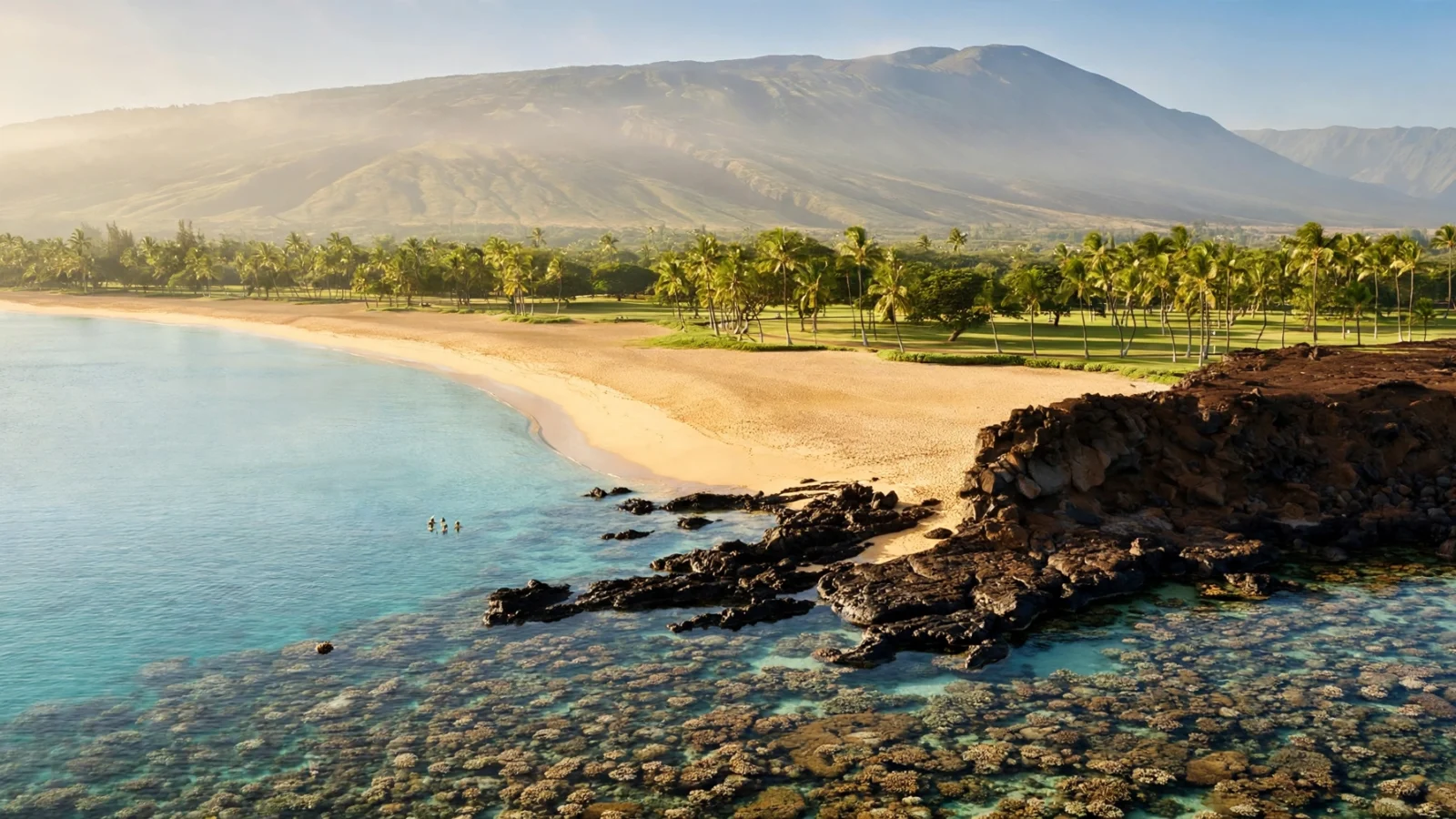
Short answer: yes, you can snorkel at all three Kamaole beach parks in Kihei — and the three sandy beaches strung along South Kihei Road hide more reef than most visitors expect. The catch is that the internet cannot agree on which one is best. One top guide swears by Kam I, another champions Kam III, and the rental-shop divers talk about a reef between Kam II and III. They are all partly right, because each beach wins for a different swimmer. This guide snorkels all three, beach by beach, so you can pick the right one for you — and it covers the two things the current top results skip: the reefs in real detail, and Kihei’s new paid beach parking.
The Kamaole parks — usually shortened to Kam I, Kam II and Kam III — are the town beaches of Kihei on Maui’s sunny south shore. All three sit inside the wider Kihei snorkeling picture, they all have lifeguards, restrooms and showers, and on a calm morning all three can deliver turtles, reef fish and easy sandy entries minutes from the condos. The snorkeling lives on the rocky points at the ends of each beach, not in the sandy middle — that single fact explains most disappointed reviews, and most great ones.
Kamaole snorkeling at a glance: Kam I vs Kam II vs Kam III
| Kam I (incl. Charley Young) | Kam II | Kam III | |
|---|---|---|---|
| Best for | Confident beginners, variety | First-timers, gentlest entry | Fish life, turtles, locals’ pick |
| Where the reef is | North end (Charley Young) + south point | Points at both ends; reef continues toward Kam III | South rocky end (strongest consensus) |
| Entry | Sandy, gentle at Charley Young | Gentle sandy slope — easiest of the three | Sandy middle; rocky at the south end |
| Parking | Park lot + street; paid (Park Maui) | Park lot + street; paid (Park Maui) | Largest lot (about 84 spaces); paid (Park Maui) |
| Lifeguard | Yes — not always on duty, check on the day | Yes — same caveat | Yes — same caveat |
| Watch out for | Afternoon wind chop | Sandier, fewer fish mid-beach | Occasional rougher surf; summer south swells |
Which Kamaole beach is best for snorkeling?
This is the question the search results argue about, so here is the honest reconciliation. The Hawaii Vacation Guide names Kam I — specifically its north end, Charley Young Beach — as the best bet. Local rental-shop guides and reviewer consensus lean to Kam III’s southern rocky end. Boss Frog’s divers describe their best snorkeling on the reef between Kam II and Kam III, roughly forty yards out. Read together, a pattern emerges: the reef runs along the points where the beaches meet the lava rock, and it improves the further south you go. Kam I’s Charley Young end is the best northern option and the most forgiving. Kam III’s south end holds the most developed reef of the three. Kam II is the easiest place to get in the water, with reef at its ends rather than its middle.
So: first snorkel ever, or nervous swimmers — Kam II or Charley Young. Confident swimmers who want the most fish — Kam III’s south end. Staying right in north Kihei — Charley Young, early, before the wind. All three verdicts assume a calm morning; a windy afternoon or a south swell rearranges the ranking completely, and on those days the right answer is a more sheltered beach (see the alternatives at the end).
Kam I and Charley Young Beach: the north-end reef
Kamaole Beach Park I is the northernmost and longest of the three, and its top end has its own name — Charley Young Beach — which is where its snorkeling concentrates. The rocky north point shelters a patch of reef that suits confident beginners: sandy entry, a short swim to structure, and enough fish to feel like a real snorkel without a long kick out. The south point of Kam I also holds rock and reef fish, so if the north end is crowded, walk the beach the other way.
Mid-beach Kam I is sand — pleasant swimming, very little to look at underwater. That is true of all three Kams and worth repeating: if you snorkel the middle of any Kamaole beach and see nothing but sand, you are in the wrong third of the beach, not the wrong beach. Aim for within about 20–30 yards of the rocky ends, stay off the reef itself, and work along the rock-to-sand edge where fish feed.
Kam II: the easiest entry in Kihei
Kamaole Beach Park II is the middle beach and the gentlest. Its sand slopes gradually, which makes it the natural first-snorkel choice of the three — no rock-hopping, no awkward shuffle over reef, just a walk-in entry. Snorkeling sits at both ends: the north point shares reef character with Kam I’s south end, and the south end begins the reef system that continues toward Kam III — the stretch the dive-shop accounts describe swimming about forty yards out, over finger, rice and branching corals with turtles cruising through.
Because Kam II is the condo beach for a dense strip of Kihei rentals, it is also the most social of the three. Snorkel it early and it is calm and clear; by midday it is a swimming beach first. Families often split the difference here — confident snorkelers head for the ends while everyone else swims the middle.
Kam III: the locals’ snorkeling pick
Kamaole Beach Park III, the southernmost, is the one local guides single out. The southern end of the beach turns rocky, and that rock carries the most continuous reef of the three parks — the “furthest south section” that reviewers praise is exactly this zone. Expect coral heads, reef fish in better numbers than Kam I or II, and a fair chance of Hawaiian green sea turtles working the rocks. The big grassy park behind the beach (the largest of the three, with the biggest parking lot — about 84 spaces, off South Kihei Road across from Haleakala Shores) makes Kam III the easiest base for a half-day: snorkel early, picnic after.
Two honest caveats. Kam III can occasionally see rougher surf than its sisters, and summer south swells hit this end of Kihei directly — on a swell day the south-end reef is the first place to become unsnorkellable. And its popularity is no secret anymore: on a calm holiday morning, go at opening light or expect company on the reef.
What you will see: marine life on the Kamaole reefs
The Kamaole points are patch-reef and rock, not a Molokini-style wall, and the life matches that scale. The dive-shop account of the Kam II–III reef names the corals: porites (finger coral), montipora (rice coral) and pocillopora (branching/cauliflower coral) — the standard south-Maui trio. Fish reported on these reefs include parrotfish, black triggerfish, yellowfin goatfish, trumpetfish, raccoon butterflyfish, yellow tang and moorish idol, with Hawaiian green sea turtles the headline sighting at Kam III and along the southern points.
Two rules make sightings more likely and keep the reef alive: never stand on or touch coral (it is a living animal and a fin kick can break years of growth), and give turtles real space — Hawaiian green sea turtles are protected, and the standard guidance is to stay at least 10 feet away and let them surface and feed undisturbed. If turtles are your main goal, our Turtle Town guide covers the south shore’s most reliable turtle reef, a short drive south.
Best time to snorkel Kamaole beaches
Every local source agrees on the core rule, and it is the same one that governs our best time to snorkel in Hawaii guide: go in the morning. Kihei’s trade winds typically build from late morning, and by afternoon the Kamaole beaches are commonly choppy and silty — one dive-shop account rated its morning a 9 out of 10 and still watched the water cloud over as the waves strengthened after midday. Aim to be in the water before about 9–10 a.m.; earlier is better in the windy season.
Season matters too. Summer brings south swells to this coast, and a real south swell closes the Kamaole points down — Kam III first. Winter is usually the calmer season for south-shore snorkeling, though no month guarantees glass. The practical habit: check a daily Maui snorkel report and the surf forecast before you go, look at the water from the beach before gearing up, and if the points are white-washed, move to a sheltered alternative rather than forcing it. Conditions at the Kams can also change within the day — a beach that was calm at 8 a.m. can be a washing machine by noon.
Parking and access: the paid-parking change most guides miss
Here is the update the current #1 result does not mention at all. Kihei beach parking now runs through the County of Maui’s Park Maui program: two independent local sources agree the visitor rates are $10 daily, $50 weekly or $150 monthly, paid through the Park Maui app or a pay station/kiosk, and local reporting dates the paid scheme at these Kihei lots from July 2026. Rates and rules can change, so treat the kiosk or app price on the day as final — but do not arrive expecting the old free lots.
One more rule worth knowing before a weekend visit: per local guide reporting, on weekends and County-observed holidays the paved lots at Kam I and Kam III are reserved for residents only before 10 a.m. Visitors on a weekend morning should plan on street parking (where legal), arrive after the resident window, or take the bus/walk from nearby condos — many Kihei rentals are genuinely walking distance from at least one Kam beach. Kam III’s lot is the largest of the three at about 84 spaces. All three parks are right on South Kihei Road, so access itself is simple; it is only the paying and the weekend window that are new.
Facilities and lifeguards
Facilities are consistent across sources: all three parks have restrooms and outdoor showers; the parks also offer BBQ grills, picnic tables and grassy areas, Kam III adds playground swings, and Kam II’s park strip is known for its benches and volleyball court. All three beaches have lifeguards — with the one caveat only one top guide bothers to print: lifeguards are not always present. Note the lifeguard stand as you arrive; if it is unstaffed, swim and snorkel accordingly, and keep weaker swimmers in the sandy shallows within their depth.
Safety at the Kamaole beaches
The Kams are town beaches, not wilderness — but our Hawaii snorkeling safety basics still apply in full. The realistic hazards here, in order, are: afternoon wind chop and silted water (the daily one), shorebreak on swell days (especially at Kam III), currents sweeping past the rocky points (stay inside the reef edge; never snorkel around a point in surf), and sun — Kihei is one of the sunniest, driest coasts in Hawaii, so reef-safe sunscreen and water are not optional. Box jellyfish can appear on south-facing Hawaiian shores in the days after a full moon; if local reports flag them, pick a different day or a north/west shore spot.
Searches about sharks at Kamaole spike whenever any incident anywhere in Hawaii makes the news. The factual picture: unprovoked shark encounters in Hawaii remain rare, the Kamaole beaches are busy, lifeguarded town beaches, and the everyday risks above are what actually end snorkel days here. Sensible habits cover most of it — snorkel in clear water in the morning, stay out of murky water after rain, and follow any lifeguard instruction or posted warning immediately.
Beginners and kids: the honest verdict
On a calm morning, the Kamaole beaches are among the friendliest first snorkels in south Maui — sandy entries, lifeguards, facilities, and reef close to shore. Kam II is the gentlest start; Charley Young (Kam I’s north end) adds a little more reef for a second outing. Our beginners’ guide to snorkeling in Hawaii covers the full first-day routine. The condition is the morning window: an afternoon Kamaole, wind-chopped and cloudy, teaches beginners nothing except that snorkeling is hard work. If your only slot is an afternoon, choose a more sheltered beach instead — Ulua Beach in Wailea or the protected ends of Keawakapu handle marginal days better, and the full Maui snorkeling hub maps every south-shore option by area.
If Kamaole is blown out: nearby alternatives
| If you want… | Go instead |
|---|---|
| A sheltered reef on a windy morning | Ulua Beach (Wailea) — protected entry, strong reef |
| Turtles above all | Turtle Town at Maluaka — the south shore’s turtle reef |
| A long quiet beach with reef at both ends | Keawakapu Beach — just south of the Kams |
| Another Kihei town beach day | Po’olenalena Beach — local feel, point reefs |
Packing light helps at town beaches — our what to bring snorkeling checklist covers the kit, and rental shops line South Kihei Road if you are not travelling with your own gear.
Frequently asked questions
Which Kamaole beach is best for snorkeling?
Kam III’s southern rocky end holds the most developed reef and gets the local vote, while Kam I’s north end (Charley Young Beach) is the best northern option and suits confident beginners. Kam II is the gentlest entry, with reef at its ends. All three verdicts assume a calm morning.
Is Kamaole Beach II good for snorkeling?
Yes — at its ends, not its middle. Kam II has the easiest sandy entry of the three and reef at both points, including the start of the reef that runs toward Kam III. Mid-beach is sand and better for swimming than snorkeling.
Can you see turtles at Kamaole Beach?
Yes. Hawaiian green sea turtles are regularly reported on the southern points, especially around Kam III’s rocky end. They are protected — watch from at least 10 feet away and never touch or crowd them.
Is parking free at Kamaole Beach?
Not anymore for visitors. Kihei’s beach lots run through the County’s Park Maui program — reported at $10 daily, $50 weekly or $150 monthly via the app or pay stations (check the price on the day, as rates can change). On weekends and County holidays, the Kam I and Kam III paved lots are reported as residents-only before 10 a.m.
Are there lifeguards at the Kamaole beaches?
All three parks have lifeguards, but they are not always on duty. Check whether the stand is staffed when you arrive and adjust — weaker swimmers should stay in the sandy shallows if no lifeguard is present.
When is the best time of day to snorkel at Kamaole?
Early morning, ideally before about 9–10 a.m. Kihei’s trade winds usually build from late morning, and afternoons are commonly choppy with silted, cloudy water over the reefs.
Is Kamaole Beach good for beginner snorkelers?
On a calm morning, yes — Kam II is one of the gentlest first snorkels in Kihei, and Charley Young at Kam I is a good second outing. Skip it on windy afternoons or south-swell days and choose a sheltered beach instead.
What is the difference between Kamaole I, II and III?
They are three separate beach parks in a row along South Kihei Road. Kam I (north) includes Charley Young Beach; Kam II (middle) is the gentlest and most condo-front; Kam III (south) has the biggest park and lot — and the strongest snorkeling reef at its southern end.