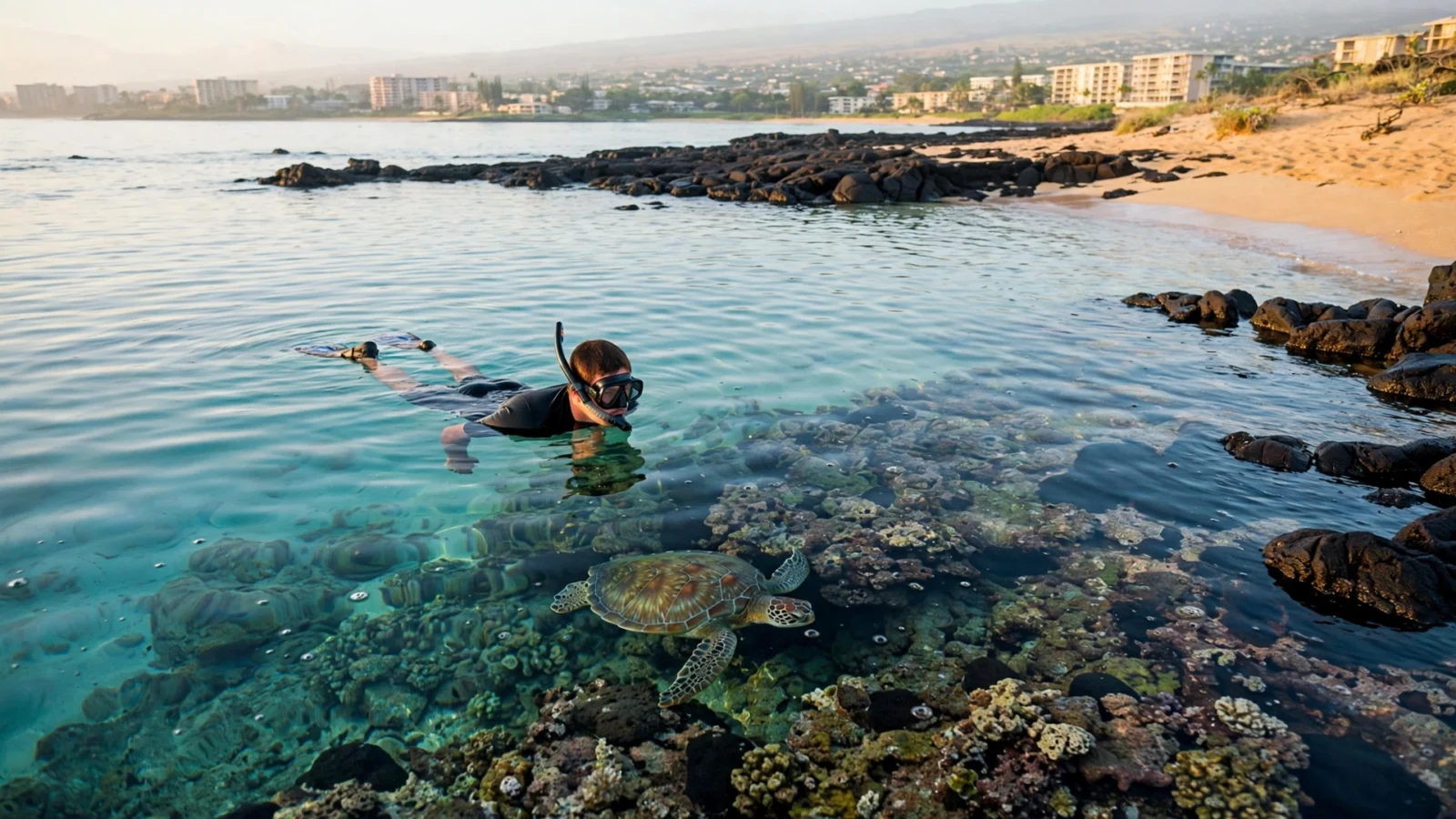
Kihei is where a lot of Maui actually stays — six miles of condos, casual restaurants and sunset-facing sand along South Kihei Road — and it is the part of the island most snorkeling guides barely cover. The famous names are all somewhere else: Kapalua and Honolua up west, Molokini offshore, Ulua down in Wailea. Kihei gets a line, if that, usually “some snorkeling at the rocky points.”
That line is true, and it undersells the place. Kihei’s snorkeling is not one beach but a chain of them — Charley Young, the three Kamaole Beach Parks and Keawakapu — and at every one of them the pattern is the same: a wide, sandy, swimmable middle where there is almost nothing to see, and reef at the rocky ends where there genuinely is. Add lifeguards at all three Kamaole parks, rental shops across the street, and the calmest winter water on Maui’s leeward side, and Kihei becomes what it really is: the easiest walk-in snorkeling on the island for anyone staying on the south shore — as long as you know which end of which beach to swim to, and you understand the new parking rules before you drive there. Beyond the beach, see our guide to the things to do in Kihei.
Charley Young Beach and Kamaole I
Charley Young is not really a separate beach — it is the northern end of Kamaole Beach Park I, reached from the small parking area off Kaiau Place, and it is where Kihei’s snorkeling reputation lives.
The snorkel. Enter anywhere along the Charley Young sand — the entry is soft, gently sloped and rock-free — then swim right, toward the rocky point at the north end. The reef hugs that point: lava rock and coral heads in roughly 5–15 feet of water, working reef fish throughout, and green sea turtles that feed along the rocks and rest in the shallows. Work the rock line slowly southward and you can connect Charley Young into the Kam I shoreline in one long, easy swim. The middle of Kam I, by contrast, is a sand-bottom swimming beach — pleasant, lifeguarded, and nearly empty of marine life.
The other end. Kam I’s south point, where it meets Kam II, also holds reef and is worth the swim if you are based at the south end of the park — turtles are frequently seen resting on the rocks between the two parks.
Facilities and parking. Kamaole I has a lifeguard tower, restrooms and outdoor showers. One honest exception: the Charley Young section at the far north end has porta-potties rather than the park restroom building — plan accordingly. Kam I’s paved lot, by the lifeguard tower at South Kihei Road and Alanui Ke Ali’i, is a Park Maui paid lot (see the parking section below); there is also a gravel lot across South Kihei Road. On weekend and holiday mornings the paved lot is residents-only before 10am — the single most common way visitors get caught out here in 2026.
Kamaole II
Kam II is the wide, friendly middle beach of the three, directly across from the shops and restaurants of central Kihei, and the one most visitors swim at without ever snorkeling — because from the middle of the beach, there is nothing to snorkel over.
Keawakapu Beach
Keawakapu is the long — roughly 0.7-mile — golden beach where Kihei runs out and Wailea begins, fronting the Mana Kai at its north end and a quiet residential stretch to the south. It feels like a different town: no park lawns, no crowds, and no lifeguard.
The snorkel. Both ends, again. At the north end, reef and rock run along the shore in front of and beyond the Mana Kai — this is also where the rental shops at the north access make it the easiest Keawakapu entry. At the south end, the rocks and reef at the end of South Kihei Road hold fish and turtles in a much quieter setting, reached down a couple of flights of stairs from the small end-of-road lot. The long middle is sand — lovely for a walk or a swim, empty for a snorkeler. Local opinion splits on which end is better; the honest answer is that the north end is more consistent and the south end is better on a calm day when you want the place to yourself.
Facilities and parking. Keawakapu is the parking bargain of South Maui: three free public lots — the gravel lot by the Mana Kai at the north end, the shaded paved lot at Kilohana Drive mid-beach (across the road, with a crosswalk to the beach access), and the small lot at the end of South Kihei Road for the south end. Facilities are limited compared with the Kamaole parks — outdoor showers and portable toilets rather than full park restrooms — and there is no lifeguard station, which is why Keawakapu sits behind the Kams for beginners despite its reef.
From Keawakapu you are a beach-path walk from Ulua Beach and the rest of Wailea — our Wailea Beach guide covers the resort crescent itself.
Kamaole I vs II vs III: which one should you pick?
| Kamaole I (+ Charley Young) | Kamaole II | Kamaole III | |
|---|---|---|---|
| Best snorkeling | Charley Young reef, north end — best in Kihei | Either rocky end — modest | Far-right lava rocks — second best of the Kams |
| Entry | Soft sand at Charley Young | Soft sand | Sand channel beside rocks at the north end |
| Lifeguard | Yes | Yes | Yes |
| Parking | Paved Park Maui lot + gravel lot across the road | Mostly South Kihei Road street parking | 84-space Park Maui lot + south gravel shoulder |
| Park Maui paid parking | Yes — paved lot | Not in the first rollout | Yes — paved lot |
| Facilities | Restrooms, showers (porta-potties at Charley Young end) | Restrooms, showers, drinking fountains, ADA ramps | Restrooms, showers, playground, big lawn, pavilions |
| Best for | Snorkelers | First-timers, swimmers, families mid-Kihei | Families who also want one good reef |
Parking in 2026: the Park Maui rules at Kamaole
This is the section most Kihei guides get wrong or leave out, because it is new. Since 15 July 2026, Maui County’s Park Maui programme charges non-residents to park in the paved lots at Kamaole Beach Parks I and III:
- Rates for non-residents: $10 per day, $50 per week or $150 per month. Weekly and monthly passes are sold through the Park Maui app only.
- Hawaii residents park free with a valid Hawaii driver’s licence or state ID — but you still start a session in the app or at a pay station so your plate is registered.
- Resident-only
Best time to snorkel in Kihei
Kihei snorkeling runs on a daily clock more than a seasonal one. The pattern on almost every day of the year:
- Go early. From sunrise to about 10–11am the water is at its calmest and clearest, the points are glassy, and the turtles are active along the rocks. By late morning the trade winds build, the surface chops up, and visibility at every Kihei spot drops.
- Winter (roughly November–April) is Kihei’s secret season: while the north and west shores take the big winter swells, the south shore stays comparatively calm, and the Kamaole chain is often the most snorkelable water on Maui. This is the mirror image of West Maui — see our island-wide best time to snorkel in Hawaii guide for the full seasonal picture.
- Summer brings the occasional south swell, which wraps into Kihei, stirs the sand at the points and can make the Kam III rock entry unsafe for a day or two. On a south-swell day, Charley Young’s more sheltered north end is usually the last Kihei spot to give up.
- After heavy rain, runoff can brown out the Kihei shore for a day — Kihei is a dry town, so this is rare, but skip the snorkel until the water clears if it happens.
What you will see
Set expectations correctly and Kihei over-delivers. This is neighbourhood reef, not a showcase bay — but it is real reef with real residents:
- Green sea turtles (honu) — Kihei’s headline. They feed along the rocky points, cruise the reef edges and rest on the rocks between the Kamaole parks. Charley Young and the Kam I south point are the most reliable places in town. Keep the legal, ethical distance — at least 10 feet (3 m) from turtles — and let them come to you. Our snorkeling with turtles guide covers the etiquette in full.
- Reef fish over the rock and coral at the points: parrotfish, surgeonfish, butterflyfish, goatfish, humuhumunukunukuapua’a and clouds of juvenile fish in the shallows at Charley Young.
- Occasional extras — octopus in the rock crevices at Kam III and Keawakapu, eagle rays over the sand channels, and in winter, humpback whales audible underwater and visible blowing offshore from the beach.
- Hawaiian monk seals haul out on Kihei sand now and then. If one is resting on your beach, the rule is 50 feet minimum and leave it entirely alone — it is resting, not stranded.
What you will not reliably get in Kihei is the dense coral gardens of Ahihi-Kinau or the turtle-cleaning-station spectacle of Turtle Town at Maluaka and Makena Landing, fifteen minutes south. Kihei’s deal is convenience and consistency, not the island’s best reef.
Is Kihei good for beginners and kids?
Yes — Kihei is arguably the best beginner base on Maui, for three structural reasons: the entries are sand, the best beaches are lifeguarded, and you are snorkeling minutes from where you sleep instead of driving an hour to a remote bay.
- Best first snorkel: Kamaole II’s ends or Kam I inside the lifeguarded swim area, on a calm morning, staying over sand until confidence builds, then edging toward the point rocks.
- Best step-up: Charley Young — a real reef, still off a soft entry, still next to the Kam I lifeguard tower’s beach.
- Not for beginners: Keawakapu (no lifeguard) and the Kam III rocks on any day with shorebreak.
- The honest rule for kids: children who are not confident swimmers should not be snorkeling the points at all — keep them in the lifeguarded shallows, or take a guided tour where a crew watches the water for you.
Our beginners’ guide to snorkeling in Hawaii and snorkeling safety guide cover the full preparation, and the gear checklist is worth a read before you rent.
Renting gear and taking a tour from Kihei
Kihei is the easiest town on Maui to gear up in. Snorkel rental shops line South Kihei Road — several sit directly across from the Kamaole parks — renting mask, snorkel and fins by the day or week, and weekly rates are usually the smart buy if you are snorkeling more than twice. Rent the morning you arrive, keep the set in the condo, and every beach in this guide becomes a walk-in.
On tours: Kihei is a base for Maui’s boat snorkeling rather than a departure beach — most Molokini Crater boats leave from Ma’alaea Harbor, about 15 minutes north, and kayak-snorkel tours launch along the Kihei–Wailea–Makena shore to the south. A tour earns its money in Kihei in two situations: you want Molokini’s offshore clarity, or you have nervous beginners who will relax with a crew in the water. For confident shore snorkelers, this guide’s beaches are free and five minutes
FAQ
Is there good snorkeling in Kihei?
Yes — with the right expectations. Kihei’s snorkeling is at the rocky ends of its beaches, not the sandy middles: Charley Young (the north end of Kamaole I) and the far-right rocks at Kamaole III hold genuine reef, reef fish and reliable turtles, and Keawakapu adds a quieter option at both ends. It is neighbourhood reef rather than a showcase bay like Honolua or Ahihi-Kinau, but it is lifeguarded, walk-in and consistent — especially in winter, when the south shore is Maui’s calm side.
Which Kihei beach is best for snorkeling?
Charley Young Beach, the north end of Kamaole Beach Park I. Enter over soft sand, swim right to the rocky point, and you are over Kihei’s best reef with its most reliable turtles. Kamaole III’s north-end lava rocks are the second pick, and Keawakapu’s ends are the pick for confident swimmers who want quiet.
Can you snorkel at Kamaole Beach?
Yes, at all three Kamaole Beach Parks — but only the ends are worth it. The middles are sand-bottom swimming beaches. Snorkel the rocky points: Charley Young at Kam I’s north end, Kam I’s south point, either end of Kam II, and the far-right lava rocks at Kam III. All three parks have lifeguards, restrooms and showers.
How much is parking at Kamaole Beach in 2026?
Since 15 July 2026, non-residents pay Park Maui rates in the paved lots at Kamaole I and III: $10 per day, $50 per week or $150 per month, paid by licence plate in the Park Maui app or at the pay station. Hawaii residents park free with a valid Hawaii licence or ID. On weekends and county holidays those paved lots are residents-only before 10am. Kamaole II’s street parking and Keawakapu’s lots remain free — and the sign at any lot wins over anything written online.
Are there lifeguards at Kihei beaches?
Yes at Kamaole I, II and III, which is a big part of Kihei’s beginner appeal. There is no lifeguard at Keawakapu Beach or at Cove Park, so those two suit confident swimmers snorkeling with a buddy.
When is the best time to snorkel in Kihei?
Early morning, before the trade winds build — roughly before 10–11am — on any day of the year. Seasonally, winter is Kihei’s quiet advantage: the south shore stays comparatively calm while north and west Maui take the winter swells. In summer, watch for a south swell, which murks the Kihei points for a day or two.
Do I need a tour to snorkel in Kihei?
No. Every beach in this guide is a free, walk-in shore snorkel, and rental shops across South Kihei Road will gear you up in minutes. A tour is worth it for Molokini’s offshore clarity (boats leave from Ma’alaea Harbor, ~15 minutes north) or if you have nervous beginners who would relax with a crew in the water.
Where can I rent snorkel gear in Kihei?
Along South Kihei Road — several rental shops sit directly across from or within a short walk of the Kamaole Beach Parks, renting by the day or week. Weekly rental usually beats daily if you plan to snorkel more than twice, and the shops are also the best free source of that morning’s honest conditions report for each end of town.
apart — our Hawaii snorkeling tours guide breaks down when each option makes sense, and the Maui island hub puts Kihei in context against every other Maui base.
Kihei vs Wailea vs West Maui: the honest verdict
- Choose Kihei if you are staying here (most of this guide’s readers are), you want lifeguarded, walk-in snorkeling with zero driving, or you are visiting in winter when the south shore is Maui’s calm side. Kihei is also the budget base — our where to stay for snorkeling guide compares the island’s bases.
- Choose Wailea, ten minutes south, for a step up in reef quality at Ulua and Makena — better coral, more turtles, resort prices.
- Choose West Maui (Kapalua, Honolua, Kahekili) in summer for Maui’s best shore reefs — and accept the drive and the winter swells that close them down.
Kihei will never top a “best snorkeling on Maui” list. It does something more useful for most visitors: it puts a decent, safe, lifeguarded reef at the end of your street, every calm morning of your trip.
Safety at the Kihei points
- Rip currents form along the rocky points — the same points you are snorkeling. The current runs along and away from the rocks, especially when there is any swell. Snorkel the points on calm mornings, stay aware of which way the water is moving you, and never fight a current head-on: swim parallel to shore to exit it, then come in.
- Shorebreak: Kam III and Keawakapu can get a dumpy shorebreak on a south swell. If the entry looks pushy from the beach, it is worse in it — pick another beach that morning.
- No lifeguard at Keawakapu or Cove Park. Swim those with a buddy, a flotation device if you are not a strong swimmer, and a definite exit point in mind.
- Rock and reef cuts at the entries beside lava rock are Kihei’s most common minor injury. Enter over sand channels, never stand on reef, and wear the reef-safe sunscreen Hawaii requires — the standard guidance is in our safety guide.
- Check the day’s conditions before you go: the county and local shops post the south-shore snorkel report each morning, and the rental shops on South Kihei Road will tell you honestly which end of town is clearest that day.
mornings:
on weekends and county-observed holidays, the paved lots at Kam I and III are reserved for residents before 10am. The beaches themselves stay open to everyone — it is only the paved lots that are held. Visitors snorkeling early on a weekend should use the gravel and street options, or walk in.
- It is pay-by-plate: pay in the Park Maui app or at the on-site pay station, type your licence plate carefully, and you do not need to display anything on the dashboard.
- Kamaole II is not in the first rollout — the county has said it will be added after the South Kihei Road improvement works. Until then its parking is mostly street parking along South Kihei Road.
- Keawakapu’s three lots remain free.
Rules and enforcement at beach lots change faster than guidebooks do: read the sign at the lot when you arrive — it wins over anything written here, including this paragraph.
The snorkel. Both ends work, the same way as everywhere in Kihei: swim to the rocky point at either end of the crescent and follow the rock line. The north end shares the point with Kam I’s south end; the south end point leads toward Kam III. Expect modest reef fish numbers, scattered coral on lava, and a reasonable chance of a turtle cruising the point. Kam II is a perfectly good first-ever snorkel — sandy entry, lifeguard, gentle slope — but if the reef is the point of your morning, Charley Young and Kam III are both better and five minutes apart.
Facilities and parking. Lifeguard, restrooms, showers, drinking fountains and picnic tables; ADA-accessible ramps run from the parking area to the shore. Parking is the most informal of the three parks — largely along South Kihei Road rather than in one big paved lot, which is also why Kam II was not part of the first Park Maui rollout (below). Arrive early; the road parking goes first.
Kamaole III
Kam III is the park Kihei families actually use: the biggest lawn of the three, a playground, volleyball, picnic pavilions and an 84-space parking lot — and, at its far right-hand end, snorkeling that most of those families never walk to.
The snorkel. Head to the far right (north) end of the beach, where the sand gives way to lava rock. The reef off those rocks is the best on any of the three Kamaole beaches after Charley Young: coral and rock structure in shallow water, solid reef-fish numbers, turtles, and enough variety to hold a confident snorkeler for an hour. The trade-off is the entry — you are entering beside rock rather than over pure sand, so pick a calm moment, watch for the small shorebreak Kam III can get, and enter where the sand channel meets the rocks rather than climbing over them.
Kam III is also the Kam most exposed to a south swell: on a summer day with swell running, this is the first of the three to get murky and pushy at the entry, while Kam I often stays workable. Check the water from the lawn before you commit.
Facilities and parking. Lifeguard, restrooms, showers, picnic tables, playground and the big grassy park. The paved lot off South Kihei Road is a Park Maui paid lot, and like Kam I it is residents-only before 10am on weekends and county holidays. A gravel shoulder at the far south end of the park is the overflow option locals use.
ules before you drive there.
This guide covers Kihei purely as a snorkeling town: every beach ranked, the reef route at each one, what you will actually see, when to go, the 2026 Park Maui paid-parking system that now runs the Kamaole lots, and an honest verdict on how Kihei stacks up against Wailea and West Maui.
Quick facts
| Where | South Kihei Road, Kihei, South Maui — beaches run north to south: Cove Park, Charley Young / Kamaole I, Kamaole II, Kamaole III, Keawakapu |
| Best snorkeling | The rocky points and ends — never the sandy middles |
| Lifeguards | Yes at Kamaole I, II and III; none at Keawakapu or Cove Park |
| Parking | Park Maui paid parking for non-residents at the paved Kamaole I & III lots since July 2026 ($10/day); residents free; Keawakapu lots free |
| Restrooms / showers | Restrooms and outdoor showers at all three Kamaole parks; limited facilities at Keawakapu |
| Best time | Early morning, before the trade winds build — roughly before 10–11am |
| Entry fee | None for the beaches themselves; no reservation system |
| Rentals | Several snorkel rental shops line South Kihei Road, most within a short walk of the Kamaole parks |
Quick answer: where is the best snorkeling in Kihei?
Ranked by what is actually under the water:
- Charley Young Beach (north end of Kamaole I) — Kihei’s best snorkel. A proper rocky reef wraps the point at the north end, with the most fish and the most reliable turtles of any Kihei beach, off a soft sandy entry.
- Keawakapu Beach (both ends) — the long, quieter beach at the Kihei–Wailea border. Reef at the north end by the Mana Kai and along the rocks at the south end; no lifeguard, so it suits confident swimmers.
- Kamaole III (far right / north lava rocks) — a real reef garden off the rocks at the north end of the park, with the best facilities of the three Kams behind you.
- Kamaole I (south point) — the point at the south end of Kam I, shared with Kam II’s north end, holds reef fish and resting turtles.
- Kamaole II (either end) — the middle child: a wide swimming beach with modest reef at both rocky ends. Fine for a first snorkel, not worth a special trip.
- Cove Park — a second snorkel, not a destination snorkel. It is Kihei’s beginner surf and paddleboard beach, and on a flat early morning, before the wind builds and the lessons fill the water, its shallow lava-rock edges hold reef fish and turtles. Go there to learn to surf — or for a quick calm-morning session if you are staying in Kihei. Full picture in our Cove Park snorkeling guide: https://hawaiisnorkelspots.com/maui/cove-park-snorkeling/
If you only have one Kihei morning, spend it at Charley Young. If you have two, add Keawakapu’s south end.
If Keawakapu makes your Kihei shortlist, our Keawakapu Beach snorkeling guide covers its two reef ends, the sandy entry and the calmest times to swim.
Cove Park is Kihei’s small surf cove — see our Cove Park snorkeling guide.