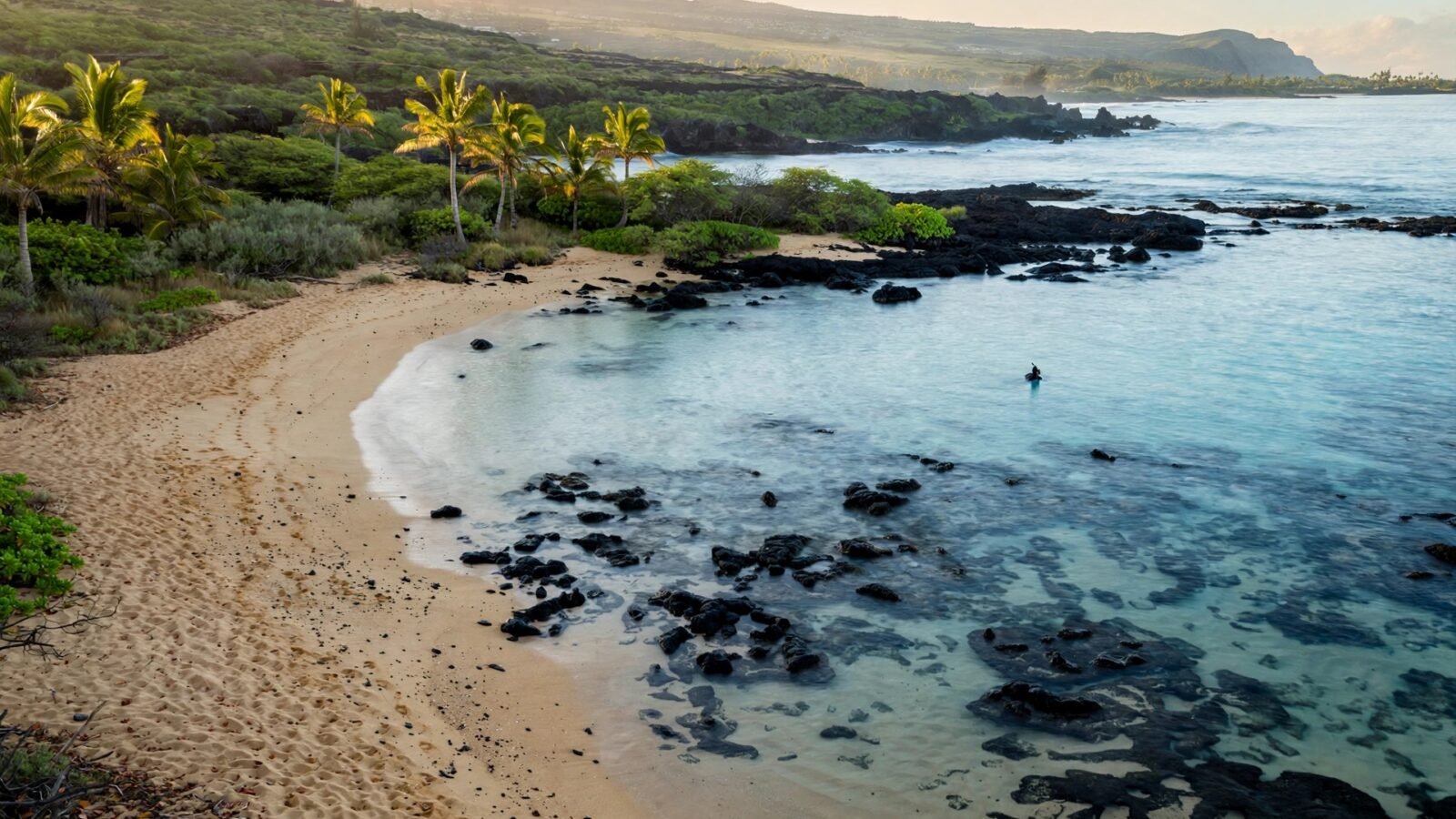
Cove Park is the smallest name on Kihei’s snorkel map, and the easiest to misunderstand. Every guide lists it as a surf beach — the place Kihei’s surf schools teach beginners — and stops there. But on a flat morning, before the wind builds and before the lessons fill the water, this little South Maui cove snorkels genuinely well: shallow, calm, rocky edges holding reef fish, and turtles that show up often enough that visitors report seeing half a dozen in a single session. This guide covers Cove Park as a snorkel, not as a surf school: where to enter, where the reef actually is, how to share a compact patch of water with surfboards, and when to skip it for the better reefs five minutes away. For the wider Kihei picture, start with our Kihei snorkeling guide and our Maui snorkeling hub.
The short answer
Cove Park is a good second snorkel, not a destination snorkel. If you are staying in Kihei and the morning is flat, it is a pleasant, easy, walk-in session with real turtles and reef fish over lava rock. If you are choosing one Kihei snorkel for the trip, go to Charley Young at the north end of Kamaole I instead — bigger reef, lifeguard, more sand. The honest rule: snorkel Cove Park early, on a calm morning, with booties on, and stay out of the surf-lesson lanes. Do that and it earns its place. Show up at midday in a south swell expecting a reef showcase and it will disappoint you.
Quick facts
Access: Walk-in from the small beach at Cove Beach Park, 2128 Iliili Road, Kihei — off South Kihei Road, near Kalama Park
Cost: Free — no entry fee, no reservation
Lifeguard: None at Cove Park
Best time: Early morning, before the trade winds build; clearest in the winter months (November–March) when the currents run clean
Parking: Small marked lot at the park, plus marked street parking nearby — it fills, especially on weekends
Facilities: Portable toilet, outdoor shower, picnic tables, grills, boat ramp
Who it suits: Confident-enough snorkelers staying in Kihei who want a quick, calm morning session — not the pick for nervous first-timers, who are better served by a lifeguarded beach
Where Cove Park actually is
Cove Park sits on Kihei’s south shore, on the busy main road through town — South Kihei Road — a short walk from Kalama Park and minutes from the Kamaole beach parks. It is a small park, not a resort beach: a pocket of sand, a grassy area with picnic tables and grills, and a boat ramp at one end. The beach itself is compact, and the water in front of it is compact too. That smallness is the whole story of this spot — it is why the surf schools like it (a contained, gentle break they can manage) and why snorkelers need a plan rather than just wandering in.
The snorkel: what the water is actually like
Enter over the sand in the middle of the cove, where the bottom is sandy and shallow, and work toward the lava-rock edges. That is where the snorkeling lives: rock and coral heads along the edges hold reef fish — butterflyfish, surgeonfish, parrotfish and the usual South Maui residents — and green sea turtles feed along the rocks and rest in the shallows. Visitors have reported seeing six turtles within the first half hour on a good day, with more passing by within the hour. Treat that as a good day, not a promise: this is neighbourhood reef, not a turtle cleaning station, and the honest expectation is fish and a decent chance of turtles, not a guarantee of either.
Two things about the bottom matter more here than at Kihei’s bigger beaches. First, it is rocky: wear booties or reef shoes, because the lava rock and coral edges will cut bare feet, and several visitor reports make exactly that point. Second, seaweed can be a nuisance here at times, washing into the cove and dulling the water — another reason the early-morning, clean-current days are the ones worth snorkeling.
Stay shallow and stay inside the cove. The water beyond the rock edges is surf water, shared with boards, and there is no reason for a snorkeler to be out there. The best session here is short and close in: an hour or so over the rock edges in the morning, then out.
Sharing the water with surf lessons — the section other guides skip
This is the part that decides whether Cove Park works for you, and it is the part no ranking page writes about. Cove Park is Kihei’s beginner surf classroom. On a typical morning, surf schools run lessons in the same small patch of water you want to snorkel, with boards, instructors and students spread across the break. The etiquette is simple and non-negotiable:
- Snorkel the edges, not the break. The surf lessons work the small waves in the middle of the cove. Your reef is along the rock edges. Keep to the edges and everyone has room.
- Watch for boards constantly. A surfboard you do not see is the real hazard here, not the reef. Look up often, stay visible, and never surface blindly in the lesson area.
- Go before the lessons fill in. The earliest morning is the quietest water twice over: calmest conditions and fewest boards. By late morning the cove belongs to the schools.
- If the lesson scene is busy, leave it. Charley Young is minutes away and has no surf-school traffic in its snorkel water. There is no reason to fight for space in a cove this small.
What you will see — and what you will not
Expect reef fish over lava rock and coral heads, green sea turtles along the rocks on a good day, and the occasional eagle ray passing over the sand. Do not expect the dense coral gardens of Ahihi-Kinau, the turtle-cleaning-station spectacle of Turtle Town at Maluaka, or the offshore clarity of Molokini — all three are different trips, and all three are covered in their own guides. Cove Park’s deal is convenience: a real, if modest, reef five minutes from a Kihei condo, on a morning when you do not want to drive anywhere.
Safety: the honest version
There is no lifeguard at Cove Park. That single fact changes the risk profile versus the Kamaole parks, which all have lifeguard towers. Snorkel with a buddy, stay inside the cove, and make your own conditions call from the water in front of you — if it looks rough, murky or crowded with boards, do not get in. High surf and strong rip currents can occur here, and the same small size that makes the cove gentle on a calm day makes it unforgiving when a swell runs: there is nowhere to move to. The full preparation — buddy rule, currents, what to do if you get into trouble — is in our snorkeling safety guide. If you are a nervous swimmer or a first-timer, this is not your beach: take the lifeguarded water at Kamaole I or II instead, and read our beginners’ advice before your first session.
Best time to snorkel Cove Park
Time of day beats everything. Go early — sunrise to around 10 a.m. — when the water is at its calmest and clearest, the surf schools are just starting, and the parking lot still has spaces. By late morning the trade winds texture the surface, visibility drops, and the cove fills with lessons.
Season helps too. The ocean here is usually clearest in the early mornings and in the winter months, roughly November through March, when the currents run clearest — which is also when Kihei’s south shore is at its calmest while Maui’s north and west shores take the winter swells. Summer brings the occasional south swell, which wraps into Kihei, stirs the sand and can make the cove’s small water rough for a day or two. On a south-swell day, skip Cove Park entirely. For the island-wide seasonal pattern, see our guide to the best time to snorkel in Hawaii.
Parking and facilities
The park’s own lot is small, with marked spaces, and it fills — especially on weekends, when local families claim the picnic areas early. Marked street parking nearby is the overflow, and arriving early solves most of the problem. Facilities are basic: a portable toilet, an outdoor shower, picnic tables and grills, and a boat ramp. There is no gear rental at the park itself; rental shops line South Kihei Road across from the Kamaole parks, minutes away, and the snorkeling gear checklist covers what to bring. If the lot is full and the street is tight, do not improvise: Charley Young and the Kamaole parks have bigger lots and better snorkeling anyway.
Cove Park vs the Kihei alternatives
| Cove Park | Charley Young (Kam I north end) | Kamaole III rocks | |
|---|---|---|---|
| Best for | A quick, quiet morning snorkel near a Kihei condo | Kihei’s best reef, full stop | Families who also want one good reef |
| Lifeguard | No | Yes (Kam I tower) | Yes |
| Reef quality | Modest rock-edge reef | Best in Kihei | Second best of the Kams |
| Turtles | Regular on good days | Most reliable in Kihei | Regular |
| Crowd pressure | Surf lessons share the water | Busy beach, open snorkel water | Busy park, open snorkel water |
| Parking | Small lot, fills fast | Small lot at Kaiau Place + Kam I lot | Large lot |
| Pick it when | The morning is flat and you want the closest water | You want Kihei’s best snorkel | You are already at Kam III with kids |
If Cove Park is your only Kihei morning, it is a fine one. If you have two mornings, spend the second at Charley Young — the comparison is not close, and our Kihei guide lays out the whole chain beach by beach.
Pair it with a South Maui day
Cove Park is a morning stop, not a day. After the snorkel, the Kamaole chain runs south from here — Charley Young, the three Kamaole parks, Keawakapu — and Wailea’s Ulua Beach is ten minutes on. If the day is a boat day instead, Molokini Crater boats leave from Maalaea Harbor about fifteen minutes north; our Molokini Crater guide covers the tour choice, and Turtle Town at Maluaka is the free shore alternative when turtles are the whole point.
Frequently asked questions
Is Cove Park good for snorkeling?
On a flat, early morning, yes — a modest but real snorkel over lava-rock edges with reef fish and regular turtles. It is not Kihei’s best snorkel (that is Charley Young), and it is not a showcase reef. Judge it as a convenient local cove, and it delivers. Judge it as a destination and it will not.
Can beginners snorkel at Cove Park?
Confident beginners on a calm morning, with a buddy and booties, yes. But there is no lifeguard, and the water is shared with surf lessons, so nervous first-timers are better at lifeguarded Kamaole I or II. The surf-lesson traffic is the reason this cove suits snorkelers who already know how to hold their line in shared water.
Are there lifeguards at Cove Park?
No. There is no lifeguard at Cove Park or at Keawakapu. The lifeguarded Kihei beaches are Kamaole I, II and III.
Where do I park for Cove Park?
The park’s small marked lot, or marked street parking nearby. Arrive early, especially on weekends — the lot fills and the park’s picnic areas go to local families first.
Is Cove Park better than Charley Young for snorkeling?
No. Charley Young, at the north end of Kamaole I, has the better reef, the more reliable turtles, a lifeguard tower and more sand. Cove Park wins only on quiet and convenience when the morning is flat and you are staying right nearby.
When is Cove Park calmest?
Early morning, before the trade winds build, and in the winter months (November–March) when the currents run clearest. Skip it on south-swell days and once the surf schools have filled the cove.
Do I need booties at Cove Park?
Yes, or reef shoes. The snorkeling is along lava-rock edges and the bottom will cut bare feet — this is the most repeated practical tip from visitors who have snorkeled here.
Can you surf and snorkel at Cove Park on the same visit?
You can, but not in the same patch of water at the same time. The surf lessons work the break in the middle of the cove; snorkelers work the rock edges. If the lesson scene is busy, the snorkel is not worth fighting for — go to Charley Young instead.