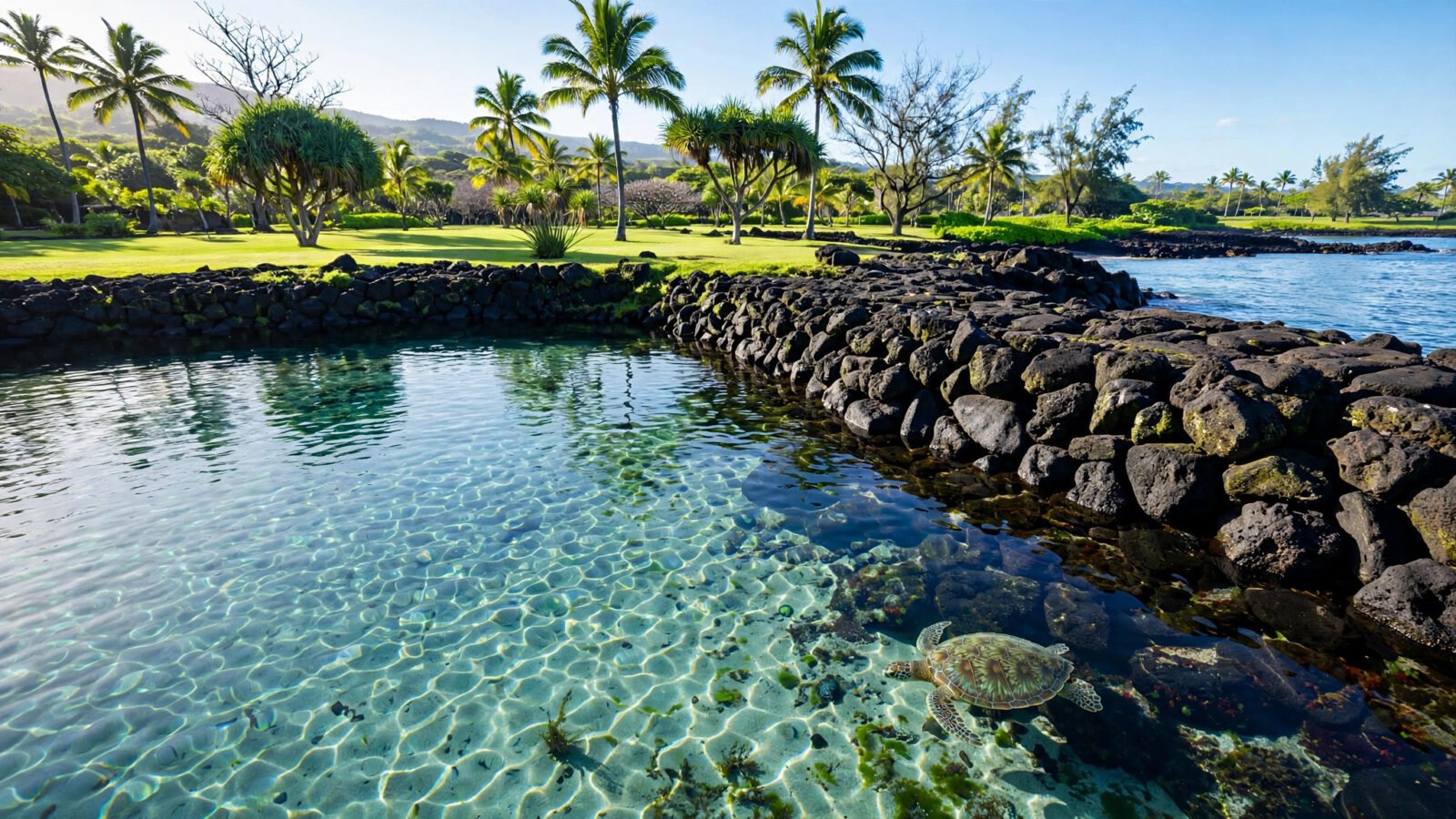
Most people drive straight past Hilo’s best beginner snorkel spot without realising it is one. Carlsmith Beach Park — locals call it Four Mile, because it sits about four miles east of downtown Hilo — is not a sandy beach at all. It is a chain of clear, spring-fed lagoons tucked behind a natural wall of lava rock, with grassy lawns where the sand should be, steel handrails to help you into the water, and green sea turtles cruising through on most days.
If Kona’s famous bays are the Big Island’s headline act, Carlsmith is the quiet local favourite: free, calm on days when the open coast is rough, and gentle enough for a first-ever snorkel — as long as you time it right and know which part of the lagoon to aim for. This guide covers exactly that.
Quick facts
- Where: 1815 Kalanianaole Ave, Hilo, HI 96720 — Keaukaha shoreline, ~10 minutes east of downtown Hilo
- Hours: 7:00 AM to 8:00 PM daily
- Cost: Free entry and free parking
- Best for: Beginners, kids, relaxed turtle-watching snorkels
- Lifeguard: Mainly weekends and holidays — check the tower on the day
- Facilities: Restrooms, outdoor showers, picnic pavilions, drinking water, lawns and shade
Carl Smith Beach, Four Mile Beach and Carlsmith Beach Park — the same place
Search for this park and you will meet it under three names: Carlsmith Beach Park, Carl Smith Beach (with a space) and Four Mile Beach. They are all the same place — the chain of lava-walled lagoons about four miles east of downtown Hilo — so whichever name your map, guidebook or cruise excursion uses, you are headed to the same park.
The park is named after the Carlsmith family, who once owned the land here; Hawaii County Councilman George K. Carlsmith is the namesake most local histories cite. The Territory of Hawaii acquired the land in 1940 and the park was developed with the help of the Civilian Conservation Corps, which is why the lawns, pavilions and stonework feel more like a built park than a wild beach. “Four Mile” is the local shorthand for the distance — about four miles along Kalanianaole Avenue from downtown Hilo — and it is the name Hilo locals still use most in conversation. Several online guides list the park as “Carl Smith Beach Park”, which is where the spaced spelling comes from; the county’s own listing uses Carlsmith, one word.
Plan your visit: hours, directions and facilities
Hours and cost. Carlsmith Beach Park is open daily from 7:00 AM to 8:00 PM. Entry and parking are both free, and there is no reservation system — it is a county park, not a ticketed attraction.
Getting there. From downtown Hilo, take Kamehameha Avenue east to Highway 11 (Hawaii Belt Road), then turn onto Kalanianaole Street and follow the Keaukaha shoreline for about four miles — that is the “Four Mile” in the local nickname — past the Port of Hilo and Keaukaha Beach Park. The drive takes roughly 10 minutes, and the park is only a few minutes from Hilo International Airport, which is why it is a popular first stop off the plane.
Arriving by cruise ship? Hilo’s cruise terminal is at the Port of Hilo, which you pass on Kalanianaole Avenue on the way to the park — a taxi or rideshare from the terminal takes only a few minutes, so Carlsmith works as an easy first stop off the ship. Give yourself the same morning window as everyone else: arrive before 9 AM and the lot and the lagoons are both at their calmest.
Facilities. Restrooms, outdoor showers, drinking water, picnic pavilions, barbecue grills and big grassy lawns with shade trees. The county lists the park phone as (808) 961-8311. Covered pavilions can be reserved through Hawaii County’s parks division — worth doing ahead of time if you are planning a weekend gathering.
Lifeguards. Hawaii County staffs the park with Hawai’i Fire Department Ocean Safety Division lifeguards on weekends, holidays, and summer break, from 9:30 AM to 4:45 PM. Outside those windows there is no lifeguard on duty, so snorkel with a buddy and stay inside the protected lagoons.
Why Carlsmith snorkeling feels different
Two things shape every snorkel here, and both come from the same source: cold freshwater springs bubbling up through the lava.
First, the springs feed a lagoon system that sits behind a broken reef and rock barrier. That barrier knocks down the surf before it reaches you, so the inner pools stay placid even when whitecaps are showing offshore. For nervous beginners and families, that protection is the whole point of the place.
Second, the spring water changes what you see and feel. Fresh water is colder than the ocean, so you will drift through distinct cool patches. Where the fresh layer floats over the salt water it creates a shimmering, blurry band — a halocline. New snorkelers often surface thinking their mask has fogged. It has not. That shimmer is a signature of the whole Keaukaha coast, and it usually thins as you move a little farther from shore and away from the spring vents.
The trade-off is honest: visibility at Carlsmith is good for the Hilo side, but it will rarely match a still morning in Kealakekua Bay on the Kona side. What you get instead is calm water, very few people, and turtles — without the drive across the island.
What the park looks like
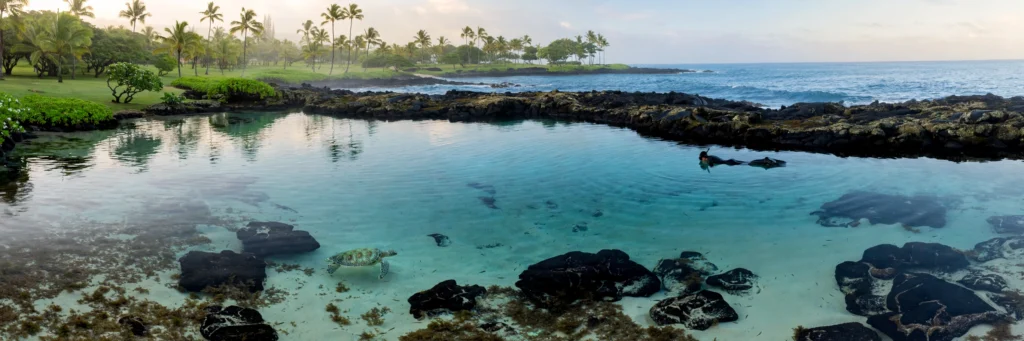
Picture a low peninsula of smooth black pahoehoe lava jutting off the Keaukaha coast, with a large lagoon snaking around it and smaller coves tucked into the rock. The water inside is a pale turquoise over sand patches and dark lava, clear enough to watch small reef fish from the lawn above. Behind the lagoons are wide grassy lawns shaded by coconut palms and ironwood trees, with picnic pavilions, barbecue grills and a restroom block near the entrance — and, on the left-hand side of the peninsula, the white lifeguard tower that watches the main swimming area. There is almost no sand beach here: the shoreline is lawn, rock and lagoon steps, which is the first thing that surprises first-time visitors. On a calm morning the whole scene is quiet enough that the loudest sounds are the ironwoods hissing in the trade winds and the water lapping at the lava.
Where to snorkel at Carlsmith: inner lagoons vs the reef edge
Think of Carlsmith as two snorkels in one park.
The inner lagoons are the beginner zone. Entry is from the lawn edges and the stepped access points fitted with stainless-steel handrails — hold on, sit, slip in, and you are floating in shallow, sheltered water over sand patches and smooth lava. This is where to take kids, first-timers, and anyone building confidence. Small reef fish dart around the rock edges, and turtles regularly feed and rest inside the protection of the barrier.
The outer reef edge, where the lagoon meets the open ocean beyond the rock wall, holds more coral structure and more fish variety. It also holds more current and surge, especially on a rising tide or a day with bigger swell. Confident snorkelers will enjoy it; beginners should treat the barrier as their boundary and stay inside it. If the water outside the rocks looks churned or you cannot easily hold your position, that is your answer — turn back into the lagoon.
Wherever you enter, wear water shoes or reef walkers until you are actually swimming. The lava around the entries is sharp, and sea urchins tuck into the cracks in places. Fins go on in the water, not on the rocks.
What you will see underwater
- Hawaiian green sea turtles (honu) — the headline sighting. They graze on algae on the rocks, rest in the shallows, and pass through the lagoons throughout the day. Sightings are frequent but never guaranteed — early and quiet visits do best.
- Reef fish — schools of small tropical fish work the lagoon edges and the reef, with the usual Hilo-side mix around the rock structure. Expect variety over density; this is a gentle lagoon ecosystem, not an aquarium bay.
- Tide-pool life — at low tide the rock shelves expose small pools worth a careful look from above: crabs, small fish, and invertebrates trapped until the water returns.
A note on expectations: after heavy rain — and Hilo is the rainy side of the island — runoff clouds the lagoons and the spring flow strengthens the blur. If it poured overnight, give Carlsmith a miss that morning and try again after a dry day. On a clear, dry morning the lagoons live up to the photos.
Best time to snorkel Carlsmith Beach Park
Go in the morning. Three reasons stack up in your favour before midday: the water is at its clearest before the trade winds pick up, the parking lot is emptier, and the park is quiet enough that turtles behave naturally instead of threading between swimmers.
Seasonally, Hilo snorkeling is a year-round activity in warm water, but the pattern follows the rain. Drier stretches — late spring through early autumn tends to be kinder — deliver the most consistent clarity. Winter brings more rain and more frequent big surf on the east side; the lagoon stays swimmable on many of those days thanks to the rock barrier, but check conditions at the park and never snorkel outside the barrier when surf is up.
Weekday mornings are the sweet spot locals aim for. Weekends and holidays bring family gatherings, full pavilions, and a busy lawn — fun, but not the calm snorkel most visitors are picturing. The ocean water stays warm all year — the cold patches you feel in the lagoon are spring water, not the sea, so you will warm up again as soon as you swim away from a spring vent.
Getting there and parking — the honest version
From downtown Hilo, head east on Kalanianaole Avenue along the Keaukaha coast. Carlsmith is about four miles out — hence Four Mile — shortly after you pass James Kealoha Beach Park. The park entrance and restrooms are on the ocean side of the road.
Parking is free, and the lot is small. That second fact matters. On a sunny weekend the main lot and the roadside spaces fill quickly. Your overflow option is the larger lot at neighbouring James Kealoha Beach Park, a short walk away. Arrive before 9 AM on weekends and you will rarely have a problem; arrive at noon and expect to circle or walk. Lock your car and leave nothing visible inside — standard advice for every beach park in Hawaii, and worth following here.
The park is open 7:00 AM to 8:00 PM daily. There is no entrance fee and no reservation system.
Is Carlsmith good for beginners and kids?
Yes — with two small caveats. The protected lagoons, shallow entries, handrails, lawns for non-swimmers, and restrooms and showers on site make this one of the easiest snorkel introductions on the Big Island’s east side.
Caveat one: there is no real sand beach. Children play on the lawn and in the enclosed-feeling pools rather than on a sandy shore. If your group specifically wants sand underfoot, neighbouring Onekahakaha Beach Park has a sand-bottomed, fully enclosed keiki (children’s) pool a few minutes farther east.
Caveat two: lifeguard coverage is part-time — mainly weekends and holidays. On a weekday, the calm is yours and so is the responsibility. Keep beginners inside the lagoon, use a buddy system, and re-read the conditions when you arrive, not just when you planned the trip.
Turtles at Carlsmith: how to watch them properly
Turtles are protected under state and federal law, and the rules are simple:
- Stay at least 10 feet (3 metres) away, on land and in the water — the viewing distance recommended by NOAA Fisheries.
- Never touch, feed, chase, or crowd a turtle, and never block its path to deeper water.
- If a turtle swims toward you, hold still or back away slowly and let it choose the distance.
Done right, this costs you nothing: a calm snorkeler floating quietly at a respectful distance usually watches a honu for far longer than someone who charges in with a camera. Zoom lenses and patience beat close approaches every time.
Safety notes specific to this park
- Stay inside the rock barrier unless you are a confident ocean swimmer and conditions are clearly calm. Currents strengthen near the gaps in the reef.
- Watch your footing. Wet lava is slippery, entries are rocky, and urchins sit in the cracks. Water shoes are close to mandatory here.
- Respect the freshwater chill. The spring-fed patches are noticeably cold. Most people are fine, but small children chill faster — shorter sessions with warm-up breaks on the lawn work better than one long snorkel.
- Use reef-safe sunscreen — Hawaii law requires sunscreens sold in the state to be reef-compliant, and lagoons like this one are exactly why. Apply before you arrive so it has time to absorb.
- If in doubt, don’t go out — Hawaii’s own water-safety motto applies at Carlsmith too, lagoon or not.
For the wider picture, see our guide to whether snorkeling in Hawaii is safe before your trip.
Carlsmith vs Richardson Ocean Park: which should you pick?
Five minutes farther east on the same road sits Richardson Ocean Park, Hilo’s other snorkeling anchor — and the two parks pair perfectly in one morning. Here is how to choose if you only have time for one:
- Pick Carlsmith if calm, easy water matters most: first-time snorkelers, younger kids, or a windy day. The walled lagoons are the most forgiving water in Hilo, and the lawn-and-pavilion setup suits a long, lazy park day.
- Pick Richardson if you want the stronger all-round snorkel: a black-sand pocket beach, a full-time lifeguard presence, and turtles that are about as close to guaranteed as wildlife gets. Entry is over black sand rather than lagoon steps, and the snorkeling edges hold a little more variety.
Honestly? They are five minutes apart and both free. Snorkel Carlsmith’s lagoons early while the water is glassy, then finish at Richardson for the black sand and the lifeguard-backed swim. Our Hilo snorkeling roundup lays out the full east-side plan, and the Big Island hub covers the Kona side for the rest of your trip.
Make a morning of it: nearby stops
- Richardson Ocean Park — black sand, lifeguards, reliable turtles (see above).
- Onekahakaha Beach Park — enclosed sand-bottom pool that is ideal for toddlers.
- James Kealoha Beach Park — Carlsmith’s immediate neighbour; handy overflow parking and its own calm coves.
- Coconut Island (Moku Ola) — back toward town in Hilo Bay, a small island park reached by a footbridge, good for a picnic stop on the way home.
Pair a Carlsmith morning with an afternoon at Hawaii Volcanoes National Park and you have Hilo’s classic day: turtles before lunch, craters after.
What to bring
- Mask, snorkel and fins (rentals are a Hilo-town errand — there is no rental shack at the park)
- Water shoes or reef walkers for the lava entries
- Reef-safe sunscreen, rash guard, and a towel for the lawn
- Drinking water and snacks — pavilions and picnic tables are on site, food shops are not
- A dry bag or pouch if you plan to leave gear on the lawn while you snorkel
New to the sport entirely? Start with our beginner’s guide to snorkeling in Hawaii and our best time to snorkel in Hawaii planner, then come back to Carlsmith — it is one of the kindest places on the island to put it all into practice. For more turtle-focused spots statewide, see where to snorkel with turtles in Hawaii.
The anchialine ponds: small pools with native shrimp
Beyond the lagoons, Carlsmith Beach Park in Hilo holds something most snorkel guides skip entirely: several small anchialine ponds scattered among the lava rock. An anchialine pond is a landlocked pool with no surface connection to the sea — it connects to the ocean underground, through lava channels, so its water is a brackish mix of fresh spring water and seawater. The ponds at Carlsmith hold native shrimp species, tiny reddish shrimp that live in exactly this kind of still, sheltered water, and Hawaiian green sea turtles visit the ponds regularly.
Look for the ponds as you walk the park, not as a separate attraction with a sign and a trail. They are still, shallow pools tucked into the rock and lawn edges around the lagoons, easy to miss if you head straight for the handrail entries. Peer in from the edge and you may catch the shrimp flicking through the clear water — that is the whole experience, and it is worth slowing down for, especially with kids who like the small-scale wildlife as much as the turtles.
Do not snorkel in the ponds. They are far too small and fragile for that, and stirring up the sediment or handling the shrimp damages the habitat that makes them interesting. Keep the ponds as a look-and-leave stop: watch from the edge, leave the shrimp alone, and do your actual snorkeling in the lagoons, where the water is deeper, the reef life is bigger, and the space can absorb a swimmer. If the lagoon is murky after rain, the ponds are a good consolation — they stay clear and still when the open water does not, and they are one more reason Carlsmith rewards a slow morning rather than a quick photo stop on the way to somewhere else.
What visitors say: Carlsmith Beach Park reviews
Review sites rate Carlsmith Beach Park highly for a Hilo beach: Wanderlog lists it at 4.7 stars from about 2,500 reviews, and Hawaii Beach Safety shows 4.8 stars from 42 reviews (ratings checked November 2026; they move as new reviews arrive). The praise repeats the same three things — the calm, protected lagoons, the frequent green sea turtles, and how easy the park is for families with small children. The complaints repeat too, and they match what this guide says: the parking lot is small and fills on sunny weekends, the spring-fed water runs cold in patches, and there is no sandy beach — lawns and lava instead. Read together, the reviews describe exactly the park this guide describes: a quiet local favourite, not a resort beach, and best on a weekday morning.
FAQ
Is Carlsmith Beach Park good for snorkeling?
Yes — for calm, beginner-friendly snorkeling it is one of the best spots on the Hilo side. The lava-walled lagoons stay sheltered, turtles visit frequently, and handrail entries make getting in and out easy. Visibility is good on dry mornings but a step below Kona’s clearest bays, and it drops after heavy rain.
Can you see turtles at Carlsmith Beach Park?
Frequently, yes. Green sea turtles feed and rest in the lagoons and along the reef edge throughout the day. Keep at least 10 feet away, never touch or chase them, and let them approach you if they choose to.
Is there a fee or reservation for Carlsmith Beach Park?
No. Entry and parking are both free, and there is no reservation system. The park is open daily from 7:00 AM to 8:00 PM.
Where do you park for Carlsmith Beach Park?
In the park’s own free lot on Kalanianaole Ave — but it is small and fills on sunny weekends. The larger lot at adjacent James Kealoha Beach Park is the standard overflow, a short walk away. Arriving before 9 AM avoids the problem almost entirely.
Is Carlsmith Beach Park safe for kids?
The inner lagoons are shallow, protected and calm, which makes Carlsmith a genuinely good family snorkel spot. Note that lifeguards are mainly on duty on weekends and holidays, there is no sandy beach (lawns instead), and water shoes are a must on the lava around the entries.
Why is the water blurry in patches at Carlsmith?
Freshwater springs feed the lagoons. Where the cold fresh layer sits over warmer salt water it creates a shimmering blur called a halocline. It is normal here, strongest near shore and after rain, and it usually clears as you move farther out into the lagoon.
What is the best time of day to snorkel at Carlsmith?
Morning, ideally before the trade winds build and before the weekend crowds arrive. You get the clearest water, the easiest parking, and the calmest turtle encounters of the day.
How far is Carlsmith Beach Park from downtown Hilo?
About four miles east — roughly a 10-minute drive along Kalanianaole Street via the Keaukaha shoreline. It is also just a few minutes from Hilo International Airport.
What are the lifeguard hours at Carlsmith Beach Park?
Per Hawaii County, lifeguards are on duty on weekends, holidays, and summer break from 9:30 AM to 4:45 PM. There is no lifeguard on regular weekdays outside the summer season.
Is Carlsmith Beach Park the same as Four Mile Beach?
Yes. Four Mile (Beach) is the local nickname for Carlsmith Beach Park, from its distance — about four miles — east of downtown Hilo. You may also see it written “Carl Smith Beach” with a space.
Can you just swim at Carlsmith Beach Park without snorkeling?
Yes — the protected lagoons are popular for casual swimming, floating and wading. The inner lagoons are shallow and calm, which is why families use them as swimming holes. Bring water shoes for the lava-rock entries either way.
What are the anchialine ponds at Carlsmith Beach Park?
They are small landlocked pools in the park that connect to the ocean underground through lava channels, so their water is brackish — part fresh spring water, part seawater. They hold native shrimp species, and Hawaiian green sea turtles visit them regularly. They are a look-from-the-edge feature, not a swimming spot.
Can you snorkel in Carlsmith’s anchialine ponds?
No. The ponds are small, shallow and fragile, and snorkeling in them would stir up sediment and disturb the shrimp. Enjoy them from the edge, and snorkel in the main lagoons instead, where the water is deeper and the reef life is bigger.
Do I need tickets for Carlsmith Beach Park?
No. There are no tickets, no entry fee and no reservation system — Carlsmith is a free Hawaii County park, open daily from 7:00 AM to 8:00 PM. The only thing you book ahead is a picnic pavilion, through Hawaii County’s parks division.
How far is Carlsmith Beach Park from the Hilo cruise terminal?
The cruise terminal sits at the Port of Hilo on Kalanianaole Avenue, and the park is a few minutes’ drive east along the same road, past Keaukaha Beach Park. A taxi or rideshare from the terminal is the easiest way to get there — the same 10-minute drive from downtown Hilo, in the other direction.
Verified October 2026 against Hawaii County park listings, NOAA Fisheries wildlife viewing guidance, and on-the-ground visitor reports. Conditions change with weather and season — always check the park noticeboards and lifeguard advice on the day.