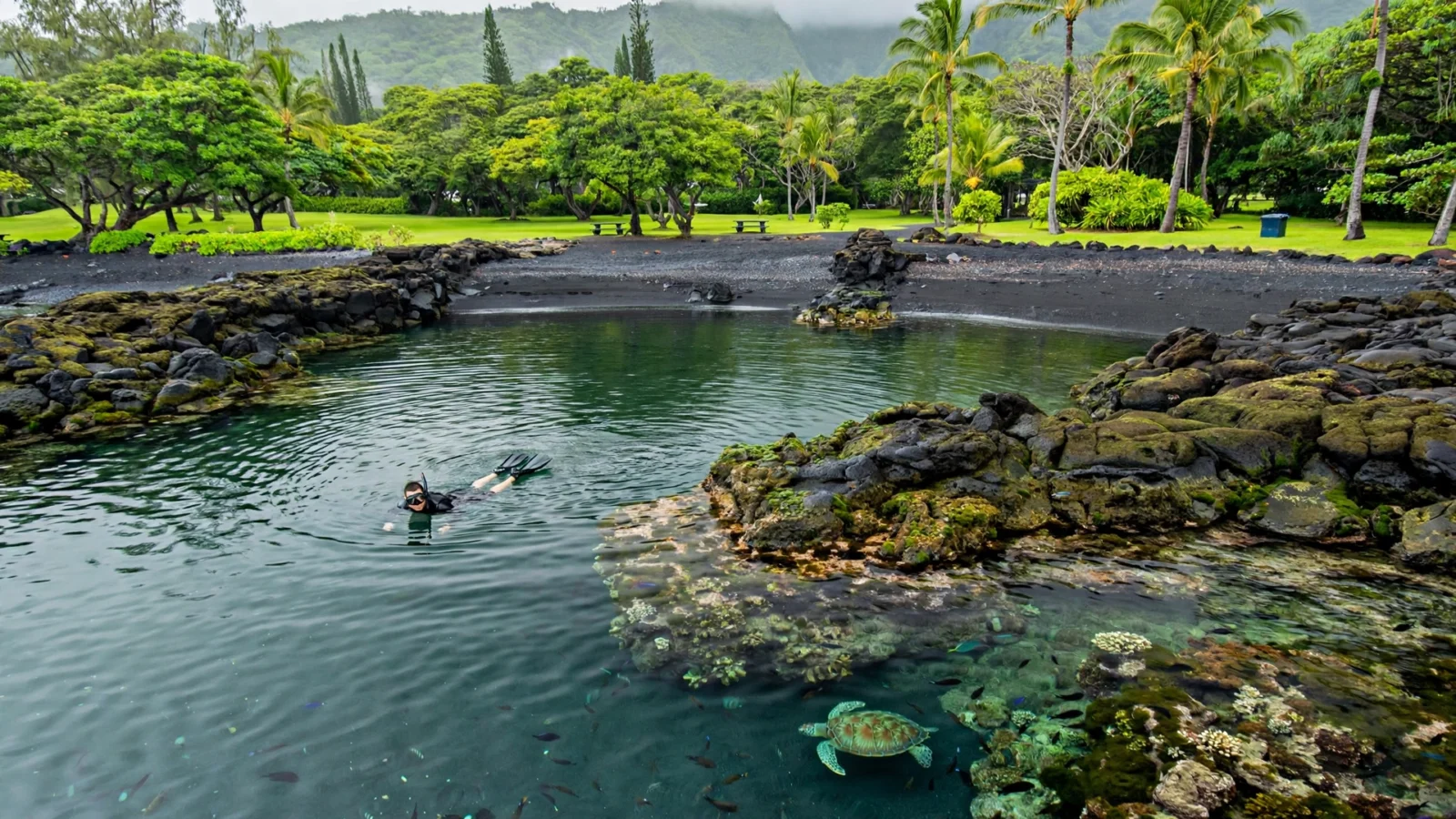
- Where
- Keaukaha shoreline, east of downtown Hilo along Kalanianaole Ave
- Cost
- Free entry and parking at the county beach parks; no gear rentals at the parks themselves
- Difficulty
- Beginner-friendly inside the protected lagoons; lava-rock entries and surge at the outer edges
- Turtles
- Very likely at Richardson; common at Carlsmith and Leleiwi
- Conditions
- Rain, runoff and freshwater mixing mean visibility changes day to day; mornings are clearest
- Lifeguards
- Richardson is the lifeguarded anchor. Cover at the smaller parks varies by day and season — check the posted signs when you arrive
Why snorkel Hilo at all?
Kona gets the fame because it gets the sun and the glassy clarity. Hilo, on the rainy east side of the Big Island, offers a different trade. The Keaukaha coast is greener, cooler and far less crowded, and its lagoons are cut into young lava rock where freshwater springs well up through the reef. Visibility usually runs a class below the famous Kona bays, and a rainy night can knock it down further. In exchange, you get turtles in numbers, water that still feels like a local secret, and free county parks where you can park steps from the entry. If you are staying on the east side — or pairing a beach morning with Hawaii Volcanoes National Park — Hilo snorkeling is absolutely worth a session. Our Big Island snorkeling hub puts the two coasts side by side.
One honest warning: Hilo rewards people who read conditions. The same rain that makes the waterfalls spectacular can cloud these lagoons for a day. The rankings below come first, then exactly how to pick your morning.
The best Hilo snorkeling spots, ranked
All five stops sit on one short coastal drive, so you can scout two or three in a single morning and settle where the water looks clearest.
1. Richardson Ocean Park — best overall, best for turtles
Richardson is the anchor of Hilo snorkeling — a black-sand pocket beach at the east end of the Keaukaha strip where green sea turtles graze on the reef and a lifeguard tower watches the protected inner water. It is our first pick for most visitors, and the full detail lives in its own guide.
Richardson Ocean Park in Hilo: the full snorkeling guide — entry points, turtle etiquette, the best zones inside the park, parking and hours.
2. Carlsmith Beach Park — the calmest lagoon
Carlsmith is the other headline park — a chain of lava-walled lagoon pools that stay swimmable on choppy days, with ladder entries, palm shade and turtles cruising the deeper channels. It is the water we recommend first to nervous beginners; the full detail lives in its own guide.
Carlsmith Beach Park (Carl Smith Beach) in Hilo: the full snorkeling guide for the lagoon layout, ladders and the calmest corners.
3. Leleiwi Beach Park and Waiolena — the local-favourite reef
Drive a few minutes further east and the parks get quieter and rougher around the edges. Sources use the Leleiwi, Waiuli and Waiolena names for neighbouring sections of this same park complex, which is part of why visitors find it confusing: expect a rocky shoreline of natural lava pools, small coves and tide pools rather than a sandy beach. Hawaii County listings for Leleiwi describe seasonal lifeguard staffing on weekends, holidays and in summer, and a sea wall runs along much of the shore with a small entry point at its base — treat both the staffing and the entry as things to confirm from the signs on the day.
On a calm morning this is rewarding snorkeling: turtles are regulars, the pools hold juvenile reef fish, and the outer reef is the most adventurous of the Keaukaha parks. It is also the easiest place on this list to get pushed around by surge or struggle on wet rock. Confident snorkelers, bring water shoes, enter only where the water is visibly calm, and be ready to relocate to Carlsmith if the trades are up. Waiolena, the small grassy section at the west end, is a pretty picnic and tide-pool stop and a good scouting point even on days you decide not to swim.
4. Onekahakaha Beach Park — the enclosed keiki pool
Onekahakaha solves the problem every Hilo parent knows: where can small children actually get in? Its centrepiece is a large, shallow pool with a white-sand bottom, enclosed by a lava-rock seawall that keeps the open ocean’s energy out. Add picnic pavilions, a playground, restrooms, showers and parking, and this is the east side’s easiest family beach morning. Hawaii County lists lifeguard staffing here on weekends, holidays and in summer — confirm on arrival rather than assuming it.
For snorkeling, set expectations honestly. The enclosed pool is perfect for a toddler’s first mask-and-snorkel float and for spotting small fish along the rocks, but it is not a reef dive: the bigger coral and fish life sits outside the wall, where only confident swimmers belong and only on calm days. As a family base where grown-ups trade short outer swims while kids stay safe inside, Onekahakaha is hard to beat.
5. Coconut Island (Moku Ola) and the Hilo Bay shoreline — check access first
Coconut Island, properly Moku Ola, is the little park island in Hilo Bay just offshore from Liliuokalani Park and Gardens on Banyan Drive — a grassy field with picnic areas, restrooms and a few tiny sandy beaches, reached for generations by a short footbridge. It was a beloved local swimming spot, though Hilo Bay snorkeling was always the murkiest on this list thanks to river and runoff influence.
The important catch for 2026: that footbridge collapsed in November 2025 during county work, the island closed, and local reporting put a realistic reopening in 2027 at the earliest, with a $2 million temporary bridge planned before a roughly $20 million permanent fix. Unless Hawaii County has announced a reopening before your visit, do not plan a snorkel session here — enjoy it as a view from the Liliuokalani shoreline, and put your water time into the Keaukaha parks above. We keep Coconut Island in this guide because older roundups still recommend it as if nothing changed; that is exactly the stale advice this page exists to correct.
The other Hilo beaches: Reeds Bay, Kealoha, Keaukaha and Hilo Bayfront
The five parks above are the Keaukaha strip, east of downtown — but they are not the whole Hilo shoreline. Four more beaches sit closer to town, and each one is worth knowing about before you choose where to swim. Two of them are genuine snorkel options; two are honest non-picks that save you a wasted drive.
James Kealoha Beach Park — the overlooked snorkel spot next to Carlsmith
Kealoha sits right beside Carlsmith on the same stretch of parks, and it is the Hilo snorkel spot most guides skip. The swimming and snorkeling is on the eastern side of the park: a deep, protected basin with generally calm, clear water and pockets of white sand, fed by natural freshwater springs that make the water noticeably cold. Signs at the parking lot entrance identify the local fish species, honu (green sea turtles) and invertebrates you might meet. Go in with eyes open, though: there are no lifeguards here, car traffic passes close to the shoreline, ocean currents reach into the basin when the swell is up, and the lava footing is uneven. Confident swimmers only, on a calm morning — and if the basin looks rough, walk next door to Carlsmith instead.
Keaukaha Beach Park — no sand, but some of Hilo’s best summer snorkeling
Do not confuse the park with the shoreline that shares its name. Keaukaha Beach Park itself is a simple grassy park off Kalanianaole Street with shade trees, steps down into the water, and no sand at all — a favourite with fishermen, and a place locals rate among the best snorkeling in the Hilo area in summer, when turtles cruise the quiet canal waters. It is also the trailhead for the Hilo Breakwater Wall walk, which we do not recommend: people have been hurt slipping on wet volcanic rock when waves come up, and access changes with conditions. Come for a summer snorkel and a picnic; leave the breakwater alone.
Reeds Bay Beach Park (Ice Pond) — a swim spot, not a snorkel pick
Reeds Bay is the closest water to the Banyan Drive hotels: a small bay sheltered by the Hilo Harbor breakwater, with white coral sand mixed with lava rock, restrooms, picnic tables and a shave-ice hut just off the beach. A natural freshwater spring at the head of the bay feeds the “Icy Pond”, and the spring water keeps the swimming area noticeably cold. You will see tropical fish and sea turtles here, and the water is calm enough for stand-up paddleboarding — but the spring mixing also makes the water cloudy and brackish at times, so it is a debated snorkel spot at best. Treat it as a convenient swim and a place to watch the cruise ships come into Hilo Harbor, and put your mask time into the Keaukaha parks above.
Hilo Bayfront Beach Park — the downtown dip
If you are staying in downtown Hilo and want water without driving east, Bayfront is your beach: a black-sand park across the highway from downtown and the Wailoa River State Recreation Area, calm enough for paddle boarding and snorkeling, with a gear-rental shop right off the beach, cafes at both ends, picnic facilities and washrooms, and the Hilo Farmers Market open daily from 7 a.m. to 3 p.m. It is a convenient dip and a good place to watch the canoe club practise — not a reef destination, and not a substitute for Richardson or Carlsmith on a snorkel morning.
Hilo snorkeling spots at a glance
| Spot | Best for | Entry type | Parking | Facilities |
|---|---|---|---|---|
| Richardson Ocean Park | Turtles, first Hilo session | Black-sand beach, calm inner water | Free lot, fills on weekends | Restrooms, showers, picnic lawns, lifeguard |
| Carlsmith Beach Park | Beginners, calm swimming | Ladders and sandy gaps into lagoons | Free lot | Restrooms, showers, shade; lifeguard cover varies |
| Leleiwi / Waiolena | Confident snorkelers, tide pools | Rocky; small entry at the sea wall | Parking at the park | Pavilions and basic park facilities; seasonal lifeguard cover listed by the county |
| Onekahakaha Beach Park | Toddlers and families | Sandy, enclosed keiki pool | Free lot | Playground, pavilions, restrooms, showers |
| Coconut Island (Moku Ola) | Views and picnics — currently closed | Footbridge from Liliuokalani (closed) | Near Liliuokalani Gardens, Banyan Drive | Grassy park and restrooms when open |
| James Kealoha Beach Park | Confident snorkelers, quiet basin | Deep protected basin, white-sand pockets | Parking at the park | Restrooms, picnic area; no lifeguards |
| Keaukaha Beach Park | Summer snorkeling, fishing | Steps into the water, no sand | Parking at the park | Grassy lawns, shade trees; no lifeguards |
| Reeds Bay Beach Park (Ice Pond) | Swimming, SUP, cruise-ship watching | Sheltered bay, cold spring water | Parking at the park | Restrooms, picnic tables; no lifeguards |
| Hilo Bayfront Beach Park | Downtown dip, paddle boarding | Black-sand beach, calm bay water | Parking at the park | Washrooms, picnic facilities; gear rental nearby |
Facilities and staffing change. Use this table to plan, then trust the signs, towers and flags you find on the day.
One day snorkeling in Hilo: the itinerary
If you have one day in Hilo and want to snorkel, this is the order that works. It strings together the ranked spots above, and it is built around the one rule Hilo rewards: go early, because the water is calmest in the morning and the trade winds pick up in the afternoon.
Start at Richardson Ocean Park at first light. It is the best overall Hilo snorkel, the turtles are usually on the rocks or in the shallows in the morning, and the inner bay stays calm on days when the rest of the coast does not. Give it a full hour or two — this is your main session, not a quick look.
Late morning, move to Carlsmith Beach Park, a few minutes back toward town. The lagoon is the calmest water in Hilo and the reliable fallback if Richardson is stirred up, and the protected pond area is where the turtles haul out. It is also the easiest entry of the day, so it is the right slot for nervous swimmers or kids who are still warming up.
In the afternoon, finish at Onekahakaha Beach Park, the enclosed keiki pool, or at Leleiwi Beach Park if you want the string of coves and the turtle sightings along the lava-rock shoreline. Both are close together on the Keaukaha drive, so you can pick whichever looks calmer from the car park and skip the other.
Check the conditions before you leave the hotel — the section below explains how to read Hilo water — and if the water is brown after rain, skip the day rather than fighting it. This is a self-guided day: no boat, no booking, no entry fees. If you would rather have a guide, the tour options are in the rentals section below.
Best time and conditions: reading Hilo water
Go in the morning. This is the single most useful rule for Hilo snorkeling. Early water is usually the calmest and clearest of the day, before trade winds roughen the surface and before afternoon showers stir things up. Aim to be in the water by about 9 a.m. on a day that follows a dry night.
Rain and runoff set the visibility. Hilo is one of the wettest cities in the United States, and heavy rain washes soil and organic matter across the shore. After a wet night, expect greener, cloudier water, especially near stream mouths and in Hilo Bay. Give it a day or two of dry weather and the Keaukaha lagoons usually clear from the outside in.
Respect brown water. If the water looks brown, stay out — full stop. Hawaii health officials issue brown-water cautions after heavy rain because runoff can carry pollutants and bacteria, and murky water also hides rocks, urchins and surge. There is always another morning; the reef is not going anywhere.
The blurry patches are a halocline. Cool freshwater springs feed these lagoons and mix with warmer seawater in shimmering layers that bend light. It looks like a fogged mask or heat haze underwater. Swim a few strokes and you pass through it; the springs are also why Hilo water can feel noticeably cooler than Kona’s.
Season helps, but the day matters more. Summer generally brings the calmest east-side seas, while winter surf can make exposed entries — Leleiwi especially — unsafe for days at a time. The protected lagoons at Carlsmith and Onekahakaha stay usable in many conditions that close the outer reef. For island-wide patterns, see our guide to the best time to snorkel in Hawaii.
Which Hilo snorkel spot should you pick today?
The rankings above are the starting point, not the answer. Hilo’s water changes from one morning to the next: a dry night can leave Richardson glassy, and one hard downpour can turn the whole Keaukaha strip murky. Before you drive east, run a three-part check: did it rain overnight, what colour is the water at the car park, and is the surf up? The answers pick the spot for you.
Dry night, calm and clear at first light: go anywhere. Start at Richardson for turtles and the lifeguard, then move to Carlsmith or Leleiwi while the water is still at its best.
Light rain overnight and green, murky water: stay inside the sheltered water. Richardson’s inner water and Carlsmith’s lagoons are your best bets, both sitting behind lava walls that keep the surge out.
Wind and surf up: pick the enclosed water only. Carlsmith’s lagoons and Onekahakaha’s keiki pool stay swimmable when the trades pick up. Skip Leleiwi’s outer reef and the Kealoha basin, where surge makes the entries unsafe.
Brown water anywhere: do not swim. Wait a day for the runoff to clear, or switch to a guided trip that picks its site for the conditions, as below.
If the shore water looks bad
A bad-water morning does not have to waste the day. Hilo Ocean Adventures runs a two-hour Boat Snorkel from Wailoa Harbor, from $179, and picks the site on the day, north or south of Hilo, based on swell and wind, so it is the option that still works when every shore entry is murky. Its Beach Snorkel, from $119 for 3 hours at 9:30 a.m. and 1:30 p.m., goes to a sheltered lagoon instead of the open coast. Both leave from Hilo town, so you lose no time driving to Kona.
What happened to Kapoho?
Older guides — and plenty of current ones that were never updated — still send snorkelers to the Kapoho, or Wai’opae, tide pools south-east of Hilo, once the east side’s crown jewel: a network of spring-fed pools with remarkable coral. They were buried by lava during the 2018 Kilauea eruption in lower Puna and no longer exist. There is no entry, no parking and nothing to snorkel. If a guide recommends Kapoho in 2026, that tells you when it was last fact-checked.
What you will see
Hilo’s mixed fresh and salt water supports a slightly different cast from Kona’s reefs. Green sea turtles are the headline — grazing on algae at Richardson, resting in Carlsmith’s channels and cruising Leleiwi’s outer edge. Reef fish regulars include yellow tang, several butterflyfish, parrotfish scraping algae from the rock, triggerfish (look for Hawaii’s state fish, the humuhumunukunukuapua’a, on the outer reef), moray eels tucked into lava crevices, and the occasional day octopus if you move slowly. Sea urchins cluster in the rocky shallows — beautiful, and the main reason for the footwear advice below.
Turtle rules are simple and strict: NOAA guidance is to stay at least 10 feet (about 3 metres) from sea turtles, never touch, feed or chase them, and let a resting turtle block your path rather than crowd it. Our dedicated guide to how to snorkel with turtles in Hawaii covers approach angles and photo etiquette.
Hilo vs Kona for snorkeling: which side wins?
Kona wins for a snorkeling-focused trip, and it is not close. Kona is the leeward side of the Big Island — drier, calmer, with the clearest water in the state at Kealakekua Bay and easy shore entries at Two Step and Kahalu’u Beach Park. Almost every boat tour leaves from Kona, including the manta ray night snorkel, which has no Hilo departure at all. If snorkeling is the reason for the trip, base yourself in Kona; see our Kona snorkeling guide and our Kealakekua Bay guide for the full picture.
Hilo is the windward side: more rain, more surf, and fewer calm days. Most of its beach entries are too rough to snorkel on an average day, which is why the reliable exceptions matter so much — Richardson Ocean Park stays calm on most days, and Carlsmith Beach Park’s lagoon is calm even when the ocean is not. Hilo’s one boat option is Hilo Ocean Adventures, which runs a boat snorkel from Wailoa Harbor; everything else here is shore entry.
So the honest split is this: stay in Kona if snorkeling is the trip, and do Hilo as a day if you are based on the east side, passing through on a cruise stop, or already staying in Hilo town. The cross-island drive is around two hours each way, so a Hilo day from Kona is a long one — better to pair a Kona boat-tour day with a self-guided Hilo day, using the itinerary above, than to try to do both sides properly in a single day.
Beginners and kids: the verdict
Hilo is a genuinely good place to learn, with one condition: learn inside the lagoons, not on the outer reef. Carlsmith is our first pick for adult beginners — calm entry, forgiving water, room to practise. Onekahakaha wins for toddlers and small children, because the enclosed sandy pool removes waves from the equation entirely. Richardson suits confident kids best, pairing a lifeguard with near-guaranteed turtles, while Leleiwi should wait until a swimmer is comfortable with rock entries and surge. Work through our beginner snorkeling guide before the trip and Hilo’s protected water will do the rest.
Safety on lava rock
Most Hilo snorkeling injuries are about feet and timing, not marine life. Wear water shoes or reef booties for every entry: lava rock is sharp, algae makes it slick, and urchin spines wait in the cracks — step in sandy gaps wherever you can and never put weight on coral or on a rock you cannot see clearly. Never snorkel in high surf, and never snorkel in brown water after heavy rain. Always go with a buddy, tell someone your park and return time, and start by checking with the lifeguard or reading the posted county signs where there is no tower. Hawaii law requires reef-safe sunscreen — mineral formulas based on zinc oxide or titanium dioxide — so apply before you arrive. Our overview of whether snorkeling in Hawaii is safe and our snorkeling gear checklist cover the full pre-swim routine.
Getting there, parking and rentals
The Keaukaha parks line up in one drive. Head east from downtown Hilo on Kalanianaole Avenue and you reach Onekahakaha first, then Carlsmith, then Richardson, with the Leleiwi and Waiolena sections a few minutes further east; Coconut Island and Liliuokalani Gardens sit back toward town on Banyan Drive. Richardson and Carlsmith are free county parks with their own parking and restrooms and showers, and every park on this list is easiest before mid-morning on weekends.
There are no gear rentals at the parks themselves, so rent the day before in Hilo town, where local dive and snorkel shops hire out mask, snorkel and fin sets — stock and prices change, so confirm when you book rather than trusting a price printed in any guide, including this one. Renting ahead also protects that early start. Fins matter here: the outer edges of these lagoons can have gentle current when the tide moves.
Renting gear and booking a guided Hilo snorkel tour
There are no gear rentals at the beach parks themselves, so rent the day before in Hilo town — the shop to know is Hilo Ocean Adventures at 1717 Kamehameha Avenue. Mask and snorkel rent for $5 a day and fins and booties for $5 a day, so a full snorkel set is about $10 a day (checked November 2026). If you are coming from the Kona side, Snorkel Bob’s in Kona charges $12 a day for a standard adult kit, $10 for a kids’ kit, and $16 to $20 for premium or prescription-lens options, with weekly rates from $30 to $60. The cheapest option is a basic kit from a supermarket for $20 to $30, which you keep — fine for calm beach entries, though the fit will not be as precise as a rental. Prices change, so confirm when you book rather than trusting a price printed in any guide, including this one.
If you would rather go with a guide, Hilo Ocean Adventures runs the only Hilo snorkel tours. The Beach Snorkel — Sea Turtle Lagoon and Black Sand Beach — is $119 per snorkeler ($59 for a ride-along who does not snorkel), about three hours shop to shop, with departures at 9:30am and 1:30pm. You meet at the shop, they fit your gear and drive you to the beach and back; the price includes the guide, a safety briefing and snorkel instruction, mask, snorkel, fins and a float belt. It is a real ocean swim with entry over natural lava rock, so you need to be comfortable in open water, though no snorkel experience is needed. The Boat Snorkel — Tropical Reef and Wildlife — is $179 per snorkeler ($89 ride-along), about two hours aboard the Mālama i ke Kai from Wailoa Harbor, with no set site: swell and wind decide where you go. Resellers list the beach tour for more (up to $150), so book direct. Prices checked November 2026.
What to bring for a Hilo snorkel day: mask, snorkel and fins (rented or your own), reef-safe sunscreen — Hawaii law requires mineral formulas — water shoes for the lava-rock entries, a towel, drinking water, and your phone in a waterproof case. Fins matter here: the outer edges of these lagoons can have gentle current, and the lava rock is sharp underfoot, so do not plan on bare feet.
Sources we checked for this update
- Hawaii County Parks and Recreation facility listings for Leleiwi and Onekahakaha Beach Parks (facilities and lifeguard staffing patterns).
- USGS documentation of the 2018 lower East Rift Zone eruption, for the loss of the Kapoho (Wai’opae) tide pools.
- NOAA Fisheries sea-turtle viewing guidance, for the 10-foot viewing distance.
- Hawaii News Now and Hawaii County reporting on the November 2025 Coconut Island footbridge collapse and closure.
- Our own dedicated Richardson and Carlsmith guides, linked above, and the consensus local reporting in our source set.
FAQ
What is the best snorkeling in Hilo?
Richardson Ocean Park, for the full package: a lifeguard, facilities, black sand and near-guaranteed turtles. Carlsmith is calmer, Onekahakaha is better for toddlers, and Leleiwi rewards confident snorkelers. All four sit within a few minutes of each other on the Keaukaha shoreline, so scout them in one morning and swim where the water is clearest.
What is the best beach to swim in Hilo?
For relaxed swimming, Carlsmith Beach Park — its lagoons sit behind a natural lava wall and stay calm when other spots are choppy. For small children, Onekahakaha’s enclosed sandy pool is the safest-feeling water in Hilo. Richardson is the best swimming beach if a lifeguard on duty matters most to your group.
Is Hilo snorkeling worth it if I am staying in Kona?
Not as a stand-alone drive — Kona’s water is clearer, and bays like Kealakekua Bay and Two Step at Honaunau beat Hilo on visibility. As part of a Hilo or volcanoes day, absolutely: Richardson plus turtles at a black-sand beach is its own memory. See the Big Island hub for the full comparison.
Why is the water blurry in patches?
Freshwater springs. Cool spring water wells up through the reef and mixes with seawater in a shimmering layer called a halocline, which bends light and looks like a fogged mask. It is normal at Richardson, Carlsmith and Leleiwi, it varies with rainfall, and a few fin kicks usually carry you through it into clearer water.
Can beginners and kids snorkel in Hilo?
Yes — inside the protected water. Start beginners at Carlsmith’s lagoons, take toddlers to Onekahakaha’s enclosed pool, and choose Richardson for confident kids who will love the turtles and the lifeguard cover. Keep beginners off Leleiwi’s outer reef and any lava-rock entry when surf is up, and always snorkel with a buddy.
What happened to the Kapoho tide pools?
They were buried by lava during the 2018 Kilauea eruption in lower Puna. The Kapoho, or Wai’opae, tide pools — once the east side’s best-known snorkeling — no longer exist, and there is no public access to snorkel where they were. Any guide still recommending them has not been updated since before 2018.
When is the best time to snorkel in Hilo?
On a calm morning after a dry night, in any month. Early water is clearest before the trade winds and afternoon showers arrive, and summer generally brings the calmest seas on this coast. After heavy rain, wait a day or two: runoff clouds the lagoons, and brown water is a firm reason to stay out.
Is it safe to snorkel in Hilo after rain?
Only once the water has cleared. Brown, murky water after heavy rain can carry pollutants washed off the land, hides rocks and urchins, and often comes with surge. Hawaii health officials advise staying out of brown water. The sheltered lagoons usually recover within a day or two of dry weather — check the colour before you commit, and ask the Richardson lifeguard if you are unsure.
Are there showers at Richardson Ocean Park?
Yes — Richardson has outdoor showers and restrooms, plus picnic lawns and a lifeguard tower. The county lists lifeguards daily from 9:30 a.m. to 4:45 p.m., but check the posted schedule on the day. Carlsmith and Onekahakaha have showers too; Leleiwi has showers and restrooms as well.
Can you still snorkel in the tide pools near Hilo?
The famous ones are gone: the Kapoho (Wai’opae) tide pools were buried by lava in 2018. What survives is smaller-scale — Leleiwi’s protected inlets and Waiolena’s pools on a calm morning, the tide pools around Onekahakaha’s perimeter (look, don’t swim in the smallest ones), and Kealoha’s basin. Expect small fish, urchins and crabs rather than a reef dive, and never enter a pool that is washing over with surf.
Can you do a manta ray night snorkel from Hilo?
No — every manta ray night snorkel on the Big Island departs from the Kona side, from Keauhou Bay or Honokohau Harbor, and none leaves from Hilo. Plan it for your Kona days: the cross-island drive is around two hours each way, and the manta sites sit just offshore from the Kona harbours. Hilo’s night water is not a manta site. Our manta ray night snorkel guide covers the Kona tours, prices and what to expect.
Is there a guided snorkeling tour in Hilo?
Yes — Hilo Ocean Adventures runs the only guided Hilo snorkel tours. The Beach Snorkel (Sea Turtle Lagoon and Black Sand Beach) is $119 per snorkeler, about three hours, with departures at 9:30am and 1:30pm from their shop at 1717 Kamehameha Avenue; gear, guide and instruction are included. The Boat Snorkel is $179 per snorkeler, about two hours from Wailoa Harbor. There is no hotel pickup — you meet at the shop. Prices checked November 2026.
Where can I rent snorkel gear in Hilo?
At Hilo Ocean Adventures on Kamehameha Avenue in Hilo town: mask and snorkel $5 a day, fins and booties $5 a day, so about $10 a day for a full set. There are no rentals at the beach parks themselves, so rent the day before. If you are coming from Kona, Snorkel Bob’s there charges $12 a day for a standard adult kit. Prices checked November 2026 — confirm when you book.
Is Hilo or Kona better for snorkeling?
Kona, for a snorkeling-focused trip: calmer, clearer water, more shore entries and almost every boat tour, including the manta ray night snorkel. Hilo works for a day if you are staying on the east side — Richardson Ocean Park and Carlsmith Beach Park are the reliable picks — and the cross-island drive is around two hours each way, so most visitors pair a Kona boat day with a self-guided Hilo day rather than trying both sides in one day.
Which Hilo snorkel spot is best on a rainy day?
None of them, if the rain was heavy. Brown water after a downpour means stay out of the ocean entirely: Hawaii health officials post brown-water cautions for exactly this, and the water needs a day to clear. If it only rained lightly and the water is green but not brown, Richardson Ocean Park is the best rainy-day pick: its inner water sits behind the reef and stays the calmest of the five, with a lifeguard on duty. Carlsmith’s lagoons are the backup. Skip Leleiwi and Kealoha on wet days: their outer entries take the surge.
Can you snorkel in Hilo in winter?
Yes. Winter is Hilo’s rougher season, not a closed one. Summer usually brings the calmest east-side seas, while winter surf can keep the exposed entries, Leleiwi especially, unsafe for days at a time. In winter, plan around calm mornings after dry nights, stick to Richardson and Carlsmith’s sheltered water, and treat a rough day as a tour day: the boat snorkel picks its site for the swell. There is no month when Hilo snorkeling is impossible, only days when the shore spots are.
Two Hilo-side family favorites now have dedicated guides of their own: Onekahakaha Beach, with its calm, keiki-friendly lagoon, and Leleiwi Beach Park, for its string of coves and turtle sightings.
For Kapoho’s current status and Hilo alternatives, see our Kapoho Tide Pools snorkeling guide.