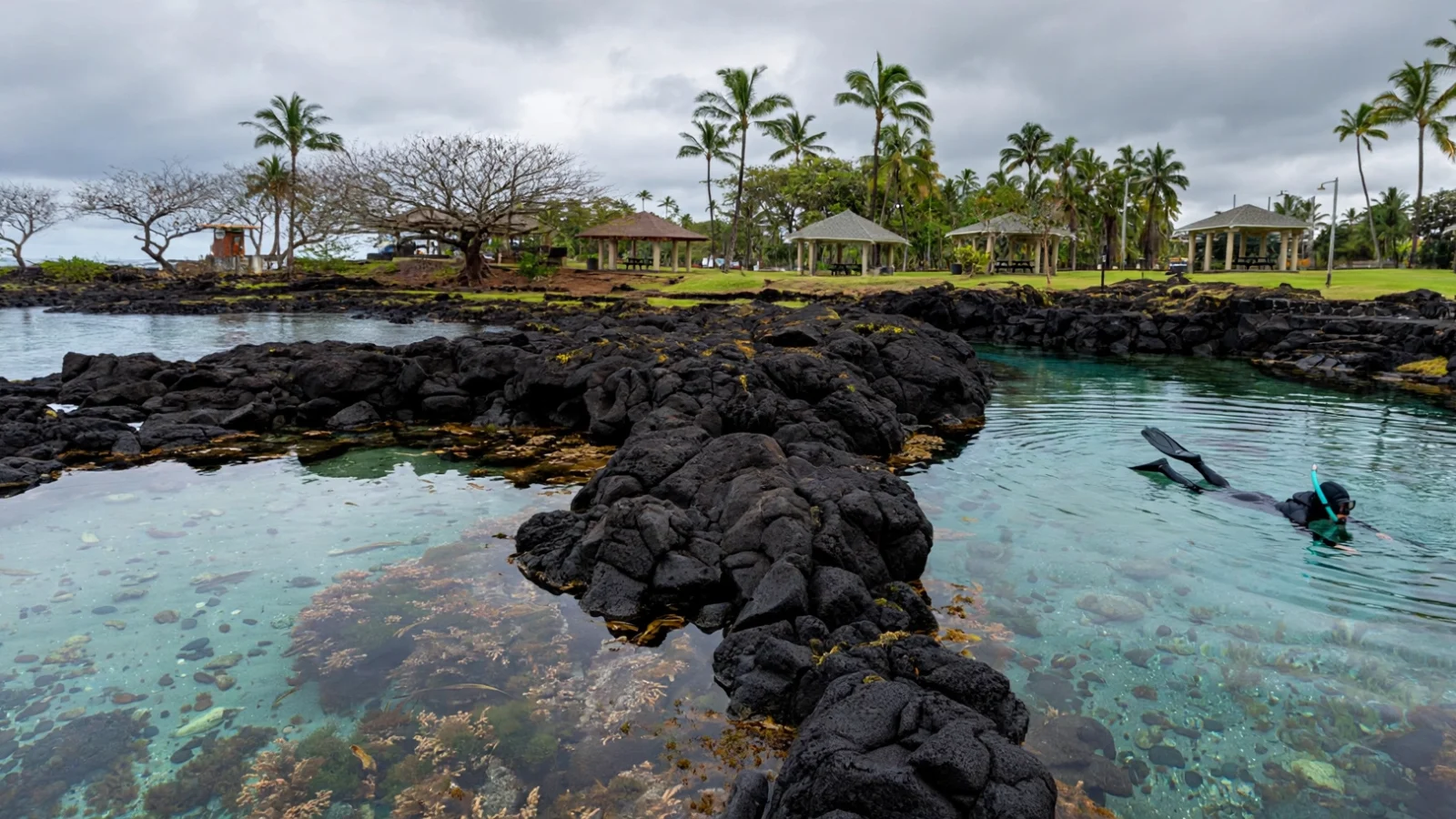
Leleiwi Beach Park is the Hilo beach park that snorkel lists keep folding into other people’s pages. It gets a paragraph inside Richardson guides, a section inside Hilo roundups, a line inside dive listings — and almost never a guide of its own. That is a shame, because Leleiwi, also called Wai’uli, is a genuinely different kind of snorkel spot from its famous neighbours: not a sand lagoon like Carlsmith, not a black-sand bay like Richardson, but a string of black-lava tide pools and protected inlets fed by freshwater springs, where green sea turtles rest and feed in water that stays calm while the open coast outside the lava wall is working hard. Our Hilo snorkeling guide has always carried Leleiwi as a summary stop on the Keaukaha chain. This page does the job the roundups do not: it separates Leleiwi’s three very different waters, tells you which tide makes each one work, untangles the park’s confusing names, and gives you the honest split verdict — a lovely shallow snorkel in the centre inlets on the right day, and outer water that belongs to experienced divers and surfers, not to anyone holding a brand-new mask.
The honest summary, up front: Leleiwi is a tide-pool park first and a snorkel park second. Inside the lava wall, in the protected inlets at the centre of the park, calm-day snorkeling over small reef fish with a very good chance of turtles is real and rewarding. The tide pools themselves are for looking, wading and photographing — shallow, fragile, and full of small life that does not need a snorkeler sitting in it. Beyond the wall, the water changes character completely: this coast is rated Hilo’s best shore-dive ground precisely because it is deep, structured and current-prone, and the surf break beyond the point is an experienced-only spot. Go to Leleiwi understanding those three zones and you will have one of the best half-days on the Hilo coast. Go expecting a sandy snorkel beach and you will be confused within five minutes — there is almost no sand here at all.
Quick facts
- Location: Kalanianaole Avenue in Keaukaha, roughly 4–5 miles east of downtown Hilo, Big Island — between Wai’olena Beach Park to the west and Richardson Ocean Park, a short walk east. The last of the Kalanianaole beach parks before the road ends
- The snorkeling, honestly: Protected lava inlets at the centre of the park — small reef fish and frequent turtles in calm conditions. Tide pools are look-and-wade water, not snorkel water. The outer reef is experienced shore-dive ground with tricky entry and currents — not a snorkel route
- Lifeguard: A lifeguard station serves the park, but published cover disagrees sharply — one Hilo guide lists daily duty, another notes the tower is not always staffed, and a guidebook lists weekends and holidays. Treat cover as variable: check the tower when you arrive and never plan around a guard for the outer water
- Fees and reservations: None. Free county beach park with free parking; no reservation system
- Parking: A free park lot with paved walkways, plus the Richardson lot a short walk east if this one fills
- Facilities: Restrooms, showers, covered pavilions, picnic tables and BBQ pits, grassy shade. No gear rentals at the park — bring your own kit or rent in Hilo
- Hours: Listed around 7 AM to 7 PM — the sign at the park is final
- Best beginner move: The centre inlets on a calm morning at mid-to-low tide, staying inside the lava wall — or Carlsmith Beach Park two minutes west for a true sand-lagoon first snorkel
First, the names: Leleiwi, Wai’uli and Wai’olena are not all the same park
Half the confusion about this spot is spelling, and the other half is geography, so here is the untangling once, clearly. Leleiwi Beach Park — sometimes written Lele’iwi — is also called Wai’uli Beach Park; those two names are the same place, the park this guide covers. Wai’olena Beach Park is a separate, smaller park a short distance west along Kalanianaole Avenue, between Carlsmith and Leleiwi. Some guidebooks and listings merge Wai’olena and Wai’uli into one entry, which is why you will find the pair described together as Hilo’s shore-dive coast.
The distinction matters because the water differs. Wai’olena has no real beach: lava shallows, strong currents, and a large pond on its east side that is a refreshing calm-day swim with slippery rock entry — swimming and snorkeling there are strongly cautioned by the guides that cover it. Leleiwi/Wai’uli, by contrast, has the protected centre inlets that make its snorkeling case. If a source tells you “Leleiwi” is both a calm family pool park and a hazardous no-beginners dive site, it is usually describing the two parks — and the two zones of this one — at the same time. This guide keeps them apart.
The shape of the park: three waters, one lava wall
Everything at Leleiwi is organised by a single feature: the broken wall of black lava that runs along the shoreline, holding the ocean back from a chain of pools and coves. Inside it, spring-fed shallows. Outside it, open Pacific. Walk the paved paths from the parking lot and you pass all three zones in a few minutes.
Zone 1 — the centre inlets (the snorkel zone). At the centre of the park the lava wall shelters a set of protected inlets where, in normal weather, the water inside is generally free of currents — the quality every family source praises. This is the snorkeling: shallow, clear-on-a-good-day water over lava and patch reef, with small tropical fish working the rocks and turtles coming in to rest and feed on algae and seagrass. Entry is over rock, not sand, so it is a careful, seated, reef-shoe entry rather than a walk-in — the walkthrough is below. If the inlets are calm and clear, this zone alone justifies the drive.
Zone 2 — the tide pools (look, wade, photograph — do not snorkel the pools). Scattered along the shore, the true tide pools are miniature ecosystems: tiny fish, crabs, shrimp and other small life trapped and thriving between tides, best explored at low tide when the pools are exposed and reachable. They are too shallow to snorkel, too fragile to climb through carelessly, and — a Hilo-wide rule — home to wana (sea urchins) and other creatures that punish bare feet and grabbing hands. Reef shoes on, hands off, nothing collected, nothing picked up: some shells in Hilo tide pools are alive, and a few residents, like cone snails, are genuinely venomous. Photograph, watch, and leave every pool exactly as you found it.
Zone 3 — outside the wall (divers and surfers, not snorkelers). Past the lava wall the bottom drops into the structured deep water — seamounts, lava caves and coral canyons in the dive descriptions — that earns this coast its “best shore dive in Hilo” reputation, along with the difficult entry and tricky currents that come with it. Divers who know this coast, usually with a local shop’s guidance, treat it as serious shore diving. The surf break beyond the point, known as Richardsons, is an experienced-only wave. For a snorkeler, Zone 3 is a view, not a route: the moment you are outside the wall you are in current-prone open ocean with a rock entry behind you. Our snorkeling safety guide is blunt about coasts like this — the snorkel stays inside the shelter, every time.
A short walk east, the park effectively continues into Richardson Ocean Park — several sources treat the two as one long string of pools and swimming spots, and our Richardson Beach Park guide covers that end in full. A Hilo sea-turtle snorkel tour also operates on this stretch of coast, which tells you something about how reliable the turtles here are.
The GO / NO-GO gates: read the park before you get wet
Leleiwi rewards a conditions check more than most Hilo parks, because the same lava wall that creates the calm inlets also hides what the ocean is doing until you are standing at the edge. Run these gates in order; any NO-GO ends the snorkel, not the visit — the pools, pavilions and turtle-watching from shore are a good day by themselves.
- Gate 1 — surf. If whitewater is washing over the lava wall into the inlets, or sets are breaking across the pool line, the answer is no. In winter especially, swell rolls straight over the pools and the “protected” inlets stop being protected. Calm surface inside the wall, with the ocean visibly breaking only well outside it, is the GO picture.
- Gate 2 — rain and brown water. Hilo is the wet side of Hawaii, and its snorkeling runs on a rain rule: heavy recent rain sends runoff into Keaukaha’s bays, the water turns brown and murky, and visibility and water quality both collapse. If the inlets look tea-coloured rather than clear, or locals are staying out, stay out — and note that the freshwater springs here add their own shimmer even on good days (see below), so judge by colour and clarity, not by a little surface blur.
- Gate 3 — tide. The tide pools are a low-tide activity: arrive as the tide falls and the pools are exposed, calm and full of visible life. For snorkeling the centre inlets, low-to-mid tide on a calm morning is the sweet spot — enough water to float over the rocks without touching, pools still sheltered, and the best light. A high, pushing tide over the wall means more surge inside; a very low tide can leave the shallowest inlets too thin to float. Check a Hilo tide chart the night before and time the visit, rather than discovering the tide at the parking lot.
- Gate 4 — the tower. Stop at the lifeguard station and look — and if a guard is on duty, ask. Published sources disagree about the rota (daily duty in one Hilo guide, “not always staffed” in another, weekends and holidays in a guidebook), so the only honest position is the one this guide takes: cover varies, the tower’s status on your day is what counts, and an unstaffed tower raises the bar for every other gate. If a guard advises against entering, that is the answer.
- Gate 5 — your entry and exit. Before getting wet, pick your exact entry over the rocks and your exact exit, and confirm you can reverse it when you are tired and the surface has texture. Leleiwi has no sand walk-in in the snorkel zone; if you cannot see a calm, shallow, seated entry inside the wall, the snorkel does not happen today.
Snorkeling the centre inlets: entry, route and what you will see
Entry. Walk the paved path to the centre of the park, where the inlets sit behind the most continuous stretch of lava wall. Choose a flat-topped rock shelf at the water’s edge inside the wall, sit, put fins on, and slide in during a lull — never step down blind between rocks, and never enter where small waves are pushing over the wall beside you. Reef shoes or sturdy sandals are for the walk and the rock work; fins are for the water; you will switch between them more than once on this shore, and that is normal for Keaukaha.
The route. Keep it simple and keep it inside: float the line of inlets along the wall, working slowly from pool mouth to pool mouth, staying where you can always see the wall between you and the open ocean. The life here is in the detail rather than the panorama — fish holding in the rock shadows, small schools over the patches of reef, life in the cracks — so slow down; a patient ten minutes in one inlet shows more than a fast lap of five. Turn around well before you are tired: the exit is a rock climb-out, and it costs more energy than a sand exit does.
The springs, and the shimmer. Leleiwi’s pools and inlets are fed partly by freshwater springs, the same groundwater system that cools Carlsmith’s lagoon. Where spring water meets seawater you get a halocline — a visible shimmer, like heat haze underwater, and noticeably cooler layers near the bottom. New snorkelers sometimes read it as “murky water” and leave; it is actually the park’s signature, and it does not mean the water is dirty. Judge clarity by whether you can see the bottom and the fish, not by the shimmer at the boundary layer.
What you will see. Green sea turtles — honu — are the headline and, by the agreement of every source on this park, a genuinely reliable one: turtles rest and feed in the protected inlets, and the shore-dive crowd reports them on most visits. The rules are federal and simple: stay at least 10 feet away, never touch, never chase, never block a turtle’s path to the surface — our snorkeling with turtles guide covers the etiquette in full. Around them, expect the small Hilo reef cast — butterflyfish, tangs, wrasses and other tropical fish over the lava and patch reef, with crabs and small life in the pools. The richer dive reports from outside the wall — moray eels, puffers, octopus, lobster on night dives — describe Zone 3’s deep structure; you may glimpse an eel in the inlet rocks, but do not plan your snorkel around the dive list, and do not go looking for it outside the wall.
Best time, tide and season
Time of day: morning, for the usual Hawaiian reasons — lightest wind, calmest surface, best light in the pools — with one Leleiwi addition: time the morning to the tide, not the clock. A calm 10 AM at the wrong tide loses to a breezier 8 AM at low-to-mid tide here, because the tide decides whether the pools are exposed and the inlets are floatable. Season: the drier, calmer months — roughly April to October — give Keaukaha its most consistent snorkeling, and our best time to snorkel in Hawaii guide sets out the island-wide pattern. Winter is the watch-and-decide season: swells wash over the pool line, the outer water is dangerous, and even the inlets need Gate 1 respect — though a flat winter morning inside the wall, with turtles in the pools, is one of Hilo’s quiet treats. Rain: year-round on this coast; a dry overnight matters more than the month on the calendar. If Hilo has had a downpour in the last day, give the bays a day to clear and do the waterfalls instead.
Beginners and kids: the split verdict
Leleiwi gets described both as “ideal for families” and “no beginners,” sometimes in the same guidebook paragraph — and both claims are half right, because they are describing different zones.
For families and careful beginners — the centre inlets and pools, yes, with conditions. The protected centre pools are generally free of currents, shallow, and fascinating at wading depth before any mask is involved: children who are happy in reef shoes, poking (visually) around low-tide pools under close supervision, will love this park. A confident beginner’s first shallow snorkel, floating inside the wall in calm water over the inlet rocks, is a reasonable plan on a Gate-passed morning — with a buddy, a short session, and the exit rehearsed.
For beginners — the outer water, never. The dive coast beyond the wall, the Richardsons break, and Wai’olena’s current-washed shallows next door are all experienced water with tricky rock entries; guidebooks that say “no beginners” are talking about this water, and they are right. Weak swimmers, first-day snorkelers who need sand underfoot, and anyone who wants a lifeguarded lagoon should start at Onekahakaha Beach Park — Hilo’s shallow seawall keiki lagoon — or Carlsmith’s sand lagoon, and treat Leleiwi as the second or third Hilo snorkel, not the first. Our beginners’ guide to snorkeling in Hawaii ranks the island’s true learn-here spots.
Safety at Leleiwi
- Stay inside the wall. The single rule that organises all the others. Currents outside the pools are the park’s real hazard, and they are invisible from the calm inlets.
- Rock is the terrain. Wet lava is slippery and sharp. Reef shoes for every walk between pools; never walk the wall itself in fins; sit to enter and exit.
- Wana and pool life. Sea urchins hold in the pool cracks and cone snails live in Hilo tide pools. Look with eyes only — a wana puncture or a cone sting turns a good day into a clinic visit.
- Brown water is a closed sign. After heavy rain, runoff coasts — this one included — carry bacteria as well as murk. Locals staying out is data; follow it.
- Lifeguard reality. As above: a station exists, published rota claims conflict, so check on arrival and snorkel as if unguarded if the tower is empty. Our Big Island snorkeling hub keeps the island-wide guard and conditions picture together.
- Turtles are protected. Ten feet minimum, no touching, no feeding, no swimming after them — it is federal law, not etiquette. Resting turtles on the rocks are a photograph from a distance, never a backdrop you climb toward.
Parking, access and facilities
Leleiwi is a Hawaii County beach park on Kalanianaole Avenue, reached by driving east from downtown Hilo through Keaukaha — about 4–5 miles, past Carlsmith and Onekahakaha — to the signed park near the end of the road, with Richardson Ocean Park a short walk further east. Parking is free in the park lot, with paved walkways through the grounds; on busy weekends, Richardson’s lot is the overflow and the walk between the two parks is part of the pleasure anyway. Listed park hours run around 7 AM to 7 PM — the sign on the day is final. Facilities are genuinely good for a Hilo park: restrooms, showers, covered picnic pavilions, tables and BBQ pits, grass and shade trees. There are no rentals and no food at the park — bring your full kit (our Hawaii snorkeling gear checklist is built for exactly these bring-everything parks), reef-safe sunscreen, drinking water and reef shoes, and rent in Hilo town if you are travelling without gear. Note the park has almost no sand beach: bring chairs for grass and pavilion time rather than planning a sand day, and pair Leleiwi with a Richardson or Carlsmith stop if your group needs its sand fix. As a shore snorkeling day, the Keaukaha chain — Onekahakaha, Carlsmith, Leleiwi, Richardson in one slow eastbound run — is hard to beat anywhere in Hawaii.
Leleiwi vs its neighbours: which Keaukaha park for you?
| Park | The water | Best for | Watch out for |
|---|---|---|---|
| Leleiwi (Wai’uli) | Spring-fed lava inlets + tide pools inside a lava wall | Patient snorkelers who like detail, turtles and tide pools; photographers | Rock entries, tide timing, outer water is dive/surf ground |
| Richardson Ocean Park | Black-sand bay with reef channels, next door east | A fuller reef snorkel from a sand entry; the Ocean Center | Channel currents on rough days; arrive early for parking |
| Carlsmith Beach Park | Protected white-sand lagoon | First snorkels, nervous swimmers, families wanting sand | Shallow lagoon — reef life is gentle, not dramatic |
| Onekahakaha Beach Park | Seawall-enclosed shallow keiki lagoon | Toddlers and true first floats; picnics | Least fish of the four — a confidence pool, not a reef |
FAQ
Is Leleiwi Beach Park good for snorkeling?
Yes — in one specific place and on the right day. The protected inlets at the centre of the park, inside the lava wall, offer calm, shallow snorkeling over small reef fish with frequent turtles. The tide pools are for looking rather than snorkeling, and the water outside the wall is experienced dive and surf ground. Judge the day by the gates in this guide: calm surface inside the wall, no brown water, low-to-mid tide.
Can you swim at Leleiwi Beach Park?
Yes, in the protected inlets and pools, which are generally free of currents in normal weather. There is no sandy swimming beach here — entry is over lava rock — and swimming outside the lava wall is not advised: currents and the surf break beyond the point are for experienced ocean users.
Are there lifeguards at Leleiwi Beach Park?
There is a lifeguard station at the park, but published sources disagree about the rota — one Hilo guide lists daily duty hours, another notes the tower is not always staffed, and a guidebook lists weekends and holidays. Check the tower when you arrive, ask the guard if one is on duty, and never treat the outer water as guarded.
When is the best time to snorkel at Leleiwi?
A calm morning timed to a low-to-mid tide, in the drier months (roughly April to October), after a dry night. Low tide exposes the tide pools at their best; the centre inlets snorkel best with enough water to float over the rocks and no whitewater washing over the wall. After heavy Hilo rain, wait a day for the brown water to clear.
Is Leleiwi good for beginners and kids?
Split answer: the centre pools and inlets suit careful beginners and supervised kids on calm days — shallow, current-free, and full of small life at wading depth. The outer reef, the surf break and the neighbouring Wai’olena shallows do not suit beginners at all. For a first-ever snorkel, Carlsmith’s sand lagoon or Onekahakaha’s keiki pool are better starting points.
Will I see turtles at Leleiwi?
Very likely. Green sea turtles rest and feed in the protected inlets so reliably that the park is rated one of Hawaii’s most consistent honu spots, and a turtle snorkel tour operates on this coast. Keep at least 10 feet away at all times — it is federal law — and let turtles surface and move freely.
How much does Leleiwi Beach Park cost, and where do I park?
Nothing: it is a free Hawaii County beach park with a free parking lot, paved walkways, restrooms, showers and pavilions, and no reservations. Listed hours are around 7 AM to 7 PM. If the lot fills, Richardson Ocean Park’s lot is a short walk east.
Leleiwi or Richardson — which should I choose?
They are neighbours and pair well in one visit. Choose Leleiwi for tide pools, spring-fed inlets, turtle reliability and a quieter, more local feel; choose Richardson for a black-sand entry, a fuller reef snorkel and the Ocean Center exhibits. Snorkel Leleiwi’s inlets at low-to-mid tide, then walk east and finish at Richardson.