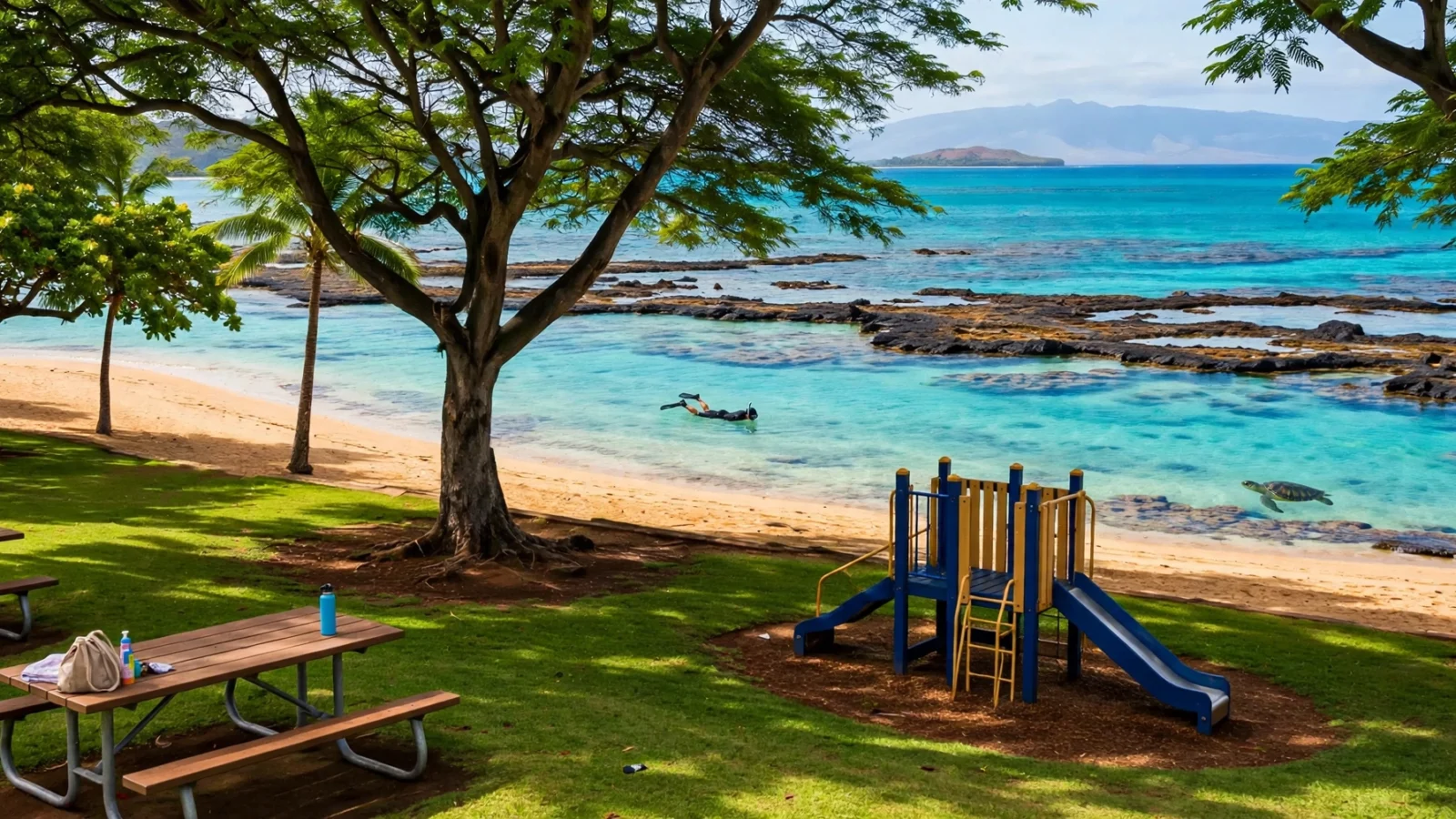
Honokowai Beach Park is the West Maui beach park that visitors drive past on the way to somewhere famous — and that is exactly why locals snorkel here. It sits on Lower Honoapiilani Road in Lahaina, wedged between condo buildings, with a playground, a big lawn and a car park of fewer than thirty spaces. There is no resort frontage, no tour desk and no snorkel boat. What there is, is a fringing reef sitting just off the sand that splits this beach into two completely different snorkels: a shallow, protected reef pool inside, where children float over coral and turtles cruise through to feed — and the open reef outside, which one experienced reviewer flatly describes as great snorkeling for strong swimmers and a place everyone else should skip. Almost every page online blurs those two swims into one vague “family-friendly snorkeling” label, and the aggregator pages that rank for this park get basic facts wrong in the process. This guide keeps the two swims separate, because picking the right one for your ability is the entire decision at Honokowai. Our Maui snorkeling hub has always listed this park in a single line. It deserves the full picture.
The honest summary, up front: Honokowai is a good snorkel used correctly and a mediocre one used carelessly. Inside the reef, on a calm morning, it is one of the easiest turtle-and-reef-fish floats on the West Maui coast — shallow, sheltered and steps from a grassy park with showers, restrooms and picnic tables. Outside the reef, it is an exposed ocean swim with reef openings, current and surf exposure that does not belong to beginners or to anyone’s first day. There is no lifeguard at either version. The water is at its best early, the reef is sharp and full of sea urchins in the cracks, and standing on it — for balance, for a photo, for any reason — is both painful and damaging. Float over it on sand entries and exits, and Honokowai rewards you. Treat it like a sandy swimming beach, and it will correct you quickly.
Quick facts
- Location: Honokowai Beach Park, Lower Honoapiilani Road, Lahaina, West Maui — between Kaanapali to the south and Napili to the north, fronting a low-rise condo strip
- The snorkeling, honestly: Two swims in one park. Inside the fringing reef: a shallow protected pool with reef fish, coral and frequent turtles — the family and first-timer zone. Outside the reef: livelier reef and more fish, but current, reef openings and surf exposure for confident, finned swimmers only
- Lifeguard: None. The inside pool is sheltered, not supervised — children stay within arm’s reach of an adult
- Fees and reservations: Free entry, free parking, no reservation. It is a Maui County beach park (listed hours 7 AM–8 PM)
- Parking: A small free lot in front of the park — roughly 27 spaces — which fills on weekends and by afternoon; Lower Honoapiilani Road street parking is the overflow. Arrive in the morning
- Facilities: Restrooms, outdoor showers, picnic tables, barbecue grills, a playground, shade trees and a large lawn. No rentals and no vendors on the beach — bring your own gear; there are shops, coffee and a farmers market across the road
- Best time: Early morning, ideally on a rising mid-tide — dead low tide makes the inside pool very shallow, and afternoon wind chops the surface. Summer is the calmest season on this coast; winter northwest swell is the outside reef’s off-switch
- The one rule that matters: Enter and exit over sand, and never stand on the reef. It is sharp, it is alive, and its cracks hold sea urchins
Where Honokowai is — and what the name means
Honokowai Beach Park is a 4.6-acre Maui County park on the Lower Honoapiilani Road, the slower shore road that runs through West Maui’s condo coast north of Kaanapali. If you are staying anywhere between Kaanapali and Napili, you are probably within a short drive or a long walk of it. Kahekili Beach Park — Airport Beach — lies a few minutes south, Napili Bay a few minutes north, and the park makes its living in the gap between those two better-known names: close to everything, claimed by nobody, and used mostly by the people who live and stay along this road.
The name is usually translated as “bay for drawing water” — freshwater springs once seeped along this shoreline, and the bay served as a traditional canoe landing. You can still feel that working-coast history in the park’s character: this is a place for birthday parties under the shade trees, volleyball on the lawn and evening dog walks at least as much as it is a visitor beach. That local rhythm is a feature for snorkelers. Mornings here are quiet, the water is rarely crowded, and the sunset crowd arrives hours after the best snorkeling is over.
Two confusions to clear before you navigate here. First, this is not Airport Beach — one popular review calls Honokowai the “old airport beach,” but that name belongs to Kahekili Beach Park down in Kaanapali, a different park with a different reef. Second, you may see Honokowai nicknamed a “baby beach” because its reef pool is so sheltered. Maui’s actual Baby Beach is a separate place with its own two-beach identity problem, which our Baby Beach guide untangles — do not navigate to one expecting the other.
The two snorkels: inside the reef and outside it
Everything at Honokowai hangs on one feature: a fringing reef running close and roughly parallel to the shore. It breaks the surf before the surf reaches the sand, and it divides the beach into an inside and an outside that barely resemble each other. Here is each swim on its own terms.
Inside the reef: the pool
Between the sand and the reef, the water forms a shallow, calm lagoon-like pool — reviewers describe natural rock walls and ledges creating a protected wading and swimming area, with barely any waves on ordinary days. This is the snorkel for families, nervous first-timers and anyone who wants reef life without an ocean swim. The bottom is a mix of sand patches, rock and coral at close range, and the fish live exactly where the structure is: reef triggerfish — including Hawaii’s state fish, the humuhumunukunukuapua’a — tangs, wrasses and juvenile reef fish working the coral heads and ledges in water shallow enough to feel manageable from the first minute.
The inside pool is also where the turtles work. Green sea turtles feed on algae growing over the reef flats here, and visitors report them in the shallows so routinely — cruising through at low tide, grazing offshore in the mornings — that a turtle encounter is a realistic hope rather than a lucky bonus, though it is never a guarantee. Give them the full distance the law and our turtle snorkeling guide call for: ten feet, always, and let them come to you if they choose to. A turtle that keeps swimming toward you while you back away is not being friendly; it is trying to get past you to the food.
Manage your expectations on one point: the inside pool is a shallow reef flat, not an aquarium wall. Visibility is best on calm mornings before feet and wind stir the shallows, and parts of the pool get genuinely thin at low tide. What it offers is ease — reef life in protected water, two minutes from your towel — and on the West Maui coast, ease with turtles is a rare product.
Outside the reef: the strong swimmer’s swim
Slip through one of the openings in the reef and the park changes personality. The bottom drops, the coral and fish life get livelier, and you are in open ocean water with everything that implies: surge working through the reef openings, current that can run along the coast, and full exposure when a northwest swell is up. The most experienced reviewers are the most enthusiastic about this swim — one strong swimmer calls the outer reef an endless bounty of sea creatures — and the same reviewers are blunt that moderate and novice swimmers, and families, should not follow them out there.
Our verdict matches that split exactly. The outside reef at Honokowai is a legitimate snorkel for confident, finned, buddy-paired swimmers on a flat morning, entered and exited through a sand channel you have identified from shore first. It is not a progression to attempt because the inside pool felt easy — the inside pool is easy precisely because the reef is holding the ocean back, and outside, nothing is. If your day’s plan depends on the outside reef, check the surf first; on a swell day, cancel that half of the plan and keep the inside swim, or move to a more sheltered bay from our best-time guide entirely.
Entry, exit and the tide: the discipline that makes this snorkel work
Honokowai’s one real hazard for the inside swimmer is not the ocean — it is the bottom. The shoreline and the pool floor mix sand with rock, broken coral and reef ledges, and the cracks in that reef hold wana, Hawaii’s spiny sea urchins. Reviewers who waded barefoot call reef shoes necessary; snorkelers who know the park do something better: they never put a foot down on reef at all.
The routine is simple. Walk in over the clearest sand patch you can find in front of the park, in reef shoes or sandals you are happy to get wet until the water is deep enough to float. Put your mask on, lie forward, and swim — over the sand first, then over the reef structure without touching it. Explore the ledges and coral heads from above; the fish are used to floating observers, not standing ones. When you come in, reverse it: swim until the sand patch, stand only on sand, and walk out. Standing on live reef kills the coral your fins are hovering over and risks an urchin spine or a coral cut, and a coral cut in tropical water is a souvenir that outlasts the trip. Our snorkeling safety guide covers why those cuts deserve respect far beyond their size.
Tide shapes the session more here than at most Maui spots. At dead low tide the inside pool thins out — beautiful for looking at the reef structure, frustrating for floating over it without your fins brushing the bottom, and genuinely too shallow in its upper reaches. At high tide the pool deepens but more ocean water pushes over the reef and the inside swim gets livelier and murkier. The sweet spot most days is a morning on a rising, mid-range tide: enough water to float the reef flat properly, early enough that the trade-wind chop has not built. That is guidance built from the pool’s shallowness and the reviews, not a posted rule — read the water when you arrive, and if the inside looks like a paddling pool with the reef showing its back, have coffee across the road and come back in an hour.
What you will see
- Green sea turtles (honu): the park’s signature animal — feeding over the inner reef flats, cruising the shallows, most often reported in the mornings. Frequent, never guaranteed, ten feet of distance always
- Reef fish: reef triggerfish including the humuhumunukunukuapua’a, tangs, wrasses and the general juvenile reef community around the inside coral heads and ledges; livelier fish life again on the outside reef for those qualified to be there
- Coral and reef structure: low fringing reef, ledges and rock walls forming the pool — modest next to a bay like Honolua, but alive and very close to shore
- Sea urchins: settled in the reef cracks — a look-don’t-touch resident, and the practical reason the no-standing rule exists
- Occasionally, a Hawaiian monk seal: seals haul out on this sand to rest. They are federally protected and easily stressed; give a resting seal a very wide berth, keep children and dogs back, and never position yourself between a seal and the water
- In winter: humpback whales work the channel offshore — the park’s lawn is a fine shore-watching seat between swims, with Molokai on the horizon
Conditions and the best time to go
Mornings are the snorkeling hours at Honokowai, for the same reason they are at nearly every West Maui shore spot: the water starts glassy and the trade winds build texture onto it as the day goes on. Summer is generally the calmest season on this coast, and the inside pool stays swimmable on many days when exposed beaches are not worth entering. The park’s listed hours are 7 AM to 8 PM, and a first-light-to-mid-morning session uses the best of both the light and the parking.
Winter flips the outside half of the park off. Northwest swells wrap down the West Maui coast, and when they do, the surf that the reef normally breaks arrives with real force: the openings in the reef become channels you do not swim through, the inside pool gets surge and stirred sand, and the honest call is a lawn-and-sunset visit rather than a snorkel. Local condition listings name strong currents and occasional high surf as this park’s dangers, and they are describing exactly those days. If you are choosing a winter snorkel from this coast, the more protected crescents — Kapalua Bay on a moderate day, or the south shore spots in our Maui hub — are the safer plan. Our best time to snorkel in Hawaii guide maps the seasonal pattern island by island.
Safety, honestly
- No lifeguard. There is no lifeguard at Honokowai Beach Park. The inside pool is protected by reef, not by supervision — a distinction that matters most for the families it attracts. Children belong within arm’s reach, and weak swimmers belong in flotation, in the pool, or on the sand
- The outside reef is a strong swimmer’s swim. Current, surge through the reef openings and surf exposure. Fins, a buddy, a flat day, an identified sand channel back in — or do not go. This is the park’s one genuinely consequential decision
- Never stand on the reef. Urchin spines and coral cuts below; living coral damaged underfoot. Float, or stay in the sand areas
- Turtles and seals are protected neighbours. Ten feet from turtles in the water and on sand. A resting monk seal gets far more — view from well back and let it sleep undisturbed
- Shorebreak and swell days. On high-surf days the inside pool loses its calm too. If the ocean looks angry from the lawn, the correct snorkel is none — the park is a good picnic with a view, and the reef will be there tomorrow
- Gear: there are no rentals at the park. Bring mask, snorkel and fins — our gear checklist covers the kit — plus reef-safe sunscreen, water and reef shoes for the entries
Parking, facilities and food
The park’s small free lot sits right in front of the grass — roughly 27 spaces — and it is the park’s only bottleneck. It fills on weekends, on holidays and by afternoon most other days; the overflow is street parking along Lower Honoapiilani Road, where you should park legally, mind the condo driveways, and expect a short walk. Morning snorkelers rarely fight for a space, which is one more reason the snorkel and the parking both argue for an early start. If you are staying along this road — and a large share of West Maui’s condos are — walking in is the smartest transport of all.
On the grass: restrooms, outdoor showers, picnic tables and barbecue grills, a children’s playground, mature shade trees and a lawn big enough for volleyball. It adds up to the best-equipped small beach park on this stretch of coast, and it is why Honokowai works as a half-day base rather than a swim-and-leave stop: snorkel the morning, shower, grill lunch, let the kids have the playground, watch the light change. Across Lower Honoapiilani Road, the little commercial strip reviewers all mention — a farmers market, coffee and food options — covers everything the park itself does not sell. There are no vendors, rentals or lifeguard stands on the beach itself, and nothing about the park is reservable for casual visitors: you simply arrive, early, with your own gear.
Honokowai vs Kahekili vs Napili vs Kapalua
Honokowai’s neighbours are all better known. Here is the honest trade, spot by spot.
| Honokowai Beach Park | Kahekili (Airport Beach) | Napili Bay | Kapalua Bay | |
|---|---|---|---|---|
| Best for | A quiet local-park snorkel with turtles close to shore | A long, proper reef swim along a big beach park | A pretty crescent with reef at the points | The easiest first snorkel in West Maui |
| Inside protection | Shallow reef pool — the calmest inside water of the four | Open coast reef, no pool | Partly sheltered bay | Sheltered crescent cove |
| Reef quality | Modest inside, livelier outside (strong swimmers) | Strong, extensive reef | Good at the points | Good, beginner-friendly |
| Lifeguard | None | None (check on the day) | None | None |
| Facilities | Restrooms, showers, picnic/BBQ, playground, lawn | Restrooms, showers, picnic pavilion, big lawn | Limited at the bay itself | Restrooms, showers nearby |
| Parking | Free, ~27 spaces, fills fast | Free, large lot | Tight, street + paid options | Paid lots, fills fast |
| The catch | Rocky/urchin bottom discipline; outside reef is advanced | Long swim to the best reef | Winter surf closes it often | Crowds and parking cost |
The short version: choose Kapalua for a first-ever snorkel, Kahekili for a long reef workout, Napili for the postcard bay — and Honokowai when you want the local version of the same coast: turtles in a calm pool, a grill for lunch, and nobody trying to sell you anything. First-timers building confidence will also like the progression in our beginners’ guide: start inside pools like this one, graduate to crescents like Kapalua, and leave outside-reef swims for later trips.
Nearby spots to pair with Honokowai
- Kahekili Beach Park — a few minutes south: the long Airport Beach reef, the natural step up when you want a bigger swim than Honokowai’s pool
- Napili Bay — a few minutes north: the classic crescent, snorkeling at both points on calm days
- Kapalua Bay — just beyond Napili: West Maui’s calmest cove and the beginner benchmark
- Black Rock — at the Kaanapali end of the coast: the famous point swim, with its own crowd and cliff-jump theatre
- Honolua Bay — further north and a class above all of these for reef quality when summer conditions allow
Frequently asked questions
Is Honokowai Beach Park good for snorkeling?
Yes — with a split verdict. Inside the fringing reef, the shallow protected pool holds reef fish, coral and frequent green sea turtles in water calm enough for families and first-timers on a good morning. Outside the reef, the snorkeling is livelier but exposed, and it belongs to strong, finned swimmers only. Judge the park by the swim that matches your ability.
Is Honokowai good for beginners and kids?
The inside pool is one of West Maui’s friendlier first snorkels — shallow, sheltered and close to shore — with two honest caveats: there is no lifeguard, so children stay within arm’s reach, and the bottom is rocky reef in places, so entries and exits happen over sand and nobody stands on the reef. Weak swimmers should use flotation or watch from the lawn.
Are there turtles at Honokowai Beach Park?
Green sea turtles feed over the inner reef flats and are reported in the shallows here very regularly, most often in the mornings. Sightings are frequent but never guaranteed. Keep ten feet of distance in the water and on the sand, and let them approach you rather than the other way around.
Is there a lifeguard at Honokowai Beach Park?
No. There is no lifeguard at this county park. The inner reef pool is sheltered water, not supervised water — plan supervision, flotation and conditions accordingly.
Where do you park for Honokowai Beach Park, and does it cost anything?
Parking is free in the park’s small lot — roughly 27 spaces — on Lower Honoapiilani Road in Lahaina. It fills on weekends and by afternoon; street parking along the road is the overflow. Entry to the park itself is also free, and the county lists its hours as 7 AM to 8 PM.
What facilities does Honokowai Beach Park have?
Restrooms, outdoor showers, picnic tables, barbecue grills, a children’s playground, shade trees and a large lawn. There are no rentals or vendors on the beach — bring your own snorkel gear. Shops, coffee and a farmers market sit across Lower Honoapiilani Road.
When is the best time to snorkel at Honokowai?
Early morning, ideally on a rising mid-range tide. Dead low tide makes the inner pool too shallow to float comfortably over the reef, and afternoon wind roughens the surface. Summer brings this coast its calmest water; winter northwest swell can shut down the outside reef and stir up the inside pool.
Can you snorkel outside the reef at Honokowai?
Confident, experienced snorkelers do, on flat days, in fins, with a buddy, entering and exiting through an identified opening in the reef. The outside water has current, surge and surf exposure, and it is not a suitable swim for beginners, children or anyone on their first days of snorkeling — the inside pool is the right swim for them.