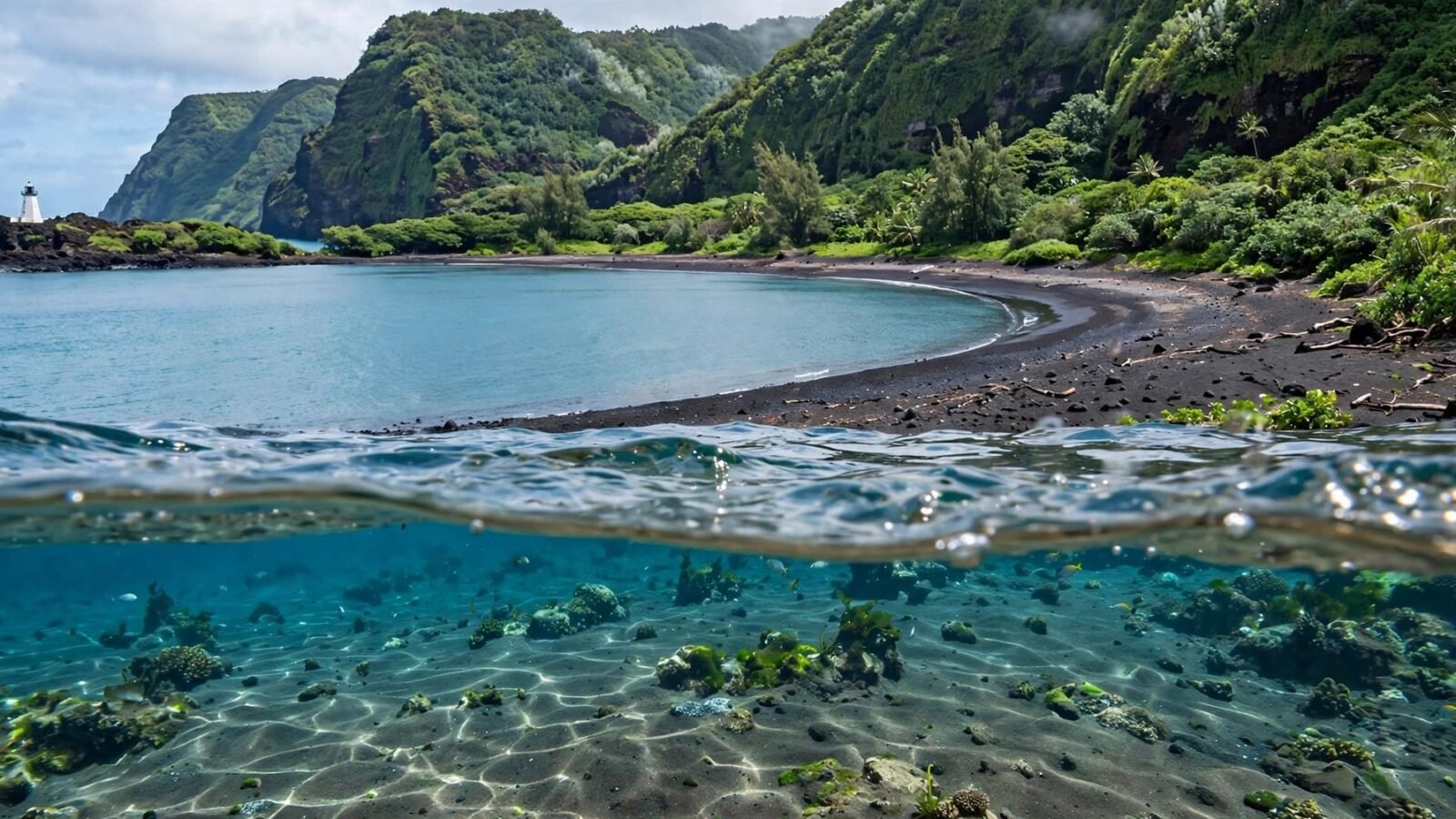
Hana is the most beautiful drive in Hawaii — and one of the weakest snorkeling destinations on Maui. If you searched “hana snorkeling” hoping the east side hides a reef to rival Molokini, here is the honest answer up front: most of the beaches along the Road to Hana are windward-facing, rough, and not snorkel spots at all. But a few specific places around Hana genuinely are worth your mask time — Hana Bay’s reef by the lighthouse, the red cinder cove at Kaihalulu on calm days, and the turtle-dotted bay at Waianapanapa. This guide tells you exactly which those are, which famous names to skip, and how to plan a Hana day so you actually get in the water. For the island-wide picture, start with our Maui snorkeling hub. For ideas once you’re out of the water, see our guide to Things to Do in Hana.
Quick facts
- Location: East Maui, at the end of the Road to Hana — more than 600 curves and 50+ one-lane bridges from Kahului, roughly a 2–3 hour drive each way.
- The snorkeling, honestly: Not a snorkel destination overall; the east side is windward and exposed. But Hana Bay, Red Sand Beach (on calm days), Hamoa Beach and Waianapanapa offer real snorkeling.
- Best spot for beginners: Hana Bay Beach Park — calm, shallow, family-friendly.
- Best for adventure: Red Sand Beach (Kaihalulu) — stunning red cinder cove with reef, but only for strong swimmers and only via a steep trail.
- Lifeguards: Effectively none. Hana Bay is the only east Maui beach with any county coverage, and even that is limited to part-time, seasonal staffing — assume no lifeguard everywhere else in this guide.
- Gear: Bring your own or rent in Hana town; see our Hawaii snorkel gear rental guide.
- Best time: Morning, before the trade winds pick up — east-side water is calmest early. See our best time to snorkel in Hawaii guide.
The honest verdict: is there snorkeling near Hana?
Yes — but only at a handful of specific spots, and the answer changes by the day. Hana sits on Maui’s windward east side, where trade-wind swells roll straight in. The same coastline that produces Hana’s waterfalls and black-sand drama also produces rough, murky water at most beaches. General “beaches of Hana” lists often name spots like Koki Beach that are fine for a swim or a photo but genuinely poor for snorkeling.
The spots below are the exceptions — the ones where calm water and something worth looking at overlap. Plan your day around one or two of them, check conditions on the morning, and have a backup from the alternatives list. If snorkeling is the main event of your Maui trip rather than one stop on the Road to Hana, the south and west shores (see the Maui hub) will serve you better.
| Spot | Drive from Hana town | Snorkel quality | Entry | Lifeguard | Best for |
|---|---|---|---|---|---|
| Hana Bay Beach Park | In town | Good — reef by the lighthouse/pier | Sandy, easy | Part-time/seasonal only | Beginners, families |
| Red Sand Beach (Kaihalulu) | ~10 min south | Good on calm days | Steep trail, no facilities | None | Strong swimmers, photos |
| Hamoa Beach | ~15 min south | Decent when calm | Sandy, surf can be strong | None | Confident swimmers |
| Waianapanapa (Honokalani Beach) | ~10 min north | Fair — turtles, scenic bay | Rocky, depth drops fast | None | Turtles, scenery |
1. Hana Bay Beach Park — the beginner pick
Hana Bay sits right in Hana town — a black-sand beach park that is the calmest, most protected swimming spot on the east side. The bay’s shape shelters it from the open ocean, which is why it doubles as the area’s best beginner snorkeling: gentle water, easy sandy entry, restrooms and picnic tables, and the pier area where the reef begins.
The snorkeling is by the lighthouse and the pier on the right side of the beach, where a coral reef sits a little deeper than the sandy swimming area — that extra depth is what holds the bigger fish. Work the reef line along the rocks rather than swimming straight out, and follow the longstanding local rule: don’t go past the lighthouse, where strong currents can run through the channel.
Two practical notes. First, Hana Bay is the only east Maui beach with any county lifeguard coverage — but that coverage is limited to part-time, seasonal staffing (per the County of Maui’s ocean safety postings), so don’t count on a tower being staffed on your day. Second, the water on the far western side of the bay is rough and choppy; stay on the protected pier side. New to the sport? Read our beginners guide before you go.
2. Red Sand Beach (Kaihalulu) — the adventure pick
Kaihalulu — Red Sand Beach — is the most photographed beach on the Road to Hana: a pocket cove of red volcanic cinders wrapped in steep cliffs, just south of Hana Bay on the ocean side of Kauiki Hill. An offshore lava rock wall works as a natural breakwater, and inside the cove the water can be clear and calm enough for genuinely good snorkeling, with colorful fish around the reef near the wall.
This is a conditional pick, not a default one. The cove has no lifeguard, currents beyond the protected water can be strong, and visibility depends entirely on the day’s ocean conditions. The access trail is a steep, narrow, often slippery path along the cliff — serious injuries have happened on it in wet weather, and it is not a trail to attempt in rain or with kids. Guidebooks also note that parts of the access cross land where ownership is disputed, so respect all posted signs and current local guidance.
Go only if: the ocean is flat, you are a strong swimmer, and you go early. If any of those fail, enjoy it as a viewpoint and snorkel at Hana Bay instead.
3. Hamoa Beach — gray sand, check the surf
About 15 minutes south of Hana town, Hamoa Beach is a half-moon of grayish sand — the color comes from wave action grinding lava and coral together. The left side of the curve is more protected and offers the calmest swimming; when the surf is down, the reef and fish on that side make for decent snorkeling.
Hamoa runs hot and cold, and it deserves respect: waves and currents are frequently strong here, and it is not a beach for kids or weak swimmers. When in doubt, don’t go out — ask a local for the surf report. For the full breakdown, see our dedicated Hamoa Beach snorkeling guide.
4. Waianapanapa (Honokalani Beach) — black sand and turtles
North of Hana, Waianapanapa State Park’s Honokalani Beach is Maui’s famous black-sand beach — jet-black lava pebbles, sea cliffs, bright blue water, and a small bay where sea turtles are regulars. Snorkeling here is more about the experience than the reef: there isn’t much coral structure, but the protected bay holds turtles and the scenery is unmatched.
The warnings matter here. There is no lifeguard, ocean conditions can be dangerous seasonally, and the ocean floor drops off quickly just past the surf line — a surprise if you expect a gradual sandy slope. Enter only when the water is calm, stay in the bay, and check current conditions before committing. Our full Waianapanapa snorkeling guide covers access, the freshwater caves, and the park’s reservation rules.
Spots to skip for snorkeling near Hana
- Koki Beach: A local favorite for swimming and bodyboarding just south of Hana, but strong currents and a rough shorebreak make it a poor snorkel spot. Photo stop, not a mask stop.
- Most waterfall pools: The famous Road to Hana swimming holes are freshwater pools — beautiful, but not snorkeling.
- Exposed roadside coves: The pullouts between mile markers look tempting, but windward surge and runoff make them murky and rough. If you can’t see the bottom from shore, don’t get in.
Snorkel gear and tours in Hana
You have two options for gear: rent in Hana town (a few local shops rent snorkel sets — convenient but limited stock, so go early in the day) or bring a set from Kahului before you start the drive. If you own a mask that fits you well, bring it — rental masks are the usual leak culprit. Our gear rental guide covers what to check on any rental set.
Guided options exist too: local operators run kayak-and-snorkel combos along the Hana coast, including trips to Kaihalulu (Red Sand Beach) — a good middle ground if the trail access or the open-water entry puts you off but you still want the red cove. As with all tours, check recent reviews and go with the morning departure for the calmest water.
Safety: the east-side rules
Hana’s ocean plays by windward rules, and most of the danger stories from the Road to Hana share a pattern: a famous, busy beach with no lifeguard where visitors misjudge the water. Read our Hawaii snorkeling safety guide before the drive, and apply these Hana-specific rules:
- Assume no lifeguard. Hana Bay’s part-time seasonal coverage is the exception that proves the rule; everywhere else in this guide has none.
- Morning only. Trade winds build through the day and the east side feels it first. Be in the water by mid-morning at the latest.
- Brown water = no swimming. After rain, stream runoff turns east-side bays murky — murky water means poor visibility and runoff-borne bacteria. Wait for it to clear.
- Never turn your back on the ocean at unprotected beaches. Shorebreak and surge at places like Hamoa and Koki punish inattention.
- Red Sand Beach is experts-only. Steep access, no lifeguard, no facilities — if you’re unsure, Hana Bay is ten minutes away.
Frequently asked questions
Is there any snorkeling near Hana?
Yes, at a few specific spots: Hana Bay Beach Park (best for beginners), Red Sand Beach / Kaihalulu (on calm days, strong swimmers only), Hamoa Beach (when surf is down), and Waianapanapa’s Honokalani Beach (turtles and scenery). Most other east Maui beaches are too rough for snorkeling.
Is there anywhere to snorkel on the Road to Hana itself?
The practical snorkeling on the drive is at the Hana end: Hana Bay, Red Sand Beach, Hamoa Beach and Waianapanapa. The waterfalls and pools along the road are freshwater swimming holes, not snorkel spots, and the exposed roadside coves are generally too rough and murky.
Where is the best snorkeling near Hana, Maui?
For beginners and families: Hana Bay Beach Park, by the lighthouse and pier. For the best experience on a calm day: the reef inside the lava-rock wall at Red Sand Beach (Kaihalulu). For turtles: Waianapanapa. Check conditions the morning of — east-side water changes fast.
Can you snorkel at Red Sand Beach?
On calm days, yes — the lava rock wall creates a semi-protected cove with reef and colorful fish. But there is no lifeguard, the access trail is steep and dangerous when wet, and strong currents run outside the cove. Strong swimmers only, morning only, and skip it after rain.
Is Hana Bay good for snorkeling for beginners?
It’s the best beginner option on the east side: calm, shallow, protected water with easy sandy entry and a real reef by the lighthouse and pier. Stay on the pier side, don’t swim past the lighthouse, and note that lifeguard coverage is only part-time and seasonal.
Do you need a reservation for Waianapanapa?
Waianapanapa State Park has used an advance day-use reservation system — check the current rules in our Waianapanapa guide before you drive out, since showing up without one can mean being turned away.
Are there lifeguards at Hana beaches?
Effectively, no. Hana Bay is the only east Maui beach with any county lifeguard coverage, and it is limited to part-time, seasonal staffing. Koki, Hamoa, Waianapanapa and Red Sand Beach have no lifeguards at all.
Where can you rent snorkel gear in Hana?
A few shops in Hana town rent snorkel sets — stock is limited, so go early. Alternatively, rent or buy in Kahului before starting the Road to Hana drive. See our snorkel gear rental guide for what to check on a rental set.