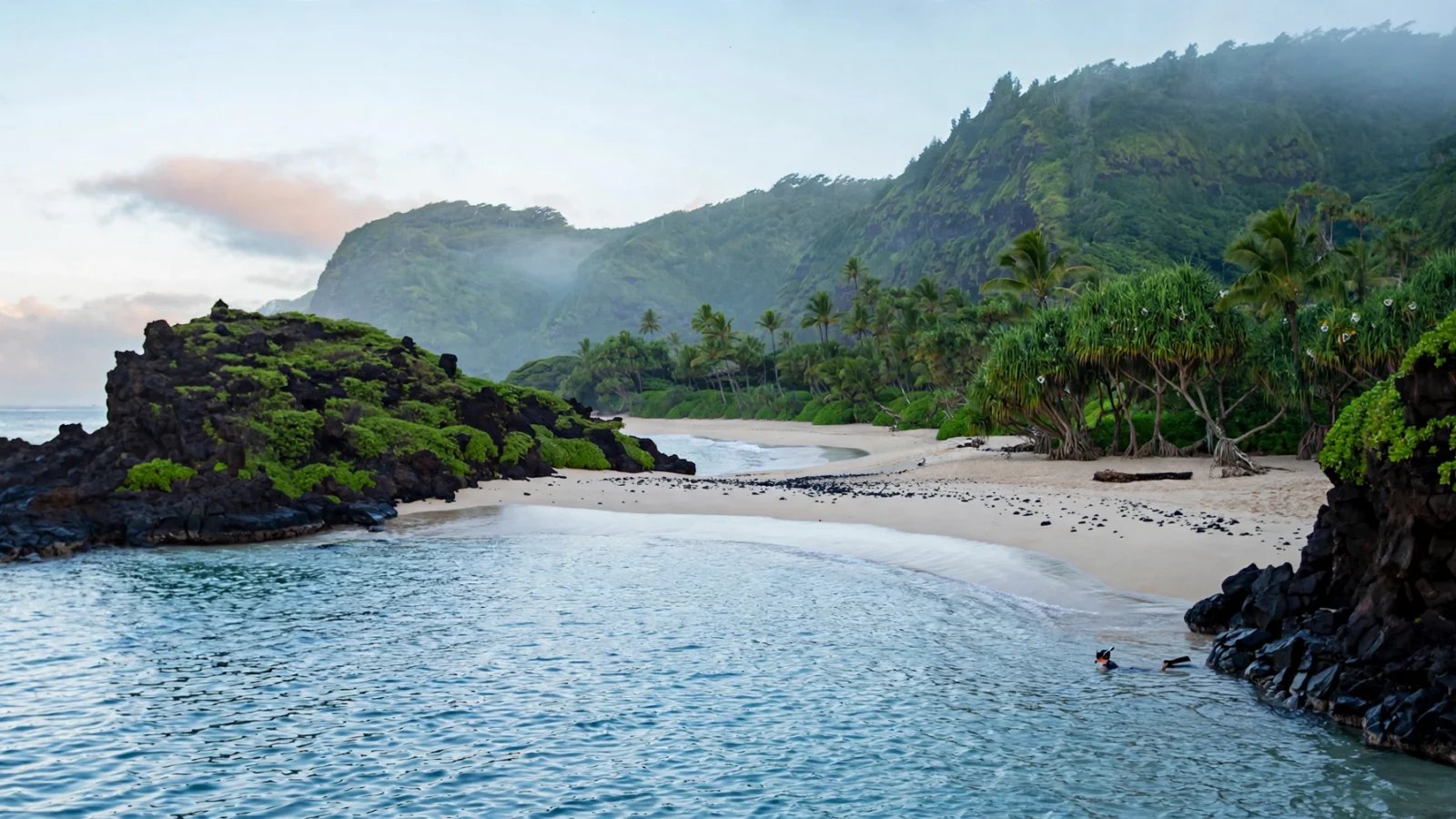
Hamoa Beach is the beach the Road to Hana saves for the end — a perfect crescent of soft sand tucked between sea cliffs just south of Hana town, lined with hala trees, and famous enough that writers have called it the most beautiful beach on Maui, maybe in all of Hawaii. People drive five hours of hairpin bends to stand on this sand, and a fair number of them arrive with a mask in the bag, because the water looks exactly like snorkeling water: clear, blue and inviting. So this guide starts with the answer the other Hamoa pages bury, soften or contradict each other over: yes, you can snorkel at Hamoa Beach — at the edges of the cove, on a small-wave morning, if you are a confident swimmer. And on most days, for most visitors, the honest recommendation is to keep the mask in the bag and enjoy one of the great beach days in Hawaii from the sand. There is no offshore reef standing guard over this cove, no lifeguard on it, and no shelter from the open Pacific. Our Maui snorkeling hub has never given Hamoa its own page. It earns one — with the edges-only rule and the missing lifeguard printed in large type.
The contradiction in the existing guides is real, and it is worth naming, because you will read all of it before your trip. One snorkeling guide dismisses Hamoa in a single line: strong surf and changing currents make it a poor spot for snorkeling. A vacation-rental blog says experienced snorkelers can enjoy good snorkeling here, with caution. A Road to Hana guide says there is decent snorkeling on the edges of the cove, but only if the waves are small enough. And visitors report everything from great snorkeling on clear days to putting a mask on and finding absolutely nothing in the water at all. Every one of those accounts is true — they are just describing different parts of the same cove on different days. The centre of Hamoa is sand, and sand holds almost no marine life, which is where the “nothing to see” reports come from. The edges of the cove, where the lava points hold the bay, are where the rock, the structure and the fish are. And the whole question is settled before either of those things matters, by the surf: on a day with waves, there is no snorkeling at Hamoa at all, at the edges or anywhere else. This guide gives you the checklist that tells you which Hamoa you have arrived at — before you get in.
Quick facts
- Location: Hamoa Beach, on Haneo’o Road just south of Hana town, East Maui — around Mile Marker 50 of the Hana Highway
- The snorkeling, honestly: Edges of the cove only, small-wave days only, confident swimmers only. The centre of the bay is sand with very little marine life. On surf days there is no snorkeling here at all
- Lifeguard: None. No lifeguard, no tower, no patrol — every judgement at this beach is yours
- Reef protection: None. No offshore reef breaks the surf before it reaches this beach, which is why conditions change so fast here
- Facilities: Restrooms and showers are reported at or near the beach, plus a foot-wash station at the path — a luxury by East Maui standards. No rentals, no food, no shade structures; the trees provide the shade
- Fees and reservations: No entrance fee and no reservation for Hamoa Beach itself (this is not Waianapanapa State Park, which is a separate stop with its own reservation system)
- Parking: Limited roadside parking above the beach along Haneo’o Road. Arrive early; read the street signs; a steep paved path and stairs lead down to the sand
- Best time: A calm morning in the drier, smaller-surf months — roughly late spring through early autumn. Winter brings the biggest swell to this coast and closes the snorkeling for long stretches
- The one rule that matters: If surf is breaking in the cove, there is no snorkeling and no casual swimming today — and there is no lifeguard to tell you so. That call is yours
Where Hamoa sits: the end of the road
Hamoa Beach lies just past Hana town on Maui’s east coast, reached near the end of the Hana Highway — the famous, narrow, waterfall-lined drive that is half the reason anyone is out here. The beach sits on Haneo’o Road, the small loop road south of town that also passes Koki Beach, Hamoa’s rougher neighbour. If you are doing the Road to Hana as a day trip, Hamoa is one of the last beach stops before the road continues on toward Kipahulu — which means most visitors arrive in the early afternoon, tired from the drive, at exactly the hour when the wind and surf are most likely to have picked up. That timing matters for snorkeling, and the best-time section below deals with it honestly.
The beach itself is a wide crescent — a few hundred yards of soft, pale sand curving between two lava points, backed by ironwood trees, palms and hala, with sea cliffs at both ends and almost no development in sight. It has the managed feel of a resort beach without a resort on it: the sand is kept clean, the shade is generous by the afternoon, and the whole place runs at a slower speed than any beach on Maui’s west side. James Michener is often quoted calling it the most beautiful beach in the Pacific — the quote’s exact wording varies by source, but the judgement has stuck because standing on this sand, it is hard to argue with. None of that beauty, however, changes what is under the water, and what is under the water is the subject of this guide.
One practical note belongs here. Hamoa is a beach the local community uses and loves, in a small town that absorbs a river of day-trip traffic every day. Keep speeds down on Haneo’o Road, park only where it is legal and off the pavement, keep noise down, and pack out everything you brought. Hana asks that of its visitors everywhere; its favourite beach deserves it most.
Getting there: parking, the path and the stairs
Almost everyone reaches Hamoa by car, at the end of the Hana Highway drive. As you pass through Hana town heading south, watch for the turn onto Haneo’o Road and follow it toward the coast; the beach is signposted along it, around Mile Marker 50 of the highway route. Parking is roadside, above the beach — a limited number of spaces along the road, free, and gone by late morning on a good day. Read every street sign before you leave the car: this is a residential road, enforcement exists, and “everyone else parked here” is not a defence. If the roadside is full, the honest options are to wait for a space or to fold Hamoa into the beach day rather than the schedule — do not invent a space on someone’s frontage.
From the road, a steep paved path and a set of stairs drop down to the sand. It is short — a couple of minutes — but steep enough that it filters out anyone with serious mobility limitations, and slippery enough after rain to deserve real shoes rather than flip-flops for the walk down. Everything you bring comes down those stairs on your back and goes back up them at the end of the day: water, shade, food, and the snorkel gear this guide may or may not talk you into using. There are restrooms and showers reported at or near the beach and a foot-wash station at the base of the path — genuinely useful after a Hana day — but there is no rental stand, no snack bar and no lifeguard station, and the nearest real town services are back in Hana. Bring the day with you.
A word on the drive itself, because it decides your snorkeling odds. The Road to Hana is a full-day commitment — hours each way at low speed, and the drive back in the dark is the part nobody recommends. A snorkeling stop at Hamoa therefore works best in one of two shapes: you are staying in or near Hana, so you can walk down to the cove at 8 or 9 in the morning when it is calmest, or Hamoa is your planned long stop on the day trip and you have already accepted that the snorkel is a bonus the conditions may grant, not the purpose of the stop. Planning the entire Hana drive around a guaranteed Hamoa snorkel is planning around the least guaranteed snorkel on Maui.
The snorkeling truth: no reef stands guard here
This is the section the other Hamoa pages skip — and it explains every contradictory report you have read.
Most of Maui’s famous snorkeling beaches work because of a reef. At Kapalua Bay, Honolua Bay or Ulua Beach, rock and coral stand between you and the open ocean, breaking the surf down to a ripple and holding the fish, turtles and structure you came to see. Hamoa has no such arrangement. The cove is open to the Pacific, the bottom in the middle is sand that runs straight out to depth, and whatever the ocean is doing that day arrives at this beach essentially undiminished. That is why Hamoa is a beloved bodysurfing beach — the waves break reliably and well here — and bodysurfing beaches and snorkeling beaches are, with very few exceptions, opposite kinds of places.
So where does the snorkeling live? At the edges. Where the two lava points close the crescent, rock replaces sand, and rock is where reef fish hold, where you may find the structure, urchins, and grazing turtles that the open middle never offers. On a small day — genuinely small, not “the waves look manageable” — a confident swimmer can work along one edge of the cove, staying close to the point, inside the bay, and see a modest, honest version of an East Maui reef edge. Visibility on those mornings can be excellent, because there is so little development and runoff on this coast in dry weather. What you will not find, even on the best morning, is a destination reef: the cast is the standard one for exposed Maui rock — tangs, butterflyfish, wrasses, the occasional turtle working the edge — seen in ones and twos, not the clouds of fish over coral gardens that the island’s protected bays hold. Set the expectation at “a beautiful swim along a lava point with fish in it” and a good Hamoa morning will beat it. Set it at “Molokini at the end of the Hana Highway” and no morning here can.
And the centre? Swim it, bodysurf it, enjoy it — on a calm day it is a gorgeous, soft-sand, waist-to-chest-deep playground, which is exactly what the happy swimming reports describe. But keep a mask off your face expecting a show: over open sand, on almost any day, there is very little to see, and the visitor who reported finding “absolutely nothing” snorkeling at Hamoa was almost certainly telling the exact truth about the middle of this bay.
The go / no-go checklist: which Hamoa did you arrive at?
Because there is no lifeguard and no posted snorkel report for this beach, the decision system has to be one you can run yourself, standing at the top of the stairs. Run it in order — the first “no” ends the snorkel, whatever the later answers are.
1. Is surf breaking in the cove? Stand and watch for a full five minutes — sets arrive in groups, with lulls between them that fool people. If whitewater is breaking across the bay, or waves are dumping on the shore, the snorkel is off, and so is casual swimming for anyone who is not a strong ocean swimmer here for the bodysurfing. This single check closes Hamoa more days than it opens it, especially in winter.
2. Is the water clear — or brown and stirred? Hana is the wet side of Maui. After heavy rain, runoff from the streams around Haneo’o Road dirties this bay, visibility collapses and the water carries the usual post-rain risks. Brown or murky water means no snorkel, full stop — there is nothing to see in it anyway. Local regulars say the same thing in fewer words: on rainy days, expect the water to be dirty.
3. Are the edges calm, not just the middle? Your snorkel lives along the lava points, where surge concentrates. If you can see water surging and sucking around the rocks at either end of the crescent, the edges are closed even if the centre looks swimmable. What you want is a morning when the points look almost boring.
4. Are you the right swimmer for an unguarded beach? Hamoa has no lifeguard, a bottom that deepens steadily, and currents that strengthen with the surf. This is not a beginner snorkel, not a place for a first-ever mask session, and not a place for children to snorkel — calm-day swimming in the shorebreak zone with an adult is a different matter from taking a child along an exposed lava point. If your group’s snorkeling is beginner-level, the right Hana-day decision is the beach day here and the snorkel at a protected bay on another day; our beginners’ guide to snorkeling in Hawaii explains what to look for instead.
5. Is it morning? Whatever the day offers, it offers the calmest version of it early. By afternoon the trade winds are usually up, the surface is chopped and a building swell shows itself. The day-tripper who reaches Hamoa at 2 p.m. is simply not looking at the same ocean as the Hana guest who walked down at 8:30. Our best time to snorkel in Hawaii guide covers the island-wide pattern; at Hamoa it is the whole game.
If all five answers are right, you have the rare thing: a Hamoa snorkel morning. Take it, take it modestly — one edge, close in, short — and count it as the bonus it is.
Where to enter, and how to work the edge
On a passing-checklist morning, enter from the sand, not the rocks. Walk in from the beach on the side of the cove you intend to snorkel, fin up in waist-deep water once you are clear of the shorebreak zone, and angle out toward the point slowly, letting the depth and the life build. Entering off the lava itself — slick, urchin-held, and exactly where the surge works — is how ankles and trips get ruined at beaches like this.
Work the edge in one direction, staying on the bay side of the point, in the lee of it, and never rounding the point into open ocean: outside the crescent there is nothing between you and the channel but current. Keep the point on your return hand the whole way, set a turnaround time before you start, and honour it — the swim back against even a light afternoon build is the part of exposed-coast snorkeling that catches tired swimmers. Exit the way you entered, through the sand, timing the shorebreak rather than wrestling it. And leave the centre of the bay to the bodysurfers on the way in and out: a snorkeler drifting through a bodysurf line is a hazard to everyone, including themselves.
Everything in our Hawaii snorkeling safety guide applies here at double strength — snorkel with a partner, never alone; wear the mask on your forehead on the beach, not around your neck; and if anyone in the group is unsure at the stairs, the stairs are where the decision gets made, not in the water. East Maui is remote: help, if it is ever needed, is a long way away by Maui standards, and mobile coverage on this coast is patchy. The checklist exists so that the question never becomes urgent.
What you might see — and what you won’t
Set the cast list honestly and a good morning delivers. Along the lava edges: yellow tangs and convict tangs grazing the rock, butterflyfish in pairs, wrasses and damselfish in the surge channels, sea urchins in the crevices — watch hands and feet around any rock here — and, on the better mornings, a green sea turtle working the edge for algae; turtles cruise this coast and the points are where they feed. Give any turtle its space and its distance, as everywhere in Hawaii: look, do not touch, do not chase, and let it choose to come closer if it wants to. Our guide to snorkeling with turtles in Hawaii covers the etiquette in full.
What you will not find at Hamoa, on any morning: coral gardens, a cleaning station, a turtle town, eagle rays on a schedule, or the density of life that a marine preserve holds. This coast is not a conservation district, the bottom is mostly sand and mobile rock, and the surf prunes whatever tries to grow in the middle of the bay. The snorkel here is a swim in beautiful water along dramatic rock, with fish in attendance — and judged as that, rather than as a failed version of somewhere else, it is a genuinely good one.
A final word on gear. There is no rental stand at Hamoa and none nearby worth planning around, so the mask, snorkel and fins come with you from wherever you rented or bought them earlier in the trip — and they stay in the car, un-rented-for-this-stop, on the many days the checklist says no. Pack from our Hawaii snorkel gear checklist, use reef-safe sunscreen as Hawaii law requires, and rinse the salt off everything at the showers before the long drive — gear left sandy in a hot boot for six hours of Hana Highway is gear you will be replacing.
Hamoa vs its neighbours: Koki Beach and Hana Bay
Two nearby names come up in every Hamoa conversation, and both deserve a clear line.
Koki Beach, minutes away on the same Haneo’o loop, is the red-cliff beach below the cinder cone — spectacular to look at, and a surf beach in the full sense: dangerous rocks, strong currents, warning signs posted, and a local consensus that it is not a swimming beach for visitors, let alone a snorkeling one. Photograph Koki, admire Koki, and keep your swim for Hamoa. Do not let a quiet-looking morning talk you into the water there.
Hana Bay, at the town wharf, is the calmer east-side alternative the snorkeling guides point to: a sheltered bay by East Maui standards, where the in-water time is far more often on than at Hamoa, and where kayak-based snorkel tours operate for the same reason. It is not a prettier beach — it is a working bay, not a crescent of paradise — but if you are staying in Hana for several days and want your snorkeling odds maximised rather than your beach perfected, split the difference: beach days at Hamoa, snorkel mornings at the bay, and the checklist deciding any given day between them.
| Hamoa Beach | Koki Beach | Hana Bay | |
|---|---|---|---|
| Best for | Beach day; edges-only snorkel on rare flat mornings | Scenery and watching surfers | The calmer East Maui snorkel |
| Snorkeling | Edges only, small days, confident swimmers | Not recommended — rocks, currents, posted warnings | More often workable; sheltered by Hana standards |
| Lifeguard | None | None | Ask locally — do not assume |
| The trap | The inviting clear centre, which holds almost nothing | A calm look over a dangerous bottom | Expecting a postcard beach — it is a working bay |
When Hamoa says no: the better Maui snorkels
A Hana trip is usually one or two days of a Maui holiday, and the island’s real snorkeling capitals are all on the other coasts — which is not a consolation prize, it is a planning instruction. If snorkeling is a priority of the trip, schedule it where it is reliable: Molokini Crater by boat for the island’s clearest water, the sheltered crescent of Kapalua Bay for beginners and families, Honolua Bay in summer for the preserve, and the south-coast run of Kihei, Makena Beach and the reserve at Ahihi-Kinau and Olowalu for shore snorkeling that works most mornings of the year. Our Maui snorkeling hub ranks them all. Let Hamoa be what it is — the great East Maui beach day, with a snorkel that shows up uninvited on the best mornings — and it will never disappoint you. Ask it to be a snorkel destination, and it will, most days, in the gentlest possible way, by closing.
Frequently asked questions
Can you snorkel at Hamoa Beach?
Yes — at the edges of the cove, on small-wave days, if you are a confident swimmer. The lava points at each end of the crescent hold the rock and the fish; the centre of the bay is open sand with very little marine life. On any day with surf breaking in the cove, there is no snorkeling at Hamoa at all.
Is Hamoa Beach good for snorkeling?
Honestly: it is a great beach with a conditional snorkel attached, not a snorkeling destination. Judged as an exposed-coast edges swim on a calm morning, it is genuinely enjoyable. Judged against Maui’s protected bays — Kapalua, Honolua, Molokini — it is not in their class, and no honest guide should pretend otherwise.
Is Hamoa Beach safe for swimming?
On calm days, the sandy centre is a popular swimming and bodysurfing beach — but there is no lifeguard, the bottom deepens steadily, currents strengthen with the surf, and conditions can change quickly because no reef shelters this cove. Weak swimmers and children belong in the shorebreak zone with an adult, on calm days only, and out of the water entirely when surf is up.
Is there a lifeguard at Hamoa Beach?
No. There is no lifeguard, tower or patrol at Hamoa Beach. Every condition judgement — including whether to snorkel, swim, or stay on the sand — is yours. The go/no-go checklist in this guide is written to be run at the top of the stairs, before you get in.
When is the best time to snorkel at Hamoa Beach?
Early on a calm morning in the smaller-surf season — roughly late spring through early autumn. Winter brings the biggest swell to Maui’s east coast and closes the snorkeling for long stretches, and any day after heavy rain will have dirty, low-visibility water. Afternoons are windier and rougher than mornings at almost any time of year.
Where do you park for Hamoa Beach, and is there a fee?
Parking is free, roadside, and limited, above the beach along Haneo’o Road — arrive early and obey the street signs, as this is a residential road. There is no entrance fee and no reservation for Hamoa Beach itself, and a steep paved path with stairs leads from the road down to the sand.
What facilities are at Hamoa Beach?
Restrooms and showers are reported at or near the beach, with a foot-wash station at the path — good facilities by East Maui standards. There are no rentals, no food service and no lifeguard station, so bring water, food, shade and your own snorkel gear, and carry everything down (and back up) the stairs.
Should beginners or kids snorkel at Hamoa Beach?
No. Hamoa is an unguarded, unsheltered, exposed-coast beach, and its snorkeling is along lava points in surge — a confident-swimmer activity. Beginners and children are far better served by Maui’s protected bays such as Kapalua, or by a calm-day swim in Hamoa’s sandy shorebreak zone with an adult instead of a snorkel along the edges.
Heading back toward Hana town, the black-sand state park makes the natural pairing — our Waianapanapa snorkeling guide covers its coves, sea caves and rough-water warnings.
For the wider Hana-area roundup — Hana Bay, Red Sand Beach, Hamoa, and Waianapanapa — see our Hana snorkeling guide.