The 15 best things to do in Hana, at a glance
Hana is the Maui most visitors never really see. It sits at the far eastern end of the island, at the end of one of the most famous drives on earth — and most people treat it as a turnaround point, a photo stop, and a long drive back. That is the mistake. Hana rewards the people who stay: a black-sand beach you need a reservation to visit, the only genuinely good snorkeling on Maui’s wild east side, a bamboo-forest hike to a 400-foot waterfall, and a small town where dinner ends around 6 p.m. and the rain falls 250 inches a year. Here are the 15 best things to do, ranked by how much they are worth your time.
| # | Activity | Best for | Cost | Time needed |
|---|---|---|---|---|
| 1 | Snorkel Hana Bay | Snorkelers, families, beginners | Free | 2-3 hours |
| 2 | Wai’anapanapa State Park black sand beach | Everyone | Reservation + parking fee | 2-3 hours |
| 3 | Hike Pipiwai Trail to Waimoku Falls | Hikers | National park entry fee | 2-3 hours |
| 4 | Pools of ‘Ohe’o (Seven Sacred Pools) | Photographers, sightseers | National park entry fee | 1 hour |
| 5 | Hamoa Beach | Beach lovers, photographers | Free | 1-2 hours |
| 6 | Red Sand Beach (Kaihalulu) | Adventurous travelers | Free | 1-2 hours |
| 7 | Wailua Falls | Everyone, photographers | Free | 15-30 minutes |
| 8 | Kahanu Garden & Pi’ilanihale Heiau | Culture, history lovers | Small admission fee | 1-2 hours |
| 9 | Hana Cultural Center & Museum | History, rainy days | Small admission fee | 1 hour |
| 10 | Hike to Fagan’s Cross | Hikers, sunrise/sunset | Free | 1-1.5 hours |
| 11 | Hana Lava Tube & Garden Maze | Families, rainy days | Paid entry | 1-1.5 hours |
| 12 | Koki Beach | Photographers | Free | 30 minutes |
| 13 | Drive the Road to Hana — best stops | Everyone | Free (stops vary) | Full day |
| 14 | Eat in Hana | Everyone | $5-$25 | Anytime |
| 15 | Stay overnight in Hana | Everyone | Paid | 1-2 nights |
The 15 best things to do in Hana, ranked
1. Snorkel Hana Bay — the only genuinely good snorkel in Hana
Here is the honest truth about snorkeling in Hana: most of the east side is not for it. The windward coast is rough, the surf is strong, and the beaches that look inviting from the road will punish you in the water. Hana Bay is the exception, and it is a good one. This black-sand beach park sits right in Hana town, sheltered enough that the water stays calm on most days, and it is one of the few places on this side of Maui where a beginner can snorkel with confidence.
Enter by the small lighthouse and the pier, on the town side of the bay. The reef sits a little deeper there and the fish are bigger — that is where the good snorkeling is. Stay inside the bay and do not swim past the lighthouse: the currents beyond it are strong, and that is where people get into trouble. The water is clearest in the morning, before the trade winds pick up, and after a few dry days — Hana’s rain washes sediment into the bay, so skip it the day after heavy rain. There is no gear rental in Hana town itself, so bring your own mask and fins or rent them in Kahului or Paia before you drive the road. Restrooms are at the beach park, and the county lifeguard coverage here is part-time and seasonal only, so treat this as an unsupervised swim. For the full snorkeling detail — entry, what you will see, and when to skip it — see our Hana snorkeling guide.
2. Wai’anapanapa State Park — the black sand beach (book ahead)
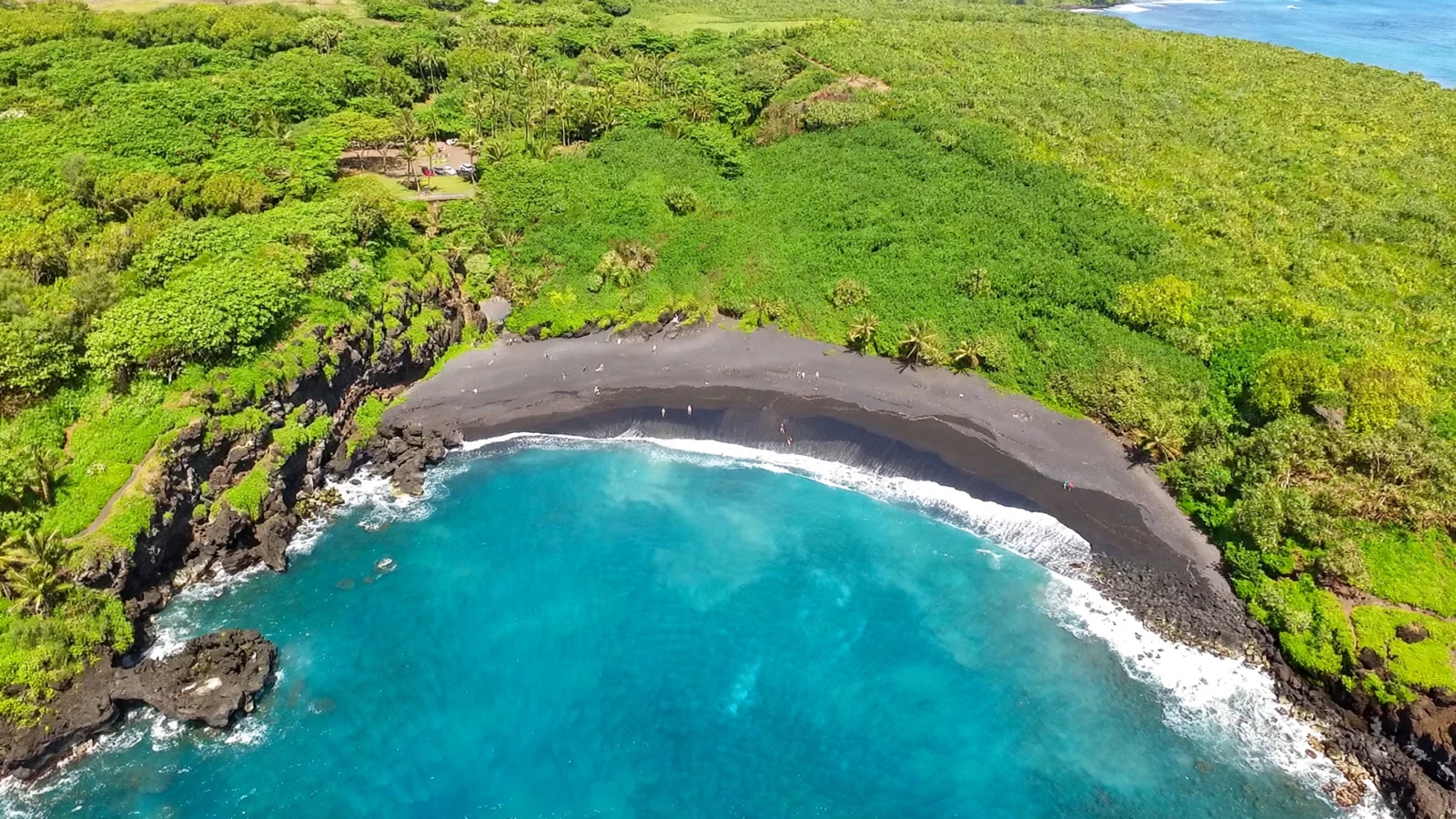
Wai’anapanapa is the single most visited spot in Hana, and it earns it. A crescent of black volcanic sand curves between green cliffs and turquoise water, with a blowhole, sea caves, and freshwater lava-tube pools tucked into the same 122-acre park. It is the image of Hana that most people carry home — and it is also the spot most people mess up, because they show up without a reservation and get turned away at the gate.
Non-residents need a reservation, and they sell out fast — book 30 days ahead when the window opens, and book the earliest slot you can, when the light is best and the crowds are thinnest. There is a parking fee on top of the reservation. Go in the morning: the beach faces east, the water is calmest early, and the parking lot fills by midday. Do not plan on snorkeling here. There is no lifeguard, the ocean is dangerous seasonally, and the depth drops fast past the surf line — turtles cruise the bay, but this is a look-and-wade beach, not a snorkel spot. Walk the coastal trail past the beach instead: it runs along the cliffs to sea arches and the blowhole, and it is the best short walk in Hana. For the snorkeling verdict on this beach specifically, see our Wai’anapanapa snorkeling guide.
3. Hike Pipiwai Trail to Waimoku Falls — the best hike in Hana
If you do one hike in Hana, make it this one. The Pipiwai Trail runs about 4 miles round trip through the Kipahulu district of Haleakala National Park, about 12 miles past Hana town — and it packs three different hikes into one: a walk past banyan trees and stream crossings, a towering bamboo forest where the stalks creak overhead, and a finish at Waimoku Falls, a 400-foot waterfall dropping down a sheer cliff face.
Allow two to three hours and wear shoes you can get wet — you cross streams, and the trail is muddy after rain, which in Hana means often. The elevation gain is around 800 feet, mostly in the last stretch to the falls, and the bamboo forest section is the flattest and most beautiful part of the walk. Start early: the trailhead parking fills up, and the afternoon rain that Hana is famous for makes the rocks slippery. The trailhead is inside the national park, so the standard vehicle entry fee applies, and your receipt also covers the Pools of ‘Ohe’o down the road — do both on the same ticket. Do not swim at the base of Waimoku Falls: rocks fall from the cliff face, and the park warns against it.
4. Pools of ‘Ohe’o (Seven Sacred Pools) — look, don’t swim
The Pools of ‘Ohe’o are the postcard of the Kipahulu district: a chain of tiered pools and small waterfalls stepping down toward the ocean, at Mile Marker 42 past Hana. They are beautiful, they are free to look at on your park ticket, and they are the most misunderstood stop in Hana — because most visitors arrive expecting to swim in them, and swimming is not reliably allowed here.
The pools have been closed to swimming in recent years, and the rules change with conditions: after heavy rain the whole area is a flash-flood zone, and the park closes access without warning. Do not plan your day around swimming here. Walk the short loop trail, photograph the pools from the viewpoints, and treat the water as scenery. If you want to swim in a waterfall pool on Maui, this is not the place to count on — and anyone who tells you otherwise is working from old information. Pair this stop with the Pipiwai Trail on the same park ticket; the two trailheads are minutes apart.
5. Hamoa Beach — the prettiest beach in Hana (not for swimming)
Hamoa Beach is the beach that makes the “best beaches in the world” lists — a half-moon of grayish sand about half a mile past mile marker 51, just past Hana town, backed by palms and ironwood trees. It is gorgeous, it is usually quiet, and it is not a swimming beach for most people. The waves and currents here are often strong, and the left side of the beach is the more protected end — if you get in, stay left, stay shallow, and stay out entirely when the surf is up.
That is the honest verdict, and it matters, because Hamoa looks calm from the sand. Park along the road and walk down the steps to the beach; there are no facilities, no lifeguard, and no shade except the trees. Bring water and sun protection, and do not bring small children expecting a swim — the surf that makes this beach beautiful is the same surf that makes it dangerous. For the full snorkeling and swimming verdict, see our Hamoa Beach snorkeling guide.
6. Red Sand Beach (Kaihalulu) — the adventure, and the name trap
Kaihalulu — Red Sand Beach — is the most dramatic cove in Hana: a small beach of red cinder sand wrapped in a crescent of red cliffs, with an offshore lava-rock wall that acts as a natural breakwater. On a calm day you can snorkel here, with fish holding close to the rock wall. On any other day, you watch it from the sand and stay out of the water, because the currents beyond the cove are strong and unpredictable.
Getting there is the hard part, and you should know it before you go. The trail is steep, narrow, and muddy, and serious injuries have been reported on it — wear proper shoes, not flip-flops, and do not attempt it after rain. The access crosses disputed private land, so respect the posted signs and stay on the path. There is no lifeguard and no facilities. And one important clarification: there is a second red-sand beach next to Koki Beach, and some guides confuse the two. That one is shallow, exposed, and not a place to hang out — it is not Kaihalulu. If a guide’s “Red Sand Beach” sounds small and disappointing, it is probably describing the wrong beach.
7. Wailua Falls — the 80-foot waterfall you see from the road
Wailua Falls is the easiest waterfall in Hana, and that is exactly its charm. The 80-foot falls drop right beside the road, a few minutes past Hana town on the way to Kipahulu, and you can see them properly without leaving your car — there is a small pullout, and the view from the roadside is the view. It is the best waterfall stop on the Road to Hana for anyone short on time, for photographers, and for anyone traveling with kids or limited mobility.
Go in the morning, when the light hits the falls and the pullout is empty — by midday the tour vans stack up and the roadside gets crowded. There is a short trail down to the base, but it is steep and slippery, and the pool at the bottom is not a swimming spot after rain. Take the photo from the road, enjoy the fact that it cost you nothing and ten minutes, and drive on. The falls run strongest after rain, which in Hana is most of the time.
8. Kahanu Garden & Pi’ilanihale Heiau — the history stop
Kahanu Garden is the quiet, serious stop in Hana — a botanical garden on the coast that holds Pi’ilanihale Heiau, a massive ancient Hawaiian temple built of basalt stone, one of the largest heiau in Hawaii. It is the opposite of the beach stops: slow, shaded, and genuinely old, and it gives Hana a depth that the waterfalls and beaches cannot.
Book online ahead of time — reservations are recommended and the garden keeps limited hours. Allow one to two hours to walk the grounds properly: the garden holds one of the world’s largest collections of breadfruit varieties alongside native Hawaiian plants, and the heiau itself is best appreciated with the garden’s own interpretation rather than a quick photo from the fence. There is a small admission fee. This is the stop for the second day in Hana, when you have already done the beaches and the trail and you want to understand the place rather than just photograph it.
9. Hana Cultural Center & Museum — the rainy-day stop
Hana’s weather will give you a rainy afternoon sooner or later — it rains here more than almost anywhere else in Hawaii — and the Hana Cultural Center is where to spend it. The small museum in Hana town holds photographs, artifacts, and the recorded history of the town and the surrounding district, from the plantation era to the present. It is modest, it is run by people who live here, and it is the best hour you will spend understanding what Hana actually is beyond the road.
Check the hours before you go — the center keeps “island time” hours and closes early, like everything else in town. There is a small admission fee. Pair it with a walk around Hana town itself: the bay, the old church, the ranch store. Hana town is tiny, and an hour on foot covers it — which is the point. This is not a resort town. It is a real one.
10. Hike to Fagan’s Cross — the sunset walk
Fagan’s Cross is the short hike with the big payoff: about 1.5 miles round trip up Pu’u o Kahaula, the hill above Hana town, to a memorial cross with a view over the whole bay, the town, and the coastline in both directions. You can see the cross from the Hana Ranch parking lot, which is where the trail starts — park there, walk up, and be back in about an hour.
Go at sunrise or sunset, when the light turns the bay gold and the trade winds drop. The trail is a ranch road and a footpath, uneven in places and muddy after rain, so wear closed shoes. There is no shade and no water on the trail, so bring both. This is the best view in Hana for the least effort, and it is the one stop that costs nothing and still feels like the highlight of the day.
11. Hana Lava Tube & Garden Maze — the underground hour
The Hana Lava Tube is the rainy-day activity that actually works in the rain: a walk through a real lava tube, about a quarter of a mile underground, where the cave formed as molten rock drained away and left a hollow tunnel behind. The walk takes 30 to 60 minutes, and the cave is cool, dark, and genuinely impressive — flashlights are provided, and the formations inside are the kind of thing you do not see anywhere else on Maui.
Entry is paid, and the Garden Maze is included with admission — a hedge maze in the gardens outside that is good fun with kids and a decent way to spend the hour after the cave. This is the best family activity in Hana when the weather turns, and it is one of the few paid attractions where the price buys something you cannot get for free elsewhere. Book ahead in busy season; walk-ins work on quiet days.
12. Koki Beach — the photo beach (not the swim beach)
Koki Beach sits just past Hana town, a wide red-sand beach that photographs beautifully and swims badly. The currents here are strong, the shore break is heavy, and this is a beach for looking, not for getting in the water. That is not a failure — it is the point. Come here for the photos: the red sand against the green cliffs, the offshore islet, the surf breaking on the rocks.
Do not confuse Koki’s red sand with Kaihalulu (number 6 above) — they are different beaches, and the red-sand beach right next to Koki is shallow and exposed, not a place to hang out. Koki itself has no facilities and no lifeguard. Spend half an hour, take the photos, and move on to a beach where the water is on your side.
13. Drive the Road to Hana — the best stops, honestly ranked
The Road to Hana is the reason most people come to this side of Maui, and it deserves its own honest treatment. The Hana Highway runs about 52 miles from Kahului to Hana town — the full loop, continuing past Hana and around the south side of the island, runs about 64 miles — with roughly 600 turns and more than 50 one-lane bridges. Driving it without stopping takes two and a half to three hours. With stops, it takes the whole day. Anyone who tells you it is a half-day trip has not done it.
The stops worth your time, in order from Kahului: Twin Falls (the first waterfall stop, crowded by 9 a.m. — go early or skip it); the Ke’anae Peninsula (a black-lava coastline with a tiny church and some of the best banana bread on the island at Aunty Sandy’s); Honomanu Bay (a black-sand bay you look at from the road, not a swim stop); and the Garden of Eden (a paid botanical garden with ocean views, worth it if you like gardens, skippable if you do not). The rule for the whole drive is simple: pull over for locals, never stop on a bridge, and never block the road for a photo. The people who live along this highway drive it every day, and they are not on vacation. For the full road-trip plan, including where to stop and where to skip, see our Things to Do in Maui guide and our best things to do in Maui list.
14. Eat in Hana — where to eat (and when)
Eating in Hana is simple, and the first thing to know is the clock: most restaurants in town close by around 6 p.m., and the food trucks wind down not long after. Plan dinner early, or plan to cook for yourself. The places worth finding are Thai Food by Pranee, the roadside Thai stand that has been feeding Hana for years — get there before it sells out — and the Hana Ranch Restaurant in town. The food trucks along the road are the real lunch scene: fish plates, plate lunches, and smoothies, cash-friendly and fast. For shave ice, find Estrella’s in town.
Stock up before you leave Paia or Kahului if you are self-catering: Hana has a small general store, but the selection is limited and the prices reflect the fact that everything arrives by that one winding road. Bring snacks and water for the drive itself — there are long stretches of the road with nothing to buy, and the stops that do sell food are the ones with the lines.
15. Stay overnight in Hana — the best decision you will make
Here is the advice that matters most in this whole guide: do not do Hana as a day trip. Stay overnight — two nights if you can. The drive in takes a full day, the drive out takes another, and a day trip leaves you with about three hours in Hana itself, most of them in a parking lot. Staying overnight means you get Hana Bay at sunrise, the black sand beach before the tour vans, the Pipiwai Trail before the crowds, and dinner at a table instead of in the car.
Your options are the Hana-Maui Resort, the town’s full-service resort on the bay; Hana Kai Maui, the condo-style stay a short walk from the beach; and Fisher’s Hana Hale, the small family-run cottages. Camping is available at Wai’anapanapa State Park and in the Kipahulu district of the national park — book well ahead, as both fill up. Wherever you stay, book early: Hana has very few rooms, and the people who plan ahead are the ones who get them. If you only remember one thing from this guide, remember this: Hana is a place to stay, not a place to pass through.
Where is Hana, and how do you get there?
Hana is a small town on the remote east coast of Maui, at the end of the Hana Highway. It is on the island of Maui, in Hawaii — about 52 miles by road from Kahului, the island’s main town and airport, though the drive feels much longer than the distance suggests. There are two ways in: drive the Road to Hana, which is the experience, or fly into Hana Airport on a small commuter flight, which is the shortcut. Most visitors drive, and most visitors should — the road is the point. Rental cars are the way to do it; tour vans run the road too, but a van means someone else’s schedule, and Hana rewards a slow one. Download your maps before you leave Kahului or Paia: there is little to no cell service in Hana, and your phone’s navigation will not help you once you are past the last tower.
How long does the Road to Hana take?
Driving the Road to Hana from Kahului to Hana town takes two and a half to three hours without stopping — and nobody drives it without stopping. With the stops in this guide, it takes the full day: leave by 7 or 8 a.m., stop at the waterfalls and the viewpoints on the way in, reach Hana by mid-afternoon, and you have done it properly. The drive back is the same road in reverse, and it takes just as long. That is why the overnight stay matters: a day trip to Hana is really a day of driving with a short visit in the middle. If you are staying overnight, the drive back the next day is a second day of stops, not a chore — take the southern loop back if your rental agreement allows it, and see the dry side of the island on the way home.
Best time to visit Hana
Hana is warm all year, and the best time to visit is May through October, when the weather is drier and the rain comes in short bursts rather than all-day downpours. November through April is wetter — and wetter in Hana means genuinely wet, with more than 250 inches of rain a year falling on this coast. That said, Hana’s rain is part of Hana: the waterfalls run full, the jungle is at its greenest, and a rainy morning usually clears by the afternoon. The worst time to visit is not a month — it is a mindset. If you need blue skies all day, go to Wailea. If you can handle a shower and a muddy trail, Hana is good in any month. For snorkeling specifically, the best time to snorkel in Hawaii is the summer months, when the water is calmest — and on the east side, that matters even more. Maui is also the best Hawaiian island for snorkeling overall, so a Hana stay pairs well with a calmer-water snorkel day on the west side before or after. If you are planning a winter trip, read our snorkeling in Hawaii in December guide before you count on the water.
Is Hana worth visiting — and worth staying overnight?
Yes, and yes. Hana is worth visiting because it is the one part of Maui that still feels like old Hawaii: a small town at the end of a long road, with no resorts lining the beach and no traffic lights, where the rain, the jungle, and the ocean set the schedule. It is worth staying overnight because a day trip gives you the drive and almost none of the place. The people who love Hana are almost always the people who stayed — the ones who swam in Hana Bay at 7 a.m. with nobody else in the water, who walked the Pipiwai Trail before the vans arrived, who ate dinner at 5:30 p.m. because that is when dinner is. If you only have one day on Maui, spend it elsewhere. If you have two or three, spend one of them in Hana — and spend the night.
Practical tips for Hana
A few things that will save your trip. First, cell service: there is little to none in Hana, so download offline maps, screenshot your reservations, and tell someone where you are going. Second, gas: fill up in Paia or Kahului before the drive — there is no reliable fuel stop on the road. Third, cash: some food trucks and small stands are cash-only, so carry some. Fourth, the rain: pack a rain jacket and water shoes, and expect to get wet — the trails are muddy, the streams are real, and the weather changes every twenty minutes. Fifth, respect: much of the land along the road is private, some pools and beaches are kapu (off-limits), and the people who live here are not part of the attraction. Pull over for locals, do not trespass for a photo, and do not swim where the signs say not to. Hana rewards visitors who behave like guests — because that is what you are.
Frequently asked questions
Is Hana worth visiting?
Yes — Hana is one of the most rewarding places on Maui, but only if you give it time. A day trip gives you the drive and very little of the town. Stay at least one night, two if you can, and you get the beaches, the trails, and the town itself instead of a windshield tour.
How long is the Road to Hana?
The Hana Highway is about 52 miles from Kahului to Hana town, with roughly 600 turns and more than 50 one-lane bridges. The drive takes two and a half to three hours without stopping, and a full day with stops. The full loop, continuing past Hana around the south side of the island, runs about 64 miles.
Do you need a reservation for Wai’anapanapa State Park?
Yes, non-residents need a reservation to enter Wai’anapanapa State Park, and they sell out fast — book 30 days ahead when the window opens. There is also a parking fee. Book the earliest slot you can, when the beach is quietest and the light is best.
Can you swim at the Seven Sacred Pools (Pools of ‘Ohe’o)?
Do not plan on it. The Pools of ‘Ohe’o have been closed to swimming in recent years, and access changes with conditions — after heavy rain the area is a flash-flood zone and the park closes it without warning. Enjoy the pools from the trail and check the current notice from Haleakala National Park before you go.
Can you snorkel in Hana?
Yes, but only in one place: Hana Bay, in town, is the only genuinely good snorkel spot in Hana — calm water, a reef by the lighthouse, and good visibility on dry mornings. Wai’anapanapa is not a snorkel spot (no lifeguard, dangerous seasonally), Hamoa Beach is too rough for most swimmers, and Kaihalulu (Red Sand Beach) is only snorkelable on calm days. Bring your own gear — there is no rental shop in Hana town.
Is there cell service in Hana?
Very little. Hana has limited to no cell coverage, so download offline maps before you leave Kahului or Paia, screenshot your reservations and accommodation details, and do not count on your phone for navigation or calls once you are on the road.