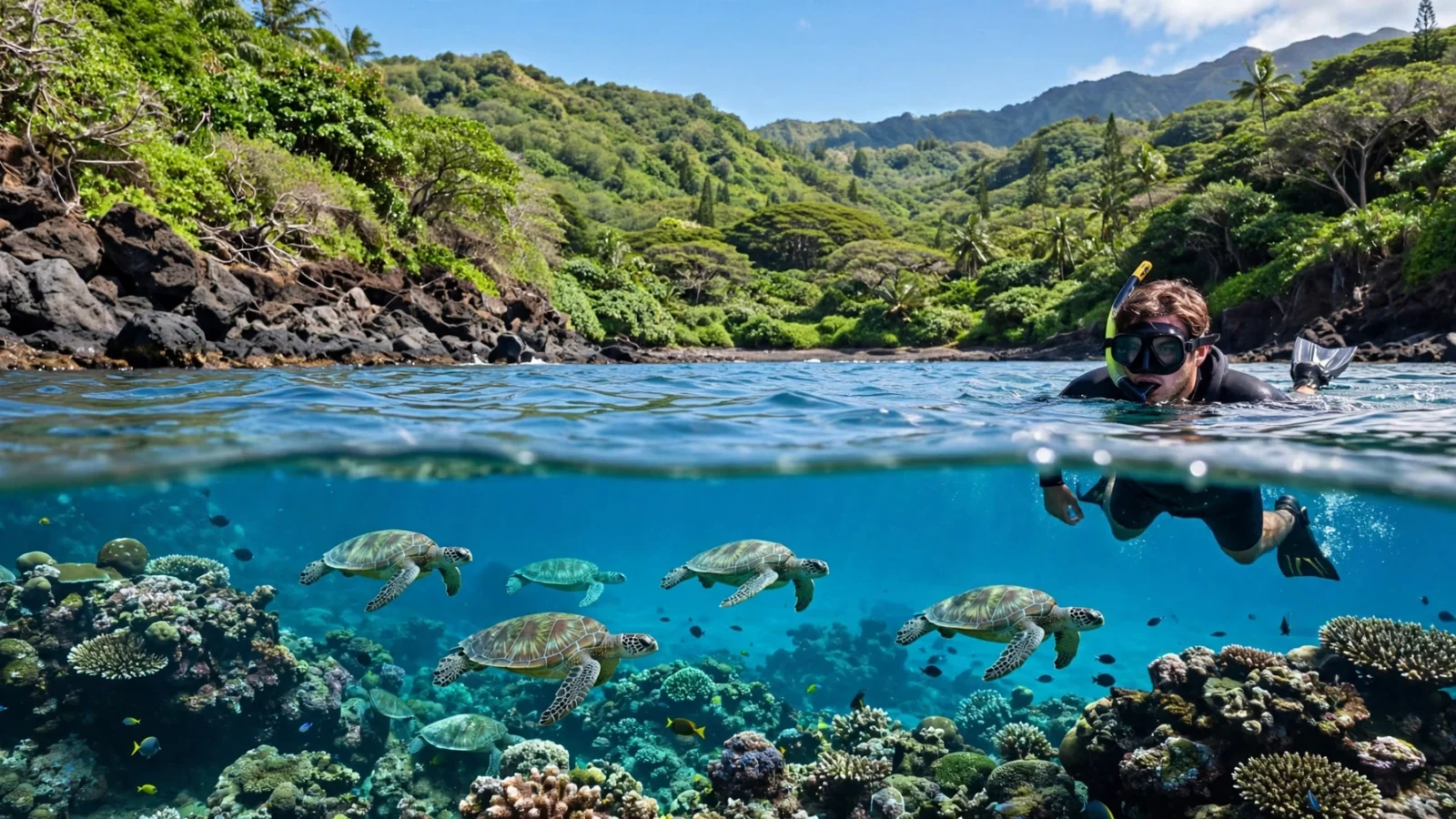
Honokeana Cove is the snorkel people talk about in Napili in the tones usually reserved for a secret — and then can’t find. It is a small, rocky cove tucked along the condo shoreline just south of Napili Bay, with no sand, no sign on the highway, no parking lot and no facilities. What it has instead is one of the most reliable turtle encounters on Maui: a resident population of green sea turtles that spends its days grazing algae off the rocks and hovering over a cleaning station, in a cove calm and clear enough, on the right morning, to watch all of it happen a few feet below you.
That trade — a famous turtle cove in exchange for a hidden path, a street-parking hunt and a rocky climb-down entry — is the whole story of Honokeana. This guide is built around it: exactly how to find the public access path, how to get in and out over the rocks without hurting yourself or the coral, which side of the cove to swim and in what order, and the honest verdict on who should skip this one and snorkel Napili Bay or Kapalua instead.
Honokeana Cove snorkeling at a glance
| Question | Answer |
|---|---|
| Where is it? | Napili, West Maui — a small rocky cove just south of Napili Bay, along Lower Honoapiilani Road, in front of the Napili-area condo shoreline |
| The draw | Resident green sea turtles — feeding on the rocks and gathered at a cleaning station; among the most reliable turtle snorkels on Maui |
| Beach | There isn’t one. Rocky shoreline only — no sand to sit on, no beach-park setup |
| Entry | A climb down over rocks at the end of the public access path, into about chest-deep water. Water shoes or reef booties are close to mandatory |
| Who it suits | Confident swimmers and intermediate snorkelers who are steady on wet rock |
| Who should skip it | Beginners, weak swimmers, anyone unsteady on rocks, and small children — Napili Bay and Kapalua Bay, minutes away, are built for you |
| Parking | No lot. Limited street parking on Lower Honoapiilani Road; or park near Napili Bay and walk |
| Facilities | None for visitors — no restrooms, no showers, no lifeguard, no rentals at the cove |
| Best conditions | Calm mornings, ideally after a day or two without heavy rain; winter surf can close it down |
| Depth | Deepens quickly — across much of the cove you cannot touch the bottom |
If you are still building confidence, read our beginner’s guide to snorkeling in Hawaii first and start at Napili Bay or Kapalua Bay — then come to Honokeana on a calm morning when the entry feels like an adventure instead of an obstacle.
Finding Honokeana Cove: the access path everyone misses
Most failed Honokeana trips fail on land. The cove is public water, but it is wrapped in private condo shoreline, and the one public way in is easy to walk straight past.
The public access path. A marked public beach-access path leaves Lower Honoapiilani Road just south of the Napili Point Resort entrance. Look for the gravel path and its “Honokeana Cove” sign — visitors also report a small ornamental turtle marker near the start of the path. The path runs a few minutes between condo properties and drops you at the north end of the cove. It is a public right of way, but the land on both sides is private: stay on the path, keep voices down, and do not cut through condo grounds, lawns, pool decks or gates to shortcut it. The steps and seawall walkways you can see along the cove belong to the condos and are for their guests.
The walk-in alternative. You can also reach the cove from Napili Bay Beach by walking south along the rocky shoreline. It is a rock-hop rather than a stroll — fine in water shoes on a calm day, and a reasonable plan B if you have parked at Napili anyway. Do not try to enter through the Napili Point Resort gate: it is private, and its signage directs the public along the rocks.
Parking reality. There is no parking lot for Honokeana Cove — none. Your options are limited street parking on Lower Honoapiilani Road and the neighbourhood streets near the path, or parking near Napili Bay and walking down. Both fill up in the middle of the day. Go early, park legally, never block a driveway, and do not wait for a condo stall: those are private. The parking hunt is part of the price of this cove, and it is also why it stays uncrowded.
The rocky entry: getting in and out without the drama
There is no sandy walk-in at Honokeana. At the end of the access path you reach a small, wave-sheltered rocky pocket at the cove’s edge, and you climb down over the rocks into water that is roughly chest-deep once you are in. Done slowly, on a calm morning, it is straightforward. Done in flip-flops, in a hurry, with surge running, it is how people get cut, bruised or worse. Treat it as a small procedure:
- Wear real foot protection. Water shoes or low dive booties that fit inside your fins. You will cross algae-slick rock where bare feet and flip-flops slide. This is the single most repeated piece of advice from everyone who snorkels here, and it is correct.
- Gear up on the rocks, fins last. Mask on, snorkel set, then sit down on a flat rock at the waterline and put your fins on there — or carry them the first few steps and put them on once you are floating. Never walk in fins.
- Sit and scootch the last few feet. Where the wet rock gets slippery, sit down and ease yourself in rather than stepping down upright. Time it between the small sets of wash so the water is helping, not shoving.
- Swim clear before you stop. Float out a few yards into the cove before you pause to adjust anything — the entry pocket is the surge zone, the middle of the cove is not.
- Plan the exit before you need it. Getting out is the harder direction: you are tired, the rocks are just as slick, and you are climbing up instead of sliding down. Finish while you still have energy, pick a calm moment, reverse the entry, and use your hands. If the entry looks rough when you arrive, believe it — snorkel Napili instead and come back another morning.
Two hard rules ride along with the entry. Never stand on coral — if you need to rest, float or tread water; the cove is deep enough that standing usually isn’t an option anyway. And if you are not a confident swimmer, wear a flotation vest: across most of Honokeana there is no bottom to stand on, which is precisely why it is not a beginner spot. Our Hawaii snorkeling safety guide covers the general ocean judgement that applies here.
The snorkel route: north side first, Turtle Central, then the garden
Honokeana rewards a plan. The cove is small, but its three zones are genuinely different snorkels, and swimming them in the right order — calmest first — is how you have the morning the regulars describe.
Zone 1: The north side and Turtle Central
From the entry, work along the right-hand (north) side of the cove first. This is the sheltered side: less wave action and less surge, with coral running roughly 6 to 8 feet beneath you — close enough to see everything clearly, deep enough that a stray kick stays off the reef. Visibility usually improves as you go: the water near the rocky shore can carry a little sand and silt, and by about a third of the way out toward the cove mouth it typically clears.
Out along this north side sits the cove’s headline feature, known locally as Turtle Central: one very large coral head — regulars describe it as the size of two school buses side by side — where turtles gather to be cleaned. A useful landmark trick from the condo-side regulars: swim out on the right until you are level with the gap between the condo buildings to your north, then turn and swim away from shore; the coral drops, a patch of sand crosses beneath you, and the big coral head rises out of it. Hover over it, patiently. Turtles rest on and under its ledges, and often one hangs almost motionless a few feet above the coral while damselfish and angelfish pick algae and parasites from its shell — a cleaning station in full working order. Give it room: at least 10 feet, never touch, never block a turtle’s path to the surface. Our guide to snorkeling with turtles in Hawaii covers the distance rules and the law behind them.
More turtles graze the north-side rocks themselves, feeding on the algae growing over the lava — this is the everyday encounter at Honokeana, and it starts within minutes of the entry on a good day. Look under coral shelves, too: resting turtles tuck themselves in with just a flipper showing.
Zone 2: The centre — sand, goatfish and open water
Crossing the middle of the cove trades coral for sand. It is the quietest zone and worth the crossing rather than a shore-hugging return: schools of goatfish hang over the open sand, larger fish cruise through, and a stingray is an occasional sighting gliding along the bottom. It is also the deepest, most exposed-feeling water in the cove — pop your head up regularly and fix your position, because a gentle drift you don’t notice in the calm zones will move you here.
Zone 3: The south side coral garden
The left-hand (south) side holds a rich coral garden — dense coral, fish tucked into every ledge, eels and small sea life working the cracks near shore. It is also the rougher side: the waves are stronger here and surge pushes toward the shallow coral, so keep more distance from the reef than you needed in the north, and do not let a set wash you in over the shallows. Snorkel it on the way back, when you already know the day’s conditions, and give it a miss entirely on a bouncy morning.
One boundary for all three zones: do not swim beyond the mouth of the cove. Inside, Honokeana is a protected pocket; outside is open ocean, where the surf break known as Little Makaha sits just beyond the south edge. If you can see surfers riding out there, that is information, not scenery — conditions inside will be surgey and visibility poor, and it is a Napili Bay morning instead.
What you will see
- Green sea turtles (honu): the reason this cove is famous. A large resident population lives here — grazing the rocks, resting under ledges, and queuing at the cleaning station. On a calm morning, seeing several is normal and seeing none is the surprise. A hawksbill turtle is reported occasionally — treat one as a lucky bonus, never an expectation.
- At the cleaning station: damselfish and angelfish working over a hovering turtle’s shell, at the big north-side coral head.
- Reef fish: the standard West Maui community over the coral gardens — surgeonfish, butterflyfish, wrasses and more, with single-species schools moving through the flat coral areas; hover quietly and camouflaged fish you swam past start to appear.
- Over the centre sand: schools of goatfish, cruising larger fish, and the occasional stingray.
- In the cracks: moray eels around the coral heads and ledges, sea urchins tucked into the rock (one more reason for the foot protection), and sea cucumbers on the bottom.
Visibility is the variable, as everywhere on this coast: excellent on the best calm mornings, ordinary after wind or rain. The pattern that matters is in the next section.
Best time, season and when to skip it
Time of day. Early morning is the reliable window — calmest surface, best light, fewest people, and the parking hunt at its easiest. Regulars also rate late afternoon near low tide. Midday brings more wind chop and more snorkelers funnelled through one small entry.
Season. Honokeana is a northwest-facing cove, and winter is northwest-swell season. In summer and on calm shoulder-season days it is the sheltered turtle cove of its reputation. When winter swell is running, the cove mouth takes the energy, the entry turns hazardous and the snorkel simply isn’t on — the same seasonal split that governs Honolua Bay just up the coast, explained island-wide in our best time to snorkel in Hawaii guide.
The rain rule. Heavy rain in the previous day or two washes mud down to this shoreline and clouds the cove. If the water looks brown-green from the path, it will not clear by the time you swim out — go another morning.
The surfer signal. Surfers out beyond the cove mouth means swell energy is arriving. Expect surge at the entry and on the south side, and poor visibility. Locals use it as a skip signal; so should you.
Honokeana vs Napili Bay vs Kapalua Bay: which Napili-area snorkel?
Three good snorkels sit within about five minutes of each other on this coast, and they suit different people. This is the honest split:
| Honokeana Cove | Napili Bay | Kapalua Bay | |
|---|---|---|---|
| Best for | Turtles, turtles, turtles — plus a quiet, uncrowded cove | A proper beach day with a good snorkel attached | Beginners and families; the easiest good snorkel on this coast |
| Entry | Rocky climb-down; water shoes essential | Sandy beach entry | Sandy crescent, gentle entry |
| Turtles | Resident population; near-guaranteed on calm days | Frequent visitors | Regular, not resident-herd levels |
| Facilities | None | Beach-park basics nearby; rentals in Napili | Restrooms/showers nearby; paid parking |
| Parking | Street only, very limited | Limited; fills mid-morning | Paid lot; fills by mid-morning |
| The catch | No sand, no facilities, no standing depth, entry excludes beginners | Winter surf closes the bay; crowds | The least wild of the three; resort setting |
Doing this coast properly means stringing them together over different mornings — and our Maui snorkeling hub maps the rest of the island’s spots, including Black Rock down in Kaanapali.
Practical bits
Gear. Bring everything — there is nothing to rent and nothing to buy at the cove. Rentals are a few minutes away in Napili (Snorkel Bob’s and Boss Frog’s both have Napili locations). Water shoes or reef booties belong on the non-negotiable list, along with a mask that fits, fins, and reef-safe sunscreen applied before you reach the water. Our Hawaii snorkeling gear checklist is the full packing list.
Facilities. None for the public: no restrooms, no showers, no lifeguard, no shade structure, nowhere to sit but rock. Sort bathrooms and water before you come, and bring everything back out with you.
Respect the neighbourhood. You are snorkeling in front of people’s homes and holiday condos, through a public path that exists because it is respected. Stay on the path, keep noise down, don’t leave anything behind, and don’t use condo facilities. The turtles, meanwhile, are protected by law as well as by etiquette — watch, photograph from a distance, and let them run the encounter.
Safety summary
- Confident swimmers only. Deep water, no standing across most of the cove, no lifeguard. Beginners and weak swimmers: Napili or Kapalua instead.
- The entry is the risk. Water shoes on, sit-and-scootch in, fins on in the water, exit with energy in reserve. Slippery algae rock is unforgiving.
- Never beyond the cove mouth. Open ocean and the Little Makaha surf area sit outside it.
- Read the signals: surfers out, brown water after rain, or surge at the entry all mean skip it today. Winter swell means skip it this week.
- Mind the south side surge — keep extra distance from shallow coral there.
- Turtles get 10+ feet, always; never touch, chase or crowd one, and never stand on coral to get closer.
Frequently asked questions
Is Honokeana Cove good for snorkeling?
Yes — it is one of Maui’s best snorkels for turtles and a genuinely good reef snorkel on a calm day. A resident turtle population, a working cleaning station, and coral gardens on both sides of the cove put it in the island’s top tier. Its limits are on land, not in the water: no beach, a rocky entry, and no facilities.
Can beginners snorkel at Honokeana Cove?
Not really, and the kind guides that say “maybe” are doing you no favour. The entry is a climb over slippery rock into chest-deep water, most of the cove has no bottom to stand on, and there is no lifeguard. Beginners will have a better day — and see turtles too — at Kapalua Bay or Napili Bay. Intermediate snorkelers who are confident swimmers will be fine here on a calm morning.
Where do you park for Honokeana Cove?
There is no parking lot. Park on the street on Lower Honoapiilani Road or nearby neighbourhood streets where legal, as close to the public access path as you can, or park near Napili Bay and walk south. Spaces are limited and midday is the worst time — go early, and never block driveways or use condo stalls.
How do you get into the water at Honokeana?
Follow the marked public access path (just south of the Napili Point Resort entrance) to the rocky pocket at the north end of the cove, climb down over the rocks in water shoes, and ease into roughly chest-deep water, timing it with the small wash. Put fins on once you are floating. Exiting is the same in reverse — save energy for it.
Why are there so many turtles at Honokeana Cove?
Because the cove feeds and services them. Algae growing on the rocks gives the resident green turtles a permanent food supply, and the big coral head on the north side works as a cleaning station where small fish graze algae and parasites off their shells. The turtles live here — they are residents, not passers-by — which is why sightings are so reliable.
When is the best time to snorkel Honokeana Cove?
A calm morning, after a day or two without heavy rain, in summer or on a settled shoulder-season day. Early beats midday for surface calm, visibility and parking. Avoid it when winter northwest swell is running, after heavy rain (runoff clouds the water), and whenever surfers are riding outside the cove mouth.
Are there facilities or a lifeguard at Honokeana Cove?
No. There is no beach park here — no restrooms, no showers, no lifeguard and no rentals at the cove, and nowhere sandy to sit. The lawns, steps and pool areas along the shore belong to the condos. Bring everything you need, including water, and use facilities in Napili before you come.
Is Honokeana Cove or Napili Bay better?
For turtles and quiet, Honokeana. For everything else about a beach day, Napili. Napili Bay has the sand, the easier entry and the better setup for mixed groups and beginners — and it is a good snorkel in its own right. Honokeana is the specialist outing: a short, purposeful snorkel with a turtle population Napili can’t match, for people equipped for the entry. Most visitors staying in the area should do both, on different mornings.