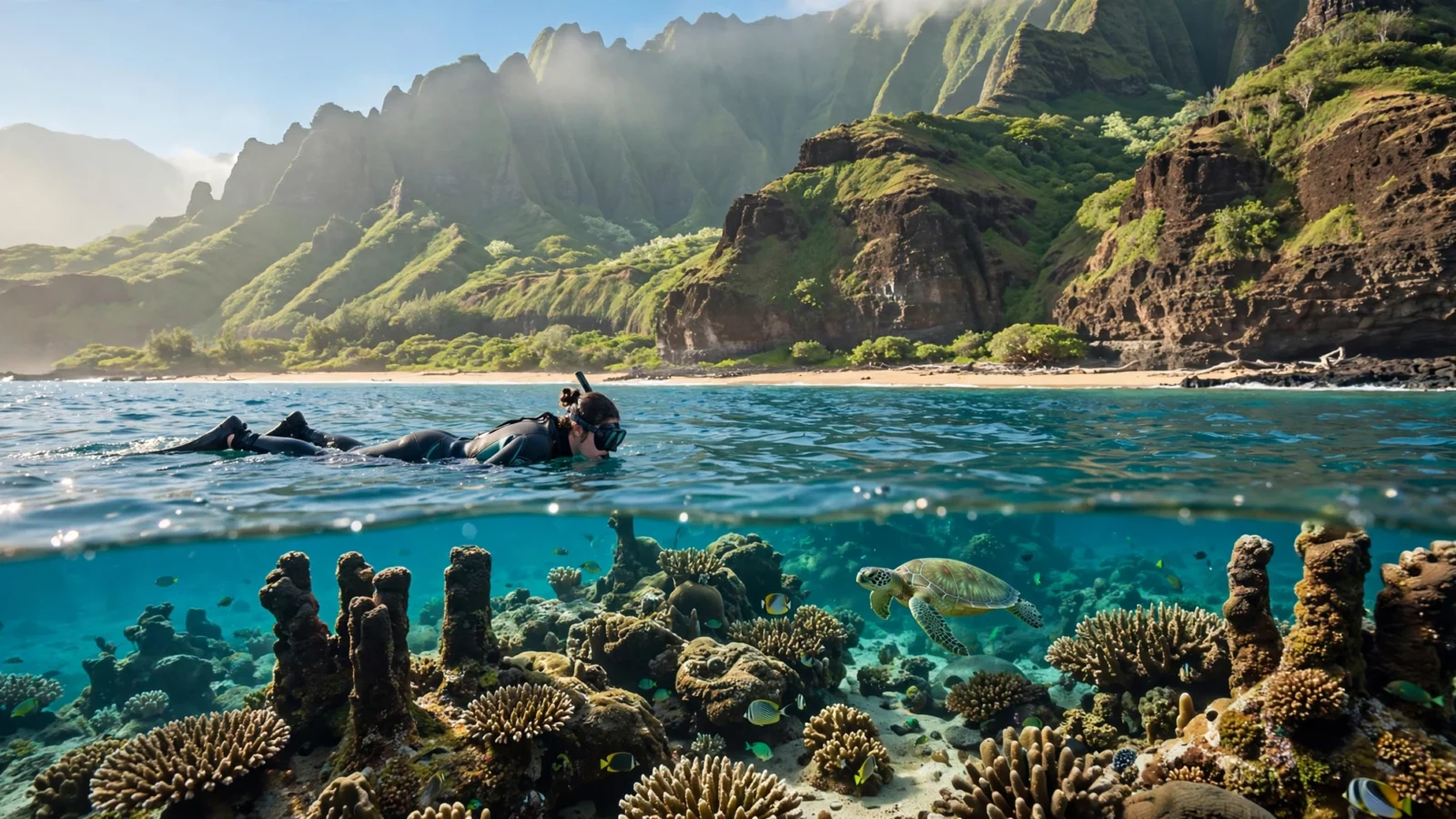
Most people meet Coral Gardens by accident. They book a Molokini boat out of Maalaea Harbor, the afternoon trade winds stand up, the captain announces that the crater is blown out — and the boat turns west instead, anchoring off a cliff-lined bay under the Pali that most passengers have never heard of. Then they get in the water and find branching coral, lava fingers, turtles and some of the clearest water of their trip. Coral Gardens is Maui’s famous backup plan, and it has quietly earned a better reputation than that. But it is also the Maui snorkel spot with the most misleading pages online: operator sites call it calm in all weather and perfect for everyone, one widely copied answer claims it is “accessible only by boat,” and almost nobody explains the shore and kayak reality from Papalaua Beach, the windy-afternoon logic that decides which boats go there, or why this reef is not the same reef as Olowalu’s “mother reef” a few miles north, which our Ahihi-Kinau and Olowalu guide covers separately. This guide is the full picture: what Coral Gardens actually is, the three honest ways to reach it, what you will see, and when to choose it over Molokini — and when not to.
The honest summary, up front: Coral Gardens is a boat-first reef. The large majority of visitors snorkel it from a tour boat out of Maalaea, usually as a morning second stop or as the afternoon alternative when Molokini is too windy. Kayaking to it from the Papalaua area is a real option for experienced paddlers on calm mornings. Swimming to it from shore is the option the internet argues about — the reef runs offshore from the south end of Papalaua Beach toward the cliffs, the swim is long, the entry is rocky, and this is a strong-swimmer, flat-morning, buddy-required undertaking, not a family beach snorkel. If your group wants an easy shore entry with a lifeguard, Coral Gardens is the wrong page — pick a spot from our Maui snorkeling hub instead. If you want a genuine coral reef with the boats as your platform, it is one of the best-value snorkels on Maui.
Quick facts
- Location: Offshore from the south end of Papalaua Beach, along the Pali cliffs on Honoapiilani Highway (HI-30), West Maui — between Olowalu and Maalaea, south of Lahaina
- The snorkeling, honestly: A branching-coral reef built over ancient lava fingers, running from shallow inshore water out to medium depths toward the cliffs. Best by boat; kayak possible for experienced paddlers; shore swimming is expert-only
- Access: Tour boats from Maalaea Harbor (the standard route); kayak launch from the Papalaua/Ukumehame shoreline; shore entry at Papalaua Wayside Park with a long swim south — see the access section before attempting it
- Lifeguard: None at Papalaua and none on the reef. Boat trips are crew-supervised; shore and kayak visits are entirely self-reliant
- Fees and reservations: No fee or reservation for the reef itself. Papalaua Wayside Park day use is free; camping there is by permit. Boat tours are paid and should be booked ahead
- Parking: Papalaua Wayside Park has a small roadside lot and pull-offs along the highway at Mile 11–12 — arrive early, and never leave valuables in the car at highway pull-offs
- Facilities: Papalaua has portable toilets and picnic/camping areas, and little else — no showers worth planning around, no rentals, no food. Bring everything
- Best time: Morning, before the trade winds build. Afternoon boat trips use Coral Gardens precisely because the bay is sheltered from the wind that ruins Molokini — but “sheltered” is relative, and rough afternoons still happen
- The one rule that matters: However you reach it, the wind decides. A calm morning here is superb; a windy afternoon swim-out from shore is a mistake. Check the marine forecast, not the beach photo
What Coral Gardens actually is
Coral Gardens is not a beach, a bay park or a marked snorkel area — it is a reef system lying offshore along the base of the Pali cliffs, stretching underwater from the south end of Papalaua Beach toward the cliff line. The reef grew over lava fingers from an ancient West Maui flow — operator and guide sources date the flow to roughly 500,000 years ago, from the old Mauna Kahalawai volcano — and those long volcanic ridges are now coated in branching and finger coral, with channels, small caves and passageways between them. The bottom slopes from shallow water near shore out to medium depths, which is why boats anchor where they do: the best coral sits in water deep enough to need a real swim down to appreciate, but shallow enough for sunlight to keep it colourful.
Two confusions to clear up before anything else. First, Coral Gardens is not Olowalu. Olowalu’s reef — the famous “mother reef,” several hundred acres of old coral heads a few miles north at Mile Marker 14 — is a different system with its own shore entry, covered in our Ahihi-Kinau and Olowalu guide. Search results constantly blend the two, and some pages describe Olowalu while naming Coral Gardens. They are neighbours, not synonyms. Second, Coral Gardens is not a backup-grade reef. It became the standard afternoon alternative because of geography, not quality: the bay sits in the lee of the West Maui Mountains, so when the trades funnel through the central valley and chop up Molokini, this coast is often still workable. On a calm morning, with no wind at all, plenty of local snorkelers would rank its coral above a crowded crater.
The three ways in — and which one is really for you
| Route | Who it suits | The honest catch |
|---|---|---|
| Tour boat from Maalaea | Almost everyone — first-timers to experienced | You snorkel on the boat’s schedule and site choice; afternoon trips only go if the captain judges the bay calm enough |
| Kayak from Papalaua/Ukumehame | Experienced paddlers, calm mornings | Open-ocean paddle along a highway coast; wind builds fast after mid-morning and the paddle back is into it |
| Shore swim from Papalaua | Strong, experienced snorkelers only | Long swim over deepening water to reach the best coral, rocky entry, no lifeguard, no exit except back the way you came |
By boat (the standard route, and the right one for most people)
The big Maalaea snorkel fleet — the same boats that run Molokini every morning — uses Coral Gardens two ways: as a second snorkel stop on some morning itineraries, and as the headline site on afternoon trips when Molokini is weathered out. Four Winds and Pride of Maui both list it as their afternoon destination; Maui Snorkeling’s afternoon reef trip works the same coast. That pattern tells you something useful: the afternoon slot exists because this bay stays snorkelable on many days when the crater does not. Do not, however, read the operators’ “always calm” language literally — captains cancel or reroute when the Pali coast is genuinely rough, and a cancelled afternoon is the system working, not a refund scam.
Boat logistics are simple: check in at Maalaea Harbor, gear is provided, and the snorkel itself is a supervised float over the reef with the boat anchored as your base. For beginners this is the gentlest way to see Coral Gardens — the crew picks the calmest anchoring on the day, flotation is available, and nobody has to solve an entry, an exit or a long swim. Prices vary by boat and season and change often; treat any specific fare printed anywhere (including older guides) as stale, and check the operators directly. Our Hawaii snorkeling tours guide compares how these Maalaea trips are structured.
By kayak (the connoisseur route)
Kayak-snorkel tours work this coast, and independent experienced paddlers launch from the Papalaua and Ukumehame shoreline to reach the reef under their own power. Done on a glassy morning, it is a superb half-day: paddle south along the cliffs, tie off or anchor carefully off the reef (never on coral — use sand channels), snorkel, and be paddling back before the trades arrive. Done on a building-wind day, the return paddle becomes a grind straight into the wind along a lee shore with cliffs, and that is the version that gets people in trouble. Experience, a marine forecast, an early start and a hard turnaround time are the price of admission. If you have never ocean-kayaked in Hawaii, take a guided kayak-snorkel trip rather than improvising this one — guides work Olowalu and this coast daily and know the wind clock.
From shore (possible, published everywhere, right for very few)
Here is the claim to handle carefully: some sources state flatly that Coral Gardens is accessible only by boat. That is the operator-safe version, and as practical advice for almost everyone, it is correct. The literal geography is that the reef system runs offshore from the south end of Papalaua Beach, and strong snorkelers do swim out from the Papalaua shoreline toward the cliffs. What the one-line answers leave out is everything that makes it an expert swim: a rocky, surge-washed entry; a long surface swim over progressively deeper water before the best coral; boat traffic in the same water; no lifeguard at Papalaua; and a return swim that must be made in whatever wind has built while you were out. Our verdict, printed plainly: if you are asking whether the shore swim is a good idea for your family beach day, it is not — the beach day at Papalaua (shade, camping, gentle shorebreak on calm days, turtles near shore) is lovely on its own, and the reef will still be there when you come back on a boat. The shore swim is for strong, experienced ocean snorkelers on flat mornings, with a buddy, a float, and the discipline to turn around early. Everyone else: boat or kayak.
What you will see
The draw at Coral Gardens is the coral itself — branching and finger coral formations grown over the lava fingers, with swim-through gaps and small caves between the ridges. Fish life follows the structure: angelfish, butterflyfish, triggerfish and parrotfish are the species the operators consistently report, alongside the usual Maui reef community of wrasse, surgeonfish and goatfish working the coral heads. Hawaiian green sea turtles feed and rest along the reef and are a regular sighting — keep the legal distance (stay at least 10 feet away, never touch, never chase; our snorkeling with turtles guide covers the etiquette properly). Octopus, crabs and moray eels live in the formation’s holes and ledges, which rewards anyone who slows down and looks into the structure instead of racing across the top of it. Operators also report the occasional Hawaiian monk seal hauled out or passing through — a privilege to see from a distance, and strictly protected: give it a wide berth. Visibility is the variable everyone exaggerates. You will read figures up to 60 feet; treat that as a best-day number. Coral Gardens’ honest range is: excellent on calm mornings, ordinary after wind and swell have stirred the inshore water, and poor after heavy rain washes down from the Pali. That is still a good deal — it is exactly the same bargain as every other West Maui reef, including Honolua Bay and Kapalua Bay.
In winter, the trip out becomes half the show: humpback whales winter in the channel between Maui and Lanai, boats stop to watch them, and snorkelers at Coral Gardens sometimes hear whale song through the water. Summer brings the calmest mornings and the best odds for the kayak and shore routes. There is no bad month for the boat route — there are only windy afternoons, which the captains manage for you.
Best time, conditions and the wind clock
Coral Gardens runs on the same clock as the rest of Maui, with one twist. The standard rule from our best time to snorkel in Hawaii guide applies in the morning: early is calmest, clearest and quietest, and any self-powered trip (kayak or shore swim) should be built around a dawn-to-mid-morning window. The twist is the afternoon. Because the bay is sheltered by the West Maui Mountains from the trade-wind funnel that wrecks Molokini, afternoon boat trips can deliver a good snorkel here when the crater is a washing machine. That shelter is real but partial — a strong trade day still chops this coast, and kona winds (from the south) remove the shelter entirely. So: mornings for everyone; afternoons only by boat, only on the captain’s call; self-powered afternoons, no. Check a marine forecast the night before, and re-check the water when you arrive — if whitecaps are marching past Papalaua, the reef will wait.
Papalaua Wayside Park: the shore base
Whether you are launching a kayak, attempting the expert swim, or just want the beach day while others boat, Papalaua is the land base. Papalaua Wayside Park is a small (about 6.7-acre) state wayside at Mile 11–12 of the Honoapiilani Highway: a narrow, shaded, tree-lined beach with roadside parking, portable toilets, picnic and camping areas, and not much else. Camping is one of its draws — it is among the most accessible beach-camping spots on Maui — and it requires a permit arranged in advance. Expect highway noise, keawe thorns in the tree line (wear footwear off the sand), and a shoreline that is part sand, part rock: fine for sitting and swimming on calm days, hit-or-miss for casual snorkeling right off the beach, which is why the real reef trip here always involves distance. No lifeguard is posted. Sunset, incidentally, is spectacular from this beach — the shore day that ends with a picnic under the trees is a perfectly good Coral Gardens itinerary for non-snorkelers.
Coral Gardens vs the neighbours
Choosing on this coast comes down to how you want to reach the reef. Molokini Crater is the bigger production — offshore crater, exceptional clarity, morning boats, higher price, weather permitting. Coral Gardens is the same fleet’s flexible reef: closer, cheaper afternoons, real coral structure, slightly less reliable clarity. Olowalu, in our Ahihi-Kinau and Olowalu guide, is the shore-entry alternative on this coast — a true beach snorkel over the mother reef’s coral heads, with its own long-swim catch for the outer reef. Turtle Town down in Makena is the turtle-focused shore-and-boat spot. A good Maui week uses two of these, not one: Molokini on the calmest morning, then Coral Gardens by afternoon boat or Olowalu by shore on another day. The full comparison lives in our Maui hub.
Safety and reef etiquette
- No lifeguard, anywhere in this guide. Papalaua has no lifeguard; boat trips substitute crew supervision, which is one more reason the boat is the default recommendation.
- Respect the wind clock. Self-powered trips end by mid-morning. If you are still swimming out when the trades arrive, you have already made the mistake.
- Boat traffic. The reef is a working anchorage. Shore and kayak visitors must stay visible (a dive float is not optional), stay out of anchoring lanes, and never assume a boat has seen you.
- Never stand on or touch coral. The branching coral here breaks under a fin kick, let alone a foot. Float over it; if you need to rest, return to sand or to your float.
- Turtles and seals keep their distance rule. At least 10 feet from turtles; much more from any monk seal. It is the law, and it is also just manners.
- Reef-safe sunscreen only. Hawaii law bans the sale of sunscreens with oxybenzone and octinoxate; our reef-safe sunscreen guide explains what to buy instead. Apply before you arrive so it does not wash straight onto the reef you came to see.
- Highway discipline. Papalaua parking is roadside on a fast highway — park fully off the pavement, cross with care, lock up, and take valuables with you.
Frequently asked questions
Where exactly is Coral Gardens in Maui?
Off the south end of Papalaua Beach, along the Pali cliffs on the Honoapiilani Highway (HI-30), at about Mile 11–12 — on the West Maui coast between Maalaea and Olowalu, south of Lahaina. There is no sign for the reef itself; Papalaua Wayside Park is the landmark and the shore base. On the water, look for the anchored snorkel boats along the cliff line.
Can you snorkel Coral Gardens from shore?
Physically, strong snorkelers do swim out from Papalaua toward the reef. Practically, for most visitors, no: the entry is rocky, the swim to the good coral is long, the water deepens as you go, there is no lifeguard, boat traffic shares the water, and the return swim is against the building wind. Despite the sources that say the reef is “boat only,” the accurate answer is “boat for nearly everyone” — treat the shore swim as an expert undertaking, not a beach activity.
Is Coral Gardens the same as Olowalu (Turtle Reef)?
No. They are neighbouring but separate reefs a few miles apart on the same coast. Olowalu, at Mile Marker 14, is the vast old “mother reef” with a proper shore entry, covered in our Ahihi-Kinau and Olowalu guide. Coral Gardens, off Papalaua at Mile 11–12, is the branching-coral reef on the lava fingers under the Pali, reached mainly by boat. Pages that use the names interchangeably are conflating two different snorkels.
Why do boats go to Coral Gardens in the afternoon?
Because of the wind. Afternoon trade winds funnel through Maui’s central valley and make Molokini rough, while Coral Gardens sits in the lee of the West Maui Mountains and often stays calm enough to snorkel. Afternoon Maalaea trips (Four Winds, Pride of Maui and others list it as their afternoon site) are built on that geography. Sheltered does not mean guaranteed — on strong trade or kona-wind days, captains will still cancel or change plans.
Is Coral Gardens good for beginners?
By boat, yes — it is one of the better beginner reefs on Maui, because the crew manages the conditions, flotation is provided, and the coral is dense enough that a beginner floating on the surface sees plenty. From shore, no — the Papalaua swim-out is a strong-swimmer undertaking regardless of how calm it looks from the beach. Total beginners should also read our beginners’ guide before booking anything.
What marine life will I see at Coral Gardens?
Expect the reef built around branching and finger coral on lava formations: angelfish, butterflyfish, triggerfish and parrotfish, the standard Maui cast of wrasse, surgeonfish and goatfish, Hawaiian green sea turtles as a regular sighting, and octopus, crabs and moray eels in the structure for those who look slowly. Occasional monk seal sightings are reported. Visibility varies honestly with conditions — excellent on calm mornings, murkier after wind or rain.
How much does it cost to snorkel Coral Gardens?
The reef itself is free — there is no entry fee, permit or reservation for Coral Gardens, and Papalaua Wayside Park is free for day use (camping permits are separate). The cost is the transport: a Maalaea snorkel boat or a guided kayak trip, priced by the operator and varying by season. Any specific fare you see printed in a guide goes stale quickly; check current prices with the operators when you book.
What should I bring for a Papalaua shore day?
Everything — Papalaua has portable toilets and shade but no rentals, food or reliable fresh water. Bring reef-safe sunscreen, water and food, a hat, footwear for the keawe thorns in the tree line, and if you are swimming or paddling, a dive float and your full kit from our gear checklist. Take all rubbish out with you, and never leave valuables visible in a car at a highway pull-off.
Coral Gardens rewards the snorkeler who understands it: a real branching-coral reef that the boats trust when the famous crater fails, reached honestly by boat, earned by kayak, and watched from the Papalaua shade by everyone with the sense not to swim for it. Book the boat, pick the calm morning, look slowly into the coral — and let the Pali wind make its one decision in your favour.