The Big Island is the youngest island in Hawaii, and it shows underwater: a lava coastline, very little river runoff on the west side, and some of the clearest water in the state. It also splits into two different snorkeling worlds — the dry Kona side with the famous bays, and the rainy Hilo side with quiet, turtle-rich parks that almost nobody writes about. This guide ranks the best snorkeling on the Big Island across both coasts, so you can pick the right spot for your ability, your base and the conditions on the day — not just the most famous name.
The short answer: for the single best underwater scene, go to Kealakekua Bay (Captain Cook). For the best free shore snorkeling, go to Two Step. For beginners and kids, start at Kahalu’u Beach Park on the Kona side or Carlsmith and Richardson on the Hilo side. And once, after dark, do the manta ray night snorkel — there is nothing else like it in Hawaii. Everything below explains why, when to go, where to park, and what can go wrong, with hedges wherever rules and fees change locally. See our Things to Do in Kailua-Kona guide to plan the west-side activities around your snorkel days. See our Things to Do in Hilo guide for the east-side waterfalls and rainy-day options.
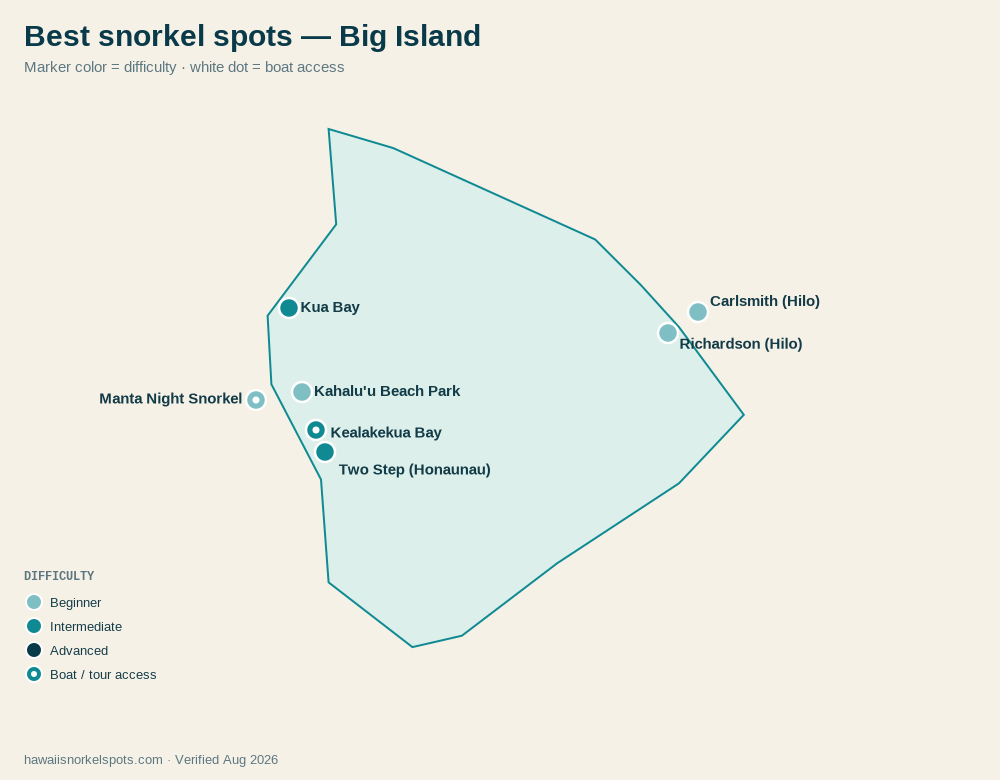
Best snorkeling Big Island at a glance
| Spot | Coast | Best for | Level | Entry |
|---|---|---|---|---|
| Kealakekua Bay (Captain Cook) | South Kona | Coral, fish density, clarity | Intermediate | Boat, permitted kayak or hike |
| Two Step (Honaunau Bay) | South Kona | Free shore snorkeling, turtles | Intermediate | Lava-rock steps |
| Kahalu’u Beach Park | Kona | Beginners, kids, first day | Beginner | Sandy entry inside reef |
| Manta ray night snorkel | Kona | Once-in-a-lifetime night float | Beginner (guided) | Boat tour |
| Kua Bay (Manini’owali) | North Kona | Beach + snorkel on calm days | Intermediate | Sand, surf-dependent |
| Richardson Ocean Park | Hilo | Turtles, black sand, lifeguards | Beginner | Protected pools |
| Carlsmith Beach Park | Hilo | Calm lagoon, families | Beginner | Lagoon behind rock wall |
That table is the whole island in one screen. The rest of this page is the detail behind it: what each spot is really like, who should skip it, and how the Kona, Kohala and Hilo coasts differ — because on an island this big, driving to the wrong coast costs you half a day.
The best Big Island snorkeling spots, ranked
1. Kealakekua Bay (Captain Cook) — the best snorkeling on the Big Island
If you snorkel one place on the Big Island, make it this one. Kealakekua Bay, on the South Kona coast, is a protected marine sanctuary where the reef drops away in clear blue water in front of the Captain Cook Monument. Expect dense coral, large schools of reef fish, spinner dolphins passing through the bay on many mornings, and visibility that firsthand reports regularly describe as the best in Hawaii — around 100 feet on a good day, though like everywhere, it varies with swell and weather.
The catch is access, and it is a real catch. There is no road down to the monument shoreline. You get there three ways: on a licensed boat tour (our comparison of the access routes is in the full Kealakekua Bay and Captain Cook snorkeling guide), by kayak — noting that state rules for this bay are specific, permits and vessel rules apply, and not every rental operation is authorised, so confirm your operator holds the right permit before you book — or by hiking the steep Ka’awaloa trail down from the trailhead above the bay and back up in the heat. The bay is a Marine Life Conservation District managed by Hawaii’s DLNR, which is exactly why the reef is in such good shape: rules here are stricter than at an ordinary beach park, and they can change, so check the current DLNR guidance before a do-it-yourself trip. Tour prices in our research have typically run about $100–170 per person, hedged because operators and seasons change pricing.
Skip it if: you are a nervous swimmer without a tour’s support, or you only have a couple of hours — every route in takes time. Go if: you want the Big Island’s best reef and you are willing to plan a morning around it. Arrive or anchor early; the light is best and the bay is calmest before the afternoon wind.
2. Two Step (Honaunau Bay) — the best free shore snorkeling
Two Step gives you much of the same South Kona clarity without a boat. The entry is the name: two natural steps in the lava shelf where you sit, put your fins on, and slide into water that deepens quickly toward a coral drop-off. Inside the bay you will find healthy coral heads, turtles on many days, and the chance of dolphins resting in the bay — give resting dolphins a wide berth and never chase or swim toward them.
Because the entry is rock, not sand, Two Step rewards confident beginners and intermediates more than first-timers. Time your entry and exit with the sets, keep your hands off the lava (it is sharp, and urchins live in the holes), and never stand on coral once you are in. Our dedicated Two Step (Honaunau Bay) snorkeling guide covers the entry technique step by step. Practicalities are hedged on purpose: the bay sits next to Pu’uhonua o Honaunau National Historical Park, parking arrangements depend on where exactly you leave the car, and if you use the national park’s facilities its rules and any entry fee apply — check the National Park Service before you go rather than relying on any blog’s number, including ours. Treat the adjoining cultural site with respect; this is a place of deep significance, not just a car park with a reef.
3. Kahalu’u Beach Park — the best Big Island snorkeling for beginners
Kahalu’u, just south of Kailua-Kona, is where we send first-timers, kids and anyone having a confidence wobble. A shallow, reef-protected bay keeps the water calm in most conditions, the entry is easy, and the bay is famous for tame, unbothered reef fish and turtles that are present so often that locals treat them as residents. It is the rare beginner spot that is not boring: the fish density here beats many ‘advanced’ spots.
Two honest downsides. First, Kahalu’u is popular — go early for the clearest water and the quietest experience, because hundreds of fins stir up a shallow bay by midday. Second, the shallows are exactly where people stand on reef, so shuffle carefully in sandy patches, float rather than stand, and follow any guidance from the reef-teach and lifeguard staff on site; presence and hours of lifeguards and education staff can vary, so do not build your safety plan around them. Parking details and any fees at this county beach park have changed over the years and may change again — check Hawaii County and on-site signs on the day. If it is your very first time in a mask, read our how to snorkel in Hawaii guide first, then start here or at Carlsmith.
4. Manta ray night snorkel — the best snorkeling in Kona after dark
The manta ray night snorkel is not really ‘snorkeling’ in the daytime sense — you float at the surface holding a light board while manta rays barrel-roll beneath you, feeding on plankton drawn to the lights. It runs off the Kona coast, it is beginner-friendly because you mostly float rather than swim, and it is the Big Island experience people still talk about years later. Our full manta ray night snorkel guide compares the main departure areas and what tours include.
Hedges that matter: mantas are wild animals and sightings, while very frequent off Kona, are never guaranteed — most reputable operators describe a high success rate and some offer a return-trip policy, but terms differ, so ask before you pay. Prices in our research have typically run about $120–200 per person. You need to be comfortable floating in the ocean at night; if that sentence makes you anxious, this is not your trip, and that is fine. Book it early in your stay, so that if weather or a no-show forces a rebook, you still have nights left.
5. Kua Bay (Manini’owali Beach) — best beach-and-snorkel combination
North of Kona, Kua Bay pairs a brilliant white-sand beach with clear, blue water and rocky points at each end where the snorkeling lives. On a flat day it is glorious — the kind of place you snorkel in the morning, then stay for the beach. On a day with shore break it is a different proposition entirely: the entry and exit cross the surf zone, turtles get harder to spot in stirred-up water, and the honest advice is to look, decide it is not a snorkel day, and just enjoy the sand.
6. Richardson Ocean Park — the best snorkeling in Hilo
Cross to the east side and the mood changes. Richardson Ocean Park, on Hilo’s beach-park coast, is a black-sand pocket beach with protected pools, lifeguards (check posted hours), picnic facilities and resident turtles that make sightings very likely on a calm morning. The water here is fed in places by cool freshwater springs, so you may feel distinct layers — a Hilo quirk that surprises first-timers and can briefly blur visibility at the surface.
Richardson’s real advantage is what it is not: it is not a two-hour drive from Hilo town, it is not crowded like Kahalu’u, and it is not dependent on a tour. Its limitation is Hilo weather — after heavy rain, runoff can cloud east-side water for a day or more, which is the single biggest difference between snorkeling Hilo and snorkeling Kona. Our Hilo snorkeling guide puts Richardson in context with the rest of the east-side parks, and our dedicated Richardson Ocean Park snorkeling guide covers entry points and the turtle pools in detail.
7. Carlsmith Beach Park — Hilo’s calm lagoon
A few minutes from Richardson, Carlsmith Beach Park protects its swimmers behind a natural rock wall, creating a lagoon that stays calm even on windy Hilo days. That makes it arguably the most forgiving beginner and family snorkeling on the whole island: easy entry, gentle water, grassy shade for the non-snorkelers in your group, and turtles that cruise the lagoon often enough that patient floaters are usually rewarded.
The trade-off is scale — this is a pleasant lagoon, not a dramatic reef wall, and after heavy rain the same east-side runoff caveat applies. But if you are based in Hilo, travelling with kids, or building confidence before a Kona boat trip, Carlsmith is the right first page of the story. It is covered in depth in our Carlsmith Beach Park snorkeling guide.
Kona vs Kohala vs Hilo: which coast should you snorkel?
Most ‘best snorkeling Big Island’ lists quietly mean ‘best snorkeling in Kona’. That undersells the island, but there is a reason Kona leads: the leeward west coast is dry, the water is clear, and the famous spots cluster within about 40 minutes of each other. Here is the honest three-coast comparison.
| Coast | Water clarity | Best spots | Watch out for | Best base |
|---|---|---|---|---|
| Kona (west, south) | Best on the island, most consistent | Kealakekua, Two Step, Kahalu’u | Crowds at Kahalu’u; access effort at Kealakekua | Kailua-Kona |
| Kohala (northwest) | Excellent on calm days | Kua Bay and resort-coast coves | Winter surf; exposed entries | Waikoloa / Kohala resorts |
| Hilo (east) | Good, but rain-dependent | Richardson, Carlsmith | Runoff after rain; cooler spring-fed water | Hilo town |
Staying in Kona? You have the easiest trip: Kahalu’u for day one, Two Step for day two, a boat to Kealakekua for the headline, mantas after dark. Staying on the Kohala coast? Snorkel your local coves and Kua Bay on calm mornings, and make one South Kona day trip rather than commuting daily. Staying in Hilo? Work the beach parks early, keep your plan flexible around rain, and consider one west-side day — the cross-island drive is long, so make it count with a morning tour plus Two Step in one trip. For help choosing a base, see our guide to where to stay in Hawaii for snorkeling.
Best Big Island snorkeling for beginners and kids
Beginners do not need the ‘best’ reef — they need calm water, an easy entry, and fish that reward them within five minutes, before confidence runs out. On that test, the ranking reshuffles: Kahalu’u first on the west side (shallow, protected, fish everywhere), Carlsmith first on the east side (lagoon-calm), Richardson a close second with lifeguards, and the guided manta float as a surprisingly beginner-friendly finale once daytime confidence is built. Kealakekua by boat also works for beginners, because a good crew handles the logistics and provides flotation and supervision — the hike-in route emphatically does not.
Practical beginner rules that matter more than spot choice: snorkel in the morning when wind and chop are lowest; practise mask clearing in waist-deep water first; use a flotation aid without embarrassment; and always snorkel with a buddy. If anyone in your group cannot swim, a beach park with a lifeguard and a shore-based plan beats any boat. Our island-wide best snorkeling in Hawaii for beginners guide goes deeper on first-day skills, and our guide to shore snorkeling in Hawaii covers entries, exits and reading surf — read that before attempting any lava-rock entry like Two Step.
Best time to snorkel on the Big Island
The Big Island snorkels well year-round, but not identically in every month or at every hour. Time of day matters most: mornings, roughly before 11 am, bring the calmest surface, the clearest water and the lightest crowds at almost every spot in this guide. Season matters by coast: winter brings the biggest surf to exposed north- and west-facing entries — that is when Kua Bay and other open coves close out, while protected Kahalu’u and the Hilo lagoons keep working — and summer generally offers the calmest all-round conditions on the Kona and Kohala coasts.
On the Hilo side, the variable is not season so much as rain in the last 24–48 hours: heavy rain means runoff, runoff means murk. If you wake in Hilo to a brown tinge along the shore, that is a waterfall-and-town day, not a snorkel day, and conditions usually recover a day or two after the rain stops. Around Kona, the equivalent trap is afternoon wind, which chops the surface and makes boat returns bumpier. For the island-by-island seasonal picture, see our best time to snorkel in Hawaii guide — and whatever any guide says, check the day’s local surf and lifeguard reports before you get in.
What you will see: turtles, mantas, dolphins and the reef
Big Island reefs deliver the classic Hawaiian cast in unusual density: green sea turtles (honu) grazing algae at Kahalu’u, Richardson and Two Step; clouds of yellow tang and other reef fish over the coral at Kealakekua; Moorish idols, butterflyfish and parrotfish on most reefs; spinner dolphins resting in bays like Kealakekua and Honaunau during the day; and, at night, the mantas. Whale sharks and monk seals happen, but they are luck, not a promise, and any operator or blog that promises them is selling something.
Wildlife rules are simple and non-negotiable. Stay at least 10 feet (about 3 metres) from sea turtles — NOAA guidance — and never touch, chase or feed any marine life. Dolphins resting in bays need space and quiet; view from a distance and let them choose to come closer. If you want turtles specifically, our snorkel with turtles in Hawaii guide ranks the islands’ most reliable turtle spots and explains the law protecting them.
Tours vs shore snorkeling, and gear on the Big Island
You can have an excellent Big Island trip without paying for a single tour — Two Step, Kahalu’u, Kua Bay, Richardson and Carlsmith are all shore entries. What tours buy you is access and ease: the boat into Kealakekua, the lights and flotation of the manta float, rental gear delivered and fitted, and a crew watching the group. Our Hawaii snorkeling tours comparison breaks down when a tour is worth it island by island; on the Big Island, the honest answer is Kealakekua and the mantas — yes; everything else — only if you value the convenience.
For gear, Kona and Hilo both have rental shops near the main bases, and weekly rentals usually beat daily rates for a multi-spot trip — confirm current pricing locally, as shop rates change. Fit matters more than brand: a leaking mask ruins more days than any reef choice. Use our Hawaii snorkeling gear checklist before you rent or pack, and add two Big Island specifics: reef shoes or sturdy sandals for lava-rock approaches (never for standing on reef), and a rash guard, because the tropical sun at the surface burns snorkelers’ backs far faster than they expect.
Parking, access and fees — hedged, because they change
We deliberately avoid printing a neat fee table for this island, because the honest position is messier: this is a mix of Hawaii County beach parks (Kahalu’u, Richardson, Carlsmith), a state park (Kekaha Kai, for Kua Bay), a state Marine Life Conservation District (Kealakekua) and a site adjoining a National Historical Park (Two Step / Pu’uhonua o Honaunau) — four systems, four rulebooks, and details that are updated from time to time. What we can say usefully: shore spots on this page have historically been free or low-cost to enter, tours are the real expense, popular car parks (Kua Bay, Kahalu’u) fill by mid-morning on weekends, and kayak and vessel access at Kealakekua is permit-controlled. Before any trip, check the managing authority — Hawaii County, Hawaii State Parks, DLNR or the National Park Service — for the spot you are visiting that day. That thirty-second check has saved more snorkel days than any tip in this guide.
Safety and reef etiquette
The Big Island’s risks are specific. Lava rock is sharp, slippery when wet, and hides sea urchins — watch every foot placement on entries at Two Step and around Hilo’s pools. Surf on exposed west and north entries can rise through the day; if locals are not swimming, take the hint. Rocky exits get harder as wind chop builds, which is another reason mornings win. And distance is a safety factor in itself: some of these spots are a long drive from help, so tell someone your plan, snorkel with a buddy, and know your limits in open water before you attempt a boat-free Kealakekua plan.
Reef etiquette protects both the coral and your trip: never stand on or touch coral (it is a living animal, and broken coral takes years to recover); keep fins up and away from the reef in the shallows; use sunscreen that complies with Hawaii’s reef-protection rules — the state restricts the sale of sunscreens containing certain chemicals such as oxybenzone and octinoxate, and mineral alternatives are widely sold locally — and take every scrap of rubbish out with you. Our guide to whether snorkeling in Hawaii is safe covers ocean risk, full-face mask cautions and when to stay out of the water in more depth; read it once and you will snorkel this island better.
A simple 3-day Big Island snorkeling plan
Day 1 (Kona, easy): Kahalu’u in the morning for confidence and turtles, a relaxed afternoon, then the manta night snorkel after dark. Day 2 (South Kona, best): a morning boat to Kealakekua Bay, then Two Step on the way back north if legs and light allow, with the cultural site at Pu’uhonua o Honaunau visited respectfully between swims. Day 3 (choose your coast): based in the west, a calm-day run to Kua Bay; based in or visiting the east, Richardson and Carlsmith in one Hilo morning — black sand, spring-cooled pools and the island’s quietest turtles. That plan covers every sub-cluster of Big Island snorkeling — reef, beginners, night, beach and Hilo — without a single backtrack drive wasted.
Comparing islands before you commit flights? Our Maui snorkeling hub wins on sheltered resort-coast coves, our Oahu snorkeling hub wins on easy access from Waikiki, and our Kauai snorkeling hub wins on dramatic north-shore scenery in summer. The Big Island wins on clarity, coral health and that one bay in South Kona — which is why it earns this page.
Things to do on the Big Island beyond snorkeling
Snorkeling is the best reason to come to the Big Island — but it is not the only one. At about 4,028 square miles, the island is bigger than all the other Hawaiian islands combined, and a good trip pairs a calm morning in the water with one land activity a day. The list below is ranked by what is actually worth your time, and every item notes the snorkel day it pairs with, so you never backtrack across the island for a single stop.
1. Hawaiʻi Volcanoes National Park — the one thing you cannot skip
Two of the world’s most active volcanoes, Kilauea and Mauna Loa, sit inside one park. The standout hike is the Kilauea Iki crater-floor crossing, about 4 miles round trip through a solidified lava lake, plus steam vents and the Thurston Lava Tube on the same visit. Entry is $30 per private vehicle, valid for seven days. Check nps.gov the week before you fly — the park closes sections without much notice when the volcano acts up or a storm hits. Pair it with a Hilo-side day: snorkel Richardson Ocean Park or Carlsmith Beach Park in the morning, then drive up to the park.
2. Mauna Kea stargazing — the clearest night sky in Hawaii
The Mauna Kea summit sits at 13,803 feet, above roughly 40% of the atmosphere, under some of the clearest night skies on the planet. Go with a tour: altitude sickness is real, and the road above the visitor center requires four-wheel drive. Most tours do sunset at the summit, then stargazing lower down. Pair it with a Kohala beach day — snorkel Hapuna Beach or Mauna Kea Beach, rest in the afternoon, and head up at sunset.
3. Manta ray night snorkel — the island’s signature after-dark experience
Floating above an underwater light bar while manta rays with 12- to 15-foot wingspans circle inches below you is the one paid activity worth booking first — it sells out, and it only happens off Kona. Read our full manta ray night snorkel guide for operators, seasons and what it actually feels like before you book.
4. Papakōlea Green Sand Beach — one of only four in the world
The green sand comes from olivine crystals in the old cinder cone, and there are only a handful of green-sand beaches on Earth. Getting there is the adventure: about 2.5 miles each way over rough lava fields on foot, or a ride with a local shuttle at the trailhead. Bring water — there is no shade and no facilities. Pair it with Punaluʻu Black Sand Beach on the same south-side day, and read our Papakōlea Green Sand Beach guide before you go.
5. Punaluʻu Black Sand Beach — turtles on black sand
Hawaiian green sea turtles (honu) haul out to bask on this black-sand beach most afternoons — one of the most reliable turtle sightings on the island without getting in the water. Stay at least 10 feet back and never touch them. Our Punaluʻu Black Sand Beach guide covers the snorkeling at its rocky edges, which is a calm-days-only proposition.
6. Akaka Falls and the Hilo waterfalls
Akaka Falls drops 442 feet through rainforest on a short 0.4-mile paved loop — the easiest big waterfall payoff on the island. As of late 2026 it costs $5 per person plus $10 for parking, paid at kiosks on arrival; fees change, so check before you go. Rainbow Falls is a ten-minute drive away in Hilo itself. Pair it with a Hilo snorkel afternoon at Richardson or Carlsmith — waterfalls in the morning, reef in the afternoon.
7. Waipiʻo Valley lookout — the island’s most dramatic valley
A mile-wide valley cut between near-vertical cliffs, with waterfalls, taro fields and a black-sand beach at the bottom. The lookout itself is free and easy; the steep road down is restricted to local traffic, so most visitors take a shuttle or a guided tour rather than driving it. The valley beach has rough surf — come for the view, not a swim.
8. Puʻuhonua o Hōnaunau (Place of Refuge) — history next to Two Step
This national historical park was once a place of refuge under ancient Hawaiian law, and its reconstructed temple, carved wooden images and royal fishponds are a short walk from one of the island’s best shore snorkels. Snorkel Two Step in the morning, walk the park in the afternoon — the pairing is the whole point.
9. Kona coffee farm tour — taste where it grows
The Kona coffee belt runs along the slopes of Hualālai above Kailua-Kona, and small farm tours with tastings are the low-key afternoon the island does best. Pair it with a morning snorkel at Kahaluʻu Beach Park — reef in the morning, coffee in the afternoon.
10. Hilo Farmers Market — the easy Hilo morning
Biggest on Wednesdays and Saturdays, the Hilo Farmers Market is local fruit, flowers, crafts and plate lunch in one stop, right in downtown Hilo. Pair it with a Hilo snorkel day — market in the morning, Richardson or Carlsmith in the afternoon.
Build your trip around that pairing — water in the morning, land in the afternoon — and the Big Island stops feeling impossibly big.
For the Hawaii-wide picture, see our list of the best things to do in Hawaii.
Frequently asked questions
What is the best snorkeling on the Big Island?
Kealakekua Bay (Captain Cook) is widely regarded as the best, for its protected reef, fish density and clarity — but it needs a boat, a permitted kayak or a steep hike. Two Step is the best free shore alternative, and Kahalu’u is the best for beginners.
Where is the best snorkeling in Kona?
In and around Kailua-Kona itself, Kahalu’u Beach Park is the top pick for most visitors. The greater Kona coast adds the island’s two signature experiences: Kealakekua Bay to the south by boat, and the manta ray night snorkel after dark.
Is Big Island or Maui better for snorkeling?
The Big Island generally offers clearer water and healthier coral, plus the manta night snorkel and Kealakekua. Maui offers more sheltered, easily reached coves close to resort areas. Neither is ‘better’ for everyone — clarity and adventure point to the Big Island; convenience points to Maui.
What is the best snorkeling on the Big Island for beginners?
Kahalu’u Beach Park on the Kona side and Carlsmith Beach Park on the Hilo side: both are calm, protected and easy-entry, with fish and often turtles in shallow water. A boat tour to Kealakekua also works for beginners thanks to crew support and flotation.
When is the best time to snorkel on the Big Island?
Mornings year-round — before about 11 am — for calm, clear water. Summer usually gives the calmest conditions on exposed Kona and Kohala entries; in winter, choose protected spots when surf is up, and on the Hilo side allow a day or two after heavy rain for runoff to clear.
Can you snorkel in Hilo, or only in Kona?
You can absolutely snorkel in Hilo. Richardson Ocean Park and Carlsmith Beach Park offer calm, turtle-rich water minutes from town — less clear than Kona after rain, but quieter, cheaper and uncrowded. Many visitors who stay east never miss the west side.
Do I need a tour to snorkel the Big Island?
No — most spots in this guide are free shore entries. Tours are worth paying for in two cases: reaching Kealakekua Bay by boat, and the guided manta ray night snorkel. Confirm that any Kealakekua operator holds the permits the bay requires.
Where can I see manta rays and turtles on the Big Island?
Manta rays on a night snorkel tour off the Kona coast — frequent but never guaranteed. Turtles most reliably at Kahalu’u, Richardson and Carlsmith, and often at Two Step. Keep at least 10 feet from turtles and never touch or chase wildlife.
Is snorkeling on the Big Island safe?
Yes, with the normal Hawaii precautions: snorkel with a buddy, mornings, in protected spots matched to your ability, watch lava-rock entries and urchins, and stay out in surf or after heavy rain on the east side. See our Hawaii snorkeling safety guide for the full checklist.
What is the number one thing to do on the Big Island?
Hawaiʻi Volcanoes National Park by day, and the manta ray night snorkel after dark. If you only have one day, do the park in the morning and the manta snorkel that night — between them you have seen the two things no other Hawaiian island can offer.
How many days do you need on the Big Island?
At least four or five days. The island is about 4,028 square miles, and the Kona–Hilo drive is roughly two hours each way, so a split stay — two or three nights in Kona, one or two in Hilo — saves more backtracking than any single itinerary trick.
Can you visit the Big Island without a rental car?
Realistically, no. The Hele-On bus exists but runs infrequently, and the snorkel spots, trailheads and beaches are spread across an island the size of Connecticut. Book a car early, especially in summer and around the winter holidays.
Five more Big Island spots now have dedicated guides of their own: on the Kohala coast, the wide bay in our Waikoloa Beach snorkeling guide, the classic white-sand beach in our Hapuna Beach snorkeling guide, the quiet resort-front reef in our Mauna Kea Beach snorkeling guide and sheltered Beach 69 in our Waialea Beach snorkeling guide; and in Kona, the manta-tour bay in our Keauhou Bay snorkeling guide.
Three more Big Island guides round out the Kohala coast: our Spencer Beach Park snorkeling guide covers the calmest entry on that shore, our Makaiwa Bay snorkeling guide covers the quiet bay by the Mauna Lani resort, and our Puako Bay snorkeling guide covers the village reef just south of Waialea.
Six more of our Big Island spot guides fill in the map beyond the ranked seven. On the South Kona coast, our Ho’okena Beach snorkeling guide covers the quieter bay south of the famous names. The North Kona and Kohala coasts add our Kiholo Bay snorkeling guide, our Mahukona Beach snorkeling guide, our Makalawena Beach snorkeling guide and our Mahai’ula Beach snorkeling guide. And black sand meets snorkeling in our 49 Black Sand Beach snorkeling guide.
And for Kua Bay itself — ranked fifth above — entry points, hazards and calm-day timing are covered in full in our Kua Bay snorkeling guide.
Newest Big Island guides: our latest spot guides cover the Kona coast in our Magic Sands Beach snorkeling guide, Old Kona Airport snorkeling guide, Kamakahonu Beach snorkeling guide and Kukio Bay snorkeling guide, plus black sand in the south in our Punalu’u Black Sand Beach snorkeling guide.
Newest Big Island guides: our Kohanaiki Beach Park snorkeling guide covers the long, quiet beach park just north of Kailua-Kona, and our Pauoa Bay snorkeling guide covers the calm resort bay up the Kohala Coast.
Newest Big Island guide: our Lapakahi snorkeling guide covers the Koai’e Cove marine reserve inside the old Hawaiian fishing village on the Kohala Coast.
Newest Big Island guides: our Kona snorkeling guide covers the best spots near Kailua-Kona, our Papakolea Green Sand Beach snorkeling guide gives the honest verdict on the famous green-sand beach, our Honokohau Beach snorkeling guide covers the Ai’opio Fishtrap cove at Kaloko-Honokohau, our Ho’okena Beach Park snorkeling guide covers the hidden reef at Kauhako Bay, and our Big Island snorkeling map pins all 32 shore spots with GPS coordinates.
Newest Big Island guides: our Kapoho Tide Pools snorkeling guide covers the east-side tide pools and their current status.