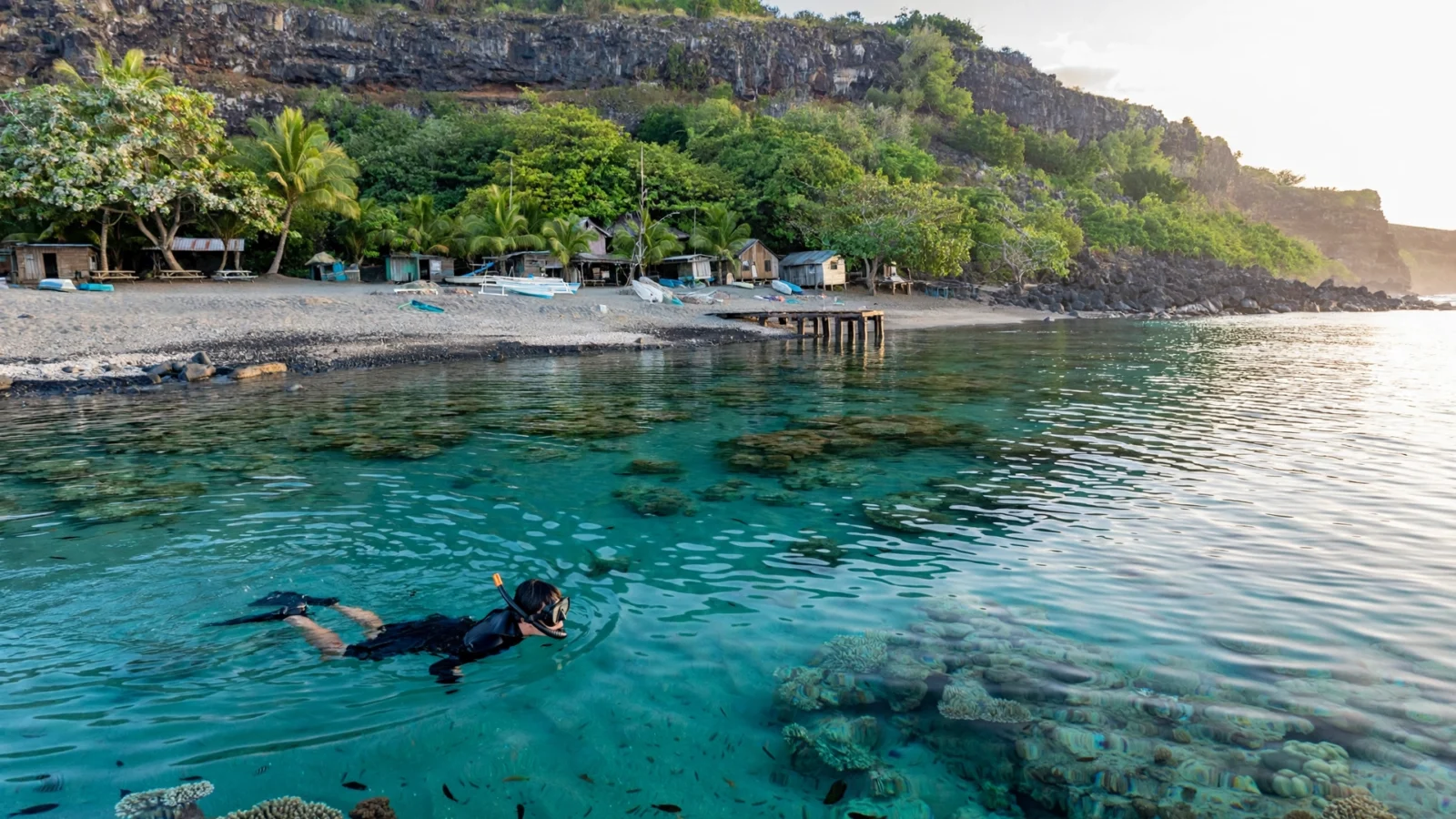
Ho’okena Beach Park is the snorkel spot South Kona keeps for itself. Twenty miles south of Kailua-Kona, at the bottom of a steep, winding, partly one-lane road, a grey salt-and-pepper sand beach curves around Kauhako Bay beneath the cliffs — a working Hawaiian fishing village long before it was a county park, and still a place where outrigger canoes, campers and local families share the shore. The reef runs the length of the beach, the water on a calm morning is some of the clearest in South Kona, and spinner dolphins rest in the bay on many mornings — which is exactly why this guide leads with the rules as well as the reef.
This is a snorkeling-first guide to Ho’okena: where to enter, which of the three reef zones to swim, what you will see, when the bay is at its best, and the honest safety picture — no lifeguard, a bottom that drops away quickly, and currents that strengthen offshore. It also covers the part no other guide joins up properly: Ho’okena is one of the few Hawaii beach parks where you can camp on the sand by permit, wake up at dawn, and be on the reef before the day visitors have even started down the hill.
Quick facts
| Detail | What to know |
|---|---|
| Where | Ho’okena Beach Park, Kauhako Bay, South Kona, Big Island — about 20 miles south of Kailua-Kona |
| Day use | Free; no reservation for day visits |
| Parking | Free lot at the park — small, fills fast, especially weekends; signed roadside overflow exists (mind the no-parking signs) |
| Lifeguard | None — the Ho’okena Beach Patrol staff are park staff on site roughly 9am–8:45pm, not a lifeguard service |
| Facilities | County restrooms, outdoor showers, covered pavilion, picnic tables, BBQ pits, shade trees |
| Rentals & food | Concession stand (about 9am–2pm daily) rents snorkel and fin sets, kayaks and boards, and sells food and drinks — proceeds support the park’s non-profit stewards |
| Camping | Tent camping by permit only, booked in advance — see the camping section below |
| Best conditions | Calm mornings, before the afternoon breeze; summer is the most reliable season |
| Snorkeling style | Sandy entry, then reef zones along the whole beach — clearest spur reef at the south end |
| Dolphins | Spinner dolphins rest in the bay by day — watch from shore or at least 50 yards away; never approach |
Hokena Beach, Ho’okena Beach Park, Hookena — the same beach
If you searched for Hokena Beach and landed here, you are in the right place. Hokena Beach is the plain spelling of Ho’okena Beach Park — the county beach park at the north end of Kauhako Bay in South Kona, on the Big Island. The official name carries the ’okina, the glottal stop in Hawaiian, so the county directory and the park’s own site write it Ho’okena. Everyone else writes it however their keyboard allows: Hokena Beach, Hookena Beach, Ho okena Beach Park. Google treats the plain spelling as a misspelling and quietly corrects it to Ho’okena — which is why this guide now spells it out plainly. Same beach, same bay, same reef.
The park’s official address is 86-3687 Hookena Beach Road, Hookena, HI 96704, about 20 miles south of Kailua-Kona. You get there on Highway 11 south, turning at the 102 mile marker onto Hookena Beach Road — the full drive is in the getting-there section below. What you find at the bottom of that road is a grey salt-and-pepper sand beach curving around Kauhako Bay beneath the cliffs, a working fishing village first and a county park second, with a reef running the length of the beach and spinner dolphins resting in the bay on many mornings. For the full South Kona picture, see our Big Island snorkeling hub.
Getting there and parking
From Kailua-Kona, drive south on Highway 11 for about 20 miles. Just past the 102 mile marker, turn right onto Ho’okena Beach Road and follow it for roughly two to two-and-a-half miles down toward the sea. The road is steep and winding, and near the bottom it narrows to a single lane — take it slowly, expect local traffic coming up, and use a lower gear rather than riding the brakes. Near the end, bear left down the narrow lane to the main parking area by the park.
Parking is free and the lot is not large. On weekday mornings there is usually room; on weekends and holidays it fills early and the overflow is signed roadside parking — park only where it is allowed and never block the lane, because residents and the Beach Patrol need it clear. Day use itself is free and needs no permit or reservation. The drive down is also your first conditions check: if the bay below looks white-capped and churned from the road, the afternoon wind has already arrived and the snorkeling will be poor — come back at dawn instead.
One practical note: this is a living village, not a resort strip. The fishing canoes on the beach are working boats and a point of ancestral pride for local families — look, photograph from a distance, but do not climb on them or move anything, and keep to the public park area. The cliffside at the south end of the beach is off limits: it is both dangerous and a sacred area for local families.
The snorkeling: three zones, one long reef
Ho’okena does not have one snorkel spot — it has a reef that runs the length of the beach, and the swim changes character as you move along it. Face the ocean and the beach runs left (south) to right (north). Most guides just say “good snorkeling here” and stop; this is the version that actually helps you choose where to get in.
Zone 1: The south spur reef — the clearest water
Walk to the far left (south) end of the sand, past where the rocks begin. Just beyond the point where the shoreline turns rocky, a small spur of rock juts into the water, and in front of and beyond it sit small, vivid reefs in notably clear water. Divers and snorkelers who know this bay consistently rate this pocket as the prettiest coral at Ho’okena — compact rather than vast, with healthy coral colour and dense fish life in relatively shallow water. Enter over the sand just before the rocks, not over the rocks themselves, then work slowly along the spur. This is the zone to spend your best, calmest hour in.
Zone 2: The centre-bay coral heads — the easy first swim
Straight out from the middle of the beach, scattered coral heads rise from the sand with plenty of fish around them. Visibility here is usually a step below the south spur — the open bay stirs more easily — but the entry is the simplest on the beach, the swim is short, and it makes a good warm-up or a first snorkel for a confident beginner on a flat morning. It is also the zone closest to where dolphins sometimes rest (see the dolphin section — the rule is distance, always).
Zone 3: The north end and the old pier — the long swim
Toward the right (north) end, by the breakwater and the remnants of the old steamship pier, the reef continues and the bottom drops toward deeper water. Experienced snorkelers enter at one end of the beach and traverse the reef along its length — local dive accounts describe following the reef edge in roughly 20 feet of water, with a large boulder field in the shallows that rewards a slow look for reef life. Treat the north end as a longer, more committing swim: further from the easy exit, more exposed if the breeze builds, and not the place to test your fitness for the first time.
Whichever zone you choose, the pattern is the same: snorkel it in the morning, stay over sand when you need to rest or adjust your mask, and never stand on coral to do it.
How to enter — and the steep drop-off nobody warns you about
The entry itself is sandy and gentle at the waterline, which is what makes Ho’okena feel beginner-friendly. Be aware of what happens next: the shoreline shelves steeply. Within a short swim the bottom falls away, so non-swimmers and anyone who needs to stand up frequently will run out of depth quickly. Wear a flotation vest or use a flotation device under your chest if you are not a strong swimmer — the park’s own ocean guidance recommends exactly that — and keep weak swimmers in the shallow centre-bay area, close to shore, on calm mornings only.
Enter where the bottom is sand, walk out until you are waist-deep, put your mask on while you can still stand on sand, then float and fin gently. Exit the same way. Sea urchins sit in the rocky areas and tide pools at the edges of the beach, so keep feet off the rocks entirely — water shoes are for the hot sand and the path, not for walking the reef.
What you will see
Ho’okena’s reef is a working, grazed, healthy inshore reef, and the fish life reflects that. Expect large schools of convict tangs — visitors regularly remark on the biggest they have seen anywhere — along with surgeonfish grazing the algae off the reef (the reason the stewards ask you never to feed the fish: fed grazers stop grazing, and algae smothers coral). The reef triggerfish, the humuhumunukunukuapua’a, shows up here, as do rays over the sand and the usual South Kona cast of reef fish around the coral heads and the south spur. Green sea turtles (honu) are seen regularly in the shallows and around the reef — give them at least 10 feet (3 metres) at all times, never touch or crowd them, and let them surface and pass on their own terms.
The headline wildlife, though, is the spinner dolphins (nai’a). Pods come into this bay to rest during the day after hunting offshore at night, on several mornings a week. Seeing fins and slow, quiet movement out in the bay from the beach is common; the next section covers the only acceptable way to share the water with them.
The dolphin rule: 50 yards, no exceptions
This is the section that matters most at Ho’okena, and the one older travel copy gets wrong. Some older guides suggest dolphins “may swim close to you anyway,” as if a close encounter is part of the attraction. It is not, and at Ho’okena the community that has lived alongside these animals for generations is explicit: the nai’a have rested in this bay for generations and were always left alone out of respect for their right to be there.
The rule, from the Friends of Ho’okena Beach Park and NOAA/DLNR guidance, is simple:
- Stay at least 50 yards from dolphins at all times — observe them from shore, or from that distance in the water.
- Never approach, chase, follow or try to swim with a resting pod. Resting dolphins are sleeping with half a brain at a time; waking and scattering them costs them the rest they came inshore for.
- If dolphins move toward you, hold your position or move calmly away — do not close the distance, and never place yourself between animals.
- Report harassment to NOAA or DLNR if you see it.
Watching a resting pod from the sand with coffee at dawn — no fins, no chasing, no stress on the animals — is genuinely one of the great free wildlife experiences on this coast. That is the Ho’okena way to see dolphins, and it is the only one this guide endorses. If a close dolphin swim is what you are after, this is the wrong beach, full stop.
Best time to snorkel Ho’okena
Time of day beats everything else here. Mornings are calm; by afternoon the breeze picks up, the surface chops, visibility drops and the swim gets tiring. Campers and early arrivals get the bay at its best — flat, clear and quiet — which is the single strongest argument for the camping permit below.
Season: summer is the most reliable snorkeling season at Ho’okena, when south swells are least frequent and the bay is most often flat. In winter and during any south swell, shorebreak builds on the sand, entry and exit get hazardous, and the right call is to watch the local bodyboarders from the beach instead of snorkeling. In moderate surf you will see keiki playing in the waves near shore — that is a shorebreak scene, not a snorkeling invitation.
Before you go: check the surf forecast for the South Kona coast and look at the bay from the road on the way down. If local snorkelers and swimmers are staying out, take the hint — conditions here can change, and there is no lifeguard to make the call for you.
Is Ho’okena good for beginners and kids?
Honest verdict: yes for confident beginners on calm mornings, with flotation — no for non-swimmers expecting to wade. The sandy entry and the centre-bay coral heads are as gentle an introduction as South Kona offers, and families camp and swim here happily. But the bottom drops steeply, there is no lifeguard, and the clearer south-spur reef involves a longer swim along rocks. Kids who snorkel should be strong swimmers, wear a vest, stay in the centre bay, and be within arm’s reach of an adult. Beginners should treat Zone 1 as a second or third snorkel of the trip, not the first — build up at Kahalu’u Beach Park first, where the bay is shallower and lifeguarded.
Safety at Ho’okena
- No lifeguard. You are responsible for your own assessment. The Beach Patrol looks after the park and campground; they are not watching the water as lifeguards.
- Currents strengthen offshore. The bay feels sheltered near shore, but strong currents can be found further out. Stay over the inshore reef, snorkel parallel to the beach, and always leave energy for the swim back.
- Steep drop-off. Depth comes quickly — see the entry section. Never let a weak swimmer drift out past standing depth unknowingly.
- Shorebreak in swell. Moderate surf turns the entry into a shorebreak. If waves are breaking on the sand, stay out.
- Hot sand, sharp edges. The salt-and-pepper sand gets hot underfoot — wear footwear to the waterline. Keep off rocks and reef (urchins), and never stand on coral.
- The road. The drive down is steep, winding and partly one lane. Drive it fresh, in daylight, and never after your snorkel when you are tired and sun-drunk — take a break at the pavilion first.
See our full Hawaii snorkeling safety guide for rip-current, jellyfish and after-flying guidance that applies here too.
Facilities, rentals and the concession stand
For a small county park, Ho’okena is unusually well set up — because its stewards run it as a community enterprise. The park has county restrooms, outdoor showers (campers rave about the warm shower), a covered pavilion, picnic tables, BBQ pits and good tree shade at the back of the beach.
The concession stand, open seven days a week from about 9am to 2pm, rents snorkel and fin sets, kayaks, stand-up paddleboards, boogie boards and beach chairs, and sells hot food, cold drinks, ice cream and reef-safe sunscreen. All proceeds go to the Friends of Ho’okena Beach Park, the non-profit that co-manages the park with the County — so renting your gear here is the rare case where the convenient option is also the one that funds the park. Hours and stock vary; if snorkeling is the whole point of your trip, bring your own well-fitting gear as a backup (see our snorkel gear checklist).
Camping at Ho’okena: wake up on the reef
Ho’okena is one of the few Big Island beach parks with tent camping right behind the sand, and for snorkelers it changes the whole equation: you get the bay at dawn, every dawn of your stay, before the wind and before the day-trip parking fills.
The essentials, from the Friends of Ho’okena Beach Park:
- Permit required, book ahead. Reservations must be made at least 72 hours in advance through the park’s online system; same-day permits are sometimes available on site from Beach Patrol staff on a first-come basis (cash only on site). Check current availability and rules on hookena.org before you plan around it.
- Fees (per person, per night): out-of-state visitors $20 plus a $1 transaction fee ($21 total); Hawaii residents $6 for adults, $3 for juniors 13–17, $1 for children 12 and under (residency ID checked at check-in). A refundable $10 tent-tag deposit applies per tent.
- Hours: no late check-in after 8:45pm; tents down by 12 noon on departure day; quiet hours 9pm–6am — which suits dawn snorkelers perfectly.
- Rules that matter: no pets, no drones, fires only in the provided pits for cooking, and the south cliffside is off limits. Campers get portable toilets in addition to the county restrooms, plus dish-washing sink and purchasable Wi-Fi.
Book early for weekends and holidays — sites are limited and this is a beloved local campground, not a tourist secret.
Ho’okena vs Two Step vs Kealakekua: which South Kona snorkel?
| Ho’okena Beach Park | Two Step (Honaunau Bay) | Kealakekua Bay (Captain Cook) | |
|---|---|---|---|
| Entry | Sandy beach entry; steep drop after | Lava shelf “two step” entry | Rocky shore at Napo’opo’o, or kayak/boat to the monument |
| Best for | Camping + dawn reef, dolphins from shore, families who swim well | Confident snorkelers wanting deep, clear reef close in | The bay’s famous monument-side reef and history |
| Reef character | Long inshore reef; clearest spur at the south end | Deep reef edge, turtles, very clear | Big coral formations, dense fish, spinner dolphins |
| Facilities | Restrooms, showers, pavilion, concession + rentals | Limited — portable toilets nearby, national park next door for facilities | Limited at Napo’opo’o; village facilities nearby |
| Parking | Free lot, fills early | Small paid/free mix nearby, fills early | Limited roadside |
| Lifeguard | None | None | None |
| Watch out for | Afternoon wind, offshore current, resting dolphins — keep 50 yards | Surge on the lava shelf; no sand for kids | Effort to reach the best reef; permits for kayaks |
Short version: pick Two Step for the deepest, clearest single swim; pick Kealakekua Bay for the monument reef; pick Ho’okena when you want a beach day (or a camping trip) with very good snorkeling attached — and the only one of the three where you can sleep beside the reef.
Near Ho’okena: where to snorkel next
Ho’okena is a one-bay snorkel, and South Kona rewards pairing it with the bays around it. The next bay north is Honaunau Bay — Two Step, the lava-shelf entry with the deep, clear reef close in. Our Two Step guide covers the entry, the surge and the turtle cleaning station. North again is Kealakekua Bay, the monument reef at Captain Cook, best reached by kayak or boat from Napo’opo’o — our Captain Cook guide covers the monument, the conservation district and the Ka’awaloa Trail. South of Ho’okena the coast turns to black sand: Punalu’ Black Sand Beach, with turtles and cold freshwater springs, is the natural next stop if you keep driving. Closer in, Manini Beach, the small cove nearby, is worth a look on a calm morning but not a full snorkel day on its own. If you only add one more stop, make it Two Step — it is the deepest, clearest single swim of the three, and the contrast with Ho’okena’s sandy entry shows you both sides of South Kona in one day.
Reef etiquette at Ho’okena
The Friends of Ho’okena publish their ocean guidance for a reason, and it doubles as the best etiquette summary for this reef:
- Never feed the fish. Fed surgeonfish stop grazing algae, and ungrazed algae smothers the coral they live on.
- Look, but don’t touch. Skin oils damage coral’s protective mucous layer; touching can kill a colony that took centuries to grow. Never stand on, walk on or kick the reef — rest over sand instead.
- Keep your distances: 10 feet from turtles, 50 yards from dolphins, and never pick up or hold any reef animal, octopus included.
- Use reef-safe sunscreen free of oxybenzone and octinoxate — the concession sells it if you forgot yours.
- Carry out your trash — and any you find. The park’s limited bins are not a reason to leave anything behind.
What to bring
Your own mask, snorkel and fins if you have them that fit (rentals at the concession as backup), reef-safe sunscreen, a flotation vest for anyone less than a strong swimmer, water shoes for the hot sand and paths, plenty of drinking water and snacks, cash for donations or on-site permits (cards are accepted at the concession), and — if you are camping — everything booked and printed at least 72 hours ahead. Our best time to snorkel guide covers the island-wide season and water-temperature picture.
Frequently asked questions
Is Ho’okena Beach good for snorkeling?
Yes — on a calm morning it is one of the best shore snorkels in South Kona, with a reef running the length of the beach and the clearest spur reef at the south end. On a windy afternoon or in south swell, it is a poor and potentially hazardous snorkel. Timing is everything here.
Where is the best snorkeling at Ho’okena Beach?
Three zones: the small spur reef at the far south (left, facing the ocean) end has the clearest water and prettiest coral; the coral heads straight off the centre of the beach are the easiest first swim; and the reef continues north toward the old pier remnants for a longer traverse. Enter over sand, never over rock or reef.
Can you swim with dolphins at Ho’okena?
No. Spinner dolphins rest in this bay during the day, and both park rules and federal guidance require you to stay at least 50 yards away and never approach or disturb a resting pod. Watch them from shore — that is the experience Ho’okena offers, and it is a privilege, not a swim-with program.
Is there a lifeguard at Ho’okena Beach Park?
No. There is no lifeguard on duty. Ho’okena Beach Patrol staff manage the park and campground during the day (roughly 9am–8:45pm), but they are not a lifeguard service. Assess conditions yourself and snorkel within your limits.
How much does it cost to visit Ho’okena Beach?
Day use and parking are free, with no reservation needed for a day visit. Camping is by permit: $21 per night for out-of-state visitors and $6/$3/$1 for Hawaii resident adults/juniors/children, plus a refundable $10 tent-tag deposit. Gear rental and food are available at the concession stand (about 9am–2pm).
Can you camp at Ho’okena Beach?
Yes — tent camping by permit behind the beach, booked at least 72 hours ahead online via the park’s stewards (hookena.org), with limited same-day availability on site. Quiet hours are 9pm–6am, checkout is 12 noon, and no pets or drones are allowed.
What is the best time of day to snorkel Ho’okena?
Early morning, as early as you can manage. The bay is calmest and clearest before the afternoon breeze, visibility is at its best, the parking lot has space, and resting dolphins — watched from shore — are most often seen in the morning.
Is Ho’okena Beach good for beginners and kids?
For confident swimmers with flotation, on a calm morning, staying in the centre-bay shallows: yes. For non-swimmers or anyone expecting to stand: no — the bottom drops steeply, there is no lifeguard, and the best reef is a longer swim. Families do swim here happily, but on the bay’s terms, not a resort pool’s.
Is Hokena Beach the same as Ho’okena Beach Park?
Yes. Hokena Beach is the plain spelling of Ho’okena Beach Park, the county beach park at Kauhako Bay in South Kona. Ho’okena is the official spelling with the ’okina; Hokena, Hookena and Ho okena are the spellings people type. One beach, one reef, one parking lot.
Where is Hokena Beach?
On the Big Island’s South Kona coast, at the north end of Kauhako Bay — about 20 miles south of Kailua-Kona. The county address is 86-3687 Hookena Beach Road, Hookena, HI 96704. Drive Highway 11 south past the 102 mile marker, turn onto Hookena Beach Road and follow it about two miles down to the sea.
The bottom line
Ho’okena is not the Big Island’s most famous snorkel, and that is its protection. Come down the hill early — or better, camp — enter over the sand, spend your calm hour on the south spur reef, watch the nai’a rest from the beach at a respectful 50 yards, and leave the reef exactly as the village that stewards it asks: unfed, untouched, and unhurried. For the full South Kona picture, pair this guide with our Big Island snorkeling hub, our snorkeling with turtles guide and our beginners’ guide.
Keep driving south from Ho’okena and the coast changes completely — our Punalu’u Black Sand Beach snorkeling guide covers the black-sand bay, its turtles and its cold freshwater springs.