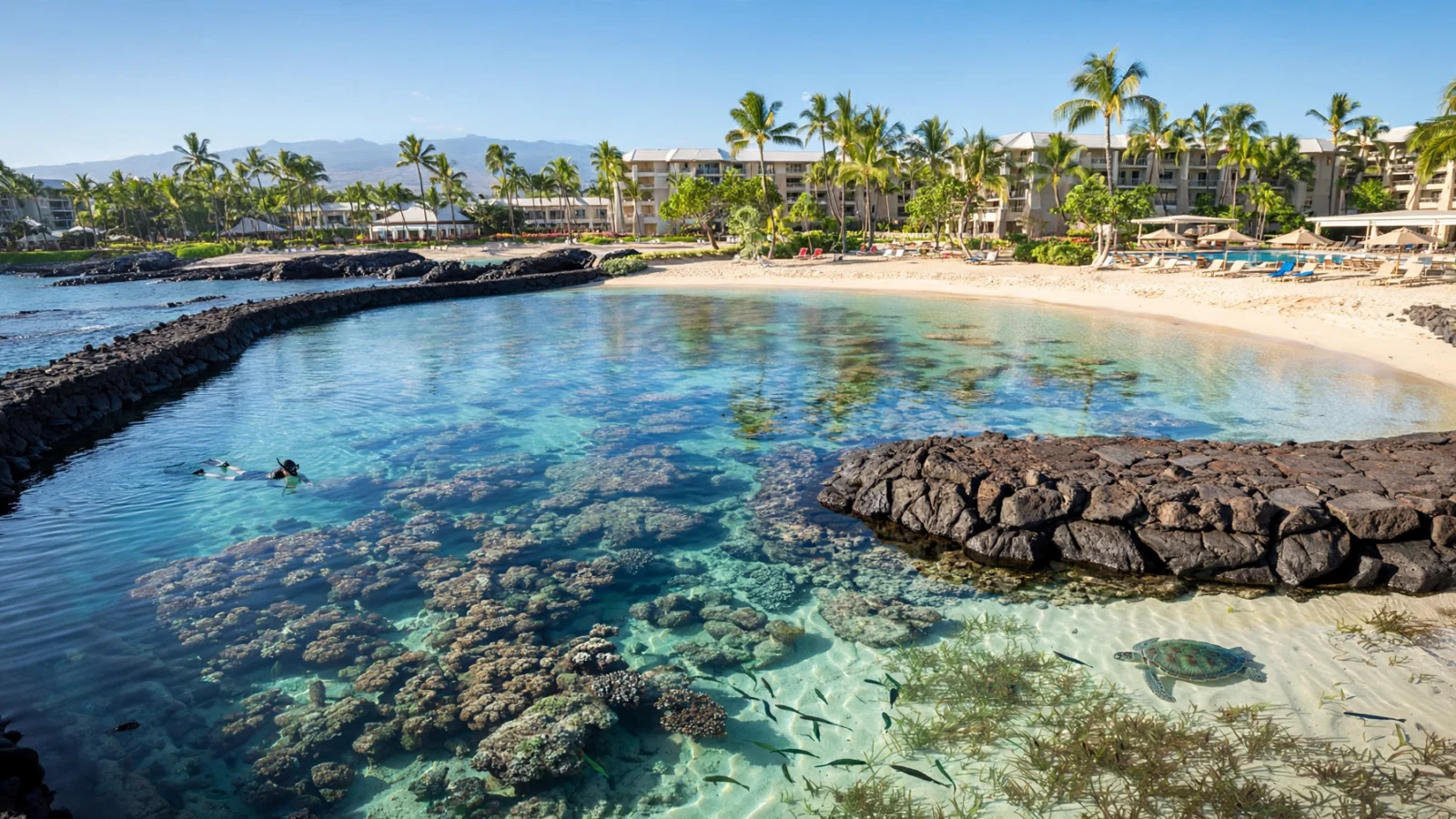
Pauoa Bay is the calm lagoon hiding in plain sight in front of the Fairmont Orchid — and it confuses almost everyone who tries to visit it without staying there. Search for it and you get hotel reviews, a photography FAQ, a general beach listing and one short paragraph inside a snorkeling roundup. Half the internet files it under the wrong resort bay entirely, folding it into Makaiwa Bay a mile south, and almost nobody answers the questions a day visitor actually has: is this beach public, where do I park if I am not a guest, which facilities am I allowed to use, and where exactly do I swim once I get there? Our Makaiwa Bay guide has carried Pauoa as a comparison stop. This page gives Pauoa Bay the full treatment it has never had: the three public-access routes decoded, the snorkel route from the lagoon to the reef at the bay mouth, and the honest split between the sheltered inside water and the outside reef that does not belong to beginners.
The honest summary, up front: Pauoa Bay is one of the gentlest snorkels on the Kohala Coast — a lava-walled lagoon with a sandy entry, scattered coral that builds into a proper reef as you swim out, frequent green sea turtles, and a coral restoration site the resort’s team works on. It is also a resort beach in every practical sense except the legal one. The sand and the water are public, as every beach in Hawaii is public. The chairs, umbrellas, rentals and beach shack are the hotel’s, for guests. There is no lifeguard. And the parking puzzle has three different correct answers depending on how much you want to walk. Get those ground rules straight and Pauoa is a superb morning snorkel, especially for confident beginners. Arrive expecting a county beach park and you will spend your first half hour wandering resort paths wondering whether you are trespassing. You are not — but read the access section before you go.
Quick facts
- Location: Pauoa Bay, fronting the Fairmont Orchid hotel inside the Mauna Lani Resort area, Kohala Coast, Big Island — the next bay north of Makaiwa Bay
- The snorkeling, honestly: A protected lagoon with a sandy entry, coral that starts scattered and improves steadily outward until it covers the bottom toward the bay opening, a cave arch and small canyon feature mid-bay, turtles year-round. The reef inside the lagoon is the beginner zone; the water outside the barrier rocks is a different, current-prone proposition
- Lifeguard: None. The bay is calm, but it is unsupervised — snorkel with a buddy
- Fees and reservations: No beach fee and no reservation for the beach itself. Public parking options split free and resort-managed — see the access section; do not rely on a fee figure from any website, including this one, without checking at the gate on the day
- Parking: Three routes: free public parking at Holoholokai Beach Park plus a coastal walk of roughly 0.4 miles; designated public beach-access parking at the Fairmont Orchid via the security gate; or the Pauoa Road public lot and its paved trail
- Facilities: Guaranteed public facilities (restrooms, showers, picnic tables) are at Holoholokai Beach Park. At the bay itself the facilities are resort-side — restrooms and showers sit near the beach by the hotel, while chairs, umbrellas and gear rentals are for Fairmont guests
- Best time: Early morning, before the trade-wind breeze builds. The lagoon is sheltered in most conditions; big winter northwest swells can still rough up the bay mouth
- The one rule that matters: Stay inside the lagoon unless conditions are genuinely calm and you are an experienced, finned snorkeler. The resort itself does not recommend swimming beyond the lagoon, and currents outside the barrier rocks can be strong
Is Pauoa Bay public? Yes — here is how the access actually works
Every beach in Hawaii is public up to the high-water mark, and Pauoa Bay is no exception — the Fairmont Orchid fronts the bay, it does not own it. What the hotel does own is everything behind the sand: the lawns, the paths, the loungers, the Beach Shack and the parking lots. That split is the whole puzzle, and once you understand it, three clean public routes in exist.
Route 1: Holoholokai Beach Park — free parking, the scenic walk
This is the route we recommend for most day visitors. Holoholokai Beach Park is the county-style shoreline park just north of the Fairmont Orchid, reached by its own access road before the hotel entrance. Parking there is free and public, and the park has the facilities Pauoa itself lacks for day visitors: restrooms, showers and picnic tables under the trees. From the lot, follow the shoreline path south — left as you face the ocean — past a signature golf hole and along the coast for roughly 0.4 miles until the path delivers you to Pauoa Bay’s white sand.
Two honest caveats. First, Holoholokai’s own shore is a rocky black-and-white stone beach: beautiful for picnics, sunset and the Puako petroglyph trail, but a poor swimming entry — do not judge Pauoa by the water in front of the car park. Second, the walk is exposed Kohala sun on a mix of sand, rock, grass and paved path; wear real footwear, carry water, and do the walk in the morning cool if you can.
Route 2: the Fairmont Orchid’s designated public parking
The resort operates designated public beach-access parking, the standard Mauna Lani arrangement for shoreline access. The drill: stop at the resort security gate, tell them you are there for public beach access to Pauoa Bay, and follow their directions to the designated parking and the short beach access trail. Sources describe this parking as paid or resort-managed, and rates and arrangements change — this guide deliberately publishes no dollar figure, because none could be verified for 2026. Ask at the gate, take the pass or ticket they give you, and park only where directed. This route is the shortest walk of the three and the right choice if the Holoholokai walk is too much for someone in your group.
Route 3: Pauoa Road public lot
A public parking lot off Pauoa Road, near the Shops at Mauna Lani side of the resort, feeds the paved shoreline trail system — the same lot our Makaiwa directions use for the fishpond path. From it, paved trails run through the resort grounds toward the coast; for Pauoa, follow the shoreline north past Makaiwa Bay. It is the longest of the three routes to Pauoa specifically, but it pairs naturally with a two-bay day: snorkel Makaiwa Bay first, walk the coast path north, and finish at Pauoa.
What is NOT yours to use
The beach loungers and umbrellas on Pauoa’s sand belong to the Fairmont Orchid and are set out for guests; the Beach Shack’s rental gear and its Fun & Sun activity passes are likewise guest products. Day visitors should arrive self-contained: your own mask, fins, towel, water, reef-safe sunscreen and shade plan. Restrooms and outdoor showers exist near the beach on the resort side, but treat Holoholokai’s public facilities as your guaranteed option — shower and change there on your way out if the resort-side arrangement is unclear on the day. None of this is a reason to skip Pauoa. It is simply a resort-front beach, and visiting it well means arriving like a self-sufficient guest of the coastline rather than a customer of the hotel.
The snorkeling: lagoon, arch and reef
Pauoa Bay reads from the sand like a pond — a crescent of white sand cupped by dark lava walls, calm blue water inside, the open ocean working beyond the rocks. Those natural seawalls are the whole story: they strip the energy out of the surf before it reaches the lagoon, which is why the bay stays swimmable on days when exposed Kohala beaches are wind-chopped. Here is how the snorkel unfolds, zone by zone.
The entry and the inner lagoon
Enter anywhere along the sandy centre of the beach — the entry is sand, gentle and wading-depth, which makes Pauoa one of the easiest first snorkels on this coast for beginners. The inner lagoon is shallow, warm and mostly sand with scattered coral heads: good for a first float, a nervous swimmer’s practice session, and children who are already comfortable in the water — always within arm’s reach of an adult, because calm is not the same as supervised and there is no lifeguard here. Expect small reef fish around the coral heads, the occasional pufferfish, and needlefish hovering just under the surface film, silver and nearly invisible until they move.
The mid-bay: arch, canyon and the building reef
The snorkeling improves on a clear gradient — the further you swim from the sand, the better it gets. The reef starts scattered, then coral begins to cover the bottom as the bay slowly deepens toward its opening. Mid-bay, look for the route’s two landmarks: a small cave arch in the reef and a shallow canyon feature you can follow outward like an underwater path. Butterflyfish, eels tucked into the structure, rays over the sand channels and a large general population of reef fish work this middle zone. Local descriptions call Pauoa’s reef one of the healthiest on the island — that is a guidebook claim rather than a measurement, but the coral cover toward the bay mouth is genuinely denser than most resort-front lagoons, and the bay holds a coral restoration site where the resort’s ocean team outplants and tends coral; the hotel runs guided snorkels to it for guests. If you come across frames, markers or neatly tended coral patches, you have found it: look, photograph, and touch nothing — restored coral is the most fragile coral in the bay.
The bay mouth and outside the rocks: the line you do not cross casually
At the opening of the bay the reef is at its richest — and the ocean starts making its own rules. Everything outside the barrier rocks is exposed water: snorkelers and swimmers in fins do venture out there on genuinely calm, low-surf days and are rewarded for it, but currents can be strong, the Fairmont itself does not recommend swimming beyond the lagoon, and other local guidance is blunt that anyone unfamiliar with these waters should stay inside the bay. Our verdict matches theirs: the outside reef is an experienced-snorkeler, flat-day, buddy-always extension — never a first snorkel, never on a building swell, and never as a solo swim. The honest secret of Pauoa is that you do not need it. The lagoon-to-mid-bay route already delivers coral, fish and turtles in water a confident beginner can handle.
The second lagoon and the salt-and-pepper beach
Just south of the main bay sits a second, smaller lagoon — shallower, less frequented because it has no real sandy beach, and safe for children in the small sandy pockets. It is a quiet add-on rather than a destination: worth a float if the main bay feels busy. And along the shoreline south of Pauoa, a salt-and-pepper sand beach is where green sea turtles most often haul out to rest. See them from a respectful distance — the full 10-foot rule applies on sand exactly as in the water — and never position yourself between a resting turtle and the sea.
What you will see
- Green sea turtles (honu): the bay’s signature animal — feeding over the reef, cruising the lagoon, and resting on the salt-and-pepper beach to the south. Frequent, never guaranteed
- Reef fish: butterflyfish, triggerfish and pufferfish among the coral heads; needlefish holding at the surface; general reef-fish density that builds toward the bay mouth
- Eels and rays: moray eels in the mid-bay structure; rays over the sand channels
- The restoration site: tended coral outplants — the bay’s conservation story, and a strict look-don’t-touch zone
- In winter: humpback whales are a from-shore sighting on this coast in season — surface entertainment between snorkels, not an in-water encounter to plan around
A note on the famous claim: you will read that Pauoa Bay is home to “one of the healthiest coral reefs in Hawaii,” a line repeated by beach directories and attributed to conservation work with the University of Hawaii. Treat it as enthusiasm with a real basis — an active restoration programme and a protected, low-pressure lagoon — rather than a ranked scientific title. What a snorkeler can verify personally is simpler: the coral here is in visibly good shape for a resort-front bay, and it gets better the further out you swim.
Conditions and the best time to go
Morning wins, as it does everywhere on the Kohala Coast. The lagoon is at its glassiest before the breeze builds; afternoons bring texture to the surface even inside the walls. The Kohala Coast is the island’s dry, sunny shore, so Pauoa is a reliable plan when Hilo-side spots are rained out — check our best time to snorkel in Hawaii guide for the island-wide seasonal picture.
Winter is the judgment call. From roughly November through March, big northwest swells wrap the Kohala Coast. The lagoon’s lava walls absorb most of it, and the inner bay usually stays snorkelable when open-coast spots do not — but the bay mouth and everything outside the rocks are off the menu on swell days, and a large enough swell will cloud even the lagoon. Read the water from the sand for ten minutes before committing: if whitewater is pouring over the barrier rocks rather than breaking on them, stay in the shallows or make it a Holoholokai picnic and petroglyph day instead.
Tide and visibility. The bay is forgiving about tide — the lagoon holds water at any stage — but visibility follows the usual Hawaii rules: best on calm mornings after a dry, settled stretch, worst after swell has stirred the bottom. Plan your visit for sunrise-to-mid-morning and you will rarely be disappointed. As a resort shoreline, treat the beach as a daylight-hours visit.
Safety at Pauoa Bay
- No lifeguard. Kona-side listings are explicit: no lifeguards, and (for the public visitor) no county facilities at the sand. Calm water lowers risk; it does not remove it. Snorkel with a buddy, tell someone your plan, and keep beginners inside the lagoon
- The inside/outside split is the whole safety briefing. Inside the lava walls: sheltered, shallow, sandy. Outside: current-prone open ocean that the resort itself advises swimmers against. Know which side of the rocks you are on at all times — it is easy, mid-snorkel and head-down, to drift further out than you meant to. Check your position against the beach regularly
- Coral and lava are sharp. The entry is sand, but the bay’s edges and the walk from Holoholokai cross lava rock. Reef shoes help on the paths; in the water, float — never stand on coral, for the reef’s sake and your feet’s
- Needlefish at the surface. The long, silver needlefish that hover at the surface film are startling up close and best given room; they are also one more reason night snorkeling is not a Pauoa activity for visitors
- Turtles are protected. Ten feet minimum, no touching, no chasing, no crowding a resting honu for a photograph — the standard turtle etiquette that applies everywhere in Hawaii
- General Hawaii ocean rules apply: if in doubt, don’t go out — and our full Hawaii snorkeling safety guide covers currents, jellyfish windows and the pre-snorkel checklist
Pauoa Bay vs Makaiwa Bay: which Mauna Lani lagoon?
These two bays, a mile apart inside the same resort coastline, get mixed up constantly — our Makaiwa guide carries a comparison table for exactly this reason. The short version:
| Pauoa Bay (this guide) | Makaiwa Bay | |
|---|---|---|
| Fronts | Fairmont Orchid | Mauna Lani Beach Club |
| The water | Lava-walled lagoon; reef builds toward the bay mouth; restoration site | Sand cove; reef at the edges; fishpond cultural setting |
| Public access | Holoholokai lot + 0.4-mi walk, resort-gate public parking, or Pauoa Rd lot | Pauoa Road lot + fishpond path (~10–15 min) |
| Facilities for day visitors | None at the bay — public facilities at Holoholokai | None at the bay — bring everything |
| Snorkeling character | Gradient reef: lagoon practice → mid-bay arch/canyon → rich bay mouth | Gentle cove snorkel with turtles; cultural walk pairing |
| Best for | A fuller reef route in a sheltered lagoon | An easy cove snorkel plus the fishpond trail |
Neither is “better” — they are two halves of the same coastline, and the paved shoreline trail means an ambitious morning can honestly do both. If you only have one, Pauoa’s reef gradient gives it the edge for snorkelers who have already done a few swims; Makaiwa’s setting gives it the edge for a slower, culture-and-cove day.
Nearby snorkeling spots
- Makaiwa Bay — the sister lagoon a mile south, via the same trail system
- Puako Bay — the local, non-resort reef just north: six public access points, tide pools, a wilder feel
- Waialea Beach (Beach 69) — the locals’ bay beyond Puako, best coral on its south side
- Hapuna Beach — the big white-sand state park beach; snorkel the rocky ends on calm days
- Mauna Kea Beach (Kauna’oa) — the classic crescent further north, with its own public-parking quota to plan around
- The full coast is mapped in our Big Island snorkeling hub
Frequently asked questions
Is Pauoa Bay open to the public?
Yes. All beaches in Hawaii are public, and Pauoa Bay is no exception — the Fairmont Orchid fronts it but does not own the sand or the water. What is private is the resort’s equipment and grounds behind the beach: loungers, umbrellas, rentals and the Beach Shack are for guests. Day visitors use the designated public access routes and parking described in this guide and bring their own gear.
Where do you park for Pauoa Bay if you are not staying at the Fairmont Orchid?
You have three options. The free public lot at Holoholokai Beach Park, followed by a shoreline walk of roughly 0.4 miles south to the bay. The Fairmont Orchid’s designated public beach-access parking, arranged at the resort security gate — ask there about the current arrangement rather than trusting any fee quoted online. Or the Pauoa Road public lot, with a longer paved-trail approach via Makaiwa Bay.
Is Pauoa Bay good for beginner snorkelers?
It is one of the better beginner spots on the Kohala Coast, with conditions: a sandy, shallow, surf-sheltered lagoon entry, coral and fish within the inside water, and turtles as a bonus. The conditions are that there is no lifeguard, beginners must stay inside the lagoon rather than following the reef out of the bay, and a calm morning will always beat a windy afternoon. True first-timers may still prefer a lifeguarded spot from our beginners guide for their very first swim.
Are there lifeguards, restrooms and showers at Pauoa Bay?
There is no lifeguard. Restrooms and outdoor showers sit near the beach on the resort side, but the facilities a day visitor can count on — restrooms, showers and picnic tables in a public park — are at Holoholokai Beach Park, where the free public parking is. Plan your day around Holoholokai for facilities and Pauoa for the snorkel.
Can you see turtles at Pauoa Bay?
Frequently, yes. Green sea turtles feed over Pauoa’s reef, cruise the lagoon, and often rest on the salt-and-pepper sand beach just south of the bay. Sightings are never guaranteed, and the rules are strict everywhere in Hawaii: stay at least 10 feet (3 metres) away, never touch or chase, and never get between a turtle and the ocean.
What is the coral restoration site at Pauoa Bay?
The bay hosts an active coral restoration site tended with the resort’s ocean team, and the hotel runs guided snorkels to it for its guests. For independent snorkelers it is a look-only zone: if you see frames, markers or carefully arranged coral patches in the mid-bay, enjoy the sight of a reef being rebuilt and touch absolutely nothing — outplanted coral is exceptionally fragile.
Is it safe to snorkel outside the lagoon at Pauoa Bay?
Only in the narrowest circumstances: genuinely calm, low-surf conditions, fins on, a buddy beside you, and real open-water experience. Currents outside the barrier rocks can be strong, the resort does not recommend swimming beyond the lagoon, and local guidance tells unfamiliar swimmers to stay inside the bay. The reef inside the bay mouth already delivers most of what Pauoa offers — the outside is an optional extension, never the main event.
How is Pauoa Bay different from Makaiwa Bay?
They are separate lagoons about a mile apart inside the Mauna Lani coastline. Pauoa fronts the Fairmont Orchid and offers a reef that builds from a sheltered lagoon to a coral-covered bay mouth, plus the restoration site; Makaiwa fronts the Mauna Lani Beach Club and pairs a gentle cove snorkel with the historic fishpond trail. Public access, parking and facilities differ between them — the comparison table above lays it out, and the shoreline trail connects the two for a two-bay day.