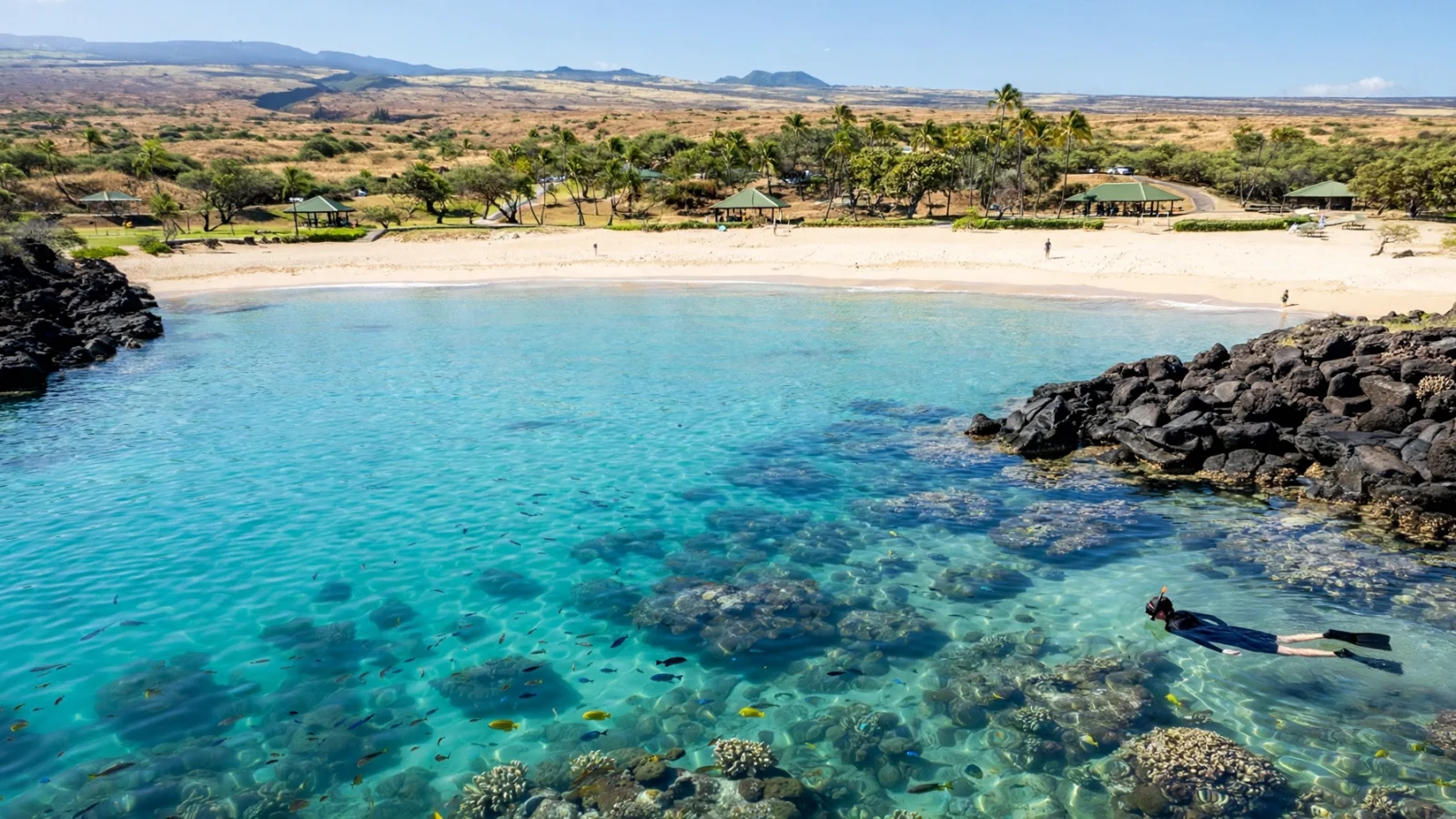
Hapuna Beach is famous as a swimming and bodyboarding beach — a long crescent of white sand on the Kohala Coast that has twice been named the best beach in America. Snorkeling is the activity most guides barely mention, usually in a single line: “good at either end when it’s calm.” That line is true, but it leaves out everything that decides whether your snorkel is worth it: which end to choose, when the shorebreak makes entry a bad idea, what it costs to get in, and the fact that there is currently nowhere at the beach to rent gear or buy food.
This guide covers Hapuna purely as a snorkeling spot — the north cliff and the south rocky point compared directly, the conditions that make or break a session, exact visitor fees, and an honest verdict on who should snorkel here and who should drive ten minutes to a calmer reef instead.
Quick answer: is Hapuna Beach good for snorkeling?
Yes — on a calm morning, and with the right expectations. The snorkeling is at the rocky points at each end of the beach, not over the sand in the middle. Expect plenty of reef fish and a fair chance of turtles, but very little coral and visibility that is often reduced by kicked-up sand. Hapuna is a beach first and a snorkel spot second: go for a great beach day with a good snorkel attached, not for the Big Island’s best reef. For a dedicated reef session, Kealakekua Bay and Two Step are in a different league.
Where to snorkel at Hapuna: the two ends compared
Hapuna is about half a mile of sand (sources vary between a third and half a mile) with lava rock at both ends. The sand flat in the middle is fishless and exposed to the shorebreak — the snorkeling is entirely at the points.
The south rocky point
The south end is the most commonly recommended entry. The rocks here create a slightly more sheltered pocket than the open beach face, and the reef fish gather along the lava edge where it meets the sand. Entry is over sand next to the rocks — never climb over the lava itself, which is sharp and slippery. This is the better end for a first Hapuna snorkel and for staying closer to the lifeguard tower’s line of sight.
The north cliff (Westin end)
At the north end, below the cliff by the Westin Hapuna Beach Resort, a more protected inlet holds reef fish and occasional turtles. The structure here is more interesting, but there is a catch the other guides underplay: reaching the far reef is a swim of 1,000 feet or more, and once you round the point you are out of the lifeguards’ sight. Treat the north end as a stay-close snorkel — work the inlet and the near rocks rather than following the cliff out.
| South rocky point | North cliff | |
|---|---|---|
| Best for | First visit, shorter swims | Calmer days, turtle chance |
| Entry | Sand beside the rocks | Sand at the inlet |
| What you see | Reef fish along the lava edge | Reef fish, occasional turtles |
| Main caution | Shorebreak on the open face | Long swim; out of lifeguard sight past the point |
What you will see
Hapuna’s points hold the standard Kohala Coast reef community: butterflyfish, yellow tangs and other surgeonfish, parrotfish, triggerfish and wrasses, with green sea turtles seen most often around the north inlet. What you will not see is a coral garden — hard coral cover is sparse (mostly lobe and mound corals), so set your expectations to fish and turtles over lava rock, not coral heads. Keep the legal distance from turtles — 10 feet — and never chase or touch them; our guide to snorkeling with turtles in Hawaii covers the viewing rules.
Two visibility quirks are worth knowing. First, the fine white sand that makes the beach beautiful gets kicked up easily, so underwater visibility is often lower than at rocky-entry spots like Two Step. Second, a thin surface layer of fresh water can blur the top of the water column after rain. Both are reasons to snorkel early, before wind and crowds stir the bottom.
Best time to snorkel Hapuna
Season: summer and the calm shoulder months are Hapuna’s snorkeling season. In winter, north-west swells hit this coast directly and the beach is known for a powerful shorebreak — on swell days, do not snorkel here at all. The official park guidance is blunt: waves over 3 feet are for experts only, and the park lists Dangerous Shorebreak and Strong Current among its hazards.
Time of day: go in the morning. Conditions are calmest before the trade winds pick up, the sand is unstirred, and you will have the points mostly to yourself. Our best time to snorkel in Hawaii guide explains the morning pattern in detail.
Why is Hapuna Beach dangerous? (A common search — 170 people a month ask it.) The danger is the shorebreak: waves that break directly onto the sand in shallow water, plus strong currents around the points. It is a genuine hazard for swimmers and bodyboarders in winter surf. For snorkelers the rule is simple — if there is surf, skip Hapuna and choose a protected bay instead. Read our Hawaii snorkeling safety guide before any ocean session.
Is Hapuna good for beginners?
With conditions attached, yes. On a calm summer morning, a confident beginner can snorkel the south point or the north inlet in shallow water over sand-and-rock, staying close to shore. But Hapuna has no sheltered lagoon and no gentle reef flat: if there is any shorebreak, this is not a beginner spot. First-timers who want a calmer first session should start with the protected water at Kahalu’u Beach Park and work through our beginners’ guide to snorkeling in Hawaii — and if you are new to the basics, how to snorkel covers entry technique step by step.
Fees, parking and hours (verified October 2026)
Hapuna is a State Recreation Area managed by the DLNR Division of State Parks. Visitor costs, confirmed on the official park page:
| Item | Cost / detail |
|---|---|
| Park hours | Daily 7:00am–7:30pm; gates close 8:00pm |
| Entry (non-residents) | $5 per person, credit card only; children 3 and under free |
| Parking (non-residents) | $10 per vehicle |
| Hawaii residents | Free entry and parking with Hawaii ID |
| Facilities | Restrooms, showers, picnic pavilions and tables, water fountains, ADA access |
| Lifeguard | Lifeguarded beach; hours are not published — and the points are out of lifeguard sight once you round them |
Fees can change, so check the DLNR park page on the day. Two time-sensitive warnings as of October 2026: the on-site food concession is temporarily closed, and day use is open during post-hurricane recovery while camping and the A-frame cabins remain closed. Check the DLNR park notices for same-day status before you drive out.
Gear: bring your own — there are no rentals at the beach
Because the concession is closed, there is currently no food and no snorkel gear rental operating at Hapuna. Searches for “hapuna beach snorkel rentals” lead to shops in Waikoloa and Kawaihae, a drive away — so bring your own kit or rent before you come. Our Hawaii snorkeling gear checklist covers what to bring, including the reef-safe sunscreen Hawaii law requires.
Hapuna vs Mauna Kea (Kaunaoa Bay): the Kohala comparison
Ten minutes north, Kaunaoa Bay at Mauna Kea Beach is Hapuna’s natural comparison — another long white-sand Kohala crescent with its snorkeling at the rocky ends, and a smaller, quieter feel. The beach is public: non-guests collect a free public-access parking pass at the Mauna Kea Beach Hotel guard gate, but passes and parking are limited and first-come, so arrive early or you may be turned away. Hapuna wins on guaranteed access (pay and park), facilities and space; Kaunaoa wins on calm and crowd levels when you can get in. Both belong in a Kohala beach day — see the full coast picture in our Big Island snorkeling hub.
Nearby Big Island snorkeling
Hapuna sits on the driest, sunniest coast in Hawaii, which is why its conditions are so reliable in summer. Build a Kohala-to-Kona snorkel run with the spots in our Big Island hub: the Kona-side reefs at Kealakekua Bay, Two Step and Kahalu’u, the night dive at the Manta Ray Night Snorkel, and the rain-fed east side in our Hilo snorkeling guide with Carlsmith Beach Park and Richardson Beach Park. If you prefer to snorkel from a boat, our Hawaii snorkeling tours guide compares operators across the islands.
Two more Kohala neighbours now have dedicated guides of their own: sheltered Beach 69 in our Waialea Beach snorkeling guide, just south of Hapuna, and the quiet resort-front reef in our Mauna Kea Beach snorkeling guide at Kaunaoa Bay, ten minutes north.
Hapuna Beach snorkeling FAQ
Can you snorkel at Hapuna Beach?
Yes. Snorkeling is an officially listed activity at Hapuna Beach State Recreation Area. Snorkel at the rocky points at either end of the beach — the sand flat in the middle has little marine life and takes the full shorebreak.
Is Hapuna Beach good for snorkeling?
On calm days, yes — for reef fish and occasional turtles over lava rock. It is not a coral site, and visibility is often reduced by sand. Treat it as a great beach with a good snorkel attached, not the Big Island’s best reef.
Where is the best snorkeling at Hapuna Beach?
The south rocky point for a first visit and shorter swims; the north cliff inlet below the Westin for a more protected pocket and turtle chances — but do not follow the north cliff out past the point, where you leave the lifeguards’ line of sight.
How much does Hapuna Beach cost?
For non-residents, $5 per person entry plus $10 per vehicle parking, credit card only (verified October 2026). Hawaii residents with ID enter and park free. Children 3 and under are free.
What are Hapuna Beach’s hours?
The park is open daily 7:00am–7:30pm and the gates close at 8:00pm.
Can you rent snorkel gear at Hapuna Beach?
Not at the moment. The beach concession is temporarily closed (October 2026), so there is no rental or food service at the beach. Bring your own gear or rent in Waikoloa or Kawaihae before you arrive.
Is Hapuna Beach safe for snorkeling?
On calm days, for swimmers who stay near shore, yes. The park lists Dangerous Shorebreak and Strong Current as hazards and states that waves over 3 feet are for experts only. If there is surf — especially in winter — do not snorkel here.
Hapuna or Mauna Kea Beach for snorkeling?
Hapuna for guaranteed paid parking, facilities and space; Kaunaoa Bay (Mauna Kea) for a quieter, calmer session if you arrive early enough to get one of the limited free public-access parking passes at the hotel guard gate.