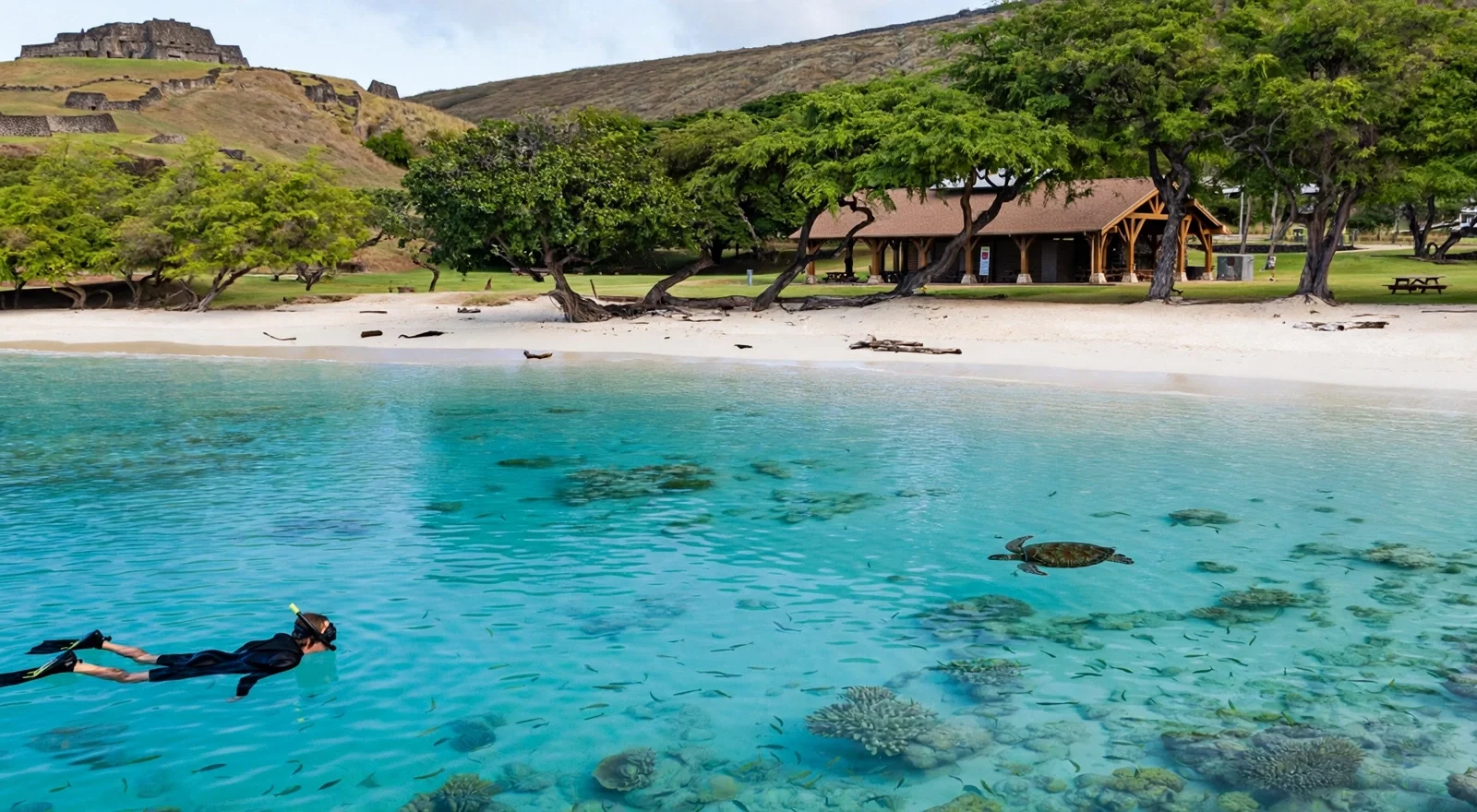
Spencer Beach Park is the Big Island’s family beach first and a snorkel spot second — and most guides never get past the first half of that sentence. They will tell you about the white sand, the shade trees and the calm water, and then stop, as if the snorkeling were just “get in, it’s calm.” There is more to it than that. At the north end of this crescent, past the sandy swimming zone, a shallow reef holds real coral, working reef fish and some of the most reliable turtle encounters on the Kohala Coast — in water calm enough for a first-timer on most mornings.
There is also a catch nobody leads with: the clarity here is modest, and the lifeguard cover is thinner than the family-beach reputation suggests. This guide covers Spencer purely as a snorkeling spot — exactly where the reef is, what the water is honestly like, when the lifeguards are actually on duty, and how it compares with Hapuna and Waialea just down the coast, so you can pick the right Kohala beach for the snorkel you actually want.
Quick facts
| Entry fee | None — cou
What you will seeSet expectations by the visibility and Spencer over-delivers. Inside 10–20 feet of clear-enough water, the north-end reef holds a proper cross-section of Hawaiian reef life:
Our snorkeling with turtles guide covers the viewing distances and protections behind every animal on that list. Best time to snorkel Spencer Beach ParkTime of day: before 10am. Spencer’s modest visibility is at its best in the calm of the morning — typically 10–20 feet. As the day warms up, the wind textures the surface and stirs the shallows, and clarity can drop to the point where the reef looks washed out. The early window also beats the weekend crowds to the parking lot. Season: most of the year, with a winter asterisk. The offshore reef and the harbour works to the north break up the wave train before it reaches the sand, so Spencer stays swimmable on many days when exposed Kohala beaches are rough. The honest exception is a large winter swell — roughly November to February — which can push higher surf and stronger rip currents into even this protected bay. On those days the family-beach reputation does not apply: check the surf report, read the posted signs, and be ready to make it a heiau-and-picnic day instead. Our best time to snorkel in Hawaii guide explains the island-wide swell calendar behind that rule. One local quirk worth knowing: Portuguese man-o-war are reported off this coast in varying numbers in the days around ten days after a full moon. If the lifeguards or signs mention them, believe them — a man-o-war sting is a bad way to end a beach day. Parking, access and facilitiesThis is one of the easiest logistics packages on the Kohala Coast: a free county parking lot a flat two-minute paved walk from the sand, no entry fee and no reservation for day use, restrooms, outdoor showers and drinking water, a large picnic pavilion with electrical outlets, picnic tables, barbecue grills, grassy lawns and tennis and basketball courts. The paved paths make the park genuinely accessible for strollers and wheelchairs. Three practical warnings:
Camping is allowed in the designated ar Pair the snorkel with Pu’ukoholā HeiauSpencer is the rare snorkel spot where the best thing to do after your swim is a thousand years of history, five minutes uphill. Pu’ukoholā Heiau National Historic Site, directly above the park, protects the massive stone temple Kamehameha I built in 1790–91 in fulfilment of a prophecy that he would unite the Hawaiian Islands — which he then did. The free visitor centre and the walk up to the heiau take under an hour and completely change how the coastline below feels. The smaller Mailekini Heiau sits below Pu’ukoholā, by Pelekane Beach: that shoreline is a sacred area, so view it as part of the historic site — it is not a swim or snorkel spot, and this guide does not treat it as one. Plan the order by the water, not the history: snorkel first in the calm morning, then walk the heiau late morning before the heat peaks, then take the long shaded picnic lunch Spencer was built for. Spencer Beach vs Hapuna and Waialea
Full guides: Hapuna Beach and Waialea Beach, and the full island picture is in the Big Island snorkeling hub. Nearby spotsSpencer anchors the north end of the Kohala snorkel run. Ten minutes south, Waialea Beach and Hapuna offer stronger reefs with less forgiving entries; beyond them, Mauna Kea Beach and Waikoloa’s A-Bay continue the coast south. A short coastal trail from Spencer’s south end also leads to little Mau’umae Beach — worth the walk for the quiet sand, though its snorkeling is far more exposed than Spencer’s and only for calm days and confident swimmers. Bring your full kit from our gear checklist — remember, there is no rental stand at Spencer itself. Stay for sunset if you can: the light over Kawaihae Bay, with Haleakalā floating across the channel on a clear evening, is the locals’ finish to a Spencer day. FAQWhere is the best snorkeling at Spencer Beach Park?At the north end of the beach. The centre of the bay is a sandy swimming zone; the reef, coral and fish are along the structure toward the north end and the breakwater. Enter over the sand, swim parallel to shore, and work the reef edge slowly — staying well clear of the harbour entrance and boat traffic. Is Spencer Beach Park good for beginners?Yes — one of the Big Island’s easiest beginner snorkels on a calm morning: a sandy entry, a shallow reef-protected bay, and a route you can do in short legs. The one caveat is lifeguard cover, which the county lists on weekends and holidays only, so on a weekday snorkel with a buddy and treat it as an unguarded beach. Is there a lifeguard at Spencer Beach Park?Sometimes. Hawaii County lists lifeguard cover at Spencer on weekends and holidays only, roughly 9:30am–4pm. Many guides imply daily cover; the county schedule is the one to plan around. Check the tower when you arrive. How much does parking cost at Spencer Beach Park?Nothing. The county lot is free, with no entry fee or reservation for day use. It fills by about 9:30am on sunny weekends and holidays, so arrive early. Camping in the park needs a Hawaii County permit arranged in advance. What will I see snorkeling at Spencer Beach Park?Parrotfish, surgeonfish and humuhumunukunukuapua’a over the north-end reef, and Hawaiian green sea turtles — seen frequently here, especially around the reef toward the breakwater. Visibility is modest (typically 10–20 ft on calm mornings), so expect a good neighbourhood reef, not Kealakekua-style clarity. Can you snorkel Spencer Beach Park year-round?On most days, yes — the offshore reef and harbour works keep the bay calm when other Kohala beaches are rough. A large winter swell is the exception: it can bring higher surf and rip currents into the bay, so check the surf report and posted signs, especially from November to February. What else is there to do at Spencer Beach Park?The park has a large picnic pavilion, barbecue grills, picnic tables, shade trees, sports courts and a permitted camping area. Directly above the beach, Pu’ukoholā Heiau National Historic Site — Kamehameha I’s great temple of 1790–91 — is a free, one-hour visit that pairs perfectly with a morning snorkel. Are there sharks at Spencer Beach Park?Small reef sharks have occasionally been reported in the shallows around the north-end reef. They are shy, uncommon, and not a feature of a normal Spencer snorkel — if you are lucky enough to see one, watch it calmly from a distance and give it a clear path away. Facts checked against Hawaii County park information, Pu’ukoholā Heiau National Historic Site sources, and Big Island snorkeling guides, October 2026. Conditions change daily — always check the surf report and posted signs before entering the water, and check the lifeguard tower for the day’s cover and conditions. ea with a Hawaii County permit arranged in advance. The entry gate locks at night (about 9pm, reopening early morning) with no re-entry after it closes, and there is no camping in the pavilions. Is Spencer Beach good for beginners and kids?For beginners and kids, this is one of the kindest classrooms on the Big Island — with one caveat that matters. In its favour: a sandy, gently sloping entry with no rocks or coral to cross, a reef-protected bay that is calm on most days, a shallow route the whole way to the reef, and full facilities behind the beach. A child’s first mask session in the sandy shallows, or a beginner’s first reef swim along the north end on a calm morning, both work beautifully here. Start with our beginners’ guide for the buddy and breathing basics first. The caveat is the lifeguard schedule. Hawaii County lists lifeguard cover at Spencer on weekends and holidays only (about 9:30am–4pm). Many guides simply say “lifeguard on duty,” which is not the weekday reality. On a weekday, snorkel here as you would at an unguarded beach: never alone, children within arm’s reach, and out of the water before anyone is tired. The rules in our snorkeling safety guide apply in full. When a lifeguard is on duty, check in — they will tell you exactly what the bay is doing that day. nty beach park, free parking, no reservation for day use |
||||||||||||||||||||||||||||||||
| Lifeguard | County lists cover on weekends and holidays only (about 9:30am–4pm) — on a weekday, plan as if there is none; check the tower on arrival | ||||||||||||||||||||||||||||||||
| Entry | Wide sandy entry; sand bottom for roughly the first 20 yards | ||||||||||||||||||||||||||||||||
| Best snorkeling | North end of the beach — reef and coral toward the breakwater | ||||||||||||||||||||||||||||||||
| Visibility | Modest — typically 10–20 ft on calm mornings, less when the wind builds | ||||||||||||||||||||||||||||||||
| Restrooms / showers | Yes — restrooms, outdoor showers, drinking water, large picnic pavilion | ||||||||||||||||||||||||||||||||
| Camping | Allowed in the park with a Hawaii County permit only; the entry gate locks at night | ||||||||||||||||||||||||||||||||
| Parking | Free county lot; fills by about 9:30am on sunny weekends and holidays | ||||||||||||||||||||||||||||||||
| Shade | Excellent — large trees and pavilions (but see the kiawe-thorn warning below) | ||||||||||||||||||||||||||||||||
| Rentals / food | None at the park — bring gear and food, or stop in Kawaihae |
Quick answer: is Spencer Beach Park good for snorkeling?
Yes — for the right expectations. Spencer is one of the easiest shore snorkels on the Big Island: a sandy entry, a reef-protected bay, and a genuine reef at the north end with frequent turtles. What it is not is a clarity spot. Visibility is typically 10–20 feet rather than the 50-plus you get at Kealakekua Bay or Two Step, and the fish life, while real, is a neighbourhood reef rather than a showcase. Come here for a calm, easy, family-length snorkel five minutes from your picnic table — especially with beginners or kids — and go to the Kona-side reefs when underwater clarity is the whole point of the day.
Where Spencer Beach Park is
Samuel M. Spencer Beach Park sits on Kawaihae Road on the Kohala Coast, just south of Kawaihae Harbor and about 45–50 minutes north of Kailua-Kona via Highway 19 and Akoni Pule Highway (270). The entrance runs past the parking for Pu’ukoholā Heiau National Historic Site — the great temple built by Kamehameha I in 1790–91 stands on the hill directly above the beach, and the park spreads out below it.
The beach itself is ‘Ōhai’ula, one of the few true white-sand beaches on this young, lava-built island — the park’s formal name is Spencer Park at ‘Ōhai’ula Beach, honouring Samuel Mahuka Spencer, Hawaii County’s chairman from 1924 to 1944, who developed this coast. A paved, flat path runs from the free parking lot to the sand in under two minutes, and the park behind the beach is all grass, shade trees, pavilions, picnic tables, barbecue grills and sports courts. It feels like a local family park that happens to have a reef — because that is exactly what it is.
The snorkel: sandy swim zone first, reef at the north end
Stand in the middle of the beach and the water in front of you is a swimming zone, not a snorkel: a gently sloping sand bottom that stays sand for roughly the first 20 yards, deepening to about 4–5 feet, with very little to look at underneath except sand, light and the occasional passing fish. That gentle entry is what makes Spencer so good for children and nervous beginners — there is no lava shelf to cross, no surge channel, no coral under your feet at the entry.
The snorkeling starts when you turn north — to your right as you face the water — toward the harbour side of the bay:
- Enter anywhere along the central sand and swim parallel to shore toward the north end, staying inside the bay.
- The bottom changes as you go north: sand gives way to scattered rock, then to a shallow, long reef that runs offshore and toward the breakwater. This reef — broken by the harbour works to the north and the offshore reef flat — is the same system that keeps the bay calm, and it is where the coral, the fish and the turtles are.
- Work the reef edge slowly. The best looking is along the structure rather than over the shallow top of it: stay in the slightly deeper water alongside the coral, never stand on the reef, and keep clear of the harbour entrance and boat traffic at the far north — the reef’s snorkel zone ends well before the working harbour begins.
Most of the swim is in water you can nearly stand in, which is the whole appeal: a beginner can do this route in short out-and-back legs, resting at the sand whenever they want, and a confident snorkeler can spend an hour working the north reef without ever needing deep water.