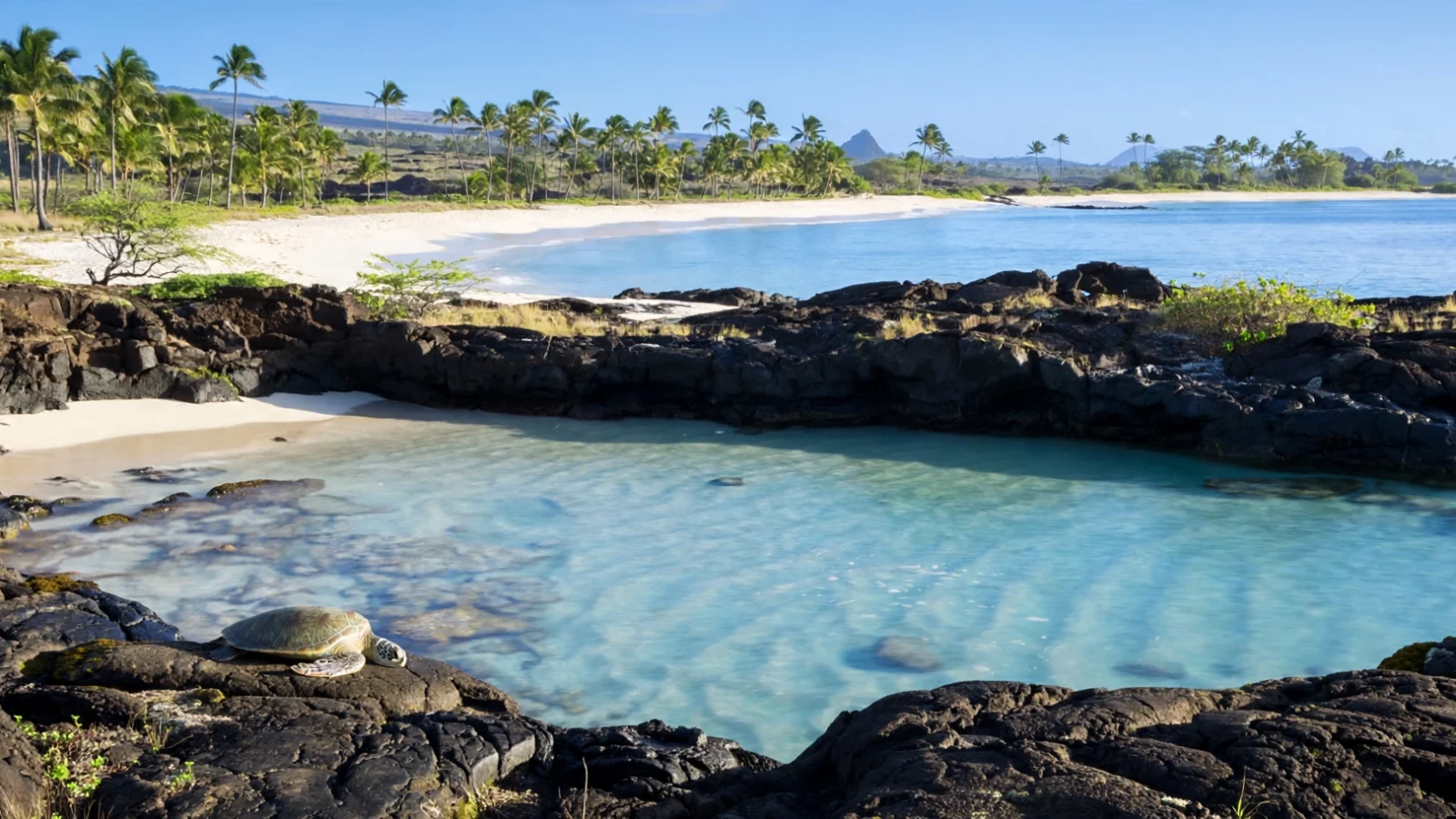
Kukio Bay is the snorkeling stop that confuses people before they even get wet. Drive the Kona coast looking for it and you will find two names, two gates and two very different pieces of water: Kikaua Point Beach Park, a small man-made cove with a shallow, lava-walled pond built for children — and Kukio Beach, the long white crescent just north of the point, where a band of lava rock guards the shoreline and the snorkeling is real but conditional. Most visitors hear about one, arrive at the other, and leave thinking the bay has nothing to offer. One well-known local beach list goes further and stamps the cove “no snorkeling” outright.
That verdict is half right, and the half it gets wrong is the half worth a trip. Inside the Kikaua pond there is no reef to speak of — it is a practice pool with sand, small fish and training-wheels water. But step outside the lava rim on a calm morning, or walk the shoreline trail north into Kukio Bay and enter through the gap in the rocks at its south end, and you are snorkeling a quiet, turtle-heavy stretch of the Kohala coast that most Kona visitors never see, precisely because the parking is capped at roughly 27 cars. This guide separates the two beaches properly: what each one is actually for, how the free gate-pass system works, when the bay is worth entering, when it honestly is not, and where to go instead on the days Kukio says no.
Quick facts
- Location: Kukio Bay, Kona/Kohala coast, Big Island — about 17 miles north of downtown Kailua-Kona and roughly 6 miles north of Kona airport, off Highway 19 at mile marker 87
- The two beaches: Kikaua Point Beach Park (the protected keiki cove, south) and Kukio Beach (the long crescent, north) — joined by a shoreline trail of a few hundred yards
- Snorkeling verdict: The pond is for first-ever snorkels and small children. Real reef snorkeling happens outside the lava rim and in Kukio Bay — calm mornings only, and the bay is frequently murky
- Access: Free, through a gated resort community. Stop at the guard shack, ask for the beach pass, and you are directed to the public lot — while stalls last
- Parking: Roughly 27 stalls at Kikaua Point; one in, one out when full. Arrive by about 9am, earlier on weekends
- Lifeguard: None at either beach
- Facilities: Restrooms, outdoor showers and drinking water at both access points; paved, stroller-friendly path to Kikaua Beach; grassy shade at the point
- Best beginner route: The Kikaua pond, mid-morning on a calm day — then graduate to Kua Bay or Makalawena for a first real reef
- Turtles: Green sea turtles rest on the lava and sand along Kukio Beach and cruise the shallows — keep at least 10 feet away, always
Kukio or Kikaua? The two-name problem, solved
Almost every confused trip report about this bay starts with the names, so here is the geography in one pass. Kikaua Point is the low lava point at the south end of Kukio Bay. On its sheltered side sits Kikaua Point Beach Park: a small cove that was reshaped when the Kukio community was built behind the point, with sand deposited into what had been a rocky inlet. The result is a compact white-sand beach, a shallow pond-like swimming area walled off from the open ocean by lava rock, a grassy park with palms, and the restrooms and showers. When people say “Keiki Beach” or “the kids’ beach at Kukio”, this cove is what they mean.
Kukio Beach is the main bay beach: a long, curving ribbon of white sand running north from Kikaua Point, fronting the Kukio community and ending toward the Four Seasons Resort Hualalai. It is scenic, shady and quiet — and its shoreline is lined with lava rock almost the whole way, which is why it has a reputation as a walking and turtle-watching beach rather than a swimming beach. Its one practical water entry is the opening in the rocks at its south end, close to Kikaua Point.
You can use either gate and walk to both beaches. The Kikaua Point gate, on Kukio Nui Drive, puts you closest to the pond. The Hualalai gate puts you on Kukio Beach itself, a slightly longer walk from the pond. The snorkeling plan is the same either way: pond first, then the outside water if — and only if — the day is calm.
| Kikaua Point cove | Kukio Beach | |
|---|---|---|
| Water | Shallow, sandy, lava-walled pond | Open bay behind a lava-rock shoreline |
| Best for | Toddlers, first snorkels, nervous beginners | Confident snorkelers on calm days; turtle watching from shore |
| Entry | Walk in off the sand | Through the rock opening at the south end only |
| Marine life | Small reef fish, occasional turtle cruising through | Reef fish along the rocks, turtles in the water and basking on sand |
| Main catch | Almost no coral or reef structure inside | Frequently murky; rocky entry; no protection once you are out |
| Facilities | Restrooms, showers, drinking water, shade grass | Restrooms, showers, drinking water at the access point |
Is Kukio Beach private? The gate, the guard shack, and your right to the beach
No — Kukio Beach is a public beach. Every beach in Hawaii is public by law, including the sand that sits inside a gated resort community. What is private is everything around it: the resort, the roads, the parking. That is the whole confusion in one sentence, and it is why the drive in feels stranger than the beach itself.
Here is exactly how the gate works. Drive Highway 19 to Kukio Nui Drive at about mile marker 87 and follow it to the guard shack. Tell the guard you are visiting the public beach — Kukio Beach, or Kikaua Point Beach Park if that is where you are headed. You will be given a free beach pass and directed to the public lot. That is the system the guards run every day for beach visitors; you are not asking for a favour, you are using a public beach.
One thing not to confuse it with: King’s Pond. That is the Four Seasons Hualalai’s man-made saltwater pond, inside the resort, for resort guests only. It is not a public snorkel spot and you cannot enter it as a beach visitor. If a listing or a photo makes it look like part of Kukio Beach, it is not — the public snorkeling is the pond at Kikaua Point and the bay itself, both reached through the guard shack above.
If the public lot is full when you arrive, the gate runs one-in-one-out, so the wait is for a car to leave rather than for a new pass to appear. The fallbacks are in the Access and parking section below — but the honest version is that there is no secret second lot, which is why the arrival time in the Best time section matters.
Zone 1: The Kikaua keiki pond — a first snorkel, not a reef
The cove at Kikaua Point is best understood as the Big Island’s gentlest classroom. The lava rim takes the energy out of the ocean before it reaches the beach, so on a typical day the inside water is shallow, sandy-bottomed and calm enough for a small child to stand, splash and — with a mask on — discover that breathing through a snorkel is easy. Local families use it exactly this way, and for a first-ever snorkel it is genuinely hard to beat anywhere on this coast: no surge to fight, no deep water to fear, no entry trickier than walking in.
What lives in the pond matches that purpose. Expect small reef fish picking around the rocks at the edges, the odd juvenile tang or butterflyfish, and — often enough to keep children scanning — a green sea turtle cruising slowly through or resting near the rocks. What you will not find is a reef: there is little coral structure inside the cove, no wall of fish, and nothing to reward an experienced snorkeler for more than a few minutes. If you have snorkeled Kahalu’u or Two Step and you come here expecting that, you will be disappointed, and the “no snorkeling” reviews are the sound of that disappointment.
Two cautions belong in this section even though the pond feels tame. First, there is a drop-off out near the rocks: the bottom shelves away at the edge of the cove, so keep small children in the shallow centre and know where the deep edge is before you let anyone swim out to the rim. Second, the protection is partial, not total — on a day with real swell running, surge pushes into the cove and the pond stops being a pond. Keep an eye on children at all times; there is no lifeguard here, and there never has been. If your family is at exactly this stage — mask practice today, real reef tomorrow — our beginners’ guide to snorkeling in Hawaii lays out that progression beach by beach.
Zone 2: Tide pools and outside the rim — the locals’ quick snorkel
The snorkeling the park regulars actually do starts where the pond ends. Just beyond the lava rim, at low tide and on calm days, the shallow pools and channels between the rocks hold a quick, easy snorkel: reef fish in the pockets, small coral growth on the rock faces, and turtles that favour the warm lava ledges around the point for resting. It is a short session, not a destination swim — the water is shallow, so move slowly, watch your clearance, and never let your fins or knees come down on rock or coral. Reef shoes or your fins are worth wearing here; bare feet on lava and urchin-spined crevices are a bad combination.
Pushing further out past the point is a different decision. Once you clear the rim you are in open Kukio Bay water with no protection, and the same drop-off that edges the pond continues into deeper water. On a flat, glassy morning a confident snorkeler can work along the rocks outside the point and find noticeably more life than the pond holds. On any day with texture on the water — wind chop, a wrapping swell, surge moving in the pools — the correct call is to stay inside or stay out entirely. Conditions, not enthusiasm, decide this zone; the best time to snorkel in Hawaii guide explains the morning pattern that governs this whole coast.
Zone 3: Kukio Bay — rocky, often murky, and honest about it
Kukio Beach demands the most honest paragraph in this guide. The shoreline is a lava band almost end to end, the one workable entry is the gap in the rocks at the south end near Kikaua Point, and the bay’s water is frequently too murky for good snorkeling — the same openness that makes the crescent beautiful means wind and swell stir it easily. Several solid local beach guides rate it a poor swimming and snorkeling beach, full stop, and on many days they are right. If you arrive to find brown-green water and waves working the rock line, believe them: watch the turtles from the sand and save your snorkel for Kua Bay.
On the right morning, though, Kukio Bay earns its place. In calm, clear conditions the snorkeling along the rocky edges — starting at the south-end opening and working the rock line — holds coral patches, reef fish and some of the most reliable turtle encounters on this coast: honu feed in the shallows, cruise the bay, and haul out to bask on the sand and warm lava, especially around low tide. Walk the beach first and you will often spot resting turtles before you ever get wet. Give every turtle at least 10 feet of space in the water and on land, never touch one, and never position yourself between a turtle and the ocean — the full etiquette is in our snorkeling with turtles guide.
A note for strong snorkelers and freedivers only: shore-diving records for this bay describe a real offshore reef — scattered coral in the shallows to the north, coral-covered blocks in the centre of the bay in roughly 15–18 feet, and a wall toward the south dropping to about 40 feet, reached by a long surface swim out from shore. That is dive data, not a casual snorkel route: it involves distance, depth and boat-free but current-exposed water. Treat it as context for what lives out there, not an invitation, and never attempt it alone or in anything but flat conditions. Everyone else will enjoy Kukio more from the rock-line shallows.
Practical entry notes for the bay: enter only through the south-end opening, time any swell sets before stepping in, keep reef shoes on until you are in fin depth, and exit the same way you entered. In winter, when the northwest swell is up, waves break along this shore and surfers take over the outside water — that is your signal that snorkeling season here is paused. Our Hawaii snorkeling safety guide covers how to read a rocky entry like this one.
The north cove: the snorkel spot most people walk past
Most visitors stop at the main beach, look at the lava rock, and conclude there is nowhere to snorkel. They are standing in the wrong place. From the main beach, turn right — north — and walk along the shore to a smaller, protected lava-rock cove with a sandy entry. This is the snorkel spot at Kukio Beach, and the bay’s own guide barely hints at it, which is why it stays quiet even on busy mornings.
Enter over the sand, then snorkel along the right-hand — northern — wall of the cove, where the rock shelters the water and the reef life concentrates. Expect yellow tang and butterflyfish along the wall, and the Hawaiian state fish, the humuhumunukuāpua‘a (reef triggerfish), picking over the rock. Green sea turtles rest on the sandy bottom here at roughly 10 to 20 feet deep; give them the same 10 feet of space the law requires everywhere in Hawaii, never touch or chase one, and let a resting turtle rest — our guide to snorkeling with turtles in Hawaii covers the rules in full.
How does the north cove compare with the south-end rock opening described in Zone 3? The south-end gap is the bay’s main entry and the one this guide has always described; the north cove is the calmer, more sheltered alternative on a flat morning, with a sandy entry instead of a rock gap. Neither is a safe choice on a rough day — if the swell is up, both entries are out, and the surf check in the Best time section is the call to make before you drive out. Wear water shoes for the lava-rock walk to the cove either way; the rock is sharp and the sand is only at the entry itself.
Access and parking: the gate pass, the 27 stalls, and your fallbacks
Both beaches sit inside gated resort communities, and both are fully public — every beach in Hawaii is public, and the guards at these gates run a well-practised system for beach visitors. It works like this. For Kikaua Point Beach Park, drive Highway 19 (Queen Ka’ahumanu Highway) to Kukio Nui Drive at about mile marker 87 — heading north from Kona airport it is the next left after the Kua Bay turn, roughly 6 miles from the airport and about 17 miles from downtown Kailua-Kona. Turn in, stop at the guard shack, and say you are visiting Kikaua Point Beach Park. The guard issues a free visitor pass, subject to space, and directs you through the community to the public parking lot. From the lot, a short paved path — flat, stroller- and wheelchair-friendly — leads to the beach park, with restrooms, showers and drinking water at the end of it.
The constraint is the lot itself: roughly 27 stalls, and when it fills, the system is one in, one out. Local advice is consistent — arrive by about 9am, and earlier on weekends and holidays. There is no fee for the pass or the parking, but there is also no way around the cap; it is a large part of why this shoreline stays quiet.
For Kukio Beach, use the Four Seasons Resort Hualalai entrance off Highway 19 near the same mile marker, take the immediate left onto the signed public beach access road, and park in the public lot. A paved path reaches the beach, with restrooms, showers and a water fountain at the access point. From the south end of Kukio Beach, the shoreline trail of a few hundred yards over the lava brings you to Kikaua Point and the pond — the two beaches function as one visit.
If the Kikaua lot is full, you have three honest options. Try the Hualalai/Kukio Beach access instead and walk south to the point — bigislandguide’s local advice, and usually the faster recovery. Come back before 9am the next day; weekday mornings fill slowest. Or switch the day entirely: Kua Bay is the next beach south (a rough shoreline trail of under a mile links it to Kikaua Point for walkers, not drivers), and its state-park lot and lifeguards make it the easier family plan B. Kikaua Point is a daytime park — listings put it at roughly 7am to 8pm, and the beach park is posted as closing about half an hour after sunset; treat the guard’s word on the day as final and plan to be walking out before dark.
One etiquette note that keeps this system working: stay on the public path and beach park areas, keep noise down in what is a residential resort community, and pack out everything you bring. Access like this survives on visitors being easy to host. The rest of this coast’s gated and resort-front beaches — 49 Black Sand Beach at Mauna Lani works similarly — are rounded up in our Big Island snorkeling hub.
What to pack for Kukio (and what the beach doesn’t have)
Kukio has restrooms, outdoor showers and drinking water at both access points, and little else. There is no gear rental on the beach, no shop, and no food — everything you need for the snorkel has to arrive in your car. Pack like the beach is undeveloped, because for practical purposes it is.
Water shoes (reef shoes). Lava rock lines the waterline at both entries — the south-end rock gap and the walk to the north cove — and this guide has already said reef shoes matter more here than at any sandy beach in the series. Make it a packing rule, not a poolside decision: wear them from the car, keep them on through the entry, and only take them off once you are floating.
Reef-safe sunscreen, on 20 minutes before you get in. Apply it before you enter the water, not at the waterline — it needs time to set, and it keeps the chemicals off the reef. Our reef-safe sunscreen guide for Hawaii explains which ingredients to avoid and why the ordinary bottle in your bag is the wrong one here.
Your own snorkel gear. There is nothing to rent at Kukio, so bring mask, snorkel and fins from town — or rent in Kona first. Our Hawaii snorkel gear rental guide has the current shop rates and the buy-vs-rent maths.
Water, snacks, a dry bag, and shade. There is grassy shade at the point but little on the beach itself, and no food for sale. Bring drinking water and snacks, a dry bag for the walk in, and a towel — the outdoor showers are for rinsing off, not for a full reset.
Best time, seasons and the murk problem
Kukio follows the Kona coast’s standard rhythm, with one local twist. The standard rhythm: mornings are the snorkeling window — arrive for the gate and parking anyway, and you will usually get the calmest, clearest water before the afternoon breeze. The local twist is clarity. Because the bay is open and its bottom stirs easily, Kukio turns murky faster than protected spots like the Kikaua pond or Kahalu’u, and recovers more slowly after wind or rain. Judge this beach by the water you can see from the point, not by the forecast alone: if you cannot see the bottom along the rock line from shore, the snorkeling will not reward the entry.
Seasonally, late spring through early autumn gives the bay its best run of calm mornings. Winter is the honest off-season for the bay itself — northwest swells wrap this coast, break along Kukio’s rock line, and turn the entry gap hazardous; on those days the pond may still work for a children’s splash, with the surge caution above, but bay snorkeling is done until the ocean settles. Year-round, the pond is at its best mid-morning at a mid-to-high tide, when the shallow water has warmed and there is enough depth over the sand to float a small snorkeler without scraping.
Check the surf before you go — and arrive at the gate between 8 and 9 AM
Check Surfline or the local surf report before you drive out. Kukio is a north-facing Kona bay: a north or northwest swell wraps this coast, breaks along the rock line, and shuts the bay down, and no amount of morning calm at your hotel changes that. If the report shows swell, save the drive — the pond may still work for a children’s splash, but bay snorkeling is done until the ocean settles.
On a flat day, arrive at the gate between 8:00 and 9:00 AM. That is the window the best local guidance gives, and it matches this guide’s own rule of arriving by about 9 AM, earlier on weekends: the gate queue forms early, the lot is small, and the calmest water is the morning’s anyway. One honest hedge on the lot size: this guide says roughly 27 stalls at Kikaua Point, while one local thread reports the gate allowing about 25 cars in at a time. Either figure is small, and once it is full the gate runs one-in-one-out — so the arrival time is not a tip, it is the difference between snorkeling and waiting in the car.
What you will see
Set expectations by zone and Kukio rewards you. In the pond: small reef fish around the edge rocks, juvenile tangs and butterflyfish, and turtles passing through or resting by the rocks often enough that local families treat them as regulars. Around the point and tide pools: more reef fish in the pockets, small coral growth on the lava, urchins in the crevices (look, never step), and turtles hauled out on the warm rock — one of the most photogenic and most protected sights on this coast, so enjoy it from a respectful distance. In the bay on a clear day: coral patches and reef fish along the rock line — yellow tang, butterflyfish, Hawaii’s state fish, the humuhumunukunukuapua’a — turtles feeding and cruising, and, out over the deeper offshore ground that divers describe, the possibility of eels and octopus for those qualified to be there. What you will not reliably get is Kahalu’u-style density: Kukio’s charm is space and quiet, not a fishbowl. Pack the right kit for rocky entries from our snorkel gear checklist — reef shoes matter more here than at any sandy beach in this guide series.
Kukio vs the neighbours: where should you actually go?
| Spot | Choose it when… | The trade-off |
|---|---|---|
| Kikaua Point pond | You have toddlers or a first-time snorkeler and zero appetite for risk | Tiny, shallow, little marine life — a classroom, not a reef |
| Kukio Bay | It is a flat, clear morning and you want turtles and quiet | Rocky entry, often murky, no lifeguard, parking capped |
| Kua Bay | You want a real reef off a postcard white-sand beach, with lifeguards | Bigger crowds, state-park fees, winter surf closes it hard |
| Makalawena Beach | You will hike for the best uncrowded reef in this stretch | 20+ minute lava-field walk, no facilities at the beach |
| Mahai’ula Beach | You want Kekaha Kai’s shade and space with easier water than Makalawena | Snorkeling is the support act, not the headline |
| Puako Bay | You want a turtle cleaning station and a proper reef, further north | Rocky entries too — and a longer drive up the Kohala coast |
The short version: Kukio is not competing with Kua Bay’s reef or Makalawena’s wilderness. Its niche is the calmest possible start for children, plus a quiet turtle bay for patient snorkelers who read conditions honestly. Families driving this coast for a week often do them in order — pond at Kikaua, reef at Kua Bay, adventure at Makalawena — and that progression is exactly right. Old Kona Airport, south toward town, is the other underrated stop in this series: a proper MLCD reef with none of the gate theatre.
Walking in: the Ala Kahakai Trail
You do not have to drive in. The Ala Kahakai National Historic Trail — the coastal trail that runs the length of the Kona coast — passes right along this beach. From Kukio it runs about 1.5 miles south to Kikaua Point Park and about 4 miles north to Kiholo Bay, over lava-rock stretches that demand proper shoes, not flip-flops. It is a hot, exposed walk with no water along the way, so carry more than you think you need — but it is the one way to arrive at Kukio without worrying about the car park at all.
One small feature to notice on the walk in: the brackish ponds near the beach. They are shallow, salty coastal pools, part of the same lava landscape as the tide pools in Zone 2 — look, don’t swim. They are a reminder that this shoreline is a living coastline, not a resort beach with the wild edges trimmed off.
Frequently asked questions
Is Kukio Bay good for snorkeling?
It depends which water you mean. The Kikaua Point pond is excellent for children and first-time snorkelers but holds almost no reef life. Kukio Bay itself offers genuine snorkeling along its rocky edges on calm, clear mornings — coral patches, reef fish and very reliable turtles — but the water is frequently murky and the entry is rocky, so it rewards patience and honest condition checks rather than guaranteeing a great snorkel.
What is the difference between Kukio Beach and Kikaua Point Beach Park?
Kikaua Point is the lava point at the south end of Kukio Bay, and its beach park is a small, man-made, protected cove — the keiki pond. Kukio Beach is the long white crescent running north from the point. They have separate public access gates and car parks, and a short shoreline trail joins them, so one visit covers both.
How do I get in, and is it free?
Stop at the guard shack — Kukio Nui Drive for Kikaua Point, or the Hualalai resort entrance for Kukio Beach — and ask for the public beach pass. It is free, issued while parking stalls remain, and the guard directs you to the public lot. All Hawaii beaches are public; the pass system manages the small car parks, not the beach.
What happens if the Kikaua Point car park is full?
The system is one in, one out, so you can wait, but the better moves are to use the Kukio Beach public access at Hualalai and walk south to the point, return before about 9am on a weekday, or switch to Kua Bay just south, which has a larger state-park lot and lifeguards.
Can kids snorkel at Kukio?
Yes — that is what Kikaua Point exists for. The protected pond is shallow, sandy and calm on typical days, ideal for a first mask-and-snorkel session. Watch for the drop-off near the rocks, keep children in the shallow centre, and remember there is no lifeguard. Kukio Bay itself is not a children’s snorkel spot.
Are there lifeguards, restrooms and showers?
No lifeguards at either beach. Yes to facilities: restrooms, outdoor showers and drinking water at the Kikaua Point beach park and at the Kukio Beach public access, plus a grassy shaded area and a paved path at Kikaua.
When is the best time to snorkel Kukio Bay?
A calm morning, ideally before the afternoon breeze, in the late-spring-to-early-autumn window of settled weather. Check clarity from the point before entering — this bay goes murky quickly after wind or swell. In winter, northwest swells commonly shut the bay down entirely.
Will I see turtles at Kukio?
Very likely, though never guaranteed. Green sea turtles cruise the pond and bay and regularly haul out to bask on Kukio Beach’s sand and warm lava, especially around low tide. Keep at least 10 feet away, never touch or chase one, and let resting turtles rest — it is both the law and the reason they keep coming back.
Is Kukio Beach private?
No. Kukio Beach is a public beach — every beach in Hawaii is public by law, even inside a gated resort community. Tell the guard at the Kukio gate that you are visiting the public beach and you will be given a free beach pass and directed to the public lot. The resort itself, including the Four Seasons’ King’s Pond, is private and guests-only.
Where exactly do I snorkel at Kukio Beach — the north cove or the south end?
Either, on a flat morning — they are the bay’s two entries. The south-end rock opening near Kikaua Point is the main entry this guide has always described. The north cove, reached by turning right (north) from the main beach, is the calmer, more sheltered option, with a sandy entry and a northern wall full of reef fish. On a rough day, neither is safe: check the surf before you go.
Do I need water shoes at Kukio Beach?
Yes — bring them and wear them from the car. Lava rock lines the waterline at both entries, and the walk to the north cove crosses sharp rock. Reef shoes are the single most useful thing you can pack for Kukio, ahead of anything except your mask.
What time should I arrive at Kukio Beach?
Between 8:00 and 9:00 AM, earlier on weekends. The public lot is small — roughly 27 stalls, with one local thread reporting about 25 cars at a time — and once it is full the gate runs one-in-one-out. Arriving early also gets you the calmest, clearest water of the day.
The bottom line
Kukio Bay is two beaches wearing one name, and it disappoints only the visitors who expect the wrong one. Come for the pond and you get the Big Island’s gentlest first snorkel, capped parking and all. Come for the bay on a flat, clear morning — through the south-end gap in the rocks, along the turtle-patrolled rock line — and you get one of the Kona coast’s quietest snorkels. Come on a windy winter afternoon expecting a reef, and no guide can help you. Read the names right, read the water honestly, and this small gated-access shoreline earns its place between Kua Bay and the wilder beaches of Kekaha Kai in any Big Island snorkeling week — start with our Big Island hub to line the whole coast up in order.