The 15 best things to do in Hilo, at a glance
Hilo is the Hawaii most visitors skip — and that is exactly why it is worth two days of your trip. It sits on the wet, green, volcano side of the Big Island, the opposite of sunny Kona: waterfalls instead of resorts, black-sand snorkeling coves instead of white-sand beaches, a farmers market instead of a shopping strip. It rains here more than anywhere else in the United States, it is cheaper than Kona, and it is the best base on the island for volcanoes, waterfalls, and rainforest. Hilo also has the Big Island’s most underrated snorkeling — calm lava-rock lagoons where turtles outnumber tourists. Here are the 15 best things to do, ranked by how much they are worth your time.
| # | Activity | Best for | Cost | Time needed |
|---|---|---|---|---|
| 1 | Snorkel Richardson Ocean Park | Snorkelers, turtle watchers | Free | 2-3 hours |
| 2 | Snorkel Carlsmith Beach Park | Beginners, families, turtles | Free | 2-3 hours |
| 3 | Akaka Falls State Park | Everyone, photographers | $5/person + $10 parking | 1-1.5 hours |
| 4 | Hawaii Volcanoes National Park | Everyone | $30/vehicle, 7 days | Full day |
| 5 | Rainbow Falls and Boiling Pots | Everyone, photographers | Free | 1 hour |
| 6 | Onekahakaha Beach Park — the keiki pool | Kids, beginners | Free | 1-2 hours |
| 7 | Hawaii Tropical Botanical Garden | Gardens, photographers | Paid admission | 2 hours |
| 8 | Hilo Farmers Market | Food, souvenirs, everyone | Free to browse | 1-2 hours |
| 9 | Lili’uokalani Gardens | Everyone, sunset | Free | 1 hour |
| 10 | Pana’ewa Rainforest Zoo & Gardens | Families, rainy days | Free | 1-2 hours |
| 11 | Kaumana Caves | Adventurous travelers | Free | 1 hour |
| 12 | Mauna Kea stargazing | Everyone, photographers | Free / tours from ~$240 | Half day (evening) |
| 13 | Leleiwi Beach Park and Reed’s Bay tide pools | Snorkelers (calm days), explorers | Free | 1-2 hours |
| 14 | Lava Tree State Monument and Kalapana | Day-trippers, volcano fans | Free | Half day |
| 15 | Downtown Hilo, Tsunami Museum and ‘Imiloa | Rainy days, culture | Free / small admission | 2-3 hours |
1. Snorkel Richardson Ocean Park — the best snorkeling near Hilo
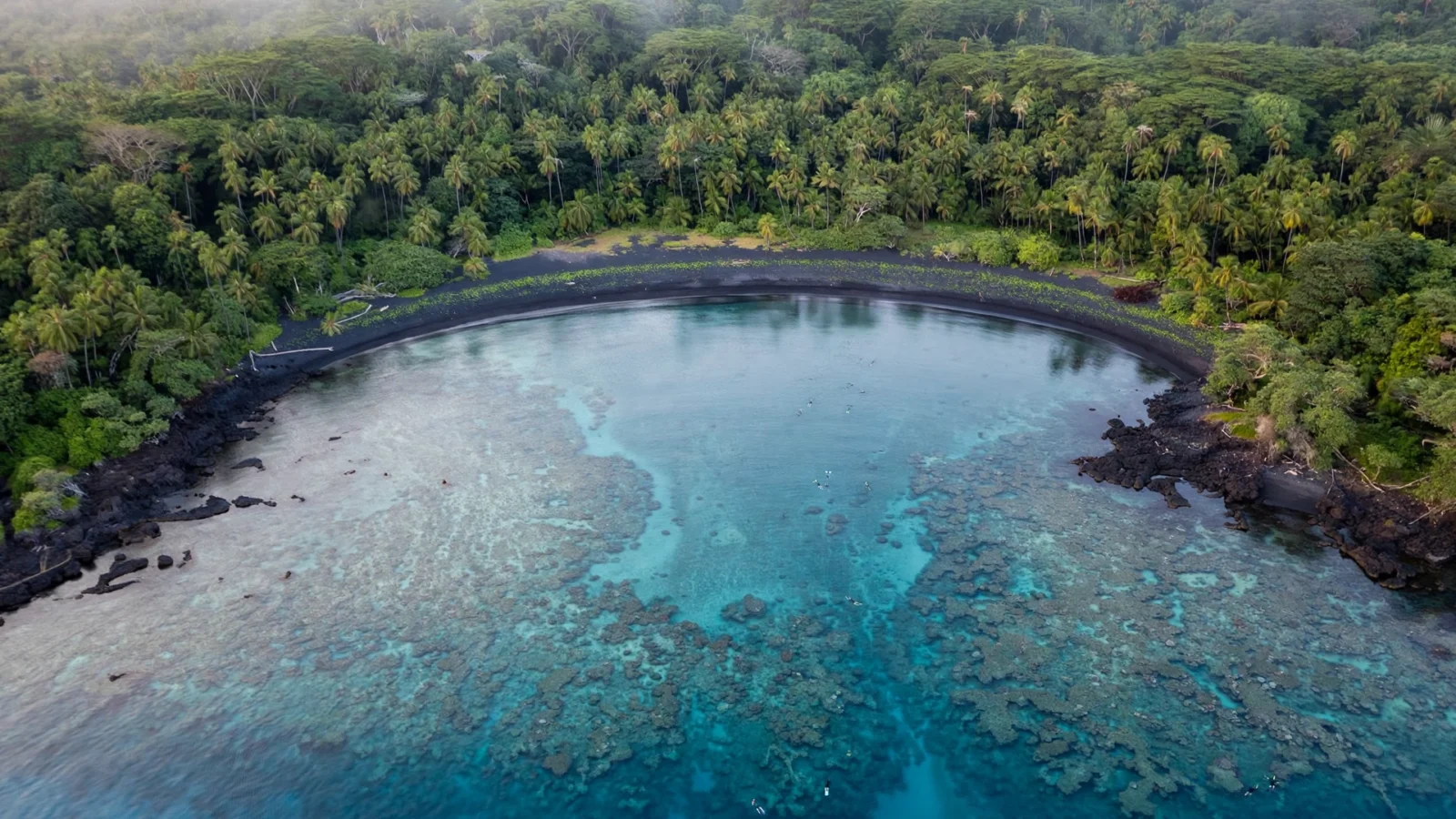
If you snorkel one place in Hilo, make it Richardson Ocean Park. It is the best snorkeling near town, and the only Hilo spot most travel guides bother to name — but they give it two sentences, and it deserves a proper briefing. Richardson is a black-sand beach with patches of green sand, wrapped around a bay that a shallow reef flat protects from the open ocean. That reef is what makes it work: the water inside stays calm enough for beginners on most days, while just past the reef edge the bottom drops away and the fish life gets serious.
Enter from the sand on the left side of the beach and swim out over the reef flat. Turtles (honu) are the main event here — they graze on the reef and rest on the black sand, and on a good morning you will see several in one swim. Give them at least 10 feet (3 metres) of space; it is the law in Hawaii, and the turtles here are used to people but not unbothered by them. Monk seals haul out on the beach occasionally too — same rule, more distance. The reef holds the usual Big Island cast: yellow tang, convict tang, Moorish idols, needlefish near the surface, and the occasional reef shark patrolling the drop-off.
Come early, and come on a weekday if you can. Richardson is the locals’ weekend beach, and by late morning on a Saturday the parking lot fills and the best entry spots get crowded. There are showers, restrooms, picnic tables and grills, so it works as a half-day base: snorkel first, eat second. The surf is usually gentle, but after rain the water goes murky — Hilo’s rivers carry sediment into the bay — so if it poured overnight, snorkel later in the day or save Richardson for the next morning. Full detail, including where exactly to enter and what the reef looks like section by section, is in our Richardson Ocean Park snorkeling guide and our Hilo snorkeling guide.
2. Snorkel Carlsmith Beach Park — the calmest lagoon on the island
Carlsmith Beach Park is the calmest snorkeling on the Big Island, and the best answer to the question “where can a nervous swimmer actually snorkel in Hilo?” The park is a chain of spring-fed ponds and small lagoons, separated from the ocean by lava rock and connected to it by narrow channels. The water inside the ponds is shallow, warm, and almost always flat — more like a natural swimming pool than the ocean. Turtles swim in through the channels and graze in the ponds, so you can watch honu from waist-deep water without ever facing a wave.
Enter from the sandy edges of the ponds and stay inside the protected water if you are a beginner. Stronger swimmers can follow the channel out to the outer reef on a calm day, but the ponds themselves hold plenty: turtles, small reef fish, and the occasional eel in the rocks. Lifeguards are on duty on weekends, holidays and during summer break, roughly 9:30 a.m. to 4:45 p.m. There is a pavilion, picnic tables, restrooms and a big grassy area under coconut palms, which makes Carlsmith the easiest family snorkeling spot in Hilo — kids can paddle in the ponds while adults snorkel ten feet away. Parking is free and the lot rarely fills the way Richardson’s does. Our full Carlsmith Beach Park snorkeling guide covers the ponds one by one, including the anchialine pools at the back of the park, and the Hilo snorkeling guide ranks it against the other three spots.
3. Akaka Falls State Park — the waterfall every Hilo visitor should see
Akaka Falls is the single best waterfall stop near Hilo, and the easiest: a paved 0.4-mile loop trail through a rainforest gorge that ends at a 442-foot waterfall dropping into a green canyon. The loop takes 30 to 45 minutes at a stroll, passes the smaller Kahuna Falls on the way, and is the closest thing Hilo has to a must-do that requires no planning beyond showing up.
The practical details: entry is $5 per person plus $10 per vehicle for parking, card only, and you can pay ahead online — do that, because the pay machine at the lot is slow and the lot fills by mid-morning. Go early or late in the day; the falls are at their best after rain, which in Hilo means most days, and the morning light reaches into the gorge before the clouds build. The trail is paved but has steps and can be slippery when wet, so wear shoes with grip, not flip-flops. Akaka Falls is about 15 miles north of Hilo on the Hamakua Coast, an easy 25-minute drive, and it pairs naturally with the Hawaii Tropical Botanical Garden further up the same coast. If you only have one morning for waterfalls, spend it here — then drive five minutes down the road to Rainbow Falls for the second one.
4. Hawaii Volcanoes National Park — the full-day trip that justifies Hilo
Hilo is the closest town to Hawaii Volcanoes National Park, and that alone is a reason to stay here instead of Kona. The park is about 30 miles and 45 minutes southwest of Hilo, and it is a full day: 50,280 acres of lava fields, rainforest, and the summit of Kilauea, one of the most active volcanoes on earth at 4,091 feet.
Entry is $30 per vehicle, good for 7 days. Start at the Kilauea Visitor Center (open 9 a.m. to 5 p.m.) and ask the rangers what the volcano is doing that day — lava activity changes month to month, and the difference between a good visit and a great one is knowing whether Halema’uma’u crater is putting on a show and where to stand for it. Then drive the Chain of Craters Road, 18 miles down to the coast in about 50 minutes, past lava flows of every age, steam vents, and the Thurston Lava Tube, a walk-through tunnel in an old lava flow. The crater rim trails are the best short walks in the park; take a jacket, because the summit sits above 4,000 feet and Hilo’s rain turns cold up there.
Stay for the after-dark glow if the volcano is active — the crater is at its most dramatic at dusk, and the drive back to Hilo in the dark is straightforward. One honest warning: the $25 fee quoted in some older guides is out of date; it is $30 now. And do not plan a Volcanoes day around a single viewpoint you saw on social media. Lava viewing depends on current activity, so check the National Park Service alerts the morning you go.
5. Rainbow Falls and Boiling Pots — free, ten minutes from downtown
Rainbow Falls is the waterfall you can see without leaving Hilo. It sits on Wailuku Drive, about ten minutes from downtown, and it is free: an 80-foot-wide, 100-foot-tall cascade over a lava cave, with the Wailuku River dropping into a pool below. On sunny mornings around 10 a.m., the sun hits the mist at the base and throws a rainbow across the falls — that is where the name comes from, and it is worth timing your visit for it.
Drive a mile further up Wailuku Drive and you reach the Boiling Pots, a series of small pools and cascades where the river churns through lava columns. After heavy rain the pools really do look like they are boiling. Do not swim in either spot: flash floods can arrive with little warning after rain upstream, and the current in the river above the falls is stronger than it looks. The two stops together take about an hour, cost nothing, and are the easiest possible add-on to a snorkeling morning — swim at Richardson or Carlsmith, dry off, and be standing at Rainbow Falls before lunch.
6. Onekahakaha Beach Park — the keiki pool for kids and first-timers
Onekahakaha Beach Park is Hilo’s answer for anyone who has ever thought “I would love to snorkel, but the ocean scares me.” The beach is a shallow, enclosed pool protected by a wall of lava rock, with a sandy bottom and water that rarely gets above waist height. It was built for children — keiki is Hawaiian for kids — and it is the safest place in Hilo to put a first-time snorkeler in the water.
The pool holds small reef fish that swim in over the rock wall at high tide, and turtles visit on calm days, so there is actually something to look at through the mask — it is not just a paddling pool. The best time is a calm morning; on rough days the surf breaks over the wall and the pool gets choppy, so check the surf before you go. There are restrooms and picnic tables, parking is free, and the park sits on the Keaukaha coast road a few minutes past Carlsmith, so it is easy to visit both in one morning: Carlsmith for the adults, Onekahakaha for the kids. Full detail is in our Onekahakaha Beach Park snorkeling guide.
7. Hawaii Tropical Botanical Garden — a rainforest valley on the ocean
The Hawaii Tropical Botanical Garden is the prettiest non-waterfall stop on the Hamakua Coast: 40 acres of gardens in a valley that drops down to Onomea Bay, with more than 2,000 species of tropical plants, palms, orchids and heliconias along a boardwalk trail. It takes about two hours to walk properly, and the trail ends at a waterfall viewpoint over the bay — the ocean is the backdrop for the whole visit.
The garden is open 9 a.m. to 5 p.m. with last entry at 4 p.m., and admission is charged — the price has changed recently and different guides quote different figures, so check the garden’s own site for the current amount before you go rather than trusting a number printed in a blog. Wear shoes with grip: the boardwalk is steep in places and slick after rain, which is most of the time. The garden sits on the Hamakua Coast north of Hilo, on the same drive as Akaka Falls, so the two pair into one easy half-day: falls in the morning, gardens after lunch, and you are back in Hilo for dinner.
8. Hilo Farmers Market — the best morning in downtown Hilo
The Hilo Farmers Market is the most Hilo thing you can do in Hilo. It fills a downtown block with local produce, tropical fruit you will not find on the mainland, orchids and cut flowers, food stalls, and crafts from Big Island makers. The main market days are Wednesday and Saturday, roughly 6 a.m. to 4 p.m., and Saturday is the big one — arrive before 9 a.m. for the best selection and the smallest crowds.
Come hungry and bring cash for the smaller stalls. The fruit is the point: rambutan, mangosteen, lilikoi (passion fruit), apple bananas, and whatever is in season that week, sold by the people who grew it. The market is also the best place in Hilo to buy a souvenir that is actually from Hawaii — orchid plants, local honey, and handmade jewelry — instead of something shipped in from overseas. It is free to browse, takes one to two hours, and sits in the middle of downtown, so it pairs with a walk along Hilo Bayfront and a poke around the shops on Kamehameha Avenue.
9. Lili’uokalani Gardens — a free Japanese garden on Hilo Bay
Lili’uokalani Gardens is a 30-acre Japanese garden on the edge of Hilo Bay, the largest Japanese garden outside Japan, and it is completely free. A half-mile loop path winds past ponds, stone lanterns, bridges, pagodas and 200-year-old stonework, with Hilo Bay and Mauna Kea behind it on a clear day. It is the best sunset walk in Hilo, and the best free hour in town.
The gardens sit next to Coconut Island (Moku Ola), the small island just offshore that used to be reached by a footbridge from the park. Do not plan to walk out to it: the bridge collapsed in November 2025 and the island is closed until the bridge is rebuilt, currently expected in late 2027. Several older guides still list Coconut Island as open — it is not. The gardens themselves are fully open, and the view across the bay to the island is still worth the stop.
10. Pana’ewa Rainforest Zoo & Gardens — free, and built for a rainy day
Pana’ewa Rainforest Zoo & Gardens is a free zoo and botanical garden set in a rainforest a short drive south of downtown Hilo, on 236 acres. It is the only zoo in the United States set in a tropical rainforest, and it is one of the best rainy-day options in Hilo — the animals are used to the rain, the paths are covered in places, and the whole point of the place is that it is wet.
It is open 10 a.m. to 4 p.m. with last entry at 3:30 p.m., closed on the first Thursday of each month, and free. The zoo side holds the usual collection — big cats, primates, reptiles — and the gardens side is a walk through native and introduced rainforest plants. Plan one to two hours. It is also the most reliable kids’ activity in Hilo after Onekahakaha: animals, space to run, and no admission fee to feel guilty about if the kids lose interest after 45 minutes.
11. Kaumana Caves — a lava tube you can walk through for free
Kaumana Caves is a lava tube formed by the 1881 Mauna Loa eruption — a tunnel 25 miles long, of which a short stretch near the entrance is open to walk. It is free, open 24 hours, and ten minutes from downtown Hilo, which makes it the easiest adventure on this list and the one most visitors never hear about.
Bring a proper flashlight or headlamp — your phone light is not enough — and wear sturdy shoes you do not mind getting muddy. The cave is dark, the ceiling is low in places, and the floor is uneven lava. Go in the morning when the air inside is cool, and do not go during or just after heavy rain, when water runs through the tube. The entrance is a short walk down from a small parking area off Kaumana Drive, and the whole visit takes about an hour. It is also a genuinely good rainy-day option: you are underground, so the weather does not matter.
12. Mauna Kea stargazing — the best night sky in Hawaii
Mauna Kea is the tallest mountain in Hawaii at 13,803 feet, and its summit is one of the best places on earth to look at the night sky — the air is thin, dry, and far from city lights. The visitor center sits at 9,200 feet, about a 50-minute drive from Hilo, and on clear nights the stars from its parking lot are already better than anything you will see at sea level.
There are two ways to do it. The free way: drive up to the visitor center in the late afternoon, watch the sunset, and stay for the stars. The guided way: a summit tour, which starts at roughly $240 per person, takes you to the top with a guide, and handles the driving and the altitude. Do not drive to the summit yourself in a regular rental car — the summit road requires four-wheel drive, most rental agreements forbid it, and the altitude affects people who are not used to it. Summit tours set a minimum age that varies by operator, usually teens and up, and the altitude warning is real: do not go to the summit the same day you fly in, drink water, and come down if you get a headache. Book the tour a day ahead in summer; it sells out.
13. Leleiwi Beach Park and Reed’s Bay tide pools — the explorer’s stop
Leleiwi Beach Park is the quietest stop on the Keaukaha coast road, a few minutes past Carlsmith and Onekahakaha, and the one for people who like poking around rock pools more than lying on sand. The shoreline here is lava rock rather than beach, and at low tide the rock shelves hold tide pools full of small fish, crabs and the occasional eel. On a calm morning you can snorkel the sheltered water close to shore; on any other day, treat it as a tide-pool walk, not a swim.
That calm-day rule is the whole point of this stop. Leleiwi faces the open ocean, so the same water that is glassy at 8 a.m. can be rough by noon — check the surf before you get in, and if the waves are breaking over the rocks, stay on dry land and enjoy the pools instead. Reed’s Bay, the small bay just back toward town, has more tide pools in the same style. There are no facilities to plan around, so pair Leleiwi with a Carlsmith morning: ponds first, tide pools second, and you have covered Hilo’s whole snorkeling coast before lunch. Full detail on Hilo’s four snorkeling spots together is in our Hilo snorkeling guide.
14. Lava Tree State Monument and Kalapana — the volcano’s aftermath, up close
Kalapana, about 28 miles south of Hilo, is where you see what a volcano actually does to a place. The 2018 lava flow buried whole neighborhoods here, including the Ahalanui warm pond that used to be the area’s famous swimming spot. What survived is just as interesting: the Pohoiki hot ponds, where warm water still pools by the black-sand shore, and the Lava Tree State Monument, a grove of lava trees — hollow stone molds left behind where lava flowed around standing trees and the wood burned away, leaving the shapes standing in the forest.
The monument is a short, easy walk on a paved path through rainforest, and it is free. Kalapana itself is a half-day drive from Hilo: out past Pahoa, down to the coast, with the new black-sand beach at Pohoiki as the turnaround point. Go in the morning, when the light is good and the heat has not built up, and bring water — there are few services out here. This is the stop for anyone who wants to understand the volcano rather than just photograph it, and it pairs naturally with the Volcanoes National Park day: the park shows you the volcano, Kalapana shows you what it leaves behind.
15. Downtown Hilo, Tsunami Museum and ‘Imiloa — the rainy-day half-day
Downtown Hilo is the best rainy-day half-day on the Big Island, and Hilo has more rainy days than anywhere else in the United States, so you will probably need one. Start on Kamehameha Avenue, the bayfront main street, where the shops sell local crafts, books and food rather than the resort souvenirs you find in Kona. Then go to the Pacific Tsunami Museum, which tells the story of the two tsunamis that shaped modern Hilo — 1946 and 1960 — through photographs, survivor accounts and a building that survived them both. It is the single best hour of history in town, and it explains why Hilo looks the way it does.
Finish at ‘Imiloa Astronomy Center, the astronomy and Hawaiian culture center on the University of Hawaii at Hilo campus, which connects the night sky over Mauna Kea to the voyaging traditions that brought people to these islands. Between the museum, ‘Imiloa, the market and the bayfront walk, downtown Hilo fills a wet afternoon without feeling like a backup plan — and on a dry day it is still the best place in town to eat, shop and get a sense of what Hilo actually is: a working town that happens to sit in the middle of the wettest, greenest corner of Hawaii.
Frequently asked questions about Hilo
Is Hilo worth visiting?
Yes — plan about two days. Hilo is the wet, green side of the Big Island, and it is the best base for volcanoes, waterfalls and rainforest. It rains more here than anywhere else in the United States, it is cheaper than Kona, and its snorkeling lagoons are the calmest on the island.
Is there a beach in Hilo?
There is no natural white-sand beach in Hilo. What Hilo has instead is black-sand Richardson Ocean Park, the spring-fed ponds at Carlsmith, the kid-friendly pool at Onekahakaha, and the tide pools at Leleiwi — calm lava-rock water where turtles outnumber tourists.
What is Hilo known for?
Rain, rainforests, waterfalls, orchids, the largest bay in Hawaii, Hawaii Volcanoes National Park, the Hilo Farmers Market, the Pacific Tsunami Museum, and the Merrie Monarch Festival, the world’s biggest hula competition, held here every spring.
Is Hilo expensive?
No — Hilo is the cheaper side of the Big Island. Hotels run roughly $150–$250 a night, food about $15–$20 a person, and most of the best activities on this list are free. A rental car is recommended: the sights are spread out along the coast.
What should I do in Hilo when it rains?
Pana’ewa Rainforest Zoo, Kaumana Caves (you are underground, so the weather does not matter), the Pacific Tsunami Museum, ‘Imiloa Astronomy Center, and the downtown shops on Kamehameha Avenue. The waterfalls are also at their best after rain — Akaka Falls and Rainbow Falls both run strongest on wet days.
Do you need a car in Hilo?
Yes. Hilo’s sights are spread along the Hamakua Coast, the Keaukaha coast road and the road to the volcano — buses exist, but a car turns a scattered list into two easy days. Book it with the rest of your trip; Hilo’s rental supply is smaller than Kona’s.
Two days in Hilo is the right amount. Day one: snorkel Richardson or Carlsmith in the morning, Akaka Falls and the Botanical Garden up the Hamakua Coast in the afternoon, dinner downtown. Day two: Volcanoes National Park from open to close, or the Kalapana drive if the volcano can wait. Everything else on this list — the market, the gardens, the zoo, the caves — fills the gaps, and the rain, which will come, is not a problem to solve. It is the reason Hilo looks the way it does.