Hawaii is simultaneously the best and the most misleading place to learn to snorkel. Best, because it has more calm, protected, fish-rich beginner water than anywhere in the United States. Misleading, because the same islands also have exposed coasts where beginners get into real trouble — and the two can sit twenty minutes apart. This guide separates them properly.
Every beginner-friendly spot, filtered
What actually makes a spot beginner-friendly
Four things, in order: calm water (protection from swell — a reef, a cove, a crater wall); easy entry (walk in over sand, not scramble over lava); shallow options (standing depth nearby is a confidence machine); and a lifeguard. Fish quantity comes fifth — and conveniently, protected calm water is exactly where fish congregate anyway.
The 12 best snorkeling spots in Hawaii for beginners, ranked
This is the short list most first-timers actually need. It ranks the best snorkeling spots in Hawaii for beginners by how forgiving they are on a normal morning — not by how spectacular they are for experienced snorkelers. If you are choosing the best place to snorkel in Hawaii for beginners, start at the top of this table and stop at the first spot that matches your island.
| # | Spot | Island | Why it is easy | Entry | Standing depth? | Lifeguard* | Best first for |
|---|---|---|---|---|---|---|---|
| 1 | Kahalu’u Beach Park | Big Island | Shallow reef lagoon with fish at ankle depth | Sand patches between lava | Yes | Usually* | A first-ever snorkel |
| 2 | Hanauma Bay (inner reef) | Oahu | Reef-protected lagoon, rentals and instruction on site | Sand | Yes | Yes* | Nervous first-timers |
| 3 | Kapalua Bay | Maui | Crescent bay sheltered by lava points at both ends | Sand | Yes, near shore | Not always* | Families |
| 4 | Poipu Beach | Kauai | Reef-protected pond on the year-round south shore | Sand | Yes | Usually* | Kids and grandparents |
| 5 | Kuilima Cove | Oahu | Small protected cove next to Turtle Bay | Sand | Yes | Not always* | North Shore stays, calm days |
| 6 | Lydgate Beach | Kauai | Rock-walled swimming ponds built with keiki in mind | Sand inside the ponds | Yes | Usually* | Toddlers and timid swimmers |
| 7 | Anini Beach | Kauai | Long fringing reef keeps the lagoon calm in summer | Sand | Yes | No* | Summer north-shore trips |
| 8 | Carlsmith Beach Park | Big Island | Lagoon-like, calm water near Hilo | Sand and lawn entry | Yes | Usually* | East-side stays |
| 9 | Richardson Beach Park | Big Island | Small black-sand coves, turtles, picnic facilities | Sand and rock mix | Yes, in the coves | Usually* | Hilo day trips |
| 10 | Magic Island Lagoon | Oahu | Walled lagoon beside Waikiki with very little surf inside | Sand | Yes | No* | Waikiki hotel stays |
| 11 | Ko Olina Lagoons | Oahu | Four man-made, calm lagoons with easy facilities | Sand | Yes | Not always* | Resort families |
| 12 | Black Rock, Ka’anapali | Maui | Clear water and turtles — the step-up, not the starter | Sand | Deeper sooner | Usually* | Day three, once confident |
*Lifeguard cover can change by day, season and county staffing — treat “usually” as “check the tower when you arrive,” and never treat a lifeguard as a substitute for the buddy rule. Fees, parking and reservation rules (especially at Hanauma Bay) also change, so confirm them on the official park or county page before you go.
The best beginner spot on each island
Big Island: Kahalu’u Beach Park
Shallow, lifeguarded, minutes from Kailua-Kona, and full of reef fish so used to snorkelers they barely yield the right of way. Turtle sightings are close to routine. The one catch is parking — the small lot fills by mid-morning. Details on the Big Island hub.
Oahu: Hanauma Bay (inner reef)
The single most forgiving snorkel in Hawaii: a volcanic bay with a reef-protected lagoon, lifeguards, rental gear and instruction on site. It requires reservations two days ahead and a $25 fee — worth both for a first-timer.
Maui: Kapalua Bay
A crescent bay sheltered by lava points at both ends, which keeps it calm when neighboring beaches aren’t. Sandy entry, turtles along the rocks, kid-friendly. Black Rock at Ka’anapali is the step up once you’re comfortable. More on the Maui hub.
Kauai: Poipu Beach
Lifeguards, a reef-protected keiki pond for small children, turtles, and — unlike Kauai’s famous north shore — it works every month of the year. The Kauai hub explains the island’s seasonal switch.
More easy spots, island by island
The table gives you a starter. Most trips deserve a second and third easy option — for a different coast, a backup when your first beach is rough, or a gentle step-up once the first session goes well. Here is how the beginner map looks island by island. If you are still choosing a base, our guide to where to stay in Hawaii for snorkeling matches places to stay to these starter beaches.
Best snorkeling in Maui for beginners
Start at Kapalua Bay, on the sheltered northwest coast. It is the most reliable beginner snorkeling Maui offers: a sandy walk-in, reef and turtles along the edges, and protection that keeps it usable on many days when exposed beaches are not. Your step-up is Black Rock at the north end of Ka’anapali Beach — clearer, deeper sooner, and best saved for a calm morning after you have a session or two behind you. What beginners should skip in winter is Honolua Bay: a superb snorkel in summer, a surf break in winter. The full picture is on the Maui hub.
Best snorkeling in Oahu for beginners
Hanauma Bay is the supported option — lifeguards, rentals, instruction — but it needs a reservation, so book it early in your trip planning, not the night before. For a no-reservation alternative, Kuilima Cove on the North Shore is a small protected cove that works beautifully on calm days, and the walled lagoons at Magic Island and Ko Olina are the gentlest water on the island for a very first float. When a beach session has given you confidence, a crewed boat trip to Turtle Canyon off Waikiki is the natural graduation. Everything else is ranked on the Oahu hub.
Best snorkeling in Kauai for beginners
Kauai is the most seasonal island, which is why Poipu Beach matters so much: the south shore is the reliable side, and its reef-protected pond works in every month. Lydgate Beach, near Wailua, is the other year-round answer, with its rock-walled ponds. In summer the north shore opens up and Anini Beach becomes one of the calmest lagoons in Hawaii — but treat famous Tunnels Beach as a later trip goal, not a first session, and never as a winter beginner spot. The Kauai hub explains the north–south seasonal switch in full.
Best snorkeling on the Big Island for beginners
Kahalu’u is where Kona-side beginners should start, full stop. If you are based on the Hilo side instead, Carlsmith Beach Park and Richardson Beach Park give you calm, lagoon-like water without the cross-island drive. The famous step that beginners should not start with is Two Step: the snorkeling is wonderful, but the entry is off lava into deep water, which is exactly the wrong first five minutes. Save it — and Kealakekua Bay — for when standing depth no longer matters to you. More on the Big Island hub.
Gear: what you need and what you don’t
You need three things that fit: a mask that seals to your face (test: press it on without the strap and inhale gently through your nose — it should hold), a snorkel, and fins. Rent for about $25/day at major beaches, or buy a basic set at any ABC Store for the price of two rentals. A flotation vest or belt is smart for the first sessions and nothing to be embarrassed about — tour crews hand them out routinely. On full-face masks: beginners like them, but they’re harder to clear if water gets in, they can trap CO2 on cheap models, and several Hawaii tour operators don’t allow them; a well-fitting conventional mask is the safer learning tool. And Hawaii law requires reef-safe sunscreen — the oxybenzone/octinoxate ban is statewide, and a rash guard beats sunscreen on your back anyway.
Beginner snorkeling gear checklist
Expanded, that starter kit looks like this — the full version, with rental-versus-buy notes, is our Hawaii snorkeling gear checklist:
- Mask that fits your face — fit beats brand; try the strap-free seal test above before you pay.
- Dry-top snorkel — a splash guard or dry top means one less mouthful of water while you are learning.
- Short, soft fins — easier on beginner legs than long freediving fins, and plenty for lagoon work.
- Flotation vest or belt — the single biggest confidence upgrade for weak swimmers and first sessions.
- Rash guard or sun shirt — sun protection that never washes off onto the reef, plus a layer against chill on longer floats.
- Mineral, reef-safe sunscreen — applied before you arrive, for the skin your rash guard does not cover.
- Anti-fog treatment or a drop of defog — a fogged mask is the most common beginner frustration, and the easiest to prevent.
- A buddy, a plan, and a time limit — not gear you can buy, but the items that matter most on the list.
Technique matters as much as kit: how to clear a mask, breathe calmly and kick without bicycling is covered step by step in our guide on how to snorkel in Hawaii. Practice the breathing in standing depth first — two minutes of boring practice prevents almost every beginner panic.
The five mistakes first-timers make
1. Snorkeling the wrong coast in the wrong season. North-facing shores (Oahu’s North Shore, Kauai’s north, Honolua on Maui) are summer-only; in winter they’re surf breaks. 2. Going out alone. Buddy up, always — most Hawaii snorkeling incidents involve solo swimmers. 3. Standing on coral. It’s alive, it’s protected, and it cuts. If you need to rest, float on your back or head for sand. 4. Overestimating range. Currents drift you farther than you notice while your face is down; look up and check your position every few minutes. 5. Ignoring the lifeguard and the signs. High-surf advisories and box jellyfish warnings (Oahu, 8–10 days after each full moon) exist because people didn’t.
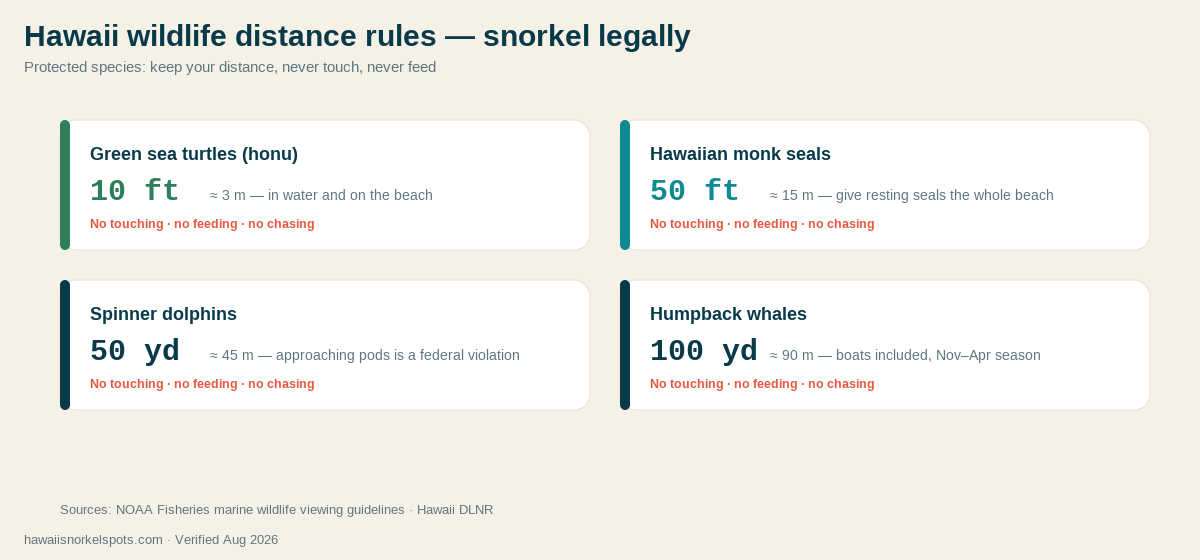
Touching nothing is the whole etiquette
Ten feet from sea turtles, fifty from monk seals, no touching or feeding anything, no standing on reef. These aren’t suggestions — turtle and seal rules are state and federal law, and the fish-feeding ban at places like Hanauma is enforced. The good news: the rules describe exactly how to have the best experience anyway — animals behave naturally around snorkelers who keep still and keep distance.
Your first session, scripted
Pick a calm, lifeguarded spot from the list above. Go in the morning. Put fins on at the water’s edge, walk backward or shuffle in, and spend your first five minutes floating face-down in standing depth, just breathing through the snorkel until it feels boring. Then follow the fish. When your legs tire or the wind picks up, get out — the reef will be there tomorrow. That’s the entire curriculum.
Snorkeling with kids — and as a non-swimmer
Non-swimmers can snorkel in Hawaii — at the right spots, with flotation, and never alone. The formula is a vest or belt, standing-depth water (the top four spots in the table all qualify), a buddy within arm’s reach, and a hard rule: if you cannot stand, you do not go. A crewed boat tour is the other good route, because crews fit your gear, watch the group and keep flotation on everyone — see how tours differ in our Hawaii snorkeling tours guide. What a non-swimmer should never do is treat a famous name as a safety guarantee: deep-entry spots like Two Step are wrong for you however calm the day looks.
For kids, choose ponds over reefs. Poipu’s keiki pond and Lydgate’s walled ponds exist precisely for small children — shallow, protected, and close to shore. Keep sessions short (20–30 minutes is a win with under-8s), go in the calm of the morning, use one adult per child in the water, and end while it is still fun. A child who leaves the water happy asks to snorkel again tomorrow; a child who gets cold, scared or stung by a fogged-mask struggle may not.
When to skip: conditions that turn easy spots hard
Every spot in the table has days when it stops being a beginner spot. Skip — or move to a more protected backup from the same island section — when you see: surf breaking inside the lagoon or over the reef; brown, murky water after heavy rain (runoff, poor visibility, and a standard local rule to stay out until it clears); posted warnings or a lifeguard telling people to keep out; strong afternoon wind chopping the surface; or a posted box jellyfish warning on Oahu’s south shore. Getting out is also a decision: tired legs, feeling cold, or a buddy who wants out are all enough. Our dedicated guide, is snorkeling in Hawaii safe, walks through rip currents, ROQI and the other Hawaii-specific risks in plain language.
The best time for a beginner to snorkel
Two clocks matter. The daily one: mornings, before the trade winds pick up, bring the calmest, clearest water and the emptiest beaches — most days, the difference between a 9 a.m. session and a 2 p.m. session is bigger than the difference between two spots. The yearly one: roughly May to September brings the warmest water and opens every coast, while winter is still fine on the south- and west-shore spots that anchor this guide. The month-by-month and island-by-island breakdown is in our guide to the best time to snorkel in Hawaii.
Sources behind this guide
- Spot data: our verified Hawaii spot database — every calm-water rating cross-checked against firsthand trip reports.
- Wildlife distance rules: NOAA Fisheries marine wildlife viewing guidelines and Hawaii DLNR.
- Sunscreen law: Hawaii’s statewide oxybenzone/octinoxate ban (Act 104).
FAQ
Do I need to be a strong swimmer to snorkel in Hawaii?
No — at the right spots. Kahalu’u, Poipu and Hanauma’s inner reef all have standing-depth water, lifeguards and calm conditions. A flotation vest closes the rest of the gap. What you shouldn’t do as a weak swimmer is attempt spots rated intermediate — the rating is about exactly this.
Which island is best for a first-time snorkeler?
Any of them, honestly — each has proper beginner water. If snorkeling is the main point of the trip, the Big Island edges it: Kahalu’u to learn, then the manta night snorkel as the graduation ceremony, since it’s beginner-safe despite sounding advanced.
Should my first snorkel be a boat tour or a beach?
Beach first — one calm session over sand makes every subsequent boat tour (Molokini, Kealakekua) dramatically more enjoyable, because deep clear water stops being scary and starts being the point.
When is the best time of year for a beginner?
May–September: every coast open, warmest water (79–80°F late summer), gentlest conditions. But south- and west-shore beginner spots work fine year-round.
What is the easiest snorkeling spot in Hawaii overall?
For support, Hanauma Bay’s inner reef — lifeguards, rentals and instruction inside a reef-protected lagoon. For pure walk-in ease without a reservation, Kahalu’u Beach Park. Both need the same caveat: Hanauma’s reservation system, fees and closed days can change, so check the official park page before you plan around it.
Can beginners snorkel with turtles in Hawaii?
Yes — turtles are routine at several beginner spots here, including Kahalu’u, Kapalua Bay and Poipu. Keep at least 10 feet of distance, never touch or chase, and let the turtle choose the encounter. Our guide to snorkeling with turtles in Hawaii covers the best spots and the rules island by island.
How much does it cost a beginner to snorkel in Hawaii?
From shore, very little: most spots in the table are free to enter, though parking fees and rules vary by beach and change over time. Renting a mask, snorkel and fins runs about $25 a day at major beaches (the figure we use in the gear section above). Hanauma Bay has its own entry fee and reservation — check the official page for the current amount. Guided boat tours cost more and vary a lot by island and inclusions; our Hawaii snorkeling tours guide explains what the money actually buys.
Do beginners need a wetsuit in Hawaii?
Usually not for a first session. Hawaii water is roughly in the mid-70s to around 80°F across the year, and most beginners are comfortable in a rash guard for 30–45 minutes. If you chill easily, are snorkeling in winter, or plan a longer boat trip, a thin wetsuit top adds real comfort — rental shops near the major beaches can advise on the day.