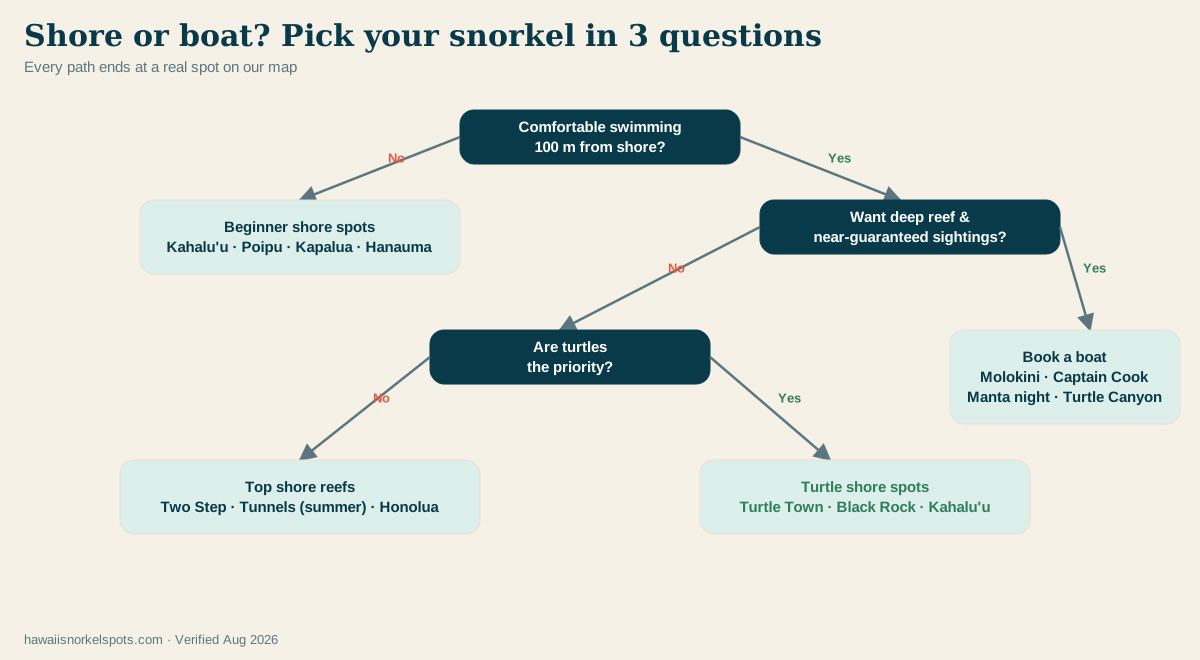
Every shore-entry spot, by island
| Spot | Island | Entry type | Level | Season |
|---|---|---|---|---|
| Two Step (Honaunau) | Big Island | Lava shelf | Intermediate | Year-round |
| Kahalu’u Beach Park | Big Island | Sand channels | Beginner | Year-round |
| Richardson & Carlsmith (Hilo) | Big Island | Sand / lagoon | Beginner | Year-round |
| Turtle Town (Maluaka) | Maui | Sand | Beginner | Year-round |
| Black Rock | Maui | Sand | Beginner | Year-round |
| Kapalua Bay | Maui | Sand | Beginner | Year-round |
| Honolua Bay | Maui | Rocks via trail | Intermediate | Apr–Oct |
| Ahihi-Kinau & Olowalu | Maui | Lava / long swim | Advanced | Year-round |
| Hanauma Bay | Oahu | Sand ($25 + reservation) | Beginner | Year-round |
| Electric Beach | Oahu | Sand channel + swim | Intermediate | Year-round |
| Shark’s Cove | Oahu | Rocks | Intermediate | May–Sep |
| Kuilima Cove | Oahu | Sand | Beginner | Year-round |
| Tunnels Beach | Kauai | Sand | Intermediate | May–Sep |
| Poipu Beach | Kauai | Sand | Beginner | Year-round |
| Ke’e & Lydgate | Kauai | Sand / lagoon | Beginner | Ke’e: May–Sep · Lydgate: year-round |
Why shore snorkeling is usually the better product
The boat sells convenience and a destination; the beach sells freedom. From shore you pick your hour (morning — always morning), stay as long as the fish are interesting, spend nothing, and skip the schedule, the crowds-per-square-meter of a catamaran drop, and the seasickness lottery. Hawaii is unusual among world snorkeling destinations in just how much of its best reef sits a fin-kick from public sand — the table above is the proof. The four legitimate exceptions — Molokini, Kealakekua, the manta night snorkel, Turtle Canyon — are legitimately exceptional, and they’re covered honestly in the tours guide.
Reading an entry before you commit
Every shore snorkel starts with the same 60-second assessment. Sand entries (Kapalua, Poipu, Maluaka): walk in backward with fins on, or carry fins to waist depth. Rock and lava entries (Two Step, Shark’s Cove, Honolua): reef shoes, unhurried movements, watch a local do it first, and plan your exit before you enter — getting out is always the harder half. Any entry: if waves are washing the entry point rhythmically, the spot is telling you no. The ocean will run the same special tomorrow morning.
The shore snorkeler’s kit
Mask, snorkel, fins, reef shoes for rocky spots, a rash guard (better than sunscreen on your back, and legal everywhere), reef-safe sunscreen for the rest (Hawaii law), and a flotation belt if distances are new to you. Nothing rents at the wilder spots — Two Step, Honolua, Electric Beach, Tunnels — so gear up in town first. A cheap ABC Store set pays for itself on day two.
The best shore snorkeling spots, island by island
The table above is the shortlist. This is how those 15 spots actually break down when you are standing on the beach with a mask in your hand — what the entry feels like, when each spot works, and which one to pick first on each island. If you are still choosing an island, start with our guide to the best Hawaiian island for snorkeling, then come back here for the shore-entry detail.
Oahu: the best shore snorkeling near Waikiki — and on the North Shore
Oahu splits into two shore-snorkeling seasons. In summer, the North Shore goes flat and Shark’s Cove becomes the island’s best free snorkel: tidepools for kids at the edge, caves and turtles for confident swimmers, all off a rocky entry at Pupukea. The same coast in winter is big-wave country and the cove is a no-go — which is exactly when Kuilima Cove at Turtle Bay earns its place on this list: a sheltered, sand-entry cove that stays snorkelable on most days when the rest of the North Shore is pumping. Year-round, Hanauma Bay is the beginner classic — a protected marine conservation district with a sand entry, facilities and the island’s easiest fish-watching — but it is the one shore spot that needs planning: entry is by reservation and non-residents pay the $25 entry fee listed in the table above. On the leeward coast, Electric Beach (Kahe Point) rewards intermediates: swim out over the sand channel to the reef in front of the power plant’s warm-water outflow and expect turtles, eagle rays on lucky mornings, and big schools of reef fish. See the full Oahu snorkeling hub for access and parking detail on each spot.
Maui: easy sand entries on the west and south shores
Maui is the easiest island for shore snorkeling, full stop. Kapalua Bay is the textbook beginner entry — a sheltered, sand-bottomed bay where you walk in, put your face down and are immediately over reef and turtles; go before 9 a.m. for glassy water and easier parking. A few minutes south, Black Rock at the north end of Ka’anapali Beach adds a gentle wall feel along the lava point, with turtles cruising its base. On the south shore, Turtle Town at Maluaka Beach is the shore answer to the boat tours: enter off the sand at the reefy ends of the beach for the turtle encounters the tour boats motor out to find. Save Honolua Bay for a calm summer morning — a marine conservation district reached by a short jungle trail, with a rocky entry, no facilities and some of Maui’s healthiest coral. The Maui snorkeling hub compares all of them side by side.
Big Island: Kona’s lava entries and Hilo’s lagoons
The Big Island has Hawaii’s clearest water, and its two best shore spots sit ten minutes apart on the Kona coast. Two Step, beside Pu’uhonua o Honaunau, is an entry down two natural lava steps into deep, gin-clear water over coral gardens — turtles, spinner dolphins resting offshore on some mornings, and no sand to stir up, which is why visibility here beats almost everywhere else on this page. It is an intermediate entry: time the small surge, sit on the step, and slip in. Beginners drive ten minutes north to Kahalu’u Beach Park, a shallow, sheltered bay with a sand entry, facilities and turtles grazing in waist-deep water. The famous one, Kealakekua Bay and the Captain Cook Monument, can be snorkeled from shore — but “from shore” here means hiking the steep Ka’awaloa Trail (roughly two miles each way, no shade or water, so start early) down to the monument, or arriving by permitted kayak or boat; check current bay and trail rules before you go. On the wet Hilo side, Carlsmith Beach Park is a spring-fed lagoon behind a reef — calm, beginner-friendly, and a reliable turtle spot — with Richardson Ocean Park’s black-sand coves a short walk away. Full detail is in the Big Island snorkeling hub.
Kauai: Poipu year-round, the North Shore in summer
Kauai is the most seasonal island on this page. The reliable year-round pick is the south shore: Poipu Beach, where a sand tombolo splits two gentle bays, the entry is pure sand, and turtles and monk seals haul out on the beach itself (watch from a distance — never approach them). The North Shore is summer-only and spectacular: Tunnels Beach (Makua) spreads a huge reef system off a sand entry, with the best fish life on the island — but parking is very limited and fills early, so plan around that or look at shuttle options. At the end of the road, Ke’e Beach sits inside Ha’ena State Park: as of the last check, advance reservations are required for out-of-state visitors, so book through the official Hawai’i State Parks system and confirm current rules before you go. For families, the same guide covers Lydgate Beach Park’s rock-walled lagoons on the east side — the most protected beginner water on Kauai, usable in almost any season. See the Kauai snorkeling hub for the full comparison.
How deep is the reef at each shore spot? Depth and visibility, spot by spot
Entry type tells you how to get in. Depth tells you what the snorkel actually feels like once you are in — whether you can stand up when you need to, how far the reef sits below you, and how much water clarity you can expect on a good morning. These are the numbers that matter, spot by spot, drawn from our own guides to each beach. Visibility is a range, not a promise: it is best on calm mornings before the wind builds, and it drops after rain, runoff or a big swell.
| Spot | Reef depth | Typical visibility | What it means for you |
|---|---|---|---|
| Two Step (Honaunau) | ~10 ft at the steps, ~25 ft a short swim out | Routinely excellent | Deep water right off the entry — the clearest shore snorkel on this page, but an intermediate entry with no shallow standing area. |
| Kahalu’u Beach Park | Shallow inner reef, waist-deep in places | Clear for a shallow bay on calm mornings | The easiest first snorkel on the Big Island — stand up whenever you want, turtles grazing in waist-deep water. |
| Richardson & Carlsmith (Hilo) | Shallow lagoons and coves, standable in places | Good on dry mornings, clouds after rain | Beginner water on the wet side of the island — check the sky first, because runoff is the visibility killer here. |
| Turtle Town (Maluaka) | Shallow near shore; deeper reef 200–400 ft out | Clear on calm mornings | The turtles sit over the deeper reef a few hundred feet out — a short swim, not a wade, to the good water. |
| Black Rock | Shallow sand entry; the wall drops deep off the point | Clear on calm mornings | Feels like a wall dive without a boat — but the depth and current around the point are real, so weaker swimmers stay on the sand side. |
| Kapalua Bay | ~5–15 ft over the reef | Clear on calm mornings | Standing depth in the middle, reef under your face the moment you float — the textbook beginner depth. |
| Honolua Bay | ~8 ft near shore to 30+ ft further out | Excellent in a good summer week | The reef gets bigger and bluer as you work outward — save it for a calm summer morning to see it at its best. |
| Ahihi-Kinau & Olowalu | Deeper water, long swim from shore | Conditions-dependent | Advanced water: a real swim over lava reef to reach the good coral, with no shallow bail-out. |
| Hanauma Bay | Shallow inner reef; deeper sand channels and outer reef | Clearest early, before fins stir the sand | Go at opening time. By midday hundreds of fins have clouded the shallows — the same reef, half the visibility. |
| Electric Beach | Waist-deep entry; ~20 ft or more at the outflow | Good on calm mornings | An open-water swim once you leave the shallows, with no bottom to stand on — intermediates only, and only on a calm day. |
| Shark’s Cove | Shallow tide pools; deeper outer cove | ~10–20 ft on good summer mornings; under 5 ft in winter surge | The honest mixed bag: lovely in summer, murky and rough in winter — the season rule here is a safety rule. |
| Kuilima Cove | Most of the cove ~4–10 ft | Typically 20–40 ft on calm days | Shallow, sheltered and genuinely beginner-friendly — the North Shore cove that still works when the rest of the coast is pumping. |
| Tunnels Beach | Shallow inner lagoon; deeper outer reef | Genuinely conditions-dependent | Two different snorkels in one beach: the calm lagoon for most visitors, the big outer reef only on a flat summer morning. |
| Poipu Beach | Mostly shallow, up to ~12 ft over the reef pockets | Clear on calm mornings | Shallow enough for kids in the reef-walled pool, deep enough over the pockets to hold real fish life. |
| Ke’e & Lydgate | Ke’e: shallow lagoon; Lydgate ponds ~2–10 ft | Calmest inside the ponds | The most protected beginner water on Kauai — waist-deep, walled off from the ocean, usable in almost any season. |
The pattern to remember: shallow does not mean worse. Kapalua, Kahalu’u and the Lydgate ponds are shallow and superb, because calm, protected water lets the reef grow close to shore. What matters is the combination — depth, shelter and entry — and that is exactly what the table above lets you compare at a glance.
Which Hawaiian island is best for shore snorkeling?
Maui, for most people. It has the most sand-entry shore spots that work year-round — Kapalua, Black Rock and Turtle Town are all walk-in, beginner-friendly and calm on the island’s protected west and south shores — plus Honolua Bay in summer for the best coral. If you want the easiest shore snorkeling with the least planning, start on Maui. Our Maui snorkeling hub compares all of them side by side, and our guide to the best Hawaiian island for snorkeling makes the full island-by-island case.
The Big Island wins on water clarity. Two Step and Kahalu’u sit ten minutes apart on the Kona coast and cover both ends of the spectrum — deep, gin-clear water at Two Step, waist-deep beginner water at Kahalu’u — and the Hilo lagoons give the island a calm backup when Kona is windy. See the Big Island snorkeling hub.
Oahu is the best first-timer setup: Hanauma Bay is the most managed, most beginner-friendly shore snorkel in the state, and Kuilima Cove covers the North Shore when the big surf arrives. The trade-off is the summer-only window for Shark’s Cove and the reservation you need for Hanauma. See the Oahu snorkeling hub.
Kauai is the most seasonal — Poipu Beach is the reliable year-round pick on the south shore, while the North Shore’s Tunnels and Ke’e are summer-only and spectacular. If your trip is June to September, Kauai’s north shore belongs on any best-of list; in winter, stick to Poipu. See the Kauai snorkeling hub.
Best shore snorkeling for beginners and kids
If it is your first time — or your child’s — judge a spot by three things: a sand entry (no lava, no surge), shallow reef close to shore, and an exit as easy as the entry. On those criteria the five best beginner shore spots in Hawaii are Kapalua Bay (Maui), Kahalu’u Beach Park (Big Island), Poipu Beach (Kauai), Kuilima Cove (Oahu) and the Lydgate lagoons (Kauai). All five let a nervous snorkeler stand up and walk out at any moment. Start in the shallows, practice clearing your mask where you can stand, use a flotation belt or vest if it buys confidence, and keep the first session to 20–30 minutes in the calm of the morning. Our dedicated beginner snorkeling guide walks through the full first-day plan, and the island sections above link each spot’s own guide with entry photos and parking notes.
When to go: the best time for shore snorkeling
Two rules cover most of it. First, the time of day: go early. Hawaii’s trade winds typically build late morning, so the glassy, clear, uncrowded window at almost every shore spot is roughly sunrise to 10 a.m. — which is also when parking is easiest and turtles are most active in the shallows. Second, the season: summer (roughly May to September) flattens the north shores, opening Shark’s Cove, Kuilima’s outer reef, Tunnels, Ke’e and Honolua; winter swells close those same spots and push you to the south and west shores — Poipu, Kapalua, Black Rock, Turtle Town, Kahalu’u and Two Step work year-round. Whatever the calendar says, check the surf and county ocean conditions for your beach that morning; conditions, not the month, make the final call. Our best time to snorkel in Hawaii guide breaks this down month by month and island by island.
What shore snorkeling costs: parking, fees and reservations
Shore snorkeling is close to free, with two paid exceptions. Most spots on this page are public beach parks with no entry fee and free parking — though the small lots at the popular west-side bays (Kapalua, Honolua’s roadside parking, Tunnels) can fill by mid-morning, which is one more reason to go early. The exceptions: Hanauma Bay, where non-residents pay the $25 entry fee and everyone needs an advance reservation; and Ke’e Beach in Ha’ena State Park, which runs an advance-reservation system for out-of-state visitors. Fees and reservation rules change, so confirm both on the official park pages before you set off — each spot guide on this site links them. Gear is the other cost: nothing rents at Two Step, Honolua, Electric Beach or Tunnels, so rent in town (a weekly rental usually beats daily rates within three days) or buy a basic set. Our Hawaii snorkeling gear checklist lists exactly what you need — and what you can skip.
What you will see from shore
You do not need a boat to see Hawaii’s headline marine life. Green sea turtles (honu) graze the reef at Kahalu’u, Turtle Town, Kapalua, Black Rock, Poipu and Carlsmith; the reef fish cast includes the humuhumunukunukuapua’a (the state fish), yellow tang, convict tang, Moorish idols, butterflyfish, parrotfish and clouds of wrasses over the shallows. Electric Beach adds spotted eagle rays on calm mornings, Two Step adds spinner dolphins resting in the bay, and a Hawaiian monk seal hauled out asleep at Poipu is a regular sight. Two rules are law, not etiquette: never touch, chase or feed turtles or monk seals, and watch from a respectful distance — and give any seal on the sand a wide berth. Our guide to snorkeling with turtles in Hawaii covers where, when and how to do it responsibly.
Shore snorkeling safety: five rules that matter
Shore snorkeling is self-guided, which is its freedom and its risk. Five rules keep it safe. 1. Never snorkel alone — go with a buddy and keep each other in sight. 2. Check conditions before you go and when you arrive: surf advisories, county beach warnings and the entry itself; if in doubt, don’t go out. 3. Plan your exit before you enter, especially at lava entries, and never turn your back on the surge. 4. Skip murky water — after heavy rain, runoff clouds the bays and the snorkeling is poor anyway; wait a day or two. 5. Know your limits and use flotation if you are building confidence; Hawaii safety officials have also raised concerns about full-face snorkel masks, so a traditional mask-and-snorkel set is the cautious choice. The full picture is in our guide: is snorkeling in Hawaii safe?
Sources
- Entry details and levels: the individual spot guides linked above, each with its own cited firsthand sources per our methodology.
FAQ
What’s the single best shore snorkel in Hawaii?
Two Step — Kealakekua-grade South Kona water, straight off the lava, free. Beginners’ answer: Kahalu’u, ten minutes up the road.
Can you snorkel off Waikiki Beach?
You can swim there; the snorkeling is poor — sand bottom, stirred water. Waikiki’s real snorkeling is the Turtle Canyon boat or a drive to Hanauma or Electric Beach.
Is shore snorkeling safe alone?
Don’t. The overwhelming pattern in Hawaii snorkeling incidents is solo swimmers. A buddy costs nothing and changes everything — it’s the one rule this site repeats on purpose.
Where is the best shore snorkeling in Hawaii?
It depends on the island and your level. For reef quality straight off the beach, Two Step on the Big Island; for beginners, Kapalua Bay on Maui or Kahalu’u on the Big Island; for turtles, Turtle Town (Maluaka) on Maui. The island-by-island section above picks a first choice for Oahu, Maui, the Big Island and Kauai.
Do you need a reservation for shore snorkeling in Hawaii?
Almost everywhere, no — you simply walk in, free. The two exceptions are Hanauma Bay on Oahu (advance reservation, plus the $25 entry fee for non-residents) and Ke’e Beach in Ha’ena State Park on Kauai (advance reservations for out-of-state visitors). Rules change, so check the official park pages before you go.
Is shore snorkeling better than a boat tour?
For most Hawaii spots, yes: it is free, unhurried and just as good at the 15 spots on this page. Boats earn their money at exactly four places — Molokini, Kealakekua if you skip the trail, the manta ray night snorkel and Turtle Canyon. Our Hawaii snorkeling tours guide covers those honestly.
What is the best shore snorkeling on Oahu’s North Shore?
In summer, Shark’s Cove — flat, clear and free, with tidepools at its edge. In winter the North Shore is big-wave country and the cove is off-limits; the year-round answer is sheltered Kuilima Cove at Turtle Bay. Never enter a North Shore spot in surf — check conditions that morning.
Is beach snorkeling the same as shore snorkeling?
Yes — same thing, different words. Beach snorkeling, shore snorkeling and snorkeling from the beach all mean entering the water from land instead of a boat. The best beach snorkeling in Hawaii is the list on this page: sand or lava entries, no tour, no schedule, and the reef starts a fin-kick from where you are standing.
How deep is the water at Hawaii’s shore snorkeling spots?
It depends on the spot, and the range is wide: waist-deep in the Lydgate ponds and at Kahalu’u, roughly 5–15 feet over the reef at Kapalua, about 10 feet at the Two Step entry deepening to 25 feet a short swim out, and 30 feet or more further out at Honolua Bay. The full depth and visibility table is in the “How deep is the reef at each shore spot?” section above. Shallow is not a drawback — the calmest, most beginner-friendly reefs on this page are also the shallowest.