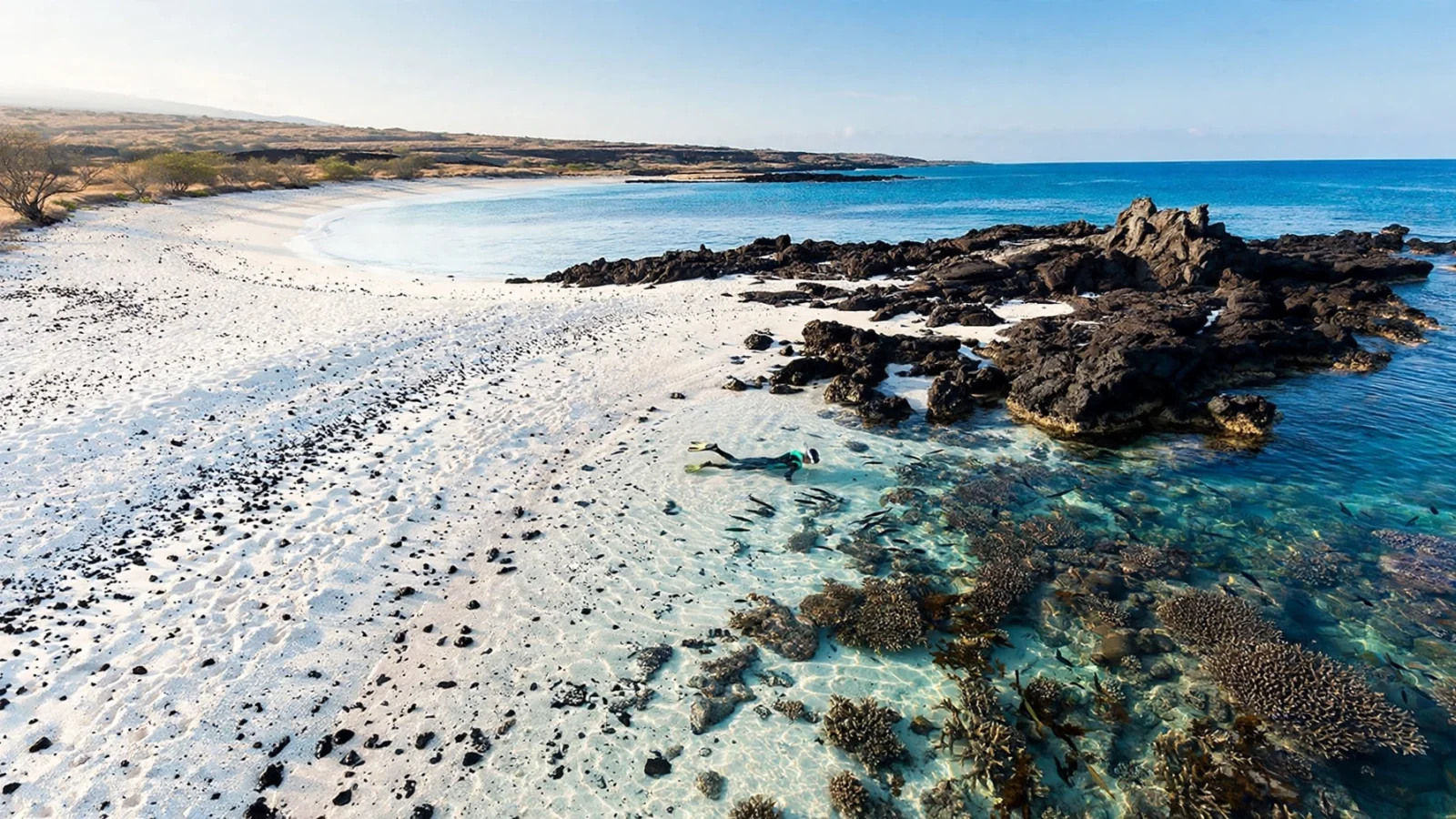
Kua Bay is the beach that makes people fall for the Kona coast: a crescent of brilliant white sand — crushed shell and coral flecked with black lava — under clear, blue water, at the north end of Kekaha Kai State Park. Almost everything written about it is about that sand, the sunsets and the boogie boarding. The snorkeling gets a sentence at most, usually “there’s some reef at the ends.”
There is, at both ends, and on the right morning it is genuinely good — clear water over rocky points, turtles working the edges, and a canyon-cut reef around the north point that almost no beach guide bothers to describe. But Kua Bay comes with the sharpest condition warning on this coast. This is an exposed bay. In winter surf it is not a mediocre snorkel, it is a closed one: pounding shorebreak, rip currents, and water you should not enter at all. The whole skill of snorkeling Kua Bay is knowing which morning you have been given.
This guide covers Kua Bay purely as a snorkeling spot: which end to swim, the route around the north point and why it is for experienced snorkelers only, the new 2026 entry fees and gate hours, the lifeguard situation as it actually is, and the honest verdict for beginners — plus how Kua Bay compares with Hapuna, Waialea and Kahalu’u when you are choosing one west-side snorkel for the day.
Quick facts
| Detail | What to know |
|---|---|
| Where | Kua Bay (Manini’owali Beach), northernmost beach of Kekaha Kai State Park, north of Kona airport, Big Island |
| Entry fee | Since January 2026: non-residents $5 per person + $10 per vehicle (children 3 and under free); Hawaii residents free with Hawaii ID |
| Park hours | Daily 8:00am–6:30pm; gates close at 7:00pm — check DLNR park notices before you drive |
| Lifeguard | A Hawaii County lifeguard tower stands at the beach, but staffing is not guaranteed — check the tower on the day |
| Facilities | Restrooms, outdoor showers, picnic tables at the parking area; no food sold at the beach |
| Shade / water | Almost no shade on the sand; bring your own drinking water — do not count on a refill |
| Reef | Rocky points at both ends of the bay; the bigger reef with canyons lies around the north point |
| Best conditions | Calm mornings in spring, summer and fall; the earlier the better |
| Level | Intermediate, surf-dependent — not a beginner snorkel |
Getting there, the 2026 fees and the gate
Kua Bay sits in Kekaha Kai State Park (formerly Kona Coast State Park), just north of Kona airport. Drive Highway 19 (Queen Ka’ahumanu Highway) and turn toward the ocean opposite the West Hawaii Veterans Cemetery — between mile markers 88 and 89 — then follow the paved park road for roughly a mile down to the parking lot. The cemetery sign is bigger than the beach sign; most first-timers navigate by it.
Two 2026 realities shape the visit. First, the fees: since January 2026, Hawaii State Parks charges non-residents $5 per person plus $10 per vehicle to enter the Manini’owali (Kua Bay) section — about $22 for a car with two people once taxes are added. Hawaii residents with a Hawaii ID or driver’s licence enter and park free. Pay at the entrance before the parking area; the payment setup is card/QR-based, so bring a phone with data and a credit card rather than relying on cash — and check the posted signs, because fee details are the park’s to change.
Second, the gate: the park is open daily from 8:00am to 6:30pm and the access road gate closes at 7:00pm. That clock matters twice. It kills the old advice to arrive at dawn — the earliest legal snorkel here starts at 8am, which is fine, because the calm window runs through the morning anyway. And it means a spring or summer sunset happens after you have to leave; only in fall and winter does the sun set before the gate closes. The park also closes outright for events and storms from time to time, so check the DLNR park notices on the morning you drive.
The lot is small and fills fast on weekends and holidays. Arrive near opening on a weekday and Kua Bay feels half-empty; arrive at noon on a Saturday and you may be walking in from up the road — in full sun, carrying everything, because there is almost no shade waiting for you at the other end.
The snorkeling: two ends, two different swims
The middle of Kua Bay is sand — beautiful for swimming on a calm day, and almost empty underneath. Everything worth seeing lives where the sand ends. The bay is really three sandy crescents separated by lava, and the rocky outcroppings at each end of the beach hold the reef, the fish and the turtles.
The south end and the shallows: the gentle introduction
Enter from the sand at the south end of the beach — stairs installed in 2018 lead down to this section — and work along the rocks at an easy pace. The snorkeling here is the more forgiving of the two ends: reef fish over the lava edges, turtles grazing where the algae grows, and a shorter swim back to an exit you can see. On a flat morning this is where a confident swimmer new to Kua Bay should start, staying inside the bay and letting the point come to an end before the open coast begins.
One seasonal catch: in winter, high surf can cut the south section off from the main beach entirely, and the entry that was stairs-and-sand in July becomes a scramble over wet lava. If the crescents are not connected when you arrive, that is the ocean telling you the snorkeling is off — believe it.
The north point: the canyon reef, for experienced snorkelers only
The best reef at Kua Bay is the one most visitors never reach. Around the rocky point at the north end of the bay, the lava continues underwater into a reef cut with canyons — a far more interesting structure than the inshore edges, with turtles, dolphins passing offshore, and eagle rays and sharks among the sightings local snorkelers report from this section.
Getting there is the filter. You swim around the point itself, which means a longer swim with no sandy exit, in water where the surge strengthens noticeably — the same swell that is a ripple inside the bay pushes and pulls around the point. This is a calm-morning, experienced-snorkeler swim: go early, go with a buddy, watch the sets before you commit, and turn back the moment the surge starts working you toward the rocks. On anything but a genuinely flat morning, the north reef is not a diminished version of itself — it is a bad idea. The in-bay points will still be there, and so will the reef next trip.
How to enter, anywhere at Kua Bay
Enter on sand, never over the lava in the middle of the beach. Winter surf strips sand off the shallows and exposes black lava rock underfoot, and even in summer the edges of the crescents hide rock in knee-deep water — water shoes or reef walkers earn their space in the car here. Shuffle in until you are deep enough to float, put your fins on in the water, and keep one eye on the shorebreak behind you: at Kua Bay the exit, through the same surf zone you entered, is the part to plan before you start admiring the reef. Our Hawaii snorkeling safety guide covers the full entry-and-exit routine.
Conditions: the season verdict
Kua Bay’s snorkeling calendar is simple and unforgiving.
Spring, summer and fall are the snorkeling seasons. The bay faces the open ocean, and when the swell drops the water turns some of the clearest on the Kona coast — this is when the white sand does its turquoise postcard trick, and when the points fish best. Mornings are the reliable window: arrive at the 8am opening, snorkel while the surface is glassy, and be out before the midday sun and the afternoon chop arrive together. There is almost no shade on the sand, so the morning plan is also the comfortable plan. Our best time to snorkel in Hawaii guide explains this seasonal pattern coast by coast.
Winter is a different beach. North Pacific swell stacks into the bay as genuinely large surf with a pounding shorebreak and dangerous rip currents. Hawaii State Parks is blunt about it: waves over three feet are for experts only, and everyone else should stay out of the water and well back from the shoreline. For snorkelers the rule is simpler — in winter surf, Kua Bay is a beach walk and a whale-watching lookout (humpbacks are visible offshore in season), not a snorkel. Drive fifteen minutes to a protected spot instead; Kahalu’u, further south, keeps working on days Kua Bay has closed down.
Whatever the season, read the morning before you commit. Watch several sets from the sand: if whitewater is breaking across the crescents, if the surface is churned and sandy-coloured, or if boogie boarders are getting worked at the shoreline, the snorkeling verdict has already been delivered. Flat, clear and quiet is the only version of Kua Bay worth gearing up for.
What you see
Green sea turtles are the reliable headline — they graze the rocky edges at both ends of the bay and rest in the shallows, common enough that a calm morning without one is the surprise. Give them at least ten feet of space on land and in the water, and never touch, feed or crowd them — our guide to snorkeling with turtles in Hawaii covers the viewing distances for every species you will meet on this coast. Spinner dolphins pass offshore regularly and occasionally travel through the bay; watch from a distance and let them move on. Hawaiian monk seals haul out to rest on the far crescent from time to time — a privilege to see and a strict look-don’t-approach animal: stay at least 50 feet away, and 150 feet from a mother with a pup.
Around the points, expect the standard Kona-coast reef community in unusually clear water: surgeonfish and tangs over the lava, butterflyfish along the edges, parrotfish grazing the reef, and the reef canyons off the north point adding the bigger visitors — eagle rays and reef sharks are reported there by experienced local snorkelers, as possibilities rather than promises. Visibility is the real draw: on a calm morning the water over that white sand is the kind of blue that makes ordinary fish look extraordinary.
Beginners and kids: the honest verdict
Kua Bay is rated intermediate on this site, and the rating is the surf’s, not the reef’s. The entry crosses a surf zone, the best reef involves a point swim, there are no sheltered lagoons or rock-walled pools, and the lifeguard tower — staffed by Hawaii County since 2019 — is not a guarantee: the county has been short of lifeguards and moves them between towers, so check whether the tower is actually staffed before you rely on it, and treat an empty tower as a reason for extra caution, not a detail.
For a first snorkel, a young child’s first reef, or anyone who is not a confident ocean swimmer, Kahalu’u Beach Park is the right Kona-side answer — protected, shallow, lifeguarded and full of turtles. Our beginners’ guide to snorkeling in Hawaii covers the first-snorkel routine to run there. Kua Bay is the second or third snorkel of a trip, for swimmers who can handle an entry through small surf on a morning they have already judged to be calm. Kids who are strong swimmers will love the beach itself; kids who are learning should learn somewhere the ocean is not part of the lesson plan.
Facilities, shade and what to bring
The parking area has restrooms, outdoor showers and picnic tables — a few of them shaded, near the entrance above the beach. Nothing is sold at the beach itself; a food truck sometimes sets up at the lot, but that is a bonus, not a plan. Sources disagree about drinking water at the lot, so treat Kua Bay as a bring-everything beach: more drinking water than you think you need, food, reef-safe sunscreen, a hat, and your own shade — an umbrella or pop-up is the difference between a morning and a whole day here.
Bring water shoes for the lava edges, and a dry bag if you plan to leave anything on the sand during the north-point swim. Our snorkel gear checklist covers the full pack list for a shade-free beach day. Everything you bring has to beat the 7pm gate, including you.
The rest of Kekaha Kai: make it a park day
Kua Bay is the northernmost of three beaches in a state park of roughly 1,640 acres, and the other two explain the coast. Mahai’ula Bay, to the south, has its own road access and a quieter, older feel. Between them, Makalawena Beach at Pu’u Ali’i Bay is the one you earn: no road, a walk of about twenty minutes across a lava path, no facilities — and a secluded white-sand cove at the end of it. A 4.5-mile stretch of the historic Ala Kahakai coastal trail links Mahai’ula to Kua Bay, with a side climb up Pu’u Ku’ili, a 342-foot cinder cone, for the wide view of this shoreline.
None of that changes the snorkel plan — Kua Bay’s points remain the park’s snorkeling — but it does mean a too-rough morning here is not a wasted drive. Walk the trail, look for whales in winter, and snorkel the protected spots on the way back south.
Kua Bay vs the neighbours
| Spot | Snorkeling | Entry | Fees / hours | Best for |
|---|---|---|---|---|
| Kua Bay (Manini’owali) | Reef at both points; canyon reef around the north point | Sand entry through a surf zone | $5/person + $10/vehicle non-resident; park 8am–6:30pm, gate 7pm | Confident swimmers on calm mornings; beach + snorkel in one stop |
| Hapuna Beach | Reef at the rocky south end of a half-mile beach | Wide sandy entry | State recreation area fees/hours apply | Families who want room, facilities and lifeguards every day |
| Waialea Beach (Beach 69) | Marine Life Conservation District reef off a small cove | Sandy entry in a sheltered bay | County beach park | A quieter, more protected Kohala snorkel |
| Kahalu’u Beach Park | Shallow, turtle-filled reef inside a protected bay | Easy sandy entry inside the reef | County beach park | Beginners, kids and first snorkels — works when Kua Bay is too rough |
Staying up the Kohala coast? Waikoloa Beach, Puako Bay and Spencer Beach Park each offer a calmer, more sheltered morning than Kua Bay’s open bay. Heading south instead, Kealakekua Bay (Captain Cook) is the Big Island’s best reef if you book the boat — and the full coast, Kua Bay included, is mapped in our Big Island snorkeling hub.
Kua Bay snorkeling tips
- Go on a weekday, at the 8am opening. You beat the small lot filling, the crowds and the afternoon chop in a single decision.
- Judge the surf, not the sky. A sunny winter morning with three-foot shorebreak is a beach day, not a snorkel day. Flat and clear is the only green light.
- Start at the south end. Learn the bay on the gentler reef first; save the north point for a morning you have already read correctly.
- Treat the north point as a one-way commitment. There is no sandy exit around it. Check your energy and the surge before you round it, not after.
- Bring a credit card and a charged phone. The 2026 entry fee is paid at the entrance by card/QR — cash in the glovebox does not get you in.
- Pack water and shade like the beach has none — because it mostly doesn’t. No food is sold on the sand and there are no trees over it.
- Plan the exit before the entrance. At Kua Bay you leave through the same surf zone you entered; know which crescent you are aiming for before the sets pick up.
- Keep the wildlife distances. Ten feet from turtles, fifty yards from dolphins, at least 50 feet from a resting monk seal — sightings here are good enough that there is never a reason to close the gap.
Frequently asked questions
Is Kua Bay good for snorkeling?
Yes — on calm mornings. The rocky points at both ends of the bay hold reef fish and turtles in very clear water, and the reef around the north point is the best snorkeling in Kekaha Kai State Park. In surf, especially winter surf, it is not good at all: the shorebreak and rip currents close the snorkeling down completely, and the right move is a protected spot like Kahalu’u.
How much does it cost to visit Kua Bay in 2026?
Since January 2026, non-residents pay $5 per person plus $10 per vehicle (about $22 for a car with two people, taxes included); children aged 3 and under are free, and Hawaii residents with a Hawaii ID or driver’s licence enter and park free. Pay at the park entrance by card/QR.
What are Kua Bay’s hours?
Kekaha Kai State Park’s Manini’owali section is open daily from 8:00am to 6:30pm, and the access-road gate closes at 7:00pm — you and your car need to be out before it does. The park occasionally closes for events or storms, so check the DLNR park notices before you drive.
Is there a lifeguard at Kua Bay?
There is a lifeguard tower, staffed by Hawaii County ocean safety officers — but staffing is not guaranteed. The county has been short of lifeguards and moves them between towers, so look for a guard in the tower before you go in, and take extra care if it is empty.
When is the best time to snorkel at Kua Bay?
Calm mornings in spring, summer and fall. Be in the water soon after the 8am park opening, while the surface is calm and clear and before the midday sun takes the shade-free beach over. Winter, and any day with surf running, is a skip.
What will I see snorkeling at Kua Bay?
Green sea turtles are the regular sighting at both ends of the bay, along with the usual Kona-coast reef fish — tangs, surgeonfish, butterflyfish and parrotfish — in very clear water. Dolphins pass offshore, monk seals occasionally rest on the far crescent, and experienced snorkelers report eagle rays and reef sharks around the north-point reef.
Is Kua Bay good for beginners?
Not really. The entry crosses a surf zone, the reef sits at the points rather than in a protected lagoon, and lifeguard cover is not guaranteed. Confident swimmers will do fine on a calm morning; genuine beginners and young kids are better at Kahalu’u Beach Park, which is protected, shallow and lifeguarded.
Kua Bay or Hapuna — which should I choose?
For a beach day with a snorkel attached, Kua Bay is smaller, prettier and usually quieter, with reef at both points — but it is surf-dependent and shade-free. Hapuna is the bigger, easier day: a half-mile of sand, more facilities, lifeguards every day, and its snorkeling concentrated at the rocky south end. Choose Kua Bay on a calm morning when snorkeling is the point; choose Hapuna when the group, the kids or the surf forecast want the safer all-rounder.
The bottom line
Kua Bay is the Big Island’s best beach-and-snorkel combination — and the combination only exists on calm mornings. Time it right (a weekday, an 8am arrival, a flat spring-to-fall morning), pay the new entry fee, start at the south end and save the north-point canyons for the day the ocean is truly quiet, and you get white sand, clear water and turtles with a fraction of the resort-coast crowds. Time it wrong, and the correct snorkeling decision at Kua Bay is the one you make from the sand — which is exactly why it rewards the snorkelers who bother to check.
The next bay south is Kua Bay’s quieter neighbour — our Kukio Bay snorkeling guide covers its rocky points, turtle cleaning stations and the public-access rules at the Kikaua Point park.