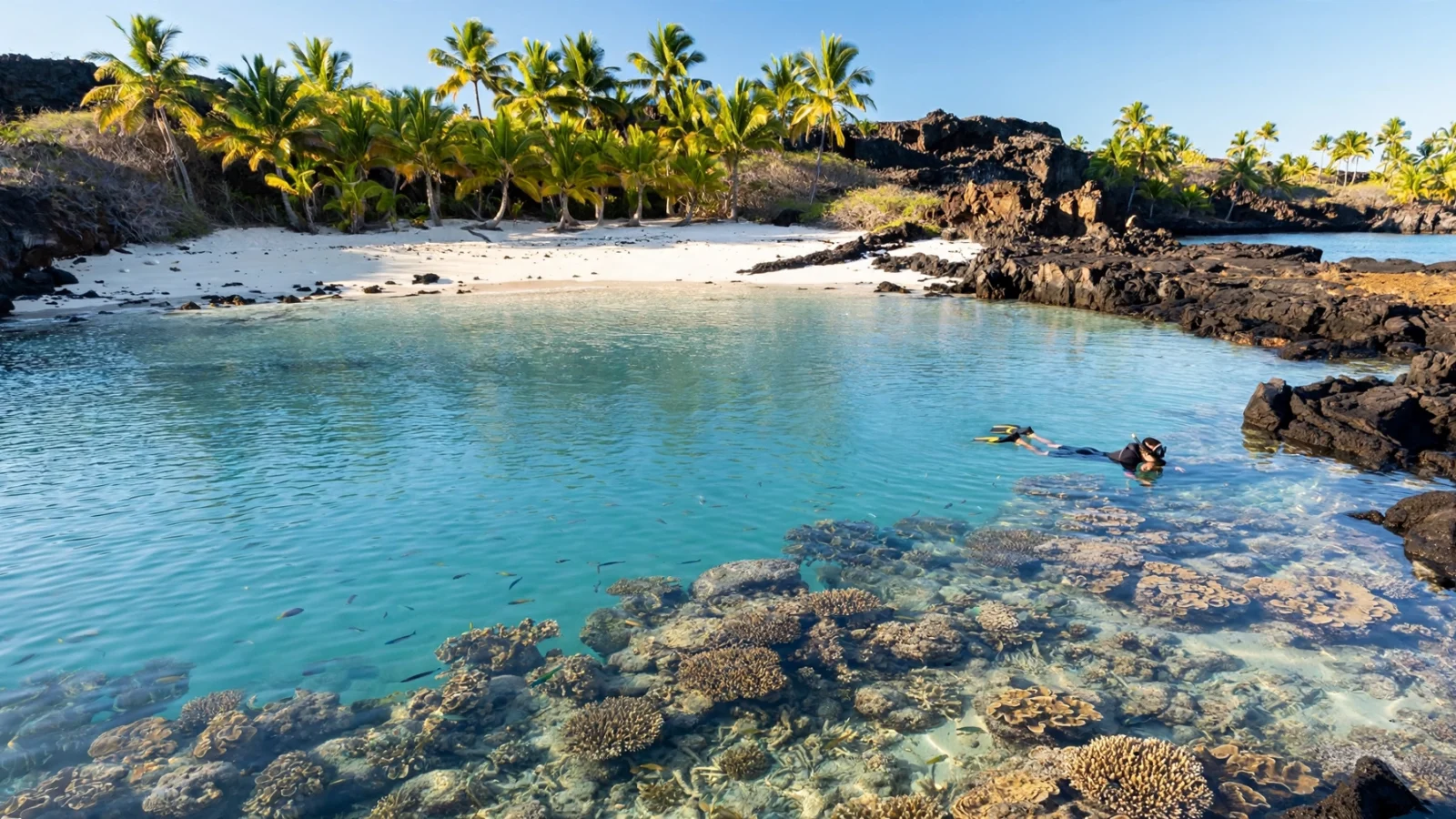
Makaiwa Bay is the little white-sand cove that fronts the Mauna Lani Beach Club on the Big Island’s Kohala Coast — and it confuses more visitors than almost any other snorkel spot on this coast. It looks like a private resort beach. The chairs, the cabanas and the beachside restaurant all say “guests only.” Yet the bay itself is a public beach, reachable on foot by anyone willing to make one of the prettiest ten-minute walks in Hawai’i: a paved path through a black lava field, past a lava-tube shelter and along the ancient Kalahuipua’a fishponds.
The snorkeling is real, too — a sheltered sandy entry, coral close to shore, reef fish from the moment you put your face in, and green sea turtles feeding along the rocks. But it comes with one honest catch that the resort brochures never mention: Makaiwa’s visibility is often the softest on this stretch of coast. This guide covers the bay purely as a snorkeling spot — how the public access actually works, what is and is not guest-only, where the reef is, when to go, and how Makaiwa honestly compares with the other Kohala Coast spots before you spend a morning on it.
Quick facts
| Entry fee | None — public beach; no reservation system |
| Parking | Free public shoreline-access lot off Pauoa Road (small, ~20 vehicles — arrive early) |
| Walk to the beach | ~10–15 minutes on a paved path past the Kalahuipua’a fishponds |
| Lifeguard | None |
| Restrooms / showers | At the Beach Club for guests/members; a restroom is reported at the historic-park parking area — check on the day and plan accordingly |
| Rentals / food | Beach Club rentals and the Napua restaurant are for resort guests — bring your own gear, water and food |
| Reef depth | Shallow reef and rocky edges close to shore, deepening gradually across the bay |
| Best conditions | Calm mornings, before the breeze builds |
Is Makaiwa Bay public? The access question, answered properly
Yes. Like every beach in Hawai’i, Makaiwa Bay is public — the sand and the water belong to everyone. What is private is the Mauna Lani Beach Club built behind it: its parking lot, chairs and cabanas, showers, gear rentals and the Napua restaurant are reserved for resort guests and members. Searchers constantly mix these two things up, arrive at the Beach Club gate, assume the whole bay is off-limits, and leave. It isn’t — you just can’t use the club’s facilities, and you can’t park in its lot.
Day visitors use the public route instead:
- Drive into the Mauna Lani resort area from Highway 19 (the entrance sits between mile markers 73 and 74) and follow Mauna Lani Drive through the roundabout.
- Turn left onto Pauoa Road. The small public parking lot for the Kalahuipua’a Historic Park and shoreline access is on your right. It holds roughly twenty vehicles, so on busy mornings it fills — come early.
- Walk the paved path — about 10 to 15 minutes — across the lava field and along the fishponds to the bay. The path is easy but it is in full sun almost the whole way, and the lava radiates heat by mid-morning. Wear real shoes for the walk, carry water, and put your reef-safe sunscreen on at the car so it has time to soak in before you swim.
Two things worth knowing before you set off. First, do not try to shortcut through the resort or the Beach Club to reach the sand — the shoreline path is the public access, and it is genuinely part of the experience. Second, everything you need for the day comes with you: there is no shop, rental stand or water refill for day visitors at the bay.
The walk in: Kalahuipua’a fishponds
Most snorkel guides skip the walk. That is a mistake, because the path to Makaiwa crosses one of the most significant cultural landscapes on the Kohala Coast. Kalahuipua’a is a complex of seven ancient Hawaiian fishponds, built to raise fish — mullet especially — for the ali’i (chiefs) who lived along this shore; the largest pond covers more than four acres. The ponds once belonged to Kamehameha the Great, and they are still a living, maintained cultural site today, not a ruin.
On the way you will pass the ponds’ sluice gates and a fishtrap, a lava-tube cave that served as a shelter, and petroglyph-era lava scenery the whole way. Slow down for it — but treat it with respect:
- Stay on the paved path at all times.
- Never enter or touch the fishpond water.
- Read the interpretive signs rather than climbing on walls or structures.
- Explore the historic park on the way in, while you are dry — nobody stops on the hot walk back to the car.
The historic park trails are generally open from dawn to dusk. If you are only here for the snorkeling, budget the walk into your timing: a “quick morning snorkel” at Makaiwa is really a half-day outing once the walk, the swim and the walk back are counted.
Where the snorkeling actually is
Makaiwa is a half-moon cove with a soft white-sand centre and reef structure around its edges, and the pattern here is the same as at most Kohala Coast spots: the middle is for swimming, the edges are for snorkeling.
Entry. Wade in from the sandy centre of the cove. The entry is gentle, sheltered and sandy — one of the easiest walk-ins on this coast, and a big part of Makaiwa’s appeal for beginners and families who are staying nearby.
The reef. Work out from the sand toward either rocky edge of the bay and along the reef and rock structure that sits close to shore. That is where the coral and the fish are: the coral cover here is genuinely good for the Kohala Coast, and fish gather along the transition where sand meets reef. Keep your exploring inside the bay — there is no reason to round the points, where the coast opens up and conditions change.
Depth. The nearshore reef is shallow enough to enjoy on a relaxed surface swim, deepening gradually as you move away from the beach. Because so much of the life is close to shore and shallow, Makaiwa rewards slow, patient snorkeling over long swims: hover over one patch of reef for five minutes and it will show you far more than a lap of the whole bay.
The honest part: visibility at Makaiwa
Here is what the resort marketing will not tell you, stated plainly because it decides whether you love this spot or leave disappointed. Local operators who snorkel this coast daily describe Makaiwa’s visibility as usually low compared with the famous Kona sites further south — the water here is often softer, greener and less crystalline than at Kealakekua Bay or Two Step, and it changes with wind, swell and what is moving through the nearshore water. Some mornings are clear and lovely. Many are not gin-clear.
Why come anyway? Three reasons:
- The shelter. The cove is protected — including from the summer south swells that stir up more exposed beaches — so on days when other spots are bumpy, Makaiwa is often still swimmable.
- The coral and fish density near shore. You do not need 100-foot visibility when the reef is ten feet from the sand and the fish are in the shallows with you.
- The setting. No other snorkel on this coast starts with a walk through royal fishponds and ends on a cove this pretty.
Set your expectations to “a sheltered, fishy, beginner-friendly cove” rather than “a clear-water showcase” and Makaiwa delivers. If crystal clarity is your top priority and you only have one Big Island snorkel day, spend it further south — our Big Island snorkeling hub is honest about which spots do what best.
What you will see
Makaiwa’s nearshore reef holds the classic Kohala Coast cast. Expect:
- Green sea turtles (honu) — the bay’s stars. Turtles feed on algae growing on the rocks along the edges and are seen regularly in the shallows. Watch them from at least 10 feet away, never touch or crowd them, and let a resting turtle rest — they are protected by law. Our guide to snorkeling with turtles in Hawai’i covers the distance rules and etiquette in full.
- Yellow tang and surgeonfish grazing the reef in loose schools.
- Butterflyfish and parrotfish working the coral heads — parrotfish are the crunching sound you will hear through your snorkel.
- Moorish idols, among the most striking fish on any Hawaiian reef.
- Moray eels tucked into crevices along the rocky edges, and — if you are patient and lucky — an octopus moving between hiding places in the reef.
Fish are present close to shore from the moment you wade in, which makes Makaiwa a kind first snorkel for children who are confident swimmers — with the caveat below that there is no lifeguard here.
Best time to snorkel Makaiwa Bay
Time of day: morning, always. The cove is calmest and the water clearest early, before the breeze builds across the Kohala Coast and the walk in becomes a hot one. An early start also beats the small public lot filling up and gets you the fishpond walk in cooler air. Aim to be parked by around 8 a.m.
Season. Makaiwa is snorkeled year-round, but it is not condition-proof:
| Season | What to expect |
|---|---|
| Spring (Mar–May) | Settled mornings, warming water, good all-round window |
| Summer (Jun–Aug) | The cove’s shelter helps most here — it is protected from the summer south swells that affect exposed beaches; mornings still best |
| Autumn (Sep–Nov) | Often the calmest, quietest stretch; warm water lingers |
| Winter (Dec–Feb) | North and west swells reach the Kohala Coast — the cove is more sheltered than open beaches, but check the surf before driving out, and skip it on big-swell days |
For the island-wide picture — trade winds, swell seasons and water temperatures month by month — see our best time to snorkel in Hawai’i guide.
Safety and honest limitations
Makaiwa is gentle as Hawaiian snorkeling goes, but it is not a supervised beach, and its resort setting can make it feel safer than it is. Read this section before you go:
- No lifeguard. There is no lifeguard at Makaiwa Bay. The Beach Club attendants serve their guests; nobody is watching the public swim area for you. Snorkel with a buddy, and keep children within arm’s reach.
- Beginners: suitable, with conditions. The sandy, sheltered entry makes this one of the better first snorkels on the Kohala Coast — on a calm morning. If you are new, read our beginners’ guide to snorkeling in Hawai’i first, stay in the shallow centre and near edges, and use a flotation aid if you are not a confident swimmer.
- Stay inside the bay. Conditions beyond the points are a different proposition — more exposure, more current. The reef inside the cove is the snorkel; there is nothing out there worth the swim.
- Heat is the hidden hazard. The walk in and out crosses exposed lava in full sun. More people have a bad day at Makaiwa from heat and dehydration than from the ocean. Carry more water than you think you need, wear a hat for the path, and turn back if anyone feels unwell.
- Reef etiquette. Never stand on coral (if you need to rest, float or return to the sand), never touch turtles or chase wildlife, and use reef-safe sunscreen — Hawai’i law bans sunscreens containing oxybenzone and octinoxate, and our snorkeling gear checklist covers what to pack.
- General ocean safety. Conditions in Hawai’i change fast even at sheltered spots. Our Hawai’i snorkeling safety guide covers currents, swell and the rules that apply everywhere, including here.
Makaiwa Bay vs Pauoa Bay: do not mix them up
The other great searcher confusion on this coast: Pauoa Bay is not Makaiwa Bay. Pauoa is the next bay north, fronting the Fairmont Orchid hotel — a separate lagoon with its own reef (including a coral-restoration site), reached publicly from Holoholokai Beach Park. Holoholokai itself is a rocky black-and-white stone shore — a lovely picnic and sunset park with restrooms, showers and the trailhead for the Puako petroglyphs, but its rocky entry makes it a poor swimming beach, and it is not where you go for an easy snorkel.
| Makaiwa Bay (this guide) | Pauoa Bay / Holoholokai | |
|---|---|---|
| Fronts | Mauna Lani Beach Club | Fairmont Orchid |
| Public access | Pauoa Road lot + fishpond path (~10–15 min walk) | Holoholokai Beach Park lot, then a shoreline walk south |
| Shore | White sand cove | Rocky stone shore at the park; lagoon sand at the bay |
| Snorkeling | Sandy entry, reef at the edges, turtles | Reef beyond the lagoon; guided restoration-site snorkels run by the hotel |
| Facilities for day visitors | None at the bay — bring everything | Restrooms, showers, picnic tables at the park |
| Best for | A proper shore snorkel + cultural walk | Picnics, petroglyphs, sunset; snorkel with realistic entry expectations |
Snorkeling at Mauna Lani: the name searchers actually type
If you searched “mauna lani snorkeling” or “mauna lani beach snorkeling”, this page is the answer — there is no separate beach called Mauna Lani Beach with its own reef. Mauna Lani is the resort area, and the snorkeling inside it happens at two named bays: Makaiwa Bay, the cove in front of the Mauna Lani Beach Club covered by this guide, and Pauoa Bay, the lagoon in front of the Fairmont Orchid a mile north. When people say they snorkeled “at Mauna Lani”, they almost always mean one of these two bays.
The distinction that matters for your day: “Mauna Lani beach club snorkeling” describes the guest side of Makaiwa Bay — the Beach Club’s chairs, rentals, showers and restaurant, which are for resort guests and members. The snorkeling itself — the sand, the water, the reef at the edges of the cove — is public, and day visitors reach it by the public route in this guide: the free shoreline-access lot off Pauoa Road and the paved path past the Kalahuipua’a fishponds. You do not need to stay at the resort, and you do not need the Beach Club, to snorkel this bay. You do need your own gear, water and food, because none of the club’s facilities are open to day visitors.
If you are staying at Mauna Lani and choosing between the two bays: Makaiwa is the sheltered cove with the cultural walk and the beginner-friendly sandy entry; Pauoa is the calmer lagoon with the better coral toward the bay mouth. Our Pauoa Bay snorkeling guide covers that bay’s three public access routes in full. Either way, go in the morning — both bays are at their clearest and calmest before the breeze builds, and both have no lifeguard.
How Makaiwa compares with nearby Kohala spots
If you are staying on the Kohala Coast, these are your realistic alternatives — all covered on this site:
- Waialea Beach (Beach 69) — just north of Mauna Lani, by Puako. Shadier, more local in feel, with reef and underwater trees; the better pick if you want a beach day with trees and a less resort setting.
- Waikoloa Beach (A-Bay) — south of Mauna Lani. A big resort bay where turtles are the draw; the snorkeling itself is modest and the visibility often soft — Makaiwa’s reef is better.
- Hapuna Beach — the great white-sand state beach further north. Superb beach day; snorkeling only at the rocky ends and only on calm days.
- Mauna Kea Beach (Kauna’oa) — one bay north of Hapuna, with reef at both ends and manta rays at the point after dark.
- Spencer Beach Park — the calmest, most family-oriented water on this coast, up by Kawaihae; gentle snorkeling, excellent facilities.
- Keauhou Bay — down in Kona, and the shore base for the manta ray night snorkel; a different outing entirely.
Honest summary: for a half-day that combines an easy, sheltered snorkel with a genuine piece of Hawaiian history, Makaiwa has no equal on this coast. For the clearest water, head south to Kona. For a long sandy beach day, head north to Hapuna or Spencer.
What to bring
- Your own mask, snorkel and fins — there are no rentals for day visitors at the bay.
- Reef-safe sunscreen, applied at the car before the walk.
- More drinking water than you think you need, plus food — nothing is sold to day visitors at the beach.
- Real shoes or sturdy sandals for the lava path, and a dry bag for the walk.
- A hat and light cover-up for the fishpond walk.
- Everything back out again: the bay and the historic park are pack-in, pack-out.
Frequently asked questions
Is Makaiwa Bay open to the public?
Yes. Makaiwa Bay is a public beach — all beaches in Hawai’i are public. What is private is the Mauna Lani Beach Club behind it: its parking, chairs, rentals, showers and restaurant are for resort guests and members. Day visitors reach the sand via the public shoreline-access lot off Pauoa Road and the paved path past the Kalahuipua’a fishponds.
Where do you park for Makaiwa Bay if you are not staying at Mauna Lani?
Use the free public shoreline-access parking lot off Pauoa Road, next to the Kalahuipua’a Historic Park trailhead. From the Mauna Lani roundabout, turn left onto Pauoa Road; the lot is on your right. It is small (roughly twenty vehicles), so arrive early. From the lot it is a 10–15 minute paved walk to the bay.
Is Makaiwa Bay good for snorkeling?
Yes — with honest expectations. It has a sheltered sandy entry, good coral close to shore, plenty of reef fish and regular green sea turtle sightings, which makes it one of the better beginner-friendly snorkels on the Kohala Coast. Its weakness is visibility, which local operators describe as often low compared with the clear Kona sites to the south. Go for the shelter, the reef and the setting, not for crystal-clear water.
Can beginners and kids snorkel at Makaiwa Bay?
On a calm morning, yes — the entry is sandy and sheltered and the best reef is shallow and close to shore. But there is no lifeguard, so children need to be confident in the water and within arm’s reach of an adult, and anyone who is not a strong swimmer should use flotation and stay in the shallows.
What will I see snorkeling at Makaiwa Bay?
Green sea turtles feeding along the rocks are the headline sighting. Around the reef expect yellow tang and other surgeonfish, butterflyfish, parrotfish, Moorish idols, moray eels in the crevices and, occasionally, an octopus. Fish are present in the shallows right off the sand.
When is the best time to snorkel Makaiwa Bay?
Early morning — the cove is calmest, visibility is at its best for the day, the public lot still has space, and the fishpond walk is cooler. The bay is snorkeled year-round, but in winter, when north and west swells reach the Kohala Coast, check conditions first and skip big-swell days.
Are there restrooms, showers and rentals at Makaiwa Bay?
The showers, restrooms, chairs and gear rentals at the bay belong to the Mauna Lani Beach Club and are for guests and members. A restroom is reported at the historic-park parking area, but day visitors should plan as if there are no facilities: bring your own gear, water and food, and use facilities before you arrive.
What is the difference between Makaiwa Bay and Pauoa Bay?
They are two different bays in the Mauna Lani resort area. Makaiwa Bay, this guide’s spot, fronts the Mauna Lani Beach Club and is reached by the fishpond path from Pauoa Road. Pauoa Bay is the next bay north, fronting the Fairmont Orchid, with public access via Holoholokai Beach Park — a rocky shore park that is better for picnics and the petroglyph trail than for an easy-entry snorkel.
Can you snorkel at Mauna Lani?
Yes — at Makaiwa Bay, the cove in front of the Mauna Lani Beach Club, and at Pauoa Bay further north. There is no separate “Mauna Lani Beach” reef; Mauna Lani is the resort area containing both bays. This guide covers Makaiwa Bay, the public cove reached by the Pauoa Road lot and fishpond path.
Is Mauna Lani beach good for snorkeling?
Makaiwa Bay is good, with an honest caveat: a sheltered, fishy, beginner-friendly cove with reef at its edges and regular turtles, but visibility that is often softer than Kona’s famous clear-water sites. If crystal clarity is your top priority, head south to Kona; if you want an easy, sheltered morning snorkel inside the resort area, Makaiwa delivers.
Where do Mauna Lani guests snorkel?
Guests use the same two bays as everyone else — Makaiwa Bay from the Beach Club side, with club facilities, or Pauoa Bay from the Fairmont side. Day visitors snorkel the same water at Makaiwa via the public Pauoa Road route, bringing their own gear. Our Pauoa Bay guide covers the second bay.
The bottom line
Makaiwa Bay will never win a “clearest water in Hawai’i” contest, and this guide has not pretended otherwise. What it offers instead is something rarer: a genuinely good, sheltered reef snorkel — coral, fish and turtles within a few fin-kicks of a soft sandy entry — wrapped inside the most interesting beach access in the state, a walk past royal fishponds that fed kings. Come early, come prepared, respect the ponds and the club boundary, and Makaiwa is one of the most rewarding half-days on the Kohala Coast.
The next bay north along the Mauna Lani shore is Pauoa — our Pauoa Bay snorkeling guide covers its calm water and busy reef fish.