Quick verdict
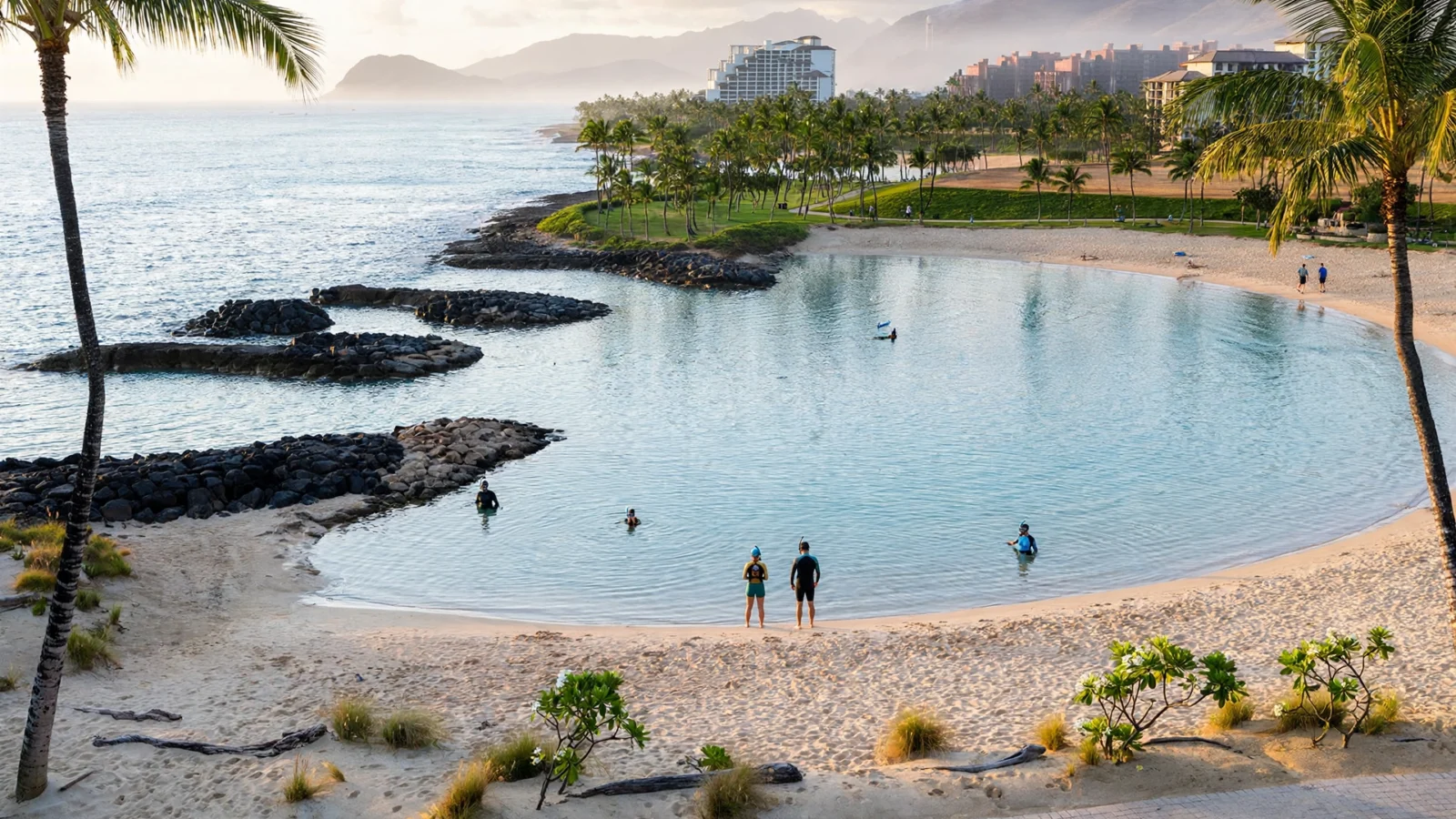
Ko Olina is the easiest shore snorkeling on Oahu — and the most misunderstood. The four lagoons are man-made, ringed by rock barriers that keep the water calm on almost any day of the year, with sandy entries you can walk into barefoot. That makes them close to perfect for a first snorkel, nervous swimmers and families with small children.
What they are not is a wild reef. There is no sprawling coral garden here: the fish gather along the rock edges, visibility is honest-average rather than gin-clear, and on a busy day you will share the water with a lot of other people who had the same idea.
Two warnings belong at the top, because most guides bury them. There are no lifeguards at the Ko Olina lagoons — everyone swims at their own risk. And public parking is genuinely scarce: the small lots run sunrise to sunset, first-come, and commonly fill by mid-morning. Arrive early or expect a frustrating loop.
If the lagoons sound too tame once you have read this guide, the wild alternative is ten minutes north: Electric Beach (Kahe Point), where a power-plant outflow draws turtles, rays and big fish schools — but with a real ocean entry and no barrier to hide behind.
What Ko Olina actually is
Ko Olina is a 642-acre resort community on Oahu’s leeward (west) coast at Kapolei, roughly 40–60 minutes from Waikiki depending on traffic. Instead of one natural beach, the shoreline was built into four crescent-shaped lagoons, connected by more than a mile and a half of paved seaside pathways. Each lagoon is sheltered by a rock barrier with narrow openings, which is why the water inside stays gentle when the open coast is rough.
One access point confuses visitors, so let us be precise: the lagoons sit on resort-owned land, but they are not resort-guests-only. Pedestrian access to the lagoon beaches and the rocky shoreline is open to the public, and there are designated public parking lots for exactly that purpose. You do not need to be staying at Aulani, the Four Seasons or the Marriott to swim here — you do need to use the public lots, follow the posted rules, and accept that resort facilities (pools, loungers, cabanas) are for guests.
Which Ko Olina lagoon is best for snorkeling?
This is the question everyone asks, and the honest answer is that local sources split — so here is the split, with the reasoning, rather than a fake winner.
Lagoon 2 (Honu) is the pick of local bloggers and many reviewers: it fronts the Beach Villas rather than a large hotel, so it tends to be quieter, with fewer swimmers stirring up the bottom and slightly better visibility on a typical morning.
Lagoon 3 (Nai’a), in front of Marriott’s Ko Olina Beach Club, is the pick of the area’s own boat-tour operator, which argues it sees the most fish activity along its rocks. Treat that as an interested source — but it matches the general rule here: the more rock edge, the more fish.
Lagoon 4 (Ulua), at Ko Olina Beach Park, is the practical pick: it has by far the largest public parking lot, the most lawn and shade, and the easiest logistics for a group.
Lagoon 1 (Kohola) fronts Aulani and the Four Seasons. It is the most resort-centred of the four and a fine choice for very small children — but its public lot is small and it feels the busiest.
| Lagoon | Fronts | Public parking | Character | Best for |
|---|---|---|---|---|
| 1 – Kohola | Aulani + Four Seasons | Small lot (under ~20 stalls) | Most resort-centred, busiest feel | Resort guests, very small kids |
| 2 – Honu | Beach Villas (no big hotel) | Small lot (under ~20 stalls) | Quietest, least stirred-up water | Snorkelers wanting calmer water |
| 3 – Nai’a | Marriott Beach Club | Small lot (under ~20 stalls) | Most-reported fish activity at the rocks | Fish-focused snorkelers |
| 4 – Ulua | Ko Olina Beach Park | Largest public lot | Most space, lawn and shade | Groups, anyone driving in |
Whichever you choose, the snorkeling technique is the same — see the next section. The differences between lagoons are real but modest; the difference between arriving at 8am and arriving at noon is bigger.
Where exactly to snorkel inside a lagoon
The middle of a Ko Olina lagoon is mostly sand — pleasant for swimming, empty for snorkeling. The life is at the edges:
- Follow the rock barrier. Fish shelter in and around the barrier rocks. Work slowly along the inside of the crescent, especially toward the tips where sand meets rock — those transition zones hold the most species.
- Depth is friendly. The water around the rocks is roughly 4–5 feet deep in most spots, so beginners can stand up almost anywhere if they need a rest. That is a large part of Ko Olina’s appeal.
- Entry is as easy as it gets. Walk in barefoot from the sand anywhere along the crescent, put your mask on in waist-deep water, and fin out to the rocks.
- Stay away from the barrier openings. The gaps in the middle of each barrier let water flow out of the lagoon and can carry a noticeable current; they are often roped off. Do not swim through them into the open ocean — outside the barrier there is no protection, no lifeguard, and no easy way back in against the flow.
Set expectations correctly and Ko Olina delights; expect a pristine reef and it will disappoint. This is gentle, close-up rock-edge snorkeling, not a coral wilderness. For the reef version on this coast, see Electric Beach; for Oahu’s classic beginner bay with reservations and a real reef, see Hanauma Bay.
What you might see
Around the barrier rocks, snorkelers commonly report a respectable cast of Hawaiian reef fish: several butterflyfish species, Moorish idols, goatfish, cornetfish, Hawaiian sergeants and dascyllus hovering over the rocks, schools of silversides, and convict, lavender and yellow tangs among the wrasses and triggerfish. Look closely at the rocks themselves for banded and rock-boring urchins, sea cucumbers, crabs, and small cauliflower and lace coral growth — modest, but real, and slowly increasing as the lagoons mature.
Green sea turtles (honu) are reported regularly in the lagoons, and Hawaiian monk seals haul out on these beaches occasionally — a seal on the sand is a reason to give it the whole beach, not a photo opportunity. Moray eels live in the rock crevices; look, never reach.
Wildlife rules are law here, not etiquette: stay at least 10 feet from sea turtles in the water and on land, and at least 50 feet from monk seals (further for a mother with a pup, and always stay behind any signs or barriers the seal-protection volunteers set up). Never touch, chase or feed anything. More on the rules in our snorkeling safety guide and snorkeling with turtles guide.
Nothing on this list is guaranteed on any given day — anyone who promises you turtles is selling something. Early mornings, before the crowds stir the bottom up, give you the best odds.
Parking and access, lagoon by lagoon
Parking is the whole game at Ko Olina, so here is the full picture:
- Hours: the designated public lots operate sunrise to sunset, first-come, first-served. There is no reservation system for lagoon parking.
- Size: the lots serving Lagoons 1, 2 and 3 are small — each under roughly 20 stalls. Lagoon 4’s lot at Ko Olina Beach Park is the largest and your best bet after the early rush.
- Timing: on weekends, holidays and most sunny weekdays, expect the small lots to fill by mid-morning. The reliable strategy is to arrive before 9am, snorkel in the best morning light, and be eating lunch while everyone else circles.
- Cost: the resort’s official lagoons page lists hours and rules but shows no fee for the designated public parking lots as of October 2026 (the $10 charge on the resort site is for marina trailer parking, a different thing). Check the signs on the day — if a lot ever introduces paid parking, the signs will say so before the internet does.
- If the lots are full: do not park illegally inside the resort or on access roads — enforcement is active. Either try Lagoon 4, come back at sunrise the next day, or pivot to a different spot on our Oahu hub.
The rules, in plain English. The resort’s official list prohibits, among other things: alcohol, fires, camping, most tents and shade structures, scuba diving, smoking and vaping, fishing/netting/spearfishing from the shoreline, drones, pets, oversized inflatables, and personal surfboards or watercraft (authorised rental gear excepted). Only reef-safe sunscreen is allowed — which Hawaii law effectively requires statewide anyway. Lifeguard stands, notably, are not on the list of things provided: there are none.
Facilities, lifeguards and safety
Each lagoon beach has restrooms, showers and drinking water nearby, with lawns and shade from the palms along the pathway — genuinely family-friendly infrastructure, as you would expect from a resort shoreline.
Safety, though, is on you:
- No lifeguards, anywhere, ever. The resort states this plainly: swim at your own risk. Children need an adult within arm’s reach, not a parent watching from the sand, however calm it looks.
- The barrier openings pull. Repeat of the warning above because it matters: keep yourself and kids well away from the gaps in the rock barrier and any rope lines.
- Calm is not the same as clear. If surf is breaking over the barrier rocks, the lagoons stay swimmable but visibility collapses into milk. On those days, swim if you like — but do not judge Ko Olina’s snorkeling by it.
- Check the water-quality advisories. Before any Oahu beach day, a same-day check of Hawaii Department of Health beach advisories takes thirty seconds and occasionally saves a holiday.
- Weak swimmers: a snorkel vest or float belt is a sensible standard here, especially for children — calm water plus no lifeguard is exactly the combination where confidence outruns ability. Our beginners’ guide covers the full first-snorkel routine.
For most families this remains one of the lowest-risk snorkels in Hawaii — read our wider safety guide once and Ko Olina becomes a relaxed morning, not a gamble.
Best time to snorkel Ko Olina
Morning, for two independent reasons. The water is clearest before wind and swimmers stir it up, and the parking lots are emptiest. An 8am snorkel at Lagoon 2 and an 11am snorkel at the same rocks are different experiences.
Season matters less here than almost anywhere else on Oahu: because the lagoons are barrier-protected, they stay swimmable through most winter weather that closes the North Shore (where Shark’s Cove is a summer-only proposition). Big west or south swells are the exception — when surf pours over the rocks, postpone the snorkel and take the pathway walk instead. Our best time to snorkel in Hawaii guide explains the island-wide seasonal pattern.
Gear and rentals — the honest version
There is no row of walk-in snorkel rental shops at the lagoons, and guides that imply otherwise are out of date. Realistically:
- Bring your own if you have it — mask fit matters more than anything else, and a mask you trust beats a rental lottery. Our gear checklist covers what to pack.
- Resort guests can usually rent through their hotel’s activities desk — ask at check-in.
- Staying elsewhere: rental shops in nearby Kapolei are the practical fallback; sort gear the day before, not on lagoon-parking time.
- Skip the full-face mask debate for children — a traditional mask and snorkel, properly fitted, plus a vest, is the safer standard setup (details in the safety guide).
Paradise Cove: the side note
Just north of Lagoon 1, the cove by Paradise Cove (the luau venue) is mentioned by local bloggers as a less-built spot where turtles are often reported. Treat it as a bonus, not a plan: access and conditions vary with tide and surf, it has none of the lagoons’ protection, and turtle sightings there rest on anecdote rather than any official source. If you go, go on a calm morning, stay well back from any turtle, and let conditions — not hope — make the call.
If the lagoons feel too tame
Ko Olina is a beginning, not a ceiling. In order of escalation:
- Electric Beach (Kahe Point) — minutes north, a real reef with turtles, rays and fish schools around the outflow, but an open-ocean entry for confident swimmers only.
- Waikiki snorkeling — gentle shore snorkeling in the Waikiki Marine Life Conservation District if you are based in town with no car.
- A boat trip from Ko Olina Marina — catamaran snorkel tours leave from the resort’s own marina and reach reefs no shore entry can; see our Hawaii snorkeling tours guide for how to choose honestly.
FAQ
Are the Ko Olina lagoons open to the public?
Yes — pedestrian access to the lagoon beaches is open to everyone, not just resort guests, via the designated public parking lots and pathways. Resort facilities themselves (pools, loungers) remain guests-only.
Which Ko Olina lagoon is best for snorkeling?
Local sources split between Lagoon 2 (Honu — quietest, least stirred-up water) and Lagoon 3 (Nai’a — most-reported fish activity). Lagoon 4 (Ulua) is the practical choice for drivers because its public lot is the largest. All four are snorkeled the same way: along the rock barrier.
Are the lagoons safe for beginners and kids?
They are among the gentlest snorkels on Oahu — sandy entry, roughly 4–5 ft depth at the rocks, barrier-calm water — but there are no lifeguards, so children need an adult within arm’s reach, and everyone should stay away from the barrier openings where water flows out.
How deep are the Ko Olina lagoons?
Shallow by design: around 4–5 feet near the rock barrier where the fish are, and stand-up depth across most of each lagoon.
Can you see turtles at Ko Olina?
Green sea turtles are reported regularly in the lagoons, but sightings are never guaranteed. If you meet one, stay at least 10 feet away — it is the law, and the turtle will usually reward patience by ignoring you completely.
What time should I arrive for parking?
Public lots run sunrise to sunset and the small lots at Lagoons 1–3 commonly fill by mid-morning. Arrive before 9am — or aim for Lagoon 4, which has the largest lot.
Do I need to pay or reserve to snorkel Ko Olina?
There is no reservation system, and the resort’s official page shows no fee for the designated public lagoon parking lots as of October 2026. Always check the lot signs on the day in case that changes.