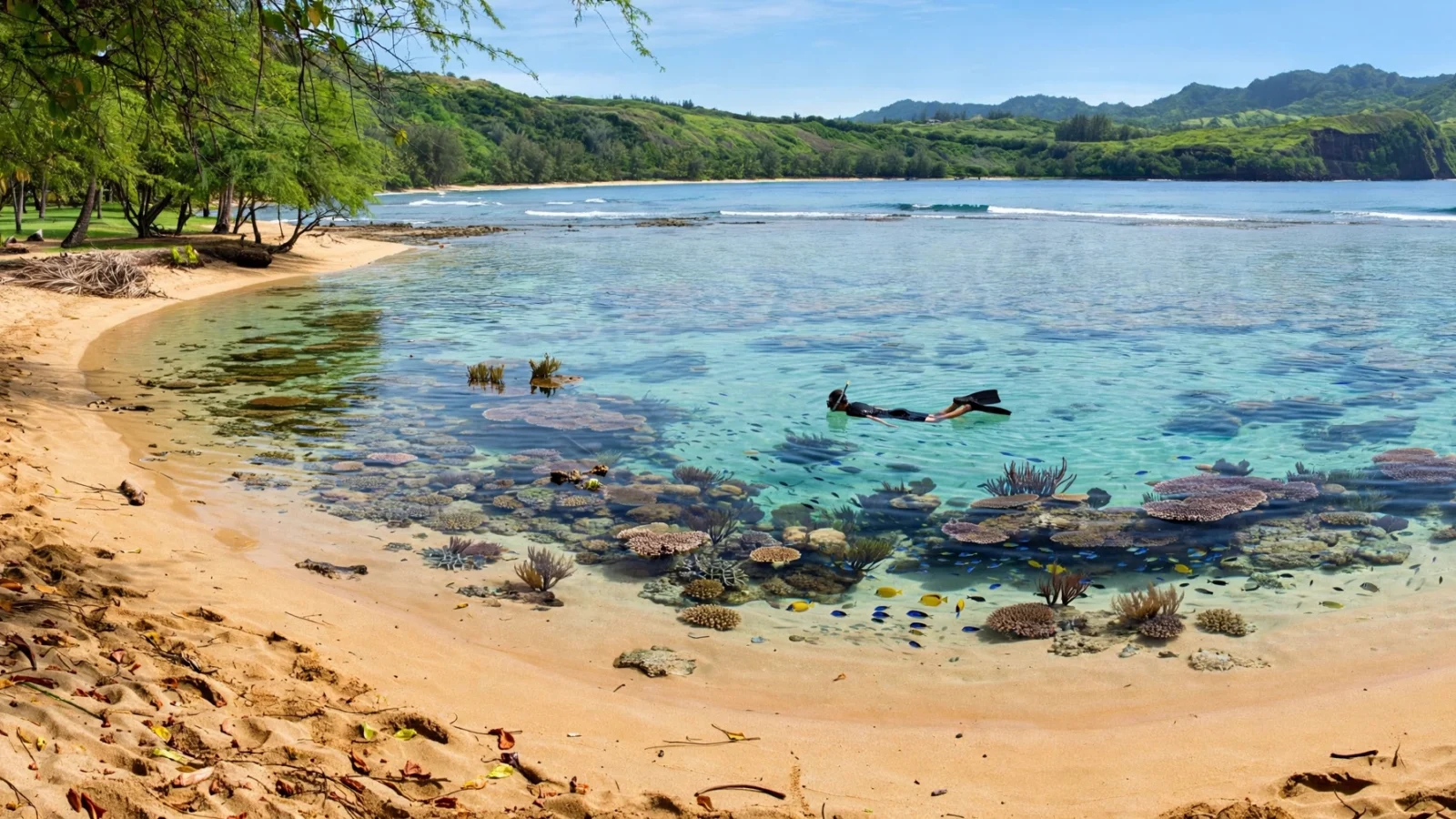
Short answer: Chun’s Reef is a famous North Shore surf break first and a snorkel spot second — and the two never share a season. In winter this reef off Kamehameha Highway, about two miles north of Haleiwa, produces a long, friendly right-hand wave that draws longboarders from across Oahu. In summer, when the North Shore goes flat, that same reef turns into a calm, shallow snorkeling ground with reef fish and green sea turtles, almost no crowd, and parking right across the road. The catch is absolute: snorkeling here is a flat-summer-day activity only. If there is any surf breaking on the reef, the snorkel is off — go to Sharks Cove or Kuilima Cove instead. For a confident swimmer who catches a glassy summer morning, though, Chun’s Reef is one of the North Shore’s quietest honest reefs. This guide covers exactly when it works, where to get in, and when to walk away. For the full coast picture, start with our Oahu snorkeling guide.
Chun’s Reef sits on the stretch of Kamehameha Highway between Kawailoa Beach to the east and Laniakea Beach — the famous turtle beach — just down the road. Local accounts credit the name to John Chun, a resident and surfer who lived by this stretch of reef, and the name has outlasted almost everything else about the spot. There is no resort frontage, no rental stand and no developed park on the sand — just a tree-shaded beach, a reef, and a small roadside pull-off that fills early. Almost everything written about Chun’s Reef online is written for surfers. This guide is written for snorkelers, honestly, because at a dual-personality beach like this one the season rule is the whole product.
Chun’s Reef snorkeling at a glance
| Chun’s Reef | |
|---|---|
| Best for | Confident swimmers on flat summer days; an uncrowded North Shore reef without the Sharks Cove scene |
| What it is | A fringing reef off a tree-shaded sand beach on Kamehameha Highway, ~2 miles north of Haleiwa Beach Park |
| Snorkel season | Roughly May to September, flat days only — winter and any swell belong to the surfers |
| Entry | Sandy gaps in the rock shelf inside the reef; never across the shallow reef flat in surf |
| Headline life | Butterflyfish, parrotfish, tangs and green sea turtles (honu) |
| Facilities | Minimal at the beach itself — plan on Haleiwa town, ~2 miles south, for food, rentals and supplies |
| Lifeguard | Sources list a lifeguard presence, but coverage is not guaranteed daily — check on the day and plan as if unguarded |
| Watch out for | Shallow sharp reef, currents that wake up with any swell, winter surf that is dangerous and posted |
The season rule: a surf break that snorkels in summer
Every North Shore spot lives by the same calendar, and Chun’s Reef states it more plainly than most. From roughly October through April, north and northwest swells wrap this reef into one of the coast’s classic waves — a mellow, peeling right-hander that is a longboard favourite precisely because it is gentler than Pipeline or Waimea. Gentler is relative. That same swell makes the inside reef a washing machine of whitewater, surge and current, and the beach is posted with warnings in high surf. There is no version of winter Chun’s Reef that is a snorkel spot.
From about May through September the North Shore typically goes lake-flat for weeks at a time, and the reef changes character completely. The inside flat becomes a shallow, sunlit snorkel garden; the outside break sleeps; and the beach settles into its summer job as a local swimming and snorkeling beach. The shoulder months — April–May and September–October — are judgement calls: a small late or early swell is all it takes to close the spot down. Our guide to the best time to snorkel in Hawaii explains the swell calendar island by island, and it is required reading before any North Shore summer plan.
The go/no-go check takes ten seconds and overrides every other plan: stand on the sand and watch the reef for a full minute. If waves are breaking on the outside reef with any consistency, or the inside water is milky and moving, do not get in — the day belongs to the surfers and the snorkeling will be poor and unsafe anyway. If the surface is glassy, the inside flat is clear enough to see the bottom from shore, and the few people in the water are standing and floating rather than bracing, you have a Chun’s Reef day. Take it — they are some of the quietest snorkel mornings on this coast.
Where the snorkeling actually is
The beach is a mix of sand and rock shelf, and the layout matters. Reviewers and locals describe the same practical split: one side of the beach is where people swim and snorkel, the other is where the surf entry and the break sit. The snorkeling is over the inside reef flat — the shallow coral and rock structure close to shore, on the calmer side away from the main surf channel. Work the edges of the reef rather than the dead centre of the flat: fish hold where coral heads, ledges and sand channels meet, and the turtle grazing is along the algae-covered shelf.
Entry is through the sandy gaps. The shoreline shelf is sharp, uneven lava and coral, and crossing it barefoot in any surge is how feet get cut and ankles get rolled. Wear reef-safe footwear to the water’s edge, pick a sandy entry, and fin up once you are floating. Stay inside the reef for the snorkel itself. The outside — beyond the breaking zone — is the surf break, with deeper water, boat-free but current-prone, and nothing a snorkeler needs. If the inside feels too shallow at low tide (it can be waist-deep or less over parts of the flat), shift along the beach to where a sand channel cuts the reef rather than forcing a crawl over coral.
Visibility follows the swell rule. On a true flat day the inside reef is clear and bright; after any surf, stirred sediment clouds it for a day or more even once the waves drop. Morning is the reliable window — earlier is calmer, clearer and easier for parking — and the trade-wind chop that builds most afternoons roughens the surface even in summer.
What you will see
Chun’s Reef is a working Hawaiian reef flat, not an aquarium bay, and that is its charm. The roundup of North Shore spots by Haleiwa’s Surf N Sea lists this reef for butterflyfish, parrotfish and sea turtles, and a calm morning adds the standard reef cast: yellow and convict tangs picking at the shelf, triggerfish over the coral heads, wrasses in the sand channels, and the occasional school working the reef edge. The coral itself is the low, hard reef-flat growth typical of this exposed coast — interesting structure and ledges rather than big coral gardens.
The turtles are the headline. Green sea turtles graze the algae on the shallow shelf here, and the beach is minutes from Laniakea, the most famous turtle-resting beach on Oahu. Expect honu in the water on most calm mornings. The rule is the same everywhere in Hawaii and it is law, not etiquette: stay at least 10 feet (3 metres) from turtles in the water and on the sand, never touch or chase them, and let them surface and move freely. Our guide to snorkeling with turtles in Hawaii covers how to read their behaviour so you get the long, relaxed encounter instead of the short stressed one. In winter, humpback whales pass offshore — one more reason the winter visit here is a beach walk and a surf watch, not a swim.
Parking, access and facilities
Chun’s Reef is directly off Kamehameha Highway and easy to drive straight past. Parking is limited roadside parking along the highway, with the informal pull-off directly across the road from the beach — you park, cross the highway carefully, and you are on the sand. It is free, there is no reservation and no entry fee, and it fills early on summer weekends; if the pull-off is full, that is the spot telling you to try Haleiwa Beach Park or come back on a weekday morning. By bus, TheBus Route 60 along the North Shore stops near the beach, with a short walk from the highway.
Set expectations on facilities before you arrive: this is an undeveloped local beach, and what is on the sand is shade trees and space. Do not plan around restrooms, showers or rentals at Chun’s Reef itself. Haleiwa town, about two miles south, is the service base for this whole stretch — snorkel rentals, food, and supplies — and the smarter pattern is to gear up there, snorkel Chun’s in the morning, and be back in town for lunch. Everything you need fits in our Hawaii snorkeling gear checklist.
Safety: the honest briefing
Chun’s Reef is safe on the days it is a snorkel spot and genuinely dangerous on the days it is not, and the gap between those two states is one swell. The specific hazards: sharp shallow reef underfoot and under your body in surge; currents that run along and out through the reef channels as soon as surf is breaking outside; and winter surf that has no business being swum in by anyone. Warning signs go up in high surf — treat them as the decision, not a suggestion.
Lifeguard information is one of the genuinely conflicting points in the sources for this beach: listings describe a lifeguard presence, but coverage is not something to build a plan on — towers on this coast are not staffed every hour of every day. Check the posted conditions on the day (the state’s hioceansafety.com carries North Shore beach statuses), snorkel with a buddy, and treat the beach as effectively unguarded for planning purposes. Our Hawaii snorkeling safety guide covers the reef-flat specifics — surge, channel currents and entries like this one. If anyone in your group is not a comfortable ocean swimmer, this is the wrong beach even in summer; the protected options further down this page exist for exactly that case.
Is Chun’s Reef good for beginners?
For a true first-timer: no. The entry is over a rock shelf, the reef is shallow enough to demand good buoyancy control from the first minute, and there is no protected lagoon to learn in. A first-ever snorkel belongs at a sheltered spot with a sandy entry and flat water in all the months Chun’s is rough.
For a beginner who can already swim confidently and has snorkeled a few times: yes, on a flat summer morning, inside the reef, this is a lovely step up — real reef, real turtles, almost no crowd. Stay shallow, stay inside, and get out the moment the surface texture changes. Families with strong-swimming older kids do well here in summer; families with small children are honestly better served by the protected water at Kuilima Cove, below — and the stop at Laniakea Beach on the way is for watching turtles from the sand, not for a toddler swim. Our beginners’ guide to snorkeling in Hawaii ranks the learn-here spots island by island.
Chun’s Reef vs the neighbours
| Spot | Best for | Snorkel window | The honest difference |
|---|---|---|---|
| Chun’s Reef | Quiet reef + turtles, no crowd | Flat summer days only | A surf break on loan to snorkelers in summer; minimal facilities, roadside parking |
| Laniakea Beach | Watching turtles on the sand | Calm days; viewing year-round | Minutes away and famous for resting honu — a turtle-viewing stop first, a snorkel second |
| Sharks Cove | The full North Shore snorkel | ~May to September | Deeper lava cove, more fish, more people — the default summer choice up the road |
| Waimea Bay | Big-water summer swims | Flat summer days | A huge sandy bay that snorkels along its rocky edges in summer and hosts giant surf in winter |
| Kuilima Cove | Beginners and families | Most of the year | The protected fallback when Chun’s has any surf — drive east and snorkel anyway |
The practical North Shore pattern from Haleiwa: base in town, check Chun’s Reef first on a summer morning because it is the closest quiet reef, and if the reef has any life in it, keep driving — Three Tables and Sharks Cove at Pupukea get their own go/no-go check, and Kuilima Cove at Turtle Bay is the protected option that saves the day trip. Our Haleiwa Beach snorkeling guide covers the in-town water you pass on the way out.
Frequently asked questions
Can you snorkel at Chun’s Reef?
Yes — in summer, on flat days. The reef inside the break is a shallow, calm snorkel ground roughly May to September. In winter, and on any day with surf breaking on the reef, it is a surf spot and not snorkelable.
When is the best time to snorkel Chun’s Reef?
A flat summer morning. Arrive early for the calmest water, the clearest visibility and a space in the roadside parking. After any swell, give the water a day or more to clear even once the surface flattens.
Are there turtles at Chun’s Reef?
Yes. Green sea turtles graze the shallow reef shelf and are a regular sight on calm mornings — the beach sits minutes from Laniakea, Oahu’s famous turtle beach. Keep at least 10 feet (3 metres) away in the water and on land, and never touch them.
Where do you park for Chun’s Reef?
In the limited roadside parking along Kamehameha Highway, directly across the road from the beach, about two miles north of Haleiwa Beach Park. It is free and fills early on summer weekends. TheBus Route 60 also stops nearby.
Is Chun’s Reef good for beginners?
Not for a first-ever snorkel — the entry crosses a sharp rock shelf and there is no protected lagoon. Confident beginners who swim well do fine inside the reef on flat summer mornings. True beginners are better at Kuilima Cove or, in summer, Sharks Cove.
Is there a lifeguard at Chun’s Reef?
Listings describe a lifeguard presence, but coverage is not guaranteed every day or hour. Check the posted conditions when you arrive, snorkel with a buddy, and plan as if the beach is unguarded.
Can you snorkel Chun’s Reef in winter?
No. Winter swell turns the reef into a working surf break with whitewater, surge and currents, and the beach is posted in high surf. Winter here is for watching the surf from the sand — come back in summer for the snorkel.
Where can I rent snorkel gear near Chun’s Reef?
In Haleiwa town, about two miles south — the service base for this stretch of coast, with rental shops, food and supplies. There are no rentals at Chun’s Reef itself, so gear up in town before you drive out.