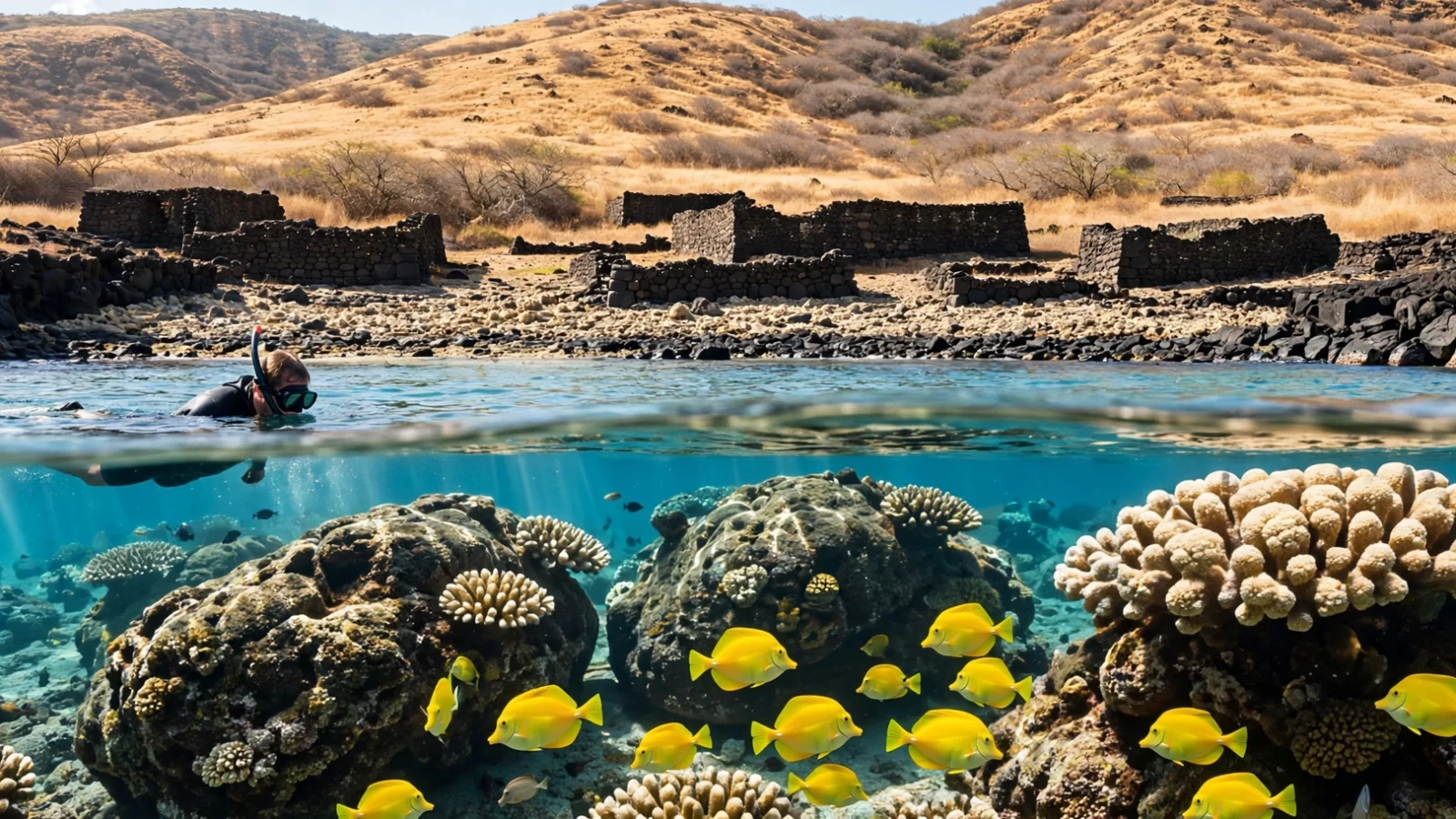
Most snorkel spots ask you to plan around parking. Lapakahi asks you to plan around a gate. This North Kohala stop pairs a protected reef — the Lapakahi Marine Life Conservation District, established in 1979 — with the partially reconstructed ruins of Koai’e, a Hawaiian fishing village founded in the 1300s, inside a state historical park that keeps short hours and closes mid-afternoon. The snorkeling happens in one place only: Koai’e Cove, a small coral-rubble cove where the reef starts a few steps from shore. Get the timing, the entry and the cove boundary right and it is one of the most atmospheric snorkels on the Big Island. Get them wrong — arrive at 3pm, or drift past the cove into the current the state brochure warns about — and it is a wasted drive up Highway 270.
This guide is honest about who Lapakahi suits. It is a calm-morning snorkel for confident swimmers who want culture and reef in a single stop. It is not a beginner beach, not a sand beach, and not a backup plan for a windy day. If your group includes first-timers, Spencer Beach Park, a few miles south, is the kinder Kohala-coast choice — this guide explains exactly when to make that call instead.
Quick facts
| Detail | Lapakahi / Koai’e Cove |
|---|---|
| Where | Lapakahi State Historical Park, Hwy 270 (Akoni Pule Hwy), about 12 miles north of Kawaihae, North Kohala |
| Snorkel area | Koai’e Cove only — Subzone A of the Lapakahi MLCD |
| Park hours | Short day-use hours (listed as 8am–4pm, no entry after 3:30pm; closed state holidays) — check the gate signage on the day |
| Entry | Two small coral-rubble beaches inside the cove — there is no sand beach |
| Depths | About 5–30 feet inside the cove |
| Lifeguard | None |
| Facilities | Portable restrooms; no drinking water — bring your own |
| Best for | Confident snorkelers on calm mornings; history-plus-reef visitors |
| Not for | Beginners, small children in the water, anyone on a rough or windy day |
What Lapakahi actually is: a village first, a reef second
Lapakahi State Historical Park protects roughly 265 acres of the ancient coastal settlement of Koai’e, occupied from the 1300s into the early 1900s. A self-guided interpretive trail of about a mile loops past excavated and partially reconstructed house sites, canoe houses, salt-making pans and temple platforms, with numbered stops explained by markers. The village existed because of the sea in front of it — and that sea is now protected in its own right. The Lapakahi Marine Life Conservation District (MLCD), designated in 1979, covers about 146 acres offshore and is divided into two subzones:
- Subzone A — Koai’e Cove. The sheltered cove at the end of the village trail. This is the snorkel zone, and the only part of the shoreline where entering the water makes sense.
- Subzone B — the adjacent shoreline. The waters extending roughly 500 feet offshore along the park frontage south of the cove. Exposed, current-swept, and not a snorkel area for visitors whatever the map suggests.
Inside the MLCD the rules are strict and simple: no taking or injuring any marine life, no removing or altering sand, coral or rock, and no fish feeding. For a snorkeler that translates to look-only — which is precisely why the fish here behave differently from at unprotected beaches. The state’s own description notes that nearly all nearshore species typical of the North Kohala coast are represented inside the district.
The snorkel: Koai’e Cove, zone by zone
Entering the water
There is no sand beach at Lapakahi. Koai’e Cove holds two small beaches of coral rubble, and the cove provides the easiest water access on this whole stretch of coast — easiest being a relative term. Wear reef shoes or your fins for the walk in, enter slowly over the rubble rather than across coral heads, and never stand on coral once you are floating. The nearshore bottom is mostly boulders and lava fingers with patch coral, so pick your line in before you commit: enter where the bottom reads as rubble and rock, not where it reads as living reef.
Where the reef is best
The state’s MLCD description is unusually specific, and it matches how the cove fishes out in practice:
- Northern cove: some good coral growth close to shore — the shorter swim, and the sensible first look.
- Southern cove: coral and fish are most abundant here. This is the main event — work along the southern side once you have your bearings.
- The rock outcropping right of the cove’s centre: considerable marine life around the rocks — worth a slow circuit.
- Further out: the reef gets denser as you swim out and depths build from the cove’s 5–30 feet toward 60–80 feet at the outer boundary, where coral and fish are abundant. Treat that outer zone as a look-from-inside destination, not a target — see the boundary rule below.
The boundary rule that matters most
The state park brochure states it plainly: swimmers and snorkelers should stay within Koai’e Cove, because strong currents exist just beyond the MLCD boundary. Local park coverage adds that strong rip currents run beyond the cove’s calm pocket, and the shoreline bluffs take open-ocean waves even on moderate days. So the rule for this spot is geometric, not vibes-based: if you can no longer see the cove’s rubble beaches as your frame, you have gone too far. Snorkel the cove thoroughly — north, centre rocks, south — rather than ranging along the coast. The neighbouring coast is exactly what our Mahukona Beach guide covers to the north; south of the cove is exposed Subzone B water, not a bonus reef.
What you will see
Lapakahi’s fish community is the North Kohala checklist in one cove. Park and reef sources consistently name long-snouted butterflyfish working the reef’s nooks for invertebrates, yellow tang — the coast’s signature surgeonfish — and stands of intricately textured cauliflower coral in the sunny shallows. Add the usual MLCD cast: schools of surgeonfish and goatfish over the lava fingers, sea urchins and sea stars in the rubble zone, moray eels in the rockwork, and green sea turtles feeding in the cove — yellow tang are sometimes seen grazing algae from turtle shells here. Keep the standard distances: at least 10 feet from turtles, and never touch or stand on coral; our guide to snorkeling with turtles in Hawaii covers the etiquette in full. In winter, humpback whales are frequently spotted just offshore — a surface-interval bonus from the bluff, not a reason to swim out.
Best time: the gate decides, then the wind does
Lapakahi has the tightest timing window of any spot we cover, for two stacked reasons. First, the park keeps short hours — listed as 8am to 4pm with no entry after 3:30pm, and closed on state holidays; check the signage at the gate, because a snorkel trip that arrives at noon has already lost its margin. Second, this is the exposed Kohala coast: the park land is arid, windy and almost shadeless, and the cove is at its calmest early, before the day’s wind builds against the bluffs. Local guidance for the park is to visit early or late for exactly this reason — and late is capped by the gate.
So the practical pattern is: arrive at opening, walk the trail while the light is low, snorkel the cove mid-morning, and be out of the water before the afternoon chop. Summer generally brings the friendlier ocean here; winter brings the whales but also the north swell that can close the cove down entirely — if there is visible whitewater breaking across the cove mouth, it is a trail-only day, and the village alone is worth the drive. For the island-wide pattern behind this, see our guide to the best time to snorkel in Hawaii.
Parking, access and the trail pairing
From Kawaihae, take Highway 270 (Akoni Pule Highway) north about 12 miles — roughly mile marker 14 — to the signed park entrance on the left; the parking area sits at the end of the park road near the small visitor building, about 45 miles north of Kailua-Kona and 7 miles south of Hawi. Facilities are minimal: portable restrooms and trash cans, but no drinking water and almost no shade — bring water, a hat and more sunscreen discipline than usual; our Hawaii snorkeling gear checklist covers the full kit list, and reef shoes earn their place at this spot specifically.
Do not treat the trail as an obstacle between you and the water. The interpretive loop is the other half of the visit: pick up the trail guide at the shack near parking, walk the village first, and finish at Koai’e Cove, where the trail ends and the reef begins. Stay off the rock walls and out of the ancient sites — the same look-don’t-touch ethic that governs the MLCD governs the village.
A realistic Lapakahi morning, step by step
Because the gate hours and the wind window overlap so tightly, it helps to run this visit like a small expedition rather than a beach stop. Arrive at opening and take the interpretive trail first, while the air is cool and the village stones are in low, raking light — the numbered stops read better, and you reach the cove with the history in your head, which genuinely changes how the snorkel feels. At the cove, spend five minutes on the bluff reading the water before anyone gears up: you are looking for a cove surface that reads as textured rather than broken, no whitewater lines crossing the mouth, and no wind streaks building offshore. If any of those fail, the village was the visit — do not negotiate with the ocean.
If the cove passes the check, snorkel it in the order the reef rewards: the northern coral patches first as a warm-up and gear check, then the rock outcropping right of centre, then the southern cove where the coral and fish density peak, all inside the cove frame. Sixty to ninety minutes is a full Lapakahi snorkel. Out of the water, rinse with the water you brought, and use the drive south as the second half of the day — Spencer Beach Park for the swim your group may still want, or continue north to Hawi for lunch if the coast has given you everything it is going to. What this morning is not is flexible: a Lapakahi plan that starts at noon, or that treats the cove as an afterthought to a beach day, is a plan that mostly produces a hot walk and a look at a closed-looking sea.
Safety: the honest list
- No lifeguard. Koai’e Cove is a self-rescue environment. Snorkel with a buddy, and stay well inside your limits — the general principles in our Hawaii snorkeling safety guide apply with extra force here.
- Stay inside the cove. Strong currents and rip currents run beyond the cove and the MLCD boundary. This is the spot’s one non-negotiable rule.
- Rocky entry, rocky exit. Coral rubble and lava underfoot, surge even on calm days. Enter and exit slowly, in the same place, and never turn your back on the water while you are standing in the shallows.
- Wind is the daily gatekeeper. The Kohala coast is famously windy. If the cove is choppy at the trail’s end, the snorkel is off — visibility and safety both go together.
- Heat and exposure. Arid, shadeless park, no drinking water. The walk back to the car after a snorkel is not the time to discover you are dehydrated.
- MLCD rules are enforced. No taking, touching or feeding marine life, and no collecting sand, coral or rock — in the water or in the village.
Beginners and kids: the straight answer
No — not in the water. Park coverage aimed at first-time visitors says the quiet part out loud: those new to the island or unsure as swimmers should steer clear of the ocean at Lapakahi and use the safer beaches a few miles south. There is no lifeguard, the entry is over rubble and lava, and the calm water ends at a current boundary. Confident, experienced snorkelers on a calm morning are this cove’s audience; new snorkelers are not, whatever their enthusiasm.
Kids can absolutely enjoy the village trail, the whale-watching bluff in winter and the cove from shore — then get their snorkel at Spencer Beach Park, the county beach park just south with the gentle entry this coast otherwise lacks, or at Hapuna Beach on a calm day. If your whole trip is built around first snorkels, start from our beginners’ snorkeling guide and let Lapakahi be the day’s history stop instead. Newer swimmers still building skills should also read our how to snorkel in Hawaii guide before any Kohala-coast water.
Lapakahi vs the neighbouring Kohala spots
| Spot | Entry | Protection | Best for |
|---|---|---|---|
| Lapakahi (Koai’e Cove) | Coral rubble, rocky | MLCD — no taking, look-only | Confident snorkelers; reef + ancient village in one stop |
| Mahukona Beach Park | Old harbour ladder / rocky shore | Open coast (MLCD begins toward Lapakahi) | Experienced snorkelers; harbour artefacts and clear water |
| Spencer Beach Park | Gentle sand | County beach park | Families, beginners, easy Kohala snorkeling |
| Waialea Beach (Beach 69) | Sand and rock, shade trees | Open coast | Calm-day reef snorkeling with a beach day attached |
The short version: Lapakahi wins on fish behaviour and atmosphere — protected fish in a storied place — and loses on convenience to every neighbour. That trade is the whole point of coming here.
FAQ
Can you snorkel at Lapakahi State Historical Park?
Yes — in Koai’e Cove, the small cove at the end of the village trail, which forms Subzone A of the Lapakahi Marine Life Conservation District. The rest of the park shoreline is exposed and current-swept and is not a snorkel area. You need a calm morning and confident swimming skills; there is no lifeguard.
Where exactly do you enter the water at Lapakahi?
At the two small coral-rubble beaches inside Koai’e Cove. There is no sand beach. Enter slowly in reef shoes or fins over rubble and rock — not over living coral — and stay inside the cove for the whole snorkel.
What are Lapakahi’s park hours?
The park keeps short day-use hours — listed as 8am to 4pm, with no entry after 3:30pm, and it closes on state holidays. Check the gate signage when you arrive, and plan the visit for the morning: the cove is calmest early anyway.
Is Lapakahi good for beginners?
No. No lifeguard, a rocky rubble entry, and strong currents just beyond the cove make it a confident-snorkeler spot. Beginners and families should snorkel at Spencer Beach Park a few miles south and enjoy Lapakahi for the village trail and the view into the cove.
What fish can you see at Koai’e Cove?
Nearly the full North Kohala nearshore community: long-snouted butterflyfish, yellow tang, surgeonfish and goatfish schools, moray eels, sea urchins and sea stars, cauliflower coral stands, and green sea turtles — protected MLCD fish are noticeably less wary than at open-coast beaches.
Why is Lapakahi a Marine Life Conservation District?
The district was established in 1979 to protect the reef fronting the historic Koai’e fishing village. Taking or injuring marine life, removing sand, coral or rock, and feeding fish are all prohibited — which is why the reef and its fish remain in such good condition.
How deep is Koai’e Cove?
About 5 to 30 feet inside the cove, deepening toward 60 to 80 feet near the outer boundary of the district. The best coral for a shore snorkeler is in the southern part of the cove and around the rock outcropping right of its centre — all well inside the stay-in-the-cove rule.
What should you combine with a Lapakahi snorkel?
The village interpretive trail is part of the same visit — walk it first, snorkel second. Nearby, Mahukona Beach Park is a short drive north for experienced snorkelers, and Spencer Beach Park to the south is the family-friendly swim. Winter visitors should also scan for humpback whales from the bluff.