Laniakea Beach Snorkeling: Turtle Beach, Honestly (2026)
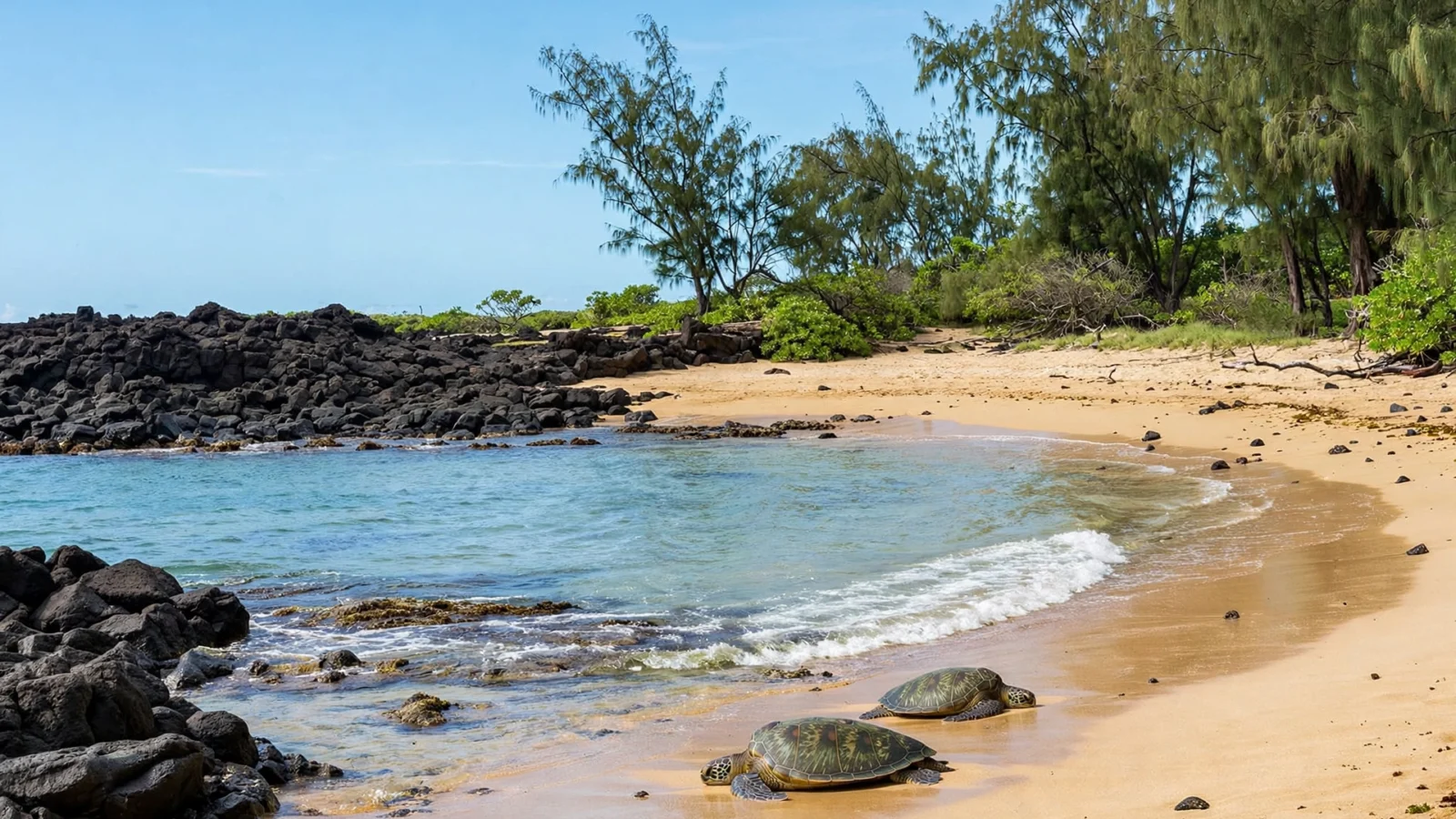
Every island has one beach that the tour buses made famous, and on Oahu’s North Shore that beach is Laniakea — “Turtle Beach”, the small golden cove about a mile east of Hale’iwa town where Hawaiian green sea turtles haul out onto the sand to rest in the sun, volunteer guardians rope off a respectful space around them, and a line of visitors stands on the sand with their phones out. It is one of the most reliable turtle-viewing stops in Hawaii, and it takes about ninety seconds on the sand to understand why.
Here is what the bus-stop version leaves out. The snorkeling at Laniakea is real but small: one shallow, rocky shelf where the turtles come to graze, in a narrow summer window, at a beach with no facilities, no reliable lifeguard, and a parking lot on the far side of a busy highway with no traffic light. Roundup blogs call it “perfect snorkeling for every skill level” and promise guaranteed turtles. Both halves of that sentence will set you up for the wrong morning. This guide gives you the honest version — what the snorkel actually is, when it works, the turtle rules that are law rather than etiquette, and the nearby North Shore reefs to choose when you want a full snorkel instead of a turtle stop. Laniakea is a wonderful visit. It is just a specific one.
Laniakea Beach snorkeling at a glance
| Question | Answer |
|---|---|
| Where is it? | On Kamehameha Highway (HI-83), roughly a mile east of Hale’iwa town on Oahu’s North Shore, between Hale’iwa and Waimea Bay |
| Also known as | Turtle Beach — which is NOT Turtle Bay (the resort at Kuilima Cove) and NOT Turtle Canyon (the boat-snorkel reef off Waikiki). See the disambiguation table below |
| The honest verdict | A turtle-viewing beach with a small bonus snorkel: fish and grazing honu over a shallow rocky shelf on calm summer days. Come for the turtles; snorkel if conditions allow |
| The snorkel zone | The rocky side of the cove (to your right as you reach the sand): a shallow lava shelf where seaweed grows and turtles feed. The long sandy stretch on the other side is the swim side, not the reef side |
| What you see | Green sea turtles (honu) basking on the sand and grazing the shelf, reef fish — parrotfish, tangs, butterflyfish — and sea urchins in the rocks |
| Best time | Summer, roughly May to September, on a calm morning. Basking turtles are often most visible late morning into the afternoon as the sand warms |
| The hard rules | Never enter the water in winter surf. Never cross the volunteers’ rope or come within 10 feet (3 metres) of a turtle, on sand or in the water. Never park in the No Parking zones on the highway |
| Lifeguards | Do not count on one. Sources disagree and cover here is inconsistent — if a tower is staffed on the day, stay on the sandy side in sight of it; the rocky turtle side is effectively unguarded |
| Parking | Free, in a small unpaved lot ACROSS Kamehameha Highway from the beach, plus limited roadside shoulder. Fills early; there is no traffic light, so you cross the highway on foot — carefully |
| Facilities | None at the beach: no restrooms, no showers, no drinking water, no food. Hale’iwa town, a few minutes back along the highway, has all of it |
| Cost / booking | Free public beach. No reservation, permit or entry fee |
First, which “Turtle” beach do you actually mean?
Oahu has three completely different places that all answer to “turtle”, and mixing them up is the single most common North Shore planning mistake.
| Name | What it is | Where | The snorkel |
|---|---|---|---|
| Laniakea Beach — “Turtle Beach” (this guide) | A wild turtle resting beach with a small rocky shelf | Kamehameha Hwy, ~1 mile east of Hale’iwa | Shore snorkel, small zone, summer only |
| Turtle Bay / Kuilima Cove | The resort bay at the island’s northern tip | Kahuku, ~20 minutes further east | A protected beginner cove — see our Kuilima Cove guide |
| Turtle Canyon | An offshore turtle cleaning-station reef | Off Waikiki, reached by boat | A boat snorkel — see our Turtle Canyon guide |
If your goal is to stand on sand and watch turtles resting, you want Laniakea. If your goal is a guaranteed in-water turtle snorkel with the family, you honestly want Kuilima Cove or the Turtle Canyon boats — and this guide will keep pointing you that way, because pretending Laniakea is the better snorkel would be doing you a disservice. For the island-wide picture, see our snorkeling with turtles guide.
The honest verdict on snorkeling at Laniakea
Snorkeling at Laniakea is a supporting act, not the headline — and judged on those terms, it is genuinely good. The rocky shelf holds real reef life in very shallow water, the turtles feed over it at arm’s-length-from-the-rope range on the right morning, and because the zone is small you can take it in slowly instead of racing a big reef. Judged as a destination reef, though, it loses to almost every other spot in this guide’s North Shore set: the fishable area is a fraction of Shark’s Cove, the bottom is rock rather than coral garden, and the season is short.
So plan it as the locals and the volunteers do: a turtle stop with a swim attached. Arrive on a calm summer morning, spend your first half hour on the sand with the basking honu, then — if the ocean is flat — take a short, careful snorkel over the shelf. If the surf is up, skip the water entirely and let the beach be what it is best at. Anyone who promises you more than that is selling you something.
The two sides of the beach
Laniakea is really two small beaches sharing one cove, and knowing which side you are on decides your whole visit.
The rocky side (right, as you reach the sand). A low lava-rock outcrop and submerged shelf run along this side of the cove. Seaweed — limu — grows thick on the rocks, and that is exactly why the turtles are here: honu graze the algae off the shelf in the shallows and haul out on the sand beside it to rest. This is the snorkel side and the turtle side. It is also shallow, uneven and slippery: enter slowly over sand patches where you can, keep your feet off the rock and reef, and expect urchins in the crevices. This is not a stand-up-and-wade beach; it is a float-gently-and-look beach.
The sandy side (left, as you reach the sand). A wide sandy stretch — a few hundred yards of it — runs off toward Chun’s Reef, the neighbouring beach a short walk along the shore. This is the swimming and sand side: softer entry, fewer rocks, and the side to use if a lifeguard tower is staffed on the day. The fish are fewer here because the structure is, but for a plain swim on a calm day it beats picking your way over the shelf.
The channel to respect. At the far western edge of the cove a wide channel cuts through the reef — the same water the surfers use to reach the offshore breaks. When any surf is running, a strong rip current forms in that channel and pulls straight out to sea. Treat the channel as a permanent no-swim zone: snorkel the shelf, swim the sand, and never drift west into the channel, whatever the day looks like.
What you will see
The turtles. Green sea turtles — honu — are the residents here, and “residents” is the right word: the same individuals return to this shelf and this sand to feed and rest, which is why sightings are so consistent by turtle standards. On a good morning you will often see a few of them: one or two basking on the sand inside the volunteers’ rope, others grazing the shelf with their heads down in the seaweed, surfacing every few minutes to breathe. Nothing is guaranteed — they are wild animals on their own schedule — but this is as close to a reliable shore-based turtle encounter as Oahu offers. Our snorkeling with turtles guide covers honu behaviour and etiquette across the islands.
The reef life. Around the shelf you will find the standard North Shore shallows cast: parrotfish scraping algae from the rock (the same buffet the turtles are working), yellow tangs and other surgeonfish in loose groups, butterflyfish picking along the edges, damselfish over the shallows, and black sea urchins wedged in the rock — watch your hands and feet. Visibility is at its best on calm summer mornings before the trades and the crowds stir the water; it drops fast after swell or heavy rain, one more reason this snorkel is a morning plan.
From the sand. Keep half an eye offshore in winter: the breaks outside the reef — Laniakea, Himalayas and Hultin’s — are serious surf spots, and watching sets roll through is its own show. A Hawaiian monk seal hauls out here occasionally, as they do all along this coast; if one does, the same rules apply, only more so — stay well back and let it sleep.
The turtle rules (these are law, not etiquette)
Hawaiian green sea turtles are protected under the US Endangered Species Act and Hawaii state law. Touching, chasing, feeding, riding, harassing or injuring one is illegal — and Laniakea is the one beach on Oahu where you are most likely to be watched doing it, because the volunteer turtle guardians of Malama na Honu are on the sand most days precisely to protect these animals.
- Keep 10 feet (3 metres) — always. On the sand and in the water, stay at least 10 feet from every turtle. If a turtle swims toward you, hold your position or back away slowly; never let yourself drift into its path, and never position yourself between a turtle and the open sea.
- Respect the rope. When a turtle is basking, volunteers set a red rope around it marking the no-go zone, and NOAA information signs on the beach explain why. Stay behind the rope, take your photos from there, and let the animal rest undisturbed — resting is the entire reason it came ashore.
- Look, never touch. No touching, no feeding, no chasing for a closer photo, no flash photography in a turtle’s face, and keep voices and sudden movement down near a resting honu.
- In the water, be a guest. Let turtles feed in peace on the shelf. Hovering over a grazing turtle, following it, or crowding it against the rocks will move it on — and you will have traded everyone’s encounter for your one photograph.
- Leave the beach as you found it. There is no rubbish collection worth relying on here. Pack out everything, including food scraps, so the resting beach stays a resting beach.
Follow those five rules and Laniakea works exactly as it should: the turtles keep coming ashore, and visitors keep being able to watch them do it. Our snorkeling safety guide covers the wider etiquette and ocean-safety picture for Hawaii.
Best time to snorkel Laniakea
Laniakea has one of the hardest seasonal splits on this coast. The North Shore that is flat and friendly in July is a professional surf arena in January, and this beach sits squarely in the firing line. Timing is not a refinement here; it is the whole decision. Our best time to snorkel in Hawaii guide explains the island-wide pattern Laniakea follows to the extreme.
| Period | Ocean at Laniakea | Snorkel verdict |
|---|---|---|
| May to September | Calm to gentle; the flat season | The window. Go on a calm morning, the earlier the better for parking and clarity |
| April and October | Transitional; flat days and building-surf days alternate | Possible on a genuinely flat day only — check the North Shore surf forecast the night before and again at the sand |
| November to March | Large North Shore swells, strong currents, dangerous shorebreak | No snorkeling, no swimming. Come to watch surf and turtles from well back on the sand, or do not come at all |
Time of day. For the snorkel, morning wins: the water is clearest, the trades have not picked up, and the small parking lot is not yet full. For turtle viewing from the sand, basking often builds late morning into the afternoon as the sun warms the beach — one of the rare North Shore stops where a late-morning arrival suits the wildlife even as it hurts your parking odds. Weekday mornings are the sweet spot for both. Circle-island tour buses call here through the middle of the day, and the cove is small enough that two busloads change its character completely.
Conditions and safety
- Winter is a hard no. From roughly November to March, swells wrap straight into this coast. Waves break across the reef, the west channel rip runs hard, and the shorebreak on the sand can knock a standing adult down. Locals read the red flags and warning signs as the final word — you should too, in every month.
- The west channel rip. As described above, the channel at the western end of the cove produces a strong outward current whenever surf is up. It is the beach’s main in-water hazard on marginal days, when the shelf looks swimmable but the channel is already moving.
- Rock, urchins and slippery entries. The shelf is uneven lava with sea urchins in the holes. Enter over sand where you can, wear your fins as your foot protection once you are floating, and never stand on the reef — for its sake and yours.
- No reliable lifeguard. Treat Laniakea as an unguarded beach. Cover here is inconsistent and guide sources disagree about it, so plan as if nobody is watching the water: snorkel with a buddy, stay shallow, and keep children within arm’s reach on the sandy side only, on calm days only.
- Sun and supplies. There is no drinking water and almost no shade structure at the beach. Bring more water than you think you need, and do the shade plan yourself with a hat and reef-safe sunscreen applied before you reach the turtles’ beach.
Parking, access and the highway crossing
Getting to Laniakea is easy. Parking at Laniakea is the adventure.
The beach sits directly on Kamehameha Highway (Highway 83), about a mile east of Hale’iwa town — roughly an hour’s drive from Waikiki on a clear run, longer once North Shore traffic builds. The parking is a small unpaved lot on the opposite side of the highway from the sand, supplemented by limited roadside shoulder parking. It is free, it is small, and on summer weekends and turtle-busy middays it fills completely.
From the lot you cross Kamehameha Highway on foot to reach the beach — and there is no traffic light or crosswalk phased for you. This crossing, multiplied by hundreds of visitors a day, is what famously knots up North Shore traffic at Laniakea, and it is the most dangerous part of the visit. Cross in a gap, in a group if you can, without stopping mid-road for photos, and keep children in hand. Never park in the signed No Parking zones along the highway, and never stop in the traffic lane to drop passengers — both are ticketed and both are genuinely hazardous here.
At the beach itself there are no restrooms, showers, drinking water or food — plan Hale’iwa town, a few minutes back down the highway, for all four, plus the shave ice that is practically mandatory after a North Shore morning. Snorkel gear rental is also a Hale’iwa errand: rent in town before you come, because there is no rental at the beach. Our gear checklist covers what a simple shore kit like this one actually needs — mask, snorkel, fins, and not much more.
Is Laniakea good for beginners and kids?
Split the answer in two, because the beach does two different jobs.
For turtle watching from the sand: excellent for everyone. It is a short, flat stop, the turtles are usually close and calm behind the rope, the volunteers are generous with explanations, and children who will never remember a reef will remember a turtle the size of a coffee table sleeping ten feet away. This is one of the best wildlife stops on Oahu for families — full stop.
For a first snorkel: only on the right day, and with modest expectations. On a flat summer morning, a confident child snorkeling beside an adult over the shallow shelf — watching fish and, with luck, a grazing turtle at a proper distance — can have a lovely, gentle introduction here. On any other day, or for a nervous beginner, choose a protected cove instead: Hale’iwa Ali’i Beach Park, fifteen minutes back in town, offers a calmer reef with lifeguards and facilities, and Kuilima Cove at Turtle Bay is the North Shore’s year-round beginner answer. Our beginner’s guide to snorkeling in Hawaii ranks all of these honestly against each other.
If you want a real reef instead: nearby alternatives
Laniakea pairs naturally with a proper snorkel before or after — all of these are within about twenty minutes, and our Oahu snorkeling hub maps the whole coast.
| Spot | Drive from Laniakea | Why go instead (or as well) |
|---|---|---|
| Chun’s Reef | A short walk along the shore | The neighbouring sandy beach: better plain swimming, softer entry, same calm summer window |
| Hale’iwa Ali’i Beach Park | ~5–10 minutes west, in Hale’iwa town | A real reef with regular turtles, lifeguards, showers and free parking — the facilities Laniakea lacks |
| Shark’s Cove | ~10 minutes east | The North Shore’s best shore reef: lava formations, dense fish life, summer only — see our Shark’s Cove guide |
| Waimea Bay | ~5 minutes east | A huge sandy bay that turns into a calm summer swim-and-snorkel lagoon — see our Waimea Bay guide |
| Three Tables | ~10 minutes east, beside Shark’s Cove | A quieter Pupukea reef for the same summer mornings — see our Three Tables guide |
| Kuilima Cove (Turtle Bay) | ~20 minutes east | The protected cove that works when the rest of the North Shore does not, winter included |
What to bring
- Your own mask, snorkel and fins — there is no rental at the beach; rent in Hale’iwa if you need to.
- Plenty of drinking water and snacks; nothing is sold here.
- Reef-safe sunscreen, a hat, and a rash guard for sun protection in the water.
- A dry bag or a car plan for valuables; the parking area is informal and roadside, so leave nothing visible in the car.
- Patience and a zoom lens: the best turtle photographs at Laniakea are taken from behind the rope, not from the water.
Frequently asked questions
Can you snorkel at Turtle Beach, Oahu?
Yes — with conditions. Turtle Beach is Laniakea Beach, about a mile east of Hale’iwa, and it has a small, shallow snorkel zone over the rocky shelf on the right-hand side of the cove, where turtles graze and reef fish gather. It works on calm days in the summer window, roughly May to September. It is not a big destination reef, and in winter it is not swimmable at all.
What is the best time to see turtles at Laniakea?
Turtles feed over the shelf through the day and haul out to bask most reliably from late morning into the afternoon, when the sand is warm; calm mornings often show a few as well. Sightings are consistent but never guaranteed. Arrive on a weekday morning for the best balance of parking, water clarity and elbow room, then let the basking build around you.
How close can you get to the turtles?
At least 10 feet (3 metres) — on the sand and in the water, no exceptions. Honu are protected by federal and state law, touching or harassing one is illegal, and volunteers on the beach rope off resting turtles and enforce the distance. If a turtle approaches you in the water, stay still or back away slowly and give it a clear path.
Is Laniakea Beach the same as Turtle Bay?
No. Laniakea (“Turtle Beach”) is the small wild cove near Hale’iwa covered in this guide. Turtle Bay is the resort at Kahuku, about twenty minutes further east, where the snorkeling beach is Kuilima Cove. Turtle Canyon, off Waikiki, is a third, different place again — a boat-access reef. The disambiguation table near the top of this guide untangles all three.
Is there a lifeguard at Laniakea Beach?
Do not count on one. Laniakea has historically been an unguarded beach and sources still disagree about cover, so treat it as unguarded: snorkel with a buddy, stay on the shelf or the sandy side in calm summer conditions only, and choose a lifeguarded beach like Hale’iwa Ali’i or Kuilima Cove if supervision matters for your group.
Where do you park for Laniakea Beach, and does it cost anything?
Parking is free in a small unpaved lot directly across Kamehameha Highway from the beach, with limited roadside shoulder parking nearby. The lot fills early on weekends and busy turtle days, there is no traffic light for the walk across the highway, and parking in the signed No Parking zones is both ticketed and dangerous. The beach itself needs no reservation, permit or entry fee.
Can beginners or children snorkel at Laniakea?
From the sand, it is one of Oahu’s best family wildlife stops. In the water, only on a flat, calm summer morning, with an adult, over the shallow shelf — and even then, expect a small, rocky snorkel rather than an easy reef. Nervous beginners and young children will have a better first snorkel at Hale’iwa Ali’i Beach Park or Kuilima Cove.
When should you NOT go to Laniakea?
In winter — roughly November to March — when North Shore swells make the beach dangerous and snorkeling impossible; after heavy rain, when runoff clouds the water; on any day with surf running, when the channel at the west end of the cove rips outward; and at midday on a summer weekend if crowds undo the point of the place for you. On those days, watch the surf from the sand or pick a protected cove from the alternatives table above.