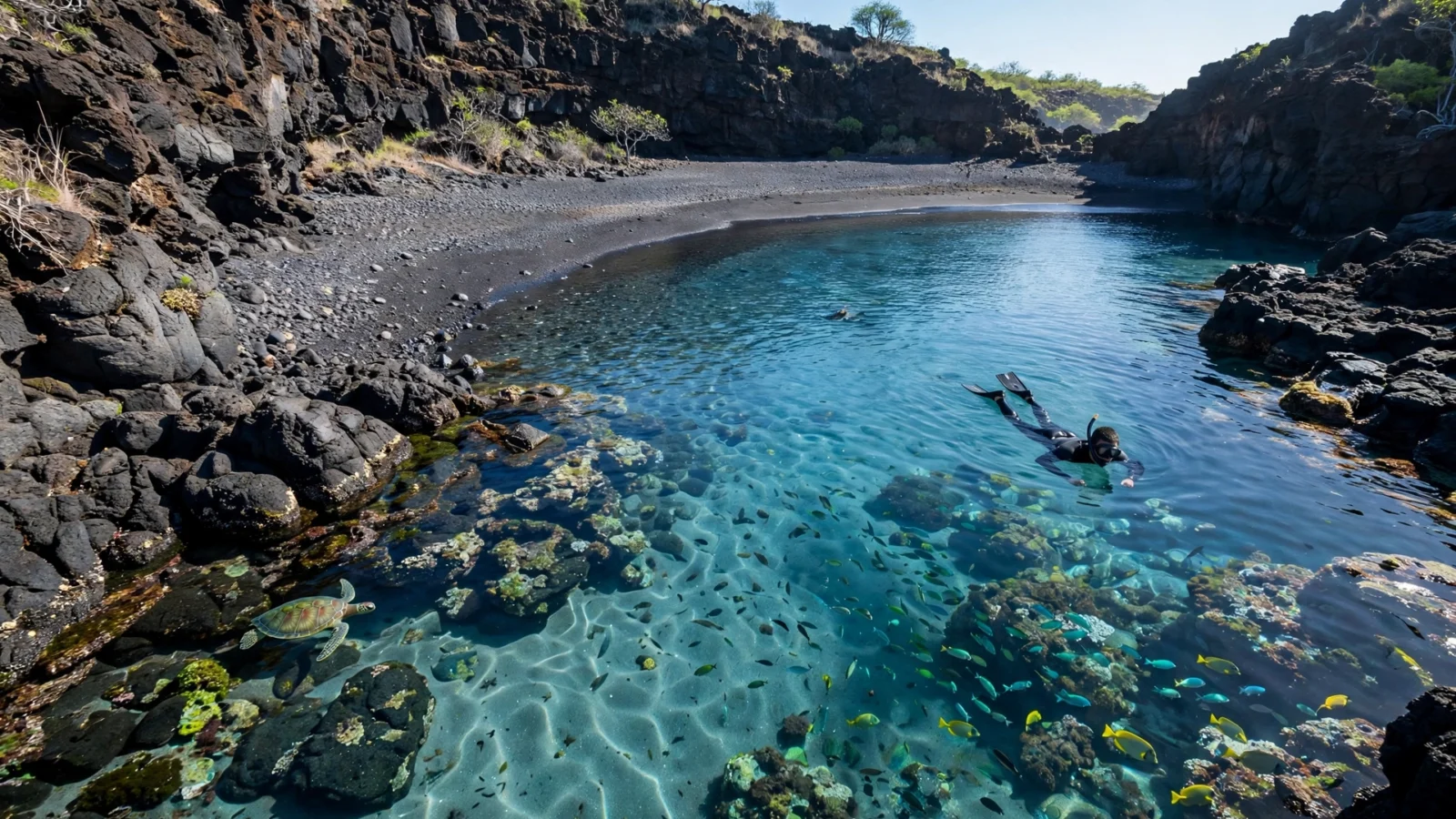
49 Black Sand Beach is the Kohala Coast’s only black sand cove — a small, lava-framed pocket of dark sand at Honoka’ope Bay, inside the gated Mauna Lani community, with a proper coral reef along its south edge and some of the clearest shore-snorkeling water on this coast. It is also the easiest good snorkel on the island to get turned away from: the public parking lot holds roughly 20 cars, the free passes at the guard gate run out early, and by mid-morning on a weekend the answer is often simply “full.”
This guide covers the whole visit in snorkeling order: how the pass system actually works, where to enter, which side of the cove to swim, what you will see, and the one honest warning that matters here — the bottom drops away fast, so this is a confident swimmer’s snorkel, not a wading beach for small kids.
Quick facts
| Detail | What to know |
|---|---|
| Hawaiian name | Honoka’ope Bay / Honoka’ope Beach (“the 49s”) |
| Where | Mauna Lani Resort, Kohala Coast, Big Island — about 20 miles north of Kona airport |
| Access | Public by law; free pass at the community guard gate, first come |
| Parking | Free public lot, roughly 20 spaces — arrive before 9am |
| Cost | Free (no entry fee, no pass fee) |
| Facilities | Restrooms by the lot, outdoor shower, a few shade trees |
| Lifeguard | None |
| Best conditions | Calm mornings, April to October |
| Snorkeling style | Lava-edge reef snorkeling from a small cove; depth drops quickly |
| Bring | Your own gear — nothing is rented or sold at the beach |
Is 49 Black Sand Beach public?
Yes. Every beach in Hawaii is public by law, and Honoka’ope is no exception. What is private is the road: the beach sits inside a gated community of 49 luxury homes (that is where the “49” comes from), and the community controls vehicle access through its gate.
In practice it works like this. You stop at the guard shack on Honoka’ope Place, tell the guard you are going to the beach, and — if public spaces remain — you are given a free pass for your dashboard and waved through to the public lot at the end of the road. If the lot is full, you are turned away. There is no booking system, no fee, and no way to reserve a space: the only strategy is arriving early.
Sources disagree on the gate’s exact hours — 8 a.m. to 5 p.m., 8 a.m. to 6 p.m. and sunrise to sunset are all published — so plan your swim inside daylight hours and do not cut the return close. The outer gate is reported to lock at 8:00 p.m., so be out well before then.
How to get there
From Kona International Airport, the drive is about 20 miles and 25 to 35 minutes:
- Head north on Queen Ka’ahumanu Highway (HI-19), past Waikoloa Beach Resort.
- Between mile markers 74 and 75, turn left onto Mauna Lani Drive.
- At the roundabout (the Mauna Lani shops and Foodland are on your right), take the third exit onto Kaniku Drive.
- Turn onto Honoka’ope Place and stop at the guard shack for your beach pass.
- Continue to the end of the road and park in the public lot.
- Walk past the restrooms and tennis courts — the sand is a minute or two away.
Stop at the Foodland by the roundabout if you need water or snacks. Nothing is sold at the beach, and the nearest rental shops are back in Waikoloa or at the Mauna Lani shops — most visitors bring their own mask and fins. Our Hawaii snorkeling gear checklist covers what to pack for rocky entries like this one.
If the lot is full: you can still reach the cove on foot via the Ala Kahakai National Historic Trail, the old Hawaiian shoreline path that runs behind the beach. The walk in from the Mauna Lani Beach Club public access area is roughly 1.5 miles over rough, shadeless lava — real shoes, a hat, and at least a litre of water per person. It is a legitimate backup, not a casual stroll. Or pivot: the backup-beach table below lists three good snorkels within 15 minutes.
What the beach is actually like
Set expectations first. This is not a long sweeping beach and it is not powder-fine black sand. The sand is a coarse mix of black and grey lava pebbles — “salt and pepper” — ground down from the lava cliffs that wall the cove on both sides. It is beautiful, photogenic, and absolutely scorching by midday: wear sandals or water shoes until you reach the waterline.
The cove itself is small and usually quiet, because the parking cap keeps it that way. A few trees at the back give the only real shade. Restrooms sit by the parking lot and there is an outdoor shower near the path. There is no lifeguard, no food, no rentals, and no shade structure — a beach umbrella is worth bringing if you plan to stay after your swim.
At low tide, the lava edges expose small tide pools worth a careful look (watch your step: the rock is sharp and slippery). The Ala Kahakai trail continues north from behind the beach toward Mauna Lani Point with wide views back over the bay.
The snorkeling: where to swim
The centre of the cove is a sandy bowl — pleasant for a swim, but there is little to see in the middle. Everything interesting lives along the lava edges, and the two sides are not equal.
South side (left, facing the ocean) — the main reef
This is the snorkel. A large coral reef runs along the south side of the bay, with coral heads and lava structure close to shore and fish density that rivals any shore spot on the Kohala Coast on a calm morning. Work your way slowly outward along the rocks, staying in the sheltered water inside the cove. Confident beginners can enjoy this side on a flat day, as long as they are comfortable in deep water (see the depth warning below).
North side (right) — rockier and quieter
The north edge is more rock than reef flat: lava outcrops, surge channels, and scattered coral. It is usually emptier and can be good on very calm days, but the footing and surge make it the second choice. Stay close to shore here.
Outside the cove — strong swimmers only
Past the mouth of the bay, wind and current pick up quickly and there is no sheltered water to retreat to. Only strong, experienced ocean swimmers should venture out, and only on the calmest mornings.
Entry technique
Enter in the middle of the cove where the sand meets the water. Shuffle your feet as you walk in — the rocks at both edges hide sea urchins in the cracks, and you do not want to step or grab blindly near them. The entry slope is steep, so you will be swimming-depth within a few metres; fit your mask and fins in the shallows before you push off, and never stand on the coral once you are over the reef.
Snorkeling 49 Black Sand Beach: the reef route, step by step
Beach 49 — locals call it the 49s — is a small cove, so the snorkel here is a route, not a wander. Swim it in this order and you see the best of the reef without fighting the depth or the edges.
The south reef route — your main swim
Enter in the middle of the cove where the sand meets the water, fins on, mask fitted, then turn left and work slowly outward along the south rocks. The reef sits close to shore here: coral heads and lava structure with the best fish density in the cove, and the water stays sheltered inside the bay as long as you stay off the mouth. Swim out along the rocks, then turn and come back the same way — there is no reason to push past the mouth, where wind and current pick up and there is no sheltered water to retreat to. Confident beginners can enjoy this side on a flat day, as long as they are comfortable in deep water: the bottom drops from about 2 feet to 6–8 feet within a few steps of the sand, and the bay itself runs to around 20 feet deep.
The north rocks — the quiet second option
The north edge is rockier and quieter: lava outcrops, surge channels and scattered coral, usually emptier than the south side. It can be good on a very calm day, but the footing and the surge make it the second choice — stay close to shore, keep your fins off the rock, and do not try to cut across the mouth to join the south reef.
Reading the conditions before you get in
The whole snorkel depends on one call: is it calm enough? Stand on the sand and watch the water for ten minutes before you enter. If waves are breaking over the lava at the cove mouth, stay out — the entry is steep and there is no lifeguard. If the water inside the cove looks milky or churned, visibility is gone and the swim is not worth it. The clearest water comes on flat mornings: calm overnight, light wind, before the trade winds build around midday and stir the sand. Afternoons are for photos and sunset, not for snorkeling. From November to March, winter swell can wrap into the cove and make entry genuinely dangerous — on big-surf days, enjoy the beach and the trail and keep your gear dry. At low tide the lava edges expose small tide pools worth a careful look; check a tide chart for the Waikoloa coast before you go, and watch your step on the sharp, slippery rock. Our best time to snorkel in Hawaii guide explains the island-wide pattern, and our snorkeling safety guide is worth a read before any unguarded cove.
If a turtle joins you in the cove
Green sea turtles feed along the rocks here and sometimes haul out on the sand to rest. If one is in the water with you, enjoy it from at least 10 feet away, never chase, touch or block it, and let it come up to breathe — a turtle that feels crowded in a small cove will leave, and a resting turtle on the sand needs a clear path back to the sea. If a turtle looks hurt or tangled, call the DLNR/NOAA hotline at 1-888-256-9840 rather than handling it yourself. Our guide to snorkeling with turtles in Hawaii covers the etiquette in full.
The depth warning (read this before bringing kids)
Honoka’ope drops fast. The bottom falls from knee-deep to over your head — roughly 2 feet to 6–8 feet — within a few steps, and the bay is around 20 feet deep. There is very little shallow wading area.
That makes this a poor choice for toddlers to splash in and for anyone who is not a confident swimmer: no lifeguard, a steep entry, and sharp lava at the edges. Families with small children will have a much easier morning at Spencer Beach Park, where the water stays shallow and calm, or at lifeguarded Hapuna Beach on a calm day. For everyone else, our snorkeling safety guide is worth a read before any unguarded cove.
What you will see
On a clear morning the water here can be genuinely glassy, and the reef is busy:
- Reef fish — yellow tang, parrotfish, butterflyfish and mixed schools working the lava edges.
- Coral — cauliflower and finger coral along the south reef and around the lava outcrops.
- Green sea turtles (honu) — frequent visitors that feed along the rocks and sometimes haul out on the sand to rest. Give them at least 10 feet (3 metres) on land and in the water, never touch or block them, and let a resting turtle keep its clear path back to the sea. Our guide to snorkeling with turtles in Hawaii explains the rules and the best spots.
- Tide-pool life — small fish, crabs and urchins in the lava pools at low tide (look, don’t touch).
A reef shark is occasionally reported out in the bay — a rare sighting, not something to plan around or worry about on a normal morning inside the cove.
Best time to snorkel 49 Black Sand Beach
Time of day: go first thing. The pass is the first reason (aim to reach the gate between 7 and 8:30am; by 9am on weekends and holidays the lot is often full) and the water is the second — mornings are calmer and clearer before the trade winds build around midday and stir the sand. Our best time to snorkel in Hawaii guide explains the island-wide pattern.
Season: April to October usually brings the calmest water and best visibility on the Kohala Coast. From November to March, winter swell can wrap into the cove and make entry genuinely dangerous — on big-surf days, enjoy the beach and the trail and keep your gear dry. If you are new to reading conditions, start with our beginners’ guide to snorkeling in Hawaii before choosing an unguarded spot like this.
49 Black Sand Beach vs the neighbours
| Spot | Sand | Access | Best for | From the 49 gate |
|---|---|---|---|---|
| 49 Black Sand Beach (Honoka’ope) | Black/grey lava pebbles | Free pass, ~20 spaces | Quiet reef snorkeling, turtles | — |
| Makaiwa Bay | White | Free public lot + short walk | Calm swimming and snorkeling at the Mauna Lani Beach Club cove | ~5 min |
| Waialea Beach (Beach 69) | White/grey | State park lot | Shady, spacious snorkeling when summer sand is in | ~10 min |
| Puako Bay | Rocky shoreline | Several public access points | Reef snorkeling and turtle cleaning stations | ~10 min |
| Hapuna Beach | Wide white sand | Paid state park lot — non-residents ~$10/vehicle + $5/person (reported Oct 2026; kiosks card/mobile only, no cash) | Families, lifeguards, a full beach day | ~10–15 min |
If you get turned away at the gate: choose Makaiwa Bay if snorkeling is the point of the morning, Hapuna if the group wants lifeguards, space and facilities. The full coast is mapped on our Big Island snorkeling hub, and Waikoloa Beach is another nearby option when the wind is up.
Pauoa Bay, next door: the calm-water alternative
Pauoa Bay is the next bay south of Honoka’ope, fronting the Fairmont Orchid at Mauna Lani — a calm, sheltered bay with one of the healthiest coral reefs on the Kohala Coast. When 49’s entry is rough, or the guard has turned you away at a full lot, Pauoa’s calm water is the easy-swimming alternative to the 49 reef: gentler entry, warmer-feeling shallows, and a reef that rewards a slow float rather than a confident swimmer’s route. The resort grounds around it are private, so respect the signs and the guest equipment and stick to the public shoreline. Makaiwa Bay, the white-sand cove in the table above, is the next cove south again — public parking near Pauoa Road, then a 10–15 minute walk past the Kalahuipua’a fishponds. The full coast is mapped on our Big Island snorkeling hub.
Tips for a smooth visit
- Arrive before 9am — earlier on weekends and holidays. The pass is the whole game.
- Wear footwear to the waterline. The dark sand burns bare feet by midday and the lava cuts year-round.
- Bring everything: water, snacks, shade, and your own snorkel gear. Nothing is sold or rented at the beach.
- Use reef-safe sunscreen (mineral, free of oxybenzone and octinoxate) and reapply after your swim.
- Watch the water for 10 minutes before entering. If waves are breaking over the lava at the cove mouth, conditions are wrong — stay out.
- Never snorkel alone, and stay inside the cove unless you are a strong ocean swimmer.
- Leave it as you found it: pack out all rubbish, take no sand, rock or coral home, and keep voices low — homes sit right above the cove, and respectful visitors are how public access keeps working smoothly.
FAQ
Is 49 Black Sand Beach public?
Yes. All Hawaii beaches are public, including this one. The road in crosses a private gated community, so drivers stop at the guard shack for a free beach pass; entry is limited only by the size of the public lot (roughly 20 spaces).
How do I get to 49 Black Sand Beach?
Drive north on HI-19 to Mauna Lani Drive (between mile markers 74 and 75), take the third exit at the roundabout onto Kaniku Drive, then turn onto Honoka’ope Place and stop at the guard shack. From Kona airport it is about 20 miles, 25–35 minutes.
Is 49 Black Sand Beach good for snorkeling?
Yes — on calm days it is one of the best shore snorkels on the Kohala Coast. The south side of the cove holds a large coral reef with plenty of reef fish and frequent turtles. Go in the morning for the clearest, calmest water.
Do I need a pass or reservation for 49 Black Sand Beach?
You need the free pass handed out at the guard gate if you are driving in — there is no reservation system and no fee. Passes are first come and run out early, so arrive before 9am, earlier on weekends.
Are there bathrooms and showers at 49 Black Sand Beach?
Yes. Restrooms are by the parking lot and there is an outdoor shower near the beach path. There is no food, shop or gear rental at the beach — bring everything with you.
Is there a lifeguard at 49 Black Sand Beach?
No. There is no lifeguard at this cove. Swim and snorkel only in calm conditions, never alone, and keep children within arm’s reach — the bottom drops off quickly.
Is 49 Black Sand Beach good for kids?
For confident young swimmers on a calm day, yes; for toddlers and weak swimmers, no. The entry is steep, the depth drops from about 2 feet to 6–8 feet within a few steps, and there is sharp lava at the edges. Spencer Beach Park and Hapuna Beach are easier family choices nearby.
What if the parking lot at 49 Black Sand Beach is full?
Either walk in on the Ala Kahakai shoreline trail from the Mauna Lani Beach Club public access (about 1.5 miles over rough lava — bring shoes and water), come back at opening time the next morning, or drive 5–15 minutes to Makaiwa Bay, Waialea Beach or Hapuna Beach instead.
How deep is the water at 49 Black Sand Beach?
The bottom drops fast: from about 2 feet to 6–8 feet within a few steps of the sand, and the bay itself runs to around 20 feet deep. There is very little shallow wading area, which is why this is a confident swimmer’s snorkel rather than a paddling beach.
Can you ride a bike to 49 Black Sand Beach?
There is no published bike policy for the beach. The guard gate controls vehicle access through a private community road, and the only documented way in without a car is the 1.5-mile Ala Kahakai shoreline trail from the Mauna Lani Beach Club public access. If you are cycling, ask the guard at the shack — do not assume bikes are waved through.
Are dogs allowed at 49 Black Sand Beach?
No. Dogs are not allowed at the beach.
What time does the gate lock at 49 Black Sand Beach?
The outer gate is reported to lock at 8:00 p.m. Plan to be out well before then — and confirm the day’s hours with Mauna Lani Resort, because published hours disagree (8 a.m. to 5 p.m., 8 a.m. to 6 p.m. and sunrise to sunset are all listed).
What is Pauoa Bay, and how is it different from 49 Black Sand Beach?
Pauoa Bay is the next bay south of Honoka’ope, fronting the Fairmont Orchid at Mauna Lani. It is a calm, sheltered bay with a healthy reef — an easier swim than the 49 reef, with gentler entry and shallower water. 49 Black Sand Beach is the small black-sand cove one bay north, inside the gated 49s community, with a proper reef along its south edge and a much steeper entry.
Is 49 Black Sand Beach the same as Punalu’u Black Sand Beach?
No. Punalu’u is the famous black sand beach on the southeast coast near Hawai’i Volcanoes National Park, a long drive from the Kohala Coast. 49 Black Sand Beach (Honoka’ope Bay) is the Kohala Coast’s black sand cove, about 20 miles north of Kona airport inside Mauna Lani.
What should I do if I see a turtle while snorkeling at 49?
Enjoy it from at least 10 feet away, never touch, chase or block it, and give a resting turtle on the sand a clear path back to the sea. If a turtle looks hurt or tangled, call the DLNR/NOAA hotline at 1-888-256-9840 rather than handling it yourself.
Bottom line
49 Black Sand Beach rewards the early riser: a free pass, a twenty-car lot, and then a quiet black-sand cove with a real reef, clear water and turtles — the kind of snorkel that feels like a private discovery an hour before the rest of the coast wakes up. Respect the depth, the lava and the neighbours, and it is one of the best mornings on the Big Island. For more Kohala Coast options, start with our Big Island hub.