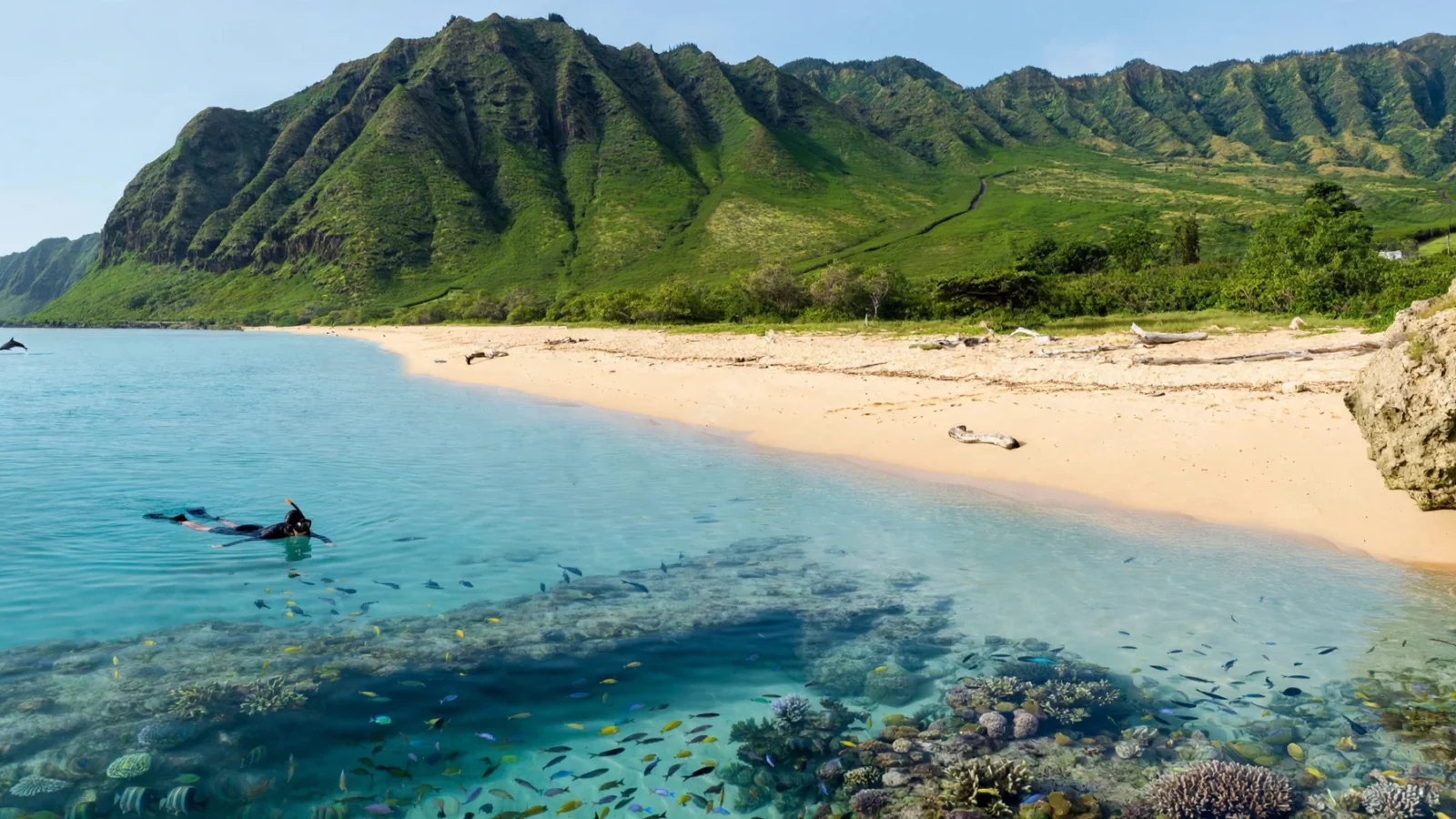
Makua Beach is the stretch of Oahu’s west coast that most drivers pass without stopping. The tour buses never come, the development thins out after Makaha, and the road narrows toward the end of the island — and there, under the steep green wall of Makua Valley, lies about half a mile of white sand with almost nobody on it. What the passing cars cannot see is what lies under the surface on a calm morning: a ledge in 15 to 50 feet of water, caves and overhangs in the rock, schools of yellow tang over the drop-off, and spinner dolphins resting offshore in water that local dive crews rate among the clearest on the island. But Makua keeps its snorkeling behind the same locked door as its neighbour Yokohama Bay: this beach has no offshore reef to protect it, the bottom drops away fast, there is no lifeguard — and for much of the year the surf owns it outright. This guide tells you exactly when the door opens, who it opens for, and when to keep driving. Our Oahu snorkeling hub has never given this beach its own page. It earns one — with its conditions, and its missing lifeguard, printed in large type.
The honest summary, up front: Makua is a confident swimmer’s snorkel, not a family beach with fins. The underwater ground here is a dive ledge — the best-known description of it, from the west side’s own boat crews, calls it a great freedive spot best reached by boat. A shore snorkeler works the shallow inshore fringe of that ledge, on a flat summer morning, in the calm window before the wind, with a buddy, a planned exit, and nobody watching from a tower. Inside that window, this is one of the most rewarding shore swims on Oahu: clear water, real fish life, turtles possible, dolphins passing at a respectful distance, and an empty beach behind you. Outside that window — any surf day, any winter day, any day the current is running — there is no snorkel here, and looking for one is how strong swimmers get into trouble on this coast.
Quick facts
- Location: Makua Beach (Mākua), on Farrington Highway past Makaha, Waianae coast, far-west Oahu — backed by Makua Valley and the Waianae range, a few minutes south of Yokohama Bay and the Ka’ena Point trailhead
- Not to be confused with: Tunnels Beach on Kauai, whose alternate name is also Makua — a completely different beach on a different island (see the note below)
- The snorkeling, honestly: The shallow inshore fringe of a 15–50 ft offshore ledge with caves and overhangs — a freedive/dive ground that shore snorkelers can work only on flat, calm mornings, almost always in summer
- Lifeguard: None. No lifeguard, no tower, no patrol — every judgement at this beach is yours
- Fees and reservations: Free access and free parking. No reservation for beach use
- Parking: A dirt road parallel to the beach and roadside pull-offs under the trees on the ocean side of Farrington Highway. Limited, unpaved, first-come. Do not leave valuables in the car; remote end-of-road lots on Oahu are break-in country
- Facilities: None at all — no restrooms, no showers, no rentals, no vendors, little shade. Bring everything, including far more water than you think you need; the last real shops are back in Makaha and Waianae
- Best time: First light to mid-morning on a flat summer day. Winter is surf season here and the snorkel is closed by the ocean, not by any sign
- The one rule that matters: If there are waves breaking, there is no snorkeling today — and at Makua there is no lifeguard to tell you so. That call is yours, and it is the whole skill this beach demands
Where Makua Beach is — and which Makua this is
Makua Beach sits at the north end of Makua Valley, where the Waianae range comes closest to the sea on Oahu’s leeward coast. The drive is the west side in full: out the H-1 to Waianae, then Farrington Highway past Makaha, until the houses thin, the road narrows, and a dirt track under the trees signals the parking pull-offs. The beach itself is a long, undeveloped crescent of white sand — at its east end stands a large limestone rock, Pohaku Kula’ila’i — with nothing built on it at all. Behind it, Makua Valley carries a weight no other backdrop on this coast matches: in Hawaiian tradition the valley is connected with the creation of people — “Makua” means “parent” — and the wider Ka’ena coastline is a leina a ka ‘uhane, a place where souls are said to depart. The valley is also a living, restricted place, used by the US military for training; treat the whole landscape as what it is — a sacred valley with a beach in front of it, not a resort backdrop.
One disambiguation matters before anything else, because the internet gets it wrong constantly. This is Makua Beach, Oahu. It is not Tunnels Beach — the famous Kauai snorkel beach whose alternate name happens to also be Makua. Whole guide pages online describe “Makua’s tunnels” and “Tunnels Beach” while giving directions down Farrington Highway on Oahu, mixing two islands’ beaches into one fictional spot. If a page about “Makua Beach snorkeling” mentions lava tubes you swim through and a Haena address, it is describing Kauai. The Oahu Makua in this guide has a ledge, small caves and overhangs you look into from above — you do not swim through anything here, and entering caves or overhangs on a snorkel is dangerous anywhere. Names settled, the beach itself is simple: wild, empty, unguarded, and honest about it.
Getting to Makua Beach, Oahu: directions, drive times and the gate
Makua Beach, Oahu sits at the far end of the leeward coast, and the drive is part of the trip. From Honolulu, take the H-1 west toward Waianae; it becomes Farrington Highway (Route 93) and follows the coast for roughly 30 miles. Plan on about an hour from Honolulu, around 70 minutes from Waikiki with no traffic, and about 40 minutes from Ko Olina. There are no tour buses out here and no shortcut — driving is effectively how you get to Makua Beach, so stock up before you leave the towns: the last real shops are back in Makaha and Waianae, and there is nothing to buy at the beach.
The turn-off is easy to miss if you are watching the ocean instead of the road. Where Farrington Highway narrows past Makaha, a dirt road parallels the beach on the ocean side, and a gate marks its entrance. When the gate is open, drive through onto the track and take one of the pull-offs under the trees. When it is closed — the state parks managers have kept it shut at times to stop overnight use — park in the adjacent area by the highway and walk in; do not block the gate or the road. Either way, this is where the “how to get to Makua Beach” question ends and the walking starts: the beach itself is a short walk from wherever you park.
Two rules govern the visit before you even reach the sand. Makua Beach is part of Ka’ena Point State Park, which is open daily from 6:00am to 7:00pm, and the park rules are blunt: no dogs, no drones, no camping and no commercial activity. Plan your day inside those hours — this is a beach you leave by sunset, not a place to linger into the dark. The nearest restrooms are at Keawa’ula (Yokohama Bay), a few minutes north; its comfort-station parking lot was partially reopened in September 2026 after road repairs, with the trail still closed, so check the DLNR Ka’ena Point State Park page on the morning you go rather than assuming the facilities are open.
The ledge: what the snorkeling here actually is
Most Oahu snorkel beaches are shallow reefs you float over. Makua is built differently, and understanding its shape is the difference between a great morning and a bad one.
Offshore, the bottom falls away quickly into a ledge system in roughly 15 to 50 feet of water. That ledge — abundant in fish and invertebrates, cut with small caves and overhangs — is the famous ground: it is why dive boats and freedivers love this coast, and west-side crews describe visibility here as normally excellent, among the best on the island. A shore snorkeler does not snorkel “the ledge” the way a diver does. You work its shallow inshore edge: the rocky fringe and the top of the drop-off, where the light still reaches, the fish schools gather, and the sand behind you stays within a short fin back to shore. Floated over that edge on a flat morning, the scene is genuinely special — caves and overhangs below you with life tucked into every shadow, the blue deepening past the ledge, and big-water species passing in the open water beyond.
What that shape rules out matters just as much. There is no protected lagoon, no shallow sandy bowl, no reef flat standing between you and the open ocean. The quick drop-off that makes the diving superb means a snorkeler who drifts past the fringe is over deep water with a current, a long way from an unpatrolled shore. Makua rewards swimmers who are comfortable in deep water, can read a surface, and hold a line. It is the wrong classroom for learning any of that — the beginners’ guide exists precisely to send first-timers to protected water like Pokai Bay, down this same coast, where the learning is safe.
The flat-day test — with no lifeguard to ask
At Yokohama, a mile or so north, the protocol starts with the lifeguard. Makua has no lifeguard, so the test here is entirely self-administered — which is why it needs to be stricter, not looser. Three checks, in order, and failing any one ends the plan.
First, look at the ocean, properly. Makua is not protected by an offshore reef, so swell arrives here unbroken. Watch the water for several minutes, a full set cycle. If waves are breaking anywhere along the beach, if whitewater is rolling, if the shorebreak is thumping — there is no snorkel today. Flat means flat: a calm, glassy or lightly rippled surface from the sand to the horizon line.
Second, read the drift. Even on calm-looking mornings this coast can run a steady alongshore current, and the deep water past the fringe gives it somewhere to take you. Stand waist-deep and feel for a pull; watch a leaf or your own stationary float line against the bottom. A noticeable drift on a beach with no lifeguard and a quick drop-off is a no — visibility is not the only thing a snorkel needs, and here the swim home is the exam.
Third, respect the clock and the season. The window is the early morning, before the day’s wind textures the surface, and overwhelmingly in the summer months. Winter on this coast — roughly November through April — is big-surf season for expert surfers, and the snorkel is closed for its whole duration regardless of how a single morning looks between sets. After heavy rain, skip until the nearshore water clears. Our best time to snorkel in Hawaii guide maps the pattern; Makua is the west coast’s strictest version of it.
Pass all three, and the routine is disciplined: enter over sand with your buddy, fin out slowly to the rocky fringe, and work along the top of the ledge — never beyond the point where the bottom disappears from easy view, never into a cave or under an overhang, and always with your exit line in mind. Come in over the same sand you entered from, well before you are tired. On this beach the snorkel ends when the plan says it ends, not when your legs say so.
What you will see
- Schools over the ledge: the west-side crews’ Makua list is the richest on this coast — large schools of yellow tang, white goatfish, schools of Moorish idol, and giant parrotfish over the drop-off, with the famous Hawaiian checker cowry among the ledge’s small treasures for sharp eyes
- Life in the shadows: the caves and overhangs shelter eels, lobsters, crabs and small reef fish — look in from above in the light; never reach in, and never follow anything inside
- Green sea turtles (honu): visitors and crews report turtles along this ground — possible, never promised, and always under the standing rule: ten feet of distance, per our turtle snorkeling guide
- Spinner dolphins — at 50 yards, always: Makua is a genuine dolphin coast; pods rest and pass offshore here, often early. Watch them from the sand or from wherever you happen to be floating — and never swim toward, chase or position yourself in their path. Resting spinner dolphins are protected by federal guidance: at least 50 yards, no exceptions. A dolphin encounter at Makua is something the ocean offers, never something a snorkeler pursues
- In winter (from shore): expert surf on an unprotected coast, and humpback whales offshore — crews on this coast describe hearing whalesong underwater in winter; from the beach in winter, you watch. The snorkel season and the whale season here do not overlap, and that is fine
Sunset, tide pools and Kaneana Cave: the rest of Makua Beach, Hawaii
Snorkeling is only part of what Makua Beach, Hawaii offers — and on the many days the ocean says no, the rest of the beach is the reason to have driven out anyway.
Sunset. Makua faces due west with nothing between the sand and the horizon, and its sunsets are among the best on Oahu — and the least crowded, because almost nobody makes this drive for the evening. Arrive in the late afternoon, watch the light drop behind the ocean from the sand, and plan to be packed up and leaving as it goes: the park closes at 7:00pm, the beach has no lights and no facilities, and the drive back down Farrington Highway is not one to rush in the dark.
Tide pools. At the northern end of the beach, a tidal shelf turns into a tide-pool playground at low tide — anemones, crabs and small fish in the rock pools, worth an unhurried half hour with shoes on. Keep an eye on the ocean while you look down: this is still an unprotected coast, and a rising tide or an unexpected set can cut off the shelf faster than it looks.
Kaneana Cave (Makua Cave). Just off Farrington Highway near the beach stands one of Oahu’s most storied places: a sea cave and lava tube roughly 100 feet high and 450 feet deep, carved by the ocean some 150,000 years ago. In Hawaiian tradition it is tied to Kane, the god of creation, and to Nanaue, the shark-man who, legend says, lured his victims into the cave. It is a sacred place — treat it as one. Stop at the entrance, take in the scale of it from the roadside, and go no further: the cave is unmaintained, the rock inside is slick, and it sits at the edge of the Makua Military Reservation, where exploring the deeper tunnels can draw a fine. It is a look-from-the-entrance stop, not a hike, and it pairs naturally with the beach as the second half of the drive out.
Conditions and the best time to go
The seasonal split at Makua is as clean as anywhere in Hawaii. Winter — roughly November through April — sends the northern Pacific’s swells straight onto this unprotected shoreline: waves can get very high, currents strengthen, and the beach belongs to expert surfers and to people watching them from the sand. Swimming itself is risky in that season; snorkeling is not a winter activity here in any honest telling, whatever a listicle’s “year-round paradise” framing suggests.
Summer — roughly May through September — is the window season, when the west side sits in its calm pattern and flat mornings happen often enough to plan a trip around, while never being guaranteed on a given day. Go at first light: the clearest water, the calmest surface, the dolphins moving early, and the whole swim finished before the trades roughen the coast by afternoon. The water here also runs a touch warmer than most of Oahu — west-side crews put it a couple of degrees above the island norm, second only to the Electric Beach outflow — a small comfort on a long morning, and one more reason this coast’s confident swimmers keep coming back to it.
Safety, honestly
- There is no lifeguard. That is the headline, not a footnote. No tower, no patrol, no one whose job is watching this water. Every check on this page — surf, current, season, your own fitness — is performed by you, and help is a long drive away
- The drop-off is fast and the current is real. The bottom falls into 15–50 ft ledge water quickly, and alongshore drift is normal on this coast. Stay over the inshore fringe, snorkel with a buddy, track where you entered, and never snorkel this beach tired
- Never enter caves or overhangs. The ledge’s small caves hold surge even on calm days and are a freediver’s environment, not a snorkeler’s route. Look in from the light; stay out
- Dolphins are protected, not a programme. Fifty yards minimum, never pursue, never surround. The same discipline covers turtles at ten feet and any monk seal hauled out on the sand at fifty feet
- No shade, no shop, no facilities, no second chances on supplies. Sun and dehydration end more days on the west side than the ocean does. Bring water, food, reef-safe sunscreen and your own shade, carry full gear — there is nothing to rent within miles — and tell someone your plan. Our snorkeling safety guide covers the general discipline; Makua is where it stops being general
- This is not a beginner’s snorkel, and not a children’s snorkel. No protection, no patrol, deep water close in. Families and first-timers belong at Pokai Bay or the protected water in the beginners’ guide — Makua is a beach to graduate to
Parking, facilities and respecting the valley
Parking is the dirt road that parallels the beach and the pull-offs under the trees on the ocean side of Farrington Highway — free, unpaved, limited, and reached by watching for the track as the road narrows past Makaha. There is no paved lot, no attendant and no posted gate; there is also no margin for error on supplies, because there are no facilities of any kind at the beach — no restrooms, no showers — and the nearest shops are back down the highway. Lock the car and leave nothing visible: remote west-side pull-offs are worked by thieves precisely because everyone is far away in the water. Walk softly here in the other sense too: Kaneana Cave, the large cave near the highway by the beach, is tied to the Nanaue shark-man tradition, and Makua Valley behind you is a sacred and restricted landscape. Stay on the beach and the pull-offs, pack out everything, and leave the valley to its own people and purposes.
Makua Beach vs Yokohama Bay vs Makaha vs Pokai Bay
The west side’s four shore snorkels, honestly traded:
| Makua Beach | Yokohama Bay (Keawa’ula) | Makaha Beach | Pokai Bay | |
|---|---|---|---|---|
| Best for | A wild ledge snorkel over deep, clear water — for confident swimmers only | An empty flat-morning reef at the end of the road, with a lifeguard to check with | The west side’s classic reef swim with a lifeguard culture | The protected first snorkel on the west side |
| Snorkel window | Flat summer mornings only — and you make the call yourself | Flat summer mornings only — lifeguard confirms | Calm days; winter surf closes it too, but the window is wider | The widest on this coast — protected most days |
| The ground | A 15–50 ft ledge with caves/overhangs — a dive/freedive ground’s inshore fringe | A shallow coral platform that is a surf break on swell days | The strongest shore reef of the four | A modest reef in gentle, harbour-mouth water |
| Lifeguard | None | Yes — south end; ask before entering | Yes | Yes |
| Facilities | None at all; dirt-road parking | Restrooms + showers (south end), free parking | Restrooms, showers, parking | Full beach-park facilities |
| The catch | No lifeguard, quick drop-off, current — the strictest self-reliance test on this coast | The flat-day test rules everything; long drive; car security | Crowds and parking pressure in season | Reef is modest — it trades wow for calm |
The short version: choose Pokai Bay to learn, Makaha for the classic west-side reef day, Yokohama for the lifeguarded end-of-the-road reef — and Makua when you are a confident swimmer who wants the coast at its wildest: deep clear water, a working ledge, dolphins passing at their distance, and nobody’s tower watching any of it.
Nearby spots to pair with Makua Beach
- Yokohama Bay (Keawa’ula Beach) — a few minutes north at the end of the road: the same flat-summer-morning discipline, but with a lifeguard to confirm the call, restrooms, and the Ka’ena Point trail starting at the car park. If Makua’s unguarded water gives you pause on the day, Yokohama is the safer version of the same morning
- Makaha Beach — fifteen minutes south: the benchmark west-side reef, and the natural fallback when Makua’s fringe is marginal but Makaha’s more established entry is working
- Pokai Bay — further south in Waianae: the protected water where this coast’s beginners and families belong on any day Makua is closed — which, honestly, is most days
- Electric Beach (Kahe Point) — down the coast: the warm-outflow fish bowl, the confident swimmer’s other west-side option, with density of fish life instead of wilderness
Frequently asked questions
Is Makua Beach good for snorkeling?
Yes — for the right swimmer, in the right window. On a flat summer morning the inshore fringe of Makua’s offshore ledge offers some of the clearest water and richest fish life on Oahu’s west coast, with turtles possible and dolphins passing offshore. But there is no protective reef, no lifeguard, and a bottom that drops quickly into 15–50 feet of water — so it suits confident, experienced snorkelers only, and on any day with surf there is no snorkeling here at all.
Is Makua Beach the same as Tunnels Beach?
No — and the confusion is everywhere online. Tunnels Beach is on Kauai, and its alternate name happens to also be Makua, which is how the two get merged into one fictional beach. Makua Beach in this guide is on Oahu’s Waianae coast, past Makaha. Its underwater ground is a ledge with small caves and overhangs — not Kauai’s lava-tube reef — and you should look into those caves from above, never swim into them.
When is the best time to snorkel at Makua Beach?
Early morning on a flat day in summer, roughly May to September, when the west side is in its calm season. Winter brings big surf to this unprotected coast and closes the snorkel entirely. Even in summer, flat is a daily verdict you make yourself — there is no lifeguard here to make it for you.
Are there lifeguards or facilities at Makua Beach?
Neither. There is no lifeguard at Makua Beach, and no restrooms, showers, rentals or vendors. Parking is free on the dirt road and pull-offs beside the beach. Bring everything you need — water, food, shade, all your gear — the nearest shops are back in Makaha and Waianae.
Is Makua Beach good for beginners?
No. It combines every factor beginners should avoid: no lifeguard, no protective reef, a quick drop-off into deep water, and currents on an exposed coast. Beginners and families belong at protected water like Pokai Bay, on this same coast — Makua is a snorkel to graduate to later.
Can you see dolphins at Makua Beach?
Spinner dolphins commonly rest and pass offshore along this coast, especially early in the morning, and watching them from the sand or from the water where you happen to be is one of the beach’s quiet highlights. Keep at least 50 yards away and never swim toward or chase them — these are protected, resting animals, and the encounter happens on their terms or not at all.
Where do you park for Makua Beach?
On the free dirt road that parallels the beach and in the pull-offs under the trees on the ocean side of Farrington Highway, past Makaha. Spaces are limited and unpaved. Leave nothing visible in the car — remote end-of-road pull-offs on Oahu are a known break-in risk.
What else is there to do at Makua Beach if the surf is up?
Plenty, and a surf day here is a good day rather than a failed one: watch expert surf from the sand, walk the beach under Makua Valley, look for whales offshore in winter, visit Kaneana Cave by the highway with the respect its traditions deserve, or drive a few minutes north to Yokohama Bay and the Ka’ena Point trail — and save the snorkel for a flatter morning or a more protected beach.
Is Makua Beach open?
Yes — Makua Beach is part of Ka’ena Point State Park, open daily from 6:00am to 7:00pm. Camping, dogs and drones are not permitted. Access can be affected by road work on Farrington Highway, so check the DLNR Ka’ena Point State Park page before you drive out.
Is Makua Beach safe for swimming?
Only on a flat summer morning, and only for confident swimmers. There is no lifeguard, no protective reef, a bottom that drops quickly into deep water, and currents on an exposed coast. On any day with surf, or in winter, there is no safe swimming here at all — the snorkel and the swim close together.
What does Makua mean in Hawaiian?
“Makua” means “parent.” The name fits the valley behind the beach: in Hawaiian tradition Makua Valley is connected with the creation of people, and the wider Ka’ena coastline is a leina a ka ‘uhane, a place where souls are said to depart.
Can you camp at Makua Beach?
No. Camping is not permitted anywhere in Ka’ena Point State Park, and the park is open daily from 6:00am to 7:00pm only. Plan Makua as a day trip and be off the beach by closing time.
Can you see the sunset at Makua Beach?
Yes — Makua Beach faces due west and its sunsets are among the best and least crowded on Oahu. Arrive in the late afternoon and plan to leave as the sun goes down: the park closes at 7:00pm and there are no lights or facilities after dark.