- Ke’e Beach
- End of the road, Ha’ena State Park, north shore · summer only (May–Sep) · lifeguard · reservation required for entry/parking
- Ha’ena logistics
- Parking passes + entry via the official Ha’ena reservation site — book as early as your dates allow; shuttle from the north shore is the fallback; walk/bike entry $1 per visitor
- Lydgate Park
- Wailua, east side · year-round · lifeguard · free, no reservation · rock-walled swimming ponds
- Difficulty
- Beginner at both, in season — that’s their entire identity
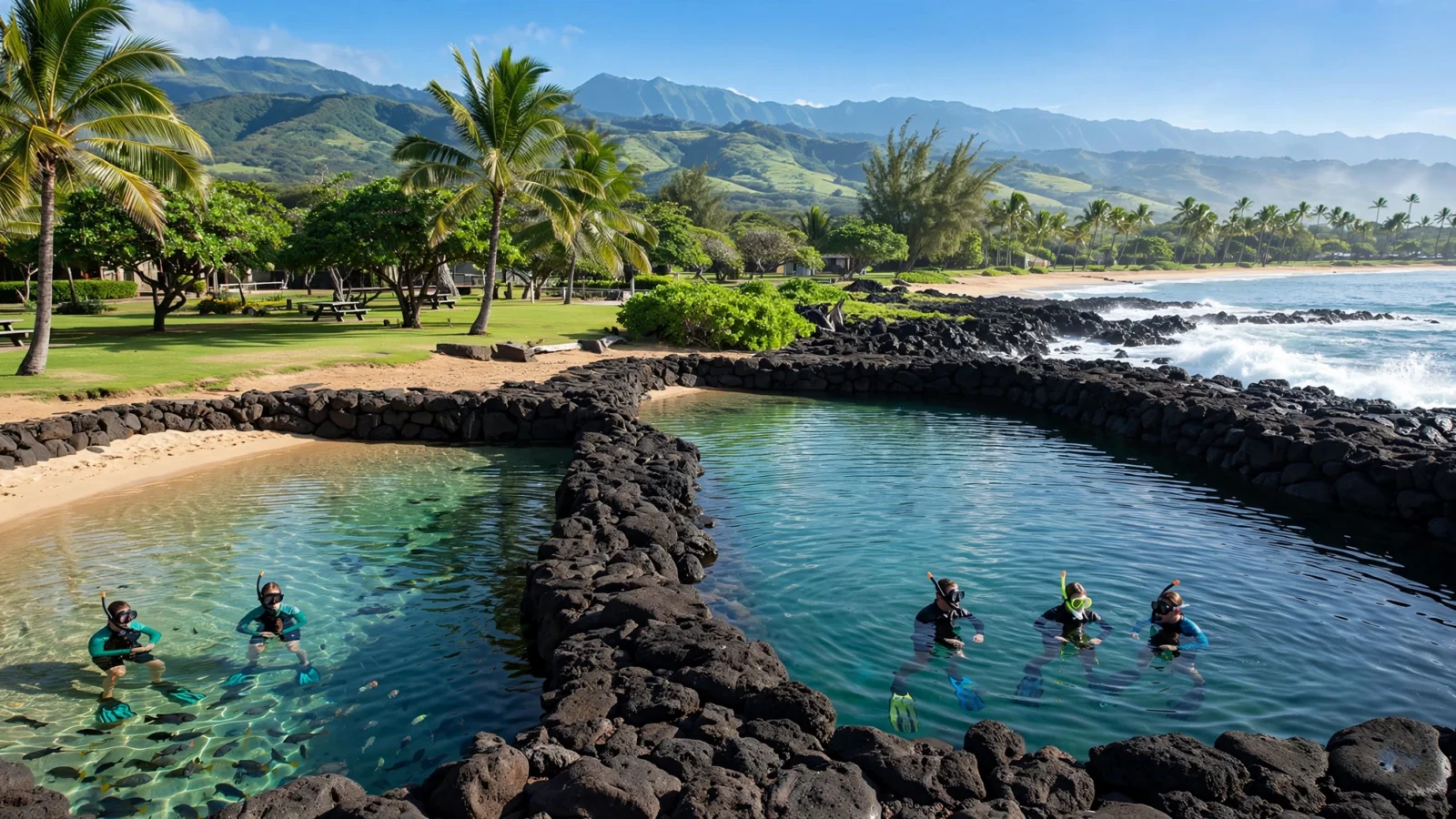
The short answer: Lydgate Beach Park in Wailua is the one place on Kauai where the snorkeling normally works every single day of the year. Two ponds walled off from the open ocean with lava rock — a big swimming pond and a shallow keiki (kids’) pond — stay pool-calm while waves break on the outside, a lifeguard watches them daily, and reef fish drift in through the gaps in the walls. It is not Kauai’s richest reef, and this guide won’t pretend otherwise. It is the island’s surest thing: the first snorkel for a four-year-old, the winter answer when the north shore is closed out, and the no-reservation, no-logistics east-side swim. This page also keeps our Ke’e Beach section — the famous reservation-only lagoon at the end of the road — because the two ponds-and-lagoon pair answer the same question from opposite ends: guaranteed easy water, one with planning, one without. If you’re visiting with little ones, plan the rest of the trip around Things to Do in Kauai with Kids. And if you’re staying on the east side, see our guide to Things to Do in Kapaa.
Morgan’s Pond is closed until further notice (November 2026)
Before you plan around Lydgate, know this: Morgan’s Pond — the large swimming pond where almost all the snorkeling happens — is closed until further notice. County crews are working with partner agencies on a debris-removal plan, and no reopening date has been announced. Do not enter the pond while the closure is in effect.
The closure covers the pond, not the whole park: Lydgate Beach Park itself — the playground, picnic areas, lawns and the paved coastal path — remains open, and the county’s notice does not set conditions for other water areas. Before any swim at Lydgate, check the County of Kauai’s latest access notice and the posted signs at the park, and ask the lifeguard on duty about the water that day.
What this means for the rest of this guide: everything below describes Lydgate as it normally works — the ponds, the fish, the morning window — and it will be true again once the pond reopens. Until then, treat it as the plan for your return visit, not for this week. If your trip is this week, our Kauai snorkeling hub lists the alternatives that are open.
Lydgate at a glance
| Detail | What to know |
|---|---|
| Location | Lydgate Beach Park, Wailua, Kauai’s east side, just south of the Wailua River mouth |
| The water | Two rock-walled ponds (Morgan’s Ponds): a large swimming pond and a shallow keiki pond |
| Depth | Roughly 2–10 feet inside the ponds |
| Lifeguard | Yes — the Lydgate tower is staffed Monday–Sunday, 8am–6pm (Hawaii Ocean Safety) |
| Facilities | Restrooms, outdoor showers, drinking fountains, shaded picnic tables, BBQ grills, bike racks, the big Kamalani Playground |
| Fees & reservations | County park; no entry fee or reservation system in place as of October 2026 — always follow posted signs |
| Best for | First-time snorkelers, small kids, nervous swimmers, winter and rough-day swims |
| Season | Year-round inside the ponds |
Morgan’s Ponds: the 1964 walls that made Lydgate
The ponds are not natural. In 1964, Kauai County built them by walling off two stretches of shoreline with lava rock, on a proposal from Native Hawaiian resident Albert S. Morgan Sr., who wanted a safe swimming area for families and children. The walls enclose about 2.6 acres of ocean inside the 62-acre county park, and the ponds still carry his name: Morgan’s Ponds.
Two naming notes that trip people up. First, Lydgate is a county beach park, not a state park — if you searched for “Lydgate State Park”, this is the place you meant; there is no Lydgate State Park. Second, the park’s full name is Lydgate Beach Park, in Wailua on Kauai’s east side, just south of the Wailua River mouth.
Getting there: from Lihue Airport, drive north on Kuhio Highway (Route 56) toward Wailua and turn right onto Leho Drive at mile marker five — roughly 15 minutes from the airport, and a few minutes’ drive south from Kapaa. The park’s parking area is inside the park, off Leho Drive.
The two ponds: which one actually holds the fish
Lydgate’s ponds — often called Morgan’s Ponds — were built by enclosing two stretches of shoreline with walls of lava rock, so the ocean fills them but the surf can’t. That single design decision explains everything about snorkeling here.
The large pond is the snorkel pond. It’s the deeper of the two (up to around 10 feet in the middle), big enough to do real laps of exploring, and it’s where the fish are. Work the inside edge of the rock wall rather than the sandy middle: fish shelter in the wall’s cracks and boulders, and they concentrate near the openings where the wall lets the sea in and out — those gaps are the pond’s front doors, and everything that lives here commutes through them. Enter from the sandy edges, fin out to the wall, and follow it slowly.
The keiki pond is the training pool. Shallower, smaller and even calmer, it’s built for toddlers and first mask dips. Adults won’t find much to look at, but for a child who has never put their face in the water it’s perfect: waist-deep on a grown-up, sandy underfoot, and still visited by the odd small fish brave enough to wander in — which, to a five-year-old, is a whale shark.
One honest expectation-set: the pond bottom is mostly sand with rock concentrated at the walls, so visibility and fish density depend on how much water the sea has been pushing through. On a calm morning after light winds, the big pond is clear and busy. After days of strong trade winds or heavy rain, it clouds up — see the conditions section below.
Lydgate Beach Park snorkeling: where to snorkel and how to do it
All Lydgate Beach Park snorkeling happens inside the two rock-walled ponds, not on the open beach — and knowing which pond you are in, and where the fish actually sit, is the whole trick. The big pond is the snorkel pond: deeper in the middle, up to around 10 feet, with the fish concentrated along the rock wall and near the gaps where the sea pushes through. The keiki pond is the shallow, sandy training pool for first dips. The steps below describe the ponds as they normally work — while Morgan’s Pond is closed, treat this as the plan for your return visit, and check the closure notice at the top of this guide first.
- Do the 60-second check first: stand at the wall and look down — if you can see the sand and the base of the wall, the water is clear enough; if it looks like tea, stay out. Ask the lifeguard (tower staffed 8am–6pm) whether the ponds are clear today.
- Start at the sandy edges of the big pond, where the bottom is soft and the water is shallow enough to stand. Put your mask on there, not at the wall.
- Fin out slowly to the rock wall and follow its inside edge — that is where the butterflyfish, yellow tangs and damselfish graze. Do not climb on the wall: the lava rock is slippery and sharp-edged.
- Pause at the gaps in the wall, where the sea pushes through — parrotfish, Moorish idols and the occasional triggerfish drift in through those openings, especially on clear, calm days.
- Stay inside the walls. The open coast outside has currents and shore break with no protection, and the walls are what keep the pond calm.
- Keep the keiki pond for first dips and under-5s — it is waist-deep on an adult, sandy and even calmer, but there is little for an adult snorkeler to see there.
That is the whole method: morning, before 10 a.m., on a day when the water is clear from the wall and the river has not run brown after rain. On the best mornings the big pond holds 15–30 feet of visibility; on murky days it is a treasure hunt in a warm pool, and the honest move is the playground, the lawns and the coastal path instead — then come back tomorrow morning.
What you’ll see in the ponds
This is beginner-grade marine life, and that’s the point — everything here is close, calm and unbothered by your presence:
- Butterflyfish — the classic first spot; several species pick around the wall rocks.
- Convict tangs and other small surgeonfish — grazing the rocks in loose groups.
- Yellow tangs — the bright-yellow schools are one of the pond’s signatures, often right along the wall.
- Parrotfish — occasional grazers that drift in through the wall openings.
- Damselfish and wrasses — small, quick and everywhere along the wall base.
- Moorish idols and triggerfish — occasional visitors through the wall openings, more likely on clear, calm days.
- Sea cucumbers and crabs — on the sand and in the wall’s shadowed cracks; look, don’t touch.
- Honu (green sea turtles) — not residents of the ponds, but they pass along the outside coast and occasionally cruise the wall; if one appears, Hawaii law and basic manners both say give it at least 10 feet and never chase or touch.
Set expectations by the day, not the brochure: on the best mornings the big pond feels like a proper little reef. On murky days it’s a treasure hunt. Either way it beats everywhere else on the island for a child’s first look underwater — for richer reef once confidence is built, our Tunnels Beach guide and Poipu guide are the step-ups.
Best time to snorkel Lydgate (and when the water turns)
Go in the morning. Kauai’s trade winds build through the day, and while the walls block the surf, afternoon wind still chops the pond surface and stirs the shallows. An early session — lifeguards come on at 8am — gets the calmest, clearest water of the day. On a calm morning the big pond typically runs 15–30 feet of visibility, with the clearest water before 10 a.m., before the trade winds pick up.Our island-wide best time to snorkel in Hawaii guide explains the pattern in full.
Season barely matters here — that’s Lydgate’s superpower. Winter’s north swells close Ke’e and Tunnels and churn Poipu on south-swell days, but the ponds stay swimmable in every month. This is the beach we send people to when the rest of the island is a write-off.
The one real condition to respect is rain. Lydgate sits just south of the Wailua River mouth, and after heavy rain the river carries silt and runoff toward the park: the ponds turn murky, visibility collapses, and county brown-water advisories can apply. After a
storm, give it a day or two to clear, check for posted advisory signs, and keep cuts out of brown water. If the pond looks like tea, it is not a snorkeling day — the playground, lawns and the paved coastal path are the consolation prize.
Checking Lydgate Beach conditions on the day
Do this 60-second check before you get in. The ponds can look the same from the parking lot on a good morning and a bad one, and the water inside the walls changes with rain and wind even when the ocean outside looks fine.
- Look at the water first: stand at the wall and look down. If you can see the sand and the base of the wall clearly, visibility is good. If the water is brown or tea-coloured, stay out. The ponds recover fast once the rain stops, but not while runoff is still coming in.
- Check the wind: mornings are calmest, with the clearest water before 10 a.m. If the trade winds are already strong and the surface inside the walls is choppy, expect reduced visibility even in the ponds.
- Ask the lifeguard: the tower is staffed 8am-6pm daily. Ask whether the ponds are clear today and whether anything is closed before you unpack. The lifeguard’s answer overrides anything in this guide.
- Read the posted signs: the county posts closure and advisory signs at the park, including the Morgan’s Pond closure. Follow them, even if the water looks inviting.
- When in doubt, wait: if the water looks wrong and nobody can confirm it, use the playground, lawns and coastal path and come back another morning. The ponds are open year-round, so a bad hour costs nothing.
For the bigger picture on which side of Kauai is calmest on your dates, see our Kauai snorkeling hub.
Is Lydgate Beach good for snorkeling? An honest verdict
For the right swimmer, it’s the best on Kauai. For the wrong one, it’s a warm-up act.
Perfect for: complete beginners, kids from toddler to tween, nervous adults, anyone snorkeling in winter, and anyone who wants a guaranteed swim with zero planning. The combination simply doesn’t exist anywhere else on the island: lifeguarded, walled, shallow, facility-rich, and open every day.
Less ideal for: experienced snorkelers chasing coral gardens, turtles on demand or big fish lists. The ponds are sand-bottomed with life concentrated at the walls — a delightful hour, not an expedition. If that’s you, treat Lydgate as a first morning and put Anini Beach or Tunnels on the clear days.
Our beginners’ guide to snorkeling in Hawaii uses Lydgate as its model first spot for a reason: mask skills learned in waist-deep calm transfer everywhere else.
Beginners, kids and nervous swimmers
- Depth by stage: the keiki pond for under-5s and first dips; the big pond’s sandy edges for new swimmers (waist-to-chest deep on an adult before it falls away toward the middle); confident kids can work the wall line with an adult beside them.
- The lifeguard is real but not a babysitter: the Lydgate tower is staffed 8am–6pm daily. Swim inside those hours where possible, and keep non-swimmers within arm’s reach regardless — ponds are calm, not shallow everywhere.
- Gear: small faces need properly fitted kids’ masks; a leaky mask in calm water still ruins a first day. Rentals and shops cluster along the Kuhio Highway corridor in nearby Kapa’a and Wailua — sort gear before you arrive so beach time is water time. Our gear checklist covers what a family actually needs.
- Sun and shade: the ponds are full-sun; the park behind them has shaded picnic tables and lawns. Reef-safe sunscreen, applied before you arrive, and rotate water time with shade time for small kids.
Parking, access and facilities
Lydgate is one of Kauai’s big county beach parks, and it feels like it: a proper parking area at the park (arrive in the morning on weekends and school holidays — it’s a local family favourite and fills accordingly), restrooms and outdoor showers for the post-snorkel rinse, drinking fountains, BBQ grills and shaded picnic tables, bike racks, and lawns that run down toward the ponds.
Two features make it more than a beach stop. Kamalani Playground, the big wooden play structure by the park, is a destination in its own right for under-10s — plan for your beach day to end there whether you intend it or not. And the paved coastal path (part of Kauai’s east-side multi-use trail) runs about 2.5 miles from the park, which turns a snorkel morning into a walk-or-ride afternoon without moving the car.
Sources for the park disagree on a precise street address (you’ll see both Kuhio Highway, Kapa’a and a Lihue-side listing) — the reliable direction is simply: Wailua, on the makai (ocean) side of Kuhio Highway just south of the Wailua River. You cannot miss the park once you’re over the river heading south.
Finding the ponds once you’re in Lydgate Beach Park
From the parking area, walk toward the ocean across the lawns. The two rock-walled ponds sit at the water’s edge, and the lifeguard tower is the landmark to aim for. If you cannot see the walls from the lot, follow the signs toward the beach or ask the lifeguard. Meeting a group? Agree on the lifeguard tower or Kamalani Playground, not the beach: the park is big and the ponds sit at the far, ocean side of the lawns.
Safety at Lydgate
The ponds are as safe as ocean swimming gets — which is not the same as risk-free. Full picture in our Hawaii snorkeling safety guide; the Lydgate-specific notes:
- Stay inside the walls. The open coast outside the ponds has currents, shore break and no protection — Kauai Sea Tours and every lifeguard will tell you the water beyond the walls can be tricky. The ponds exist precisely so you never need it.
- Mind the wall rocks. They’re slippery, sharp-edged lava rock colonised by sea life. Look at fish around them; don’t climb, stand or sit on them.
- Brown water rule. After heavy rain, if the water is murky brown, stay out — runoff near the river mouth can carry bacteria. Wait for clear water and check posted signs.
- Lifeguard hours: 8am–6pm daily at the Lydgate tower. Outside those hours the ponds are calm but unwatched — extra caution with kids.
- Turtle distance: 10 feet minimum, by law. Enjoy, photograph from a distance, never touch — see our snorkeling with turtles guide for the full etiquette.
Sharks: the rock walls are built to keep larger marine life out while letting small fish through, so seeing a shark inside the ponds is extraordinarily unlikely — but the ponds are not an aquarium, and the open ocean outside the walls is exactly that. Stay inside the walls and the question never arises.
Ke’e Beach: now its own guide
Ke’e Beach — the reef lagoon at the end of the road in Ha’ena State Park — now has its own dedicated guide: Ke’e Beach snorkeling, with the full Ha’ena reservation playbook, lagoon zones, best months and safety. In short: it is the north shore’s special-occasion snorkel in summer, it always needs an advance booking, and it is the dramatic opposite of Lydgate’s walk-in ponds below.
Ke’e is the other end of the easy-water spectrum from Lydgate, and the contrast is the point: where Lydgate is a walled, guaranteed swim, Ke’e is a living reef lagoon at the end of the road in Ha’ena State Park, under the cliffs at the start of the Kalalau Trail. In summer — May through September — it is the most dramatic easy snorkel on Kauai, with a lifeguard on duty 8am–6pm. Outside summer, the north swells that make the north shore famous close it to swimming, which is why this guide pairs the two: Lydgate for the guarantee, Ke’e for the setting.
Lydgate vs Ke’e vs the rest: choosing your Kauai easy water
| Spot | Book ahead? | Season | Lifeguard | Best for |
|---|---|---|---|---|
| Lydgate ponds | No | Year-round | Yes, 8am–6pm | First snorkels, small kids, rough-day guarantee |
| Ke’e Beach | Yes — Ha’ena reservation | Summer (May–Sep) | Yes, 8am–6pm | Setting + lagoon, Kalalau Trail days |
| Tunnels Beach | No | Summer mainly | No | Richer reef once confident |
| Poipu Beach | No | Year-round (south swells aside) | Yes | All-round south-shore default |
| Anini Beach | No | Best in summer | No | Long calm lagoon, fewer crowds |
The pattern: Lydgate is the default; everything else is an upgrade on the right day. Summer trip with a confident group and a love of dramatic settings? Fight for the Ke’e reservation. Small kids, shoulder-season dates, or a no-logistics day? Lydgate, every time. All of them sit on our Kauai snorkeling hub.
Visiting while Morgan’s Pond is closed
Morgan’s Pond is closed until further notice, but the park itself is open: the playground, picnic areas, lawns and coastal path are all usable. Do not assume the other pond is open, so check with the lifeguard before anyone gets in. If you came to snorkel and the ponds are not an option, the closest no-reservation alternatives are Anini Beach in summer and Poipu Beach year-round.
FAQ
Is Lydgate Beach good for snorkeling?
Yes — for beginners and kids it’s Kauai’s best. The rock-walled ponds keep the water pool-calm year-round with reef fish around the walls, a lifeguard on duty daily and full facilities. Experienced snorkelers will find richer reef at Tunnels or Anini, but nowhere easier to start.
Can you snorkel Lydgate in winter?
Yes — that’s its superpower. The walled ponds are Kauai’s one guaranteed swim regardless of season or swell direction, on days when the north shore is closed out entirely.
Do you need a reservation or pay a fee for Lydgate Beach Park?
As of October 2026, no — Lydgate is a county park with no entry fee and no reservation system. That’s the sharpest contrast with Ke’e Beach, where Ha’ena State Park booking is mandatory. Always follow posted signs, as park rules can change.
Is there a lifeguard at Lydgate?
Yes. The Lydgate tower is staffed Monday–Sunday, 8am–6pm (Hawaii Ocean Safety). Plan kids’ swimming inside those hours where you can.
What fish can you see at Lydgate?
Butterflyfish, convict tangs, damselfish and wrasses around the rock walls are the regulars, with Moorish idols and triggerfish on clearer days and the occasional turtle cruising outside the wall. Fish concentrate along the wall’s inside edge and near its openings.
When is the best time of day to snorkel Lydgate?
Morning, before the trade winds build. The walls block surf but not wind chop, so early sessions — lifeguards start at 8am — get the calmest surface and clearest water.
Where do you park for Lydgate Beach snorkeling?
In the park’s own parking area at Lydgate Beach Park in Wailua, makai side of Kuhio Highway just south of the Wailua River. On weekends and holidays, arrive in the morning — it’s a local family favourite.
How far ahead should I book Ha’ena parking for Ke’e?
The moment reservations open for your dates — passes for peak summer weeks go almost immediately. Miss out, and the north-shore shuttle (ticket includes entry) is the reliable plan B. Full details are in our Ke’e Beach snorkeling guide.
Is Morgan’s Pond at Lydgate closed?
Yes, until further notice. The County of Kauai closed Morgan’s Pond on November 2, 2026, after Hurricane Lowell left logs and fine wood particles in the pond. No reopening date has been announced. Do not enter the pond while the closure is in effect — check the county’s latest access notice and the posted signs at the park before you go.
Is Lydgate Beach Park a state park?
No. Lydgate is a county beach park in Wailua, run by the County of Kauai. “Lydgate State Park” is a common misnomer — if that is what you searched for, Lydgate Beach Park is the place you meant.
Are there sharks at Lydgate Beach?
Inside the rock-walled ponds, a shark sighting is extraordinarily unlikely — the walls are built to keep larger marine life out while small fish swim in through the gaps. Outside the walls is open ocean, which is exactly why you stay inside them.
Can you swim at Lydgate Beach?
Yes, swimming is what the ponds were built for. The two rock-walled ponds are the safest place to swim on Kauai’s east side: the water is shallow and pool-calm inside the walls, and the lifeguard tower is staffed 8am-6pm daily. Swim inside the walls only: the open coast outside them has currents and shore break and is not a casual swimming area.
Where is Lydgate Beach Park?
In Wailua on Kauai’s east side, on the ocean (makai) side of Kuhio Highway (Route 56), just south of the Wailua River mouth. There is no single reliable street address for the park, so search for Lydgate Beach Park in your maps app and drive into the park’s own parking area.
Where to snorkel at Lydgate?
In the big pond (Morgan’s Pond), along the inside edge of the rock wall and near the gaps where the sea pushes through — that is where the fish concentrate. The keiki pond is for first dips, not for snorkeling: it is waist-deep, sandy and calm, but there is little for an adult snorkeler to see. Stay inside the walls either way, and check the Morgan’s Pond closure notice at the top of this guide before you go — the big pond is closed until further notice.
Can you snorkel at Lydgate Beach Park?
Yes — that is what the ponds were built for, and on a normal day the big pond is the most reliable snorkel on Kauai. Right now, though, Morgan’s Pond (the main snorkel pond) is closed until further notice after Hurricane Lowell, so check the county’s latest access notice and ask the lifeguard before you get in. The park itself — playground, picnic areas, lawns and coastal path — stays open.
Do you need a reservation for Ke’e Beach?
Yes. Ke’e Beach sits inside Ha’ena State Park, and entry and parking both run through the official Ha’ena reservation site — book the moment reservations open for your dates, because passes for peak summer weeks go almost immediately. If parking is sold out, the north-shore shuttle is the fallback, and walk-in or bike entry is $1 per visitor. The full playbook is in our Ke’e Beach snorkeling guide.
Can you swim at Ke’e Beach?
Yes, in summer — the reef lagoon is swimmable from May through September, with a lifeguard on duty 8am–6pm. Outside summer, north swells close the lagoon to swimming. Because entry is reservation-only, sort the Ha’ena reservation before you plan a swim day; the lagoon zones and safety notes are in our Ke’e Beach snorkeling guide.