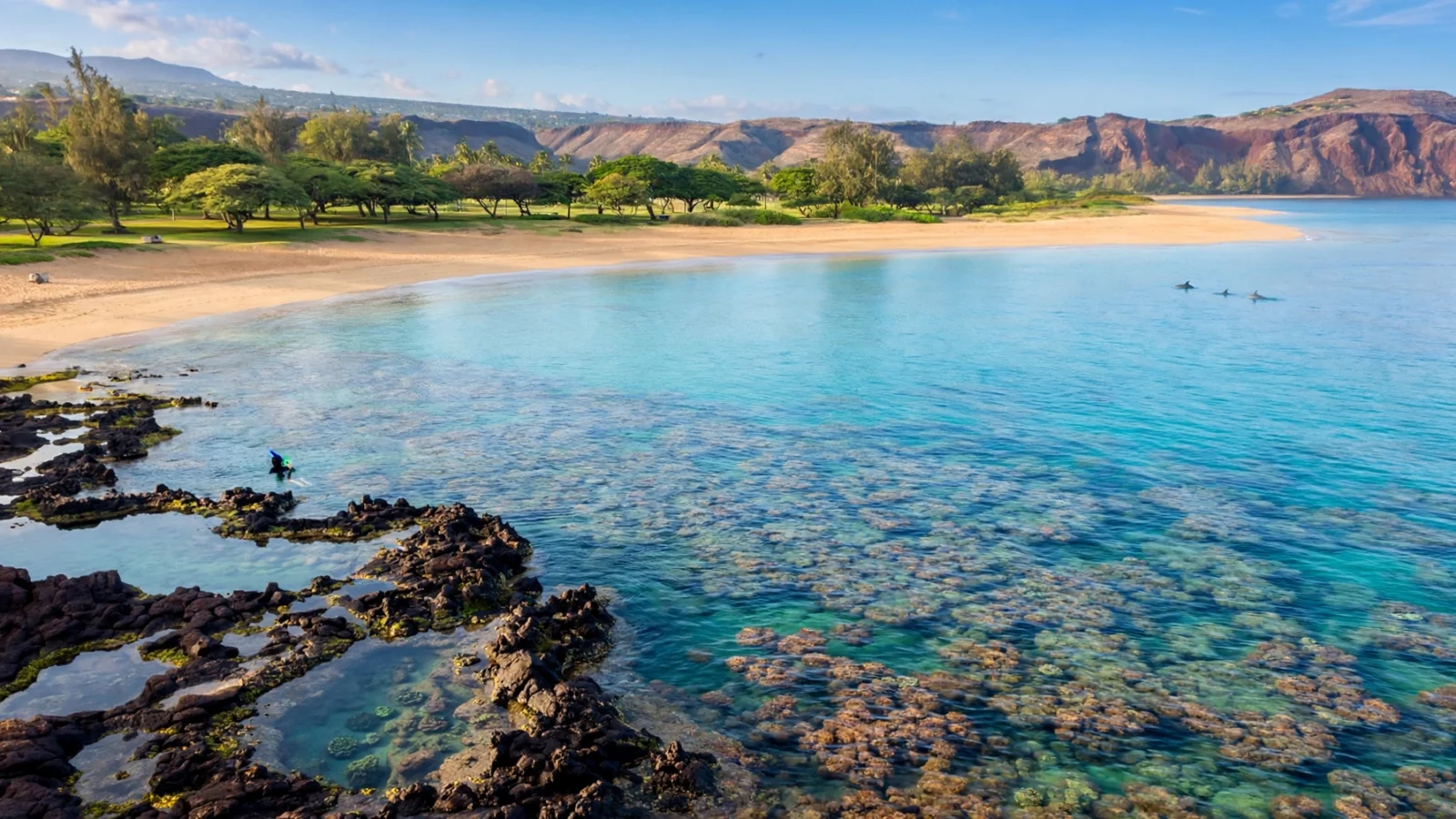
Hulopoe Beach is the snorkeling beach Hawaii keeps on its smallest inhabited island — a golden crescent on Lanai’s south coast, fronting a marine conservation district that has been protected since 1976, with tide pools at one end, a shallow reef just offshore, and spinner dolphins that cruise the bay on calm mornings. It was named America’s best beach by Dr. Beach in 1997, and it still feels like the Hawaii of an earlier decade: no resort towers on the sand, no rental stands, no crowd. What it also does not have is a lifeguard — and that single fact, which most Hulopoe pages never state at all, shapes everything about snorkeling here. This guide gives Hulopoe the full treatment no page in the current search results gives it: where in the bay the snorkeling actually is, the conservation-district rules that apply the moment you enter the water, how the Maui ferry day-trip really works, and the honest safety picture for a protected but unguarded bay.
One thing to clear up first, because the name confuses people: Hulopoe (Hulopoʻe in Hawaiian spelling) is the beach and bay; Manele is the small boat harbor in the next bay over, where the ferry from Maui arrives; and the two bays together form the Mānele-Hulopoʻe Marine Life Conservation District. Boats — including the snorkel tours that cross from Maui — work out of Manele. The shore snorkeling is at Hulopoe. When a tour page says “Lanai snorkeling,” it usually means a boat anchored off this coast; when this guide says it, it means walking in off this sand, which is a different and — on a calm morning — better experience. Our guide to the best Hawaiian island for snorkeling has listed Hulopoe among Hawaii’s finest bays for a long time. It finally gets its own page. For the rest of your time on the island, see our guide to Things to Do in Lanai.
Quick facts
- Location: Hulopoe Beach Park, on Manele Road on Lanai’s south coast — about 8 miles south of Lanai City, next to Manele Harbor
- The snorkeling, honestly: A shallow protected reef (guides put it at roughly 6–22 feet) just offshore, best along the left/eastern side of the bay, plus large volcanic tide pools at the left point. The middle of the bay is sand
- Protection: The bay is inside the Mānele-Hulopoʻe Marine Life Conservation District (established 1976, 309 acres). Taking or injuring marine life is prohibited, and so is taking or altering sand, coral or rock
- Lifeguard: None. No lifeguard is present at this beach — every conditions judgement is yours
- Facilities: Restrooms, showers, picnic tables and barbecue grills at the beach park; the park is open to the public
- Fees and reservations: No beach entrance fee, no parking fee and no reservation for snorkeling — the cost of a Hulopoe day is getting to Lanai (ferry or flight), not entering the water
- Getting there: Most visitors day-trip from Maui: the ferry from Lahaina crosses to Manele Harbor in about 45 minutes, and Hulopoe is a 10–15 minute walk from the harbor. From Lanai City, drive south on Manele Road; parking is available at the bay
- Best time: Mornings, before wind and boat wake build. The sources disagree about the best season (see below) — the honest answer is year-round with a surf-forecast check first
- The one rule that matters: Protected water is not supervised water. No lifeguard, open-ocean swells in southern storms, and a 10–15 minute walk from the harbor — snorkel with a partner and pick your morning
Where Hulopoe sits: Lanai’s south coast
Lanai is the small island you can see from Maui’s west shore — across the channel from Lahaina, close enough that its cliffs fill the sunset view from Kapalua and Honolua. Almost everything on Lanai happens in one small upland town, Lanai City, and almost every visitor who comes for the water ends up on the south coast, where Manele Harbor and Hulopoe Bay sit side by side at the end of Manele Road, about eight miles from town.
The beach itself is a wide, clean crescent of pale sand curving around a bay that deepens gently and then shelves to reef. Behind it is a proper county-style beach park — grass, shade trees, picnic tables, grills, restrooms and showers — and above the east end of the bay sits the Four Seasons resort on the bluff, present but not on the sand. To the left (the eastern side as you face the water) the shoreline turns to volcanic rock and the bay’s famous tide pools. Out in the bay, most mornings, is the other thing Hulopoe is known for: a pod of spinner dolphins that rests and socialises in these waters, their dorsal fins rolling through the bay while snorkelers are still rinsing their masks. In winter, humpback whales pass along this coast as well.
Hulopoe feels remote, and by Oahu or Maui standards it is — but it is remote in the managed way of a protected park, not the wild way of an unguarded north-shore beach. The reef is the reason. This whole bay has been a conservation district for nearly fifty years, which is why the fish here behave the way fish behave where nobody has been allowed to take them: they stay.
Getting there: the ferry day-trip, and the drive from Lanai City
From Maui (the way most snorkelers come). Passenger ferries cross from Lahaina Harbor to Manele Harbor on Lanai — a crossing of roughly 45 minutes that is itself one of the great cheap boat rides in Hawaii, with Molokai and Kahoolawe on the horizon and, in winter, whales on the route. Ferry schedules and prices change, and no price is quoted in this guide deliberately: check the current timetable before you build a day around it, and book the crossing you need rather than assuming walk-up space on a busy morning. From Manele Harbor, Hulopoe Beach is a 10–15 minute walk — out of the harbor, along the road toward the beach park. Do not snorkel in the harbor bay itself: boat traffic is common in Manele Bay (the state conservation page says so plainly), the harbor is a working boat basin, and the snorkeling beach is the next bay along for a reason.
Staying on Lanai. If you are based on the island, the drive is simple: south from Lanai City on Manele Road to the end of the coast road, about eight miles. The state notes parking is available at both Manele and Hulopoe bays. There is no entrance fee for the beach park and no reservation system for the beach — Hulopoe is not Hanauma Bay; you arrive, you park, you walk in.
Boat tours. A fleet of Maui-based catamarans also crosses to this coast — the tours typically snorkel boat-only reefs off Lanai or in the conservation district’s permitted areas, land or anchor near Hulopoe, and sell the island as the quiet alternative to Molokini Crater. (One long-standing local arrangement worth knowing: the best-known operator states it does not run its Lanai beach trips on weekends and public holidays, under a 1973 agreement to leave the beach to local residents — which makes weekday mornings the calmest window of all for everyone.) The tours-versus-DIY table below helps you choose; the short version is that Hulopoe is one of the few famous Hawaii snorkels where the shore version rivals the boat version, because the reef starts at the sand.
The snorkeling: a protected reef that starts at the shoreline
The Mānele-Hulopoʻe Marine Life Conservation District covers 309 acres across the two bays, established in 1976 under Hawaii Administrative Rules chapter 13-30, and divided into two subzones with vessel restrictions in Subzone A. For a snorkeler, the legal part is simple and strict: taking or injuring marine life is prohibited (the state’s narrow exceptions are for shoreline pole-and-line fishing under the rules, not for anything a snorkeler does), and taking, altering or damaging sand, coral, rock and other geological features is prohibited too. In plain terms: look, photograph, float — touch nothing, take nothing, feed nothing. That half-century of protection is the whole product here. Reef fish that would scatter at a fished beach hold their ground at Hulopoe, and the bay’s structure — shallow reef close in, deepening gradually — means beginners and photographers get conservation-district life without a boat, a deep entry or a long swim.
Where in the bay? The guides agree on the shape of the answer, if not every compass point. The state’s aquatic resources page describes Hulopoe’s offer exactly: large tide pools at the bay’s left point, and a shallow reef just offshore with excellent snorkeling. The tour guides describe the reef at roughly 6–22 feet of water. Work it like this:
- The left / eastern side, along the rocks toward the tide pools, is the primary snorkel: reef structure close to shore, the bay’s best fish density, and the point where the sand gives way to coral and rock. Enter from the sand at the edge of the reef rather than climbing over the rock itself — the volcanic shoreline is sharp, urchin-held and exactly where any surge concentrates.
- The centre of the bay is sand — beautiful for a swim, mostly empty for a snorkeler. Cross it if you are moving between zones; do not spend your morning hovering over it expecting a show.
- The tide pools at the left point are a snorkeling-adjacent joy of their own: big volcanic pools holding hermit crabs, sea stars, ʻopihi (limpets) and small fish, best explored on a low, calm tide, on foot, with reef shoes — and with the same conservation rules as the bay, because the pools are inside the district too. For children and non-swimmers, a careful tide-pool hour at Hulopoe is honestly one of the finest marine-life experiences on Lanai.
- The right / western side toward the harbor headland gets less guide attention and sits closer to the Manele boat traffic picture; treat the harbor side as a boundary, not a destination, and never drift toward the harbor channel.
Depth and visibility deserve honest handling. Guide consensus puts the reef at about 6–22 feet — shallow enough for easy surface snorkeling and freediving to the sand patches. Visibility claims in the existing guides range from 80 feet to well over 100; both figures describe the best mornings anyone remembers, not a promise, and this guide will not print a number as fact. What is fair to say: a protected, undeveloped, south-coast bay with no stream runoff in dry weather is clear by Hawaii standards on most calm mornings, and murky after the southern storms the safety section covers. Judge the water you can see from the sand, the way you would at any beach in our shore snorkeling guide.
What you will see
The cast list the tour guides publish for this reef is a greatest-hits of Hawaiian reef life, and the protection is why it is credible: parrotfish grazing the coral, schools of convict tangs, saddle wrasses, goatfish working the sand edges, yellow tangs, pencil sea urchins in the crevices, peacock groupers, whitemouth morays in the rockwork, and Hawaii’s state fish, the humuhumunukunukuapuaʻa, patrolling its territory. Green sea turtles cruise Lanai’s south coast and a turtle over a protected reef is a realistic hope rather than a scheduled event — give it the full legal distance and let it choose the encounter, as our snorkeling with turtles guide sets out.
And then there are the dolphins. Spinner dolphins use Hulopoe Bay the way they use a handful of sheltered Hawaiian bays: resting and socialising in the calm water, often in the morning, sometimes while snorkelers are in the water nearby. The rule is federal and simple — do not chase, approach or swim at resting spinner dolphins; Hawaii’s spinners are protected, approaching them closely is prohibited, and the encounter, if it comes, must be entirely on the dolphins’ terms and at distance. Watching a pod roll through the bay from the sand with a coffee in your hand is, for most visitors, the Hulopoe moment they actually remember. In winter the bay adds humpback whales offshore — a shore and boat sight, not a snorkeling one.
Best time: the season argument, settled honestly
Hulopoe is where this site has to overrule the guidebook habit of crowning a season, because the sources flatly contradict each other. The official destination guide says summer is prime and warns that winter brings surf and current. One of the long-running tour operators says the opposite: winter offers the calmest, clearest water, and large surf is most common in summer. The longest blog guide on the page contradicts itself between sections. All three cannot be right, and the truthful synthesis is the one the state’s own safety wording supports: this is a south-facing bay, and south-facing bays in Hawaii take their dangerous swell from southern and kona storms rather than from the winter north swells that close the north shores — which is why Hulopoe is snorkelable across far more of the year than, say, Kauai’s north shore, and also why its bad days arrive on a storm forecast rather than a calendar page.
So the working advice is: year-round, mornings first, forecast always. The calmest, clearest version of Hulopoe is an early morning on a day with no southern swell running — whatever month that falls in. By late morning the wind, the boat wake near the harbor side and the day’s own chop build. If you are ferrying over for the day, take an early crossing, walk straight to the beach, and snorkel the first hours; save the tide pools, the Puʻu Pehe hike and the long beach-park lunch for the afternoon. Our best time to snorkel in Hawaii guide covers the island-wide patterns this bay bends.
Safety: protected water, no lifeguard
Say it the way the official guide says it, because the competitor pages mostly don’t say it at all: no lifeguards are present at this beach. Hulopoe’s calm reputation is real — a sheltered-feeling bay, a shallow reef, a resort on the bluff — and it is still an unguarded open-ocean beach on a remote island, where help is a walk, a drive and possibly a ferry ride away. Keep the safety picture in proportion:
- The state’s warning: all areas of this coast can have dangerous swells and currents during southern (kona) storms. If the bay is churned, brown or pushing whitewater over the reef, the snorkel is off — conservation districts do not calm the ocean, they only protect what lives in it.
- Surge at the points: the tide-pool side is where the rock is, and rock plus any swell means surge. On a day with visible movement around the point, snorkel the reef flat inside the bay and leave the point alone.
- Boat traffic belongs to Manele. Snorkel in Hulopoe Bay; never in or near the harbor channel, and stay alert anywhere near the bay mouth — everything in our Hawaii snorkeling safety guide about boat awareness applies double next to a working harbor.
- No lifeguard means self-rescue fitness: a partner in the water with you, an honest read of your own swimming before you cross a channel to get here, and a turnaround point set before you start. If your group includes first-time snorkelers, Hulopoe’s shallow reef edge on a glassy morning is a genuinely good classroom — our beginners’ guide covers the skills — but a windy or surging morning here is nobody’s first lesson.
- Sun and salt: Lanai’s south coast is dry and hot, the park’s shade is at the tables rather than over the water, and Hawaii law requires reef-safe sunscreen — doubly non-negotiable inside a conservation district. Pack the full kit from our snorkel gear checklist; there is no rental stand on this beach to rescue a forgotten mask.
Facilities, food and camping
The beach park is one of Hulopoe’s quiet luxuries: restrooms and showers (the state confirms facilities at both bays), picnic tables and barbecue grills under the trees, and a park that is open to the public — this is a community beach park that a famous resort happens to overlook, not a resort beach that tolerates the public. What the official listings do not include is any food concession at the beach itself, and one of the only questions searchers ask about Hulopoe is whether you can buy food there: plan on the answer being to bring your own. Lanai City, eight miles up the road, is the supply run; ferry day-trippers should carry food and more water than seems necessary, because the walk back to the harbor at the end of a hot day is not the moment to discover the island’s shops keep island hours.
Camping is the other facility almost nobody covers: you can camp at Hulopoe Beach Park, by permit. Published permit fees in the existing guides contradict each other wildly — three sources give three different prices, and the only official permit document we could verify is years old — so this guide prints no price and points you at the permit process itself: arrange the permit before you travel, through the beach park’s managing authority, and confirm the current fee and rules on that paperwork rather than on any blog, this one included. A permitted night at Hulopoe — the dolphins at dawn, the bay to yourself before the first ferry — is one of the great legal camps in Hawaii, and it deserves accurate paperwork rather than a guessed number.
Tours or DIY? The Hulopoe choice
| DIY shore snorkeling | Maui boat tour | |
|---|---|---|
| The water | The Hulopoe reef itself, from the sand — left/eastern side and tide pools | Boat reefs off Lanai’s coast and/or the Hulopoe area, operator’s choice of the day |
| The day’s shape | Ferry ~45 min each way + 10–15 min walk; your schedule, your pace, beach park for lunch | Hotel pickup, a full hosted day, snorkel gear and meals usually included |
| Best for | Confident shore snorkelers; photographers; anyone who wants the park, tide pools and Puʻu Pehe too | Non-drivers and first-timers; anyone who wants gear, guidance and a second reef |
| The trade-off | No guide, no lifeguard, no rental stand — your judgement carries the day | Cost and a fixed timetable; the best-known operator leaves weekends/holidays to local residents |
And the comparison the forums argue about — Hulopoe or Honolua Bay on Maui, both conservation districts? Honolua is the bigger reef system with the easier logistics (a drive, not a ferry). Hulopoe is the quieter, more complete day: park, tide pools, dolphins, a hike and a beach that still feels like a secret the ferries let out a few times a day. If your trip already includes a Lanai day, Hulopoe is the snorkel. If it doesn’t, Honolua is not a consolation prize — it is a different, equally protected bay an hour from your Maui hotel.
Beyond the reef: Puʻu Pehe and Manele
Leave an hour of the day dry. Southeast of the tide pools, a trail climbs the cliff to Puʻu Pehe — Sweetheart Rock — a roughly 15–20 minute hike to an ~80-foot summit between Hulopoe and Manele bays, with the love-story legend every guide retells and a view back over the whole crescent that explains the Dr. Beach award better than any paragraph. The state adds a warning that belongs in bold in every version of this story: access down to Puʻu Pehe Cove itself is dangerous — steep cliffs and loose lava — so the hike is to the viewpoint, never a scramble down to the water. Photograph the cove; snorkel the bay you came for.
Manele Bay, the harbor side, is worth the walk over in its own right: watch the boats, look back at Hulopoe from the harbor mole, and — if the day is a splurge — the resort and its restaurants sit on the bluff between the two bays. Lanai City, with Dole Park at its centre, is the island’s other half-day: plantation-era streets, local shops and the island’s small-town present tense. A Hulopoe day that ends with an hour in Lanai City is the day the tour brochures can’t sell you, because most of it isn’t a product.
Frequently asked questions
Can you snorkel at Hulopoe Beach?
Yes — from the shore, inside a marine conservation district, over a shallow reef just offshore. The best water is along the left/eastern side of the bay toward the tide pools; the centre of the bay is sand. Enter from the sand at the reef’s edge, never by climbing over the volcanic rock at the point.
Is Hulopoe Beach good for snorkeling?
It is one of Hawaii’s best shore snorkels on a calm morning — protected since 1976, so the fish are abundant and unafraid, the reef is shallow (guides say roughly 6–22 feet) and the tide pools add a second experience at the same beach. Its honest limits: no lifeguard, no rentals, and bad days during southern storms when the state warns of dangerous swells and currents.
Is there a lifeguard at Hulopoe Beach?
No. Officially and plainly: no lifeguards are present at this beach. It is a protected bay, not a supervised one — snorkel with a partner, judge the conditions yourself, and keep beginners to the shallow reef edge on calm mornings only.
Does it cost anything to snorkel at Hulopoe?
The beach itself is free: no entrance fee, no parking fee and no reservation for snorkeling at Hulopoe Beach Park. Your costs are getting to Lanai — the Maui ferry or a flight — plus any gear or tour you choose. Camping in the park is by permit, arranged in advance; confirm the current permit fee on the official paperwork, as published prices in older guides contradict each other.
How do you get to Hulopoe Beach from Maui?
Take the passenger ferry from Lahaina to Manele Harbor (about 45 minutes), then walk 10–15 minutes from the harbor to the beach park. Check the current ferry timetable and fares before you go — they change, and the snorkeling is best early, so aim for a morning crossing. Do not snorkel in Manele Harbor itself; boat traffic is common there.
What are the rules in the Mānele-Hulopoʻe Marine Life Conservation District?
The district (established 1976, 309 acres, under Hawaii Administrative Rules 13-30) prohibits taking or injuring marine life and taking or altering sand, coral, rock or other geological features, with vessel restrictions in one subzone. For snorkelers: look and photograph only, touch nothing, feed nothing — and keep the federally required distance from spinner dolphins and turtles.
Can you see dolphins at Hulopoe Beach?
Often, yes — spinner dolphins rest and socialise in the bay, most often in the mornings, and humpback whales pass offshore in winter. Watch dolphins from a distance and never chase or swim at a resting pod: approaching Hawaii’s spinner dolphins closely is prohibited, and any close encounter has to be the dolphins’ own choice.
Can you camp at Hulopoe Beach?
Yes, by permit, at the beach park — one of the few legal beach camps beside a top-tier snorkel in Hawaii. Arrange the permit before travelling and confirm the current fee and rules on the official permit paperwork; the prices quoted across older guides contradict each other and none could be verified as current.
The verdict
Hulopoe is the snorkel Hawaii’s crowds forgot to find: a conservation-district reef fifty years into its protection, starting at the sand of the beach Dr. Beach once called America’s best, with tide pools at one end, dolphins in the middle distance and a cliff hike for the dry hour. Its price is logistics — a ferry, a walk, your own gear, your own judgement in unguarded water — and for a confident snorkeler that price buys the quietest famous snorkel in the state. Come on a weekday morning, snorkel the left side early, work the tide pools as the tide drops, and let the last ferry decide when the day ends. Our Maui hub covers the coast you sailed from, and the best Hawaiian island for snorkeling guide explains where Lanai’s one great bay fits in the state-wide picture.