- Where
- Ali’i Drive, Kona — a short drive south of Kailua-Kona town
- Cost
- Beach entry free · parking reportedly paid for non-residents — check signs on arrival
- Difficulty
- Beginner — shallow, protected, lifeguard posted on many days
- Turtles
- Very likely — grazing the rocks or basking nearby
- Facilities
- Restrooms, showers, picnic tables, covered pavilion, rentals nearby
- Best time
- Early morning — for parking and for glassy water
Why Kahalu’u is where beginners learn
Most great snorkel spots ask something of you first: a rocky scramble, a long swim out, or the nerve to enter deep water straight off a lava shelf. Kahalu’u Beach Park asks for almost none of that. The bay sits inside the remains of an old breakwater wall, built in ancient times to create a protected fishpond-like lagoon, and that wall still does its job today. It blunts the open-ocean swell before it reaches the shore, so the water inside stays shallow, sandy in patches and noticeably calmer than the coast on either side. For a first-timer, that changes everything. You can stand, adjust a leaking mask, put your face back down and try again, all without being pushed around by waves.
It also helps that the fish here are unusually relaxed. Kahalu’u is one of the most visited snorkel sites on the Big Island, and the reef community has had decades to get used to people floating above it. Reef fish that would dart for cover at a quieter site often keep feeding here while you watch from a respectful distance. Add restrooms, showers, shade, picnic tables and a town full of rental shops a few minutes north in Kailua-Kona, and you have the most forgiving place on the island to find out whether you like snorkeling at all. If you are building a first trip, pair this page with our beginner snorkeling guide for Hawaii — Kahalu’u is the Big Island stop we usually suggest first.
What you will see underwater
Expect a classic Kona reef in miniature, compressed into water you can mostly stand up in. Bright yellow tangs work the rocks in loose groups. Butterflyfish pick their way along the coral heads in pairs, parrotfish scrape algae off the reef with an audible crunch on calm mornings, and boxfish, goatfish and wrasses busy themselves in the sandy gaps between the rocks. Moray eels are sometimes spotted tucked into crevices, so look into the shadows before you put a hand down — though you should never put a hand on the reef at all. Further out, toward the opening in the breakwater, the bottom drops away a little, the coral cover improves and the fish life gets busier and less tame.
Visibility is the variable that decides whether a session here is good or unforgettable. On a still morning after several flat days, the water over the inner reef can be remarkably clear for such a shallow, sandy bay. After south swell, heavy rain or a busy weekend of stirred-up sand, it can turn milky inside the wall even while the outer reef stays clearer. That is not a reason to skip the day — the turtles and the tame fish are still there — but it is a reason to go early, before fins and feet have churned the shallows, and to move slowly. The slower you kick, the less sand you lift, and the more the reef settles around you. Kahalu’u is also a good place to practise the core skill behind every shore snorkeling site in Hawaii: reading where the sand channels run between the rocks, because those channels are both your safest entry and the corridors the fish use themselves.
Reading the bay: where to enter and where to swim
Walk the shoreline before you get wet. The easiest entries are the sandy patches toward the middle and southern side of the little beach, where you can wade in over sand, sit down in knee-deep water to pull your fins on, and push off without ever standing on coral or rock. Entering over the dark, uneven lava rock at the edges is how ankles get twisted and reefs get damaged, so if the bottom under you looks black, rough and alive, move along until it looks pale and sandy again. Water shoes or reef walkers help on the mixed patches, but they are not a licence to stand on coral — stand only on sand.
Once you are floating, think of the bay in three bands. The inner band, inside the breakwater and close to shore, is beginner water: shallow, sheltered and full of grazing fish and turtles. The middle band, around the broken sections of wall, holds the best mix of coral and fish and is still comfortable for confident beginners on a calm day. The outer band, beyond the opening, is a different place — deeper, livelier and exposed to ocean current, particularly near the mouth of the bay when surf is running. Local guidance and the original reporting behind this guide agree on the same warning: an outbound pull can develop near the opening on bigger-surf days. Stay inside the protected zone unless conditions are clearly calm and a lifeguard on duty says otherwise, and you will never need to think about it. At low tide, save ten minutes for the exposed rocks at the edges of the bay, where small tide pools trap hermit crabs, sea stars and little fish until the water returns — look, photograph, but leave everything exactly where it sits.
The turtles of Kahalu’u
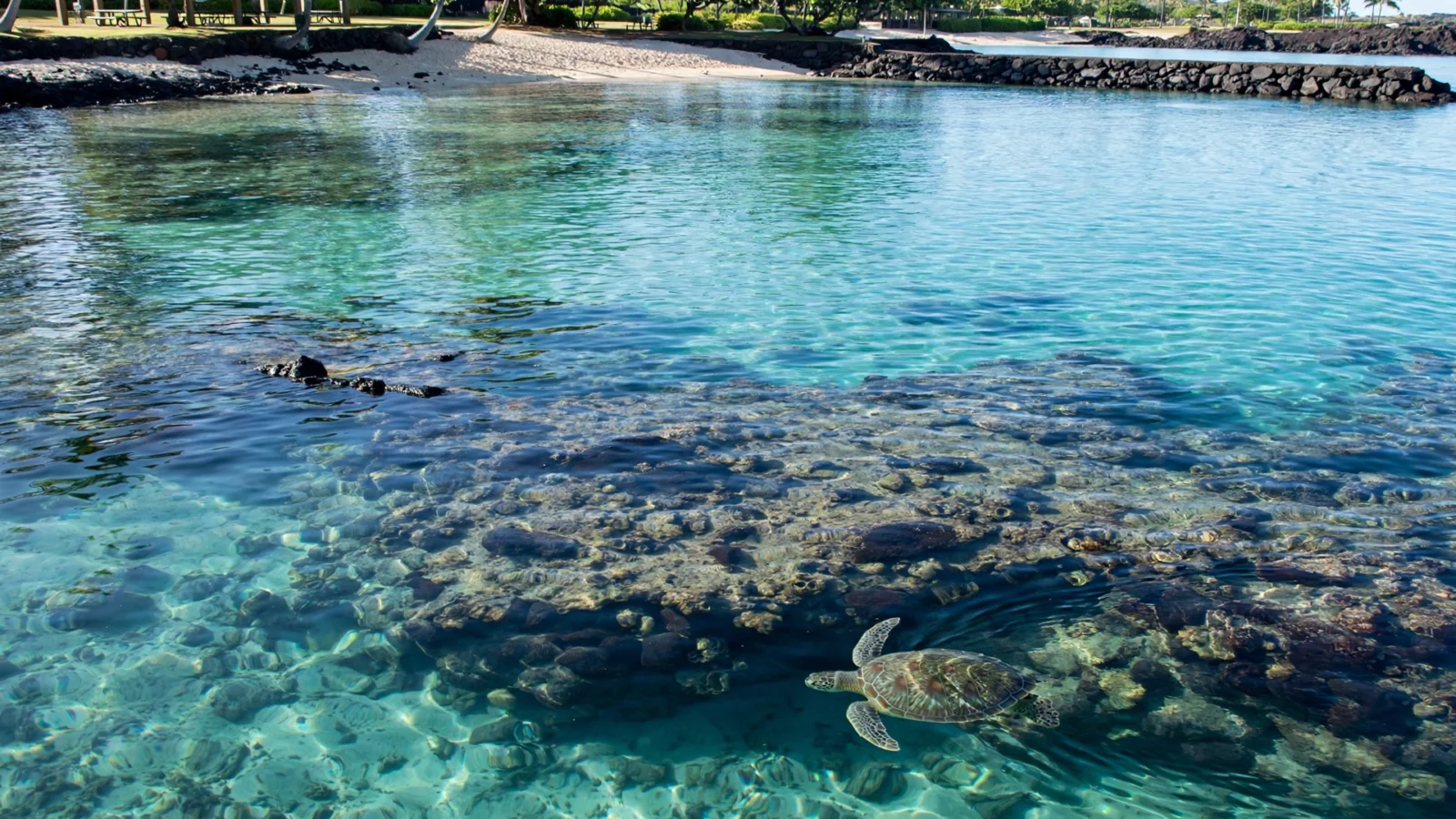
Green sea turtles — honu — are the reason many people come, and Kahalu’u rarely disappoints. Turtles graze the algae on the shallow rocks here on most days and sometimes haul out onto the sand or rocks to rest in the sun. Encounters feel close because the bay is small and the turtles are habituated, which is exactly why the rules matter more here, not less. Keep at least 10 feet (about two body lengths) between you and any turtle, in the water and on land. Never touch, chase, feed or block the path of a turtle, and if one swims toward you, hold your position calmly and let it choose the distance. These are protected animals under state and federal law, and touching or harassing one can bring serious fines.
Reef-education volunteers are often stationed at the park to talk visitors through exactly this etiquette, and they are worth your time before you swim — they can usually tell you where turtles have been resting that morning and which parts of the reef are fragile right now. For the wider picture on finding turtles responsibly across the islands, see our guide to snorkeling with turtles in Hawaii. The short version applies perfectly here: the best turtle encounter is the one where the turtle never had to change its behaviour because of you.
Best time to snorkel Kahalu’u
Morning wins on every count. The lot is at its emptiest, the wind has usually not yet picked up, the surface is at its glassiest and the sand stirred up by yesterday’s crowd has settled overnight. Arriving around opening time — listings for the park commonly show a 7 a.m. opening, but check current county information before you set an alarm around it — or at least before 9 a.m. gives you the clearest water of the day and a realistic chance of parking inside the park rather than hunting along Ali’i Drive. By late morning on a sunny weekend, both the lot and the inner bay can feel busy, and afternoon trade winds often roughen the surface even inside the wall.
Season matters less here than at exposed Kona sites, because the breakwater works all year, but winter can still bring larger northwest swells that wrap into the Kona coast and make the bay mouth lively, while summer and early autumn tend to deliver the longest runs of flat, clear mornings. Tide makes a smaller difference: very low tides expose more rock and shrink the comfortable swimming area, while a mid-rising tide usually gives beginners the nicest depth over the inner reef. Our statewide guide to the best time to snorkel in Hawaii explains how to read swell, wind and tide forecasts before any beach day — spend two minutes with it the night before and you will rarely be surprised.
Parking, fees, hours and facilities
Beach entry itself is free, and in the sources checked for this October 2026 update Kahalu’u had no reservation requirement — you simply arrive. Parking is where the picture has changed and where sources disagree, so treat this carefully. Older guides, and this page until now, described parking as simply free. Recent local reporting and visitor reviews describe paid parking for non-residents in the park lot, with one detailed local guide listing $12 for four hours (7 a.m. to 7 p.m.) via a mobile parking app, with Hawaii residents exempt. Fees and enforcement in Hawaii county beach lots have been changing quickly, so do not budget around any single number on any website, including this one: expect that non-resident parking may be charged, read the signs in the lot on the day, and pay exactly as the signs direct. What has not changed is capacity — the lot is small, it fills by mid-morning on good days, and there is limited overflow along Ali’i Drive, where you should only park where it is clearly legal and safe.
The park itself is well equipped for a half-day visit: restrooms, outdoor showers, picnic tables, a covered pavilion, trash bins and a grassy area behind the small sandy beach. Lifeguard cover is regularly reported at Kahalu’u and a tower stands at the park, and one local guide lists daily lifeguard hours — but cover can vary with staffing and conditions, so check the tower and any posted flags or signs when you arrive and never assume a guard is on duty. There is no large cafe inside the park itself; food trucks and small shops operate nearby on Ali’i Drive on many days, and Kailua-Kona town, a short drive north, covers everything else. Bring water — the Kona sun reflects hard off the pale sand and the lava, and most ruined snorkel mornings here are really just dehydration.
Gear rental and what to bring
Rental stands operate near the park on many days and the full-service snorkel shops of Kailua-Kona rent mask, snorkel and fin sets by the day or week, which almost always works out cheaper if you will snorkel three or more times on your trip. Prices change too often to quote responsibly here — compare two or three shops in town, check that the mask seals to your face without the strap, and ask whether a flotation belt or vest is included, because for new snorkelers at Kahalu’u a little buoyancy is a confidence trick that works. Bring mineral, reef-compliant sunscreen (Hawaii law restricts the sale of sunscreens containing certain chemicals that harm reefs), or better, a long-sleeve rash guard so you need far less sunscreen at all. Add a dry bag for keys, a towel for the hot car park afterwards, and, if you have them, water shoes for the mixed-sand entry.
Safety and reef etiquette
Kahalu’u is beginner-friendly, not beginner-proof. The same three hazards account for almost every bad day here: sun, surge and standing where you should not. Reapply sunscreen on land, not in the water, and cover the backs of your knees and neck — they burn first while you float face-down. If surf is up, watch the bay for a full five minutes before entering; if white water is pushing through the opening in the wall, keep your session to the innermost shallows or save snorkeling for another morning, and always respect any lifeguard instruction, flag or closure sign over anything written on a website. Never turn your back on the ocean while wading in or out over the sand channels, and exit the same sandy way you entered.
Etiquette is safety for the reef. Do not stand on, kick or touch coral — a single fin strike can break years of growth and cuts from coral infect easily. Do not feed fish, do not chase turtles for a photo, and keep fins up and slow in the very shallow water over the rocks. If you are not a strong swimmer, wear flotation, stay where you can stand, snorkel with a buddy, and tell someone on shore where you are going. None of this is special to Kahalu’u — it is the standard code for the Kona coast — but this little bay, with its education volunteers and its tame wildlife, is the best classroom on the island for learning it.
Beginners and kids: the honest verdict
For beginners: yes, start here. There is no Big Island shore site that combines sheltered entry, standing depth, facilities and reliable marine life as completely as Kahalu’u, and a nervous first-timer who succeeds here will usually go on to enjoy harder sites all week. For kids: yes, with supervision and inside the breakwater. Children who can swim can manage the inner bay comfortably on a calm morning, and the tide pools give non-swimming younger kids a genuine reef experience without getting their faces wet. The honest caveats are crowding and sun, not danger: at midday in peak season the inner bay can feel like a swimming class, and small children tire and burn fast in Kona heat. Go early, keep sessions short, and treat the afternoon as pool or beach time. If your family graduates quickly, the natural next steps are Two Step at Honaunau, with clearer water and a slightly trickier rock entry, and a boat trip to Kealakekua Bay and the Captain Cook Monument, where the reef drops into the deep, fish-filled water most people picture when they dream about Hawaii.
Kahalu’u or somewhere else? Nearby Big Island spots
Kahalu’u is the learning bay, not the whole story of Kona snorkeling. Two Step, about a 35–40 minute drive south, offers better visibility and a bigger reef, but its entry is off a lava bench and suits confident beginners and intermediates. Kealakekua Bay, best reached by boat, kayak permit or a hot hike, is the island’s marine-life showpiece and the right upgrade once Kahalu’u feels easy. After dark, the famous manta ray night snorkel off the Kona coast runs from harbours north of town and makes a perfect same-trip pairing — turtles by morning, mantas by night. On the island’s east side, the sheltered coves covered in our Hilo snorkeling guide (including Richardson and Carlsmith beach parks) offer a greener, quieter alternative when you are based in Hilo. And if your trip also includes Oahu, the obvious comparison is Hanauma Bay: a grander, more regulated preserve with a reservation system and entry fee, where Kahalu’u is its free, spontaneous, turtle-rich Big Island cousin. Booking a guided trip instead? Compare options in our Hawaii snorkeling tours guide before you pay for water you could walk into for free here.
A simple Kahalu’u half-day plan
Arrive soon after the park opens and park while the lot is still honest. Walk the shore, find your sand channel, and listen to any reef-education volunteer on duty. Snorkel the inner bay first while it is clearest, rest in the shade with water, then take a second, slower session around the middle of the bay if conditions allow. Shower, change, and be eating lunch in Kailua-Kona by the time the midday crowd is fighting for your parking space. That is the whole secret of Kahalu’u: it rewards the early and the unhurried, and it has been teaching Hawaii visitors to snorkel, one calm morning at a time, for generations.
Field reports we drew from
- Expedia’s Big Island guide — amenities, tide pool life and the beginner framing.
- The Hawaii Vacation Guide — island-wide context for where Kahalu’u fits.
- Hawaii County Parks & Recreation and recent local guides — facilities and the changing non-resident parking picture; check signs on the day.
- Wildlife rules: NOAA Fisheries viewing guidelines (10-ft turtle rule).
FAQ
Is Kahalu’u Beach Park good for snorkeling?
Yes — it is one of the best beginner snorkel sites in Hawaii. The sheltered bay inside the old breakwater holds shallow, calm water, tame reef fish and frequent turtle sightings, with restrooms, showers and rental options nearby. Experienced snorkelers may find the inner bay small, but the middle and outer sections still reward a visit on a calm morning.
Is Kahalu’u good for kids?
One of the best in Hawaii: standing-depth water, sand-channel entries, restrooms and, on many days, a lifeguard. Keep kids inside the breakwater, supervise constantly, go early before crowds and sun peak, and use the low-tide pools as a bonus for younger children.
Do you need reservations for Kahalu’u Beach Park?
No reservation system was in place in the sources checked for October 2026 — unlike Hanauma Bay on Oahu, Kahalu’u is a county beach park you simply arrive at. Rules in Hawaii change, so check Hawaii County Parks information before you travel, and expect the small parking lot, not a booking system, to be your real limit.
How much does parking cost at Kahalu’u?
This is changing and sources disagree. Beach entry is free, but recent local reporting describes paid parking for non-residents — one detailed guide lists $12 for four hours via a mobile app, with residents exempt — while older guides still say free. Budget for paid non-resident parking, read the lot signs on arrival, and pay as directed.
What is the best time of day to snorkel Kahalu’u?
Early morning, ideally soon after the park opens and before 9 a.m. You get the emptiest lot, the calmest surface, the clearest water before fins stir the sand, and the best chance of quiet time with grazing turtles. Afternoons work on calm days but are windier and busier.
Will you see turtles at Kahalu’u?
Very likely, but never guaranteed. Green sea turtles graze the shallow rocks here on most days and sometimes rest on shore. Keep at least 10 feet away in water and on land, never touch or chase one, and let the turtle decide how close your encounter gets.
Can you swim at Kahalu’u Beach Park, or is it only for snorkeling?
You can swim — the inner bay is a popular, shallow swimming area as well as a snorkel site. Stay inside the breakwater if you are not a strong swimmer, watch for surge near the bay opening on bigger-surf days, and follow any lifeguard instructions or posted signs.
Kahalu’u or Two Step — which should you choose?
Kahalu’u for learning, families and a relaxed first session: easier sand entry, more shelter and full facilities. Two Step for clearer water and a larger reef once you are confident, accepting a rockier entry off a lava bench. Many Kona visitors do Kahalu’u first, then graduate to Two Step later in the same trip.
Keauhou is the next bay south of Kahalu’u, and it now has a dedicated guide of its own: our Keauhou Bay snorkeling guide covers its calm, resort-front water, the best entry points and the manta viewing that brings the boats back after dark.