- Access
- Boat only — no landing, no beach, no shore entry
- Cost
- Varies by boat and season; about $90–$310 per adult across the boats we checked in November 2026, most full trips $150–$270 — confirm at booking
- Difficulty
- Beginner–intermediate; deep water, but crews usually provide flotation and in-water support
- Best time
- Earliest morning departure, year-round; wind usually builds later
- Protection
- Molokini Shoal Marine Life Conservation District — look, do not take or feed
What Molokini actually is
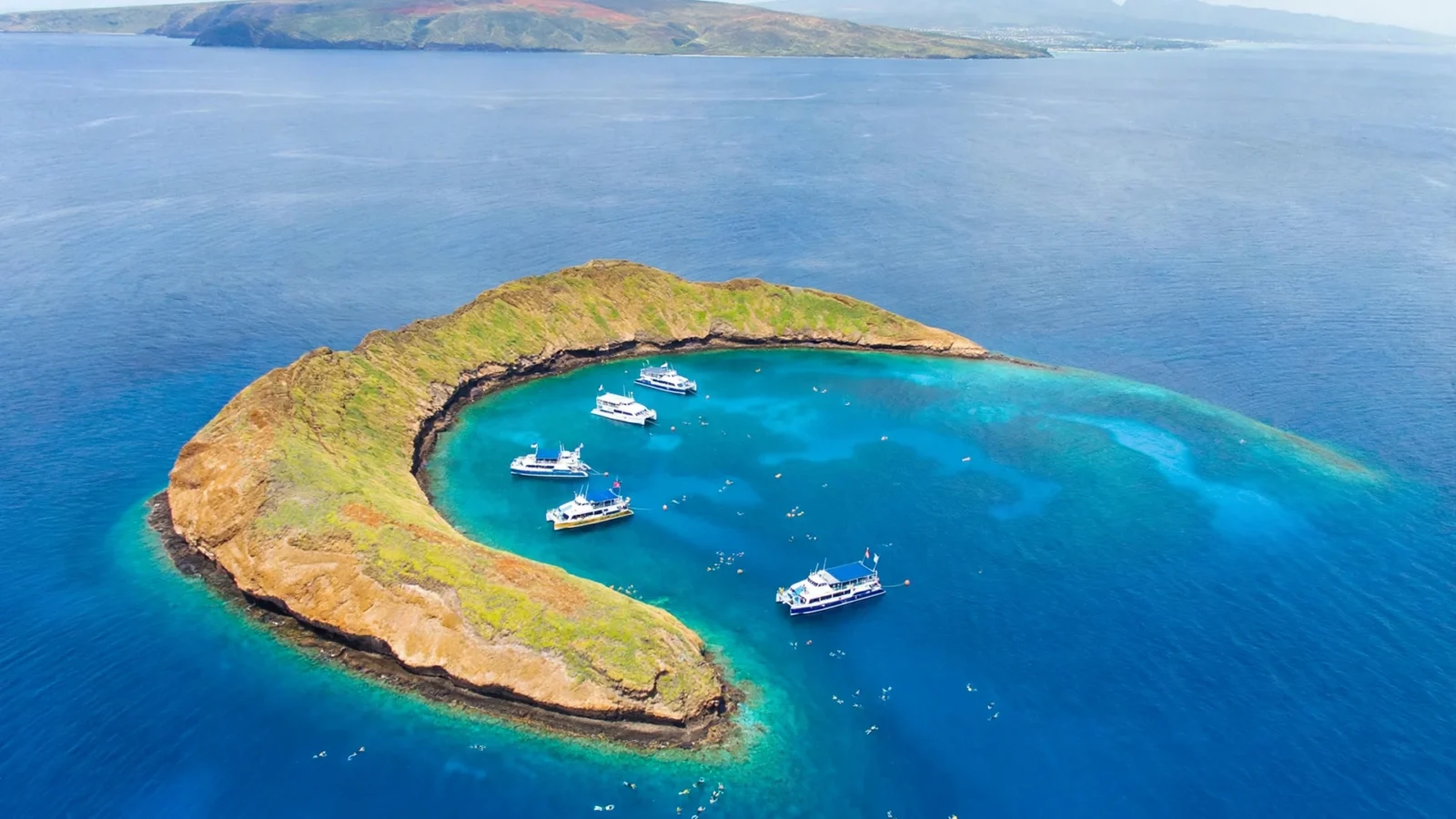
Molokini is the curved, exposed rim of a largely submerged volcanic crater, sitting roughly three miles off Maui’s south shore in the channel between Maui and Kaho’olawe. From a boat it looks almost too neat to be natural: a low crescent of dark rock enclosing a bowl of strikingly blue water, with open ocean on the other side. That shape is the whole reason the snorkeling works. The crescent shelters the inner reef from much of the swell, and because there is no stream or beach runoff flowing into the crater, the water is not clouded the way a shore reef can be after rain.
Operators and reviewers consistently describe visibility inside the crater that can exceed 100 feet on a good morning, and around 250 fish species are often cited for the reef. Treat both numbers as a description of Molokini at its best, not a promise for a particular day. Wind, swell and recent weather still matter here — they just tend to matter less, and recover faster, than they do at a beach. For the wider picture, start with our Maui snorkeling hub and the round-up of the best snorkeling in Maui.
Is Molokini Crater snorkeling worth it?
It is worth it if you want one memorable boat snorkel, you like clear water and reef fish, and you are comfortable floating in deep water with flotation. It is less worth it if your only goal is turtles, if boats make you miserable, or if your budget is tight and you have several good beach days planned. Shore spots cannot copy Molokini’s offshore clarity, but Maui has excellent free snorkeling too, and a paid boat day should earn its place in your itinerary rather than replace every beach session.
The honest comparison is this: Molokini wins on water clarity, fish density and the sense of occasion. A good shore reef wins on price, flexibility and being able to leave whenever you like. Many visitors do both — one calm beach snorkel to find their confidence, then Molokini as the headline trip.
Molokini vs Turtle Town: which one should you choose?
This is the comparison most Maui visitors are actually making, so here it is honestly — starting with the part the brochures bury: it is often not an either-or choice at all. Many morning Molokini tours stop at Turtle Town as their second snorkel on the way back, conditions permitting, and Turtle Town is also free to snorkel from shore at Maluaka Beach. So the real questions are narrower: is the crater worth paying for, and if turtles are your goal, do you need a boat at all?
| Factor | Molokini Crater | Turtle Town (Maluaka Beach) |
|---|---|---|
| Access | Boat only — about 3 miles offshore, no landing, no shore entry | Free shore entry over sand at Maluaka Beach, or a second stop on many Molokini tours |
| Cost | A paid tour — roughly $90–$310 per adult in our November 2026 checks, most full trips $150–$270 | Free from shore; you only pay for gear rental if you need it|
| Water clarity | The clearest water most visitors will ever snorkel — 100 feet or more on a good morning, because no stream or beach runoff reaches the crater | Good on a calm morning, but it is a shore reef: rain, runoff and south swell cloud it faster, and it recovers slower |
| The main event | Reef fish density and coral inside a protected crater — hundreds of fish species over hard coral | Green sea turtles at cleaning stations on the reef — the most reliable turtle snorkel on Maui |
| Turtles | Possible, but not the main event inside the crater | The whole point — a resident population, not a lucky sighting |
| Depth and entry | Deep water off a boat — you float over reef roughly 20–50 feet below, with flotation and crew support | Sandy entry, then a moderate swim of roughly 200–400 feet out to the turtle zone over deeper reef |
| Time it takes | Half a day — check-in, boat ride, two snorkels and the ride back | An hour or two at the beach, on your own schedule — be in the water early |
| Boats and seasickness | A boat ride is unavoidable; seasickness is the most common day-ruiner | No boat at all from shore |
| Supervision | Crew briefings, flotation and in-water support included | No lifeguard at Maluaka — you are your own safety cover |
Picks by traveller type
You can only afford one paid trip, and you want the clearest water: Molokini. No shore reef copies offshore clarity, and a morning tour that adds a second stop may give you Turtle Town on the same ticket anyway.
Turtles are the whole point of the trip: Turtle Town from shore, and keep your money. As our Turtle Town guide puts it: pay for the crater, not for the turtles — the boat anchors over the same reef you can swim to free from Maluaka’s south end.
Beginners and nervous swimmers: Turtle Town first, on a calm morning, in the inshore reef with flotation. Learn your mask and breathing where you can stand up, then decide whether Molokini’s deep water still appeals — for many people it does, and the beach session is what makes it enjoyable.
Families with small children: Turtle Town from shore. A sandy entry, a short session and an easy exit beat a half-day boat trip with a tired four-year-old. Older kids who swim confidently usually love a big, shaded catamaran to Molokini — shade, space and a slide matter at that age.
Tight budget, several beach days planned: Skip the boat. Turtle Town is free, and Maui’s shore reefs can fill a whole trip. Spend the tour money only if the crater itself — the clarity, the fish, the occasion — is what you are buying.
Short on time: Turtle Town. An early hour at Maluaka fits around a flight day or a packed itinerary; Molokini needs a protected half day and an early start.
Prone to seasickness: Turtle Town from shore, no contest. If you do book Molokini, take any medication before departure, as directed — starting it once the boat is rolling rarely helps.
Can you do both — and in what order?
Yes, two ways. The easy way is a morning Molokini tour with a Turtle Town second stop — but read the fine print: the second stop is always conditions permitting, and on a windy day the captain may reroute or skip it, so a combo ticket is a strong chance of turtles, not a guarantee. The flexible way is to do them on separate mornings: Maluaka from shore first (it doubles as your practice session), then Molokini once you are comfortable. That order — beach first, crater second — is the one we recommend to almost everyone, and it means a blown-out Molokini day never costs you the turtles as well.
Inside the crater, the back wall and the second stop
Not all water at Molokini is the same, and knowing the zones helps you understand what a tour is actually selling.
| Zone | What it is like | Best for |
|---|---|---|
| Inner crater | Sheltered bowl, reef below you, the main snorkel area for most tours | Almost everyone; first Molokini visit |
| Outer / back wall | Deeper, more exposed wall on the ocean side; conditions decide access | Experienced snorkelers and divers, only when the captain says conditions allow |
| Second stop | Often a coastal reef such as Turtle Town or Coral Gardens, conditions permitting | Turtles, variety, a second kind of reef |
Most visitors should plan on the inner crater and enjoy it properly rather than chasing the back wall. Captains reroute or skip a zone when wind and swell make it a poor idea, and that judgement is a feature of a good tour, not a failure of one.
What you will see under water
Expect a reef scene built around hard coral, volcanic rock and very clear light. Yellow tangs and other surgeonfish graze over the reef, butterflyfish work in pairs, parrotfish scrape at coral and rock, and triggerfish — including Hawaii’s reef triggerfish — patrol their patches. Moray eels tuck into crevices, so look into shadowed holes slowly rather than expecting every animal to be out in the open. Larger visitors appear at the edges: eagle rays sometimes glide past, and white-tip reef sharks are occasionally seen resting well below snorkelers. Neither should be chased or crowded.
Turtles are possible at Molokini, but they are not the main event inside the crater. That is why the second stop matters. At Turtle Town, off Maluaka Beach, green sea turtles rest on sand and visit cleaning areas over the reef — a completely different scene from fish over coral in the crater. If turtles are your top priority, read our guide to how to snorkel with turtles in Hawaii responsibly, and remember that turtles are protected: watch from a respectful distance and never touch or block them.
What you will not see is a guarantee. Wildlife moves, seasons shift and a windy week changes everything. A good day at Molokini still feels abundant even without a ray or a shark, because the everyday reef — the fish, the coral and the light — is the real attraction.
Which Molokini tour should you book?
Most tours follow a familiar pattern: an early check-in, a ride out to the crater, a guided snorkel there, then — conditions permitting — a second stop on the way back, with food served on board on longer trips. The real differences are boat size, group size, trip length, comfort and price. The table below reflects our November 2026 check of operator listings and the big comparison guides; operators change prices and run specials often, so use it as a range and a comparison, not as a quote — and confirm the current total, fees and cancellation terms with the operator before you pay.
| Operator | Departs | Boat / trip | Adult price (Nov 2026) | Notes |
|---|---|---|---|---|
| Malolo (Boss Frog’s) | Ma’alaea | Power catamaran · 5 hr | ~$155–176 (August 2026 check) | Molokini + Turtle Town, breakfast & lunch — usually the value pick |
| Calypso | Ma’alaea | Triple-deck catamaran · 5 hr | ~$175 | Biggest boat, waterslide, lots of shade — good for families |
| Pride of Maui | Ma’alaea | Catamaran · 5 hr | ~$198 all-in | BBQ lunch, slide, optional SNUBA add-on |
| Pacific Whale Foundation (PacWhale) | Ma’alaea | Double-decker · 5 hr | $219.95 regular; $119.95 online (offer ends Nov 30, 2026) | Molokini + Turtle Arches, breakfast + BBQ lunch, marine naturalists, under 100 passengers; 100% of profits support whale research. Note: full-face masks are not permitted on this operator’s tours. |
| Four Winds II | Ma’alaea | Large catamaran · 5 hr or 3.5-hr afternoon | From ~$180 | Waterslide, glass-bottom viewing room — the family-first big boat; the afternoon sailing is the main later option |
| Sail Maui | Ma’alaea | Catamaran · 4.5 hr | Check site (10% off with promo HVG426 as of Oct 1, 2026) | Paragon II, breakfast + lunch, comfortable boarding from the harbor |
| Kai Kanani | Maluaka Beach, Wailea | 65-ft catamaran · sunrise + mid-morning | From $269 | Beach-loads at Maluaka Beach, first in the crater on the sunrise sailing, breakfast + deli lunch, open bar |
| Redline Rafting | Kihei Small Boat Ramp | Power raft · 2 hr or 5 hr | Lowest-priced 2-hr option in the November checks | 11 passengers, ~20-minute ride to the crater; the 5-hr trip adds the back wall (weather permitting) and Turtle Town |
| Makena Coast Charters | Kihei Small Boat Ramp | Small boat · 2 hr or 4 hr | Check site | Shortest trip, early departure — snorkeling-first, minimal cruise; the 4-hr adds Turtle Town and a meal |
| Maui Reef Adventures | Kihei | Small raft · 4 hr | Check site | Faster boat; visits smaller coves where big boats cannot go |
| Aqua Adventures | Ma’alaea | Catamaran | ~$160+ | A mid-price Ma’alaea option in the November 2026 listings |
Choose a big catamaran if you want shade, space, easier boarding, toilets on board and a steadier platform for kids or nervous passengers. Choose a small raft or small boat if you want speed, a smaller group and a better chance of reaching the crater before the largest boats, and you do not mind a bouncier, wetter ride with fewer frills. Either way, check what is included — gear, flotation, food, drinks and fees — before you compare headline prices. For broader help choosing, see our Hawaii snorkeling tours guide. Two more format notes: several operators also offer SNUBA (surface-supplied diving) as an add-on for non-certified guests who want to go a little deeper than snorkeling, and at least one operator — Pacific Whale Foundation — does not allow full-face snorkel masks on its tours, so bring a standard mask and fins if you book with them.
Which departure point is closest to Molokini?
Molokini tours leave from three places, and the departure point decides how long you sit on a boat before you snorkel. Wailea is closest: boats beach-loading at Maluaka Beach reach the crater in about 15 minutes. Kihei is next, at about 20 minutes from the Kihei Small Boat Ramp. Ma’alaea Harbor, in central Maui, is the farthest — about a 45-minute ride — but it is also where the most boats leave from, including all the big catamarans.
| Departure point | Ride to Molokini | Who leaves from here |
|---|---|---|
| Maluaka Beach, Wailea | ~15 minutes | Kai Kanani (beach-loading catamaran) |
| Kihei Small Boat Ramp | ~20 minutes | Redline Rafting, Makena Coast Charters, Maui Reef Adventures (rafts and small boats) |
| Ma’alaea Harbor | ~45 minutes | Malolo, Calypso, Pride of Maui, Pacific Whale Foundation, Four Winds II, Sail Maui, Aqua Adventures (the big boats) |
Pick by where you are staying, not just by price. A Wailea or Kihei departure saves you the drive to Ma’alaea and the long ride out — and on a morning when you are already up before dawn, that shorter day matters. The trade-off is choice: the south Maui departures are fewer boats, mostly rafts and one catamaran, while Ma’alaea has the full range, including the big shaded boats with toilets, slides and easy harbor boarding. If you are staying in West Maui, build in extra drive time to any of the three — and if you are staying in Kihei or Wailea, there is rarely a reason to drive to Ma’alaea unless the specific boat you want only leaves from there. See the Maui snorkeling map for where each departure sits on the island.
Departure points, parking and check-in
There is no drive-to access, parking lot or beach at Molokini itself. Your logistics are entirely about the harbor or launch point your operator uses, and not every tour uses the same one. Many large boats leave from Ma’alaea Harbor, while some smaller Maui boats use south Maui launch points in the Kihei–Makena area. Confirm the exact departure point, check-in time and meeting instructions when you book, and save them offline — harbor mornings start early and run on the boat’s schedule, not yours.
Harbor parking arrangements and charges can change, so follow the operator’s current guidance, arrive with time to park and check in, and do not assume you can sort it out at the dock. Build in extra time if you are driving from West Maui. If you miss check-in, the crater will not wait, and rebooking options are the operator’s call.
Morning vs afternoon, and the best time of year
If you remember one booking rule, make it this one: go in the morning. Trade winds typically build through the day, and by afternoon the surface inside the crater can be choppy enough that some later trips are shortened or rerouted to a sheltered coastal reef instead. A reroute can still be a pleasant snorkel, but it is not the trip you paid Molokini prices for. Book the earliest departure you can realistically make, and protect the night’s sleep before it.
Season matters less than time of day here, because Molokini is an offshore site rather than a seasonal beach. Winter brings humpback whales to Maui waters, so winter morning tours can double as a whale-watch on the ride out and back — a bonus, never a guarantee. Summer often brings calmer seas overall. For the island-wide pattern, see our guide to the best time to snorkel in Hawaii, and always let the captain’s call on the day override any seasonal generalisation, including ours.
One exception to the morning rule: Four Winds II runs a 3.5-hour afternoon sailing from Ma’alaea (from about $180 in the November 2026 listings), and a few operators list later departures when the morning boats sell out. An afternoon trip is still a real Molokini trip, but go in with open eyes — the trade winds have usually built by then, the surface inside the crater can be choppy, and the captain is more likely to shorten the crater time or reroute to a sheltered coastal reef. Book the afternoon only if the morning is sold out or your schedule leaves no choice, and treat a reroute as the captain keeping you safe rather than short-changing you.
Beginners, kids and nervous snorkelers
Beginners do snorkel Molokini successfully every week, but it helps to be honest about the one real challenge: the water is deep. You float over a reef bowl rather than standing in sand, and some first-timers find that unsettling for the first few minutes. Crews usually provide flotation, give a briefing and keep staff in or near the water, which makes a big difference. Stay close to the boat and the guide at first, use the flotation offered even if you are a decent swimmer, and give yourself a few relaxed minutes before you swim off exploring.
If you have never snorkeled before, a calm beach session first makes Molokini far more enjoyable. Try Kapalua Bay snorkeling on a calm morning, practise clearing your mask and breathing through the snorkel, and read our beginners’ snorkeling guide for Hawaii and how to snorkel in Hawaii before you go. For kids, a larger, shaded boat with a shorter time in deep water is usually the kinder choice than the fastest raft.
Safety: the risks that actually matter
The main risks at Molokini are ordinary ocean risks handled well, not exotic ones. Seasickness is the most common day-ruiner: if you know you are prone to it, talk to a pharmacist or clinician in advance and take any medication before departure, as directed — starting it after the boat is already rolling rarely helps. Sun is the second: there is no shade in the water and very little escape from glare on the ride, so cover up, reapply reef-safe sunscreen as directed and drink water.
In the water, stay with the group, listen to the crew’s boundaries, and surface and signal early if you are tired, cold or anxious rather than pushing on. Do not stand on coral — in deep water there is nowhere to stand anyway — and keep fins up and away from the reef when you are close to it. Our general snorkeling safety guide for Hawaii covers buddy rules, currents and when to skip a session. There is no lifeguard station or shore at the crater; your crew is your surface support, which is another reason to choose a reputable, permitted operator.
Conservation rules you are agreeing to by going
Molokini Shoal is a Marine Life Conservation District managed by the State of Hawaii. In our summary of the official Division of Aquatic Resources rules: taking or injuring marine life in the district is prohibited, with only limited exceptions described in the rules; do not take, alter or damage sand, coral or other geological features, and do not feed fish. Commercial activity in the district requires a permit, and vessels use the day-use mooring arrangements rather than anchoring freely where moorings apply. Rules can change, so follow the current official guidance and your captain’s briefing on the day.
Good visitor behaviour is simple: look without touching, keep sunscreen reef-safe as Hawaii law requires for certain chemical filters, take every wrapper and loose item back to the boat, and give wildlife space to move. A protected reef stays worth visiting only if visitors treat protection as part of the experience, not as fine print.
What to bring — and what the boat usually provides
Most tours include mask, snorkel, fins and flotation, and longer trips include food and drinks, but inclusions vary, so check your booking rather than assuming. Bring reef-safe sunscreen, a towel, a light layer for the windy ride back, a dry bag or secure pocket for your phone, and a payment method for optional extras and, if you wish, a crew tip. Leave valuables you do not need ashore. Our Hawaii snorkeling gear checklist helps if you prefer using your own mask — a well-fitting mask of your own is the one personal item most likely to improve the day.
If Molokini is sold out, windy or not for you
Maui does not stand or fall on one boat trip. For a sheltered bay with an easier shore entry, try Kapalua Bay. For a wilder, reserve-style south Maui day, see our combined guide to Ahihi-Kinau and Olowalu snorkeling. For an iconic West Maui shore reef, Black Rock snorkeling is a very different, walk-in experience. And if turtles are the whole point, Turtle Town from shore at Maluaka Beach can deliver that without a boat fare at all. Choosing a shore day instead is not settling — on the right morning, it can be the best snorkel of a trip.
Quick tips that make a real difference
- Book the earliest morning departure you can make, and book ahead in busy weeks.
- Confirm the departure point, check-in time, inclusions and cancellation terms in writing.
- Practise at a calm beach first if you are new, nervous or travelling with kids.
- Use the flotation the crew offers, even if you swim well — you will snorkel longer and relax more.
- Protect against seasickness and sun before the boat leaves, not after it starts.
- Stay off coral, do not feed or chase wildlife, and bring every loose item back aboard.
Sources and field reports we drew from
- Hawaii Division of Aquatic Resources — Molokini Shoal Marine Life Conservation District page, for the district’s location, prohibited activities, permit and mooring context. Summarised in our own words above.
- Operator listings and pricing: Pride of Maui, Auntie Snorkel (Calypso), Maui Reef Adventures, Pacific Whale Foundation and Kai Kanani — re-checked November 2026; prices and inclusions change, so confirm at booking.
- The Hawaii Vacation Guide, ‘The 6 Best Molokini Snorkeling Tours’ (June 2026, updated) — departure-point groupings, ride times and firsthand tour notes.
- Snorkel Molokini comparison guide — November 2026 price range across 15+ tours.
FAQ
How deep is the water at Molokini Crater?
Inside the crater you typically float above reef that sits roughly 20–50 feet below the surface, sloping deeper toward the open side. You snorkel on the surface; the clarity is what makes the depth feel so dramatic. The back wall drops much deeper and is mainly a dive and experienced-snorkeler area when conditions allow.
Is Molokini Crater snorkeling worth it?
For most visitors, yes — if clear water, reef fish and a special boat trip are what you want, and you are comfortable in deep water with flotation. If your only goal is turtles, your budget is tight, or boats make you ill, a good Maui shore reef may suit you better. See the worth-it section above for the honest trade-off.
Can you snorkel Molokini without a tour?
Practically, no. Molokini is about three miles offshore, there is no landing or beach, and commercial activity in the conservation district is permitted. A reputable tour boat using the mooring system is the normal, responsible way in. Do not attempt to swim or paddle there from shore.
What is the best time to snorkel Molokini?
Morning, and the earlier the better. Winds usually build through the day and can chop the surface or cause later trips to be rerouted. Season is secondary: winter can add whales on the crossing, summer often brings calmer seas, but the captain’s call on the day always wins.
Are there sharks at Molokini?
White-tip reef sharks are occasionally seen resting on the bottom well below snorkelers, and an encounter is usually treated as a highlight rather than a hazard. As with all wildlife, watch from a distance, do not chase or crowd any animal, and follow your crew’s guidance in the water.
Is Molokini good for beginners and kids?
Yes, with preparation. The deep water unsettles some first-timers, but crews usually provide flotation, briefings and in-water support. A calm beach practise session first, a larger shaded boat for kids, and staying close to the guide at the start make the trip much more enjoyable for new snorkelers.
How much does a Molokini snorkeling tour cost?
Prices vary by boat, trip length, inclusions and season. In our November 2026 checks, listed adult prices across the boats in the table above ran roughly $90–$310, with most full trips in the $150–$270 range: the 2-hour raft trips from Kihei are the cheapest way in, the big Ma’alaea catamarans cluster around $175–$220, and the luxury Wailea catamaran starts at $269. Watch for online-only deals — Pacific Whale Foundation lists its 5-hour tour at $119.95 online against a $219.95 regular price, with the offer ending November 30, 2026. Treat all of these as a guide range only and confirm the current total, fees and cancellation terms with the operator before you pay.
Molokini or the Kona manta night snorkel — if I can only do one paid trip?
They are different islands and different experiences: Molokini is clarity and coral by day off Maui; the manta ray night snorkel is a wildlife encounter after dark off the Big Island. If you are based on Maui, Molokini is the practical pick. If you are splitting your trip, choose by island first, then by the experience you want most.
Which Molokini snorkeling tour is the cheapest?
The cheapest way to Molokini is a 2-hour raft trip from the Kihei Small Boat Ramp — Redline Rafting’s 2-hour tour is the lowest-priced option in our November 2026 checks, and Makena Coast Charters runs a similar 2-hour trip. Both get you about an hour in the crater with a small group and no frills. The other budget route is an online-only deal: Pacific Whale Foundation lists its 5-hour Molokini and Turtle Arches tour at $119.95 online (against a $219.95 regular price) with the offer ending November 30, 2026. Cheap and good are not the same thing, though — the rafts are fast, wet and bouncy, and the cheapest ticket with no food, no shade and a rough ride can be worse value than a mid-price catamaran.
Which departure point should I choose for Molokini?
Choose by where you are staying. Wailea (Maluaka Beach) is the closest at about 15 minutes to the crater, Kihei is about 20 minutes, and Ma’alaea Harbor is about 45 minutes — but Ma’alaea has the most boats, including all the big catamarans. Staying in Kihei or Wailea? Book a south Maui departure and skip the drive. Staying in West Maui or central Maui? Ma’alaea is your natural harbour. The full comparison, boat by boat, is in the departure-point section above.
Are there afternoon Molokini snorkeling tours?
Yes, but they are the exception, not the rule. Four Winds II runs a 3.5-hour afternoon sailing from Ma’alaea, and a few operators list later departures when the morning boats sell out. Expect choppier water, a higher chance the captain shortens the crater time or reroutes to a sheltered reef, and the same price band as the morning trips — the afternoon does not come cheaper. Book the earliest morning departure you can make; take the afternoon only if the morning is sold out.
Can you kayak to Molokini Crater?
Not practically, no. There is no kayak launch, no landing and no shore access at Molokini — the crater is a protected islet and seabird sanctuary inside the Molokini Shoal Marine Life Conservation District, and the only realistic way in is a licensed tour boat using the mooring system. The crossing is about three miles of open channel from Maui’s south shore, and the wind that builds through the day makes a paddle back genuinely dangerous. Do not attempt to swim or paddle there from shore. If you want a paddle-based day instead, our Maui snorkeling map shows the shore reefs you can reach under your own power.
How far is Molokini Crater from Maui?
About 2.5 to 3 miles off Maui’s south shore, near Makena — close enough to see from the coast on a clear day, far enough that the only way there is by boat. The ride takes about 15 minutes from Maluaka Beach in Wailea, about 20 minutes from the Kihei Small Boat Ramp, and about 45 minutes from Ma’alaea Harbor. The full comparison, boat by boat, is in the departure-point section above.
What is the best Molokini snorkel tour?
There is no single best tour — it depends on what kind of day you want. The cheapest way in is a 2-hour raft from Kihei (Redline Rafting’s 2-hour trip is the lowest-priced option in our November 2026 checks). Families and first-timers usually do best on a big shaded catamaran such as Four Winds II or Calypso, with toilets, shade and a slide. If you want the crater before the crowds, Kai Kanani’s sunrise sailing from Maluaka Beach is first in, from $269. And the best value full trip is often an online-only deal — Pacific Whale Foundation lists its 5-hour Molokini and Turtle Arches tour at $119.95 online against a $219.95 regular price, with the offer ending November 30, 2026. Compare all eleven boats in the tour table above, and confirm the current total, fees and cancellation terms with the operator before you pay.
Is snorkeling at Molokini safe?
For most visitors, yes — with the honest caveat that the water is deep and the boat ride is real. The risks that actually matter are seasickness, sun and tiredness, not sharks: crews provide flotation, briefings and in-water support, and there is no lifeguard station or shore at the crater, so your crew is your surface support. Stay with the group, use the flotation offered even if you swim well, take seasickness medication before departure as directed, and surface and signal early if you are tired, cold or anxious. The full picture is in the safety section above.
For the boat-day decision between Lanai and Molokini, see our Lanai vs Molokini snorkeling guide.